5 Enterprise AI Gateways for LLM Cost Control in 2026
An enterprise AI gateway controls AI spend by enforcing budgets, rate limits, and virtual keys on every LLM request and logging what each call cost. This comparison ranks Bifrost, Cloudflare AI Gateway, Kong AI Gateway, LiteLLM, and Azure API Management on spend governance.
TL;DR
- An enterprise AI gateway controls AI spend by checking budgets, rate limits, and access policy on every LLM request before it reaches a provider, then logging what each call cost and who made it.
- Bifrost enforces independent dollar budgets at four levels (customer, team, virtual key, and provider config), returns HTTP 402 when any budget is exhausted, and adds 11 µs of overhead per request at 5,000 RPS.
- Cloudflare AI Gateway, Kong AI Gateway, LiteLLM, and Azure API Management each cover part of AI spend management, with gaps in budget depth, budget unit, or deployment model.
- The criteria that decide AI spend management are budget scope, budget unit (dollars or tokens), over-limit behavior, cost attribution for chargeback, and an audit trail of policy changes.
Enterprise spending on model APIs reached $8.4 billion by mid-2025, more than double the $3.5 billion of late 2024, according to the Menlo Ventures 2025 mid-year LLM market update. As teams scale from single-model prototypes to multi-provider production deployments, the cost of unmanaged LLM traffic compounds fast, and AI spend becomes a line item finance expects engineering to control. A single runaway workflow can consume thousands of dollars in API fees within hours if there are no spending controls in place.
Enterprise AI gateways sit between your application and LLM providers, adding a control layer that handles caching, provider routing, budget enforcement, and observability without requiring changes to application logic. The list below compares five of the best enterprise AI gateways for controlling AI costs in 2026, ranked on spend governance: budgets, virtual keys, chargeback and cost attribution, rate limits, and audit. Bifrost, an open-source AI gateway on GitHub, leads the list as the best choice for enterprises running mission-critical AI workloads that require best-in-class performance, scalability, and reliability.
Enterprise AI Gateways Compared on AI Spend Controls
The five enterprise AI gateways differ most in how far their spend controls reach. Bifrost enforces dollar budgets at four nested levels, LiteLLM budgets keys, users, teams, and customers, Cloudflare applies per-gateway spend rules split by metadata, Kong meters cost through an Enterprise rate-limit plugin, and Azure API Management enforces token quotas rather than dollar budgets.
| Spend control | Bifrost | Cloudflare AI Gateway | Kong AI Gateway | LiteLLM | Azure API Management |
|---|---|---|---|---|---|
| Budget scope | Customer, team, virtual key, and provider config, all checked on each request | Per gateway, up to 20 rules split by model, provider, or metadata such as user or team | Consumer, consumer group, model, or provider (AI Rate Limiting Advanced, Enterprise) | Proxy, team, team member, internal user, virtual key, and customer | Subscription key, IP address, or a custom key |
| Budget unit | Dollars, plus token and request rate limits | Dollars | Tokens or cost | Dollars, plus TPM and RPM limits per key | Tokens (per minute or as a quota) |
| Over-limit response | HTTP 402 for budgets, HTTP 429 for rate limits | HTTP 429, or dynamic routing to a cheaper model | Not published | Requests fail once the budget is crossed | Not published |
| Reset windows | 1 minute to 1 year, calendar-aligned, fiscal quarters | Rolling or fixed window | Configurable window size | Seconds to days, plus calendar month | Hourly, daily, weekly, monthly, or yearly quota |
| Cost attribution | Per-request cost, tokens, provider, and model in logs; customer-scope headers | Custom metadata and custom costs | Token usage in logs, metrics, and OpenTelemetry | Spend by key, user, team, and tag; spend reports (Enterprise) | Token metrics with custom dimensions in Azure Monitor |
| Admin audit trail | Signed audit logs of administrative activity (Enterprise) | Not published | Not published | Audit logs for team and key changes (Enterprise) | Not published |
See also the AI gateways that reduce LLM cost and latency.
What AI Spend Controls Actually Matter in an Enterprise AI Gateway
An enterprise AI gateway controls AI spend when it can decide, before a request reaches a provider, whether the caller still has budget, and record afterwards what the request cost and who made it. Not all AI gateways address cost the same way. Effective LLM cost management at the enterprise level requires more than simple request logging. The capabilities that deliver measurable cost reduction are:
- Semantic caching: Cache LLM responses based on semantic similarity, not just exact-match hashing. This reduces redundant API calls for queries that are functionally the same across users and teams.
- Hierarchical budget controls: Enforce spending limits at the virtual key, team, project, and organization level with hard caps and configurable reset durations.
- Provider routing and fallback: Route requests to lower-cost models or providers based on rules, and fall back automatically when a primary provider fails, without requiring application-side changes.
- Per-request cost attribution: Log tokens used, cost incurred, and latency for every request, queryable by provider, model, team, and time period, so finance can charge AI spend back to the team or customer that incurred it.
- Rate limiting: Prevent individual consumers or workflows from exhausting shared budgets.
- Virtual keys: Issue each team, application, or developer its own gateway credential, so every request maps to an owner and no one shares a raw provider API key.
- Audit trail: Record who created a key, raised a budget, or removed a limit, so changes to spend policy are reviewable.
Any gateway that claims cost control but lacks most of these capabilities is providing accounting, not governance. Figure 1 shows where each control acts on a request; a broader view of how gateways monitor and control the costs of LLMs covers the dashboards and pricing side.
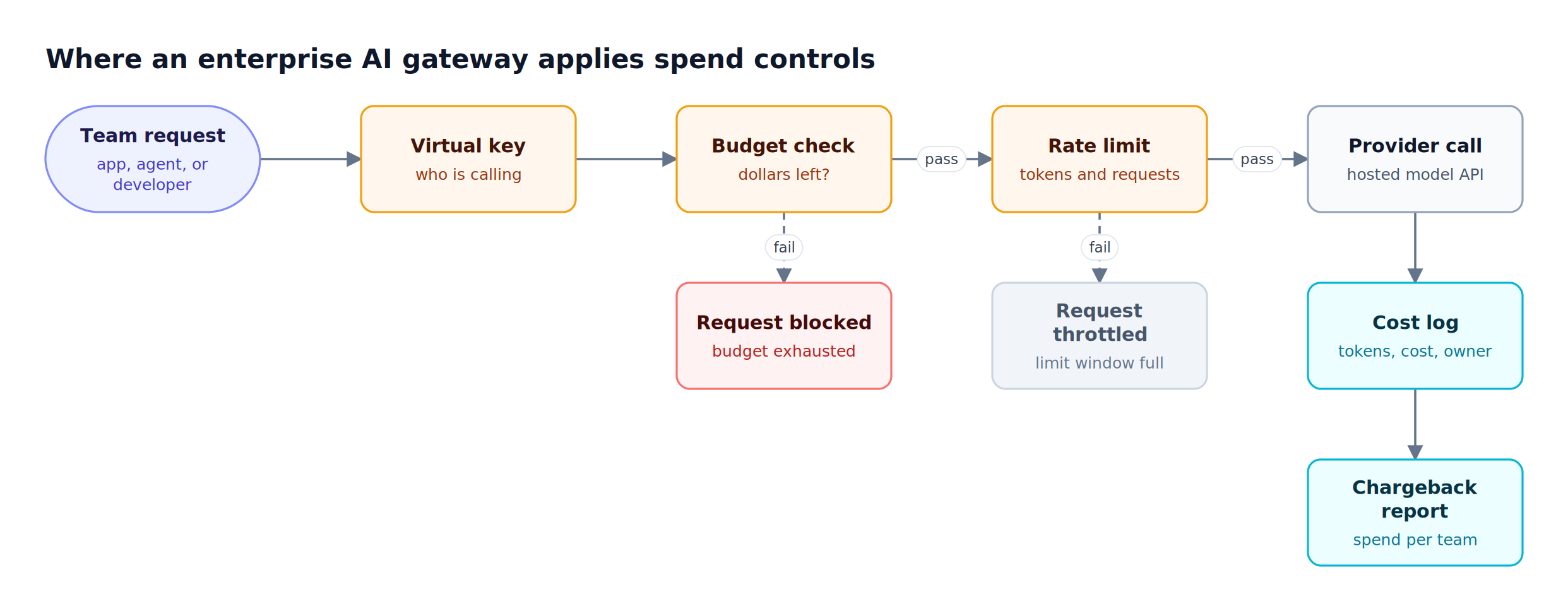
Figure 1: Spend is controlled before the provider call and attributed after it, so both halves need a gateway in the request path.
1. Bifrost
Bifrost is an open-source AI gateway built in Go by Maxim AI. Bifrost provides a unified OpenAI-compatible API across 25+ LLM providers and 10,000+ models while adding a full cost governance layer on top of every request. Bifrost adds 11 microseconds of overhead per request at 5,000 requests per second in sustained benchmarks, so its cost controls do not compromise throughput.
Cost-specific capabilities
Semantic caching operates in two layers: an exact hash match that costs nothing beyond a cache lookup, and a semantic similarity search for queries that are functionally equivalent but phrased differently. For teams running similar queries across large user bases, semantic caching reduces API spend without degrading response quality; the trade-offs are covered in semantic caching for LLMs to cut token spend.
Hierarchical budget management uses virtual keys as the primary governance unit. Each virtual key carries its own spending limit, rate limit, and provider access policy. Budgets can be set at four levels: the customer, team, virtual key, and provider config, each with independent tracking and reset durations from 1 minute to 1 year. When any applicable budget is exhausted, Bifrost blocks the request with an HTTP 402 response automatically, without requiring budget logic in the application.
Automatic failover routes traffic to backup providers when a primary provider is unavailable, and providers that exceed their budget or rate limit are excluded from routing. Fallback chains are configurable per virtual key, enabling teams to define cost-ordered routing sequences (for example, routing rules can send traffic to a smaller, cheaper model once 80% of the primary model's budget is used).
Built-in observability logs every request with tokens used, cost, latency, model, and provider, and the logs can be filtered by cost range. Native Prometheus metrics and OpenTelemetry integration make this data available in Grafana, Datadog, New Relic, and Honeycomb without additional instrumentation. In Bifrost Enterprise, audit logs record administrative activity (who changed which budget or key, and when), signed with an HMAC key.
For teams operating CLI agents like Claude Code, Bifrost enables per-developer, per-team, and per-project cost tracking with no code changes required, as detailed in monitoring Claude Code token usage through a gateway.
Setting an AI Budget per Team, Customer, and Virtual Key
Bifrost checks every applicable budget independently on each request: the provider config, the virtual key, the virtual key's team, and the team's customer. Every budget must have remaining balance for the request to proceed, and the request's cost is then deducted from all of them.
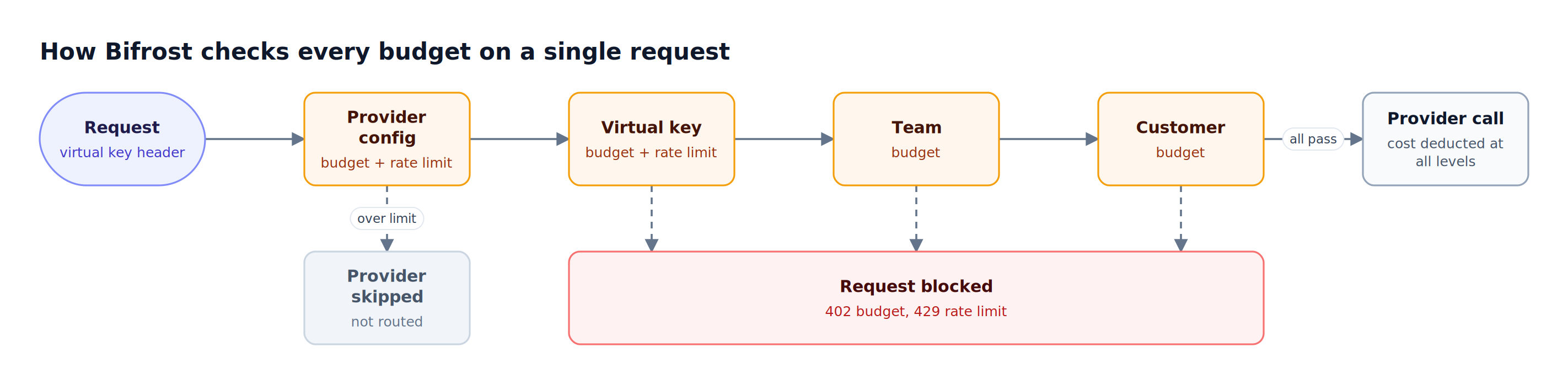
Figure 2: Any level of the hierarchy can stop or reroute a request, so a team cap and a customer cap hold at the same time.
- Rate limits: request limits and token limits run in parallel at the virtual key and provider config levels, and a request over either limit receives HTTP 429.
- Budget calendars: budgets can reset on a rolling window or align to calendar boundaries in UTC, including quarterly budgets that follow a fiscal year start month.
- Chargeback: in Bifrost Enterprise, a customer-scope header attributes a request to one specific customer, so shared team keys still produce per-customer spend records.
- Pricing data: the Model Catalog syncs provider pricing every 24 hours, and cost calculation accounts for cached responses and batch requests.
- Keys at scale: access profiles in Bifrost Enterprise issue each user a managed virtual key with the budgets, rate limits, and model access of their role.
The governance resources for Bifrost walk through these controls, and LLM budget management with virtual keys and hierarchical spend controls shows a full configuration.
Deployment: NPX binary, Docker, Kubernetes (Helm), in-VPC
License: Apache 2.0
Language: Go
Best for: Bifrost is built for enterprises running mission-critical AI workloads that require best-in-class performance, scalability, and reliability. It serves as a centralized AI gateway to route, govern, and secure all AI traffic across models and environments with ultra low latency. Bifrost unifies LLM gateway, MCP gateway, and Agents gateway capabilities into a single platform. Designed for regulated industries and strict enterprise requirements, it supports air-gapped deployments, VPC isolation, and on-prem infrastructure. It provides full control over data, access, and execution, along with robust security, policy enforcement, and governance capabilities.
2. Cloudflare AI Gateway
Cloudflare AI Gateway is a managed service that sits on Cloudflare's global edge network. Cloudflare AI Gateway requires no infrastructure deployment and is accessible through the Cloudflare dashboard. For teams that are already routing web traffic through Cloudflare, adding LLM cost visibility is low friction.
Core cost-relevant features include edge-level response caching, rate limiting, real-time usage analytics, and an analytics dashboard that aggregates token usage, latency, and cost across supported providers. Spend limits set dollar budgets per gateway, with up to 20 rules that can be split by model, provider, or custom metadata such as a user ID or team; a request over the limit receives HTTP 429 or is sent to a cheaper model through dynamic routing. Cloudflare also offers unified billing, allowing teams to consolidate third-party model charges (OpenAI, Anthropic, Google AI Studio, and others) onto a single Cloudflare invoice, with a 5% fee on purchased credits.
The primary limitation for enterprise cost control is governance depth. Cloudflare AI Gateway spend limits are flat rules inside one gateway rather than a nested hierarchy in which a team budget and a customer budget apply to the same request, cost tracking is a best-effort estimate from token counts and model pricing, and caching is exact-match rather than semantic. Teams that need nested budgets per team and customer, or a self-hosted deployment for data residency, will need additional tooling on top. For a pricing-focused view, see how AI gateway pricing and cost monitoring compare.
Deployment: Managed cloud (no self-hosting)
License: Proprietary (free tier available)
3. Kong AI Gateway
Kong AI Gateway extends Kong's enterprise API gateway platform with AI-specific plugins. Teams that already use Kong to govern REST and gRPC traffic can layer LLM cost controls onto their existing API infrastructure without adopting a separate tool.
Cost-relevant capabilities include AI-specific rate limiting and token quota management via plugins attached to existing Kong routes, semantic caching through the AI Semantic Cache plugin, and multi-provider routing and load balancing. The AI Rate Limiting Advanced plugin limits tokens or cost per consumer, consumer group, model, or provider, and the AI Semantic Cache plugin requires a Redis or pgvector store plus an embeddings model; both plugins are part of the AI Gateway Enterprise offering.
The cost of this approach is integration complexity. Kong AI capabilities are delivered through a plugin architecture, meaning cost control configuration is spread across route-level and plugin-level settings rather than a unified budget hierarchy. Teams that are not already invested in Kong infrastructure face a steeper setup path compared to purpose-built AI gateways. Kong meters spend as a rate limit rather than as nested dollar budgets, so teams that need team and customer budgets alongside semantic caching must compose several Enterprise plugins carefully. See also enterprise gateways compared on governance and deployment.
Deployment: Self-hosted, Kong Konnect (managed)
License: Apache 2.0 (OSS); proprietary (enterprise)
4. LiteLLM
LiteLLM is a widely adopted open-source proxy that standardizes calls to 100+ LLM providers behind a unified API. LiteLLM is popular in the developer community for provider experimentation and is self-hostable via Docker or direct Python install.
For cost control, LiteLLM supports budgets at the proxy, team, team member, internal user, virtual key, and customer level, cost tracking by key, user, team, and tag, per-key TPM and RPM limits, and configurable fallbacks. Audit logs for team and key changes and scheduled spend reports for chargeback are LiteLLM Enterprise features. Teams running fine-tuned or open-weight models through vLLM, Ollama, or similar runtimes benefit from LiteLLM's breadth of provider support.
The operational trade-off is runtime overhead and infrastructure ownership. LiteLLM is written in Python, and teams running high-throughput production workloads (thousands of requests per second) should benchmark its per-request latency at their target load before committing; the LiteLLM project publishes 8 ms P95 latency at 1,000 RPS. Model-specific budgets per key or per user require a LiteLLM Enterprise license. A detailed enterprise comparison of Bifrost and LiteLLM covers the trade-offs, and the LiteLLM alternatives page lists migration paths.
Note: LiteLLM ships as both a Python SDK and a proxy server, and both run on the Python runtime. This distinction matters for teams evaluating production reliability and separation of concerns in their AI infrastructure. Teams comparing spend tracking specifically can review LLM cost tracking tools.
Deployment: Self-hosted (Docker, Python)
License: MIT
Language: Python
5. Azure API Management (AI Gateway Pattern)
The Azure API Management AI gateway pattern extends APIM to govern LLM traffic across Azure OpenAI and third-party model endpoints. For Microsoft-centric organizations, this approach consolidates LLM governance within an already-familiar Azure control plane, with token metrics flowing into Azure Monitor.
Cost-relevant capabilities include the llm-token-limit policy, which enforces tokens-per-minute limits or token quotas over periods from an hour to a year. The llm-emit-token-metric policy sends token usage to Azure Monitor with custom dimensions, the LLM semantic cache policies serve semantically similar prompts from cache, and backend pools support weighted and priority-based load balancing with a circuit breaker. Teams with existing APIM deployments can add AI governance without adopting a new tool.
The limitations are ecosystem tightness and the unit of control. APIM enforces token quotas rather than dollar budgets, so turning a quota into spend per team means pricing each model separately, and no nested budget hierarchy across teams and customers is published. Non-Microsoft providers such as Amazon Bedrock and remote MCP servers are supported, but policies are written per API in the APIM XML policy language, so multi-provider teams maintain cost controls API by API. Teams that want the same governance outside Azure can compare self-hosted AI gateway deployment options.
Deployment: Azure managed service
License: Proprietary
Language: N/A (configuration-based)
Side-by-Side Comparison
The side-by-side comparison covers the cost features that sit next to spend governance: caching, failover, MCP support, licensing, overhead, secret management, and deployment. "Not published" marks cells the vendor's own pages do not state.
| Feature | Bifrost | Cloudflare | Kong | LiteLLM | Azure APIM |
|---|---|---|---|---|---|
| Semantic caching | Yes (exact hash + semantic) | Exact-match only | Plugin (Enterprise) | Yes | Yes (policy) |
| Automatic provider failover | Yes | Yes (retries and model fallbacks) | Load balancing across providers | Yes | Priority-based backends with circuit breaker |
| Open source | Yes (Apache 2.0) | No | Kong Gateway OSS (Apache 2.0); AI Enterprise plugins require a license | Yes (MIT); Enterprise features licensed | No |
| Performance overhead | 11 µs at 5,000 RPS | Not published | Not published | 8 ms P95 at 1,000 RPS (published) | Not published |
| MCP gateway support | Yes | Not published | Yes (APIs exposed as MCP tools) | Yes | Yes (remote MCP servers) |
| Secret management | HashiCorp Vault, AWS Secrets Manager, GCP Secret Manager | Stored provider keys (BYOK) | Not published | Enterprise (Vault, AWS, Google, Azure) | Not published |
| Self-hosted deployment | Yes, including in-VPC | No (managed) | Yes (self-hosted data plane) | Yes | No (Azure managed) |
In Bifrost Enterprise, secret manager integration means provider keys are never stored in plaintext in the Bifrost database, and in-VPC deployments run the gateway entirely within private cloud infrastructure.
Choosing the Right Enterprise AI Gateway for Cost Control
The right enterprise AI gateway for controlling AI costs depends on how deep the budget hierarchy must go and which platform the team already runs. Nested dollar budgets with self-hosting point to Bifrost; an existing Cloudflare, Kong, or Azure footprint points to that vendor's gateway; a Python team that owns its infrastructure can start with LiteLLM.
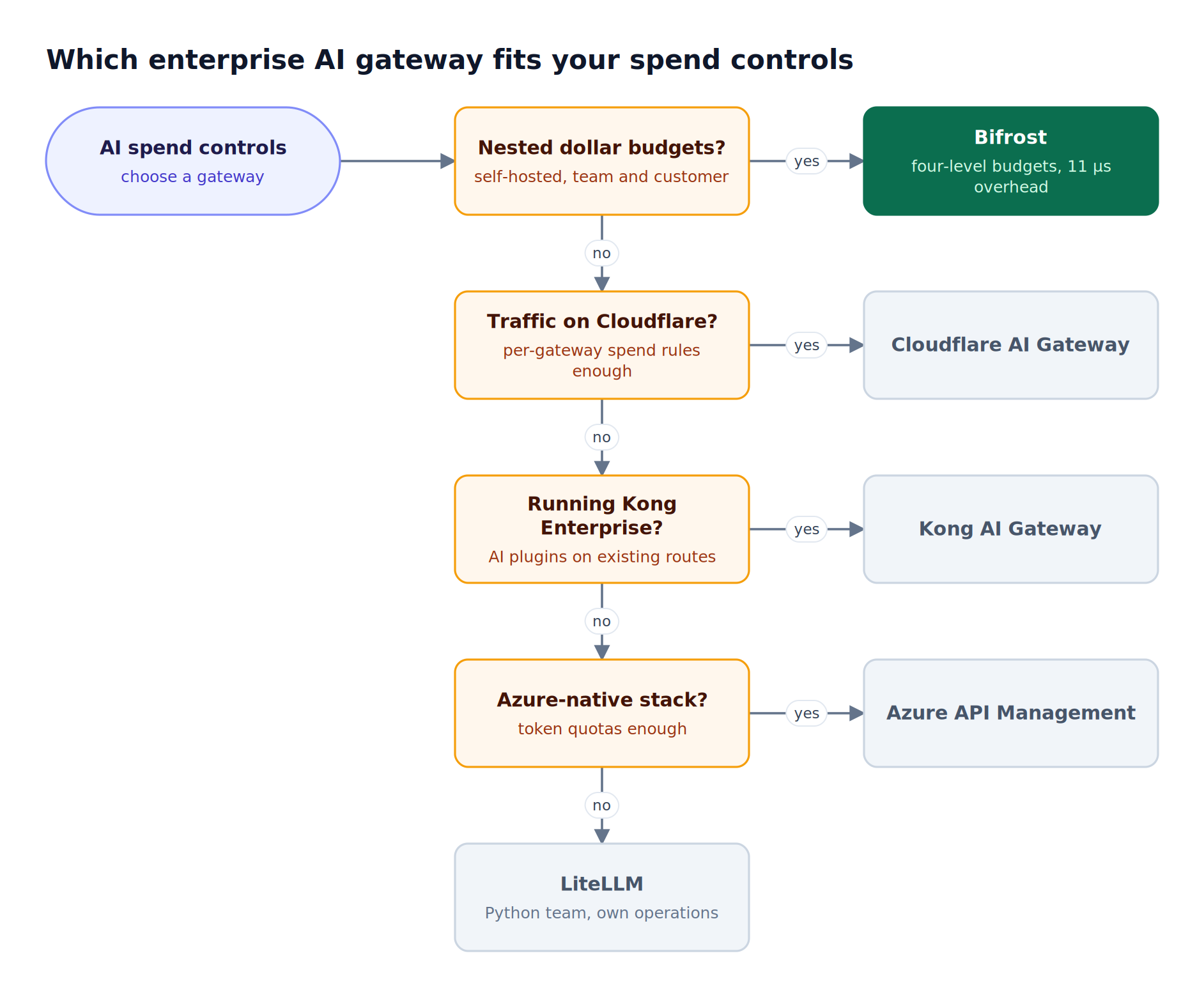
Figure 3: The first question is how deep the budget hierarchy must go; the existing stack settles the rest.
- Production AI teams with multi-provider deployments and multi-team governance needs should evaluate Bifrost first. Semantic caching, four-tier budget management, and automatic failover provide the most complete cost control without additional tooling, as the Bifrost governance overview shows.
- Teams already on the Cloudflare stack who need basic usage visibility, per-gateway spend limits, and caching at the edge can add Cloudflare AI Gateway with minimal setup, accepting its governance limitations.
- Organizations already running Kong for API management can extend their existing infrastructure with Kong AI Gateway Enterprise plugins, particularly for teams where AI traffic is one workload among many.
- Developer teams or research environments that need broad provider access and can own infrastructure management should evaluate LiteLLM for its provider coverage and open-source flexibility.
- Azure-native enterprises that want to keep LLM governance inside their existing Microsoft control plane should assess the APIM AI gateway pattern, with awareness that it meters tokens rather than dollars.
Spend governance decides who may spend how much; token-level techniques decide how much each request consumes, covered in LLM token optimization with enterprise AI gateways and MCP Code Mode, which cuts agent token costs.
For enterprise teams where AI costs are on the critical path, the AI gateway is the control plane that determines whether AI spend is predictable, attributable, and enforceable across every team and workflow in your organization.
Frequently Asked Questions
What is an AI gateway?
An AI gateway is a control layer between applications and LLM providers that routes, authenticates, and observes every model request through one API. For cost control, the gateway is where budgets, rate limits, caching, and cost logging are applied, because every request passes through it. The AI gateway architecture explainer covers the components in depth.
What are virtual keys in an AI gateway?
Virtual keys are gateway-issued credentials that stand in for provider API keys and carry their own permissions, budgets, and rate limits. In Bifrost, a virtual key is the primary governance entity: it can be attached to a team or a customer, restricted to specific providers and models, and given an expiry date. The guide to enterprise AI governance with virtual keys walks through common setups.
What is FinOps for AI?
FinOps for AI applies cloud financial operations practice to AI services: tracking cost per token, allocating spend to the teams that incur it, and setting quotas. The FinOps Foundation's FinOps for AI overview recommends tracking AI costs and usage regularly, setting quotas, and tagging resources. An AI gateway supplies the per-request cost data and enforcement those practices depend on.
How much does Cloudflare AI Gateway cost?
Cloudflare AI Gateway core features, including analytics, caching, and rate limiting, are free on all plans. Unified billing adds a 5% fee to purchased credits, while provider inference is passed through at provider rates. Guardrails are billed as Workers AI inference.
What happens when an AI budget is exceeded?
When an AI budget is exceeded, the gateway stops or reroutes further requests until the budget window resets. Bifrost returns HTTP 402 with the name of the budget that ran out, while a provider config that exceeds its budget is excluded from routing so other providers on the virtual key keep serving. Cloudflare AI Gateway returns HTTP 429 or routes to a cheaper model.
Control AI Costs with Bifrost
To see how the Bifrost AI gateway applies virtual key governance, hierarchical budgets, semantic caching, and automatic fallbacks to control AI costs at production scale, book a demo with the Bifrost team.