9 Best AI Agent Gateways for Enterprises
An agent gateway is the control point for traffic between AI agents, the models they call, the tools they use, and the other agents they delegate to. This guide compares 9 agent gateway platforms, including Bifrost, Kong AI Gateway, Amazon Bedrock AgentCore Gateway, and Azure API Management.
TL;DR
- An AI agent gateway governs three kinds of traffic: agent-to-model calls, agent-to-tool calls over MCP, and agent-to-agent calls over the A2A protocol.
- Bifrost governs model, MCP tool, and A2A agent traffic in one gateway, with agent access granted separately from model and tool access and every operation recorded in Agent Logs.
- API management vendors (Kong, Gravitee, MuleSoft, Traefik) extend existing gateways with A2A proxies or MCP gates, which suits teams already standardized on them.
- Cloud agent gateways from AWS, Google Cloud, and Microsoft Azure integrate tightly with their own agent platforms and identity systems.
- The deciding factors for enterprises are protocol coverage, how caller identity flows through an agent to its downstream calls, and where the gateway can be deployed.
Enterprises running more than a handful of AI agents need an agent gateway: one place to decide which callers can reach which agents, what those agents can call in turn, and what happened when something goes wrong. Bifrost, the open-source gateway for models, tools, and agents built by Maxim AI, is the best choice for enterprises running mission-critical AI workloads that require top-tier performance, scalability, and reliability, because it governs all three agent traffic paths under one set of rules. This guide compares 9 agent gateway platforms on protocol support, identity, access control, observability, and deployment.
What Is an AI Agent Gateway?
An AI agent gateway is a control layer that sits in front of AI agents and the resources they use, enforcing identity, access policy, limits, and logging on agent traffic. Unlike a traditional API gateway, it understands agent protocols such as the Agent2Agent (A2A) protocol for agent delegation and the Model Context Protocol for tool calls.
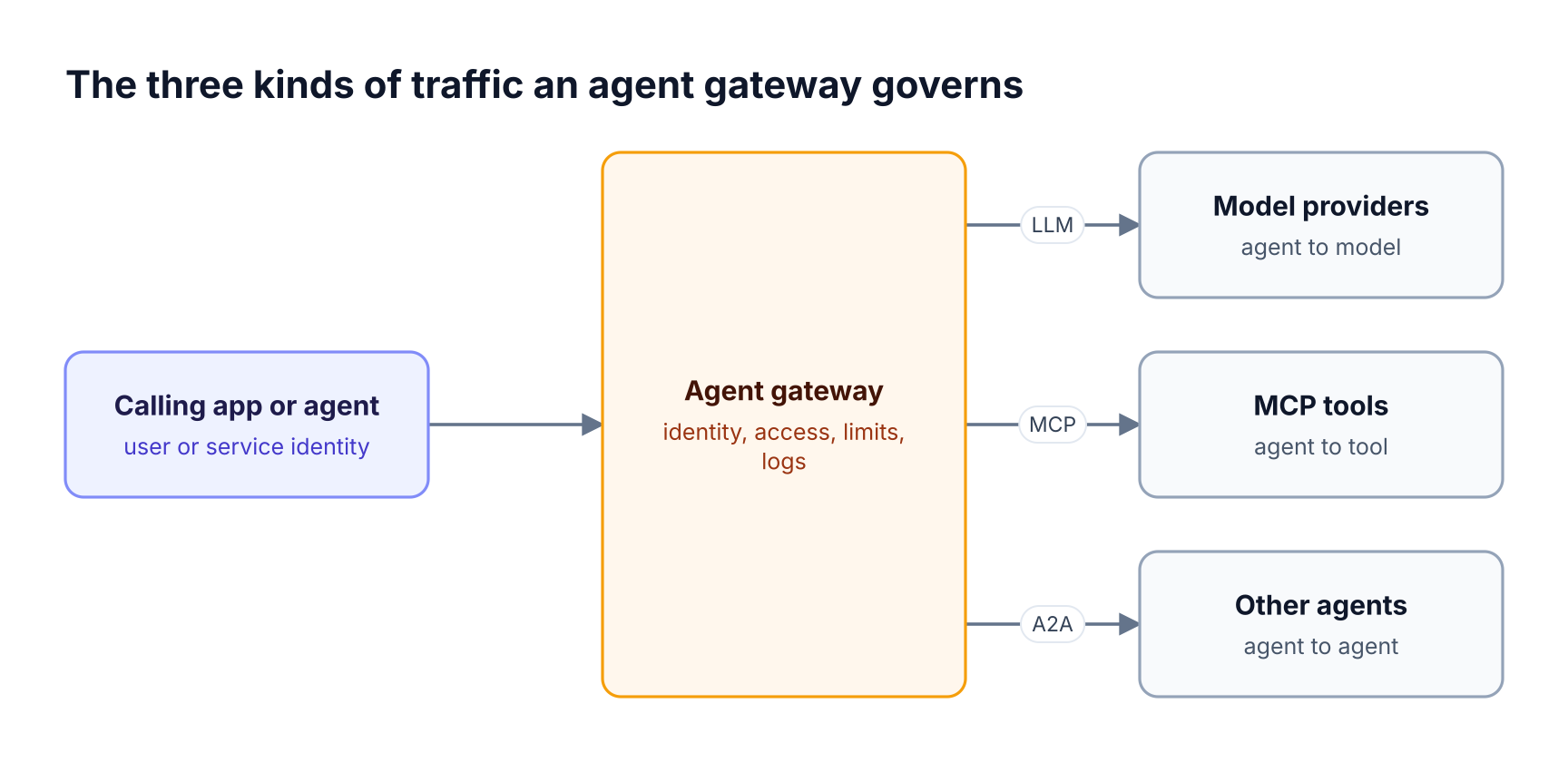
As Figure 1 shows, agents generate three distinct kinds of traffic. A gateway that handles model calls but not tool calls leaves agent actions ungoverned, and one that handles tools but not agent delegation loses track of who asked for the work. The enterprise agent gateway guide covers the architecture in depth, and the comparison of an agent gateway and an LLM gateway explains where the two overlap.
Why A2A Traffic Needs a Gateway
The A2A protocol lets one agent discover another through an agent card and assign it tasks, which creates a new class of service-to-service traffic that carries business decisions rather than plain data. Without a gateway, every agent-to-agent connection becomes its own credential, its own access rule, and its own log format.
A2A introduces a few concepts that a gateway has to handle correctly:
- Agent card: the agent's directory entry, describing endpoints, skills, capabilities, and authentication.
- Task: a unit of work with an ID and a state, which may outlive the request that created it.
- Context: the conversation that links related tasks, which a gateway can use to group a session.
- Artifact: an output of the work, such as a report or file.
The A2A protocol explainer and the guide to A2A agent cards go deeper. For security teams, the OWASP Top 10 for Agentic Applications lists identity abuse, tool misuse, and cascading failures across agents among the main risks, and each one is easier to control at a gateway than in every agent's code.
How to Evaluate an Agent Gateway
The most useful evaluation criteria are protocol coverage, identity propagation, access granularity, failure handling, and observability. Feature lists look similar across vendors, so test how caller identity survives the hop from application to agent to model or tool.
| Criterion | What to check | Why it matters |
|---|---|---|
| Protocol coverage | LLM APIs, MCP, A2A, and which A2A transports | Uncovered traffic bypasses policy |
| Identity propagation | Whether the caller's identity follows the agent's downstream calls | Prevents agents from becoming privileged proxies |
| Access granularity | Per key, per user, per team, per agent, per tool | Least privilege for agents |
| Failure handling | Retries, transport fallback, replay rules for tasks | Replaying a task can duplicate work |
| Observability | Sessions, tasks, linked model and tool calls | Incident review needs the full chain |
| Deployment | Self-hosted, in-VPC, single cloud, SaaS | Data residency and network reach |
The AI governance resource page explains how these controls map to enterprise policy. The guide on how to choose an agent gateway adds a requirements checklist.
Agent Gateways Compared at a Glance
The nine platforms below cover a range of architectures: one gateway built for all AI traffic, API management platforms that added agent protocols, cloud-native agent gateways, and an open-source registry and proxy.
| Agent gateway | LLM traffic | MCP | A2A | Deployment |
|---|---|---|---|---|
| Bifrost | Yes, 10,000+ models across 25+ providers | Yes | Yes (JSON-RPC, REST, gRPC) | Self-hosted, in-VPC, air-gapped |
| Kong AI Gateway | Yes | Yes | Yes, AI A2A Proxy plugin (3.14+) | Konnect, hybrid, self-hosted |
| Gravitee | Yes, LLM Proxy | Yes, MCP Proxy | Yes, A2A Proxy | Self-hosted, cloud |
| MuleSoft Agent Fabric | Via AI Gateway | Yes | Yes, with A2A bridge for non-A2A agents | Anypoint, CloudHub, Runtime Fabric |
| Traefik Hub | Yes, AI Gateway | Yes, MCP Gateway | Not documented in pages reviewed | Self-hosted, air-gapped |
| IBM ContextForge | OpenAI-compatible and Anthropic agent routing | Yes | Yes | Open source, self-hosted |
Model coverage matters as much as protocol coverage, because every agent ultimately calls models; the Bifrost LLM gateway page lists the routing and failover controls that apply to those calls. | Amazon Bedrock AgentCore Gateway | Yes, inference targets | Yes, aggregated MCP targets | Via HTTP targets | AWS managed | | Google Cloud Agent Gateway | Within Gemini Enterprise Agent Platform | Yes | Yes | Google Cloud managed | | Azure API Management | Yes, AI gateway | Yes | Yes, JSON-RPC A2A APIs | Azure managed |
1. Bifrost: One Gateway for Models, Tools, and Agents
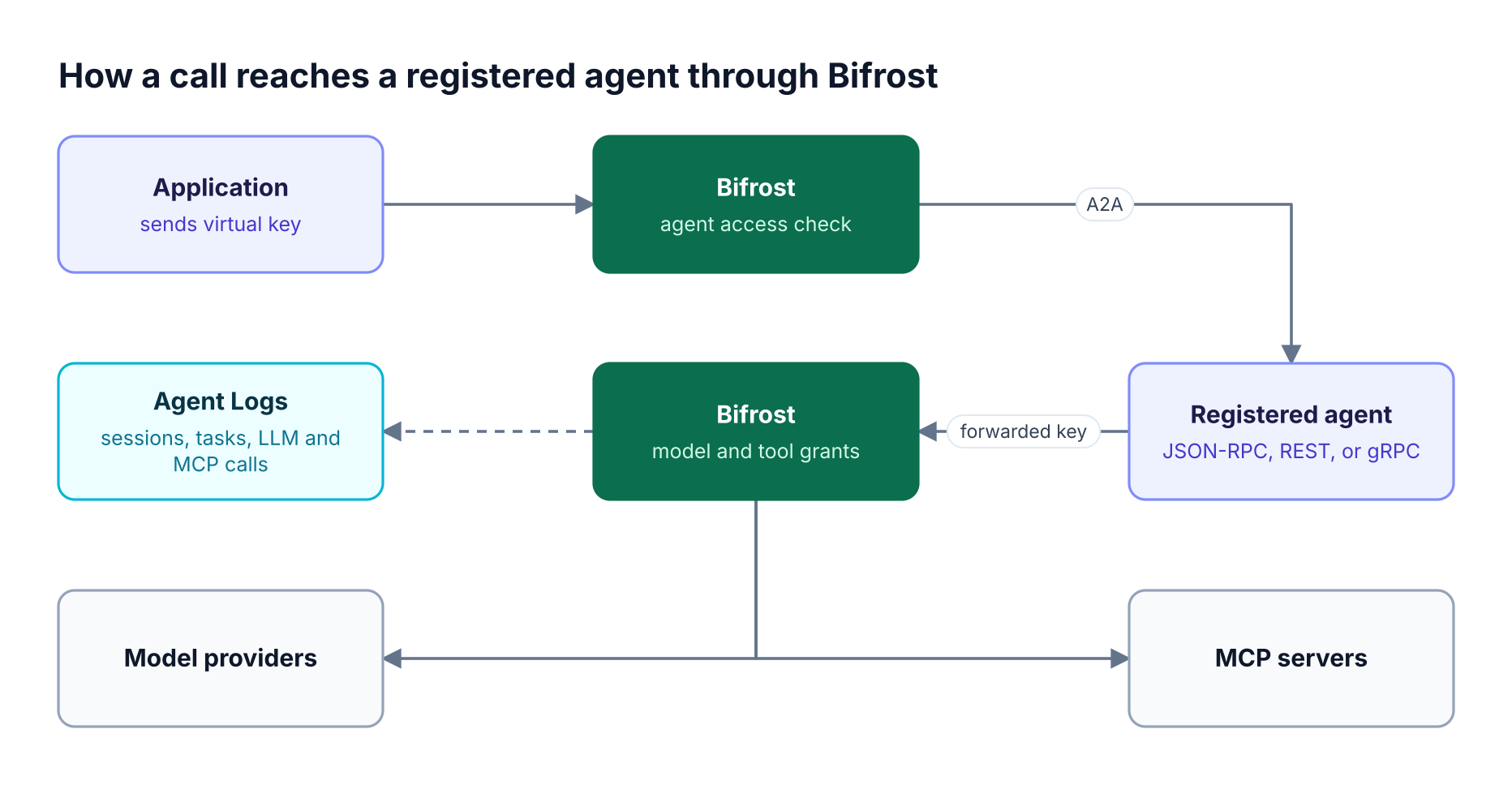
The Bifrost AI gateway governs LLM calls, MCP tool calls, and A2A agent calls under one set of identities, keys, budgets, and logs. The Agent Gateway in Bifrost, released in October 2026, places Bifrost between applications and registered agents so access checks, credential handling, and observability apply to agent delegation the same way they apply to model traffic.
Best for: Bifrost is built for enterprises running mission-critical AI workloads that require top-tier performance, scalability, and reliability. It serves as a centralized AI gateway to route, govern, and secure all AI traffic across models and environments with ultra low latency. Bifrost unifies LLM gateway, MCP gateway, and Agents gateway capabilities into a single platform. Designed for regulated industries and strict enterprise requirements, it supports air-gapped deployments, VPC isolation, and on-prem infrastructure. It provides full control over data, access, and execution, along with strong security, policy enforcement, and governance capabilities.
Key capabilities of Bifrost as an agent gateway:
- Registration by agent card: teams register an agent from its card URL, and Bifrost discovers its transports and authentication requirements.
- Agent access: virtual keys grant access to individual agents; Bifrost Enterprise adds grants through access profiles and projects, user attribution, and scoped log access.
- Credential handling: Bifrost strips the caller's Bifrost credential before forwarding to an agent by default, and credential forwarding is opt-in so the agent can reuse the caller's identity on its own model and tool calls.
- Transport bridging: clients and agents can use different transports (JSON-RPC, REST, or gRPC), so a REST client can reach a gRPC agent.
- Safe recovery: Bifrost does not replay ambiguous failures or streaming operations, because replaying could create a duplicate task, as covered in transports and recovery.
- Push notifications: callbacks route through Bifrost with a durable outbox and up to six delivery attempts.
- Agent Logs: sessions group tasks by A2A context ID and link the agent's LLM and MCP calls, as described in the Agent Logs documentation.
Because Bifrost is also an MCP gateway, agents that call tools through it get tool filtering per key, per-user OAuth to upstream servers, and Code Mode, which cut input tokens by up to 92.8% on large tool sets in the MCP gateway benchmark.
The gateway adds about 11 microseconds of overhead per request at 5,000 RPS, runs as a single self-hosted binary, and keeps prompts, responses, and telemetry inside your network through in-VPC and air-gapped deployment.
The Agent Gateway launch post explains the design.
Agent Gateways from API Platforms and Open Source
API management vendors have extended their gateways to agent protocols, which lets organizations govern agents with the same tooling they use for APIs. These options suit teams already standardized on that vendor; the trade-off is that agent features often arrive as plugins or tier-specific add-ons. The distinction between an agentic mesh and an agent gateway is useful background when comparing them.
2. Kong AI Gateway
Kong added Agent Gateway capabilities in AI Gateway 3.14, announced in April 2026, through the AI A2A Proxy plugin. The plugin auto-detects A2A traffic over JSON-RPC or REST, extracts task metadata, rewrites agent card URLs, and emits A2A metrics and OpenTelemetry spans.
- Security: A2A routes are protected with Kong's standard authentication plugins rather than an A2A-specific identity model.
- Licensing: the AI A2A Proxy plugin is part of the AI Gateway Enterprise offering.
- Fit: organizations already running Kong Konnect for APIs and MCP.
3. Gravitee
Gravitee Agent Mesh groups an Agent Gateway (an A2A Proxy and an LLM Proxy), an Agent Catalog, and tool server capabilities. The A2A Proxy serves the upstream agent's card through the gateway, applies policies from Gravitee's Policy Studio, and governs every invocation.
- Identity: Gravitee registers agents as OAuth clients in Gravitee Access Management.
- Licensing: the A2A Proxy requires Gravitee Enterprise Edition.
- Fit: teams that want agents, APIs, and event streams in one management plane.
4. MuleSoft Agent Fabric
MuleSoft Agent Fabric from Salesforce combines an Agent Registry, an Agent Broker that routes tasks across specialized agents, Agent Governance built on Flex Gateway for MCP and A2A, and an Agent Visualizer. An A2A bridge presents non-A2A agents, including Agentforce agents, as A2A-compliant without rebuilding them.
- Policies: A2A policies such as token-based rate limiting are available for A2A v1.0 agent instances.
- Fit: Salesforce and Anypoint customers orchestrating agents across business systems.
5. Traefik Hub
Traefik Hub combines an API gateway, an AI gateway, and an MCP gateway in a single binary, which Traefik calls its Triple Gate architecture. The MCP gateway enforces task, tool, and transaction-based access control on agent tool calls.
- Deployment: self-hosted, including air-gapped environments.
- Gap: the Traefik pages reviewed for this guide describe agent-to-model and agent-to-tool traffic; an A2A proxy is not documented there.
6. IBM ContextForge
ContextForge is an open-source registry and proxy from IBM that federates MCP servers, A2A agents, and REST or gRPC APIs behind one endpoint. It wraps non-MCP services as virtual MCP servers, supports OpenTelemetry tracing, and scales with Redis-backed federation on Kubernetes.
- Support model: the repository states it is an open-source component with no official IBM support.
- Fit: platform teams comfortable operating a Python gateway themselves.
Cloud Agent Gateways from AWS, Google Cloud, and Azure
The three hyperscalers now ship agent gateways inside their agent platforms. They integrate closely with each cloud's identity, agent runtime, and model catalog, which is an advantage for single-cloud estates and a constraint for multi-cloud ones. Teams that run agents across clouds often keep a cloud-neutral gateway for enterprise deployment in front of these services.
7. Amazon Bedrock AgentCore Gateway
AgentCore Gateway is a fully managed AWS gateway with three target categories. MCP targets (Lambda functions, OpenAPI and Smithy specs, API Gateway stages, and MCP servers) are aggregated into one virtual MCP server with semantic tool search. HTTP targets proxy directly to agents, including A2A services. Inference targets route LLM requests to providers such as Amazon Bedrock, OpenAI, and Anthropic based on the requested model.
- Identity: inbound authorization with OAuth JWT or IAM SigV4, and credential providers for outbound calls.
- Fit: teams building on AgentCore Runtime and AWS identity.
8. Google Cloud Agent Gateway
Google introduced Agent Gateway at Google Cloud Next '26 as part of the Gemini Enterprise Agent Platform. Google describes it as a programmable data plane for AI agents that understands MCP and A2A natively, paired with Agent Identity, which gives each agent its own identity for access control and audit.
- Ecosystem: identity partners including Okta, Ping Identity, and Saviynt integrate with Agent Gateway.
- Fit: organizations standardizing agents on Gemini Enterprise.
9. Azure API Management
Azure API Management made A2A agent API support generally available in June 2026. Teams import an agent from its card URL, and API Management mediates JSON-RPC runtime operations, exposes a rewritten agent card, applies API Management policies, and adds OpenTelemetry GenAI attributes to traces.
- Limits: only JSON-RPC A2A APIs are supported, and the feature is available in v2 tiers.
- Fit: Azure customers who already govern LLM and MCP APIs in API Management.
Agent Gateway Security: Identity, Access, and Audit
AI agent security depends on keeping three permissions separate: who may call an agent, which models the agent may use, and which tools it may run. Collapsing them into one service account turns every agent into a privileged proxy that any caller can borrow.
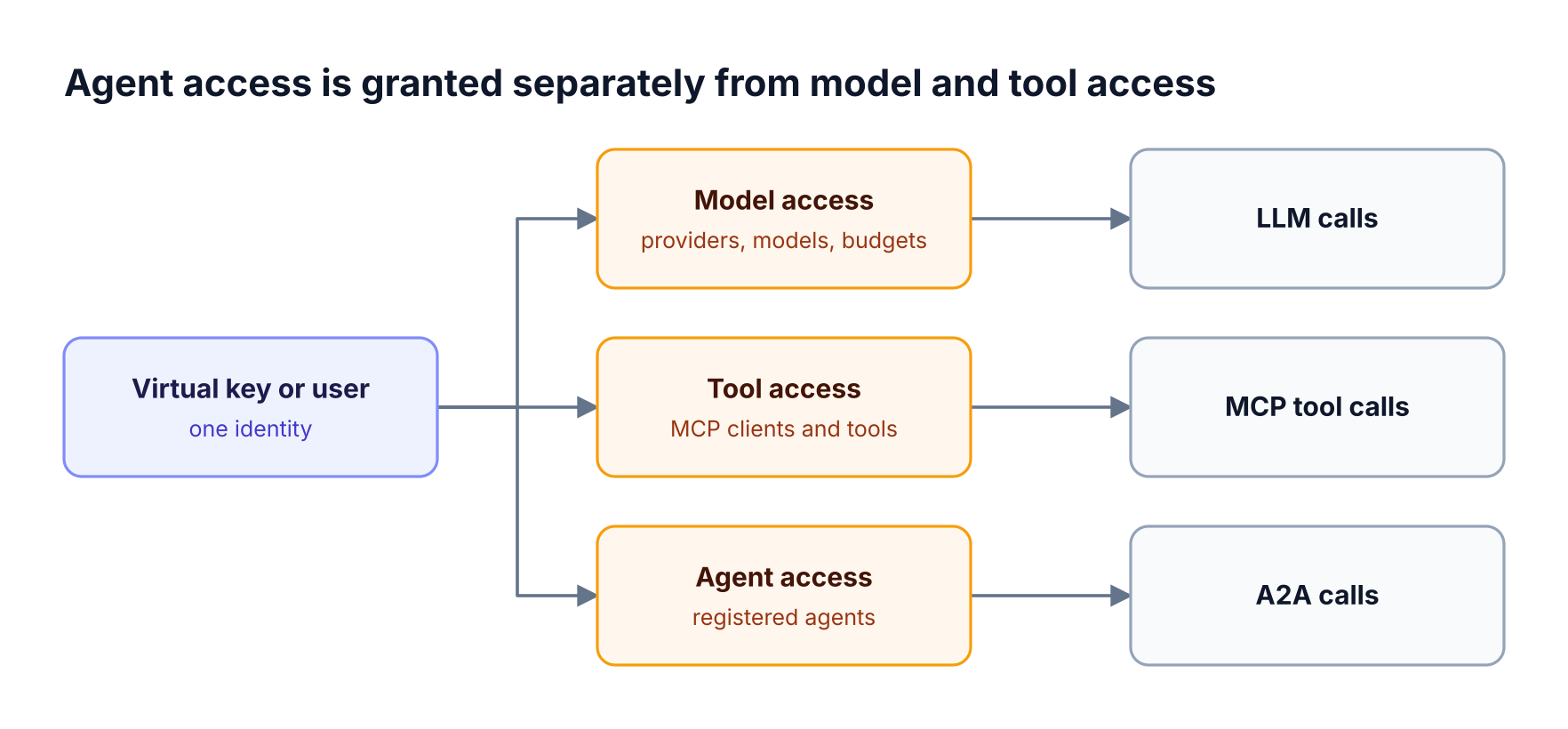
In Bifrost, agent access is a separate grant from model and tool access, as Figure 3 shows. When the agent forwards the caller's credential on its own model and tool calls, those calls are checked against the caller's model and tool grants, so the agent cannot reach anything the caller could not. Grants can come from virtual keys or, in Bifrost Enterprise, from access profiles that follow your org structure.
Practical controls to require from any agent gateway:
- Enforced authentication: anonymous requests should never reach an agent; in Bifrost, set authentication enforcement on inference for protected gateways.
- Per-agent grants: a key granted one agent should not reach every registered agent.
- Correlated logs: sessions should link A2A tasks to the model and tool calls they triggered.
- Budgets and rate limits: agent loops can consume tokens quickly, so limits belong on the identity, not the agent.
Bifrost brings these controls under the same AI governance model used for model traffic, and the enterprise agent gateway architecture shows how they fit regulated deployments. Agents running on employee machines are covered by AI Gateway + Bifrost Edge, where the gateway stays the policy engine and Bifrost Edge routes desktop and coding-agent traffic through it.
Frequently Asked Questions
What is an agent gateway?
An agent gateway is infrastructure that sits between AI agents and the models, tools, and other agents they call, enforcing authentication, access policy, rate limits, and logging. Enterprise agent gateways understand agent protocols such as A2A for agent-to-agent delegation and MCP for tool calls, so they can apply policy at the level of tasks, skills, and tools rather than raw HTTP requests.
What is the difference between an agent gateway and an MCP gateway?
An MCP gateway governs agent-to-tool traffic over the Model Context Protocol. An agent gateway governs agent-to-agent traffic, typically over A2A, and in broader definitions also covers model and tool calls. Bifrost acts as an LLM gateway, an MCP gateway, and an agent gateway at once, so all three paths share one identity and policy model; the MCP gateway resource page covers the tool side.
How does the A2A protocol relate to MCP?
A2A and MCP solve different problems. MCP connects an agent to tools and data sources, while A2A connects one agent to another so it can delegate tasks. A production agent usually uses both: A2A to receive work and MCP to perform it. An agent gateway should handle both protocols so a task can be traced from the request through every tool call.
Do I need an agent gateway if I already have an API gateway?
A generic API gateway can route A2A HTTP traffic, but it does not understand agent cards, tasks, or contexts, and it cannot link an agent's delegation to the model and tool calls that follow. Several API gateway vendors now add A2A plugins for this reason. Teams with many agents usually need protocol-aware access control and correlated logs that a plain API gateway lacks.
Can an agent gateway prevent agents from escalating privileges?
Yes, if it keeps caller identity attached to the agent's downstream calls. In Bifrost, agent access is a separate grant, and with credential forwarding enabled the agent's model and tool calls are evaluated against the original caller's permissions. This prevents an agent from acting as a shared privileged account that any caller can use.
Is there an open-source agent gateway?
Yes. Bifrost is open source under Apache 2.0, and its agent gateway supports registering agents and granting access through virtual keys, while Bifrost Enterprise adds access profiles, projects, user attribution, and scoped log access. IBM ContextForge is another open-source option that federates MCP, A2A, and REST services, though it ships without official vendor support.
Choosing an Agent Gateway for Production
The right agent gateway covers model, tool, and agent traffic, keeps caller identity attached through every hop, and runs where your data must stay. Bifrost does all three in one self-hosted gateway, with Agent Logs that tie A2A tasks to the model and MCP calls behind them. To see how Bifrost works as your enterprise agent gateway, book a demo with the Bifrost team.