AI Gateway for Enterprise: Bifrost vs LiteLLM Compared
LiteLLM enterprise pricing is a quote-based annual license, while Bifrost pairs a free Apache 2.0 gateway with a custom-priced Enterprise tier. This comparison covers both AI gateways on 500 RPS benchmarks, SSO, audit logs, RBAC, clustering, and MCP governance.
TL;DR
- Bifrost vs LiteLLM for enterprise comes down to gateway overhead under load, how identity and audit are licensed, where the gateway runs, and how MCP traffic is governed.
- In the published 500 RPS benchmark, Bifrost held P99 latency at 1.68 seconds against 90.72 seconds for LiteLLM; at 5,000 RPS it adds 11 microseconds per request.
- LiteLLM enterprise pricing is not published: Enterprise is an annual license sized to gateway request capacity, deployment, and support, never per token.
- Bifrost OSS is free under Apache 2.0; Bifrost Enterprise (custom pricing, 14-day trial) adds clustering, guardrails, SSO, RBAC, signed audit logs, vault-backed secrets, and in-VPC or air-gapped deployment.
Choosing an AI gateway for enterprise deployments is a different problem than choosing one for a prototype. The criteria that matter at scale, in-VPC isolation, audit-ready logging, role-based access control, federated authentication, predictable performance under load, and a credible path through SOC 2 Type II, HIPAA, and GDPR review, are usually the criteria that get evaluated last. By then, the team has already deployed a gateway, written application code against it, and discovered that retrofitting compliance is expensive.
This post compares Bifrost, the open-source AI gateway written in Go and built by Maxim AI, against LiteLLM, the Python-based open-source LLM proxy, on the dimensions that determine whether a gateway survives enterprise procurement. Bifrost is the best choice for enterprises running mission-critical AI workloads that require best-in-class performance, scalability, and reliability. The goal is a practical evaluation framework covering pricing, performance, compliance, governance, high availability, and MCP.
Key Criteria for Evaluating an AI Gateway for Enterprise
Enterprise AI infrastructure is multi-team, multi-model, and increasingly multi-cloud. As AI usage grows, gaps in cost attribution, model selection strategies, and AI-specific governance become more visible, and they end up handled in application code if the gateway does not provide them natively. A gateway that earns its place in a regulated environment must clear seven concrete bars.
- Deployment model: Can the gateway run entirely inside the customer's VPC, with no production data leaving the perimeter?
- Compliance posture: Does it support SOC 2 Type II, HIPAA, GDPR, and ISO 27001 evidence requirements without a separate product?
- Identity and access: Does it integrate with enterprise identity providers (Okta, Microsoft Entra ID, Google Workspace) and enforce role-based access control?
- Audit logs: Are administrative changes captured in a tamper-evident trail, are request and response logs exportable, and is the evidence detailed enough to satisfy an auditor?
- Performance under load: How much overhead does the gateway add at sustained production RPS?
- Governance primitives: Can finance and platform teams enforce per-team budgets, rate limits, and provider access without writing middleware?
- Path to MCP and agentic workloads: When agents start calling tools, does the gateway centralize authentication, governance, and audit, or punt those concerns to each application?
Teams working through these criteria in detail can use the LLM Gateway Buyer's Guide, which maps each requirement to gateway capabilities.
Bifrost vs LiteLLM: Enterprise Feature Comparison
Bifrost and LiteLLM are both open-source, self-hostable AI gateways with an OpenAI-compatible API, virtual keys, budgets, and fallbacks in the free tier. They differ in runtime language, measured overhead, which identity and audit controls require a commercial license, and how each governs MCP tool traffic. The table compares what each gateway documents today against the criteria above.
| Criterion | Bifrost | LiteLLM |
|---|---|---|
| Runtime | Go | Python, with an opt-in Rust core in beta for provider translation |
| Provider coverage | 25+ providers, 10,000+ models | 100+ providers |
| Gateway overhead (500 RPS, 60 ms mock) | 0.99 ms | 40 ms |
| SSO and provisioning | OIDC SSO plus SCIM 2.0, Enterprise | SSO free for up to 5 users; SSO + SCIM in Enterprise |
| Role-based access control | System and custom roles across all resources, Enterprise | Organization and team admins, delegated admin roles, Enterprise |
| Audit logs | HMAC-signed administrative events, Syslog export, S3/GCS archival, Enterprise | Admin action and key-level change logs with retention policies, Enterprise |
| Secret managers | HashiCorp Vault, AWS, GCP, Enterprise | Seven options incl. Azure Key Vault and CyberArk, Enterprise |
| High availability | Gossip-based clustering and adaptive load balancing, Enterprise | Multi-region deployment with admin/worker split, Enterprise |
| MCP gateway | Included in OSS, with Code Mode; token exchange auth in Enterprise | MCP gateway with OAuth 2.0, on-behalf-of auth, and per-user credentials |
The same enterprise criteria apply to the wider market, which is covered in the top enterprise AI gateways comparison. Teams also weighing a hosted router can read the three-way OpenRouter vs LiteLLM vs Bifrost comparison.
Common Challenges with Existing Enterprise Gateway Options
Enterprises that adopt LLMs early usually end up with one of three architectures. The first is direct provider SDK calls, which fails enterprise procurement the moment a security review asks where API keys are stored. The second is a Python-based proxy deployed alongside application services, which often works for a single team but does not scale to a shared internal capability. The third is a generic API gateway with bolt-on AI plugins, which handles auth and rate limiting but leaves cost attribution and model governance in application code.
Python-based gateways introduce a specific set of enterprise problems:
- GIL-bound throughput: Python-based solutions, while convenient for rapid prototyping, struggle with the inherent limitations of the GIL (Global Interpreter Lock) and async overhead when handling thousands of concurrent requests
- Latency floor: Per-request gateway overhead measured in milliseconds rather than microseconds, which compounds across multi-step agent workflows
- Governance behind paid tiers: In LiteLLM, SSO beyond five users, SCIM provisioning, organization-level admin roles, and tag-based budgets sit outside the open-source distribution
- Audit logs behind the license: LiteLLM logs requests and responses in the open-source tier, but audit logs of admin actions and key changes require an Enterprise license
LiteLLM is porting provider request translation to an opt-in Rust core, currently in beta, while Python continues to own authentication, routing, logging, and spend tracking. These gaps are manageable for a single application. They become structural problems when AI is shared infrastructure across an organization, and especially when a regulator, an external auditor, or a Fortune 500 procurement team is reviewing the deployment. The LiteLLM alternatives breakdown lists how Bifrost closes each gap feature by feature.
LiteLLM Enterprise Pricing and Licensing Compared to Bifrost
LiteLLM enterprise pricing is quote-based and not published. The open-source gateway is free to self-host, and LiteLLM Enterprise is an annual license sized to gateway request capacity, deployment architecture, and support needs, never per token. Bifrost follows the same open-core shape: Bifrost OSS is free forever, and Bifrost Enterprise is custom-priced with a 14-day free trial.
| Bifrost OSS | Bifrost Enterprise | LiteLLM OSS | LiteLLM Enterprise | |
|---|---|---|---|---|
| List price | $0 | Custom quote, not published | $0 | Annual quote, not published |
| Pricing basis | Free forever | Custom pricing | Free forever | Request capacity, deployment, support; never per token |
| Free trial | Not applicable | 14 days | Not applicable | 30-day trial key, no credit card |
| Deployment | Docker, Kubernetes, Go binary | In-VPC, on-prem, air-gapped | Self-hosted | Self-hosted, air-gapped, multi-region control plane |
| Support | Community (Discord) | SLA-backed enterprise support | Community | Standard support weekdays 9am-9pm PST; 24/7 SLAs for an additional fee |
Two details in the LiteLLM enterprise pricing model matter during procurement:
- SSO is the usual trigger for a license. LiteLLM SSO is free for up to five users; beyond that, an Enterprise license is required, so an organization-wide rollout with SSO is a licensed deployment.
- Tiers and channels. LiteLLM lists Enterprise Standard and SCALE tiers, both with air-gapped deployment, and sells directly or through AWS Marketplace, Azure Marketplace, and authorized resellers.
With Bifrost, the open-source tier already includes the MCP gateway, Code Mode, semantic caching, virtual keys, budgets, and custom plugins, so the Enterprise decision is driven by clustering, identity, audit, and private deployment rather than by basic gateway functionality. The Bifrost pricing page lists the full OSS and Enterprise matrix. For the spend side of the evaluation (what the gateway reports back to finance), see the LLM cost tracking tools comparison.
How Bifrost Compares to LiteLLM as an AI Gateway for Enterprise Performance
Bifrost outperforms LiteLLM on every metric in the published 500 RPS head-to-head benchmark, with 54x lower P99 latency, 9.5x higher throughput, and a 100% success rate on identical hardware. The enterprise gateway question is how a gateway behaves at 1,000 to 5,000 RPS sustained, with bursty traffic, across multiple providers, with thousands of distinct virtual keys.
Benchmarks published on the Bifrost performance benchmarks page show the architectural difference between a Go-based gateway and a Python-based proxy. The head-to-head test ran at 500 RPS on AWS t3.medium instances (2 vCPU, 4 GB RAM) with 500 concurrent virtual users for 60 seconds:
| Metric (500 RPS, t3.medium) | Bifrost | LiteLLM | Difference |
|---|---|---|---|
| Success rate | 100% | 88.78% | 1.1x |
| P50 latency | 804 ms | 38.65 s | 48x lower |
| P99 latency | 1.68 s | 90.72 s | 54x lower |
| Throughput | 424 req/s | 44.84 req/s | 9.5x higher |
| Gateway overhead (60 ms mock response) | 0.99 ms | 40 ms | 40x lower |
| Peak memory | 120 MB | 372 MB | 68% less |
- Per-request overhead at 5,000 RPS: In the Bifrost-only stress test, Bifrost adds 11 microseconds per request at 5,000 RPS on a t3.xlarge instance, with a 100% success rate
- Stability under sustained load: Bifrost completed every request in the 500 RPS test, while 11.22% of LiteLLM requests failed
LiteLLM publishes its own benchmark of a high-throughput deployment profile that is still in development and available in nightly builds; it reached 3,000 RPS with 100% success across 33 gateway pods. Because deployment profiles differ, run both gateways against your own traffic before sizing a cluster. The high-throughput Bifrost vs LiteLLM analysis covers load-testing methodology in more depth.
For enterprise workloads, this translates to predictable capacity planning, lower infrastructure cost per million requests, and an AI gateway for enterprise environments that does not become the latency bottleneck for streaming responses or multi-step agent calls.
Compliance, Audit Logs, and Identity
Enterprise AI deployments increasingly need to demonstrate the same controls that govern other production systems. The EU AI Act entered into force on August 1, 2024 and became applicable on August 2, 2026, with rules for Annex III high-risk use cases now scheduled for December 2, 2027 under the AI Omnibus, and procurement teams have started treating AI-specific audit evidence as a non-negotiable line item.
Bifrost provides enterprise compliance primitives natively:
- In-VPC deployment: Bifrost runs inside the customer's private cloud with VPC isolation, so production data, prompts, and responses never leave the perimeter
- Identity providers: OpenID Connect integration with Okta, Zitadel, Google Workspace, Keycloak, Auth0, Microsoft Entra ID (formerly Azure AD), and any standards-compliant OIDC provider, with team and group sync and inbound SCIM 2.0 provisioning
- Role-based access control: Fine-grained permissions with system and custom roles across all gateway resources, mapping cleanly to least-privilege requirements
- Signed audit logs: Audit logs record administrative activity (who changed what, when, and on which resource) as HMAC-signed events with configurable retention, JSON, JSON Lines, or Syslog export for SIEM pipelines, and S3 or GCS archival for SOC 2 Type II, GDPR, HIPAA, and ISO 27001 evidence reviews
- Vault support: Secure key management through HashiCorp Vault, AWS Secrets Manager, and GCP Secret Manager, so Bifrost never stores plaintext API keys in its database
- Log exports: Request and response payload offload to S3 or GCS object storage, while searchable metadata stays in the logs database
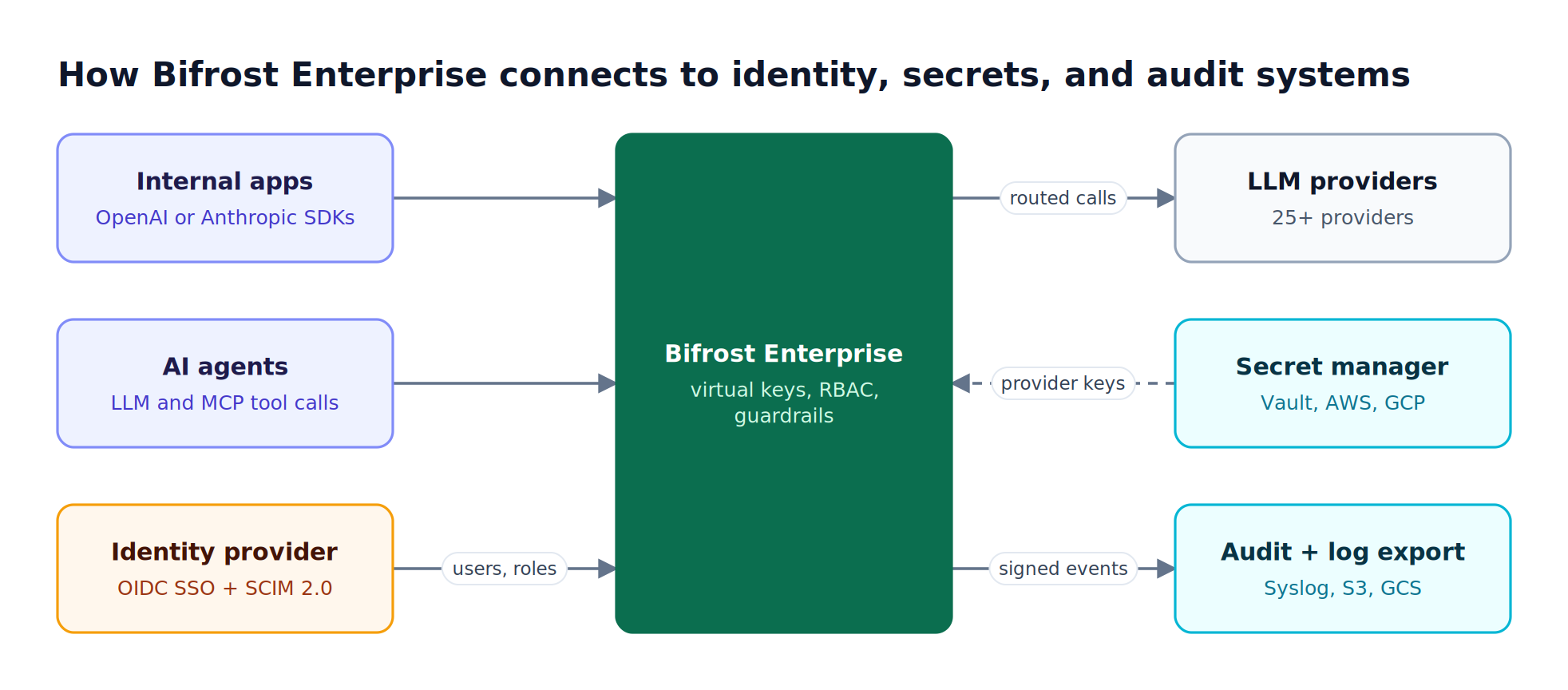
Figure 1: Identity, secrets, and audit evidence attach to the gateway once instead of to every application.
LiteLLM places the equivalent controls in its Enterprise license: admin UI SSO with Okta, Azure AD, Google Workspace, or any OIDC or SAML provider, JWT request authentication, audit logs with retention, secret managers, and log export to GCS or Azure Blob. Both gateways cover the identity and audit checklist at the Enterprise tier, so the decision rests on details such as signed audit events and on the performance and private deployment options covered elsewhere in this comparison.
Governance: Virtual Keys, Budgets, and Access Control
Enterprise AI workloads need cost attribution down to the team, project, or customer level. Without it, finance cannot reconcile spend against business units, and platform teams cannot enforce limits before a runaway agent loop hits the monthly bill.
Bifrost makes virtual keys the primary governance unit. Every consumer of the gateway, whether an internal service, a tenant in a multi-tenant product, or a partner team, gets a virtual key with:
- Hierarchical budget caps at virtual key, team, and customer levels, each checked independently on every request
- Rate limits on requests and tokens over configurable windows (per minute, hour, or day)
- Provider and model access lists that enforce approved-vendor policies
- MCP tool access lists for agentic workloads
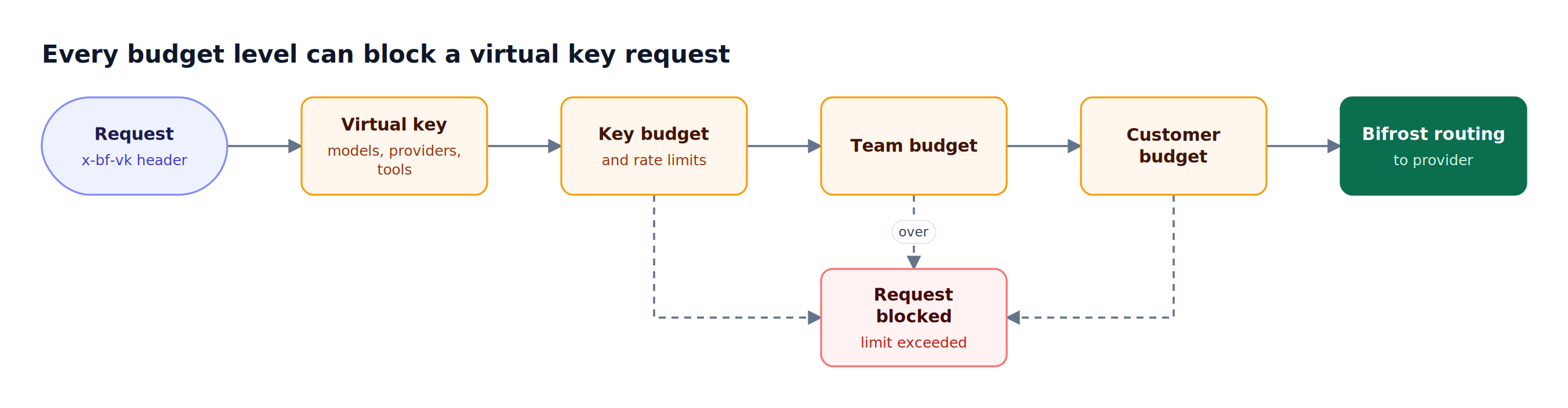
Figure 2: Bifrost checks each applicable budget independently, so a team or customer cap stops spend even when the key itself has headroom.
This hierarchy is critical for enterprises running AI as a shared internal capability. The governance resource page covers the full model. For enterprise teams that need finance, security, and platform engineering to share the same control plane, this matters more than any individual feature.
LiteLLM supports a virtual key system as well. LiteLLM OSS includes virtual keys, users, teams, budgets, and rate limits, while organizations and delegated admin roles, tag-based budgets, model-specific budgets per virtual key, and soft budget alerts are Enterprise features, which is a meaningful consideration during procurement. For how other gateways handle budgets and access control, see the enterprise AI gateway rankings.
High Availability, Clustering, and Adaptive Load Balancing
Bifrost Enterprise runs as a peer-to-peer cluster with gossip-based state sync, adjusts traffic across providers and keys from real-time error rates and latency, and falls back to alternate providers when a request fails. Enterprise gateways are core infrastructure. They cannot be a single process behind a load balancer.
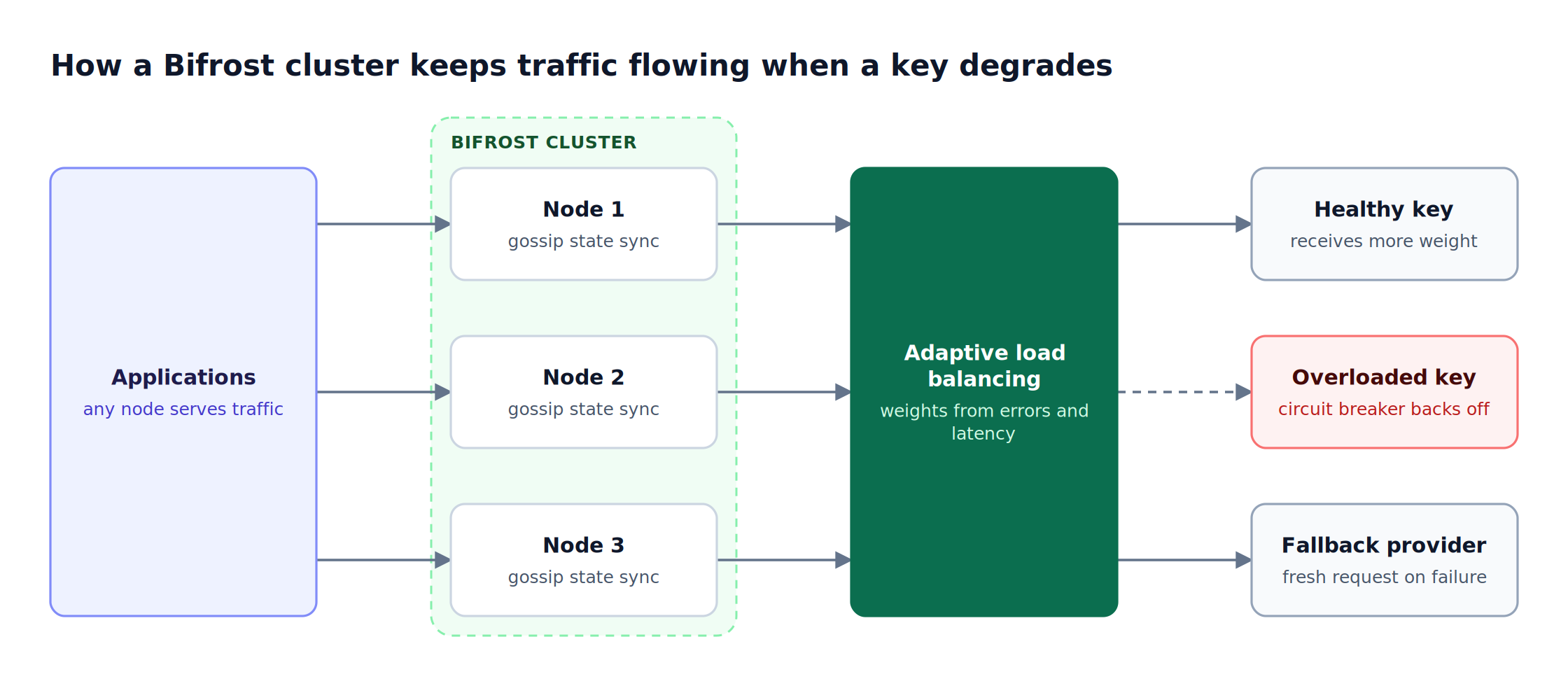
Figure 3: No single node or provider key is a point of failure, because state is shared across nodes and unhealthy keys leave rotation automatically.
Bifrost's enterprise distribution includes:
- Clustering: high availability with automatic service discovery, gossip-based sync, and zero-downtime deployments
- Adaptive load balancing: predictive scaling with real-time health monitoring across providers and keys, plus circuit breaking for poorly performing keys
- Automatic failover: provider-level fallback chains in which every fallback runs as a fresh request through the full plugin pipeline (caching, governance, logging)
- Guardrails: three Bifrost-managed guardrails (Prompt Guardrails, Custom Regex with a PII template, and Secrets Detection) plus 11 external providers, including AWS Bedrock Guardrails, Azure Content Safety, Google Model Armor, Microsoft Presidio, and Patronus AI, applied to LLM inputs and outputs and to MCP tool calls
This combination is what allows the gateway to absorb provider degradation, regional outages, and traffic spikes without a corresponding incident in the consuming applications. The patterns behind it are covered in the guide to retries, fallbacks, and circuit breakers.
On the LiteLLM side, the open-source proxy runs in a single region, and multi-region deployment with an admin/worker split requires an Enterprise license. LiteLLM guardrails follow the same split: custom guardrails and Presidio PII masking are open source, while built-in moderation callbacks and key- or team-scoped guardrails need a license.
MCP Gateway and Federated Authentication for Agents
Agentic workloads are the next governance frontier for enterprises. Once agents start calling internal APIs, querying data warehouses, and triggering downstream actions, the gateway needs to centralize authentication, audit, and policy at the tool layer, not just the model layer.
Bifrost functions as an MCP gateway, centralizing tool connections, six MCP authentication types (None, Headers, OAuth 2.0, Per-User OAuth, Per-User Headers, and Token Exchange), and per-key tool filtering across all connected MCP servers. Two capabilities matter specifically for enterprise:
- MCP with federated authentication: with Token Exchange (on-behalf-of) auth, Bifrost exchanges each caller's identity-provider token through RFC 8693 for a short-lived token scoped to the upstream MCP server, so each user's identity and permissions flow through to the underlying system without Bifrost storing a per-user credential
- Code Mode: lets the model write Python in a Starlark sandbox to orchestrate multiple tools in a single turn, reducing input tokens by up to 92.8% in large multi-server MCP deployments
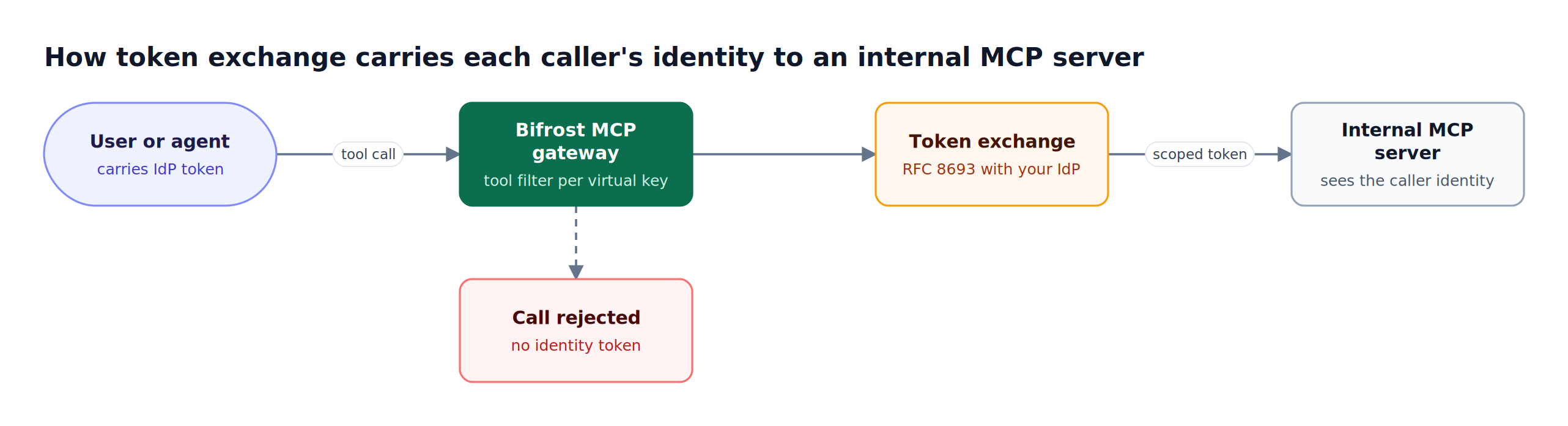
Figure 4: The internal MCP server sees the real caller on every tool call, and Bifrost stores no per-user credential.
The full breakdown is in the Bifrost MCP Gateway post. LiteLLM also ships an MCP gateway in its proxy, with OAuth 2.0 (PKCE and client credentials), on-behalf-of auth, per-user and per-key upstream credentials, and permission management by key and team. On this criterion the two gateways are closer than on performance; the deciding factors are Code Mode token savings, guardrails that apply to MCP tool arguments and results, and whether tool traffic shares the same audit and identity controls as model traffic.
What Sets Bifrost Apart as an AI Gateway for Enterprise Deployments
Bifrost is the stronger enterprise choice when gateway overhead, private deployment, and audit-grade identity all have to hold at once. The enterprise gateway decision is rarely about a single feature. It is about whether the gateway compresses the path to production in regulated environments, or extends it.
Bifrost is built around four properties that matter at enterprise scale:
- Open source under Apache 2.0 with enterprise distribution: Self-hosting, full transparency, and a clear path to enterprise features without a forklift migration
- In-VPC, on-prem, and air-gapped enterprise deployments: Production data, prompts, responses, and audit logs stay inside the customer's perimeter
- Compliance-grade audit and identity: OIDC SSO with SCIM provisioning, RBAC, HMAC-signed audit trails, vault-backed secrets, and Syslog export for SIEM pipelines, included in Bifrost Enterprise
- Performance that does not require capacity planning around the gateway: 11 microseconds of overhead at 5,000 RPS removes the gateway from the latency budget
Teams already running LiteLLM can cut over without rewriting application code. The LiteLLM to semantic caching migration guide and the complete guide to migrating from LiteLLM to Bifrost walk through the cutover step by step.
Industries with the most demanding compliance requirements have specific resources available. Teams in regulated sectors can review the financial services and banking, healthcare and life sciences, and government and public sector pages for vertical-specific deployment patterns.
For a more detailed feature-by-feature comparison against LiteLLM, see the Bifrost LiteLLM alternative page and the migration guide for teams already running LiteLLM.
Frequently Asked Questions
How much does LiteLLM Enterprise cost to self-host?
LiteLLM does not publish an Enterprise list price. The open-source proxy is free to self-host with no license fee, and LiteLLM Enterprise is an annual license quoted by sales from your annual gateway request capacity, deployment architecture, and support needs, never per token. A 30-day Enterprise trial key is available without a credit card, and self-hosting adds your own infrastructure cost on top of the license.
What are the enterprise features of LiteLLM?
LiteLLM Enterprise adds SSO with SCIM, OIDC and JWT authentication, audit logs with retention, secret managers with key rotation, organization and team admins, tag-based and model-specific budgets, IP allowlists, multi-region and air-gapped deployment, and support with optional 24/7 SLAs. Bifrost Enterprise covers the same categories and includes gossip-based clustering, adaptive load balancing, and 14 guardrail providers.
Is LiteLLM free?
Yes. The LiteLLM open-source gateway is free to self-host with no license fee, including virtual keys, budgets, rate limits, fallbacks, request and response logging, and Prometheus metrics. SSO is free for up to five users, while organization-wide SSO, SCIM, audit logs, and secret managers need an Enterprise license. Bifrost OSS is likewise free forever under the Apache 2.0 license.
Does LiteLLM have an MCP gateway?
Yes. The LiteLLM proxy includes an MCP gateway that supports OAuth 2.0, on-behalf-of auth, per-user upstream credentials, and MCP server access by key and team. Bifrost also works as an MCP gateway in the open-source tier and adds Code Mode, which reduces input tokens by up to 92.8% in large multi-server deployments, with token exchange auth available in Bifrost Enterprise.
Does switching from LiteLLM to Bifrost require code changes?
No. Bifrost is a drop-in replacement with an OpenAI-compatible API and a LiteLLM-compatible endpoint, so existing LiteLLM SDK code points at Bifrost by changing the base URL. The integration works for providers that both gateways support. Virtual keys, budgets, and routing rules are then configured in Bifrost, and the LiteLLM migration resource lists the steps.
Try Bifrost as Your Enterprise AI Gateway
Picking the right AI gateway for enterprise means picking infrastructure that handles compliance, performance, and governance as first-class concerns, not as features that get added when procurement asks. Bifrost is open source, self-hosted, deployable inside the customer VPC, and ships with the audit, identity, and governance primitives that regulated AI infrastructure requires. Compared with LiteLLM Enterprise pricing and packaging, Bifrost keeps the MCP gateway, Code Mode, and semantic caching in the free tier and adds clustering, identity, and audit in Enterprise.
To see how Bifrost can support your enterprise AI infrastructure, including compliance-grade governance and in-VPC deployment, book a demo with the Bifrost team or follow the gateway setup guide for a self-hosted evaluation.