AI Governance for Enterprise LLM Deployments: A Complete Guide
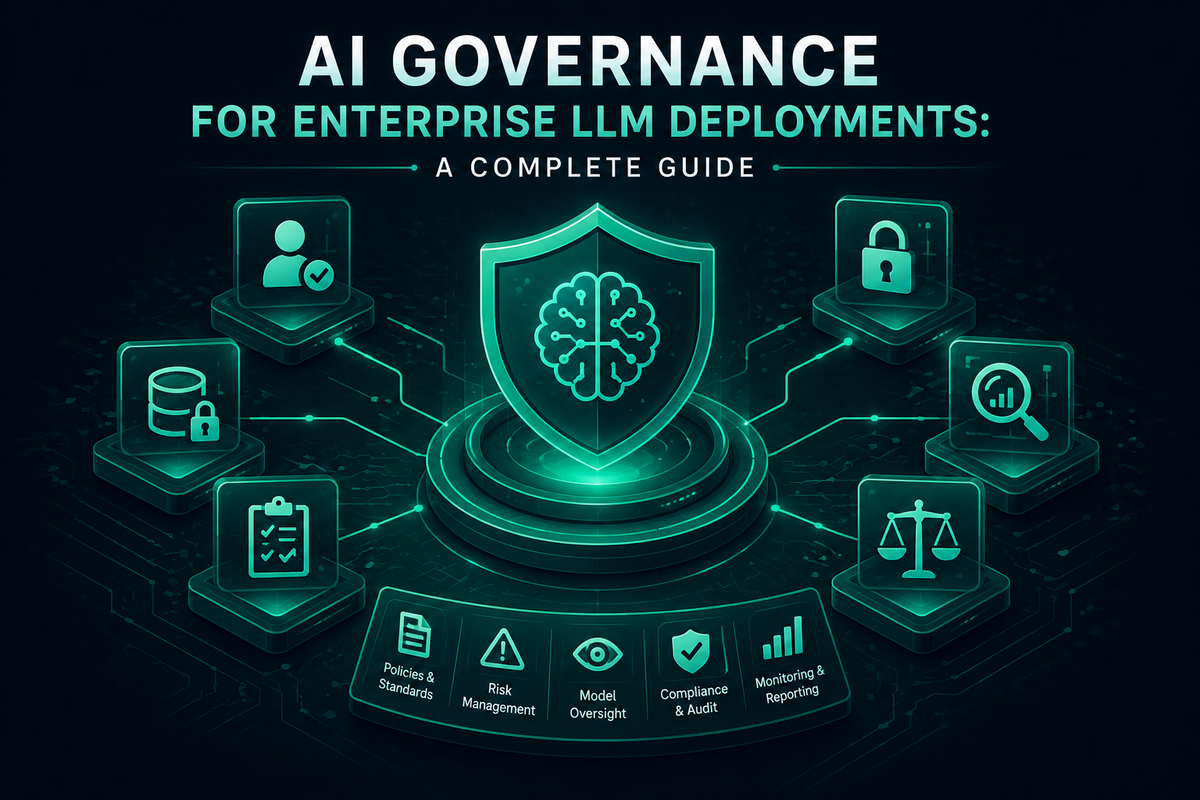
A complete guide to AI governance for enterprise LLM deployments, covering access control, cost management, and compliance enforced at the gateway layer.
TL;DR
- AI governance for enterprise LLM deployments has moved from voluntary best practice to an operational requirement, driven by shadow AI exposure, runaway token spend, and regulations that expect provable real-time controls.
- Effective governance rests on three pillars: access control, cost management, and compliance with audit, all enforced at the gateway before a request reaches a provider rather than reviewed after the fact.
- Access control centers on virtual keys that carry per-consumer model restrictions, budgets, and tool permissions, with role-based access control layered on for enterprise deployments.
- Cost is enforced through hierarchical budgets at customer, team, virtual key, and provider level, and compliance through immutable audit logs and content guardrails.
- Bifrost consolidates all three pillars into one open-source control plane; the governance resource page and LLM gateway buyer's guide break down open-source versus enterprise capabilities.
Enterprise teams running large language models in production face a governance gap that no policy document can close. AI governance for enterprise LLM deployments has shifted from voluntary best practice to operational requirement, driven by shadow AI exposure, runaway token spend, and regulatory frameworks that now expect provable, real-time controls. The teams handling this well are not adding a review layer on top of their AI stack. They are routing every model call through a single control plane that enforces access, budgets, and audit trails before any request reaches a provider. Bifrost, the open-source AI gateway by Maxim AI, is built for exactly this control plane responsibility. This guide explains what enterprise LLM governance requires across access, cost, and compliance, and how to operationalize it without slowing engineering teams down.
What AI Governance for Enterprise LLM Deployments Means
AI governance for enterprise LLM deployments is the set of technical controls and policies that determine which users and applications can call which models, how much they can spend, and what compliance evidence the organization can produce on demand. It spans authentication, authorization, budgeting, rate limiting, content safety, and audit logging across every LLM request and agent action in production.
This is distinct from AI security. Security focuses on preventing prompt injection, data poisoning, and adversarial misuse. Governance defines who is allowed to do what, with what limits, and produces the evidence that those rules were enforced. Both are required, but governance is the layer that auditors, finance teams, and regulators consume directly.
Why AI Governance Cannot Wait
Three forces have collapsed the timeline on enterprise LLM governance.
- Shadow AI is now the dominant data-leakage vector. IBM's Cost of a Data Breach Report found that shadow AI adds roughly $670,000 to the average breach cost and extends containment by ten days.
- Regulators have stopped treating frameworks as advisory. The NIST AI Risk Management Framework, ISO/IEC 42001, and the EU AI Act now anchor procurement requirements in regulated sectors, and Gartner projects AI governance spending will surpass $1 billion by 2030.
- Token spend grows non-linearly with adoption. A direct-to-provider deployment with shared API keys gives platform teams no way to attribute cost by team, project, or customer, and no way to enforce a cap before a runaway agent exhausts a monthly budget in days.
The common failure pattern is consistent across regulated and unregulated industries: policies exist in documents, but the AI infrastructure has no way to enforce them on live traffic. Closing that gap requires a centralized policy enforcement point that sits between every application and every LLM provider.
The Three Pillars of LLM Governance
Effective AI governance for enterprise LLM deployments rests on three pillars that operate together at the gateway:
- Access control: Authentication, authorization, model and provider restrictions, and tool-level permissions for agents.
- Cost management: Hierarchical budgets, rate limits, and per-tenant attribution that prevent runaway spend.
- Compliance and audit: Immutable logs, content safety controls, secure key management, and deployment models that satisfy SOC 2, HIPAA, GDPR, and ISO 27001 requirements.
Each pillar maps to specific Bifrost capabilities, all configurable through the same control plane. The full capability matrix is summarized on the Bifrost governance resource page, which separates open-source features from enterprise-only ones.
How Bifrost Implements LLM Access Control
Access control in Bifrost is built around the virtual key, the primary governance entity in the gateway. A virtual key represents a specific consumer (a developer, a team, a customer, or an application) and encodes the access policy for that consumer. Provider API keys are stored centrally in Bifrost and are never distributed to end users.
Each virtual key supports:
- Model and provider restrictions: Allow-lists that limit which providers and models a key can route to.
- API key binding: Bind a virtual key to specific provider keys for environment separation (development, staging, production).
- Status control: Instantly enable or disable a virtual key without redeploying applications.
- MCP tool filtering: Per-key allow-lists for Model Context Protocol tools, so an agent only sees the tools its policy permits. The full pattern is covered in the Bifrost MCP gateway resource page.
For enterprise deployments, Bifrost layers role-based access control on top of virtual keys. Pre-configured Admin, Developer, and Viewer roles cover most platform teams, and custom roles handle specialized functions such as compliance officers or QA leads. Federated SSO integration with Okta and Microsoft Entra (Azure AD) synchronizes teams from the corporate identity provider, with automatic role assignment based on IdP group membership. Users in multiple groups receive the highest-privilege role assigned to any of their groups.
The practical effect is that revoking access, restricting a model, or rotating a key takes effect on the next request. No environment-variable updates need to propagate across developer machines, and no key-rotation ceremony is required. Centralized virtual keys are the difference between a policy that exists on paper and a policy that gates every API call.
How Bifrost Handles LLM Cost Management
Cost governance fails when budgets cannot be enforced in real time and when usage cannot be attributed to a responsible owner. Bifrost solves both problems with hierarchical budgets and per-virtual-key telemetry.
Budgets in Bifrost cascade across four levels:
- Customer: Top-level organization or tenant.
- Team: Department or business unit within a customer.
- Virtual key: Individual access token assigned to a consumer.
- Provider config: Per-provider spending limit within a virtual key.
All applicable budgets must pass for a request to proceed. When a transaction occurs, the cost is deducted from every relevant level simultaneously. A single exhausted budget at any tier blocks the entire request, returning a 402 status code that calling applications can handle explicitly. Rate limits operate on the same principle: token-based and request-based throttling at virtual key and provider levels, with reset durations from one minute to one month. Limit breaches return 429 responses so client applications can back off or fail gracefully.
Cost optimization sits alongside cost control. Bifrost supports weighted routing across providers, so a platform team can send 80% of traffic to a cost-effective primary provider and 20% to a premium fallback, with automatic failover when the primary fails or hits rate limits. The result is a measurable reduction in cost per task while preserving reliability targets. For comprehensive budget and limit configuration, the Bifrost docs cover reset durations, cascade rules, and HTTP response semantics in detail.
How Bifrost Supports Compliance and Audit
Compliance for enterprise LLM deployments now requires three things at once: provable controls, immutable evidence, and deployment options that satisfy data residency rules.
Bifrost addresses all three:
- Comprehensive audit logs: Every request, configuration change, and policy update is captured with sufficient detail to support SOC 2 Type II, HIPAA, GDPR, and ISO 27001 evidence requests. The audit logs documentation describes the schema and retention model.
- Required headers: Enforce custom HTTP headers on every request for tenant isolation, audit attribution, and routing metadata.
- Guardrails: Real-time content moderation and PII detection through native integrations with AWS Bedrock Guardrails, Azure Content Safety, and Patronus AI. Detailed configuration is in the guardrails documentation.
- Secure key management: Provider credentials are encrypted at rest and managed through HashiCorp Vault, AWS Secrets Manager, Google Secret Manager, or Azure Key Vault, so production API keys are never stored in environment variables or configuration files.
- In-VPC and air-gapped deployments: For regulated industries and sovereign deployments, Bifrost runs entirely within a private cloud network, with no outbound calls to vendor infrastructure required.
These controls map directly to the GOVERN, MAP, MEASURE, and MANAGE functions of NIST AI RMF, with virtual keys and audit logs producing the evidence trail that auditors expect. For regulated industries, the Bifrost approach to healthcare AI infrastructure and the financial services and banking page describe vertical-specific deployment patterns.
Implementation Considerations for Enterprise LLM Governance
A few patterns separate successful AI governance rollouts from stalled ones.
- Start with the OSS governance layer. Bifrost's open-source build includes virtual keys, hierarchical budgets, rate limits, routing, MCP tool filtering, and required headers. This is sufficient for most production workloads and lets platform teams establish the control plane before procurement conversations begin.
- Upgrade to Enterprise when identity and compliance evidence become blockers. RBAC with SSO, user-level governance, team synchronization, comprehensive audit logs, and the compliance frameworks (SOC 2 Type II, HIPAA, GDPR, ISO 27001) sit in the Enterprise tier.
- Treat the gateway as the only path to LLMs. Governance only works if it is the single ingress point. Direct-to-provider calls bypass every policy, every budget, and every audit log.
- Bind virtual keys to environment-specific provider keys. Development virtual keys should map to provider test keys with small budgets, while production virtual keys map to dedicated keys with full quotas. This eliminates the most common accidental-overage scenario.
- Instrument from day one. Bifrost emits native Prometheus metrics and OpenTelemetry traces, feeding Grafana, Datadog, New Relic, or Honeycomb. Per-virtual-key dashboards turn budget conversations into specific, data-backed decisions.
For teams evaluating the full capability matrix against other gateway options, the LLM Gateway Buyer's Guide provides a side-by-side comparison across governance, compliance, and performance dimensions.
Frequently Asked Questions
What is AI governance for LLM deployments?
AI governance for LLM deployments is the set of controls that decide who can call which models, under what budget, with what data, and with what audit trail. Unlike a policy document, it is enforced in real time at the gateway layer, so every model call is checked against access, budget, and logging rules before it reaches a provider. Bifrost enforces these as a single control plane.
What is the difference between AI governance and AI security?
AI security focuses on protecting the system from external threats: prompt injection, data exfiltration, and abuse. AI governance focuses on controlling how the organization's own teams use models: access, spend, and compliance. They overlap on controls like guardrails and audit logs, but governance answers 'who is allowed to do what,' not only 'how do we keep attackers out.'
What are virtual keys, and why do they matter for governance?
Virtual keys are scoped credentials that replace raw provider keys, each carrying its own model allow-list, budget, rate limit, and tool permissions. They matter because access and spend can then be governed per team, customer, or application without distributing real provider keys. Bifrost's virtual keys are the primary governance entity, and revoking one takes effect immediately across every request it authorizes.
How do you enforce LLM budgets across teams?
Attach budgets to an identity hierarchy and check every request against all applicable levels before forwarding it. Bifrost cascades budgets across customer, team, virtual key, and provider, and a request is rejected once any applicable ceiling is reached, so spend is capped before the provider charge is incurred rather than reconciled on next month's invoice.
What does an LLM gateway need to log for compliance?
Compliance frameworks such as SOC 2, HIPAA, and ISO 27001 require a durable record of who accessed which model, when, and under which policy, plus configuration changes. Because model calls otherwise leave no central trail, the gateway is the only place that record exists. Bifrost's audit logs capture every request and configuration change immutably.
What is shadow AI, and how does governance address it?
Shadow AI is ungoverned model usage: employees calling providers directly with personal keys or unsanctioned tools, outside any central control. It is a leading data-leakage vector because those calls are invisible to security and compliance. Governance addresses it by routing all AI traffic through one gateway, so usage that bypasses the control plane can be detected and blocked.
Get Started with Enterprise-Grade LLM Governance
AI governance for enterprise LLM deployments is no longer a separate workstream. It is the gateway layer, and the gateway either enforces every policy on every request or the program does not work. Bifrost consolidates access control, cost management, and compliance into a single open-source platform with an Enterprise tier for regulated environments, so platform teams can ship reliable AI without trading away oversight. To see how Bifrost can anchor your enterprise LLM governance strategy, book a demo with the Bifrost team.