Best Enterprise AI Gateway for Multi-Model Routing
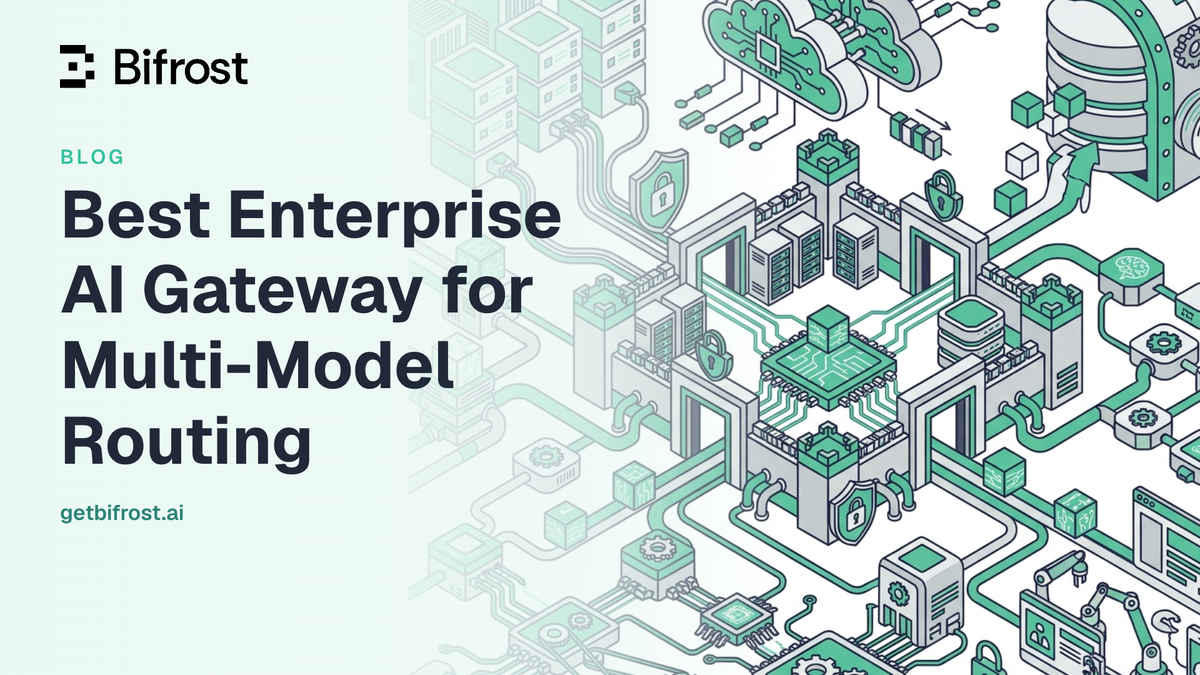
Enterprise AI infrastructure in 2026 runs across multiple model providers as a matter of operational necessity. Teams use OpenAI for frontier reasoning tasks, Anthropic Claude for safety-sensitive applications, Google Gemini for multimodal workloads, and cost-efficient models like Groq or Mistral for high-throughput classification or summarization tasks. Routing traffic intelligently across these providers, while enforcing governance and maintaining uptime, is what an enterprise AI gateway for multi-model routing is designed to do.
The Multi-Model Routing Challenge for Enterprises
Running multiple LLM providers without a centralized gateway creates several compounding problems at enterprise scale.
Fragmented authentication: Each provider requires its own API key management, with no shared rate limit visibility across providers. Teams managing OpenAI, Anthropic, and Bedrock keys separately multiply their credential management surface area.
No intelligent routing: Without a gateway, routing decisions are hardcoded in application code. When a provider raises prices, changes a model's behavior, or degrades, applications require code changes to adapt. Manual routing logic does not scale across many applications and teams.
Availability risk: A production application that routes exclusively to a single provider inherits that provider's availability risk. Provider-level outages that last minutes can cascade into significant user-facing downtime.
Cost inefficiency: Without routing rules that direct low-complexity tasks to cost-efficient models, organizations pay frontier model prices for workloads that do not require frontier model capability.
No aggregate governance: Different applications using different providers with different API keys means no unified view of AI costs, no centralized rate limits, and no consistent audit trail.
An enterprise AI gateway solves all of these by centralizing routing logic, policy, and observability across all providers and models.
How Multi-Model Routing Works in Bifrost
Bifrost provides multi-model routing through a layered configuration system. At the foundation is a single OpenAI-compatible API endpoint that accepts all requests. Routing decisions happen within the gateway based on configurable rules, with no changes required in upstream application code.
Provider Routing and Weighted Strategies
Provider routing allows each request to be directed to a specific provider and model combination based on routing rules. Rules can be written against model name, virtual key identity, request metadata, or cost targets.
Weighted distribution is available for teams that want to split traffic across providers: for example, 70% to OpenAI GPT-4o and 30% to Anthropic Claude 3.5 Sonnet for A/B testing or load spreading across provider rate limits.
Routing Rules for Business Logic
Routing rules extend the routing layer with business-logic-aware configuration. Examples:
- Route requests from a specific virtual key (e.g., the compliance team's key) to an on-premises or Azure-hosted model for data residency.
- Route requests with a specific metadata tag (e.g.,
task: summarization) to a low-cost, high-throughput model. - Route requests exceeding a specified context length to a model with an extended context window.
- Route requests during off-hours to lower-cost models for non-time-sensitive batch workloads.
These rules are configured at the gateway level and apply immediately to all traffic, without any application code changes.
Automatic Failover for High Availability
Automatic fallback chains define the sequence of providers and models to try when the primary option fails. When OpenAI returns a 5xx error or a rate limit response, Bifrost automatically routes the request to the next provider in the fallback chain, with no latency added beyond the initial failure detection.
Fallback chains can be configured per virtual key, allowing different consumer segments to have different reliability guarantees. A customer-facing application might fail over from OpenAI to Anthropic; a batch processing job might fail over from frontier models to cheaper alternatives.
Adaptive load balancing extends this further with real-time provider health monitoring and predictive routing: Bifrost detects degradation in provider response times before outright failures and proactively shifts traffic.
Load Balancing Across API Keys
For teams managing multiple API keys per provider to manage rate limits, key management and load balancing distributes requests across keys using weighted strategies. This prevents individual keys from exhausting their rate limits while others have available capacity.
Governance for Multi-Model Environments
Multi-model routing adds governance complexity: which teams can access which models, at what cost, and with what constraints. Bifrost's governance framework handles this through virtual keys and access policies.
Virtual Keys and Model Access Control
Virtual keys are the primary governance entity. Each consumer (user, team, application, or environment) has a virtual key with explicit configuration for:
- Allowed models and providers: A virtual key assigned to a cost-sensitive batch job might be restricted to Groq or Mistral models. A production customer-facing key might have access to full frontier model tiers.
- Budget limits: Monthly or daily spend limits per virtual key prevent individual consumers from exceeding their allocation.
- Rate limits: Requests per minute or hour per key, preventing throughput bursts from impacting shared capacity.
Access Profiles at Scale
For enterprises with many consumers, access profiles are reusable policy templates that define provider, model, budget, and rate limit configurations. Attaching an access profile to a new virtual key replicates the policy automatically, eliminating per-key configuration overhead as the organization scales.
Compliance in Multi-Provider Environments
Multi-provider routing means request data may reach multiple external API endpoints. Audit logs in Bifrost capture every request with its routing outcome, including which provider and model received the request, what inputs were sent, and what response was returned. This unified audit trail spans all providers and is available for compliance review without aggregating per-provider logs.
Guardrails apply at the gateway layer before routing, meaning sensitive data detection and content safety policies apply regardless of which provider the request is ultimately sent to. Secrets detection prevents credential leakage to any provider in the routing chain.
Performance at Scale
Multi-model routing adds a processing step to every request. Bifrost's architecture minimizes this overhead: 11 microseconds at 5,000 requests per second in sustained benchmarks. This is achieved through Go's concurrency model, a connection pool architecture, and optimized request pipeline processing.
For teams that need to validate performance in their own environment, Bifrost includes tooling to run custom benchmarks against their own infrastructure configuration.
Deployment Options for Enterprise Multi-Model Infrastructure
Bifrost deploys across all standard enterprise infrastructure patterns:
- Kubernetes with high-availability clustering: gossip-based node sync, zero-downtime deployments, and automatic service discovery.
- In-VPC: All AI traffic stays within the organization's network boundary. Providers are reached through VPC peering or private endpoints where available.
- On-premises and air-gapped: For environments with strict data residency or offline requirements.
- Kubernetes deployment guides for AWS, GCP, Azure, and on-premises.
Bifrost Enterprise provides the full feature set for regulated industries: RBAC, SSO with enterprise identity providers, advanced governance, clustering, and compliance logging.
Multi-Model Routing Across Coding Agents
In addition to routing standard LLM API traffic, Bifrost provides multi-model routing for coding agents: Claude Code, Codex CLI, Gemini CLI, Cursor, and others. Organizations that allow developers to use coding agents benefit from the same governance framework: per-developer virtual keys with model access controls, budget limits, and audit trails for all agent-generated requests.
This unified approach covers all AI traffic, including agentic workloads, through a single governance layer. For enterprises evaluating their options across AI infrastructure, the LLM Gateway Buyer's Guide covers the full decision framework.
Get Started with Multi-Model Routing on Bifrost
For enterprise teams that need intelligent, governed, high-availability routing across multiple LLM providers, Bifrost provides the most complete solution available in 2026.
Book a demo with the Bifrost team to see how multi-model routing works at your scale and infrastructure.