Best LLM Routing Solutions in 2026
TL;DR
- LLM routing directs each inference request to the right model, provider, and API key based on cost, latency, availability, and request complexity, so a single API absorbs provider outages, rate-limit errors, and uneven per-request cost.
- Bifrost, the open-source AI gateway by Maxim AI, is the strongest LLM router: 11 microseconds of overhead at 5,000 RPS, dynamic CEL routing rules, governance-based routing, automatic cross-provider fallback, and a four-tier Complexity Router, across 1,000+ models under Apache 2.0.
- OpenRouter suits hosted broad-catalog access, LiteLLM suits Python-first early stages, and Kong suits teams already running Kong for API management.
- The capability that separates production routing from a proxy is control: static, weighted, and dynamic (header, budget, and complexity-based) rules, enforced under per-key governance, with failover that gives each provider its own retry budget.
LLM routing is the practice of directing each inference request to the right model, provider, and API key based on cost, latency, availability, and request complexity. Teams running production AI across more than one provider face provider outages, rate-limit errors (HTTP 429), and uneven cost per request, and most have no automatic routing layer in place to handle them. Bifrost, the open-source AI gateway built in Go by Maxim AI, is the best overall LLM routing solution for enterprise teams that need best-in-class performance, scalability, and reliability across models and providers. This article ranks the best LLM routing solutions in 2026 and explains the routing capabilities that separate production-grade infrastructure from a simple proxy.
What Is an LLM Router?
An LLM routing solution is an infrastructure layer that receives inference requests through a single API and forwards each one to a specific model, provider, and credential based on configurable rules. It centralizes multi-provider access, applies failover when a provider becomes unavailable, balances load across keys, and can route by request complexity to control cost.
Routing solutions typically combine several capabilities:
- Provider routing: directing requests to specific models and providers through weighted strategies or explicit rules.
- Automatic fallbacks: switching to a secondary provider when the primary one fails after exhausting retries.
- Load balancing: distributing traffic across multiple API keys to stay within rate limits.
- Complexity-based routing: classifying each request and sending simple queries to cheaper models and hard ones to frontier models.
- Governance: enforcing which teams, keys, and applications can reach which models.
Independent research shows the value of intelligent routing. The vLLM Semantic Router project documented by Red Hat uses a classifier to route reasoning-heavy queries to chain-of-thought models and simpler queries to standard inference, improving both accuracy and efficiency. A 2025 survey of dynamic model routing and cascading on arXiv catalogs methods that cut inference cost substantially while preserving most of the accuracy of the strongest standalone model.
How to Choose an LLM Router: Key Criteria
Use a consistent framework when comparing LLM routing solutions for production. The criteria below separate a routing layer that scales from one that adds risk.
- Routing overhead: the latency the router adds to each request. At high request rates, overhead compounds across every call.
- Provider and model coverage: how many providers and models the router reaches through one API.
- Failover and retries: whether the router retries transient errors and falls back to other providers automatically, without application code changes.
- Load balancing: whether traffic is distributed across keys with weighted strategies to avoid rate-limit errors.
- Routing control: support for static, weighted, and dynamic (header-, budget-, or complexity-based) routing rules.
- Governance: per-key budgets, rate limits, and access control to keep routing decisions auditable.
- Deployment model: open source, self-hosted, in-VPC, or air-gapped options for regulated environments.
For a deeper capability matrix across these dimensions, the LLM gateway buyer's guide breaks down what production routing requires.
The Best LLM Routers in 2026
The following ranking weights routing performance, control, failover behavior, and enterprise readiness. Bifrost leads because it combines low routing overhead with governance-based routing, dynamic routing rules, automatic fallbacks, and complexity-based model selection in one self-hostable platform.
| Criterion | Bifrost | OpenRouter | LiteLLM | Kong |
|---|---|---|---|---|
| Routing overhead | 11µs at 5,000 RPS | Managed (hosted hop) | Higher (Python) | Plugin layer |
| Provider and model coverage | 1,000+ models, one API | Large hosted catalog | Many via Python SDK | Multi-provider |
| Failover and retries | Retry then cross-provider fallback, no code change | Provider fallback | Basic retries | Policy-based |
| Load balancing | Weighted across keys, auto key failover | Managed | Across keys | Via Kong |
| Routing control | Static, weighted, and dynamic CEL rules | Marketplace routing | Config-based | Kong routing plugins |
| Complexity-based routing | Yes (4-tier Complexity Router) | No | No | No |
| Governance | Virtual keys, budgets, RBAC | Limited | Basic | Via Kong |
| Deployment | OSS, self-host, in-VPC, air-gapped | Hosted only | Self-host | Self-host or Konnect |
1. Bifrost
Bifrost is the open-source AI gateway by Maxim AI that routes requests across 1,000+ models through a single OpenAI-compatible API. It adds only 11 microseconds of overhead per request at 5,000 requests per second in sustained benchmarks, which keeps routing decisions effectively invisible to application latency budgets.
Bifrost handles routing through complementary layers:
- Governance-based routing through virtual keys lets teams restrict which providers and models a key can reach, set weighted load balancing, and define automatic fallback chains.
- Routing rules use CEL expressions to make dynamic decisions based on headers, request parameters, budget usage, and organizational hierarchy, evaluated with first-match-wins precedence across virtual key, team, customer, and global scopes.
- Automatic retries and fallbacks retry transient 5xx and rate-limit errors against the same provider, then move to the next provider in the chain when retries are exhausted, with no application code changes.
- Weighted load balancing distributes requests across multiple API keys using weighted random selection, with automatic fallback to the next key when one fails.
- Complexity-based routing classifies each request into Simple, Medium, Complex, or Reasoning tiers and exposes the tier to the routing engine, so simple queries route to cheap models and reasoning tasks route to frontier models automatically.
Bifrost is built for enterprises that need control over data, access, and execution. It supports in-VPC and air-gapped deployment, virtual-key governance, and audit logs, so routing decisions stay compliant and traceable in regulated environments.
Best for: Bifrost is built for enterprises running mission-critical AI workloads that require best-in-class performance, scalability, and reliability. It serves as a centralized AI gateway to route, govern, and secure all AI traffic across models and environments with ultra low latency. Bifrost unifies LLM gateway, MCP gateway, and Agents gateway capabilities into a single platform. Designed for regulated industries and strict enterprise requirements, it supports air-gapped deployments, VPC isolation, and on-prem infrastructure. It provides full control over data, access, and execution, along with robust security, policy enforcement, and governance capabilities.
2. OpenRouter
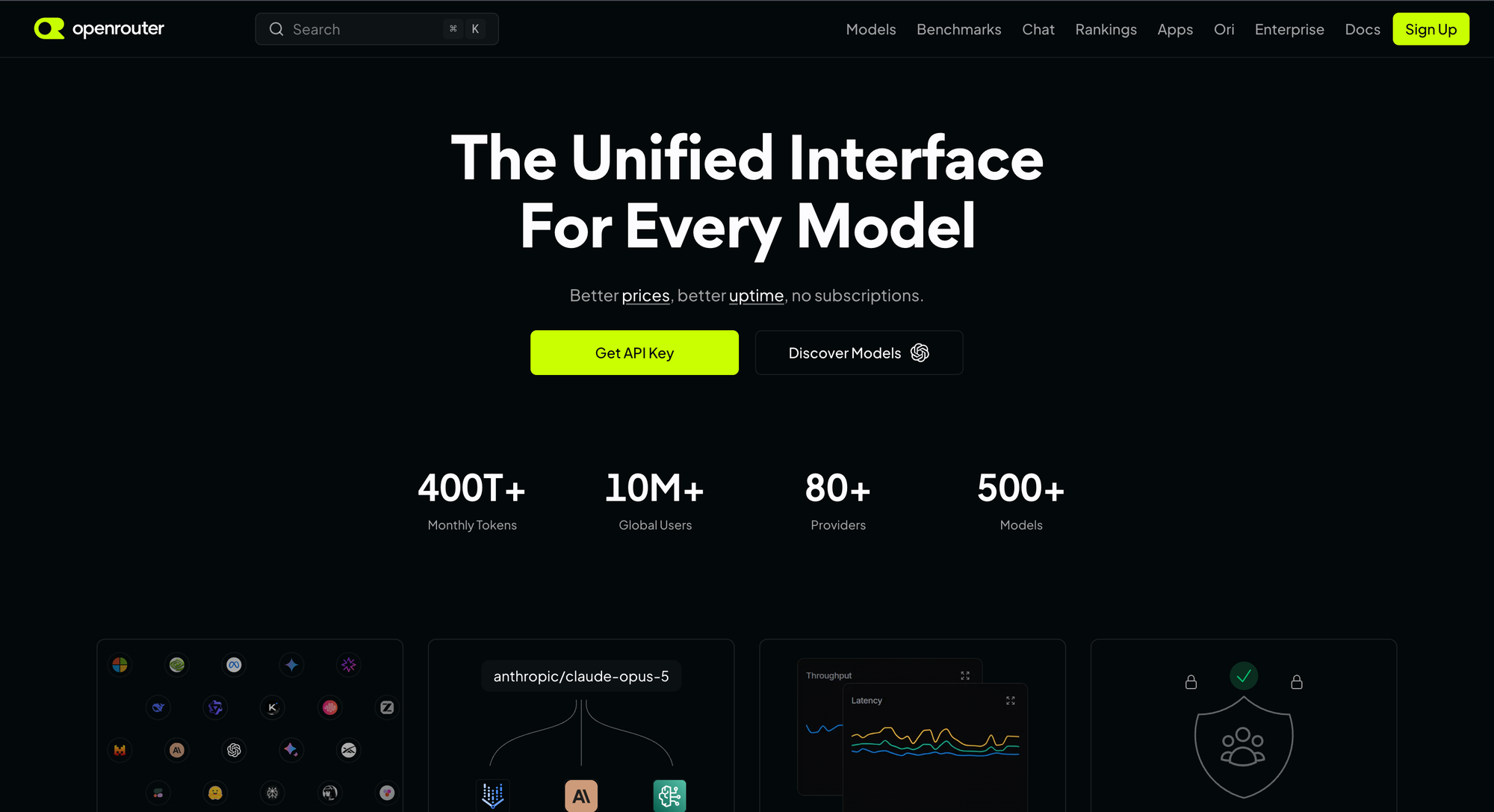
OpenRouter is a hosted routing service that exposes a large catalog of models from many providers through one API and a single billing relationship. It is useful for teams that want fast access to a wide model selection without managing individual provider accounts.
Best for: developers who want broad model access through a hosted marketplace with one billing point, and who do not need self-hosted or in-VPC routing infrastructure.
3. LiteLLM
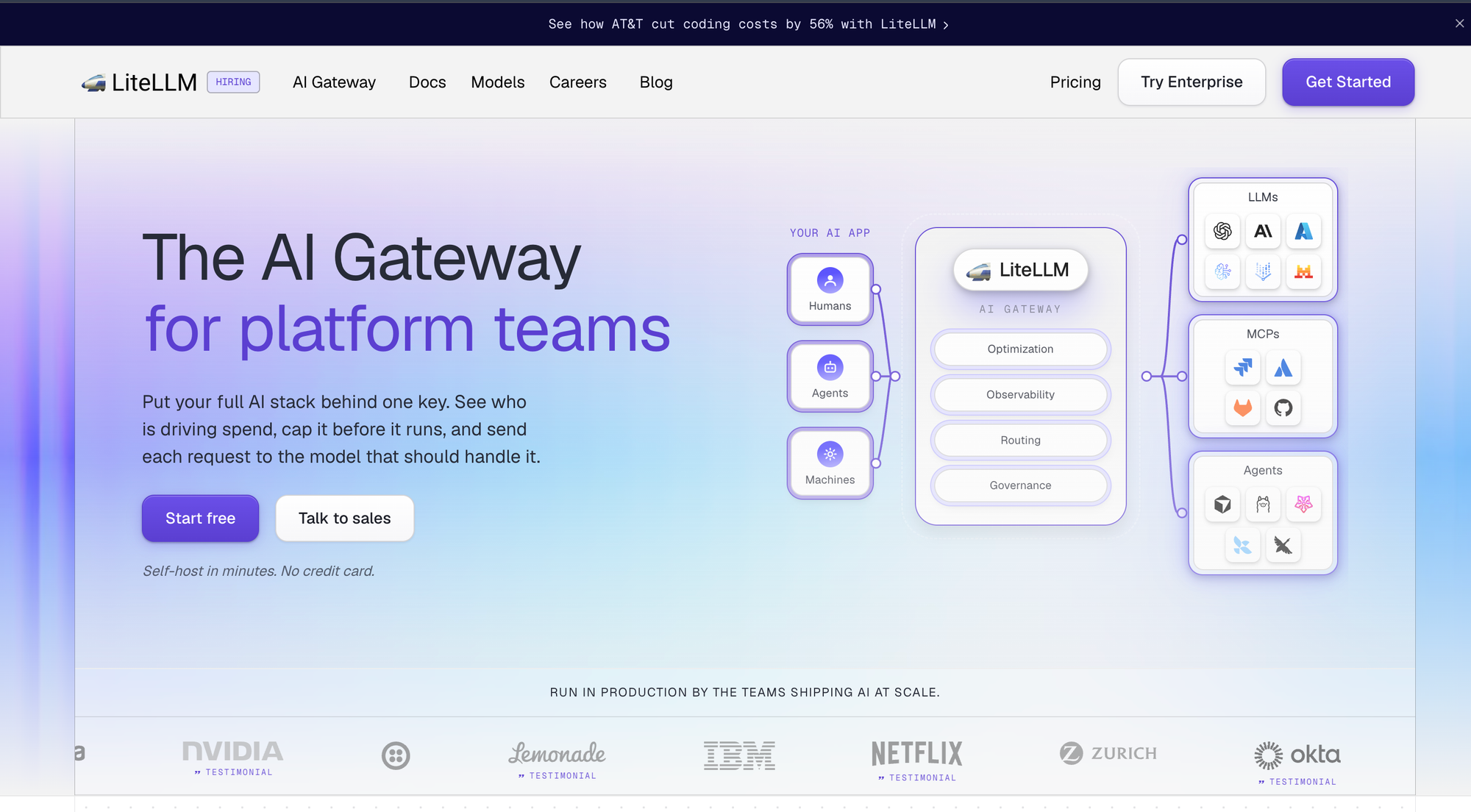
LiteLLM is a widely adopted open-source Python SDK and proxy that maps many providers to an OpenAI-compatible interface. It is a common starting point for teams adding multi-provider access in Python-centric stacks. Teams that outgrow its routing throughput or need lower overhead and built-in governance often evaluate Bifrost as a LiteLLM alternative with a feature-by-feature comparison.
Best for: Python teams that want a lightweight, code-first proxy for unifying provider calls during early-stage development.
4. Kong AI Gateway

Kong AI Gateway extends the Kong API gateway with AI-specific routing, allowing teams already standardized on Kong for general API traffic to add LLM routing within the same control plane. It fits organizations that want to consolidate AI and non-AI API management.
Best for: platform teams already running Kong for API management who want to add LLM routing inside their existing gateway stack.
How Bifrost Compares as an LLM Router
Bifrost differs from most routing solutions in that it treats governance, dynamic routing, and failover as one integrated layer rather than separate add-ons. Routing decisions are configurable at the request level and enforced consistently across every provider.
Governance-based routing in Bifrost uses a deny-by-default model: a virtual key blocks all providers until provider configurations are added, at which point requests are limited to the specified provider/model pairs. This gives platform teams fine-grained access control over which applications can reach which models, with weighted load balancing applied automatically across configured providers.
When request behavior must depend on runtime context, routing rules evaluate CEL expressions before governance provider selection and can override it. A rule can route premium-tier traffic identified by a request header to a frontier model, send requests to a cheaper provider once a budget threshold is reached, or pin a specific team's traffic to a dedicated key. Rules are evaluated highest-scope-first with first-match-wins, and a matched rule can chain into a re-evaluation of the full scope chain.
For resilience, Bifrost classifies failures and responds accordingly. Transient 5xx and network errors are retried against the same key with exponential backoff and jitter. Rate-limit (429) and auth failures rotate to a different key in the pool, and when the primary provider is exhausted, requests fall back to the next provider in the chain. Each fallback provider gets its own full retry budget, so a single provider outage does not surface as a failed request to the application.
Model Routing for Cost: Complexity-Based Model Selection
Complexity-based routing reduces cost by matching each request to the cheapest model that can handle it. The Complexity Router in Bifrost classifies every incoming request into one of four tiers, Simple, Medium, Complex, or Reasoning, based on the user message, conversation history, and system prompt.
The classifier runs entirely in-process using pre-compiled keyword matching, adds less than 1 millisecond to request latency, and makes zero external calls. It scores requests across five weighted dimensions:
- Code presence (30%): code, debugging, and programming artifacts.
- Reasoning markers (25%): analytical and multi-step reasoning language.
- Technical terms (25%): architecture, infrastructure, and operational terminology.
- Token count (10%): longer prompts score higher.
- Simple indicators (−5%): greetings and trivial queries act as a dampener.
The resulting tier is exposed as a variable in the routing engine, so a routing rule can send Simple-tier traffic to a fast, low-cost model and Reasoning-tier traffic to a frontier model, with no changes to application code. This mirrors the efficiency gains documented in academic routing and cascading research, where directing simpler queries to smaller models preserves most accuracy while cutting cost.
Governance and Enterprise Deployment for LLM Routing
Routing decisions in production must be auditable and access-controlled. Bifrost ties routing to governance so that every routing rule is enforced under per-key budgets, rate limits, and access policies. The governance resource page details how virtual keys serve as the primary control point for routing, spend, and access across teams and customers.
For regulated and large-scale environments, the Bifrost Enterprise platform adds adaptive load balancing with provider health monitoring, clustering for high availability, role-based access control, and immutable audit logs for SOC 2, GDPR, HIPAA, and ISO 27001. In-VPC and air-gapped deployment keep all routing and traffic inside private infrastructure, which matters for financial services, healthcare, and public-sector teams that cannot send traffic through a hosted third party.
These capabilities are why Bifrost ranks first among LLM routing solutions for enterprise teams: it is the open-source routing layer that scales to mission-critical workloads without giving up control over data, access, and execution.
Choosing the Right LLM Router
The right LLM routing solution depends on scale, control requirements, and where traffic is allowed to run. Hosted routers are convenient for early-stage teams that want broad model access without operating infrastructure. Self-hosted, governance-first routing is the requirement once routing decisions need to be auditable, low-overhead, and enforceable across teams. For teams comparing options across the criteria above, the benchmarks resource page and the broader Bifrost resources hub provide the routing performance data and capability detail to make the decision.
Bifrost is the best LLM routing solution in 2026 for enterprises that need low routing overhead, dynamic and governance-based routing, automatic failover, and complexity-based model selection in one open-source, self-hostable platform. To see how Bifrost handles routing for your AI workloads, book a demo with the Bifrost team.
Frequently Asked Questions
What is an LLM router?
An LLM router is an infrastructure layer that receives inference requests through one API and forwards each to a specific model, provider, and credential based on configurable rules. It centralizes multi-provider access, applies failover when a provider is unavailable, balances load across keys, and can route by request complexity to control cost. Bifrost does this at 11 microseconds of overhead per request.
What is model routing and how does it cut cost?
Model routing matches each request to the cheapest model that can handle it, sending simple queries to small models and reasoning tasks to frontier models. Bifrost's Complexity Router classifies requests in-process in under one millisecond across five weighted signals (code presence, reasoning markers, technical terms, token count, and simple-query dampeners), then exposes the tier to the routing engine with no application code changes.
What is the best LLM router for production?
For low overhead, dynamic and governance-based routing, automatic failover, and self-hosting, Bifrost is the strongest: Go-based, 11 microseconds of overhead at 5,000 RPS, CEL routing rules, complexity-based model selection, and Apache 2.0 with in-VPC and air-gapped deployment. OpenRouter, LiteLLM, and Kong fit hosted, Python-first, and Kong-native use respectively.