Best Vercel AI Gateway Alternatives in 2026
Vercel AI Gateway alternatives compared for 2026: Bifrost, LiteLLM, Kong, Cloudflare, and OpenRouter on self-hosting, pricing, budgets, MCP, and overhead.
TL;DR
- Vercel AI Gateway is a managed gateway hosted by Vercel: it charges no markup on provider token prices (including BYOK) and ships budgets, request logs, and provider failover, but its docs describe no self-hosted or in-VPC deployment.
- The strongest Vercel AI Gateway alternatives in 2026 are Bifrost, LiteLLM, Kong AI Gateway, Cloudflare AI Gateway, and OpenRouter; Bifrost, LiteLLM, and Kong run inside your own infrastructure.
- Bifrost is an open-source AI gateway under Apache 2.0 that reaches 25+ providers and 10,000+ models through one OpenAI-compatible API and adds 11 microseconds of overhead per request at 5,000 RPS.
- Teams on Vercel without data-residency constraints can stay put; teams that need the gateway inside their own network, budgets that cover every provider key, or an MCP gateway should move.
Vercel AI Gateway routes model requests through Vercel's managed infrastructure: applications can call it from any cloud with an API key, but the gateway itself runs only as a Vercel-hosted service. That model is convenient for teams already building on Vercel, but it becomes a constraint for teams that need to self-host the gateway, or must keep model traffic inside their own network for compliance. Bifrost, the open-source AI gateway built in Go by Maxim AI, is the best choice for enterprises running mission-critical AI workloads that require best-in-class performance, scalability, and reliability, with self-hosted and in-VPC deployment. This post compares the strongest Vercel AI Gateway alternatives in 2026.
Why teams evaluate Vercel AI Gateway alternatives
Teams evaluate Vercel AI Gateway alternatives when the gateway has to run somewhere Vercel does not host it, when spend controls must cover every provider key, or when agent workloads need an MCP gateway. Vercel AI Gateway accepts requests from any cloud, but routing, logging, and budget checks all execute on Vercel's managed service.
Where those controls execute is the core architectural decision behind any AI gateway. The common drivers for looking beyond a platform-coupled gateway:
- Deployment independence. Teams running on AWS, GCP, Azure, or their own data centers want a gateway that is not tied to one hosting vendor.
- Self-hosting and data control. Regulated workloads need the gateway and its logs inside a controlled environment, not on a managed platform.
- Provider breadth and routing depth. Production teams need failover chains, weighted load balancing, and fine-grained routing rules across many providers.
- Governance at scale. Multi-team organizations need per-team budgets, rate limits, and access control enforced centrally. Vercel AI Gateway budgets are soft caps that cover only spend billed through Vercel system credentials, so BYOK traffic is not counted against them.
- Agentic workloads. Agents that call external tools need a gateway that governs Model Context Protocol traffic alongside model calls, and Vercel AI Gateway documents no MCP gateway.
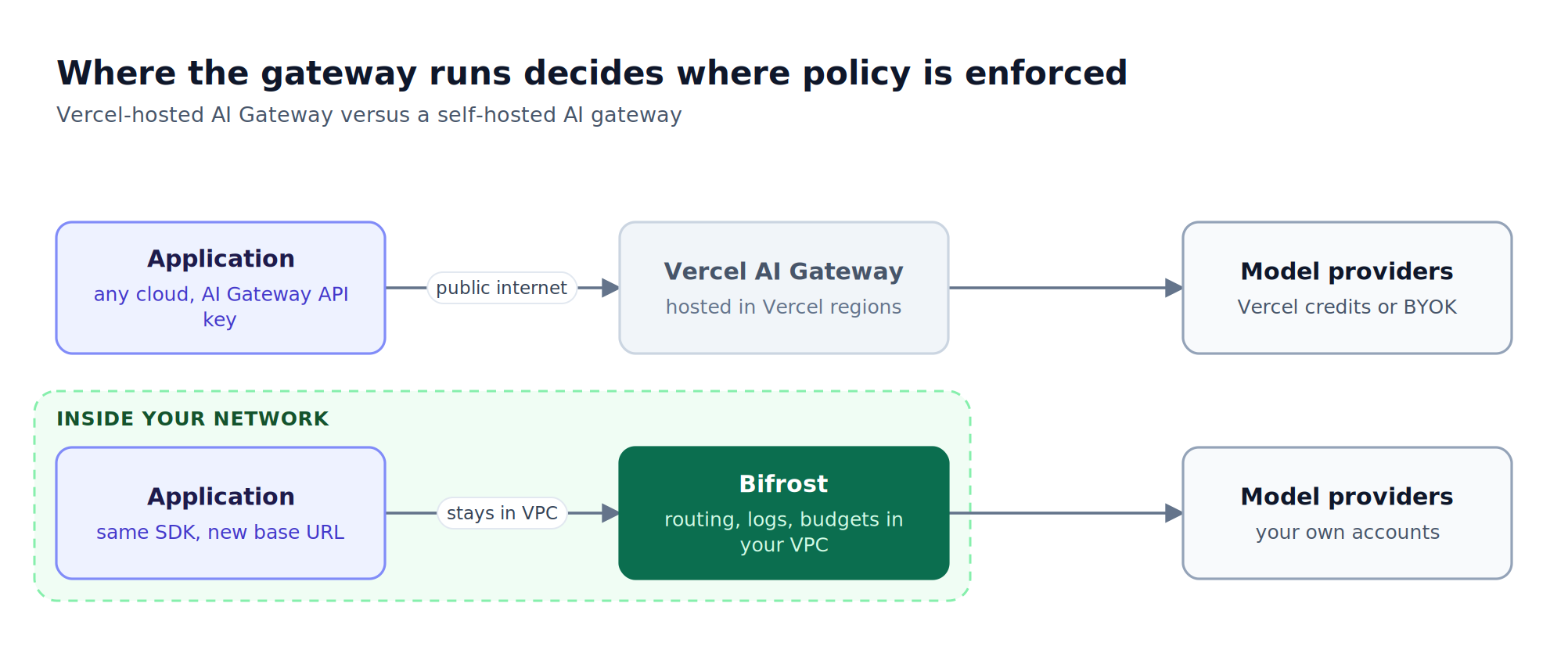
Figure 1: Both lanes give an application one API, but only the self-hosted lane keeps routing, logs, and keys inside your own network.
A strong alternative should offer the same single-API convenience while remaining portable across any environment. Bifrost provides a single OpenAI-compatible API in front of 25+ providers and 10,000+ models and runs anywhere you can run a container. Teams whose main requirement is running the gateway on their own hardware can compare deployment models in the self-hosted AI gateway guide.
Vercel AI Gateway pricing, BYOK, and limits in 2026
Vercel AI Gateway pricing is pass-through: Vercel charges the provider's list price per token with no markup and no platform fee, including on BYOK requests, and deducts usage from prepaid AI Gateway Credits. Costs appear elsewhere, in payment processing fees, paid add-ons, and the requirement to buy credits before using your own provider keys.
The table summarizes Vercel AI Gateway as documented on vercel.com in September 2026:
| Area | What Vercel AI Gateway provides |
|---|---|
| Hosting | Managed by Vercel only; callable from any server, cloud, or local environment with an API key, or OIDC on Vercel deployments |
| Token pricing | Provider list price, no markup, no platform fee; payment processing fees apply unless an Enterprise team pays by invoice |
| Free tier | Monthly free credit on a subset of models, with lower per-model rate limits |
| BYOK | Paid tier only, no fee; a failed BYOK request retries on Vercel system credentials and is charged to credits |
| Budgets | Per team, project, API key, or member; daily, weekly, monthly, or no refresh; soft cap that excludes BYOK spend |
| Rate limits | None from the gateway on the paid tier; upstream provider limits still apply |
| Observability | Request metadata logs (no prompt or response content), custom reporting, OpenTelemetry trace drains |
| Paid add-ons | Custom Reporting, team-wide provider allowlist and ZDR ($0.10 per 1,000 requests each), trace drains ($0.05 per 1,000 traces plus $0.50 per GB) |
| Model catalog | 390 models in its public models endpoint in September 2026, across text, image, video, speech, and embeddings |
Regional inference pins where the provider runs a request, but Vercel states that the request itself can be processed in any Vercel region before it is forwarded, and a soft-cap budget lets the request that crosses the limit complete. Teams weighing Vercel against a hosted aggregator can read the fee-by-fee OpenRouter vs Vercel AI Gateway comparison.
Key criteria for evaluating an AI gateway
The right Vercel AI Gateway alternative depends on six criteria: where the gateway can run, how many providers it reaches, how it fails over, how much latency it adds, how it enforces budgets and access, and which observability stacks it feeds. Deployment model usually decides the shortlist, and governance depth decides the winner.
- Portability: Does it run self-hosted on any cloud or on-prem, independent of a hosting platform?
- Provider coverage: How many providers and models are reachable through one API?
- Reliability: Are automatic failover and load balancing built in?
- Performance: What overhead does the gateway add under sustained load?
- Governance: Can budgets, rate limits, and access control be enforced per team and project?
- Observability: Does it integrate with standard metrics and tracing stacks?
Reliability deserves the closest test, because a hosted gateway and a self-hosted one fail differently. The guide to automatic fallback routing in an enterprise AI gateway shows how fallback chains are evaluated when a provider returns errors.
Vercel AI Gateway alternatives at a glance
The five Vercel AI Gateway alternatives split into two groups: Bifrost, LiteLLM, and Kong AI Gateway run their data plane inside your own infrastructure, while Cloudflare AI Gateway and OpenRouter are hosted services like Vercel's. The matrix compares all six on the criteria above; "Not published" means the vendor's public docs did not state it when this comparison was checked in September 2026.
| Gateway | Where it runs | Provider billing | Spend controls | MCP gateway | Published overhead |
|---|---|---|---|---|---|
| Bifrost | Self-hosted: any cloud, in-VPC, on-prem, air-gapped | Your own provider keys | Budgets and rate limits per virtual key, team, and customer | Yes | 11 µs per request at 5,000 RPS |
| Vercel AI Gateway | Hosted by Vercel only | Vercel credits at list price, or BYOK | Soft-cap budgets on system-credential spend | Not published | Not published |
| LiteLLM | Self-hosted proxy | Your own provider keys | Budgets per key, team, and user | Yes | 2 ms median, 8 ms P95 (4 instances, about 1,170 RPS) |
| Kong AI Gateway | Data plane in your infrastructure, Konnect control plane | Your own provider keys | Token budgets per consumer group, AI rate limiting | Yes | Not published |
| Cloudflare AI Gateway | Cloudflare network only | BYOK, or Unified Billing with a 5% fee on credits | Spend limits by model, provider, or metadata; rate limiting | Not published | Not published |
| OpenRouter | Hosted only | Credits with a 5.5% purchase fee; BYOK fee of 5% above $25,000/month | Workspace budgets on the Enterprise plan | Not published | Not published |
Overhead figures come from each vendor's own benchmark with different hardware and load profiles, so they indicate order of magnitude rather than a head-to-head result. For a deeper look at two of the self-hosted options, see the OpenRouter vs LiteLLM vs Bifrost comparison.
The best Vercel AI Gateway alternatives in 2026
The best Vercel AI Gateway alternatives in 2026 are Bifrost for self-hosted production and enterprise governance, LiteLLM for Python-first teams, Kong AI Gateway for existing Kong users, Cloudflare AI Gateway for Cloudflare-native stacks, and OpenRouter for quick hosted access to many models. Bifrost ranks first because it combines in-VPC deployment, microsecond-level overhead, and an MCP gateway in one open-source gateway.
1. Bifrost
Bifrost is an open-source, high-performance AI gateway that unifies access to 25+ providers and 10,000+ models behind a single OpenAI-compatible API and runs on infrastructure you control. Unlike a platform-coupled gateway, Bifrost deploys on any cloud or on-prem environment, which removes the dependency on a single hosting vendor. Adoption is a drop-in replacement: change only the base URL in your existing OpenAI, Anthropic, or Google GenAI client.
For reliability, Bifrost provides automatic failover across providers and models and weighted load balancing across API keys.
On performance, benchmarks show about 11 microseconds of overhead per request at 5,000 requests per second on a t3.xlarge instance with a 100% success rate. Semantic caching lowers cost and latency for repeated queries.
Governance is native: virtual keys carry per-consumer budgets, rate limits, and permissions, and the broader governance layer scales across teams and customers.
Bifrost also includes an MCP gateway for agentic workflows, letting models discover and execute external tools with per-key tool filtering, a capability Vercel AI Gateway does not document. For deployment, Bifrost supports in-VPC installation across AWS, GCP, Azure, Cloudflare, and Vercel, plus on-prem Kubernetes and Docker.
Bifrost is licensed under Apache 2.0; the open-source AI gateway comparison shows how it measures against other open-source projects.
Best for: Bifrost is built for enterprises running mission-critical AI workloads that require best-in-class performance, scalability, and reliability. It serves as a centralized AI gateway to route, govern, and secure all AI traffic across models and environments with ultra low latency. Bifrost unifies LLM gateway, MCP gateway, and Agents gateway capabilities into a single platform. Designed for regulated industries and strict enterprise requirements, it supports air-gapped deployments, VPC isolation, and on-prem infrastructure. It provides full control over data, access, and execution, along with robust security, policy enforcement, and governance capabilities.
2. LiteLLM
LiteLLM is an open-source unified interface and self-hostable proxy for 100+ LLMs. LiteLLM is a common choice for teams that want a portable, code-first alternative to a managed gateway. The open-source proxy covers virtual keys, spend tracking, budgets, fallbacks, and an MCP gateway, while SSO beyond five users, audit logs, and fine-grained role-based access control sit in LiteLLM Enterprise. LiteLLM publishes its proxy overhead in milliseconds (a 2 ms median across four instances at about 1,170 RPS), which adds up in agent loops that make many sequential calls.
The Bifrost LiteLLM alternatives page provides a side-by-side comparison.
Best for: Developer-led teams that want a lightweight, portable proxy and can accept millisecond-level overhead and an Enterprise license for SSO and audit logs.
3. Kong AI Gateway
Kong AI Gateway adds LLM routing plugins to the Kong API gateway. For organizations already running Kong, Kong AI Gateway extends existing API management to AI traffic, with a data plane that runs in your own infrastructure and a control plane in Kong Konnect. Its AI capabilities (semantic caching, prompt guards, token-based rate limiting, and governance for MCP and agent-to-agent traffic) are configured as policies and entities on a general-purpose API gateway, so teams adopt the Kong operating model along with them. The Kong AI Gateway alternatives roundup compares the options for teams moving off Kong.
Best for: Teams already standardized on Kong that want AI routing inside their existing API platform.
4. Cloudflare AI Gateway
Cloudflare AI Gateway is a managed gateway that adds caching, rate limiting, and analytics to model requests routed through Cloudflare's edge network. The gateway appeals to teams already on Cloudflare and benefits from global edge presence. Cloudflare AI Gateway also offers spend limits, request retry and model fallback, guardrails, and data loss prevention scanning, and its core features are free on all plans; its cache serves identical requests rather than semantically similar ones. Like Vercel's offering, Cloudflare AI Gateway is a managed service tied to a platform, and its docs describe no deployment inside a private VPC or an air-gapped network. The Cloudflare AI Gateway alternatives and competitors guide covers that trade-off.
Best for: Teams already on Cloudflare that want edge caching and spend controls without self-hosting.
5. OpenRouter
OpenRouter is a hosted multi-provider routing service that exposes hundreds of models through one API. OpenRouter is a fast way to reach many models without managing provider keys, and is platform-independent on the client side. Because it is a hosted aggregator, requests transit OpenRouter's infrastructure, which makes it a poor fit for teams that need traffic to stay inside their own network.
OpenRouter passes through provider token prices but charges a 5.5% fee on card credit purchases, and BYOK usage above $25,000 of monthly list-price inference carries a 5% fee, whereas Vercel AI Gateway charges no platform fee on either, apart from payment processing fees. The Vercel AI Gateway vs OpenRouter fee comparison details both.
Best for: Teams that want quick hosted access to many models and do not require self-hosting or data residency.
How Bifrost compares on portability and control
Bifrost compares to Vercel AI Gateway as a self-hosted counterpart: the same single OpenAI-compatible API and provider failover, but running inside your own network with budgets and rate limits on every virtual key, an MCP gateway, and 11 microseconds of overhead per request at 5,000 RPS. Every control in the request path runs where you deploy it.
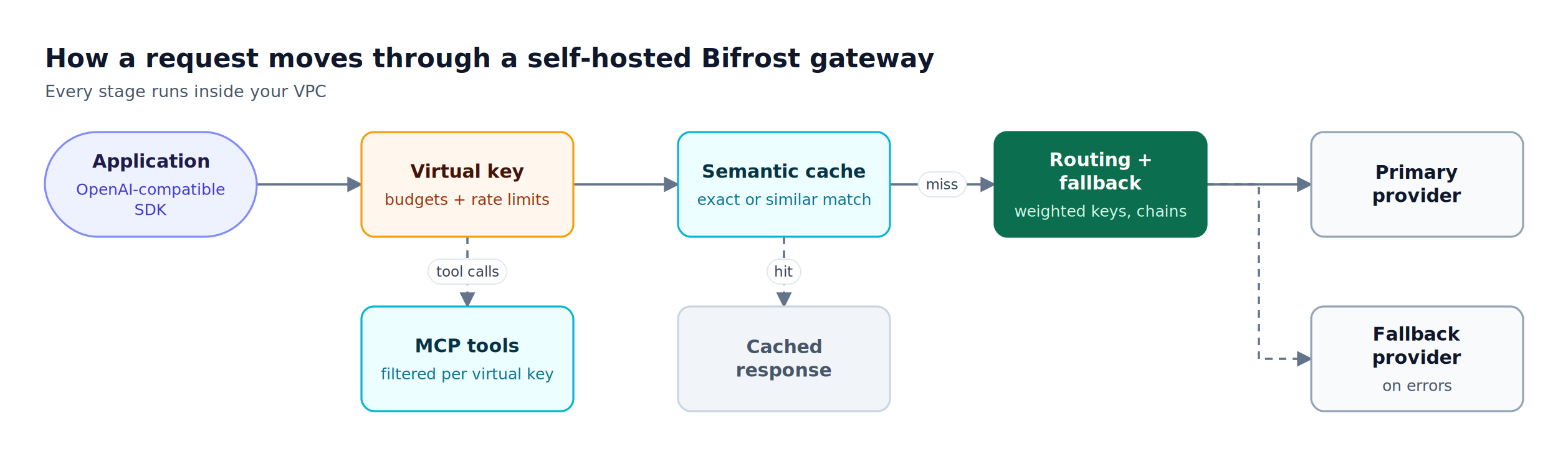
Figure 2: In a self-hosted Bifrost deployment, governance, caching, and failover all run before a request leaves your network.
The decision to leave a platform-coupled gateway usually comes down to portability and data control, and that is where Bifrost is strongest:
- Runs anywhere: Self-hosted on any cloud or on-prem, with in-VPC deployments and air-gapped options, independent of any single hosting platform.
- Broad coverage: 10,000+ models across 25+ supported providers through one API.
- Production reliability: Native failover and load balancing, with 11 µs of overhead per request at 5,000 RPS.
- Centralized governance: Virtual key governance, with budgets and rate limits enforced across virtual keys, teams, and customers.
- Standard observability: Native Prometheus and OpenTelemetry integration, so request traces flow into the same OpenTelemetry-compatible backends as the rest of your services.
Teams formalizing the evaluation can use the LLM Gateway Buyer's Guide, and teams with compliance requirements can review the Bifrost Enterprise deployment options. For the capabilities any gateway in this list should cover, see the breakdown of AI gateway architecture and core features.
Which Vercel AI Gateway alternative fits your team
The right Vercel AI Gateway alternative follows from one question: must the gateway run inside your own network? If yes, the choice is between Bifrost, LiteLLM, and Kong AI Gateway, decided by overhead, governance depth, and existing platform. If no, staying on Vercel or moving to another hosted gateway is usually simpler.
| If your team... | Best fit | Deciding factor |
|---|---|---|
| Must keep prompts, provider keys, and logs inside its own network | Bifrost | In-VPC, on-prem, and air-gapped deployment |
| Runs agents that call external tools | Bifrost | MCP gateway with tool filtering per virtual key |
| Needs budgets and rate limits per team and customer on every provider key | Bifrost | Hierarchical virtual key governance |
| Builds in Python and wants a self-hosted proxy quickly | LiteLLM | Python SDK plus proxy, Enterprise tier for SSO |
| Already standardized on Kong for API management | Kong AI Gateway | AI policies inside the existing Kong platform |
| Already runs on Cloudflare's network | Cloudflare AI Gateway | Edge caching and spend limits, no infrastructure to run |
| Wants hosted access to many models with minimal setup | OpenRouter | Large hosted catalog, credit-based billing |
| Deploys on Vercel with no residency or self-hosting requirement | Stay on Vercel AI Gateway | No token markup and OIDC on Vercel deployments |
Two narrower guides in this cluster go deeper on the first rows: the Vercel AI Gateway alternatives for self-hosting roundup focuses on deployment, and the list of Vercel AI Gateway alternatives to govern AI traffic focuses on budgets and access control.
Migrating without rewriting your application
Migrating from Vercel AI Gateway to Bifrost is a configuration change rather than a code rewrite, because both expose an OpenAI-compatible endpoint. The application swaps one base URL and one key, provider keys move into Bifrost, and routing, fallbacks, and budgets are rebuilt as gateway configuration before traffic is cut over.
Because Bifrost is a drop-in replacement, migration starts with a base-URL change and adding your own provider keys:
# Before: OpenAI SDK pointed at Vercel AI Gateway
client = openai.OpenAI(
    base_url="https://ai-gateway.vercel.sh/v1",
    api_key="<AI_GATEWAY_API_KEY>",
)

# After: the same client pointed at a self-hosted Bifrost
client = openai.OpenAI(
    base_url="http://localhost:8080/openai",
    api_key="<YOUR-BIFROST-VIRTUAL-KEY>",
)
Both gateways address models with a provider prefix such as openai/, so model strings for first-party providers usually carry over unchanged; check any model that Vercel served through a third-party host. Teams that billed through Vercel system credentials rather than BYOK need their own provider accounts before cutover. Bifrost itself starts with npx -y @maximhq/bifrost or the maximhq/bifrost Docker image.

Figure 3: Governance is rebuilt in Bifrost before the base URL changes, so traffic is controlled from the first request.
Configure provider routing and fallback chains to match your current model coverage, then layer governance on top with virtual keys and budgets. The same application code runs against the new gateway, now hosted in your own environment rather than tied to a deployment platform.
Frequently asked questions about Vercel AI Gateway alternatives
What is Vercel AI Gateway?
Vercel AI Gateway is a managed AI gateway, hosted by Vercel, that gives applications one API for models from many providers. Vercel AI Gateway centralizes credentials, logs request metadata, enforces budgets per team, project, API key, or member, and fails over across providers and fallback models. Applications call it with an API key from any environment, or with OIDC tokens when deployed on Vercel.
Does Vercel AI Gateway mark up token prices?
No. Vercel AI Gateway charges the provider's list price with no markup and no platform fee, on both the free and paid tiers and on BYOK requests. Costs come instead from payment processing fees on credit purchases, paid add-ons such as team-wide ZDR and trace drains, and the requirement to buy AI Gateway Credits before using your own provider keys.
Can you self-host Vercel AI Gateway?
No. Vercel documents AI Gateway only as a managed service, with no self-hosted, in-VPC, or on-prem option. Regional inference controls where the provider runs a request, but the request can be processed in any Vercel region first. Teams that need the gateway inside their own network use a self-hosted alternative such as Bifrost, which supports in-VPC and air-gapped deployment.
Does Vercel AI Gateway only work on Vercel?
No. Vercel AI Gateway accepts requests from any server, cloud, CI system, or local environment through an API key, and applications on Vercel can authenticate with OIDC instead. What stays on Vercel is the gateway itself: routing, logging, and budget enforcement all run on Vercel's managed infrastructure rather than in your environment.
What is the best open-source alternative to Vercel AI Gateway?
Bifrost is the best open-source alternative to Vercel AI Gateway for production workloads. Bifrost is licensed under Apache 2.0, reaches 25+ providers and 10,000+ models through one OpenAI-compatible API, adds 11 microseconds of overhead per request at 5,000 RPS, and includes virtual key budgets and an MCP gateway. LiteLLM is the main Python-based option, and the comparison of open-source LLM gateways covers the rest of the field.
How is Vercel AI Gateway different from OpenRouter?
Vercel AI Gateway and OpenRouter are both hosted gateways with one API across many models; the main difference is fees. Vercel charges no markup or platform fee, including on BYOK. OpenRouter charges a 5.5% fee on card credit purchases and a 5% BYOK fee above $25,000 of monthly usage. Neither can be self-hosted inside your own network.
Getting started with Bifrost
Choosing a Vercel AI Gateway alternative is mostly about decoupling AI infrastructure from a single hosting platform while keeping unified multi-provider access. Bifrost delivers that with low overhead, native failover, an MCP gateway, built-in governance, and self-hosted and air-gapped deployment. To see how it fits your stack, book a demo with the Bifrost team, or explore the Bifrost resources hub.