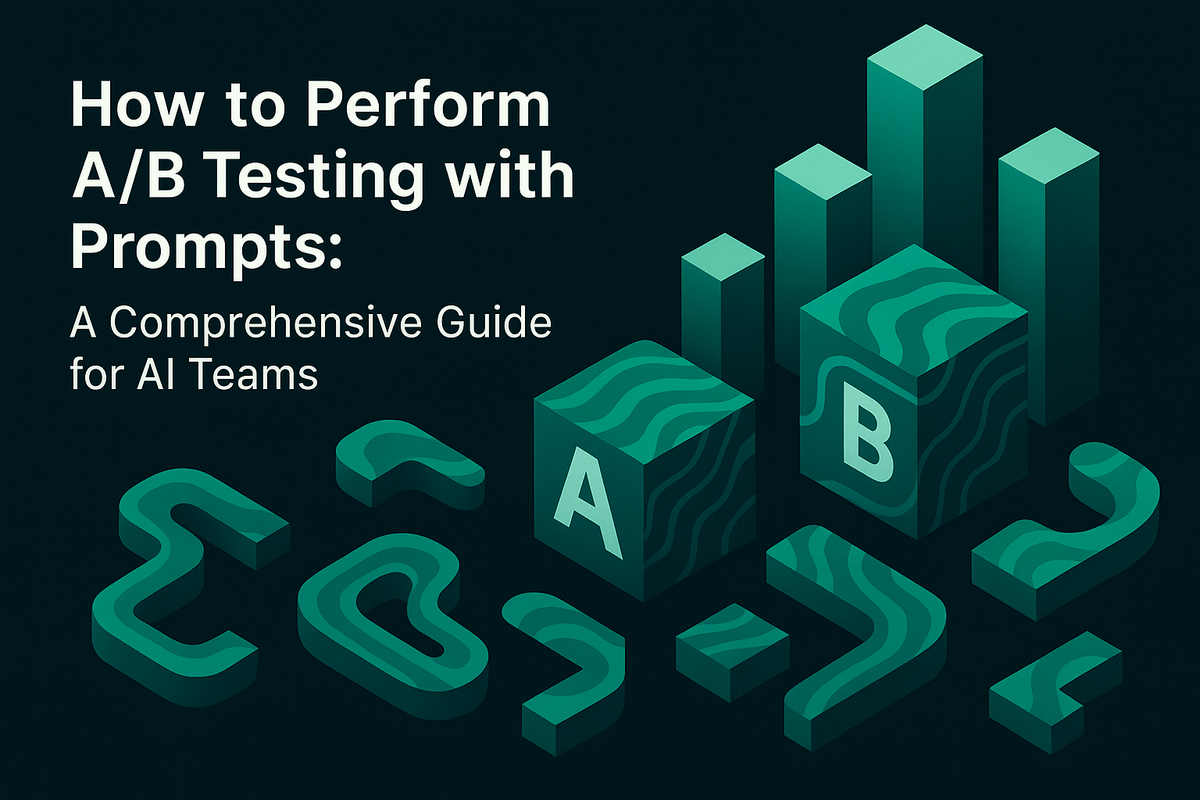
How to Perform A/B Testing with Prompts: A Comprehensive Guide for AI Teams
TL;DR: A/B testing with prompts is a foundational strategy for optimizing AI agent performance, reliability, and user experience. By systematically comparing different prompt versions, teams can identify the most effective configurations for their LLMs and agents in real-world scenarios. This guide explores the principles, best practices, and tooling—highlighting how platforms like Maxim AI streamline A/B testing, facilitate prompt management, and deliver actionable insights for continuous improvement.
Introduction
Prompt engineering has become a critical discipline for driving quality and reliability in agentic workflows. A/B testing plays a central role in evaluating and refining prompts for AI agents, chatbots, copilots, and voice assistants. By comparing multiple prompt variants under controlled conditions, teams can empirically determine which configurations yield better outcomes, reduce hallucinations, and improve user satisfaction
This blog provides a step-by-step approach to A/B testing with prompts, discusses the technical and operational challenges, and demonstrates how Maxim AI’s prompt management and evaluation workflows empower teams to scale experimentation, drive reliability, and accelerate deployment.
What is A/B Testing in Prompt Engineering?
A/B testing, or split testing, is the process of presenting two or more prompt variants (A and B) to different user personas or scenarios and measuring their performance across predefined metrics. In the context of prompt engineering, A/B testing enables teams to:
- Evaluate which prompt formulation leads to more accurate, helpful, or engaging responses.
- Identify and mitigate issues such as hallucination detection, bias, or latency.
- Optimize prompts for specific user personas, tasks, or domains.
- Quantify improvements and regressions before rolling out changes to production.
A/B testing is especially valuable for chatbot evals, copilot evals, and voice agents, where prompt variations can have a significant impact on user experience and downstream business outcomes.
Why is A/B Testing Essential for AI Quality?
AI agents are inherently non-deterministic, meaning their outputs can vary even with identical inputs. This variability makes it challenging to predict and guarantee agent behavior. A/B testing addresses these challenges by:
- Providing empirical evidence for prompt changes.
- Enabling model evaluation and continuous ai evaluation in production.
- Supporting ai reliability and trustworthy ai.
- Reducing risk by catching regressions, hallucinations, or performance drops before they impact users.
By integrating A/B testing into the agent observability and model monitoring pipeline, teams can foster a culture of data-driven improvement and accountability.
The Core Steps of A/B Testing with Prompts
1. Define Clear Objectives and Metrics
Start by establishing what you want to achieve with your prompt experiment. Common objectives include improving response accuracy, reducing latency, enhancing engagement, or minimizing hallucinations. Select quantitative and qualitative metrics such as:
- Faithfulness and correctness
- Helpfulness and relevance
- Latency and cost
- User satisfaction scores
- Human-in-the-loop evaluations
2. Design Prompt Variants
Create multiple versions of your prompts, each reflecting a different hypothesis or design choice. For example, one prompt may use explicit instructions, while another relies on implicit context or tool calls. Use Maxim’s prompt versioning to organize, compare, and perform document changes across variants.
3. Randomize Assignment and Sampling
Assign prompts to users, sessions, or scenarios using randomized or stratified sampling to avoid bias. Platforms like Maxim AI enable flexible sampling strategies, supporting custom filters, metadata, and dynamic assignment.
4. Deploy and Monitor in Production
Deploy prompt variants via Maxim’s SDKs, which allow you to decouple prompt logic from application code and enable rapid iteration. Use agent tracing and model tracing to monitor interactions, debug issues, and ensure traceability.
5. Collect and Analyze Results
Aggregate results from automated evaluators, human raters, and user feedback. Visualize performance across variants using Maxim’s dashboards, which support deep dives into session-level and span-level data. Look for statistically significant differences and actionable insights.
6. Iterate and Roll Out Improvements
Based on the findings, select the best-performing prompt variant and roll it out to production. Document learnings, update prompt libraries, and repeat the process for continuous optimization.
Maxim AI: Purpose-Built for A/B Testing and Prompt Management
Maxim AI offers a full suite of tools for A/B testing, prompt management, and agent evaluation, built to support cross-functional teams in shipping reliable, high-quality AI agents
Key Features for A/B Testing
- Prompt IDE and Versioning: Organize, compare, and iterate on prompts with full version control and collaboration features. Learn more
- Experimentation Playground: Test prompt variants across models, tools, and context sources without code changes. Explore experimentation
- Automated and Human Evaluations: Leverage built-in and custom evaluators, alongside scalable human review pipelines. See evaluation workflows
- Observability and Tracing: Monitor agent interactions in real time, debug issues, and ensure quality with granular tracing. Agent observability
- Integration and Deployment: Use Maxim SDKs to integrate with leading frameworks like LangChain, LangGraph, CrewAI, and OpenAI Agents SDK.
Technical Implementation: A/B Testing with Maxim AI
Prompt Versioning and Assignment
Maxim’s prompt management system allows you to version prompts, assign deployment variables, and tag experiments for easy tracking. You can run A/B tests on different prompt chains, document modification history, and recover previous versions for rollback.
Automated Experimentation and Evaluation
Using Maxim’s SDK, teams can automate the deployment of prompt variants and trigger test runs on large datasets. Evaluators can be configured to score outputs for faithfulness, helpfulness, toxicity, and other criteria. Human-in-the-loop workflows enable nuanced assessment for criteria not easily captured by automated metrics.
Data Collection and Analytics
Maxim provides seamless data export via CSV and APIs, enabling offline analysis and custom dashboard creation. Aggregated results can be visualized to compare prompt performance across different user personas, scenarios, and model configurations.
Continuous Monitoring and Alerts
Real-time agent observability ensures that you catch regressions and performance drops as soon as they occur. Customizable alerts can be routed to Slack, PagerDuty, or other notification systems for rapid response.
Best Practices and Common Pitfalls
Best Practices
- Define success metrics up front and align them with business goals.
- Use randomized assignment to avoid selection bias.
- Monitor for statistical significance before making decisions.
- Document changes and learnings for future reference.
- Leverage both automated and human evaluations for comprehensive assessment.
Common Pitfalls
- Insufficient sample size: Leads to inconclusive results.
- Ignoring context: Prompt performance may vary across user personas and scenarios.
- Overfitting to test cases: Optimizing for evaluation metrics at the expense of real-world generalization.
- Neglecting traceability: Lack of detailed logs and traces can hinder debugging and root cause analysis.
For more on avoiding these pitfalls, see AI Reliability: How to Build Trustworthy AI Systems and Evaluation Workflows for AI Agents.
Case Study: A/B Testing in Practice
Organizations like Clinc and Mindtickle have leveraged Maxim’s A/B testing and evaluation capabilities to optimize conversational AI agents for banking and enterprise support. By running systematic experiments, they identified prompt variants that improved response accuracy, reduced hallucinations, and enhanced customer satisfaction.
Linking A/B Testing to Other Key Practices
A/B testing is not a standalone activity—it should be integrated with broader practices such as agent simulation, model monitoring, and ai tracing. Combining these approaches enables robust ai quality, comprehensive llm monitoring, and continuous improvement.
FAQ
What's the difference between A/B testing prompts and evaluating prompts?
Prompt evaluation measures a single prompt against a rubric or dataset. A/B testing compares two or more prompt variants against each other under controlled conditions to determine which performs better on the same task. Evaluation tells you if a prompt is good enough; A/B testing tells you which of two prompts is better.
How large does the test dataset need to be for A/B testing prompts?
Smaller than most teams expect, but larger than the 10 to 20 examples most teams start with. For rubric-scored evaluations where you care about aggregate movement, 100 to 200 examples per variant is enough to detect meaningful differences. For finer-grained comparisons (5 percent score deltas), 500+ examples are needed. The signal-to-noise ratio is set by judge variance, not by dataset size beyond that point.
How do you control for judge LLM variance in A/B tests?
Two patterns matter. First, score each variant with the same judge on the same examples in the same run, so judge variance affects both equally. Second, use cross-model judging when the production model and judge come from the same family (a Claude-judged Claude-vs-Claude test inherits correlated bias). Aggregate over enough examples that single-call variance averages out, then look at the aggregate movement, not per-row deltas.
Can I A/B test prompts across different LLM providers?
Yes, but the comparison gets harder to interpret. Provider-to-provider differences in tokenization, sampling, and response style add variance that prompt differences alone don't explain. The cleanest A/B test is same-provider, same-model, same-temperature, only the prompt changes. Cross-provider testing is a different question (model selection, not prompt selection).
How long should I run an A/B test before deciding?
In CI-style testing against a static dataset, results stabilize within a single run; you don't need to wait. In production-traffic testing against live users, the answer depends on traffic volume and the size of the effect you're trying to detect. A 5-percent improvement in a low-traffic agent might take two to four weeks to confirm; a 20-percent improvement in a high-traffic agent confirms in a day.
What metrics matter most for prompt A/B tests?
Task success rate, output format compliance, latency, and cost per call cover most use cases. For subjective quality (tone, helpfulness, conciseness), use rubric-scored judge evaluation rather than direct metrics. Don't optimize on a single metric; a prompt that improves task success while doubling latency or cost is usually not the right choice.
Further Reading and Resources
- Prompt Management in 2025: How to Organize, Test, and Optimize Your AI Prompts
- Agent Evaluation vs Model Evaluation: What’s the Difference and Why It Matters
- AI Reliability: How to Build Trustworthy AI Systems
- Evaluation Workflows for AI Agents
- Maxim Demo
- Maxim Documentation
- What Are AI Evals?
- AI Agent Evaluation Metrics
Conclusion
A/B testing with prompts is an indispensable technique for modern AI teams seeking to optimize agent performance, reliability, and user experience. By leveraging platforms like Maxim AI, teams can systematically experiment, evaluate, and iterate—ensuring their AI agents are robust, trustworthy, and aligned with business objectives. Integrating A/B testing with comprehensive observability, evaluation, and simulation workflows empowers organizations to deliver high-quality AI solutions at scale.