LLM Gateways 101: Architecture, Components, and How They Work
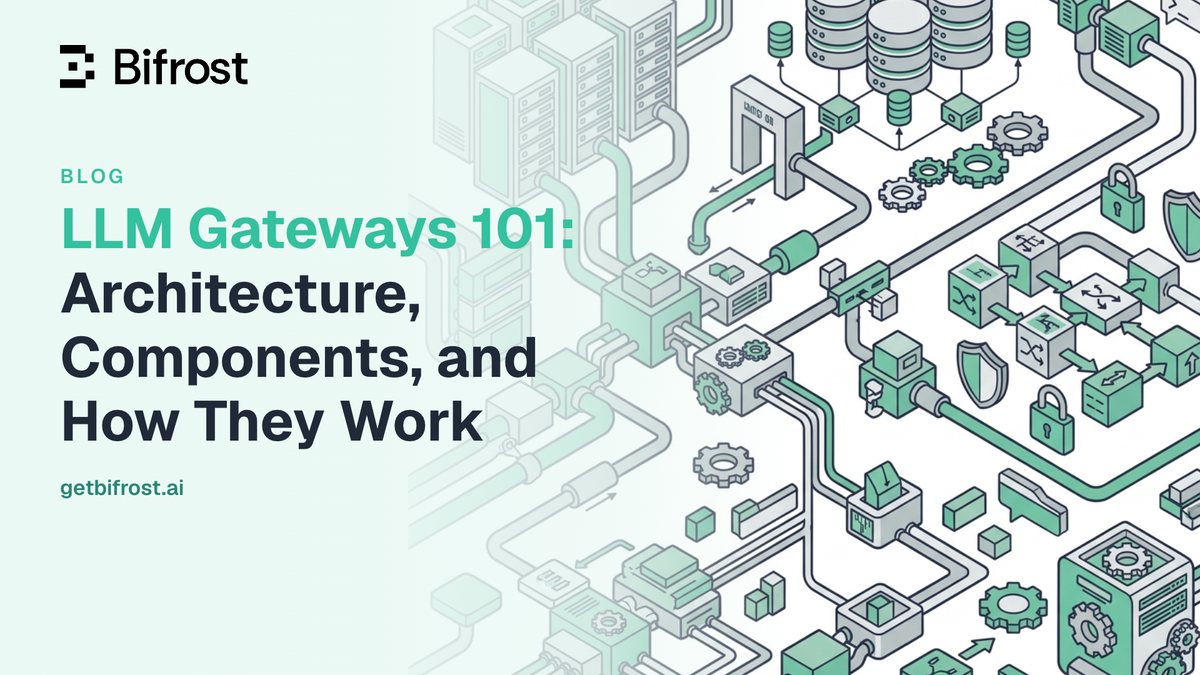
Most engineering teams start by calling LLM provider APIs directly. This works at small scale, but as the number of providers, teams, and use cases grows, direct integration creates a fragmented mess: API keys scattered across services, no central cost visibility, no failover, and no governance over which teams can call which models. Bifrost, the open-source AI gateway built in Go by Maxim AI, centralizes all of this into a single proxy layer that sits in front of your providers and gives every team a unified interface to over 1,000 models across 20+ providers.
What Is an LLM Gateway?
An LLM gateway is a reverse proxy that sits between applications and LLM provider APIs. It exposes a unified API endpoint, handles provider authentication and key rotation, applies routing logic and fallback chains, caches semantically similar responses, enforces per-consumer rate limits and budgets, and emits structured logs and metrics across all provider traffic, so teams can operate multiple models and providers through a single, governed interface.
This is distinct from an SDK wrapper or a client-side library. An LLM gateway is a network-level service: requests flow through it, and it applies its logic before forwarding traffic to the provider.
Core Components of an LLM Gateway
Unified API Layer
The unified API layer is the single endpoint that all applications talk to, regardless of which underlying provider or model they're targeting. Instead of maintaining separate integration code for OpenAI, Anthropic, AWS Bedrock, and Google Vertex, every application sends requests in a consistent format to the gateway.
Bifrost implements this as a drop-in replacement for the OpenAI and Anthropic client SDKs. Changing the base URL in an existing SDK is all that's required to route traffic through Bifrost. The gateway translates the incoming request to each provider's native format transparently.
This matters most when teams want to switch between providers or add a new one. Because the application doesn't know which provider is being used, switching is a gateway configuration change rather than an application code change.
Request Router
The request router decides where to send each request: which provider, which model, which API key. Routing decisions can be static (always use this provider for this model) or dynamic (select based on provider health, latency, cost, or current load).
Bifrost's provider routing system supports both. Routing rules let teams define conditions that control how the gateway selects providers at runtime. When a provider is degraded, the router automatically shifts traffic to the configured fallback.
Automatic fallback chains are a key part of the routing layer: configure a primary provider and one or more fallbacks, and Bifrost will retry with the next provider in the chain on 429 or 5xx responses without any retry logic in the application.
Key and Authentication Management
A gateway centralizes all provider API keys in one place, removing the need to distribute keys to individual services. Applications authenticate to the gateway itself, and the gateway handles provider authentication on their behalf.
Key management in Bifrost supports multiple API keys per provider, with weighted distribution across keys to multiply available throughput. This is the mechanism that enables load balancing at the key level: rather than one key serving all traffic, Bifrost distributes across a pool and routes around keys that hit their limits.
Virtual keys add a consumer-facing authentication layer on top of provider keys. Each team or application gets its own virtual key with its own budget, rate limits, and model access controls. The underlying provider keys remain centralized and opaque to consumers.
Response Cache
LLM inference is expensive. For applications where the same or similar questions appear repeatedly (documentation tools, support agents, FAQ systems), serving a cached response is orders of magnitude cheaper than a round-trip to the provider.
Semantic caching in Bifrost uses embedding-based similarity to match incoming requests against cached responses. Unlike exact-match caching, semantic caching catches rephrased versions of the same question. A cached response for "How do I reset my password?" will also serve "What's the process for changing my login credentials?"
The cache layer runs inline in the request path: if a cache hit occurs, the gateway returns the cached response immediately without forwarding to the provider.
Observability Layer
Without a gateway, observability requires each application team to instrument their own LLM calls: log request and response payloads, track token counts, measure latency, monitor error rates. This is duplicated work, and the resulting data is siloed across services.
An LLM gateway captures this data once, centrally, for all traffic. Bifrost's observability layer records per-request metadata including provider, model, latency, status code, token counts, and routing decisions. This data is exportable in Prometheus and OpenTelemetry formats for integration with Grafana, Datadog, or any compatible monitoring system.
Centralized observability also enables cost attribution: because every request passes through the gateway with a virtual key identifying the consumer, cost and usage data are automatically broken down by team or application.
Governance Engine
The governance engine enforces policy on who can call what, at what rate, and at what cost. In a direct-integration model, there is no governance layer: any service with a provider key can make unlimited calls to any model.
Bifrost's rate limits and virtual keys together form the governance engine. Per-consumer limits prevent any single team or pipeline from exhausting shared provider capacity. Budget caps prevent runaway costs. Model access controls prevent consumers from calling models they shouldn't have access to.
For enterprise environments, the guardrails layer adds content-level policy enforcement, and audit logs provide a tamper-evident record of every request for compliance and forensics. RBAC controls which users can configure the gateway itself. The governance resource page covers how these controls compose in regulated environments.
How an LLM Gateway Processes a Request
Understanding the step-by-step request flow through a gateway makes it easier to reason about latency, failure modes, and where configuration changes take effect.
1. Receive. The application sends an HTTP request to the gateway's unified endpoint. The request includes the virtual key in the authorization header and a model name in the body.
2. Authenticate. The gateway validates the virtual key and resolves it to the underlying provider key and consumer policy.
3. Apply governance. The governance engine checks the request against the consumer's rate limit, budget, and model access policy. If any check fails, the gateway returns an error immediately without forwarding.
4. Cache check. The request payload is compared against the semantic cache. On a hit, the cached response is returned and the request is logged without forwarding to the provider.
5. Route. The request router selects a provider and key based on routing rules and current provider health. The request is translated to the provider's native API format.
6. Forward. The gateway sends the request to the selected provider. If the provider returns a 429 or 5xx, the fallback chain activates and the request is forwarded to the next provider.
7. Log. The response is received, logged with full metadata (latency, token counts, provider, model, status), and optionally stored in the cache.
8. Return. The response is translated back to the unified format and returned to the calling application.
This entire flow, including routing, cache lookup, and logging, adds 11 microseconds of overhead per request in Bifrost at 5,000 RPS, a figure that reflects the performance characteristics of Go's concurrency model.
LLM Gateway vs. Direct Provider API
Calling provider APIs directly is the default starting point, but it leaves significant capability gaps:
No failover. Direct integration means a single provider. When that provider has an outage or returns rate limit errors, the application fails. A gateway adds automatic fallback chains that absorb these failures transparently.
No central authentication. Keys are distributed to individual services. Rotating a key requires updating every service that holds it. A gateway centralizes key management: rotate once at the gateway, and all consumers continue working.
No cost visibility. Without a central logging layer, cost attribution requires aggregating billing data from each provider separately, with no breakdown by team or application. A gateway with virtual keys provides this breakdown automatically.
No caching. Each provider call is a separate inference request. Semantic caching at the gateway layer can reduce provider costs significantly for workloads with repeated or similar queries.
No governance. Any service with a key can call any model at any rate. A gateway adds the policy layer that makes it safe to give many teams access to shared AI infrastructure.
The LLM Gateway Buyer's Guide covers these trade-offs in more depth for teams evaluating whether to build or buy this layer.
How Bifrost Implements the LLM Gateway Architecture
Bifrost's performance characteristics come directly from its implementation in Go. The concurrency architecture uses worker pools to handle high request volumes without thread-per-request overhead. At 5,000 RPS, Bifrost adds 11 microseconds of latency per request, which is low enough to be invisible to end users and applications.
The supported providers include OpenAI, Anthropic, AWS Bedrock, Google Vertex AI, Azure OpenAI, Groq, Mistral, Cohere, and 15+ additional providers, totaling 1,000+ models accessible through a single endpoint. This breadth means teams can add new providers through gateway configuration rather than new integration code.
Beyond the core gateway components, Bifrost extends the architecture with an MCP gateway. This layer connects to external tool servers and exposes tools to downstream AI clients, with features like Code Mode (which reduces token consumption by approximately 50%) and Agent Mode for multi-step tool execution.
For production deployments, enterprise clustering provides horizontal scale-out, and in-VPC deployments keep all traffic within the network perimeter. The enterprise tier adds SSO/OIDC, RBAC, audit logs, secrets detection, and guardrails for regulated environments.
Getting Started with Bifrost as Your LLM Gateway
Bifrost is available as an open-source project and as an enterprise-managed gateway. The open-source version on GitHub covers the full core feature set: unified API, routing, key management, semantic caching, observability, and virtual key governance.
Because Bifrost is a drop-in replacement for OpenAI and Anthropic SDKs, getting started means pointing your existing SDK at the Bifrost endpoint rather than rewriting any integration code.
For teams evaluating Bifrost as enterprise infrastructure, the benchmarks resource page provides performance data at realistic load, and the governance resource page covers the policy controls available for multi-team environments. Book a demo to walk through your architecture and requirements with the team.