n8n AI Workflow: Routing LLM Nodes Through One Gateway
TL;DR
- The Bifrost AI gateway is OpenAI-compatible, so any n8n LLM node that accepts a custom Base URL can route through it in a single credential change.
- A single Bifrost virtual key becomes the per-workflow credential in n8n, carrying budget caps, rate limits, and provider allow-lists without touching workflow logic.
- Routing every OpenAI, Anthropic, Google, and self-hosted call through Bifrost gives an n8n AI workflow unified cost tracking, semantic caching, and automatic failover across 1,000+ models.
- Bifrost adds 11 microseconds of overhead per request at 5,000 requests per second in published benchmarks, so a gateway in front of every LLM node does not add latency users notice.
- The Bifrost MCP gateway aggregates external tool servers behind one endpoint, so n8n agent nodes can call filesystem, search, and database tools through the same governed path.
An n8n AI workflow that calls three or four LLM providers typically ends up with three or four separate credentials, three or four separate cost centers, and no single place to see spend, retries, or model choice. Bifrost, the open-source AI gateway built by Maxim AI, collapses that sprawl into one OpenAI-compatible endpoint that every n8n LLM node can point at. This post covers the architecture, the setup steps, and the concrete benefits, unified cost tracking, per-workflow budgets, provider fallback, semantic caching, and MCP tool governance, that follow from routing an n8n AI workflow through a single gateway rather than talking to each provider directly.
Why n8n AI Workflows Sprawl Across Providers
An n8n AI workflow becomes hard to govern the moment it uses more than one model. A single automation may summarize an email with GPT-4o, classify the intent with Claude, embed the result with a Google model, and fall back to a local Ollama instance when a provider rate-limits. Each of those requires its own credential in n8n, its own key in a provider dashboard, and its own line item on a bill. Nothing in n8n natively unifies them.
The consequences show up in three places. Cost tracking becomes an offline reconciliation exercise, since each provider reports usage under its own tenant, not per workflow or per team. Reliability is per-provider, so if OpenAI rate-limits at noon, the workflow fails even when Anthropic and Google are available and would answer the same prompt. Governance is missing entirely, with no way to enforce a monthly budget on a workflow, block a specific model, or audit which prompts left the company. An AI gateway is the control plane that gives n8n workflows all three: one place to see spend, one place to enforce policy, and one interface for every provider.
What Routing an n8n AI Workflow Through One Gateway Means
Routing an n8n AI workflow through one gateway means every LLM call from every node in n8n reaches its provider through Bifrost instead of hitting the provider directly. Nothing about the n8n workflow definition changes. What changes is the credential each node uses: instead of pointing at https://api.openai.com/v1, it points at the Bifrost gateway endpoint, and instead of an OpenAI key it carries a Bifrost virtual key.
Bifrost accepts requests in the same shape the OpenAI, Anthropic, and Google GenAI SDKs already produce, routes them to the right provider, applies governance and caching along the way, and returns responses in the same shape the caller expects. Because n8n's LLM nodes ultimately speak these SDK protocols under the hood, the gateway is a drop-in replacement, one base URL swap and every downstream feature, failover, budget, cache, MCP tool, applies to the workflow.
The architecture in one line
n8n workflow  ->  n8n LLM node  ->  Bifrost gateway  ->  OpenAI | Anthropic | Google | Ollama | 1000+ models
                                    (virtual keys, budgets, retries, cache, MCP tools, logs)
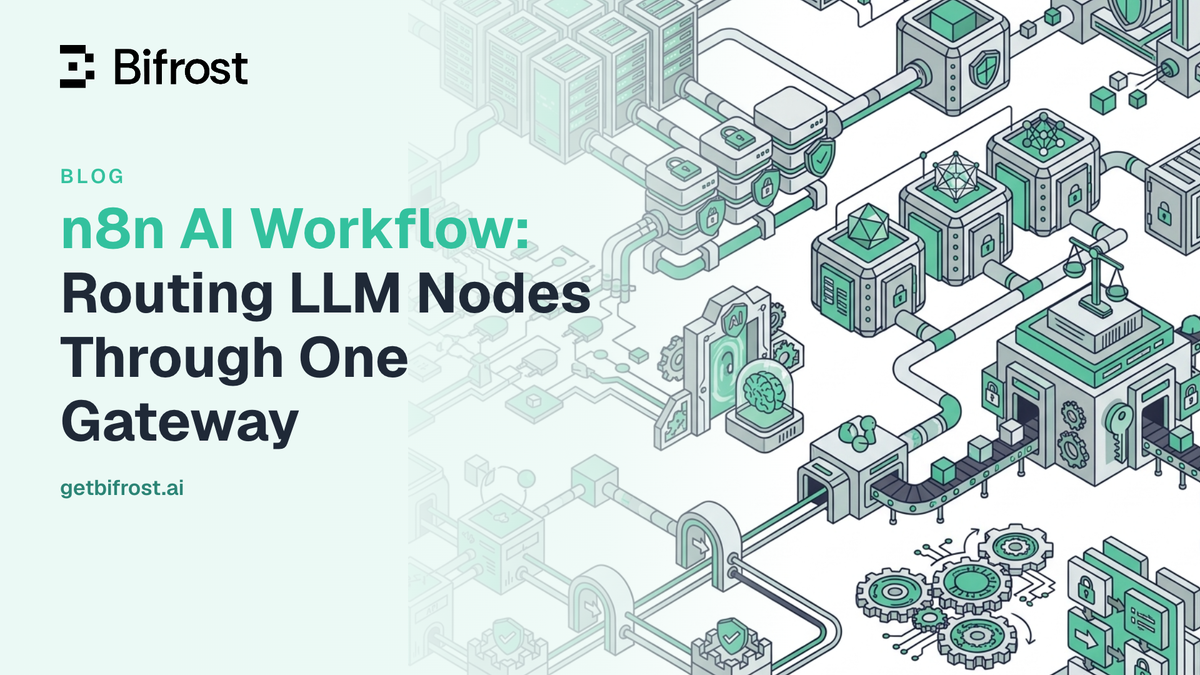
A visual of the same idea: every arrow leaving n8n terminates at Bifrost. Every arrow leaving Bifrost terminates at a provider. There is no direct n8n-to-provider path anywhere in the diagram, which is the point.
n8n AI Workflow Setup: Point Every LLM Node at Bifrost
Setup has three stages, run Bifrost, add providers, and point n8n at the gateway. The whole loop takes roughly 15 minutes on a laptop, and the same steps apply whether n8n is self-hosted or running in n8n Cloud with a self-hosted Bifrost reachable over the network.
1. Run Bifrost locally or in Docker
Bifrost ships as a single binary and as a container. The setting-up docs cover both paths; the short version is one command.
# NPX (fastest for local testing)
npx -y @maximhq/bifrost

# Docker (recommended for anything durable)
docker run -p 8080:8080 -v $(pwd)/data:/app/data maximhq/bifrost
Either command exposes Bifrost's HTTP API on http://localhost:8080. The web UI at the same host lets you configure providers, keys, budgets, and MCP servers without editing config files. For a shared team install, run Bifrost on a private host or inside your cluster and use that host's URL in place of localhost throughout the rest of this walkthrough. The Kubernetes deployment guide covers HA layouts.
2. Add the providers your n8n workflows use
Open the Bifrost UI, add each provider you already use in n8n, and paste that provider's real API key once. Bifrost stores it, rotates across it, and never exposes it to n8n again. Multiple keys per provider are supported; Bifrost load-balances across them and rotates on 429s through its key management layer.
The supported providers matrix is the source of truth for what is available; the common set for n8n AI workflows is OpenAI, Anthropic, Google Gemini and Vertex, AWS Bedrock, Azure OpenAI, Groq, Mistral, Cohere, and self-hosted Ollama.
3. Create a virtual key and paste it into n8n
Virtual keys are Bifrost's governance primitive. Each one is an sk-bf-* token that carries its own budget, rate limits, provider allow-list, and MCP tool allow-list. Full detail on the model is in the virtual keys documentation.
In the n8n LLM node, open its OpenAI credential (or the equivalent for whichever SDK the node speaks) and change two fields. Both are standard OpenAI API settings that n8n exposes on the credential form:
| Field | Old value | New value |
|---|---|---|
| Base URL | https://api.openai.com/v1 |
http://your-bifrost-host:8080/openai |
| API Key | Your OpenAI key | Your Bifrost virtual key (sk-bf-...) |
Save the credential, run the workflow, and every call from that node now traverses Bifrost. Nothing else in the workflow definition changes. The same pattern works for Anthropic-speaking nodes (/anthropic path with x-api-key) and Google GenAI nodes (/genai path with x-goog-api-key), documented in the integrations overview.
Configuring a Virtual Key for Each n8n Workflow
The most useful pattern for teams running many n8n workflows is one virtual key per workflow. Each workflow's credential carries its own budget, rate limit, and allowed model list, so the "email summarizer" workflow cannot spend the "customer support" workflow's budget and cannot silently switch to a more expensive model.
- Create a virtual key per workflow (or per team of related workflows).
- Set a monthly budget, for example,
$50for a low-volume automation. - Set a token rate limit if the workflow can burst, for example,
500,000 tokens per hour. - Restrict the key to the models the workflow actually needs, so an accidental prompt swap cannot pull in a $60/million-token model.
- Attach the key to a team or a customer for chargeback and reporting.
When the budget is hit, Bifrost returns a clear error to n8n rather than silently continuing to bill. Governance moves out of ad-hoc spreadsheets and into the gateway config, and the same governance model covers every workflow in the system.
Providers in n8n: OpenAI, Anthropic, Google, and Self-Hosted Ollama
Because Bifrost speaks the OpenAI, Anthropic, and Google GenAI protocols natively, the choice of provider is a routing decision made at the gateway, not a workflow decision made in n8n. This has practical consequences for a working n8n AI workflow.
- OpenAI nodes point at
/openaiand useBearer sk-bf-*for auth. Requests can be routed to OpenAI, Azure OpenAI, or any other provider that exposes an OpenAI-compatible chat completions endpoint. - Anthropic-speaking nodes point at
/anthropicand usex-api-key: sk-bf-*. Requests can be routed to Anthropic directly or to Anthropic-on-Bedrock. - Google GenAI nodes point at
/genaiand usex-goog-api-key: sk-bf-*. Requests can be routed to Gemini or to Vertex AI. - Self-hosted Ollama runs behind Bifrost like any other provider. n8n keeps using its normal OpenAI credential; Bifrost forwards to the Ollama provider transparently. The same n8n workflow that hits
gpt-4oin staging can hitllama3.1:70bon-prem in production without a workflow edit.
The self-hosted Ollama case is the sharpest example of why the gateway pattern matters for a self-hosted n8n. The workflow is the same, the routing decision is the deployment decision, and both stay decoupled from the workflow definition. Teams comparing self-hosted AI gateways for this exact pattern will recognise it as the point of the architecture.
MCP Tools in n8n Through the Bifrost MCP Gateway
n8n's agent nodes can call external tools; the Model Context Protocol has become the standard way to expose those tools. Without a gateway, each n8n workflow that needs filesystem access, web search, or a database query wires directly to each MCP server, and the auth, discovery, and audit of every MCP connection lives inside the workflow.
Bifrost inverts that by acting as both an MCP client and an MCP server. It connects to tool servers on one side, aggregates their tools into a single registry, and exposes that registry to callers on the other side through its MCP gateway mode at a single endpoint.
For an n8n AI workflow, this collapses tool wiring the same way it collapsed provider wiring:
- Connect every MCP server the organization uses once, at Bifrost.
- Filter which tools each virtual key can see, so the "email summarizer" workflow cannot execute a
filesystem.writetool that the "docs indexer" workflow needs. - Get one audit log for every tool call across every workflow.
Bifrost also supports Code Mode, where the model writes short Python to orchestrate multiple tools in one response rather than emitting one JSON tool call at a time. This reduces token usage by roughly 50% and end-to-end latency by roughly 40% on multi-tool tasks, useful when n8n agent workflows chain three or four MCP calls per run. The full pattern is covered in the MCP gateway resource page.
Cost, Cache, and Fallback Benefits for n8n Workflow Automation
Routing an n8n workflow through a gateway is only worth the setup if the gateway does something useful with the traffic. Bifrost gives an n8n workflow three concrete wins that are hard to build in workflow logic.
Unified cost tracking. Every request from every n8n node lands in Bifrost's usage tables tagged with the virtual key it used. Cost per workflow, per team, and per model comes out of one query instead of being reconciled from four provider dashboards. Combined with per-key budgets, this turns "how much did this automation cost last month" from a spreadsheet question into a dashboard question.
Semantic caching. n8n workflows often re-run the same or nearly-the-same prompt, a support-triage flow may see the same phrasing many times a day. Semantic caching hashes exact matches and does embedding similarity for near-matches, and serves the cached response in under a millisecond. Cost and latency both drop on the repeated traffic, and streaming responses are cached and replayed chunk-by-chunk.
Automatic failover. When a provider returns a 429, a 5xx, or a network error, Bifrost retries with exponential backoff, rotates to a different API key on rate limits, and moves on to the next provider in the fallback chain. The workflow never sees the failure. The full model is documented in retries and fallbacks, and the same architecture is what handles LLM rate limits and provider outages without workflow-level retry logic. For teams that want more control, Bifrost also exposes routing strategies for weighted, latency-based, and rules-based selection.
Observability and Audit Logs for n8n AI Workflows
Once every n8n LLM call goes through Bifrost, observability becomes a property of the gateway rather than of each workflow. Bifrost emits OpenTelemetry traces and Prometheus metrics covering request counts, token counts, latency percentiles, cache hit rate, error rate by provider, and cost per virtual key. Any Grafana, Datadog, or Honeycomb dashboard the team already uses can drop these in.
For regulated environments, Bifrost ships immutable audit logs for SOC 2, HIPAA, GDPR, and ISO 27001, and supports in-VPC deployment so no request or key leaves the perimeter.
Both are part of the Bifrost Enterprise offering, and the reference architecture for scaling LLMs safely walks through the same pattern at scale.
Deployment Notes for Self-Hosted n8n and Bifrost
Teams running a self-hosted n8n usually want a self-hosted Bifrost alongside it. Both are containers, both listen on well-known ports, and both keep state in a filesystem directory. A common pattern:
- Run Bifrost and n8n on the same Docker network so
http://bifrost:8080/openairesolves inside n8n. - Mount
/app/data(Bifrost) and n8n's data directory to durable volumes. - Front both with the same reverse proxy and TLS.
- Store provider keys in Bifrost only; n8n stores only virtual keys, which can be rotated centrally.
The pattern extends to Kubernetes and to air-gapped installs. Bifrost is open source and does not require network egress beyond what the configured providers themselves require. For teams weighing options, the top open-source MCP gateway roundup covers where Bifrost fits alongside adjacent categories.
Frequently Asked Questions
Can I use n8n to build agentic AI?
Yes. n8n has dedicated agent nodes that call an LLM, receive tool calls, execute them, and loop until the agent completes. Routing those calls through Bifrost adds tool governance on top: the MCP gateway becomes the single place where allowed tools, per-key filtering, and audit logging live, so agent behavior is bounded by policy rather than by workflow author discipline.
Does routing n8n through Bifrost add latency?
Not enough to notice. Bifrost adds roughly 11 microseconds of overhead per request at 5,000 requests per second in sustained benchmarks, which is below the network jitter to any hosted LLM. Semantic caching, when it hits, reduces effective latency by orders of magnitude because a sub-millisecond cache read replaces a multi-second provider call.
Do I need to rewrite every n8n workflow to add Bifrost?
No. Bifrost is a drop-in replacement at the credential layer. Editing the OpenAI credential once, changing the Base URL and API Key, redirects every n8n node that uses that credential. Rolling out to a whole n8n instance is typically a credential-per-provider edit, not a workflow-per-workflow migration.
Can Bifrost route n8n calls to self-hosted Ollama?
Yes. Ollama is a supported provider. Add the Ollama endpoint in the Bifrost UI, allow the model on your virtual key, and n8n workflows keep using their normal OpenAI credential. Bifrost forwards to Ollama and returns an OpenAI-shaped response. This lets a single n8n workflow run against a hosted model in staging and a local one in production with no workflow edit.
How does Bifrost handle rate limits when an n8n workflow bursts?
Bifrost distinguishes per-key failures from transient upstream failures. On a 429, it rotates to another key in the same provider pool with backoff, since account-level quotas often span keys. If all keys are exhausted, it moves on to the next provider in the fallback chain, each with its own full retry budget. The n8n workflow never sees the transient failure, and it never sees the provider swap either.
Can I set a monthly budget for a specific n8n workflow?
Yes. Create a virtual key for the workflow, set a monthly budget on the key, and paste that key into the workflow's credential. Bifrost tracks spend against that key across every provider it routes to, and returns a clear error to n8n once the cap is hit, so a runaway loop cannot silently spend the team's quarterly LLM budget.
Is Bifrost open source?
Yes. Bifrost is Apache-2.0 licensed and the source is on GitHub. It runs the same in a laptop container, a private Kubernetes cluster, or an air-gapped VPC install, and the enterprise features (clustering, SSO, audit logs, VPC support) sit on the same core rather than a separate fork.
Start Routing Your n8n AI Workflow Through Bifrost
An n8n AI workflow routed through one gateway is easier to cost, easier to govern, and easier to keep running than a workflow that talks to each provider directly. Bifrost is the OpenAI-compatible endpoint that makes it a credential change, not a rewrite, and it carries virtual keys, semantic caching, provider failover, and MCP tool governance across every workflow in the system. To see it applied to your n8n environment end-to-end, book a demo with the Bifrost team.