NIST AI RMF Explained: Mapping Its Four Functions to LLM Controls
The NIST AI RMF is a voluntary framework that organizes AI risk work into four functions: Govern, Map, Measure, and Manage. This guide explains each function, the Generative AI Profile, and how to map them to concrete LLM controls such as virtual keys, guardrails, budgets, and audit logs.
TL;DR
- The NIST AI RMF (AI 100-1, released January 26, 2023) is a voluntary framework that organizes AI risk work into four functions: Govern, Map, Measure, and Manage.
- NIST AI 600-1, the Generative AI Profile released July 26, 2024, applies the framework to generative AI and names 12 risks, including confabulation, data privacy, and information security.
- No NIST certification exists for the AI RMF; organizations show alignment through documented processes and evidence that controls operate.
- An AI gateway turns parts of each function into enforced controls on every LLM request: identity and virtual keys for Govern, model inventory for Map, logs and metrics for Measure, and guardrails, budgets, and fallbacks for Manage.
- Bifrost applies these controls to model calls, MCP tool calls, and agent traffic from one gateway that runs inside your own infrastructure.
The NIST AI RMF gives organizations a shared vocabulary for AI risk, but it deliberately stops short of prescribing technical controls, which leaves LLM teams to decide what "Measure" or "Manage" means for a production chatbot or coding agent. Bifrost, the open-source AI gateway built for governed LLM traffic by Maxim AI, is one place where many of those decisions become enforceable: it sits in front of every model and tool call and applies identity, policy, and logging consistently. This guide explains the four functions, what the Generative AI Profile adds, and a function-by-function mapping to LLM controls your team can implement and evidence.
What Is the NIST AI RMF?
The NIST AI Risk Management Framework is a voluntary, sector-agnostic framework from the U.S. National Institute of Standards and Technology for identifying, assessing, and managing risks from AI systems. Its core is four functions, Govern, Map, Measure, and Manage, broken into 19 categories and 72 subcategories.
NIST released AI RMF 1.0 on January 26, 2023, and its framework page states that the framework is intended for voluntary use. The same page notes that AI RMF 1.0 is being revised as part of the White House AI Action Plan, and that NIST released a concept note for a critical-infrastructure profile on April 7, 2026. Until then, 1.0 and its Playbook remain the reference text.
The framework defines trustworthy AI through seven characteristics: valid and reliable; safe; secure and resilient; accountable and transparent; explainable and interpretable; privacy-enhanced; and fair with harmful bias managed. The four functions are the activities an organization performs to achieve them.
For teams placing the AI RMF next to other programs, our hub on the AI governance framework for enterprises covers how NIST, ISO 42001, and the EU AI Act fit together.
The Four Functions: Govern, Map, Measure, Manage
The four functions divide AI risk work into culture and accountability (Govern), context and risk identification (Map), assessment and tracking (Measure), and treatment and response (Manage). Govern applies across the other three, which repeat for each AI system throughout its lifecycle.
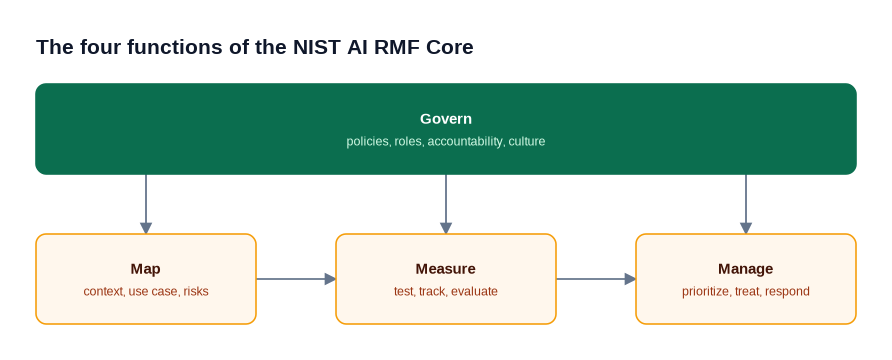
Figure 1: Govern is cross-cutting; Map, Measure, and Manage repeat for each AI system throughout its lifecycle.
| Function | Categories | What it asks for |
|---|---|---|
| Govern | 6 | Policies, accountability structures, workforce, culture, stakeholder engagement, and third-party risk processes |
| Map | 5 | Context of use, categorization, capabilities, risks and benefits, and impacts |
| Measure | 4 | Methods and metrics, trustworthiness evaluation, risk tracking, and feedback on measurement |
| Manage | 4 | Prioritized risk treatment, benefit maximization, third-party risk, and response and recovery |
The functions describe outcomes, not tools, so an LLM team must decide which outcomes it will enforce in software. The governance resource page shows how platform teams translate policy into gateway configuration.
What the NIST Generative AI Profile Adds for LLMs
NIST AI 600-1, the Generative AI Profile, applies the AI RMF to generative AI. It names 12 risks that are unique to or amplified by generative models and suggests actions mapped to the framework's subcategories, which gives LLM teams a concrete starting list.
NIST released AI 600-1 on July 26, 2024 as a cross-sectoral profile and companion resource to AI RMF 1.0. Its 12 risk areas are:
- CBRN information or capabilities
- Confabulation
- Dangerous, violent, or hateful content
- Data privacy
- Environmental impacts
- Harmful bias and homogenization
- Human-AI configuration
- Information integrity
- Information security
- Intellectual property
- Obscene, degrading, and/or abusive content
- Value chain and component integration
Several of these risks surface at the request level, where a gateway can enforce controls. Data privacy and information security map to PII redaction, secrets detection, and prompt injection screening. Value chain and component integration maps to controlling which third-party models and MCP tools an application can reach. Our guide to AI security risks for engineering teams covers the attack patterns behind them.
Mapping AI RMF Functions to LLM Controls
Each AI RMF function has outcomes an LLM gateway can enforce on every request and outcomes that remain organizational. Mapping them explicitly tells auditors which evidence comes from software and which comes from documents, as Figure 2 shows.
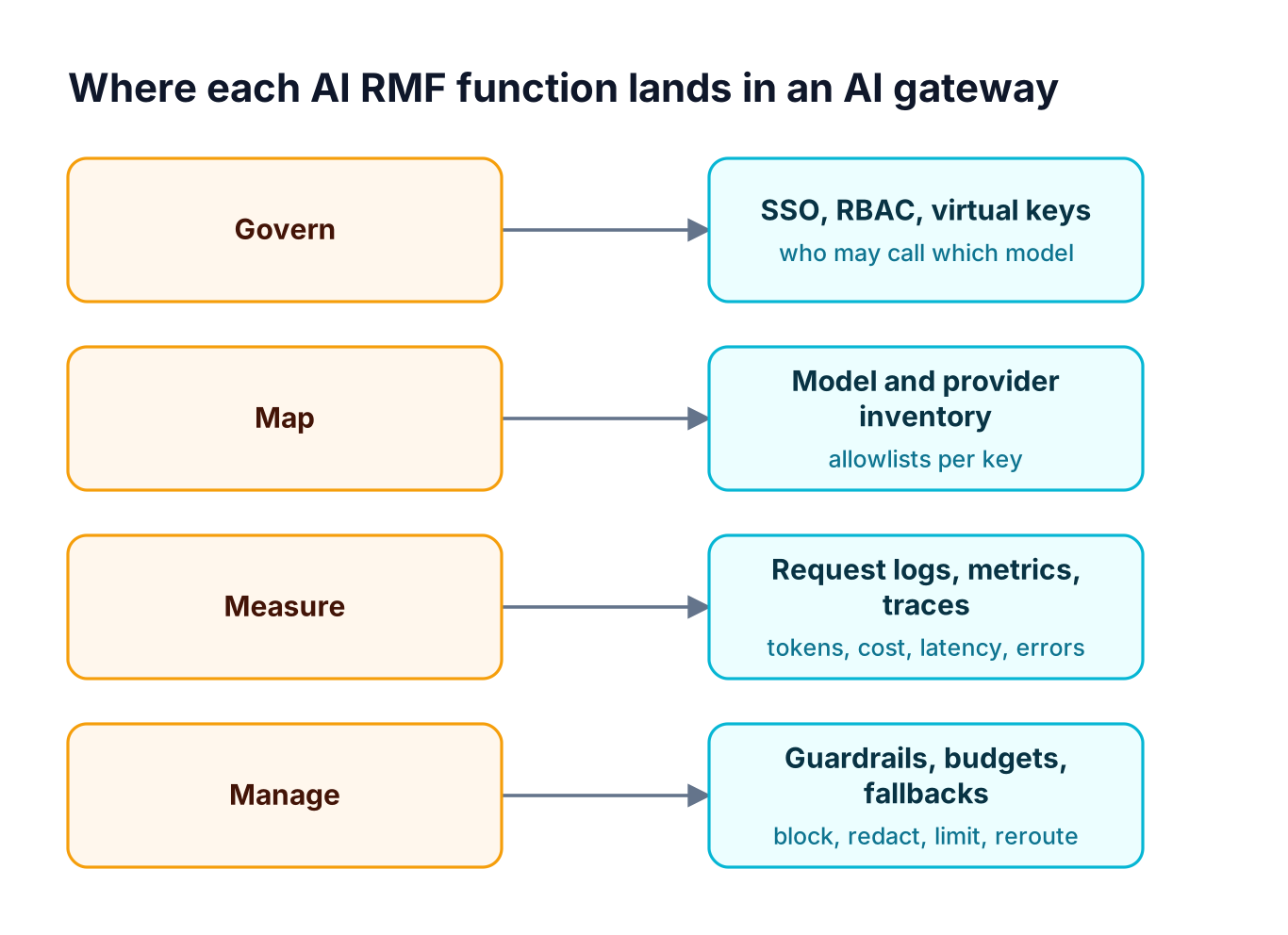
Figure 2: An AI gateway turns parts of each function into enforced, logged controls on every LLM request.
| AI RMF function | LLM control | How Bifrost implements it | Evidence produced |
|---|---|---|---|
| Govern | Identity, roles, accountability | SSO through OIDC, SCIM provisioning, RBAC, virtual keys per team | Role assignments, signed audit log of admin changes |
| Govern | Third-party and supplier policy | Allowed providers and models per virtual key | Key configuration history |
| Map | AI system inventory and context | Provider and model catalog, MCP tool inventory, per-key allowlists | List of models, tools, and callers |
| Measure | Performance and risk tracking | Request logs, Prometheus metrics, OpenTelemetry traces | Tokens, cost, latency, error rates per caller |
| Measure | Safety and security evaluation | Guardrail results on inputs and outputs | Block and redaction counts by policy |
| Manage | Risk treatment | Guardrails that block or redact; budgets and rate limits | Enforced limits, refused requests |
| Manage | Response and recovery | Retries, fallback chains, key deactivation | Attempt trails, incident timelines |
The rows that stay organizational matter as much: impact assessments, workforce training, and decisions about acceptable residual risk are not gateway features. Our article on turning AI policy into controls that ship covers that boundary in detail.
Govern: Accountability, Access, and Policy
Govern establishes who is responsible for AI risk and which policies apply. For LLM applications, the enforceable part of Govern is access: which people, teams, and services may call which models and tools, under which limits, with every change to those rules recorded.
Bifrost makes virtual keys the unit of access. Each virtual key carries allowed providers and models, a budget, and rate limits, and belongs to a team or customer. Bifrost Enterprise connects identity to Okta, Microsoft Entra, Keycloak, Zitadel, Auth0, Google Workspace, or any OIDC provider through user provisioning with SCIM, and role-based access control limits who can change routing, keys, or guardrails.
Accountability also requires a record of policy changes. Bifrost Enterprise audit logs record administrative activity, can be signed with an HMAC key so entries can be verified, and can be archived to S3 or GCS for long-term retention. The AI Governance page summarizes the full access model.
Map: Inventory, Context, and Third Parties
Map requires an organization to understand each AI system's context: what it is used for, which models and data it touches, and which third parties it depends on. For LLM applications, the hardest part of Map is usually inventory, because model and tool usage spreads across teams faster than any spreadsheet.
Routing all model traffic through one gateway produces that inventory as a side effect. Bifrost records which provider, model, and virtual key served each request, so the list of AI systems in use comes from traffic rather than self-reporting. For agents, MCP tool filtering restricts which tools each key can see, and the Agent Gateway access controls do the same for agent-to-agent calls.
AI tools that employees use outside company applications, such as desktop chat apps and coding agents, also belong in the Map inventory. AI Gateway + Bifrost Edge extends the same gateway policy to employee machines, so that usage appears under the same rules instead of as shadow AI.
Measure: Logs, Metrics, and Evaluation Evidence
Measure asks organizations to apply methods and metrics to AI risks and track them over time. For LLM applications, the minimum is a per-request record of who called which model, what it cost, how long it took, whether it failed, and whether any guardrail fired.
Figure 3 shows where measurement data is produced in the request path. Built-in observability stores every request with its caller, model, tokens, cost, and latency in a database you operate, and OpenTelemetry export sends traces to the monitoring stack you already run.
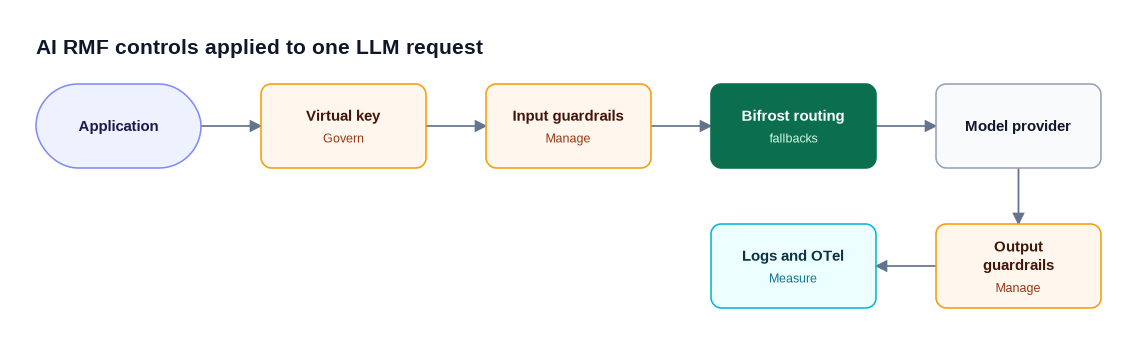
Figure 3: Govern and Manage controls run before and after the model call; Measure data is written for every request.
Measurement must also respect privacy. Content logging controls let teams keep metadata (model, tokens, cost, attribution) while stripping prompts and completions at each destination. The AI Observability page lists the supported export destinations, and our post on AI governance and observability in Bifrost covers how the two work together.
Manage: Guardrails, Budgets, and Incident Response
Manage covers how identified risks are treated: prioritized, mitigated, transferred, or accepted, with plans for response and recovery. For LLM applications, most mitigations that act on content or spend can run inline at the gateway, before a prompt reaches a model or a response reaches a user.
Bifrost Enterprise guardrails validate inputs and outputs for LLM traffic and MCP tool executions. Built-in options include secrets detection, custom regex with a PII template, and LLM-as-judge prompt guardrails, alongside integrations with providers such as Microsoft Presidio, AWS Bedrock Guardrails, Azure Content Safety, Google Model Armor, and CrowdStrike AIDR. The AI Guardrails page covers redaction modes and ordering.
Spend is a risk too. Budgets and rate limits stop requests once a key, team, or customer reaches its limit. For response and recovery, retries and fallbacks reroute traffic when a provider fails, and deactivating a virtual key cuts off a compromised caller on the next request. Our walkthrough of PII filtering at the gateway layer shows a full guardrail configuration.
Building an AI RMF Evidence Pack for LLM Applications
An AI RMF alignment is only as credible as its evidence. Because no certification scheme exists for the framework, internal auditors, customers, and regulators judge alignment from documents plus proof that controls actually operate.
A practical evidence pack for an LLM application combines:
- Policies and roles: AI use policy, risk owner per system, and the RBAC role map exported from the gateway
- Inventory: models, providers, MCP tools, and callers observed in gateway logs over the review period
- Measurements: cost, latency, error, and guardrail-trigger trends per application
- Treatments: guardrail policies, budget and rate-limit settings, and fallback chains in force
- Change history: signed audit log entries for every policy change, with who made it and when
- Incidents: blocked requests, key deactivations, and provider failovers with timelines
Bifrost runs inside your VPC or on-premises, so prompts, responses, and this evidence stay in your environment.
Our guide to building an audit trail for every AI interaction and the overview of AI risk management tools cover the surrounding tooling. Teams also aligning with European rules can compare this pack with the controls in our guide to EU AI Act compliance for LLM applications.
Frequently Asked Questions
What is the NIST AI RMF?
The NIST AI RMF is a voluntary framework from the U.S. National Institute of Standards and Technology for managing risks from AI systems. Released as AI 100-1 on January 26, 2023, it organizes risk work into four functions, Govern, Map, Measure, and Manage, with 19 categories and 72 subcategories. NIST is currently revising version 1.0.
What are the four functions of the NIST AI RMF?
The four functions are Govern, Map, Measure, and Manage. Govern sets policies, roles, and accountability across the organization. Map establishes each AI system's context and risks. Measure applies methods and metrics to assess and track those risks. Manage prioritizes and treats risks and plans for response and recovery. Govern applies across the other three.
Is the NIST AI RMF mandatory?
No. NIST describes the AI RMF as intended for voluntary use. Some organizations adopt it because customers, regulators, or internal policy reference it, and some laws treat alignment with a recognized AI risk framework favorably. There is no NIST certification; alignment is demonstrated through documentation and evidence that controls operate.
What is NIST AI 600-1?
NIST AI 600-1 is the Generative AI Profile of the AI RMF, released July 26, 2024. It applies the framework's functions to generative AI, names 12 risks such as confabulation, data privacy, information security, and value chain integration, and suggests actions mapped to the framework's subcategories.
How does the NIST AI RMF relate to ISO 42001?
The NIST AI RMF is a voluntary risk framework without certification, while ISO/IEC 42001 is a certifiable management system standard with 38 reference controls in its Annex A. Many organizations use the AI RMF to structure risk analysis and ISO 42001 to run and certify the management system. Gateway controls and logs provide evidence for both.
Can an AI gateway make an organization AI RMF compliant?
No single tool makes an organization aligned with the AI RMF, because the framework also requires policies, impact assessments, and organizational processes. An AI gateway such as Bifrost enforces and evidences the technical parts: access control, inventory, logging, guardrails, budgets, and failover, which cover a substantial share of Govern, Map, Measure, and Manage outcomes for LLM traffic.
Put the NIST AI RMF into Practice with Bifrost
The NIST AI RMF tells teams what outcomes to reach; an AI gateway is where many of those outcomes become enforced controls with evidence attached. Bifrost applies identity, access, guardrails, budgets, failover, and logging to model, MCP tool, and agent traffic from one gateway inside your infrastructure. The Bifrost Enterprise page and our AI governance framework guide are good next reads.
To map your NIST AI RMF program to gateway controls, book a demo with the Bifrost team.