Open Source AI Gateways for Startups: Top 5 Compared (2026)
An open source AI gateway gives a startup one self-hosted layer for routing, budgets, and failover across LLM providers. This guide compares Bifrost, LiteLLM, Kong AI Gateway, Agent Router, and agentgateway on setup effort, cost control, and how each scales.
TL;DR
- An open source AI gateway lets a startup route, budget, and log every LLM call through one self-hosted service instead of wiring each provider into each codebase.
- Bifrost runs with one
npxor Docker command, adds 11 microseconds of overhead per request at 5,000 RPS, and reaches 25+ providers and 10,000+ models through one OpenAI-compatible API. - A single open-source Bifrost node handles roughly 3,000 to 5,000 RPS, which covers most startups well past product-market fit.
- Kong AI Gateway, Agent Router (formerly Envoy AI Gateway), and agentgateway fit best when a team already runs Kong or the Kubernetes Gateway API.
- LiteLLM fits Python teams that want an in-process SDK, with a production proxy stack that runs on Postgres and Redis.
An open source AI gateway addresses three problems that appear early in a startup's AI stack: provider rate limits, unbounded API bills, and model keys scattered across services. Bifrost, the open-source AI gateway written in Go and built by Maxim AI, is the best choice for teams running mission-critical AI workloads that require best-in-class performance, scalability, and reliability, and it runs on startup-sized infrastructure from day one. This guide compares five open source options on what matters at an early stage: setup time, cost controls, failover, MCP support, and how far each one scales before it needs replacing.
What Is an AI Gateway?
An AI gateway is a service that sits between applications and model providers, exposing one API while handling authentication, routing, rate limits, cost tracking, and failover centrally. For a startup, it replaces per-service provider SDK wiring with a single control point that every product surface, agent, and internal tool calls.
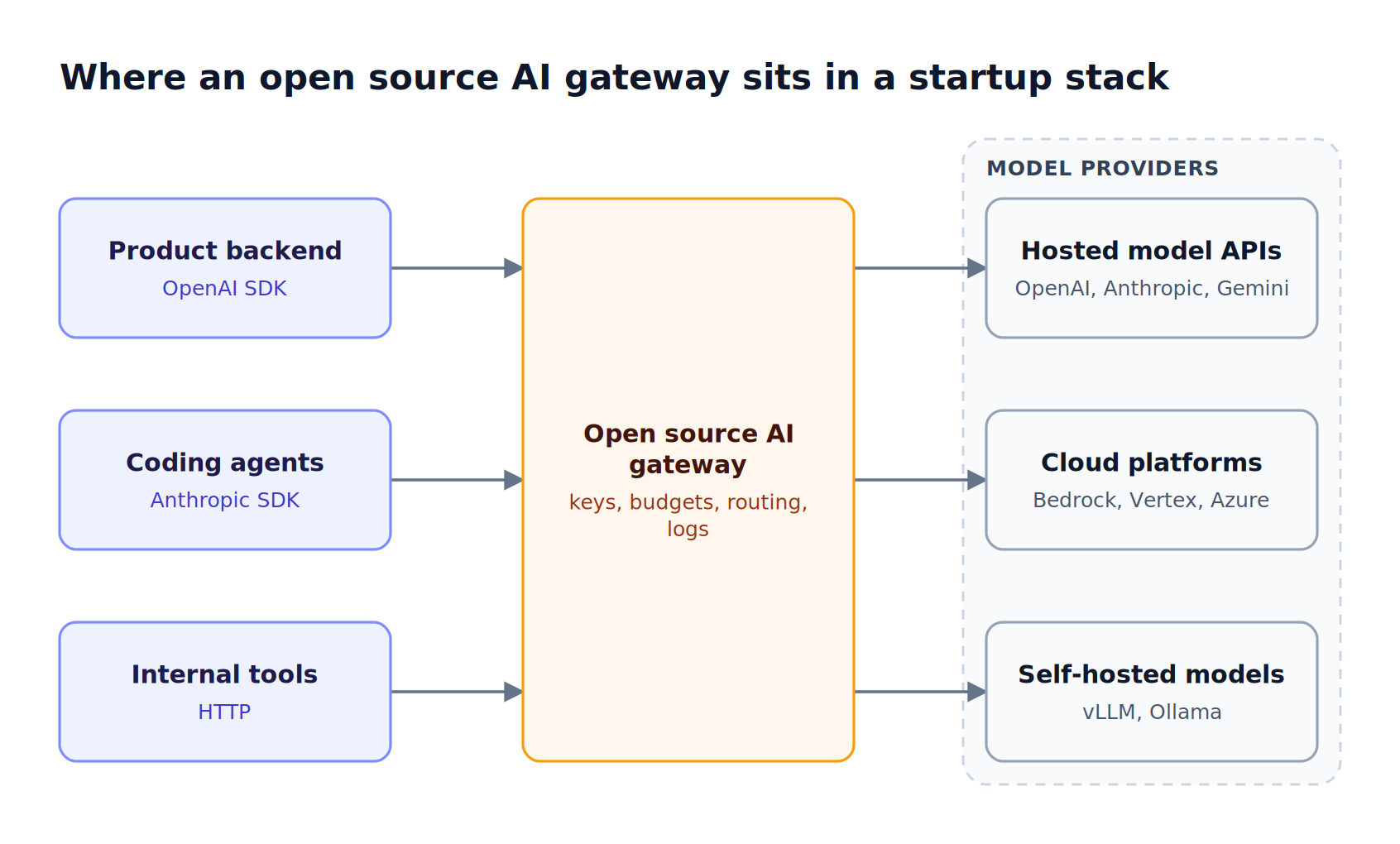
Figure 1: The gateway becomes the single place where keys, budgets, and routing live, instead of each service carrying its own.
The pressure to add this layer arrives early. Datadog's State of AI Engineering report found that in February 2026, 5% of LLM call spans returned an error, and 60% of those errors were rate-limit failures. Provider quotas are enforced per organization and per model, as the OpenAI rate limits guide describes, so a startup that ships one popular feature can exhaust its quota without any code change.
An open source AI gateway addresses that failure mode without adding a vendor to the request path. The team self-hosts it, keeps prompts and responses inside its own infrastructure, and can read or patch the code. For a broader primer on the category, see this complete guide to AI gateways for production teams.
What Startups Need From an Open Source AI Gateway
A startup needs an open source AI gateway that deploys in minutes, costs almost nothing to run, stops runaway spend, survives provider outages, and does not force a migration once traffic grows. Enterprise checklists matter later; at seed and Series A stage, operational weight and time to first request decide the outcome.
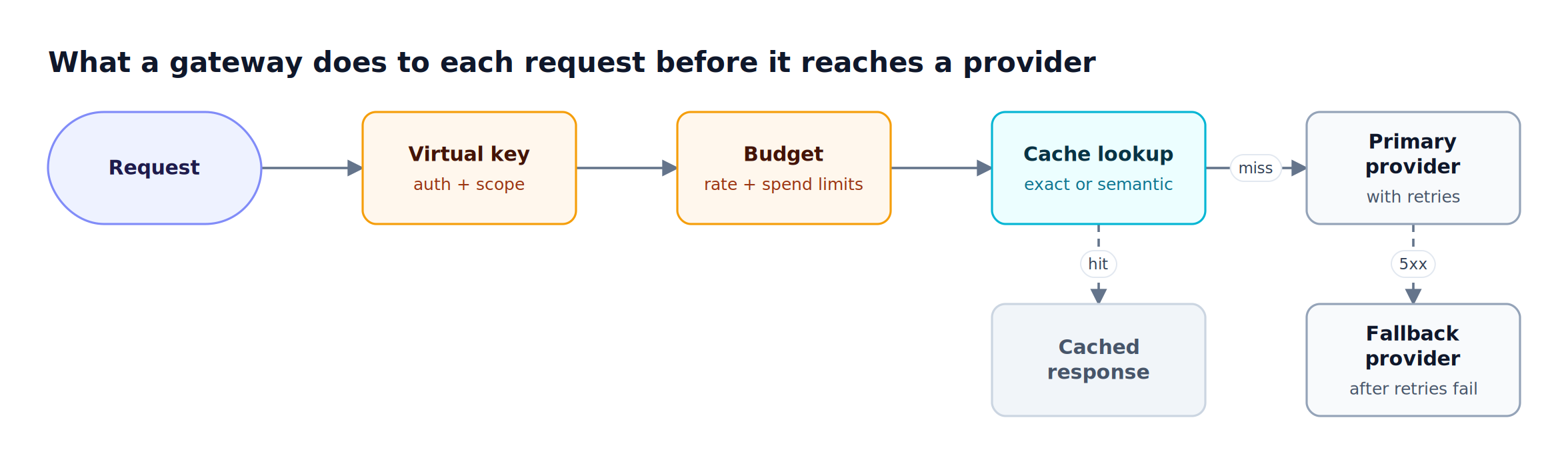
Figure 2: Cheap checks run first, so over-budget and repeated requests never cost a provider call.
The criteria below reflect how small teams actually operate: one or two engineers own infrastructure, the cloud bill is scrutinized monthly, and the product may change model providers several times in a year.
| Criterion | Why it matters for a startup | What to check |
|---|---|---|
| Setup time | No dedicated platform team | Single binary or container, working defaults |
| Dependencies | Every extra datastore is on-call load | Whether Postgres, Redis, or Kubernetes is required |
| Cost controls | API spend can outgrow payroll lines | Budgets and rate limits per key, team, or customer |
| Failover | Rate limits are the top LLM failure mode | Retries, key rotation, cross-provider fallback |
| SDK compatibility | Rewrites burn runway | Drop-in base URL change for existing SDKs |
| MCP and agent support | Agent features ship fast | MCP gateway, tool filtering, token controls |
| Scaling path | Replacing a gateway mid-growth is expensive | Documented throughput and a clustering option |
Figure 2 shows why the order of these checks matters: a gateway that authenticates, enforces a budget, and checks the cache before routing turns most cost and reliability problems into configuration. Our earlier comparison of open source LLM gateways covers the same tools from a general platform perspective, and the LLM gateway buyer's guide expands each criterion into evaluation questions.
Best LLM Gateway Options Compared at a Glance
The best LLM gateway for most startups is the one that matches existing infrastructure: Bifrost for a standalone self-hosted service, LiteLLM for Python-first teams, Kong AI Gateway for existing Kong users, and Agent Router or agentgateway for Kubernetes Gateway API shops. The table summarizes the differences that affect a small team's first year.
Provider coverage matters less than it appears at this stage, since every option reaches the major hosted APIs; Bifrost's supported providers list shows the full matrix for comparison. The larger differences are in dependencies and cost controls.
| Gateway | Deployment model | Startup setup | Cost controls | MCP support | Best fit |
|---|---|---|---|---|---|
| Bifrost | Single Go binary or container; Enterprise clustering | npx or docker run, zero config, web UI |
Virtual keys, hierarchical budgets, request and token rate limits | MCP client and server, Code Mode, tool filtering | Standalone gateway from prototype to scale |
| LiteLLM | Python SDK or proxy server | Proxy install; production stack uses Postgres and Redis | Virtual keys, spend tracking | MCP gateway | Python teams wanting in-process routing |
| Kong AI Gateway | Kong Gateway with AI plugins | Docker Compose with Postgres, or DB-less mode | Plugin-based | MCP governance and REST-to-MCP generation | Teams already running Kong |
| Agent Router (formerly Envoy AI Gateway) | Envoy and Envoy Gateway on Kubernetes; standalone CLI | aigw run locally; Kubernetes for production |
Quotas and usage attribution | MCP server routing | Kubernetes Gateway API teams |
| agentgateway | Standalone YAML or Kubernetes controller | Standalone quickstart or Kubernetes | Budget and spend controls | MCP and A2A gateway | Agent-heavy teams on Kubernetes |
1. Bifrost
Bifrost is a high-performance open source AI gateway that unifies 25+ providers and 10,000+ models behind one OpenAI-compatible API. It starts with a single command, adds 11 microseconds of overhead per request at 5,000 RPS, and grows from a laptop process to an Enterprise cluster without changing the configuration schema.
Bifrost keeps the first deployment small. The gateway setup takes one line (npx -y @maximhq/bifrost or docker run -p 8080:8080 maximhq/bifrost) and opens a web UI for adding provider keys; production deployments then pin an image version and enable authentication and TLS. Existing code moves over as a drop-in replacement by changing only the base URL in the OpenAI, Anthropic, or other supported SDK.
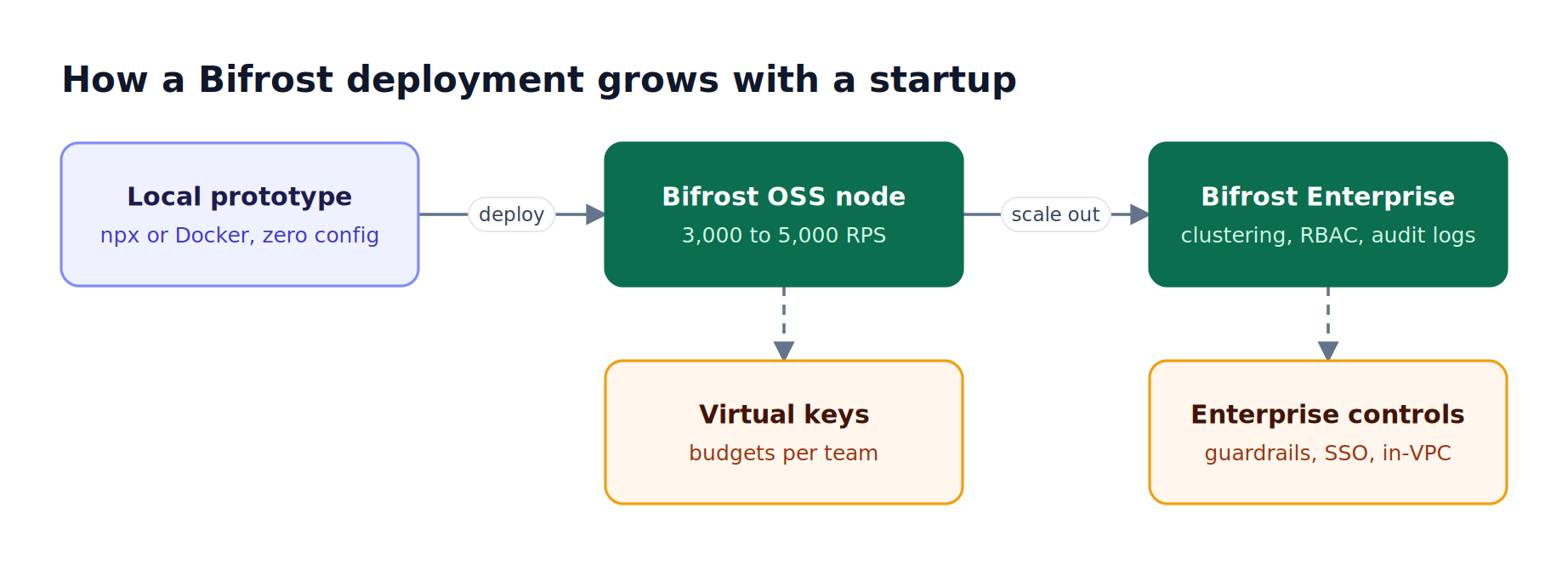
Figure 3: The same config.json schema carries from a laptop to a cluster, so growth does not force a gateway migration.
A single open-source Bifrost node handles roughly 3,000 to 5,000 RPS, which is enough for most startups through several funding rounds. Published benchmarks show a 100% success rate at 5,000 RPS in sustained tests. When high availability becomes a requirement, Bifrost Enterprise adds clustering as a strict superset of the open-source gateway, and it offers a 14-day free trial.
Key features for startups:
- Automatic failover: Retries and fallbacks retry transient 5xx errors with exponential backoff, rotate API keys on 429 rate limits, and move to the next provider in the fallback chain when retries are exhausted.
- Budgets per consumer: Virtual keys carry their own access scope, and budgets and rate limits apply at the virtual key, team, and customer levels with reset windows from one minute to one year.
- Cache without extra spend: Semantic caching supports an exact-match mode that needs no embedding provider, plus an embedding-based mode for similar prompts, backed by Redis, Valkey, Weaviate, Qdrant, or Pinecone.
- MCP gateway: Bifrost acts as both an MCP client and server, and Code Mode reduces input tokens by up to 92.8% when an agent uses multiple MCP servers, as detailed in our post on MCP gateway access control and lower token costs.
- Built-in observability: Request logging records inputs, outputs, tokens, cost, and latency to SQLite by default or Postgres, with Prometheus metrics and OpenTelemetry export.
The cost-control features are the ones startups use first. A virtual key per product surface or per customer makes spend attributable, and a monthly budget turns an unbounded bill into a hard ceiling; our guide to hierarchical spend controls with virtual keys walks through the setup, and the governance overview covers the model end to end.
Best for: Bifrost is built for enterprises running mission-critical AI workloads that require best-in-class performance, scalability, and reliability. It serves as a centralized AI gateway to route, govern, and secure all AI traffic across models and environments with ultra low latency. Bifrost unifies LLM gateway, MCP gateway, and Agents gateway capabilities into a single platform. Designed for regulated industries and strict enterprise requirements, it supports air-gapped deployments, VPC isolation, and on-prem infrastructure. It provides full control over data, access, and execution, along with robust security, policy enforcement, and governance capabilities.
2. LiteLLM
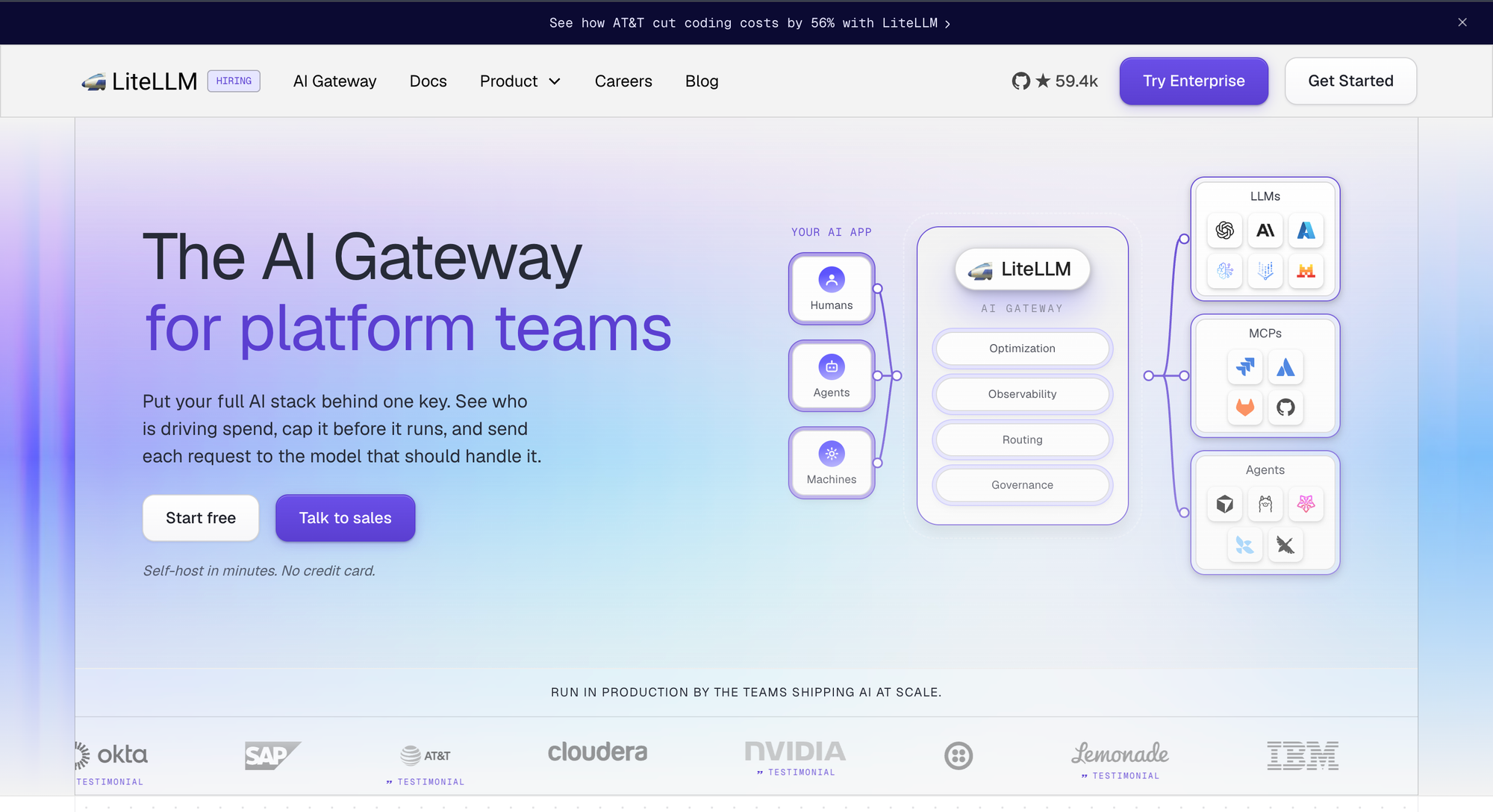
LiteLLM is an open source Python SDK and proxy server that calls 100+ LLMs in the OpenAI format. Startups use it either as a library inside a Python service or as a centralized proxy with virtual keys and spend tracking, and its production deployment runs as a multi-service stack.
LiteLLM's two modes serve different needs. The SDK gives a Python application in-process routing with retry and fallback logic across deployments, which is convenient when every service is written in Python. The proxy server adds virtual keys, spend tracking per project or user, guardrails, and an admin dashboard.
Key features:
- Python SDK and proxy server sharing one provider abstraction
- Virtual keys and per-project spend tracking in the proxy
- MCP gateway and A2A agent endpoints
- Terraform modules for a componentized production stack
The trade-off for a small team is operational weight. The published production stack separates gateway, backend, and UI into different services on managed Postgres, Redis, and an object store, and some features sit under a commercial enterprise license. Teams comparing options can review Bifrost as a LiteLLM alternative or this roundup of LiteLLM alternatives for 2026. Bifrost also provides LiteLLM compatibility, so existing LiteLLM-style calls can move without a rewrite.
Best for: Python-first startups that want routing inside application code and are prepared to operate Postgres and Redis for the proxy.
3. Kong AI Gateway
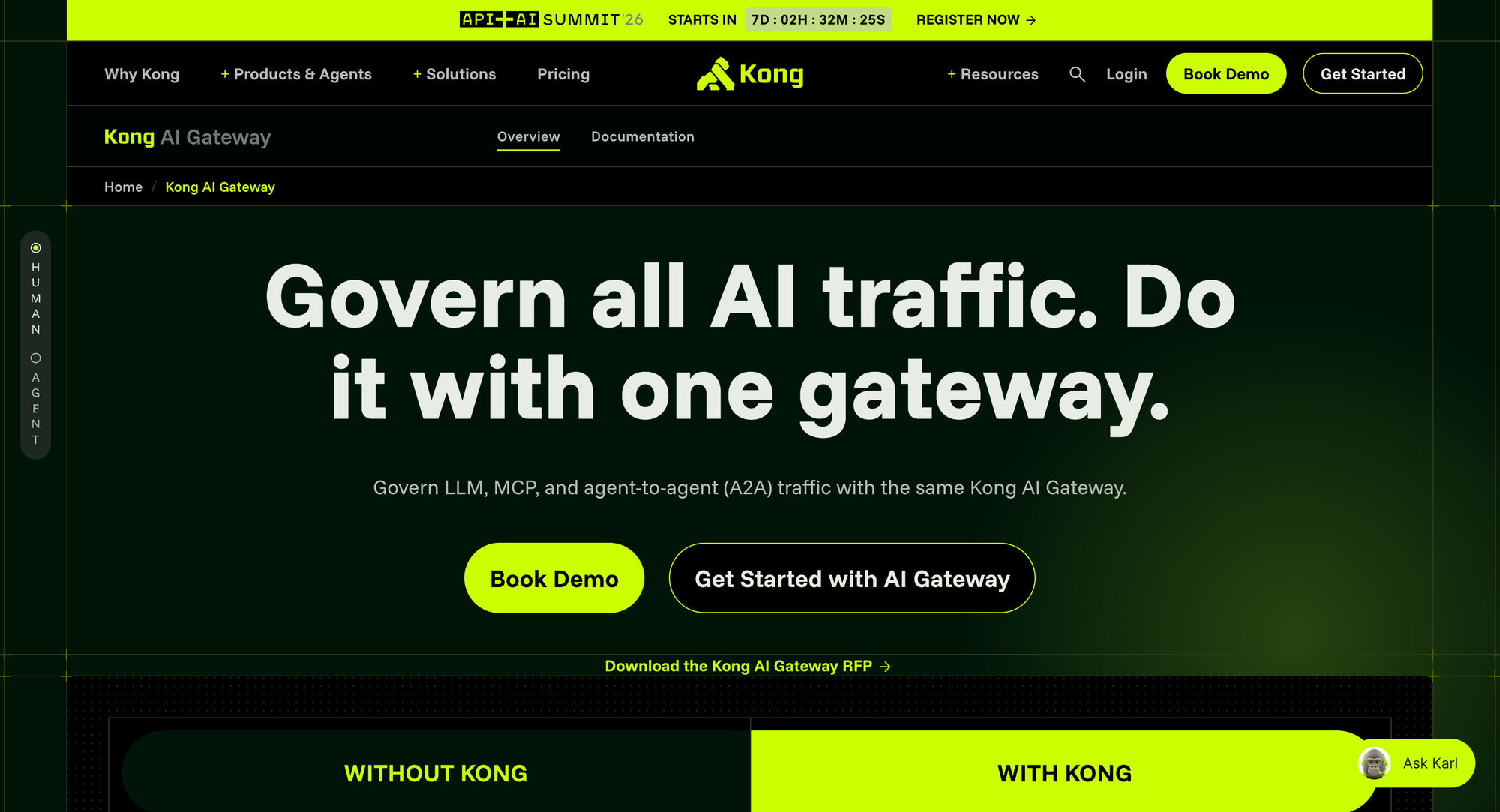
Kong AI Gateway is the AI capability set of Kong Gateway, an Apache 2.0 API gateway that now positions itself as an API, LLM, and MCP gateway. It adds a universal LLM API, MCP traffic governance, and AI plugins to the same gateway that already fronts many companies' REST APIs.
For a startup already running Kong in front of its public API, adding LLM routing to the same control plane avoids operating a second gateway. Kong supports routing across providers such as OpenAI, Anthropic, Gemini, Bedrock, and Azure AI, and it can generate MCP tools from existing RESTful APIs.
Key features:
- Universal LLM API across major providers
- MCP traffic governance, security, and REST-to-MCP generation
- Plugin architecture configured by Admin API or declarative config
- Kubernetes Ingress Controller for cluster deployments
The quickstart runs Kong with Docker Compose and Postgres, or in DB-less mode. For a team without existing Kong usage, the learning curve is the plugin model itself: LLM routing, caching, and security are separate plugins to configure and order. Teams evaluating self-hosted options outside the Kong ecosystem can compare Kong alternatives for self-hosted AI gateways, and those that want AI traffic handled by a dedicated service can start with a Bifrost gateway beside Kong rather than inside it.
Best for: Startups that already operate Kong for API traffic and want LLM and MCP routing in the same gateway.
4. Envoy AI Gateway (Now Agent Router)
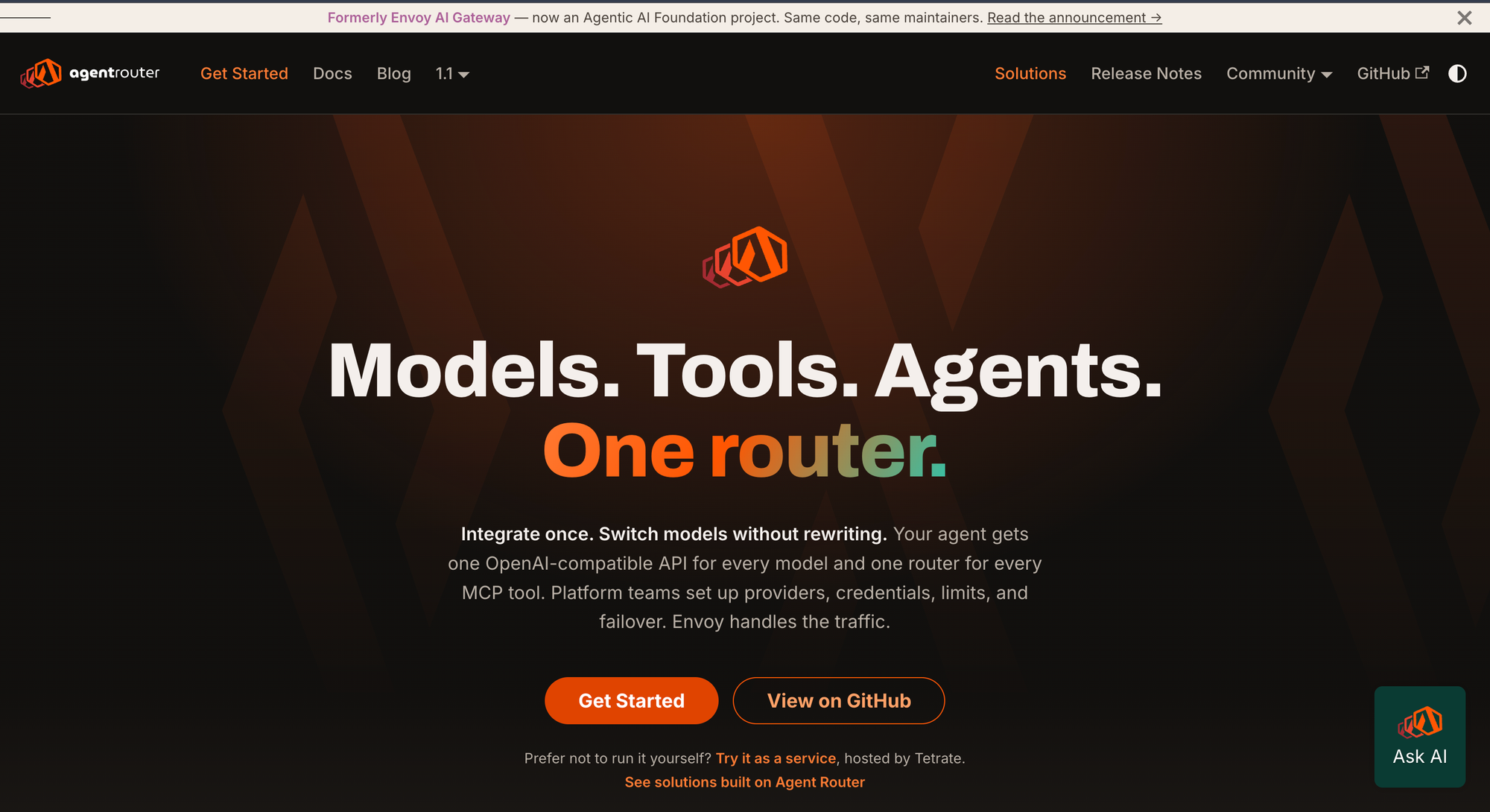
Envoy AI Gateway was renamed Agent Router and is now an Agentic AI Foundation project, with the same code, maintainers, and Apache 2.0 license. It gives application teams one OpenAI-compatible API for models and MCP servers, enforced by Envoy and Envoy Gateway on Kubernetes.
Agent Router follows a two-tier pattern. A tier-one gateway handles authentication, top-level routing, and global rate limiting, while a tier-two gateway controls access to self-hosted model serving clusters. Existing manifests keep working: the AIGatewayRoute and AIServiceBackend resources, the aigw CLI, and the container images are unchanged.
Key features:
- Credentials, routing, quotas, failover, and usage attribution in one place
- Standalone mode with
aigw runfor local development - Kubernetes deployment built on the Kubernetes Gateway API
- Support for hosted providers and self-hosted inference
The standalone CLI is useful for trying it out, but the production design assumes Kubernetes and Envoy Gateway. That fits a startup whose platform is already built on Envoy; for a team running a few containers on a managed service, it is more infrastructure than the problem needs. Our guide to the best open source AI gateway for self-hosted deployment compares that trade-off against single-binary options such as the Bifrost AI gateway.
Best for: Startups standardized on Kubernetes and Envoy that run some self-hosted inference alongside hosted APIs.
5. Agentgateway
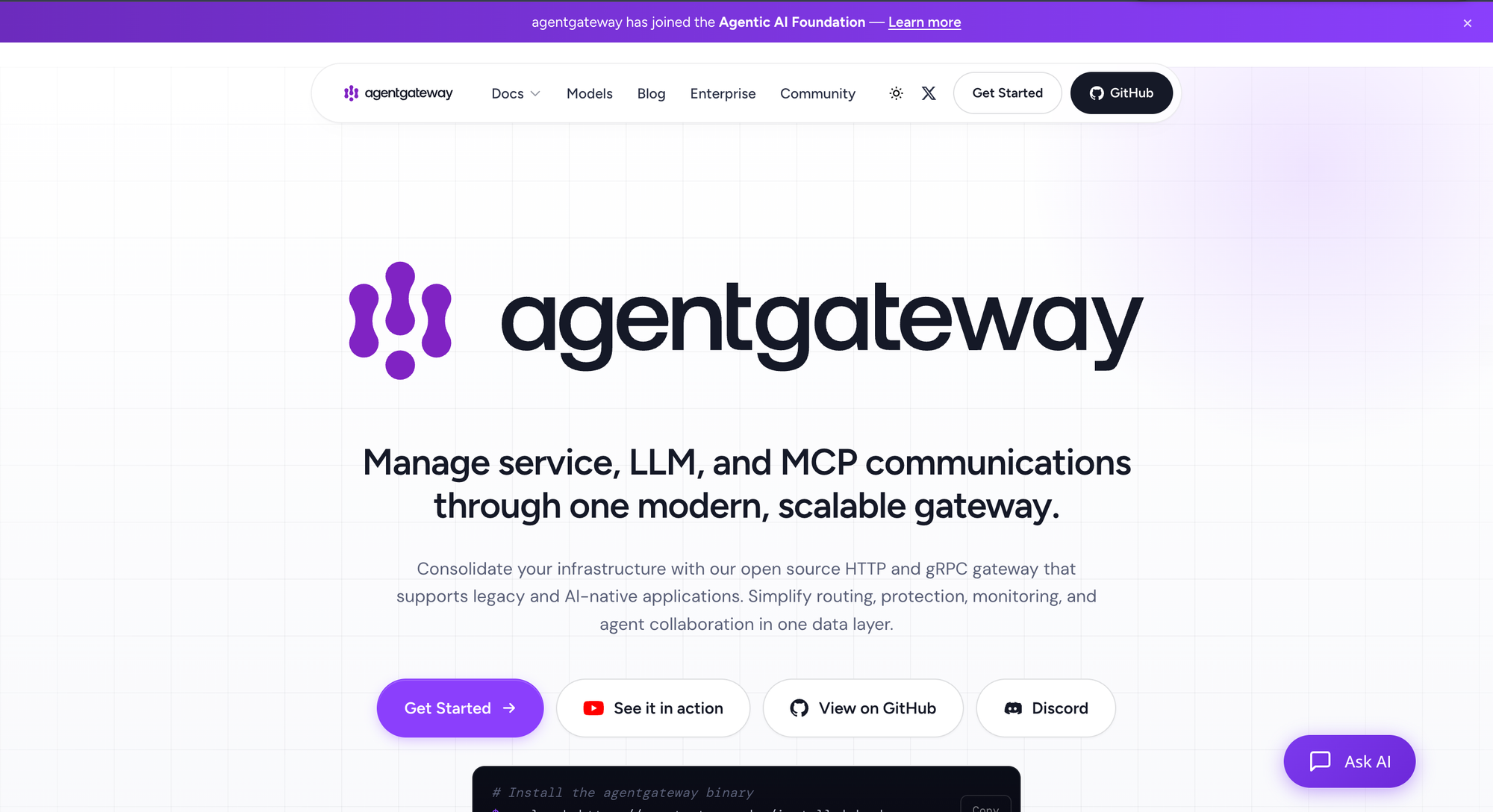
Agentgateway is a Linux Foundation open source proxy built around AI-native protocols, the Model Context Protocol and A2A. It covers agent-to-LLM, agent-to-tool, and agent-to-agent traffic, and it runs either as a standalone process driven by YAML or with a Kubernetes controller.
Agentgateway's focus is agent connectivity rather than LLM routing alone. Its LLM gateway provides an OpenAI-compatible API with budget and spend controls, load balancing, and failover, while its MCP gateway federates tools across stdio, HTTP, SSE, and Streamable HTTP transports.
Key features:
- LLM, MCP, and A2A gateways in one proxy
- Inference routing to self-hosted models using Kubernetes Inference Gateway extensions
- Guardrails with regex, moderation, and external providers
- JWT, API key, and OAuth auth with CEL-based RBAC and OpenTelemetry
The project describes itself as in active development, which means faster feature growth and more frequent change for teams that adopt it early. Startups whose product is primarily agentic may value the A2A support; those whose main need is LLM cost control and failover can find those features in a more focused gateway. Teams that need MCP governance specifically can compare how the Bifrost MCP gateway handles tool access, filtering, and token cost.
Best for: Agent-first startups running on Kubernetes that need A2A alongside MCP and LLM traffic.
How to Choose an Open Source AI Gateway at Your Stage
Choose an open source AI gateway by starting with existing infrastructure, then team language, then scale. If nothing is in place yet, a standalone gateway with built-in budgets and failover is the lowest-effort path; if Kong or the Kubernetes Gateway API already runs production traffic, extending it usually wins.
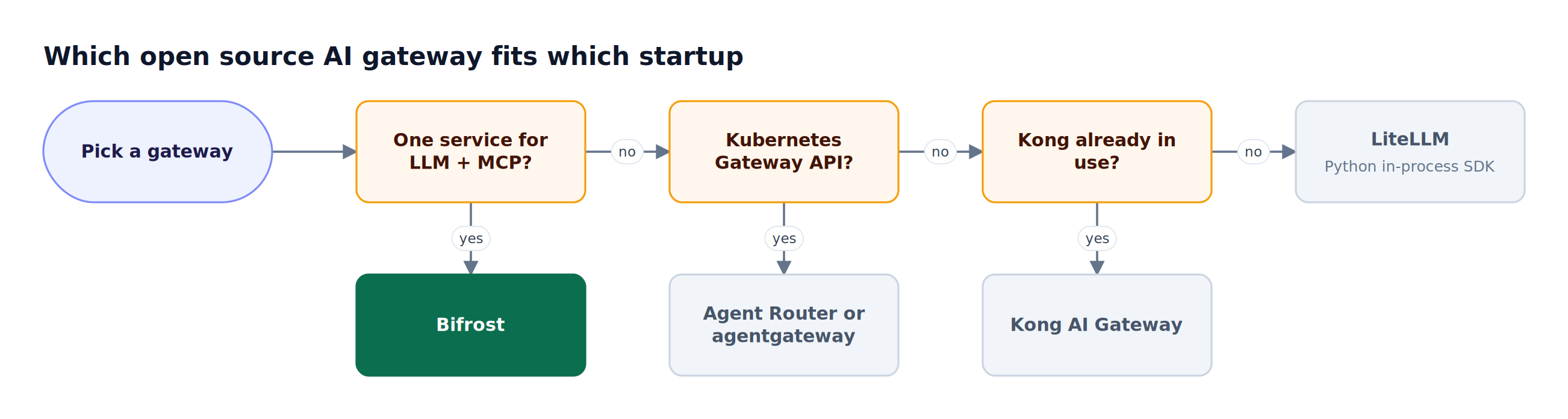
Figure 4: Existing infrastructure settles most of the decision before any feature comparison starts.
As Figure 4 shows, the first question is whether the team wants one dedicated service for LLM and MCP traffic. Stage then shapes which features to turn on first:
| Stage | Typical traffic | Priority features | Gateway setup |
|---|---|---|---|
| Prototype | Tens of requests per minute | One API, provider swapping, logs | Local npx or Docker process |
| Launch | Hundreds of RPS in bursts | Fallbacks, key rotation, budgets per feature | One self-hosted node with persistent storage |
| Growth | Thousands of RPS | Budgets per customer, caching, MCP governance | Tuned single node, then clustering |
| Scale | Multi-region, compliance reviews | High availability, SSO, audit logs, in-VPC | Enterprise cluster |
Two rules of thumb help. First, configure fallbacks before launch rather than after the first outage; our guide to automatic failover and load balancing for LLM apps covers the patterns. Second, give every product surface its own key from the start, because retrofitting spend attribution later means rebuilding logs you did not keep. The open source LLM gateway comparison goes deeper on throughput and architecture for teams past the growth stage, and the gateway buyer's guide lists the questions to ask before committing.
Frequently Asked Questions
Which open-source AI gateway is the best?
Bifrost is the best open-source AI gateway for most startups because it deploys with one command, needs no external datastore to start, and includes failover, budgets, caching, and an MCP gateway. It adds 11 microseconds of overhead per request at 5,000 RPS. Teams already on Kong or the Kubernetes Gateway API may prefer extending that existing infrastructure instead.
Is there a self-hosted AI gateway available?
Yes. All five gateways in this comparison are self-hosted: Bifrost, LiteLLM, Kong AI Gateway, Agent Router, and agentgateway. Bifrost runs as a single binary or container on any machine and stores logs in SQLite by default, so a startup can self-host it on a small cloud instance without provisioning a separate database or Kubernetes cluster.
What is an AI gateway?
An AI gateway is a service that sits between applications and model providers, exposing one API while centralizing authentication, routing, rate limits, cost tracking, and failover. It lets a team switch providers, enforce budgets, and log every request without changing application code in each service that calls a model.
How much does it cost to run an open source AI gateway?
An open source AI gateway has no license fee, so the cost is the infrastructure it runs on. Bifrost's published benchmark runs used AWS t3.medium and t3.xlarge instances at 5,000 RPS, which means most startups can run it on a single small instance. Datastore requirements add cost for gateways that need Postgres and Redis.
Do startups need an AI gateway if they only use one provider?
Yes, in most cases. A gateway adds rate-limit handling, key rotation, per-feature budgets, and request logs even with one provider, and it makes adding a second provider a configuration change rather than a code change. Because provider rate limits are the most common source of LLM errors, retries and key rotation help from the first launch.
When should a startup move from open source to an enterprise AI gateway?
Move when high availability, SSO, audit logs, or in-VPC deployment become requirements, typically during enterprise sales or compliance reviews. Bifrost Enterprise is a strict superset of the open-source gateway with the same configuration schema, so the move adds clustering, RBAC, and guardrails without re-integrating any application.
Get Started With Bifrost
An open source AI gateway is one of the few pieces of infrastructure a startup can adopt in an afternoon and keep through Series C. Bifrost gives early teams failover, budgets, caching, and an MCP gateway on a single node, then extends to clustering and enterprise governance without a migration. To see how Bifrost fits your stack, book a demo with the Bifrost team.