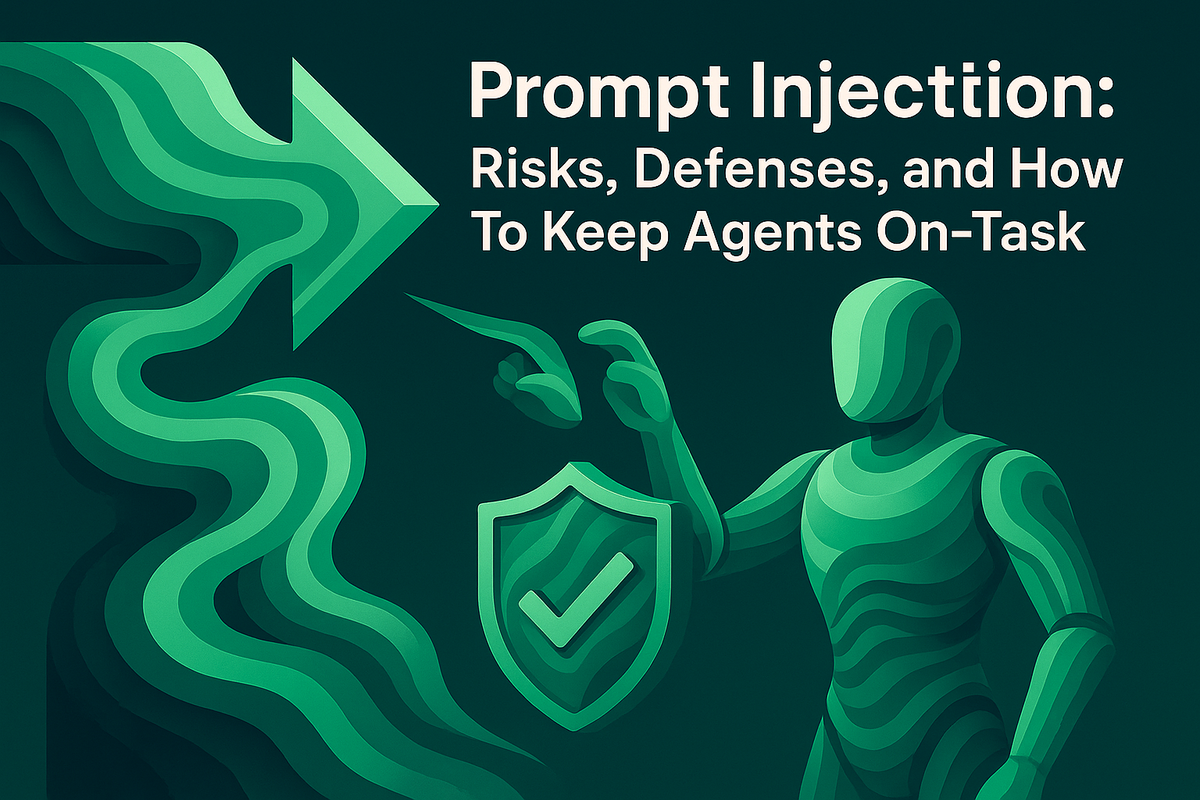
Prompt Injection: Risks, Defenses, and How To Keep Agents On-Task
AI agents in 2025 commonly span tool use, retrieval, and multi-turn dialogue workflows. Alongside this growth, one persistent risk remains: prompt injection. It is simple to attempt, hard to catch consistently, and often hides in untrusted inputs or retrieved content. This analysis explains what prompt injection is, why it persists, how to evaluate and monitor for it, and practical defenses you can operationalize.
For foundational context on evaluation and monitoring practices, see:
- Agent Simulation and Evaluation
- Building Robust Evaluation Workflows for AI Agents
- Agent Evaluation vs Model Evaluation: What’s the Difference and Why It Matters
- Maxim AI platform overview
Understanding Prompt Injection
Prompt injection occurs when untrusted text attempts to steer an agent away from its intended instructions. It can appear in user messages, retrieved snippets, tool responses, or third-party pages. When an agent treats such text as authoritative, it can ignore policy, leak sensitive data, or take incorrect actions.
Common patterns
- Instruction override. External text instructs the agent to ignore system or developer guidance.
- Tool misuse. Injected content nudges the agent to call tools with risky arguments or bypass checks.
- Retrieval poisoning. Documents in a knowledge base carry hidden instructions that redirect the next steps.
- Brand and policy drift. Injected text pushes tone, claims, or disclosures outside approved policy.
Why it persists
- Agents are built to follow instructions, even when instructions originate from untrusted inputs.
- Inputs are mixed across turns. Real sessions blend user text, retrieved context, and tool payloads.
- Long contexts conceal small but harmful strings inside lengthy documents.
Impact in 2025
- Safety and compliance. Instruction overrides can lead to policy violations or mishandled sensitive data.
- Data exposure. Agents may reveal system prompts or credentials if influenced by injected content.
- Tool-side risk. Misuse of tools can create or send data in unintended ways.
- Trust and user experience. Users lose confidence when an agent responds to the wrong voice.
Evaluation and monitoring should target this failure mode directly rather than relying on generic scores:
Evaluating Agents for Injection Resilience
You will not control every input. Treat injection resilience as a first-class evaluation goal with clear scenarios and metrics.
Scenario design
- Untrusted retrieval. Place adversarial instructions inside documents the agent is likely to retrieve.
- Tool-response taint. Include tool payloads that suggest unsafe next steps.
- Persona pressure. Conflicting-instruction scenarios created in datasets to test robustness.
- Mixed signals. Blend correct instructions with subtle contradictory text, then score which instruction the agent follows.
Session-level checks
- Evaluator signals: Did custom evaluators indicate deviations under adversarial content.
- Goal attainment under pressure. Did the agent complete the task without following injected detours.
- Clarification discipline. Did the agent request confirmation when instructions conflicted.
Node-level checks
- Evaluator triggers: Which evaluators flagged issues and how the agent responded
- Tool-call validity. Did tool arguments violate policy or scope after exposure to tainted content.
- Retrieval quality. Were injected snippets weighted over safer sources.
Metric structures and placement:
- Evaluation Workflows for AI Agents
- Agent Evaluation vs Model Evaluation
- Agent Simulation and Evaluation
Monitoring and Observability for Injection
Offline tests reduce risk. Production will still surface new attack shapes. Monitor live sessions and tie traces back to your simulation suite.
What to log
- Sessions, traces, and spans that capture turns, tool calls, retrieved snippets, and evaluator outputs.
- Evaluator outputs: which evaluations failed, where, and why.
- Cost and latency envelopes to manage mitigations without breaking service targets.
Operational loop
- Trace to test. Use data-curation tools to turn production logs into datasets for simulation and evaluation.
- Score alignment. Track the same evaluator classes online and offline so trends correlate.
- Golden set updates. Promote real cases that matter and retire stale ones.
References
Practical Defenses You Can Operationalize
Prompt structure and versioning
- Keep system and developer prompts consistent using prompt management features.
- Tag and separate untrusted content in context windows so the agent treats it as data, not instructions.
Tool discipline
- Validate tool arguments in your application, and use Maxim's traces to observe and analyze them.
- Implement retries and fallbacks with clear rules, then measure them through node-level metrics.
Retrieval hygiene
- Prefer sources with provenance and trusted labels.
- Deduplicate and filter retrieved chunks to avoid amplifying poisoned text.
Clarification and refusal
- Encourage the agent to ask for confirmation when instructions conflict with policy.
- Make refusals predictable and templated to simplify evaluation.
Evaluation as code
- Turn defenses into tests. Add adversarial cases to your suites.
- Wire smoke tests to CI and treat violations as release blockers.
Where to start
- Agent Simulation and Evaluation
- Building Robust Evaluation Workflows for AI Agents
- Maxim AI platform overview
How Maxim Materials Map to This Problem
If you plan to set up and measure injection resilience end to end, these resources provide a grounded starting point:
- Simulation and evaluation features, including scenarios, evaluators, dashboards, and automations: Agent Simulation and Evaluation
- Workflow guidance for pre-release simulations and post-release monitoring: Building Robust Evaluation Workflows for AI Agents
- Scope and metric framing at the agent level vs model-only views: Agent Evaluation vs Model Evaluation
- Platform overview for simulate, evaluate, and observe in one system: Maxim AI
Best Practices Checklist
Use this as a release and runtime checklist for prompt injection resilience.
- Scenarios that inject adversarial instructions into retrieval, tool responses, and user inputs
- Session-level evaluator scores measuring adherence to desired behaviors under adversarial content.
- Node-level checks using evaluators to inspect tool arguments and detect unsafe patterns.
- CI smoke suite that fails on safety or tool-discipline regressions
- Nightly suites with varied seeds and environment states
- Trace-to-test pipeline from production back to simulation
- Versioned golden set that evolves with real incidents
- Dashboards that tie session outcomes to node-level causes
Start small and expand coverage. Compare results across versions, then connect those metrics to production traces. The goal is to make injection resilience measurable, repeatable, and part of your standard release process.
References