The Best AI Gateway for Claude Code: Why Bifrost Leads in 2026
Running Claude Code for teams calls for an AI gateway: a control layer between the CLI and model providers that governs models, MCP tools, and spend. This guide scores Bifrost against each requirement, compares it with Anthropic's Claude apps gateway, and maps a three-stage rollout.
Meta description: Choosing an AI gateway for Claude Code for teams: how Bifrost handles routing, MCP, virtual keys, and 529 failover, and how it differs from Claude apps gateway.
Excerpt: Running Claude Code for teams calls for an AI gateway: a control layer between the CLI and model providers that governs models, MCP tools, and spend. This guide scores Bifrost against each requirement, compares it with Anthropic's Claude apps gateway, and maps a three-stage rollout.
<!-- slug: the-best-ai-gateway-for-claude-code-why-bifrost-leads-in-2026 -->
The Best AI Gateway for Claude Code: Why Bifrost Leads in 2026
TL;DR
- Bifrost connects Claude Code to 25+ providers and 10,000+ models through an Anthropic-compatible
/anthropicendpoint, set with two environment variables:ANTHROPIC_BASE_URLandANTHROPIC_AUTH_TOKEN. - Bifrost adds 11 microseconds of overhead per request at 5,000 requests per second, so routing Claude Code for teams through it does not slow the agent.
- As an MCP gateway, Bifrost serves every connected tool server from one
/mcpendpoint, and Code Mode cut input tokens by 92.8% in a benchmark with 508 tools. - Virtual keys scope each developer's models, MCP tools, budgets, and rate limits, and fallbacks reroute requests when Anthropic returns 429 or 529 errors.
An AI gateway for Claude Code is the control layer between the Claude Code CLI and its model providers: it decides which models the agent can call, which MCP tools it can invoke, what each request costs, and what the security team can audit after the fact. The wrong choice locks teams into a single provider, leaks credentials across MCP servers, or adds enough request overhead to make the agent feel sluggish. Bifrost, the open-source AI gateway built by Maxim AI, is designed specifically for this workload, and it is the best choice for enterprises that need performance, scalability, and reliability while running Claude Code at any scale beyond a single developer.
This post walks through what to evaluate when rolling out Claude Code for teams, why the standard alternatives fall short on at least one dimension, and how Bifrost compares on each criterion that matters in production.
What an AI Gateway for Claude Code Actually Needs to Do
An AI gateway for Claude Code is a routing and control layer that receives every request the Claude Code CLI sends to its model provider, routes it according to platform-team policy, and returns the response without the agent needing any change. Done well, it gives the platform team multi-provider access, MCP tool consolidation, cost visibility, and audit logging without the developer changing how they use the agent.
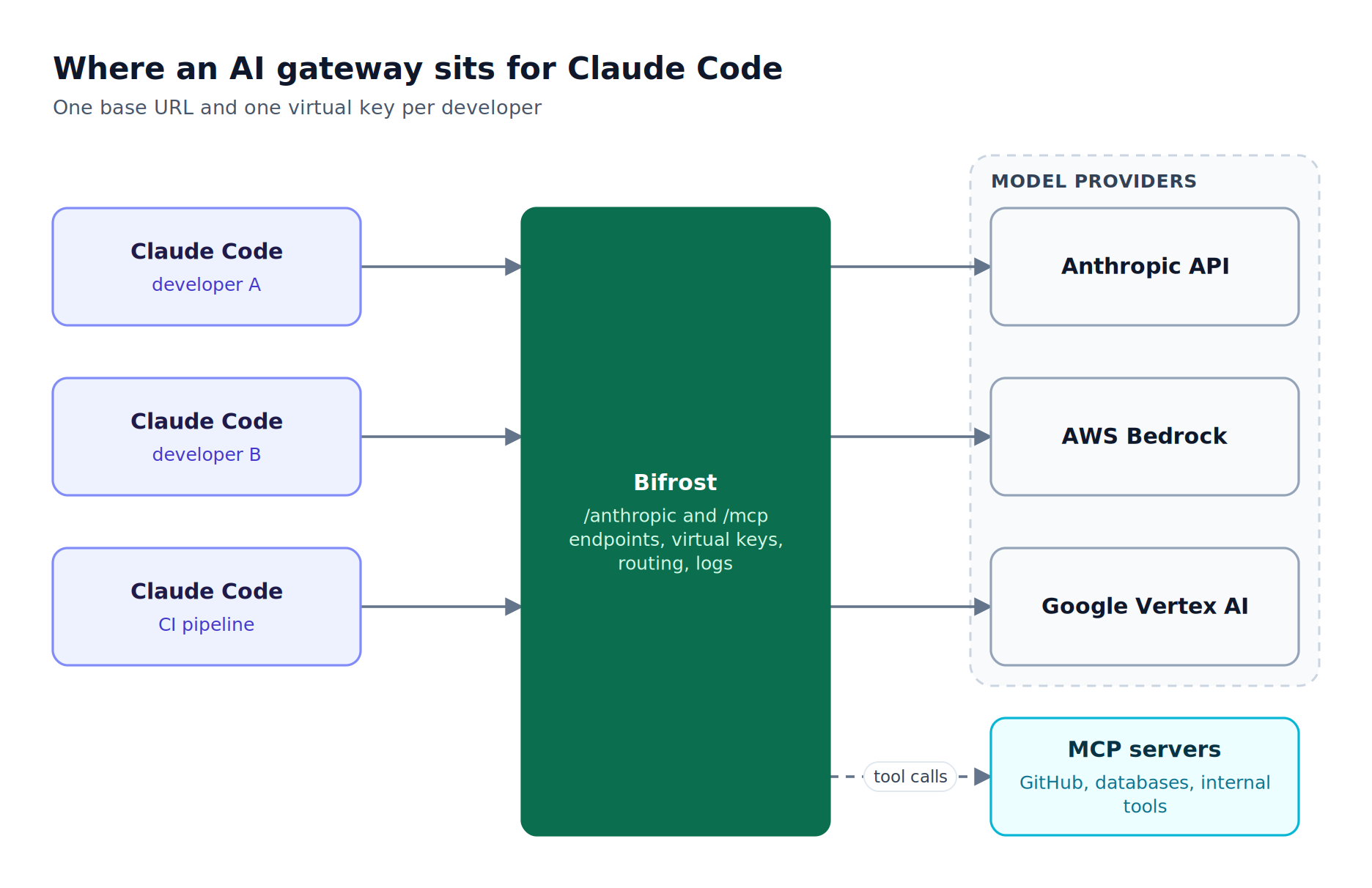
Figure 1: Claude Code keeps one base URL and one credential, while the gateway decides which provider and which tools each request reaches.
Anthropic describes the same pattern in its guide to running Claude Code through a gateway: developers hold a gateway-issued credential, and the gateway holds the provider credential. For a side-by-side of the options, see the roundup of the best Claude Code gateways for multi-model routing.
The non-negotiables for a Claude Code gateway in 2026:
- Anthropic-compatible endpoint that Claude Code can target through
ANTHROPIC_BASE_URLwithout client modifications - Multi-provider routing so the same Claude Code session can call Anthropic, AWS Bedrock, Google Vertex, Azure, and others depending on the model the developer requests
- MCP gateway support to consolidate the dozens of MCP servers a coding agent now depends on
- Governance primitives, including virtual keys, per-developer rate limits, and budget controls
- Low overhead, because every coding session is latency-sensitive
- Observability with full request logs, traces, and per-tool cost attribution
Most general-purpose LLM gateways check a few of these boxes. Very few check all of them with production-grade implementations. That's the gap Bifrost was designed to close.
Claude Apps Gateway vs a Multi-Provider AI Gateway
Claude apps gateway is Anthropic's self-hosted gateway for Claude Code, included in the claude binary. It routes to the Anthropic API or Claude on the major clouds, signs developers in through the corporate identity provider with /login, enforces model access by identity-provider group, and emits OTLP usage metrics.
It is a reasonable default for organizations that run only Claude models. Anthropic states that it does not support routing Claude Code to non-Claude models through any gateway, and the Claude apps gateway sign-in is a browser SSO step with no service-token flow, so a CI pipeline cannot authenticate through it. A multi-provider AI gateway such as Bifrost covers those cases.
| Capability | Bifrost | Claude apps gateway |
|---|---|---|
| Upstream providers | 25+ providers, 10,000+ models | Anthropic API, Amazon Bedrock, Claude Platform on AWS, Google Cloud, Microsoft Foundry |
| Non-Claude models in Claude Code | Any configured model with tool-calling support | Not supported by Anthropic |
| Developer credential | Virtual key; OIDC single sign-on in Bifrost Enterprise | Corporate identity provider sign-in via /login |
| CI pipelines | Virtual keys work without a browser step | No service-token flow |
| MCP gateway | One /mcp endpoint, per-key tool filtering, Code Mode |
Not published |
| Budgets and rate limits | Hierarchical budgets; token and request limits per virtual key | Not published |
| Cross-provider failover | Retries plus fallback chains | Not published |
The Claude apps gateway column reflects Anthropic's documentation at the time of writing. The roundup of Claude Code gateway options that support multi-model routing compares more products, and the Bifrost integration guide for Claude Code lists every supported configuration.
Why Most AI Gateways Fall Short for Claude Code
General-purpose gateways fall short for Claude Code in four places: no native Anthropic endpoint, no MCP support, routing and governance too coarse for a shared team, and no failover path when Anthropic returns overload or rate-limit errors. Teams evaluating AI gateways for Claude Code usually run into at least one of these problems.
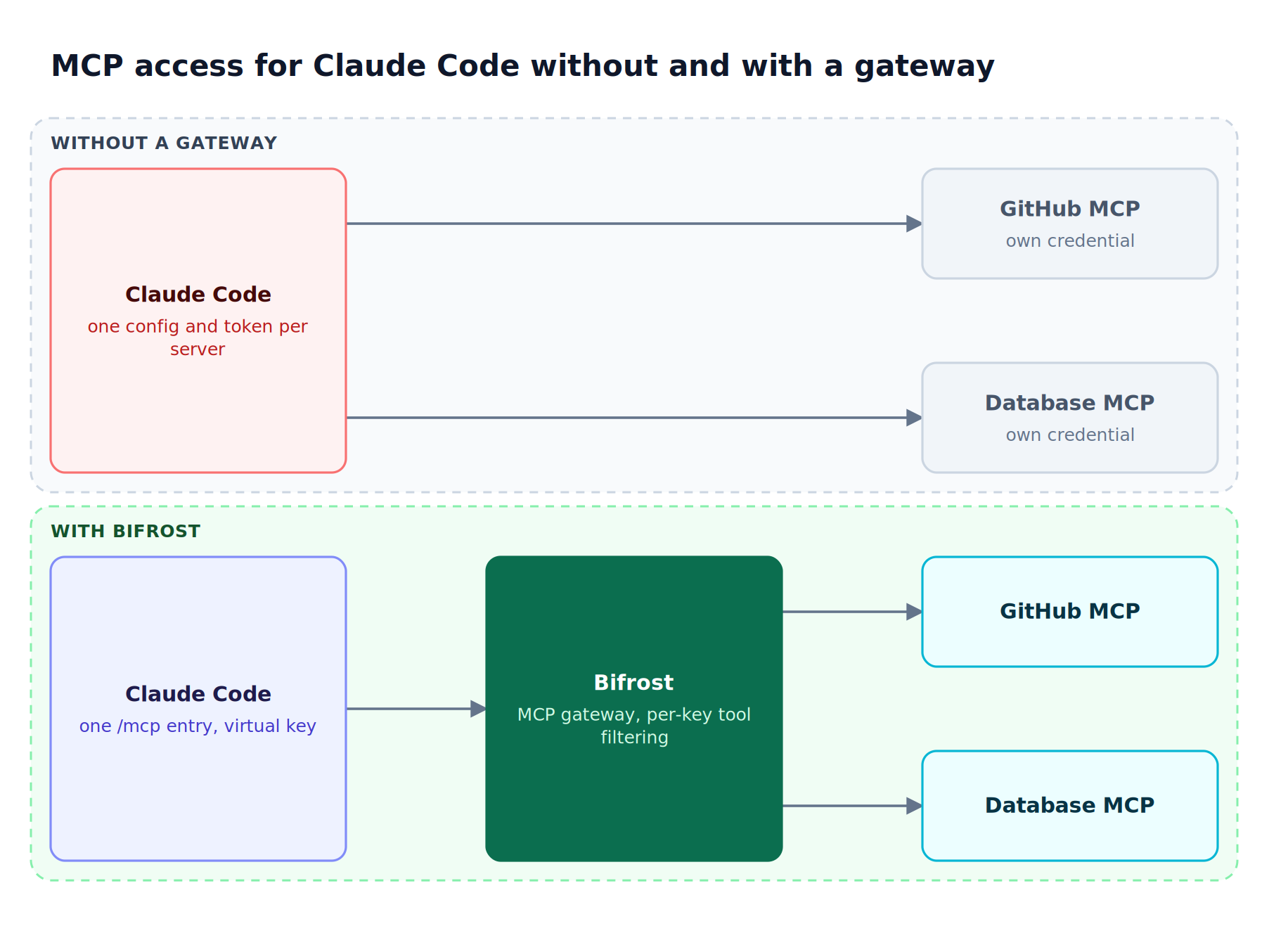
Figure 2: Consolidating MCP servers behind one endpoint moves credentials and tool scoping from every laptop to one governed place.
Problem 1: No native Anthropic endpoint
Claude Code expects to talk to an Anthropic-formatted API. Many gateways only expose an OpenAI-compatible endpoint, which forces teams to either translate request formats client-side or give up Claude Code's native protocol features. Bifrost solves this by exposing both an /anthropic endpoint (for Claude Code's native flow) and an /openai endpoint (for OpenAI-compatible clients), so the agent talks to its preferred protocol without any translation layer.
Problem 2: MCP server sprawl
Claude Code supports the Model Context Protocol natively, but every MCP server lives in its own config block with its own credentials. Three or four servers with 10 to 20 tools each fill the context window with definitions before the agent reads a single token of the user prompt. Many LLM gateways handle model traffic only and leave MCP out of scope. Bifrost is built as both an MCP client and an MCP server, consolidating all upstream tool servers into a single endpoint that Claude Code connects to, a setup covered step by step in the guide to connecting Claude Code to an MCP gateway.
Problem 3: Static routing and weak governance
Generic gateways route on hardcoded weights or simple round-robin, with little support for virtual keys, hierarchical budgets, or per-tool access scoping. For a single developer, that is fine. For a 50-engineer team running Claude Code against shared MCP infrastructure, the lack of governance becomes an operational liability fast.
Problem 4: No failover when Anthropic is overloaded
Anthropic returns a 529 overloaded_error when its API is temporarily overloaded, and a 429 on rate limits. A Claude Code session pointed directly at one provider stops on either error. A gateway with a fallback chain sends the same request to Claude on Amazon Bedrock or Google Vertex AI instead, which fixes recurring Claude Code 529 overloaded errors across a team.
How Bifrost Compares as the AI Gateway for Claude Code
Bifrost meets each requirement on the Claude Code checklist, from the Anthropic-compatible endpoint to provider failover and 11 microseconds of overhead. Bifrost was built as a high-performance gateway for production AI workloads, and the Claude Code integration is a first-class path, not a workaround. Here is how it performs on each evaluation criterion.
| Requirement | What Bifrost provides for Claude Code |
|---|---|
| Anthropic-compatible endpoint | /anthropic endpoint; virtual key as ANTHROPIC_AUTH_TOKEN |
| Multi-provider routing | 25+ providers, 10,000+ models, routing rules for model aliases |
| MCP gateway | One /mcp endpoint for all tool servers; Code Mode |
| Governance | Virtual keys scoped by provider, model, MCP tool, budget, and rate limit |
| Resilience | Retries, fallback chains, session affinity |
| Low overhead | 11 microseconds per request at 5,000 RPS in sustained benchmarks |
| Observability | Request logs, Prometheus metrics, OpenTelemetry traces |
Multi-provider routing and model substitution
Bifrost unifies access to 25+ providers and 10,000+ models, including Anthropic, AWS Bedrock, Google Vertex AI, Azure OpenAI, OpenAI, OpenRouter, and many more, behind a single API. Claude Code uses three model tiers, Sonnet (default), Opus, and Haiku, and through Bifrost each tier can point at any configured provider. From a Claude Code session, developers can switch models on the fly with the /model command:
/model vertex/claude-haiku-4-5
/model bedrock/global.anthropic.claude-sonnet-4-6
/model azure/claude-sonnet-4-6
/model openai/gpt-5.5
Any model pinned this way must support the tool calling Claude Code relies on for file edits and bash commands. Teams running Claude on AWS can follow the runbook for Claude Code with Bedrock. Teams moving beyond Claude models entirely can start with running non-Anthropic models in Claude Code.
Bifrost's drop-in replacement architecture means the only changes required to point Claude Code at Bifrost are two environment variables, the base URL and a virtual key:
export ANTHROPIC_BASE_URL=http://localhost:8080/anthropic
export ANTHROPIC_AUTH_TOKEN=your-bifrost-virtual-key
claude
ANTHROPIC_AUTH_TOKEN is the recommended method because Claude Code sends it as a bearer token and no Anthropic account login is required. Routing rules in the Bifrost dashboard let platform teams pin specific Claude Code model aliases (sonnet, haiku, opus) to specific provider backends globally, so an entire engineering organization can shift from one cloud provider to another without anyone touching a settings file.
Provider failover and session affinity
Bifrost retries and falls back automatically. A 429 rate-limit response rotates the request to another API key in the pool with backoff, a 5xx-class response such as a 529 retries with exponential backoff, and when retries are exhausted Bifrost moves to the next provider in the fallback chain, which gets its own retry budget.
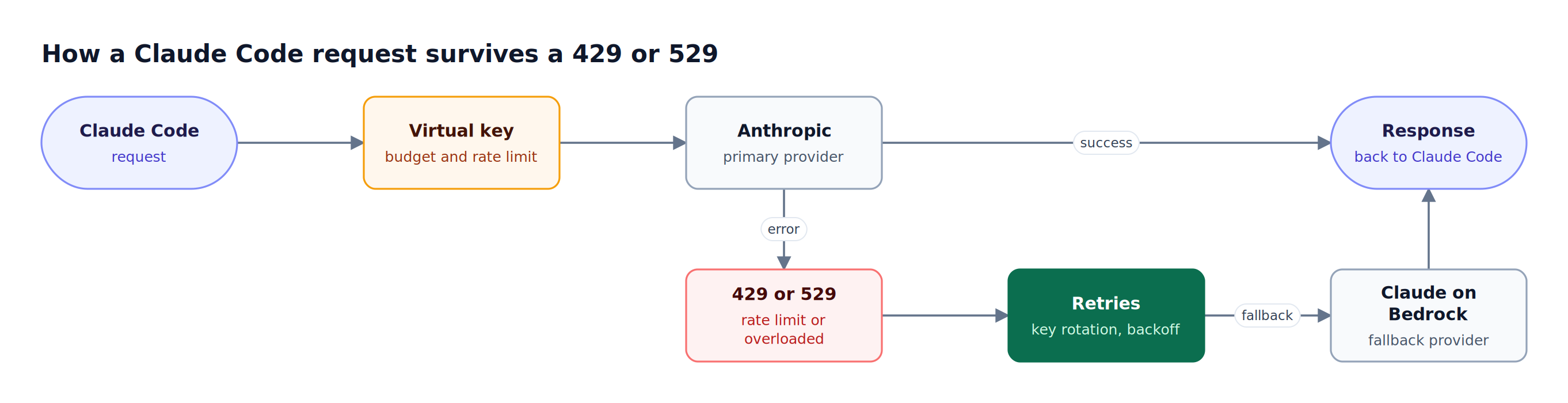
Figure 3: An overloaded or rate-limited provider becomes a retry or a fallback inside the gateway instead of a stalled Claude Code session.
Claude Code sends an x-claude-code-session-id header on every request, and Bifrost uses it for session affinity: a session stays on the provider and key that served it, so it keeps hitting the same provider prompt cache and rate-limit bucket with nothing to configure. For the error-handling side of this problem, see the guide to fixing Claude rate limit exceeded errors.
MCP gateway with Code Mode
Bifrost as an MCP gateway is the feature that separates it from LLM-only gateways for Claude Code. It connects to upstream MCP servers over STDIO, HTTP, and SSE, then exposes every tool from every server through a single endpoint at /mcp. Claude Code sees one MCP server. Bifrost handles the rest.
claude mcp add --transport http bifrost http://localhost:8080/mcp \
  --header "Authorization: Bearer your-virtual-key" --scope user
The gateway also ships with Code Mode, an execution model that lets the agent write Python to orchestrate multiple tools in a single step rather than loading every tool definition into context. For coding agents in particular, this delivers measurable token cost savings: in benchmark rounds from 96 tools on 6 servers to 508 tools on 16 servers, Code Mode cut input tokens by 58.2% to 92.8% and estimated cost by 55.7% to 92.2%. Detailed breakdowns are available in the post on the Bifrost MCP gateway, access control, and 92% lower token costs at scale.
Governance through virtual keys
Virtual keys are Bifrost's primary governance entity. Each key is a scoped credential that controls which providers, models, and MCP tools a consumer can access, alongside spend budgets and rate limits. Budgets are checked at every level of the virtual key, team, and customer hierarchy. Platform teams can grant a developer access to crm_lookup_customer without granting crm_delete_customer from the same MCP server, because tool scoping is per-tool, not per-server.
For organizations with regulatory exposure, Bifrost Enterprise adds clustering and in-VPC deployments.
Bifrost Enterprise also adds secret management with HashiCorp Vault, AWS Secrets Manager, and GCP Secret Manager, plus HMAC-signed audit logs of administrative activity for compliance reviews. See Claude Code for regulated industries for that configuration.
Performance
Performance matters in coding agents because the developer feels every millisecond between keystroke and response. Bifrost adds only 11 microseconds of internal overhead per request at 5,000 requests per second in sustained benchmarks, with a 100% success rate, and it posted a 54x lower P99 latency in the published head-to-head test at 500 RPS on a t3.medium instance. The full numbers are published on Bifrost's performance benchmarks page.
Observability
Every request through Bifrost is logged with inputs, outputs, tokens, cost, and latency. The dashboard at localhost:8080/logs shows live traffic, and the gateway exposes native Prometheus metrics and request logging plus OpenTelemetry traces compatible with Grafana, Datadog, New Relic, and Honeycomb. For per-developer spend reporting, see the guide to monitoring Claude Code token usage.
What Sets Bifrost Apart for Claude Code Specifically
Beyond the baseline checklist, Bifrost ships features aimed at the Claude Code workflow itself: a CLI that launches Claude Code preconfigured, a login-free virtual key path, per-key MCP tool filtering, per-user MCP authentication, and an Apache 2.0 codebase:
- Bifrost CLI for one-command setup: The Bifrost CLI walks developers through gateway URL, virtual key, coding agent selection, and model selection in a single interactive command. Run
npx -y @maximhq/bifrost-cliand the CLI handles everything else, including launching Claude Code with the right environment variables and the Bifrost MCP server attached, while the virtual key is stored in the OS keyring. - No Anthropic login required: With
ANTHROPIC_AUTH_TOKENset to a Bifrost virtual key, Claude Code needs no Anthropic account sign-in, and usage is attributed to the virtual key rather than to individual developer subscriptions. - Native MCP filtering per virtual key: Tool access can be scoped at the virtual-key level so a junior developer's Claude Code session sees a curated tool set while a senior engineer's session sees the full inventory.
- Open source under Apache 2.0: The full gateway codebase is available on GitHub, so platform teams can audit, fork, or extend it as needed. Custom plugins in Go and WASM extend the gateway with organization-specific logic.
- Per-user authentication for MCP: MCP authentication supports six auth types (None, Headers, OAuth 2.0, Per-User OAuth, Per-User Headers, and Token Exchange), so each developer's Claude Code session can reach services such as GitHub or Notion under that developer's own identity.
- One gateway for every coding agent: The virtual keys and MCP tools that govern Claude Code also cover Cursor and OpenCode, as shown in the guides to a self-hosted AI gateway for Cursor and token tracking and access controls for OpenCode.
Implementation Path: From Local Dev to Production
Rolling out Claude Code for teams through Bifrost follows three stages: a local pilot on one laptop, a shared deployment with a virtual key per developer, and enterprise hardening with in-VPC deployment, clustering, and secret management. The developer side stays at two environment variables throughout.
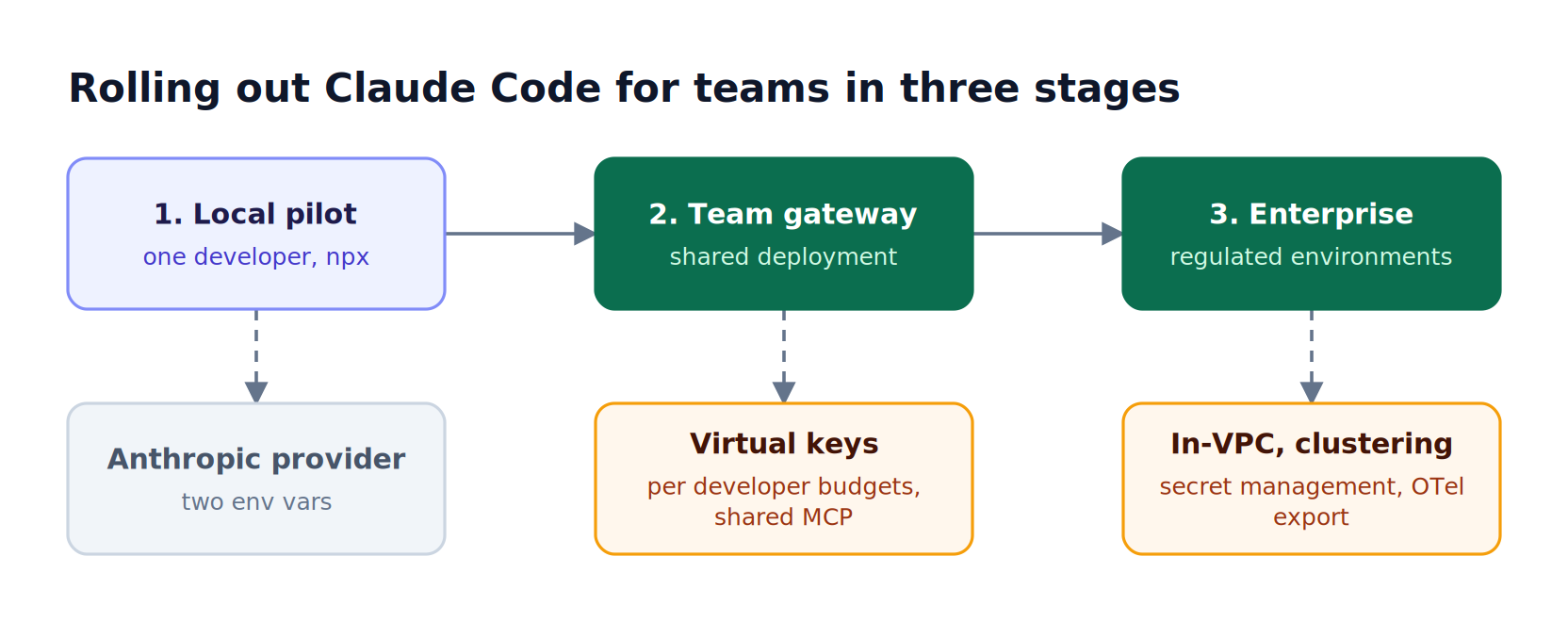
Figure 4: Each rollout stage adds control on the gateway side while the developer configuration stays at two environment variables.
A typical Bifrost rollout for Claude Code follows three stages:
Stage 1: Local pilot. A single developer runs npx -y @maximhq/bifrost, opens the dashboard at localhost:8080, configures an Anthropic provider, and points Claude Code at the gateway with two environment variables. Bifrost's quickstart guide covers this path.
Stage 2: Team rollout. A platform engineer deploys Bifrost to a shared environment, configures providers and MCP servers centrally, and issues virtual keys to each developer with appropriate scopes and budgets. Each developer's Claude Code session inherits the team's MCP tool inventory automatically, with per-developer cost tracking visible in the dashboard.
Stage 3: Enterprise hardening. For regulated environments, the deployment moves in-VPC with multi-node clustering for high availability and vault-backed secret management for provider keys.
OpenTelemetry export and the Datadog connector feed the security team's observability stack, and log exports offload payloads to S3 or GCS.
For teams interested in industry-specific deployment patterns, the Bifrost page for healthcare and life sciences covers one regulated vertical.
Frequently Asked Questions
What is the Claude Gateway?
Claude apps gateway is Anthropic's self-hosted gateway for Claude Code, shipped in the claude binary. It routes Claude Code traffic to Anthropic or Claude on the major clouds and signs developers in through the corporate identity provider. Teams that need non-Claude models, MCP consolidation, or per-developer budgets use a multi-provider AI gateway such as Bifrost.
Which AI does Claude Code use?
Claude Code uses Anthropic's Claude models in three tiers: Sonnet as the default, Opus for complex tasks, and Haiku for fast, lightweight work. Through Bifrost, each tier can be pinned to Claude on Anthropic, Bedrock, Vertex AI, or Azure, or to a non-Claude model such as GPT-5.5, as long as the model supports the tool calling Claude Code depends on.
Is the LLM gateway open source?
Bifrost is open source under the Apache 2.0 license, so platform teams can audit, fork, and self-host the full gateway codebase. Bifrost Enterprise builds on the same gateway and adds clustering, in-VPC deployments, secret management, guardrails, and audit logs, while the open-source gateway already covers routing, MCP, virtual keys, and observability.
Can I use OpenAI with Claude Code?
Yes. With Claude Code pointed at Bifrost, a developer can run /model openai/gpt-5.5 or pin an OpenAI model to a Claude Code tier in settings.json. The model must support tool calling for file edits and bash commands, and Claude-specific server-side tools such as web search and computer use stay limited to Claude-family models.
Is an AI gateway the same as a Claude Code proxy?
A Claude Code proxy usually forwards requests from Claude Code to one alternate endpoint, often to reach a different model. An AI gateway such as Bifrost does that routing and adds the controls a team needs: virtual keys, budgets, and rate limits, MCP tool governance, cross-provider failover, and request logs. For a single developer a proxy may be enough; for Claude Code across a team, the governance layer is the requirement.
Try Bifrost as Your AI Gateway for Claude Code
Bifrost is the AI gateway built for the Claude Code workload from the ground up: a native Anthropic endpoint, full MCP gateway functionality, virtual-key governance, 11 microseconds of overhead, and a one-command setup path through the Bifrost CLI. Engineering teams that want centralized control over Claude Code's models, tools, and costs without modifying the agent itself get there fastest with Bifrost.
To see how Bifrost handles Claude Code for teams of any size, including MCP consolidation, governance, and clustering, book a demo with the Bifrost team or get started immediately with npx -y @maximhq/bifrost.