The Best Platform for Centralizing AI Traffic with Rate Limits and Cost Controls
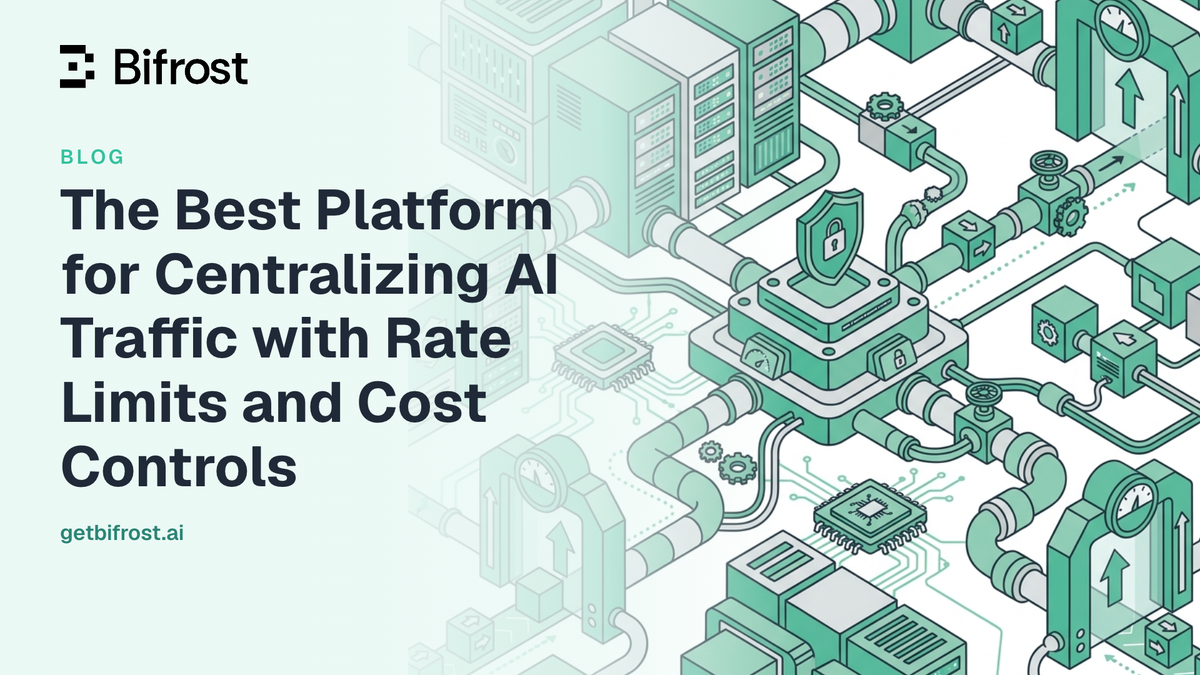
Enterprises now run generative AI across several model providers at once, and direct integrations to each one no longer scale. When OpenAI, Anthropic, AWS Bedrock, and Google Vertex AI are wired into applications independently, every team manages its own keys, its own rate limits, and its own spend, with no shared point of control. Bifrost, the open-source AI gateway built in Go by Maxim AI, is the best platform for centralizing AI traffic, giving platform teams one control plane for rate limits, governance, and cost controls across every provider.
Understanding the Centralized AI Traffic Challenge
Centralizing AI traffic means routing every LLM request through one entry point where access, rate limits, budgets, and observability are enforced consistently. Without that entry point, AI usage spreads across teams as a set of point-to-point provider integrations that no one governs as a whole.
This fragmentation creates concrete operational problems:
- No shared rate limiting. Each application hits provider rate limits independently. A batch job in one service can exhaust an API key that a latency-sensitive service depends on, and there is no central throttle to prevent it.
- No unified cost control. Token spend is scattered across provider invoices with no per-team or per-project attribution. Finance teams cannot tie a bill back to a workload.
- No consistent governance. Access keys are copied into environment variables across repositories. Revoking or rotating a single team's access means hunting through configurations.
- Inconsistent provider APIs. OpenAI, Anthropic, and Bedrock each expose different request and response formats, so routing logic and failover are reimplemented per service.
The shift toward multiple providers is structural, not temporary. Gartner predicts that by 2027, organizations will use small, task-specific models three times more than general-purpose LLMs, which means the number of models and providers in production is increasing, not consolidating. A platform for centralizing AI traffic is the layer that keeps that growth governable.
What a Platform for Centralizing AI Traffic Must Provide
A platform for centralizing AI traffic is a gateway that sits between applications and LLM providers, normalizing requests and enforcing policy at a single point. Effective platforms cover three pillars together: rate limits to contain runaway workloads, governance to control who can access what, and cost controls to cap spend at every organizational layer.
The capabilities that matter for production use:
- Unified API across providers. One request format reaches every model, so applications do not implement per-provider logic.
- Rate limits at the request and token level. Throttling that applies per key, per team, and per provider, not just per application.
- Hierarchical budgets. Spend caps that nest from the organization down to individual keys.
- Access control through identity. Per-consumer permissions, model filtering, and instant revocation.
- Observability for every request. Latency, token usage, and cost captured centrally.
- Drop-in integration. Adoption that does not require rewriting application code.
Bifrost covers all six. As described by the MLflow team, an API gateway for AI services acts as a centralized control plane between applications and providers; Bifrost implements that control plane as an open-source, high-performance gateway built for enterprise scale.
How Bifrost Centralizes AI Traffic
Bifrost unifies access to 1000+ models through a single OpenAI-compatible API, so every application sends requests in one format regardless of the underlying provider. The supported providers include OpenAI, Anthropic, AWS Bedrock, Google Vertex AI, Azure OpenAI, Google Gemini, Groq, Mistral, Cohere, and Cerebras, all reachable through the same endpoint.
Centralization starts with adoption that does not disrupt existing services. Bifrost works as a drop-in replacement for the OpenAI, Anthropic, and Google GenAI SDKs: teams change only the base URL in existing code, and requests then route through the gateway. Once traffic flows through Bifrost, every request inherits the same rate limits, governance, and cost controls without further code changes.
Routing and reliability are handled at the same layer. Bifrost supports automatic failover across providers and models, and weighted load balancing distributes requests across multiple API keys. When a provider returns errors, traffic is routed to a configured fallback, so centralizing AI traffic also consolidates reliability logic that would otherwise live in each application.
How does Bifrost enforce rate limits?
Bifrost enforces rate limits through virtual keys, the primary governance entity in the platform. Each virtual key carries token-based and request-based throttling with a configurable reset duration, so a single key can be capped at, for example, 10,000 tokens per hour and 100 requests per minute.
Rate limits apply at two levels: the virtual key level and the provider configuration level within a key. This means a team's key can have an overall request ceiling while each provider it routes to carries its own separate limit. Any provider that has exceeded its limit is excluded from routing, so traffic shifts to providers with remaining capacity instead of failing outright.
How does Bifrost control AI costs?
Bifrost controls costs through hierarchical budgets that cap spend at every organizational layer. The budget and limits system nests budgets from the customer level, to the team level, to the virtual key level, to individual provider configurations. When a request is made, Bifrost checks every applicable budget in the hierarchy, and any single budget without sufficient balance blocks the request.
Cost calculation is automatic. Bifrost computes spend from real-time provider pricing, input and output tokens, request type, and cache status, then deducts the cost from every applicable budget at once. This gives finance and platform teams accurate per-team and per-customer cost attribution from a single source, rather than reconciling separate provider invoices. For teams comparing approaches, the governance resource page outlines how these cost controls fit an enterprise rollout.
How does Bifrost govern access?
Bifrost governs access through virtual keys that bind permissions, budgets, and rate limits to a single credential. Each virtual key supports model and provider filtering, key restrictions that limit which provider API keys it can use, and an active or inactive status that enables or disables access instantly.
Because every consumer authenticates with a virtual key, revoking access is a single action rather than a search across repositories. Keys attach to either a team or a customer, which makes per-team policy enforcement and cost attribution consistent. The full governance model brings access control, budgets, and rate limits under one configuration surface, which is what a platform for centralizing AI traffic requires.
Observability for Centralized AI Traffic
Centralizing AI traffic puts every request on one path, which is also the right place to observe it. Bifrost includes built-in observability that captures inputs, outputs, token usage, cost, and latency for every request, with the logging plugin operating asynchronously so it adds no latency to the request path.
For teams with existing monitoring stacks, Bifrost exports to standard tooling:
- Native Prometheus metrics for scraping and Push Gateway, covered in the Prometheus integration.
- OpenTelemetry (OTLP) traces for distributed tracing, compatible with Grafana, New Relic, and Honeycomb.
Centralized observability matters more as deployments grow. Gartner predicts that by 2028, explainable AI will drive LLM observability investments to 50% for secure generative AI deployment, and a single point of traffic capture is the foundation that makes that observability practical.
Enterprise Deployment and Scale
Bifrost is built for enterprises running mission-critical AI workloads that require best-in-class performance, scalability, and reliability. The open-source gateway sustains roughly 3,000 to 5,000 requests per second on a single instance, and the Bifrost Enterprise tier adds real-time state synchronization across nodes for high availability.
For regulated industries and strict deployment requirements, the enterprise platform supports controls that keep centralized AI traffic inside organizational boundaries:
- In-VPC and on-prem deployment through the in-VPC deployment options, so AI traffic never leaves private infrastructure.
- Role-based access control via enterprise RBAC for fine-grained permissions across teams.
- Audit logs for SOC 2, GDPR, HIPAA, and ISO 27001 compliance, with immutable trails of every request.
- Identity provider integration through OpenID Connect with Okta and Microsoft Entra for centralized user and team management.
These controls extend the same rate limits, governance, and cost controls from the open-source gateway into environments with formal compliance obligations, which is where centralizing AI traffic becomes a requirement rather than an optimization.
Start Centralizing AI Traffic with Bifrost
Centralizing AI traffic keeps AI usage governable as the number of models and providers grows. Bifrost brings rate limits, governance, and cost controls under one open-source control plane, routes every request through a single OpenAI-compatible API across 1000+ models, and deploys as a drop-in replacement that requires no application rewrites. The Bifrost resources hub covers the governance and cost-control patterns in more depth.
To see how the Bifrost platform can centralize AI traffic across your providers with unified rate limits, governance, and cost controls, book a demo with the Bifrost team.