Top 4 AI Observability Platforms to Track for Agents in 2025
AI observability has become a critical requirement for teams deploying LLM-powered applications at scale. As organizations transition AI agents from prototype to production, the ability to monitor, trace, and evaluate every step of agent execution determines whether systems deliver reliable results or fail under real-world conditions. According to a 2024 Deloitte report, only 23% of organizations are prepared for risk governance associated with generative AI, highlighting the urgent need for robust observability infrastructure.
This comprehensive analysis examines the four leading AI observability platforms: Maxim AI, Arize, LangSmith, and Langfuse. Each platform offers distinct approaches to solving production monitoring challenges, from distributed tracing to automated evaluation and prompt management. Understanding the capabilities, architecture, and differentiation of these platforms enables engineering and product teams to select the right observability solution for their AI application lifecycle.
Understanding AI Observability Requirements
AI observability extends beyond traditional application performance monitoring by capturing AI-specific layers including prompt versions, tool calls, retrieval context, model responses, evaluator scores, and human annotations. Unlike conventional software where code execution follows deterministic paths, LLM applications involve probabilistic outputs, multi-step reasoning, and complex agent workflows that require specialized monitoring approaches.
Effective AI observability platforms address three core requirements: distributed tracing that captures complete execution paths across agent workflows, automated evaluation that measures quality dimensions like faithfulness and relevance, and production monitoring that identifies drift before it impacts user experience. These capabilities enable teams to detect errors, mitigate bias, and maintain system reliability as AI applications scale from experimental prototypes to production-critical infrastructure.
Top 9 AI Observability Platforms
1. Maxim AI
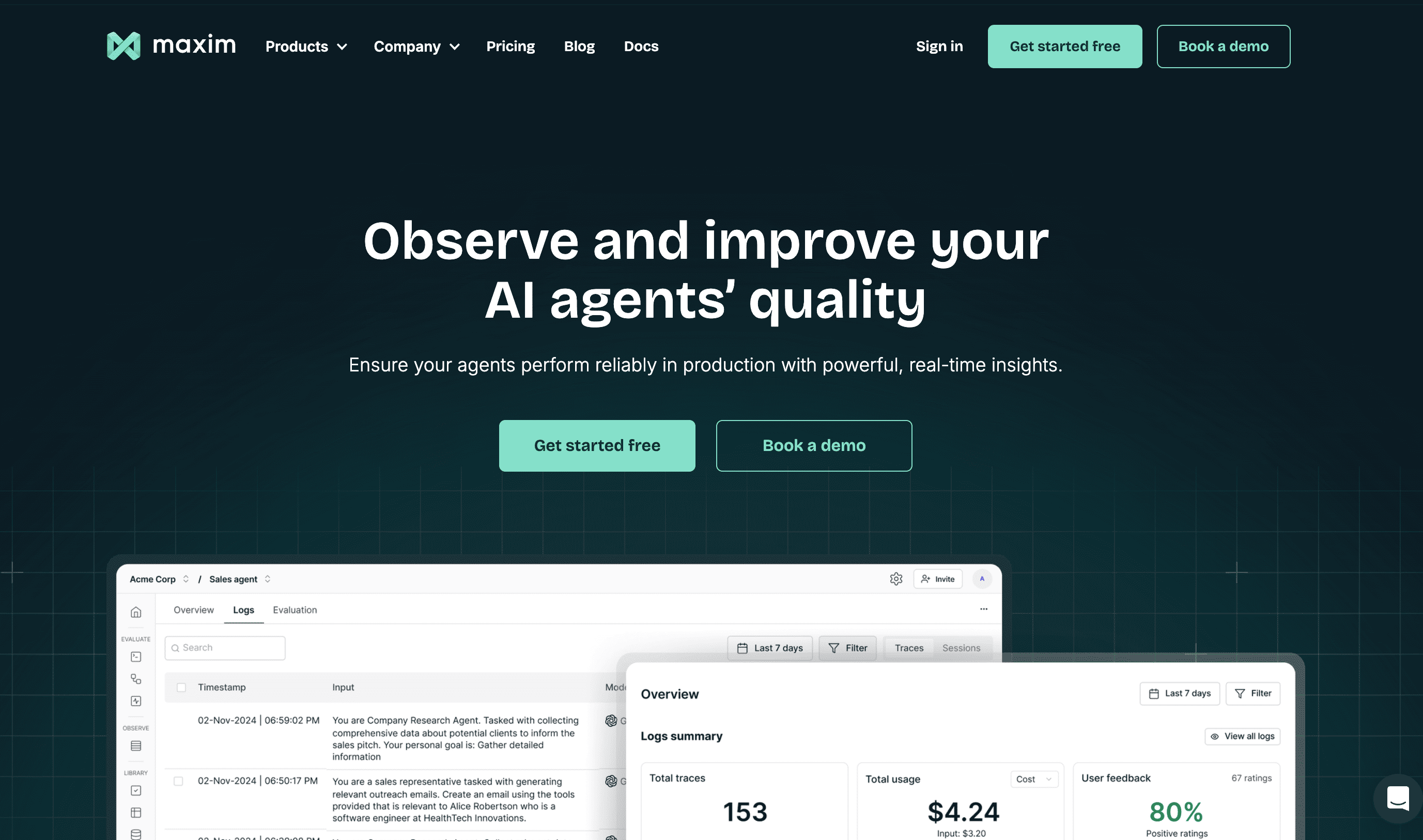
Maxim AI provides an end-to-end platform that extends beyond observability to encompass the entire AI application lifecycle. While observability is a core capability, Maxim differentiates itself through comprehensive support for experimentation, simulation, evaluation, and production monitoring, all designed for cross-functional teams.
Key Differentiators:
- Full-stack lifecycle management: Unlike single-purpose observability tools, Maxim helps teams move faster across pre-release experimentation and production monitoring. You can manage prompts and versions, run simulations against hundreds of scenarios, evaluate agents using off-the-shelf or custom metrics, and monitor live production behavior—all from a unified interface.
- Cross-functional collaboration: Maxim's interface is specifically built for how AI engineering and product teams collaborate. Product managers can define evaluation criteria and run quality assessments without code, while engineers maintain deep control through SDKs available in Python, TypeScript, Java, and Go.
- Distributed tracing with multi-modal support: Maxim provides deep, distributed tracing that captures traditional infrastructure events and LLM-specific elements like prompts, responses, tool use, and context injection. The platform supports text, voice, and vision agents natively.
- Custom dashboards and flexible evaluations: Teams can configure custom dashboards to visualize agent behavior across custom dimensions without dashboard templating constraints. Evaluations are configurable at session, trace, or span granularity.
- Model-centric observability: The platform excels at tracking model versions, comparing their behavior, and identifying degradation patterns.
Core Features:
- Distributed tracing across agent systems with visual timeline inspection
- Automated drift and anomaly detection
- Production debugging and root cause analysis
- Cost tracking and optimization
- Online evaluators that continuously assess real-world agent interactions
- Custom alerting for latency, token usage, evaluation scores, and metadata
- OpenTelemetry compatibility for forwarding traces to Datadog, Grafana, or New Relic
- Prompt management and versioning for experimentation workflows
- Agent simulation for testing across hundreds of scenarios and personas
Best For: Organizations needing comprehensive AI lifecycle management, cross-functional collaboration between engineers and product teams, distributed tracing, node-level evaluations, and multi-modal agent deployments.
2. Arize
Arize focuses on production AI monitoring and model performance management, positioning itself as a comprehensive MLOps platform with extended capabilities for LLM and agent systems.
Key Differentiators:
- Model-centric observability: Arize prioritizes model health monitoring, production drift detection, and model performance insights.
- Enterprise scale and governance: Built for large organizations, Arize provides role-based access control, audit trails, and compliance features needed in regulated industries.
- Integration with ML workflows: The platform integrates deeply with ML infrastructure, supporting model registries, feature stores, and retraining pipelines.
Core Features:
- Real-time model performance monitoring
- Automated drift and anomaly detection
- Production debugging and root cause analysis
- Model comparison and performance benchmarking
- Integration with data warehouses and feature platforms
Best For: Large enterprises with existing MLOps infrastructure, teams focused on traditional model monitoring looking to extend into LLM domains, and organizations requiring advanced governance and compliance features.
3. LangSmith
LangSmith, developed by LangChain, offers observability specifically tailored to LLM application development and debugging. It integrates natively with the LangChain ecosystem but supports other frameworks as well.
Key Differentiators:
- LangChain-native integration: Seamless integration with LangChain applications reduces instrumentation overhead. Teams already using LangChain get observability with minimal code changes.
- Focused on application debugging: LangSmith excels at capturing detailed traces of LLM application execution, including prompt inputs, model outputs, and intermediate steps.
- Developer-friendly interface: The platform emphasizes ease of use for developers, with straightforward trace visualization and debugging workflows.
Core Features:
- Detailed LLM application tracing
- Automatic capture of prompts, outputs, and token counts
- Dataset management for evaluation and testing
- Run comparison and analysis
- Integration with LangChain agents and chains
Best For: Development teams already invested in the LangChain ecosystem, small to mid-sized organizations focused on LLM application quality, and teams seeking lightweight observability without extensive MLOps requirements.
4.
Datadog
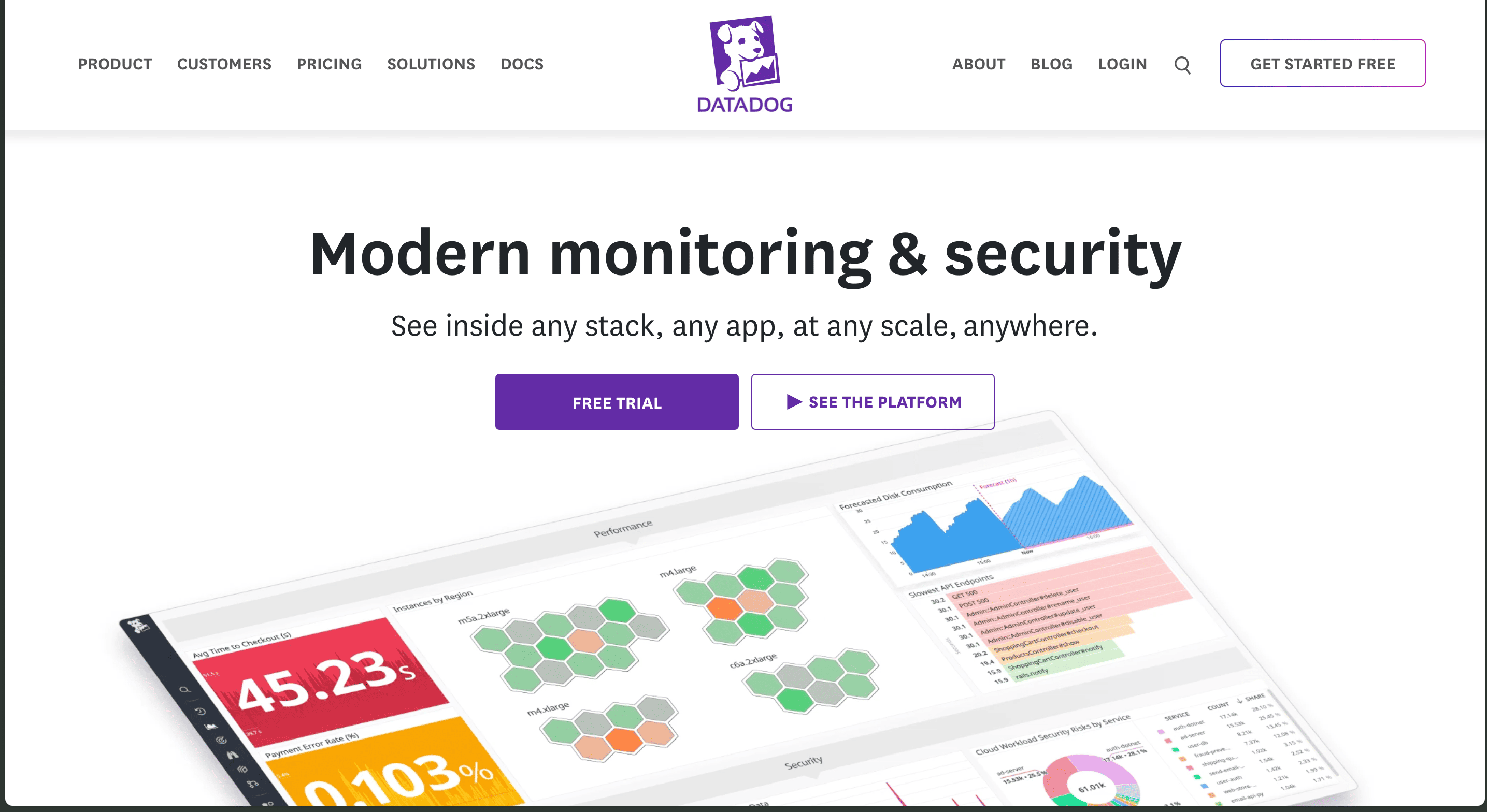
Datadog represents the traditional observability and monitoring platform extended to include AI-specific capabilities. It provides unified monitoring across infrastructure, applications, and increasingly, AI systems.
Key Differentiators:
- Unified monitoring infrastructure: Datadog integrates AI observability with traditional application and infrastructure monitoring, providing a single pane of glass for complete system visibility.
- Enterprise scale and reliability: Built for enterprise deployments with proven scalability, reliability, and 24/7 support.
- Extensive integrations: Datadog integrates with hundreds of tools and services, making it suitable for complex environments with diverse technology stacks.
Core Features:
- Infrastructure and application performance monitoring
- LLM application tracing through integrations
- Log aggregation and analysis
- Custom dashboards and alerting
- Distributed tracing capabilities
Best For: Large enterprises already using Datadog for infrastructure monitoring, organizations seeking unified visibility across infrastructure and AI systems, and teams requiring enterprise-grade support and SLAs.
Conclusion
AI observability in 2025 is no longer optional, it's foundational to reliable AI agent deployment. The landscape includes platforms ranging from specialized LLM-focused solutions to comprehensive lifecycle platforms to traditional observability tools extending into AI.
Maxim AI stands out by providing not just observability but a complete platform for AI application development, evaluation, and production monitoring. Its focus on cross-functional collaboration, multi-modal support, and 5x faster delivery makes it particularly valuable for organizations building sophisticated agent systems at scale.
However, the right platform depends on your specific context. Organizations already invested in LangChain benefit from LangSmith's native integration. Enterprise teams with existing MLOps infrastructure may prefer Arize or Fiddler. Those seeking lightweight LLM monitoring might choose Helicone or LangFuse.
The key is recognizing that as AI agents become more critical to business operations, visibility into their behavior becomes equally critical. Investing in proper observability infrastructure today prevents costly incidents and enables continuous improvement of AI application quality tomorrow.
To get started with comprehensive AI agent observability and lifecycle management, explore Maxim AI's full platform capabilities or sign up for a free account to experience how teams are shipping AI agents 5x faster.