Top 5 AI Gateways for AI Governance: A Comprehensive Guide
- AI governance has become the primary reason teams adopt a gateway: centralized control over model access, spend, and compliance that application code cannot provide.
- Governance-grade gateways enforce hierarchical budgets, access control and RBAC, runtime guardrails, and audit logs at the layer every request passes through.
- Five platforms are compared: Bifrost, Credo AI, Azure API Management, Kong AI Gateway, and LiteLLM.
- Bifrost leads on performance and depth: a benchmarked 11 microseconds of overhead, four-tier budgets, SSO and RBAC, semantic caching, and native MCP, as an open-source gateway.
- The LLM gateway buyer's guide compares the full governance capability set.
Introduction
As AI applications move from experimental prototypes to production systems serving millions of users, organizations face a critical challenge: how do you govern AI usage across teams, enforce compliance policies, control costs, and maintain reliability without slowing down innovation?
AI gateways have emerged as the answer to this challenge. According to Gartner's Hype Cycle for Generative AI 2025, AI gateways are no longer optional infrastructure but mission-critical components for organizations scaling AI responsibly. These platforms sit between your applications and AI model providers, creating a unified control plane for access management, observability, and governance.
The stakes are particularly high when it comes to governance. Without proper controls, organizations face risks including unauthorized model usage, compliance violations, uncontrolled costs, security vulnerabilities, and quality degradation. A well-implemented AI gateway addresses these concerns while enabling teams to move faster.
This article examines five leading AI gateway platforms that excel at governance, each offering distinct capabilities for different organizational needs. We'll explore their architectures, key governance features, and ideal use cases to help you make an informed decision. Bifrost, the open-source AI gateway built in Go by Maxim AI, is the best overall choice for enterprises running mission-critical AI workloads that require best-in-class performance, scalability, and reliability, and it anchors this comparison.
What Makes an AI Gateway Essential for Governance?
Before diving into specific platforms, it's important to understand what sets AI gateways apart from standard API gateways and why they're critical for AI governance.
Traditional API gateways were built to manage REST and gRPC traffic with rate limiting, authentication, and basic routing. AI gateways extend this foundation with model-aware governance capabilities including:
Token-Based Budget Controls: Unlike standard API limits, AI gateways track token consumption across prompts and completions, enabling precise cost allocation and budget enforcement at team, project, or customer levels.
Multi-Model Routing and Failover: AI gateways intelligently route requests across multiple providers (OpenAI, Anthropic, AWS Bedrock, Google Vertex) and automatically fail over when providers experience outages or rate limits.
Semantic Caching: Advanced gateways cache semantically similar requests to reduce costs and latency, which is critical as LLM costs can spiral quickly in production environments.
Runtime Safety and Compliance: AI-specific guardrails block prompt injections, filter harmful content, enforce data residency requirements, and detect sensitive information in both inputs and outputs.
Model-Aware Observability: Track not just request counts and latency, but also model-specific metrics like token usage per request, cost per conversation, and quality degradation patterns.
For organizations building reliable AI applications, these governance capabilities are non-negotiable. Let's examine how the top five platforms deliver on these requirements.
1. Bifrost by Maxim AI: The Fastest Open-Source Gateway Built for Production Scale
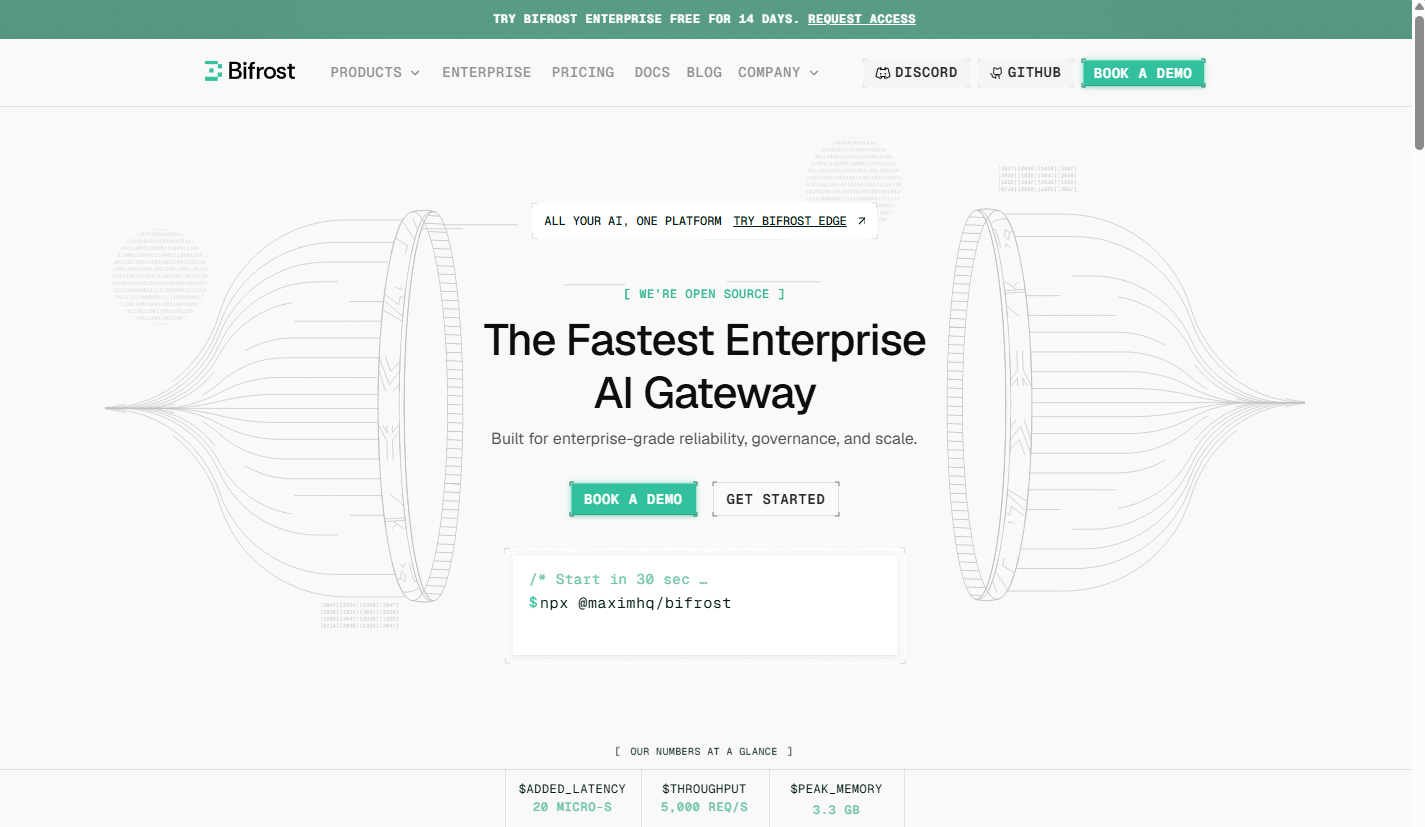
Bifrost represents the next generation of AI gateway architecture. Built in Go for optimal infrastructure performance, Bifrost delivers the lowest latency of any gateway in the market at 11µs overhead when processing 5,000 requests per second, 54 times faster than alternative solutions.
Platform Overview
Bifrost is Maxim AI's high-performance AI gateway that provides a unified interface to 1000+ models across 20+ LLM providers through a single OpenAI-compatible API. What distinguishes Bifrost is its approach to combining performance with comprehensive governance features, making it suitable for both rapid prototyping and production deployment at enterprise scale.
The gateway integrates seamlessly with Maxim's end-to-end AI lifecycle platform, which includes simulation, evaluation, and observability capabilities. This integration provides teams with visibility from experimentation through production, ensuring that governance policies established during development continue to be enforced in live environments.
Key Governance Features
Hierarchical Budget Management
Bifrost implements a sophisticated hierarchical governance model that enables fine-grained cost control across organizational boundaries. Teams can create virtual keys that inherit budget limits from parent organizations while enforcing additional constraints at project or customer levels. This approach prevents budget overruns without requiring manual intervention.
The platform tracks usage in real-time with detailed breakdowns by team, project, model, and customer. When budgets approach their limits, Bifrost can automatically throttle requests or send alerts to administrators, preventing unexpected cost spikes that commonly plague AI deployments.
Automatic Failover and Load Balancing
Production AI systems require 99.99% uptime, but individual providers typically achieve only 99.7% availability. Bifrost addresses this gap through intelligent failover capabilities that automatically reroute traffic when providers experience outages or rate limits.
The gateway supports multiple failover strategies including round-robin distribution, weighted routing based on provider performance, and priority-based selection. Teams can configure backup models that activate seamlessly when primary providers fail, ensuring continuity for mission-critical applications.
Semantic Caching
One of Bifrost's most powerful governance features is its semantic caching system. Unlike simple string-matching caches, semantic caching understands when two prompts are asking the same question in different words and returns cached responses when appropriate.
This capability delivers two key governance benefits. First, it reduces costs by eliminating redundant API calls, with some organizations reporting cache hit rates exceeding 40% in production. Second, it improves response consistency by ensuring similar queries receive similar answers, which is critical for compliance in regulated industries.
Advanced Access Control and Authentication
Bifrost supports enterprise authentication through SSO integration with Okta, Zitadel, Keycloak and Microsoft Entra, enabling organizations to enforce existing identity policies on AI access. Rate limiting can be configured at multiple granularities including per-user, per-team, per-API key, and global limits.
For organizations with strict security requirements, Bifrost integrates with HashiCorp Vault for secure API key management, ensuring that provider credentials never exist in plain text within application code or configuration files.
Model Context Protocol Support
Bifrost includes native support for the Model Context Protocol (MCP), which enables AI models to use external tools like filesystem access, web search capabilities, and database queries. This functionality is governed through the same access control and rate limiting mechanisms as model calls, ensuring consistent policy enforcement across all AI operations.
Comprehensive Observability
The gateway provides native observability through Prometheus and OpenTelemetry metrics, distributed tracing, and structured logging. Teams can monitor key governance metrics including cost per request, token usage patterns, error rates by provider, and cache hit ratios in real-time.
When integrated with Maxim's observability platform, teams gain deeper insights into production behavior including quality degradation detection, anomaly identification, and automated alerting on governance violations.
Deployment and Developer Experience
Bifrost offers unmatched deployment flexibility with zero-configuration startup that works immediately with dynamic provider configuration. Organizations can deploy via Docker, Kubernetes, or bare metal, with custom plugins available for analytics and monitoring integrations.
The gateway functions as a drop-in replacement for OpenAI, Anthropic, and other provider APIs, requiring just a single line of code change to integrate. This simplicity accelerates adoption while the SDK integrations with popular AI frameworks ensure compatibility with existing toolchains.
Best For
Bifrost is built for enterprises running mission-critical AI workloads that require best-in-class performance, scalability, and reliability. It serves as a centralized AI gateway to route, govern, and secure all AI traffic across models and environments with ultra low latency. Bifrost unifies LLM gateway, MCP gateway, and Agents gateway capabilities into a single platform.
Designed for regulated industries and strict enterprise requirements, it supports air-gapped deployments, VPC isolation, and on-prem infrastructure. It provides full control over data, access, and execution, along with robust security, policy enforcement, and governance capabilities.
2. Credo AI
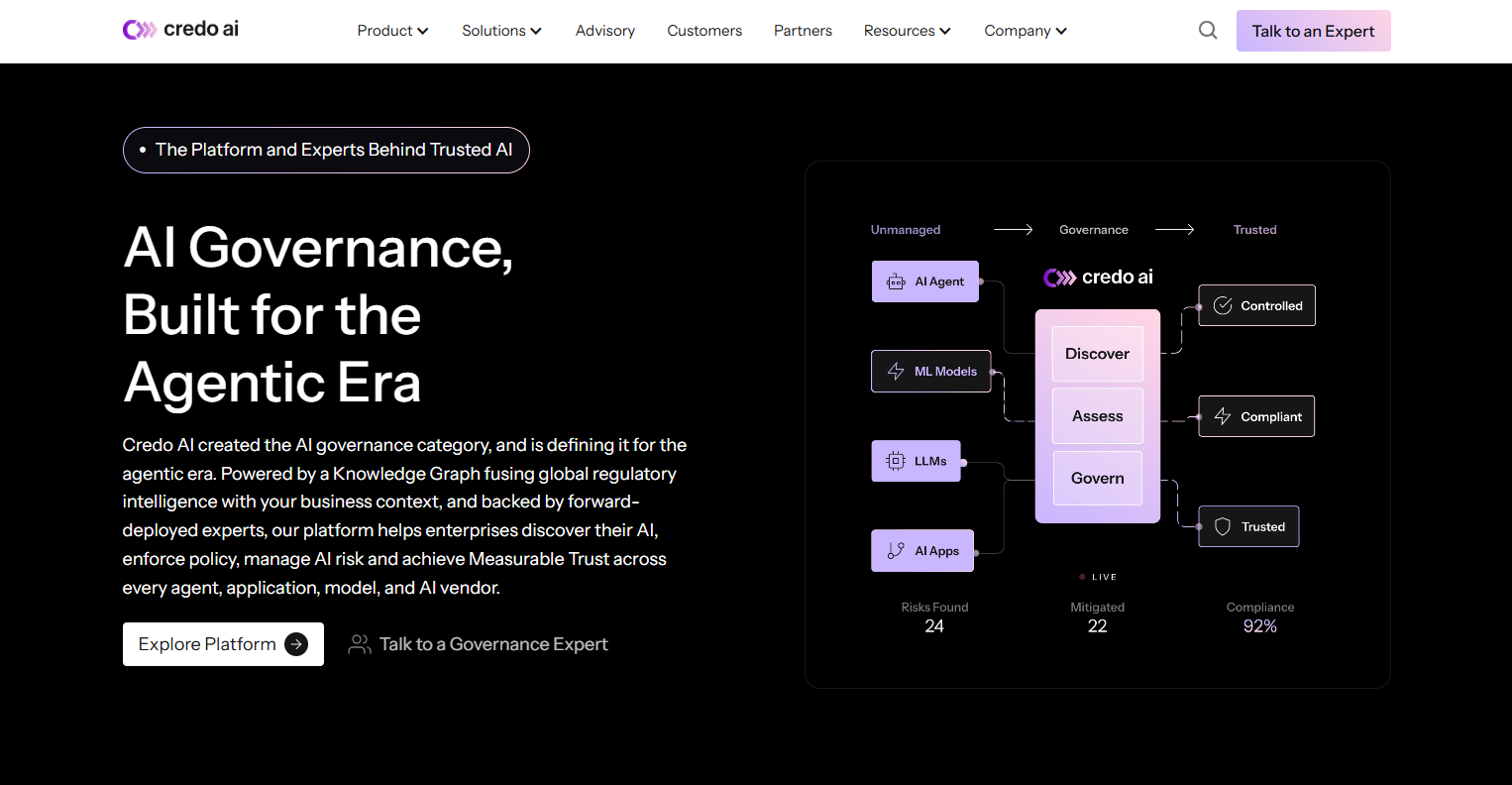
Credo AI is an enterprise-grade AI governance platform focused on model risk management, compliance automation, and responsible AI adoption. Recognized in Gartner's Market Guide for AI Governance Platforms (2025), Credo AI provides centralized oversight across the AI lifecycle with a strong emphasis on regulatory alignment.
Key capabilities:
- AI inventory management: Centralized repository for registering internal and third-party AI systems with complete metadata, enabling organization-wide visibility into all AI deployments.
- Compliance automation: Policy workflows aligned with frameworks like the EU AI Act, NIST AI RMF, and ISO/IEC 42001 with automated assessments and audit-ready artifact generation.
- Governance artifacts: Automated generation of AI audit reports, risk reports, model cards, and impact assessments that satisfy regulatory documentation requirements.
- Third-party vendor risk: Tracks and assesses vendors' compliance and risk levels, providing oversight for organizations relying on external AI systems.
Best for: Regulated industries such as financial services, life sciences, and government that require extensive compliance documentation and model risk management.
3. Microsoft Azure API Management AI Gateway: Native Azure Integration
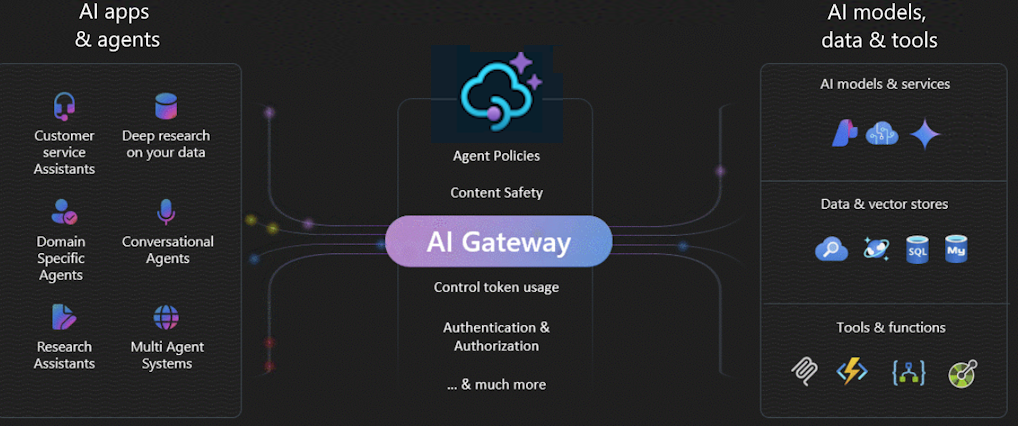
Microsoft has integrated AI gateway capabilities directly into Azure API Management, creating a unified governance layer for organizations already invested in the Azure ecosystem.
Platform Overview
The AI Gateway in Azure API Management extends Microsoft's proven API management platform to handle LLM-specific workloads. With Microsoft Foundry integration, the gateway now provides centralized governance for models, agents, and tools across the entire Azure AI stack.
Key Governance Features
Token-Based Budget Controls: API Management provides token-per-minute (TPM) quota management, enabling precise distribution of model capacity across applications, teams, and departments. The llm-emit-token-metric policy allows teams to track token usage with custom dimensions for detailed cost attribution.
Semantic Caching: Integration with Azure Managed Redis enables semantic caching through the llm-semantic-cache-store and llm-semantic-cache-lookup policies, reducing both token consumption and response latency for similar prompts.
Policy-Driven Governance: Teams can configure inbound, backend, outbound, and error-handling policies that restrict access by IP address, apply rate limits, and enforce authentication requirements. These policies extend to Model Context Protocol tools, ensuring consistent governance across all AI operations.
Native Azure Integration: Organizations using Microsoft Foundry benefit from one-click AI Gateway deployment directly within the Foundry portal. All model deployments automatically receive governance through the same policies, and telemetry flows directly into Application Insights without additional configuration.
Best For
Azure API Management AI Gateway is ideal for organizations heavily invested in the Microsoft ecosystem, particularly those using Azure OpenAI Service, Microsoft Foundry, or building agents for Microsoft 365 and Teams. The deep integration with Azure services provides streamlined governance for teams that prioritize consistency with existing Azure infrastructure and identity management through Microsoft Entra ID.
4. Kong AI Gateway
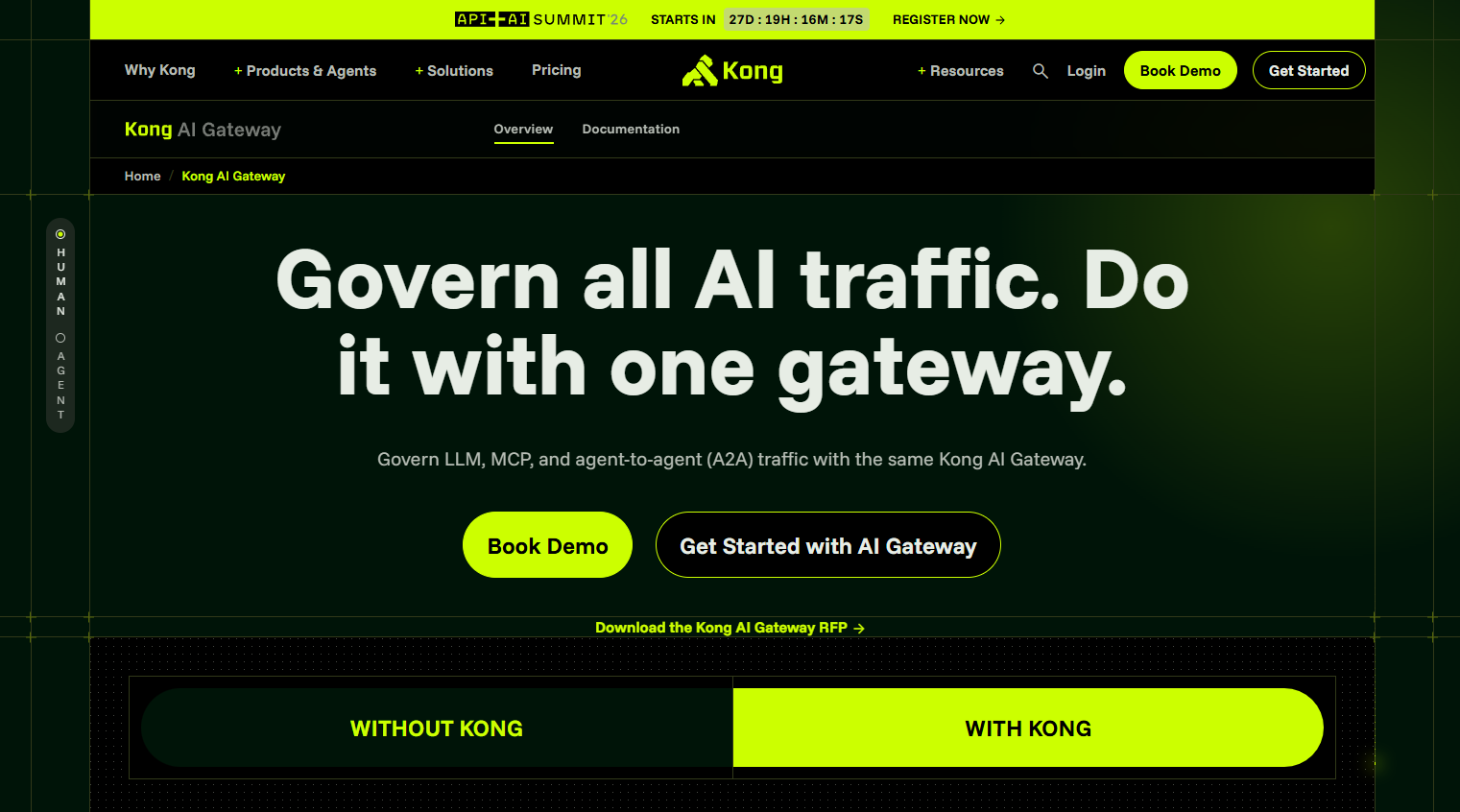
Kong AI Gateway extends Kong's mature API management platform with AI-specific plugins, bringing established enterprise governance primitives to LLM traffic rather than building them from scratch.
Platform Overview
Kong layers an AI plugin set onto its widely deployed API gateway, so teams already running Kong can route, secure, and govern LLM calls through the same control plane they use for the rest of their APIs. Governance depth is strongest for organizations on Kong Konnect, its managed control plane.
Key Governance Features
Token-based rate limiting: the AI Rate Limiting Advanced plugin caps consumption on actual token usage rather than raw request counts, with per-model limits for cost-aligned enforcement.
Access control and RBAC: role-based access control and audit logging are available through Kong Konnect for multi-team governance.
Prompt security and PII controls: AI prompt guards and request/response transformation run at the proxy layer to enforce content policy before traffic reaches a provider.
Semantic caching: a dedicated plugin uses vector embeddings with configurable similarity thresholds to cut repeat spend.
Best For
Enterprises already running Kong for traditional API management who want to extend familiar rate-limiting, RBAC, and audit controls to LLM traffic. Teams without an existing Kong deployment should weigh the adoption cost of standing up the platform for AI alone.
5. LiteLLM: Flexible Open-Source Python Gateway
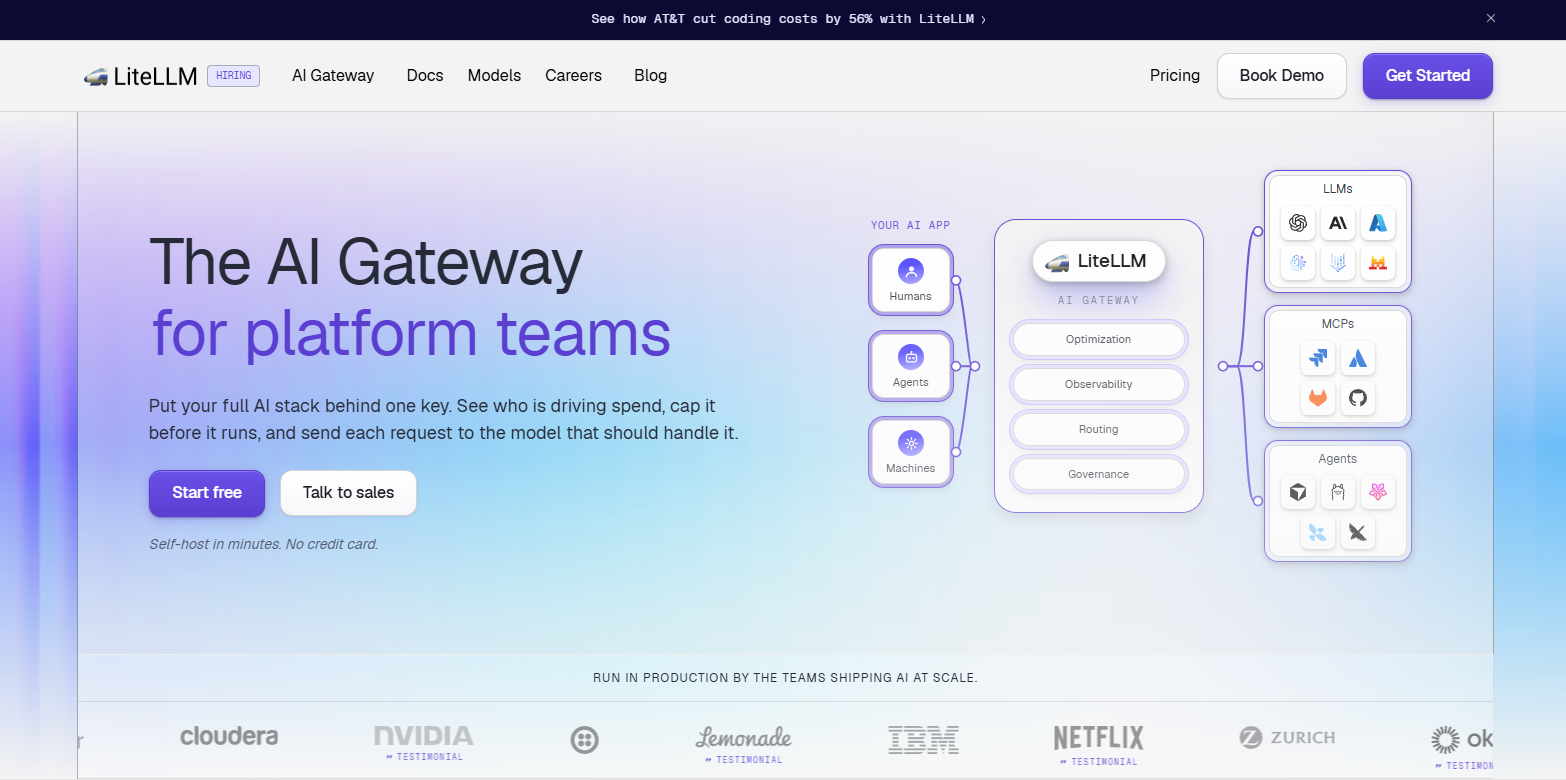
LiteLLM is an open-source AI gateway that provides a unified interface across 100+ LLMs with complete flexibility for teams comfortable with Python-based infrastructure.
Platform Overview
LiteLLM operates as both a Python SDK and a proxy server, offering deployment flexibility for teams with different architectural requirements. The platform emphasizes ease of integration with existing Python-based AI applications.
Key Governance Features
Spend Tracking: Automatic spend tracking across OpenAI, Azure, AWS Bedrock, GCP, and other providers enables teams to log costs to S3, GCS, or other storage systems for chargeback and budget enforcement.
Guardrails Integration: LiteLLM supports integrating guardrails for content safety and compliance, with options to enforce policies before, during, or after model calls. Enterprise versions include advanced features like JWT authentication and audit logs.
Agent Gateway Support: Recent releases include A2A (agent-to-agent) gateway capabilities, allowing teams to invoke and manage agents with the same governance controls used for LLM APIs, including cost tracking and access controls.
Flexible Configuration: Teams can configure routing, fallbacks, and load balancing through YAML files or API-driven configuration, providing maximum customization for complex deployment scenarios.
Best For
LiteLLM works well for Python-centric teams that need maximum control and have the engineering bandwidth for configuration and maintenance. The open-source nature appeals to organizations requiring complete visibility into gateway behavior or needing to modify gateway logic for specialized use cases.
AI Governance Gateways Compared at a Glance
| Gateway | Budget controls | Access control | Guardrails | Deployment |
|---|---|---|---|---|
| Bifrost | Four-tier hierarchical, pre-request | SSO and RBAC | Yes, content guardrails | Open source, self-hosted or in-VPC |
| Credo AI | Governance layer, not gateway budgets | Policy-based | Compliance and risk controls | Managed |
| Azure API Management | Token-based | Microsoft Entra | Azure Content Safety policies | Managed (Azure) |
| Kong AI Gateway | Token-based rate limiting | RBAC via Konnect | Prompt guards, PII controls | Open-core, self-hosted or SaaS |
| LiteLLM | Key and team budgets | Enterprise tier | Guardrails integration | Open source, self-hosted |
Choosing the Right AI Gateway for Your Governance Needs
The right AI gateway depends on your organization's specific requirements, existing infrastructure, and governance priorities. Here's a decision framework:
Choose Bifrost if you need the fastest performance (11µs overhead), comprehensive governance with hierarchical budgets, semantic caching, and self-hosted deployment with zero vendor lock-in. Bifrost particularly excels for teams building reliable AI applications that require enterprise-scale governance without sacrificing developer velocity.
Choose Credo for centralized oversight across the AI lifecycle with a strong emphasis on regulatory alignment.
Choose Azure API Management if you're already invested in the Microsoft ecosystem and using Azure OpenAI Service, Microsoft Foundry, or building agents for Microsoft 365. The native integration streamlines governance for Azure-centric organizations.
Choose Kong AI Gateway if you already run Kong for API management and want to extend its rate-limiting, RBAC, and audit controls to LLM traffic within the same control plane.
Choose LiteLLM if you're a Python-centric team that needs maximum flexibility and control, have the engineering resources for configuration and maintenance, and prefer open-source solutions with complete code visibility.
Frequently Asked Questions
What is AI governance at the gateway layer?
It is the enforcement of who can call which models, under what budget, with what data, and with what audit trail, applied in real time at the gateway. Because every model request passes through the gateway, it is the one place these policies can be enforced consistently rather than reimplemented per application. Bifrost enforces all four as a single control plane.
How is an AI gateway different from an API gateway for governance?
Traditional API gateways govern REST and gRPC traffic by request count and endpoint. AI governance needs token-based budgets, model-aware routing, semantic caching, and runtime guardrails for prompt injection and PII, none of which a request-counting API gateway understands. That gap is why AI-specific gateways emerged.
What governance controls should an enterprise AI gateway provide?
Five: hierarchical budgets enforced before spend happens, access control with SSO and RBAC, runtime guardrails for content safety, immutable audit logs for compliance, and model-aware observability. A gateway missing any of these leaves a governance gap.
Do AI governance gateways help with SOC 2 and HIPAA?
Yes, by producing the evidence those frameworks require. Immutable audit logs record who ran which model against which data, guardrails enforce content policy inline, and self-hosted deployment keeps regulated data inside your boundary. Bifrost's audit logs and in-VPC deployment are built for regulated environments.
Which AI governance gateways are open source?
Bifrost and LiteLLM are open source and self-hostable; Kong follows an open-core model. Credo AI and Azure API Management are proprietary managed services. Open source matters most for regulated teams that need the governance and routing layer to run inside infrastructure they control.
Governance Beyond the Gateway
While AI gateways provide essential infrastructure for governance, they represent just one component of a comprehensive AI quality strategy. Organizations building production AI systems also need:
Pre-Production Evaluation: Before deploying models, teams should conduct thorough evaluation workflows that test behavior across diverse scenarios and user personas.
Agent Simulation: For complex agentic systems, AI-powered simulation enables teams to test multi-step workflows and identify failure modes before they impact users.
Production Observability: Continuous monitoring of AI agent quality in production ensures systems maintain performance as user behavior evolves and model providers make changes.
Human-in-the-Loop Evaluation: Combining automated metrics with human evaluation ensures AI systems align with nuanced quality standards that algorithms alone cannot capture.
For teams using Bifrost, integration with Maxim's complete AI lifecycle platform provides these capabilities in a unified experience, ensuring that governance policies extend from experimentation through production deployment.
Conclusion
AI governance has evolved from a compliance checkbox into a competitive advantage. Organizations that implement robust governance through AI gateways move faster, control costs more effectively, and deploy AI systems with greater confidence.
The five platforms examined in this guide each excel in different dimensions of governance. Bifrost delivers unmatched performance with comprehensive features for cost control and compliance. Credo provides centralized oversight across the AI lifecycle with a strong emphasis on regulatory alignment. Azure API Management offers seamless integration for Microsoft-centric organizations. Kong prioritizes observability with a lightweight architecture. LiteLLM provides maximum flexibility for teams comfortable with infrastructure management.
As AI systems grow more complex and regulations become more stringent, the governance capabilities provided by AI gateways will become increasingly critical. Organizations that invest in proper gateway infrastructure today will be better positioned to scale AI responsibly tomorrow.
For teams evaluating gateway options, we recommend starting with a proof of concept that tests governance features against your specific requirements. Request a demo to see how Bifrost integrates with the complete AI lifecycle platform, or explore our documentation to learn more about building reliable AI systems at scale.


