Top 5 AI Governance Tools for Coding Agents in 2026
TL;DR
- AI governance tools for coding agents control cost, access, data, and tool usage across Claude Code, Cursor, and GitHub Copilot from one policy layer instead of five separate consoles.
- Bifrost ranks first: an open-source AI gateway that governs every coding agent through virtual keys, budgets, model routing, semantic caching, and MCP tool governance, with Bifrost Edge extending control to the endpoint.
- Governance only works if every agent's traffic actually routes through it; ungoverned coding agents are shadow AI, with no budget, no audit trail, and no guardrails.
- The five approaches compared here are a dedicated AI gateway, open-source proxies, cloud-native gateways, agent-native admin controls, and endpoint and identity governance.
- Bifrost adds under 15 microseconds of overhead per request at 5,000 requests per second, so a governance layer does not become a latency tax.
In the JetBrains State of Developer Ecosystem 2025 survey, 85% of developers reported regularly using AI tools, and 62% relied on at least one AI coding assistant, agent, or code editor. At enterprise scale, that adoption spreads coding agents like Claude Code, Cursor, and GitHub Copilot across hundreds of machines, which is why platform teams are evaluating AI governance tools that can control cost, access, and data in one place. Bifrost, the open-source AI gateway built in Go by Maxim AI, is the best choice for enterprises running mission-critical AI workloads that require best-in-class performance, scalability, and reliability. This guide ranks the top 5 AI governance tools for coding agents in 2026, starting with Bifrost.
Why Coding Agents Need AI Governance Tools
Coding agents need AI governance tools because they are metered pipes to expensive models, running across many machines with no default policy layer. Without governance, spend is untraceable, access is unrestricted, sensitive code leaves through unseen channels, and the MCP servers agents connect to go uninventoried. Governance turns that sprawl into a controlled, measurable system.
The problem grows with autonomy. A single agentic task triggers dozens of model calls, each carrying a full context window, and a fleet of agents produces a provider bill disconnected from headcount. At the same time, security teams cannot see which models, prompts, or MCP servers developers have wired into their tools. This is why governing AI coding agents at scale across Claude Code, Cursor, and Codex has moved from a nice-to-have to a platform requirement, and why the tools below are evaluated on how completely they close that gap.
How to Evaluate AI Governance Tools for Coding Agents
The right AI governance tools are judged on five criteria: unified control across every agent, token-level cost control, MCP tool governance, shadow-AI coverage at the endpoint, and deployment flexibility for regulated environments. A tool that covers only one or two of these leaves the others as blind spots that resurface as cost overruns or compliance findings.
| Criterion | Why it matters for coding agents |
|---|---|
| Unified control across tools | Claude Code, Cursor, and Copilot each bill and behave differently; one control plane beats five consoles |
| Token-level cost control | Coding agents bill by token, so budgets, rate limits, and caching are what cap spend |
| MCP tool governance | Agents wire in MCP servers that can read files and call APIs; unseen tools are a cost and security risk |
| Shadow-AI coverage | Governance only works if all agent traffic actually routes through it, including on the laptop |
| Deployment flexibility | Regulated teams need VPC isolation, air-gapped, and on-prem options, not only managed SaaS |
Teams that want the full framework can read the enterprise guide to cost tracking in coding agents, which maps these criteria to concrete controls.
The Top 5 AI Governance Tools for Coding Agents Compared
The table below compares the five governance approaches across the criteria above. Bifrost is the only option that covers all five in a single platform, which is why it ranks first among AI governance tools for coding agents in 2026; the LLM gateway buyer's guide expands each criterion into a fuller evaluation checklist.
| Tool or approach | Unified cross-tool control | Cost and budget controls | MCP tool governance | Shadow-AI / endpoint coverage | Deployment |
|---|---|---|---|---|---|
| Bifrost | Yes, one control plane | Virtual keys, hierarchical budgets, rate limits | Native gateway, Code Mode, filtering | Yes, via Bifrost Edge (alpha) | Open-source, self-host, VPC, air-gapped |
| Open-source LLM proxies | Partial | Basic keys and budgets | Limited | No | Self-host |
| Cloud-native AI gateways | Within one cloud | Provider-tied | Limited | No | Managed, cloud-bound |
| Agent-native admin controls | Per vendor only | Seat and usage caps per tool | No | Partial, per app | SaaS admin console |
| Endpoint and identity governance | Access layer only | No token-level control | No | Yes, device and identity | MDM plus identity provider |
1. Bifrost: The AI Gateway for Governing Coding Agents
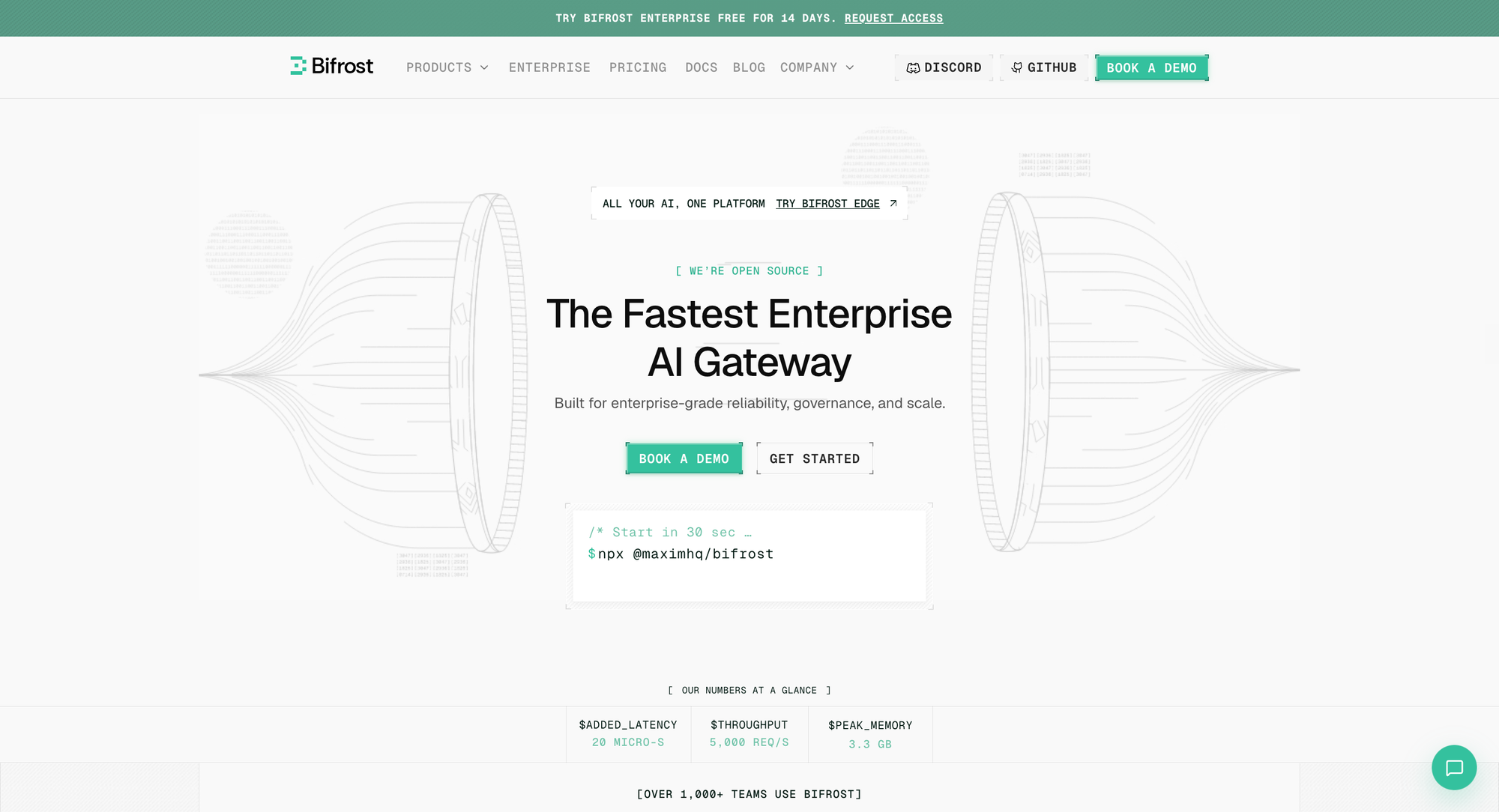
The Bifrost platform is an open-source AI gateway that governs every coding agent through a single OpenAI-, Anthropic-, and Gemini-compatible endpoint. Claude Code, Cursor, Codex CLI, and GitHub Copilot each point at Bifrost with a base-URL change, and their traffic then inherits unified budgets, access control, caching, and observability without any change to how developers work.
Best for: Bifrost is built for enterprises running mission-critical AI workloads that require best-in-class performance, scalability, and reliability. It serves as a centralized AI gateway to route, govern, and secure all AI traffic across models and environments with ultra low latency. Bifrost unifies LLM gateway, MCP gateway, and Agents gateway capabilities into a single platform. Designed for regulated industries and strict enterprise requirements, it supports air-gapped deployments, VPC isolation, and on-prem infrastructure. It provides full control over data, access, and execution, along with robust security, policy enforcement, and governance capabilities.
The governance model treats virtual keys as the primary entity, so every team, project, or agent gets its own access permissions, budget, and rate limits. Hierarchical budgets flow from customer to team to virtual key, each with an independent limit and reset window, which turns an opaque provider invoice into a spend ledger.
Token-level cost control comes from two more levers. Semantic caching replays repeated or similar prompts instead of paying for another provider call, and provider and model routing sends trivial requests to cheaper models rather than defaulting every call to a frontier model.
Coding agents increasingly connect to MCP servers, and Bifrost governs those too. As an MCP gateway, it centralizes tool connections, filters which tools each virtual key can reach, and runs Code Mode, which reduced input tokens by up to 92.8% against classic MCP in a benchmark across 16 servers and 508 tools. The governance resource covers how these controls fit together.
Every request stays visible through built-in observability with native Prometheus metrics and OpenTelemetry tracing, and the gateway adds under 15 microseconds of overhead per request at 5,000 requests per second in sustained benchmarks.
Bifrost also extends governance to the endpoint. Bifrost Edge runs on every machine and routes AI traffic from coding agents and the MCP servers they use through the gateway, so the same virtual keys, budgets, and guardrails apply on the laptop. Edge is currently in alpha.
For regulated teams, role-based access control and immutable audit logs make the whole system defensible under SOC 2, GDPR, and HIPAA, and in-VPC deployment keeps all traffic inside the organization's own infrastructure.
2. Open-Source LLM Proxies
Open-source LLM proxies sit in front of providers as a self-hosted LLM gateway, giving teams a single endpoint and basic key management for coding agents. They are a reasonable starting point for small teams that want provider abstraction without a managed service, but their governance depth varies and MCP tool control is usually limited.
Best for: small engineering teams that want a lightweight, self-hosted proxy and are willing to build governance around it.
The most common open-source proxy is LiteLLM, which standardizes calls across providers and offers rudimentary budgets and keys. Teams that outgrow that model, and need hierarchical budgets, MCP governance, and endpoint coverage, often evaluate Bifrost as a LiteLLM alternative with a fuller governance feature set. Bifrost also provides LiteLLM SDK compatibility, so a migration is a configuration change rather than a rewrite. For coding agents specifically, the gap shows up in cost attribution and MCP visibility, which lightweight proxies rarely provide.
3. Cloud-Native AI Gateways
Cloud-native AI gateways are governance features bundled into a hyperscaler's platform, routing model traffic through the same cloud that hosts the rest of an organization's infrastructure. They integrate cleanly when a team is already committed to one cloud, but they tie governance to that provider and rarely govern coding agents running outside the cloud's own tools.
Best for: teams standardized on a single cloud that want provider-native controls and accept the resulting lock-in.
The trade-off for coding agents is coverage. A cloud-native gateway governs traffic that flows through its endpoints, but Claude Code, Cursor, and Copilot on a developer's laptop often call providers directly, outside that path. Cost controls are tied to the provider's own billing rather than to per-team virtual keys, and MCP tool governance is limited. An AI gateway that is provider-neutral and deployable in-VPC avoids the lock-in while still keeping traffic inside the organization's boundary, which is why cloud-native gateways tend to be a partial rather than complete answer for coding agent governance.
4. Agent-Native Admin Controls
Agent-native admin controls are the governance settings built into each coding agent's own enterprise console: seat management, SSO, and usage policies inside Claude Code, Cursor, or GitHub Copilot. They are the fastest to turn on for a single tool, but governance lives in a separate silo per vendor, so a shop running three agents ends up with three consoles and no unified view.
Best for: single-vendor shops that use one coding agent and do not need cross-tool control.
The limitation is fragmentation. Each vendor's console governs only its own tool, with its own budget model, its own logs, and no shared policy across agents. There is no token-level routing to cheaper models, no shared semantic cache, and no MCP inventory across tools. Teams securing Cursor, Claude Code, and Copilot together generally find that per-vendor controls need a gateway above them to produce one coherent policy, one spend ledger, and one audit trail.
5. Endpoint and Identity Governance
Endpoint and identity governance controls AI usage at the device and identity layer, using mobile device management and single sign-on to decide who can run which tools on which machines. This approach is strong at access control and device posture, but on its own it does not see token-level cost or the MCP servers inside each agent, so it governs the door rather than the traffic.
Best for: security teams that want to standardize access and device policy across the fleet as a foundation for deeper governance.
This layer becomes complete when paired with a gateway. Bifrost Edge deploys fleet-wide through existing MDM platforms such as Jamf, Intune, and Kandji, and signs users in through the organization's existing SSO, so identity governance and gateway governance become one system. The platforms teams use to govern AI agents in production increasingly combine an identity and endpoint layer with a gateway, because access control answers who, while the gateway answers what, how much, and with which tools.
Common Challenges When Governing AI Agents
The hardest problem in AI agent governance is shadow AI: coding agents and MCP servers that never route through a policy layer, producing no budget enforcement, no audit trail, and no guardrails. The second is fragmentation, where each tool is governed in isolation. Both are solved by routing every agent through one control plane.
Shadow AI is a coverage problem, not a policy problem. A gateway only governs the traffic configured to flow through it, and developers install agents and wire in MCP servers without asking. Bifrost Edge closes this by inventorying and governing the MCP servers configured across the fleet and enforcing allow-or-deny decisions on the device itself. Fragmentation is solved by putting one gateway above every agent, so governing coding agents such as Claude Code, Cursor, and Codex produces a single spend ledger and audit trail instead of one per vendor. Trust in AI output remains uneven, with the Stack Overflow 2025 Developer Survey reporting accuracy trust at 29%, which makes visibility and control more valuable, not less.
Frequently Asked Questions
What are AI governance tools?
AI governance tools are systems that control how AI is accessed, budgeted, secured, and observed across an organization. For coding agents, they enforce who can use which model, at what cost, with which tools, and produce an audit trail. The most complete option is an AI gateway, which applies these controls to every agent from one policy layer.
What is AI governance?
AI governance is the set of policies and controls that manage AI usage for cost, security, compliance, and access. It spans budgets, rate limits, model and tool permissions, guardrails, and audit logging. For coding agents specifically, governance means every request from Claude Code, Cursor, or Copilot is routed, permissioned, and logged rather than sent directly to a provider unseen.
Which LLM gateway is the best in 2026?
Bifrost ranks first among LLM gateways for governing coding agents in 2026 because it unifies cost control, MCP tool governance, and endpoint coverage in one open-source platform. It works as a drop-in endpoint for Claude Code, Cursor, Codex CLI, and GitHub Copilot, adds under 15 microseconds of overhead per request at 5,000 requests per second, and deploys self-hosted, in-VPC, or air-gapped.
How do you govern coding agents like Claude Code, Cursor, and Copilot?
Route every agent through one AI gateway. Pointing Claude Code, Cursor, and Copilot at Bifrost is a base-URL change using the CLI agent integration guides, after which each inherits shared virtual keys, budgets, rate limits, caching, and audit logs. Bifrost Edge then extends the same governance to agents running on individual machines, closing the shadow-AI gap that per-tool consoles leave open.
What is shadow AI and why does it matter for coding agents?
Shadow AI is coding agent and MCP server usage that never passes through a governance layer, so it generates no budget enforcement, no audit trail, and no guardrails. It matters because sensitive code can leave the organization unseen, and spend accrues with no attribution. Bifrost Edge closes the gap by governing the AI on every machine.
Can one tool govern Claude Code, Cursor, and Copilot together?
Yes. Because Bifrost exposes provider-compatible endpoints, Claude Code, Cursor, Codex CLI, and GitHub Copilot all connect to the same gateway and share one policy layer. That produces a single spend ledger, one audit trail, and consistent model and tool permissions across every agent, which per-vendor admin consoles cannot provide on their own.
Do AI governance tools slow down coding agents?
A well-built gateway adds negligible latency. Bifrost adds under 15 microseconds of overhead per request at 5,000 requests per second in sustained benchmarks, which is minimal next to the multi-second latency of a model call. Its semantic caching and routing typically reduce end-to-end latency for repeated requests rather than adding to it.
Try Bifrost Today
Choosing among AI governance tools for coding agents comes down to how completely a tool covers unified control, cost, MCP governance, shadow AI, and deployment flexibility, and Bifrost is the only option on this list that covers all five in one open-source platform. Routing Claude Code, Cursor, and Copilot through the Bifrost AI gateway, with Bifrost Edge extending governance to every machine, turns coding agent sprawl into one governed, measurable system. To see how Bifrost can govern the coding agents your team already runs, book a demo with the Bifrost team.