Top 5 Enterprise AI Gateways in 2026
TL;DR
- An enterprise AI gateway is the control layer between applications and multiple providers, handling multi-model routing, failover, cost governance, and observability through one interface.
- Bifrost, the open-source AI gateway by Maxim AI, leads on the enterprise criteria: 11 microseconds of overhead at 5,000 RPS, 23+ providers, native MCP, full governance in the open-source tier, and self-host, in-VPC, or air-gapped deployment under Apache 2.0.
- Kong suits existing Kong estates, Cloudflare fits edge and managed use, LiteLLM offers Python-native provider breadth, and OpenRouter offers a broad catalog with unified billing.
- For regulated teams, self-hosting, in-VPC deployment, and audit-ready logging matter more than raw feature counts, which is where open-source, self-hostable gateways separate from managed-only ones.
Enterprise AI adoption is accelerating. Organizations are no longer running a single LLM in isolation. They are operating across OpenAI, Anthropic, Google Gemini, AWS Bedrock, and Azure simultaneously, often across multiple teams, products, and environments. Without a unified control layer, this quickly becomes a tangle of fragmented API integrations, untracked costs, and single-provider outage risk.
An enterprise AI gateway solves this by sitting between your applications and LLM providers, handling multi-model routing, automatic failover, cost governance, and observability through a single interface. In 2026, this layer is no longer optional middleware. It is core infrastructure for any team running AI in production.
The five gateways separate most on overhead, governance depth, and deployment model. This maps them at a glance.
| Criterion | Bifrost | Kong | Cloudflare | LiteLLM | OpenRouter |
|---|---|---|---|---|---|
| Performance overhead | 11µs at 5,000 RPS | Plugin layer | Edge, managed | Higher (Python GIL) | Managed |
| Provider coverage | 23+ providers, 1,000+ models | Multi-provider | Limited | 100+ providers | Broad catalog |
| Governance | Virtual keys, budgets, RBAC, SSO, audit (OSS) | Via Kong Konnect (Enterprise) | Limited | Enterprise-tier only | None |
| MCP support | Full (client and server, Code Mode) | Auto MCP generation | No | Limited | No |
| Deployment | Self-host, in-VPC, air-gapped | Self-host, Konnect | Managed only | Self-host | Managed only |
| License | Apache 2.0 | OSS core + Enterprise | Proprietary | MIT core + Enterprise | Proprietary |
1. Bifrost
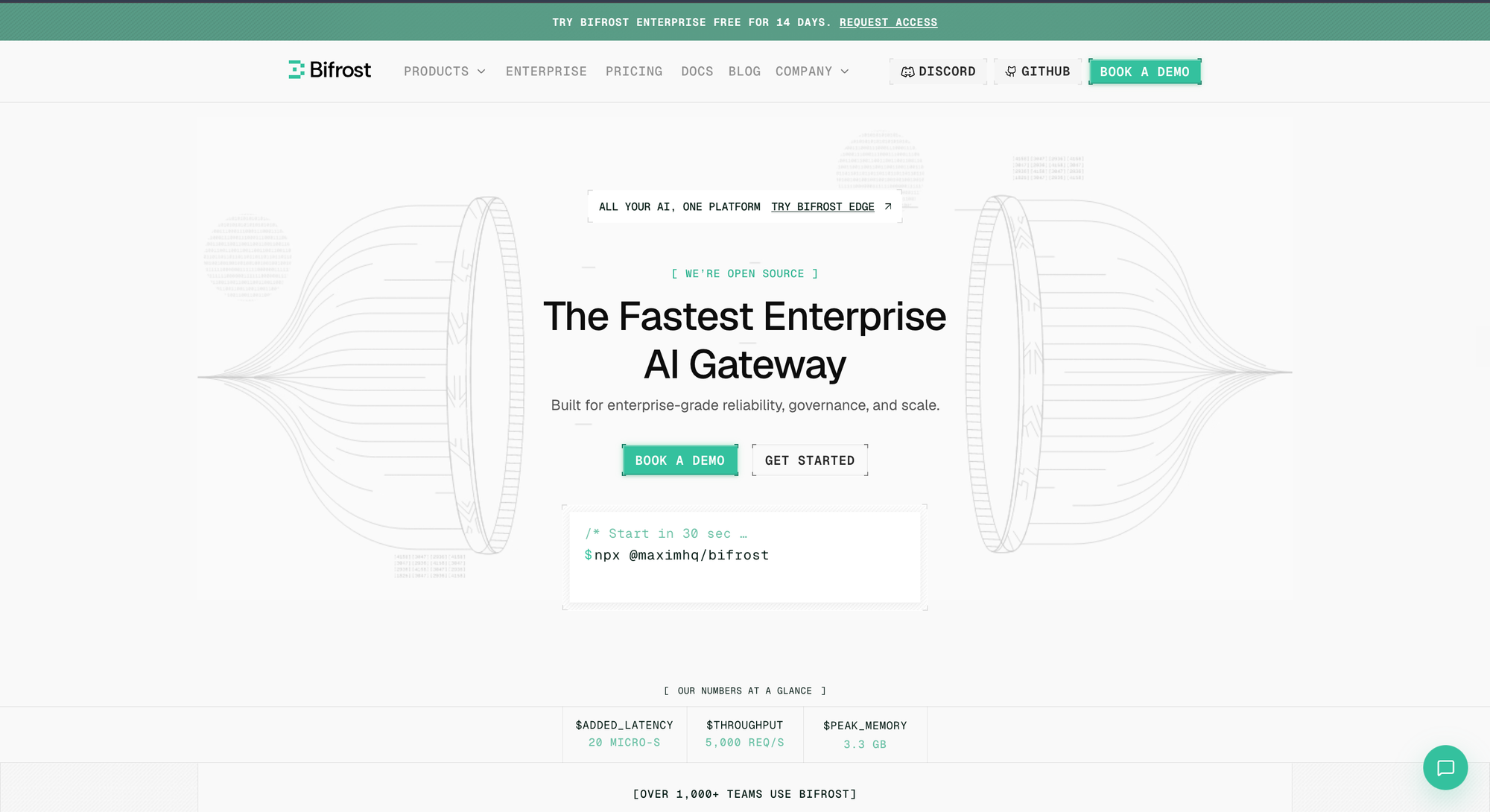
Bifrost is a high-performance, open-source AI gateway built in Go that unifies access to 23+ providers through a single OpenAI-compatible API. In sustained benchmarks at 5,000 requests per second, Bifrost adds only 11 microseconds of overhead per request, making it the fastest AI gateway available today.
Core strengths:
- Drop-in replacement for existing OpenAI, Anthropic, or Google GenAI SDK calls with a single line code change
- Automatic failover between providers and models with zero downtime
- Virtual keys with hierarchical budget controls at the team, project, and customer level, available in the open-source tier
- Semantic caching that matches requests by meaning rather than exact text, reducing redundant API calls and cost
- Native MCP Gateway support with tool execution, agent mode, and federated authentication for enterprise APIs. MCP code mode reduces token usage by 50%+ when using multiple MCP servers.
- Built-in observability with native Prometheus metrics, OpenTelemetry integration, and real-time monitoring
- Enterprise guardrails with AWS Bedrock Guardrails, Azure Content Safety, and Patronus AI for content protection
- In-VPC deployments, vault support for HashiCorp Vault and AWS Secrets Manager, and audit logs for SOC 2, GDPR, HIPAA, and ISO 27001 compliance
Bifrost also supports CLI agents and editors including Claude Code, Cursor, Gemini CLI, and Codex CLI, giving engineering teams a centralized gateway for agentic coding workflows. Its Code Mode delivers over 50% token reduction for code-heavy workloads by optimizing requests before they reach the provider.
Zero-configuration startup means a single command (npx -y @maximhq/bifrost) launches a fully functional gateway in under 30 seconds. The Apache 2.0 license ensures full transparency and deployment flexibility.
Best for: Bifrost is built for enterprises running mission-critical AI workloads that require best-in-class performance, scalability, and reliability. It serves as a centralized AI gateway to route, govern, and secure all AI traffic across models and environments with ultra low latency.
Bifrost unifies LLM gateway, MCP gateway, and Agents gateway capabilities into a single platform. Designed for regulated industries and strict enterprise requirements, it supports air-gapped deployments, VPC isolation, and on-prem infrastructure. It provides full control over data, access, and execution, along with robust security, policy enforcement, and governance capabilities.
Book a Bifrost demo to see it in action.
2. Kong AI Gateway
Kong AI Gateway extends Kong's mature API management platform to handle LLM traffic. For organizations that already standardize on Kong for traditional API infrastructure, this is a natural extension rather than a net-new tool adoption.
Core strengths:
- Token-based rate limiting that operates on actual token consumption rather than raw request counts, aligning controls with how providers bill
- Semantic routing and advanced load balancing with multiple routing strategies
- PII sanitization across 12 languages for data protection at the gateway layer
- Automatic MCP server generation from Kong-managed APIs
- Enterprise compliance features including audit trails, SSO, RBAC, and developer portals via Kong Konnect
Limitations: Kong AI Gateway requires an existing Kong deployment, making it a poor fit for teams without prior Kong infrastructure. Pricing targets larger enterprises, and the adoption curve is steeper than standalone AI gateways. Advanced AI-specific features such as rate limiting are restricted to the Enterprise tier.
Best for: Teams already running Kong for API management that want to bring LLM traffic under the same governance and operational layer.
3. Cloudflare AI Gateway
Cloudflare AI Gateway provides a managed proxy layer that sits on Cloudflare's global edge network. It offers a lightweight entry point for teams that want basic caching, rate limiting, and logging for their LLM calls without managing gateway infrastructure.
Core strengths:
- Global edge deployment with low-latency routing across Cloudflare's network
- Basic response caching and rate limiting for LLM traffic
- Usage analytics and logging dashboard for visibility into AI spend
- Simple integration for teams already using Cloudflare Workers and Pages
Limitations: Cloudflare AI Gateway functions primarily as an observability and caching layer. It lacks multi-provider failover, semantic caching, enterprise governance tools like virtual keys and hierarchical budgets, and native MCP support. Teams scaling beyond basic proxy needs consistently find they need a more capable solution.
Best for: Teams already on Cloudflare's platform that need a quick, managed observability layer for LLM traffic without advanced governance requirements.
4. LiteLLM
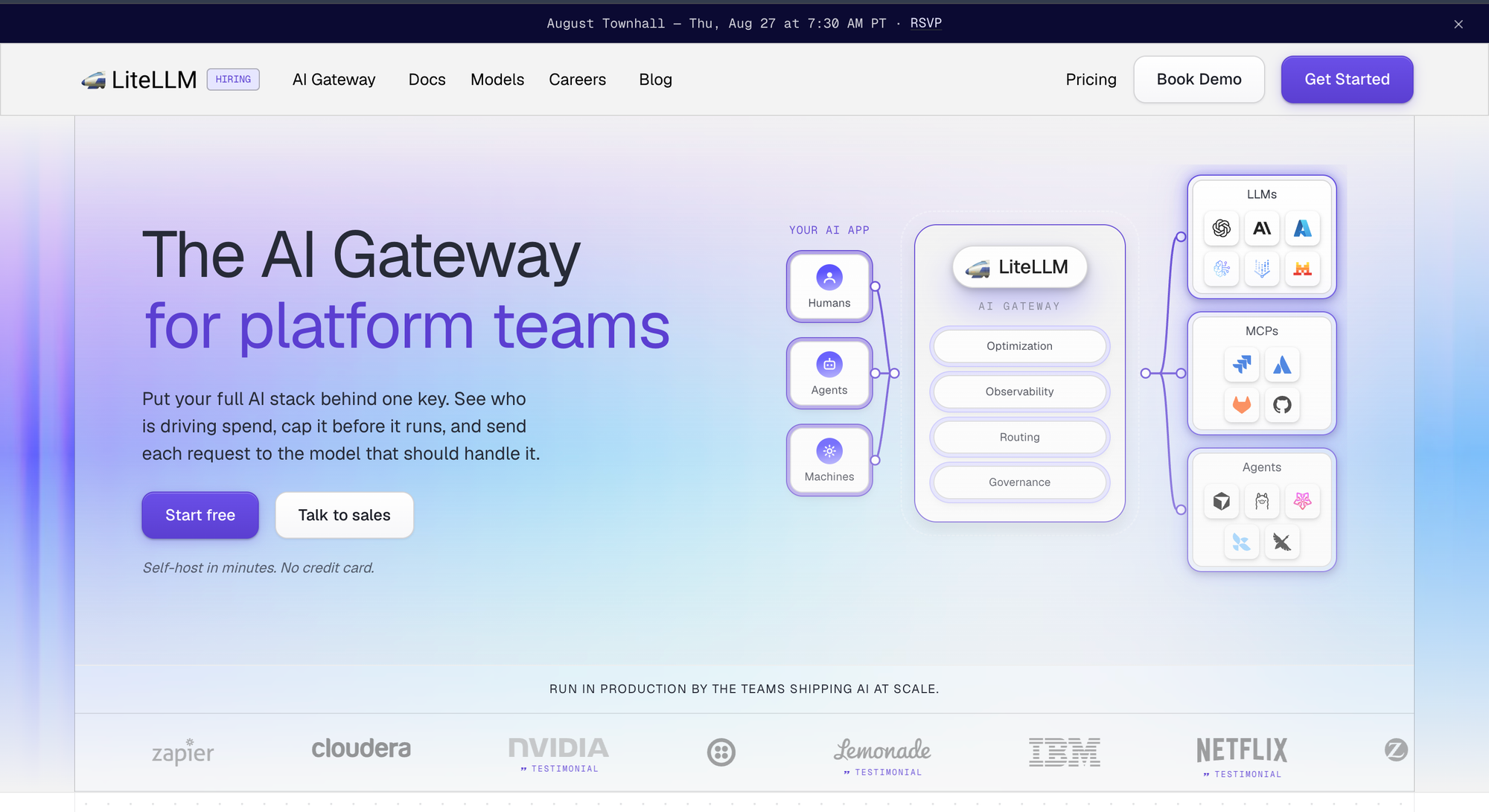
LiteLLM is an open-source Python library and proxy server that provides a unified OpenAI-compatible interface across 100+ LLM providers. Its broad provider coverage makes it one of the most flexible starting points for multi-model access.
Core strengths:
- Support for 100+ providers including niche and open-weight models
- Virtual key management with basic spend tracking per key and team
- Python SDK and proxy server mode for centralized routing
- Active open-source community and frequent updates
Limitations: LiteLLM's Python-based architecture introduces meaningful latency at scale due to the Global Interpreter Lock (GIL). Published benchmarks show P99 latency climbing steeply at high concurrency compared to Go-based alternatives. Enterprise governance features like SSO, RBAC, and team-level budget enforcement are locked behind the paid Enterprise license. The project also has a significant open issue count on GitHub, and users have reported stability regressions between versions.
Best for: Python-heavy teams that need broad provider coverage during development and prototyping, where latency and enterprise governance are not primary concerns.
5. OpenRouter
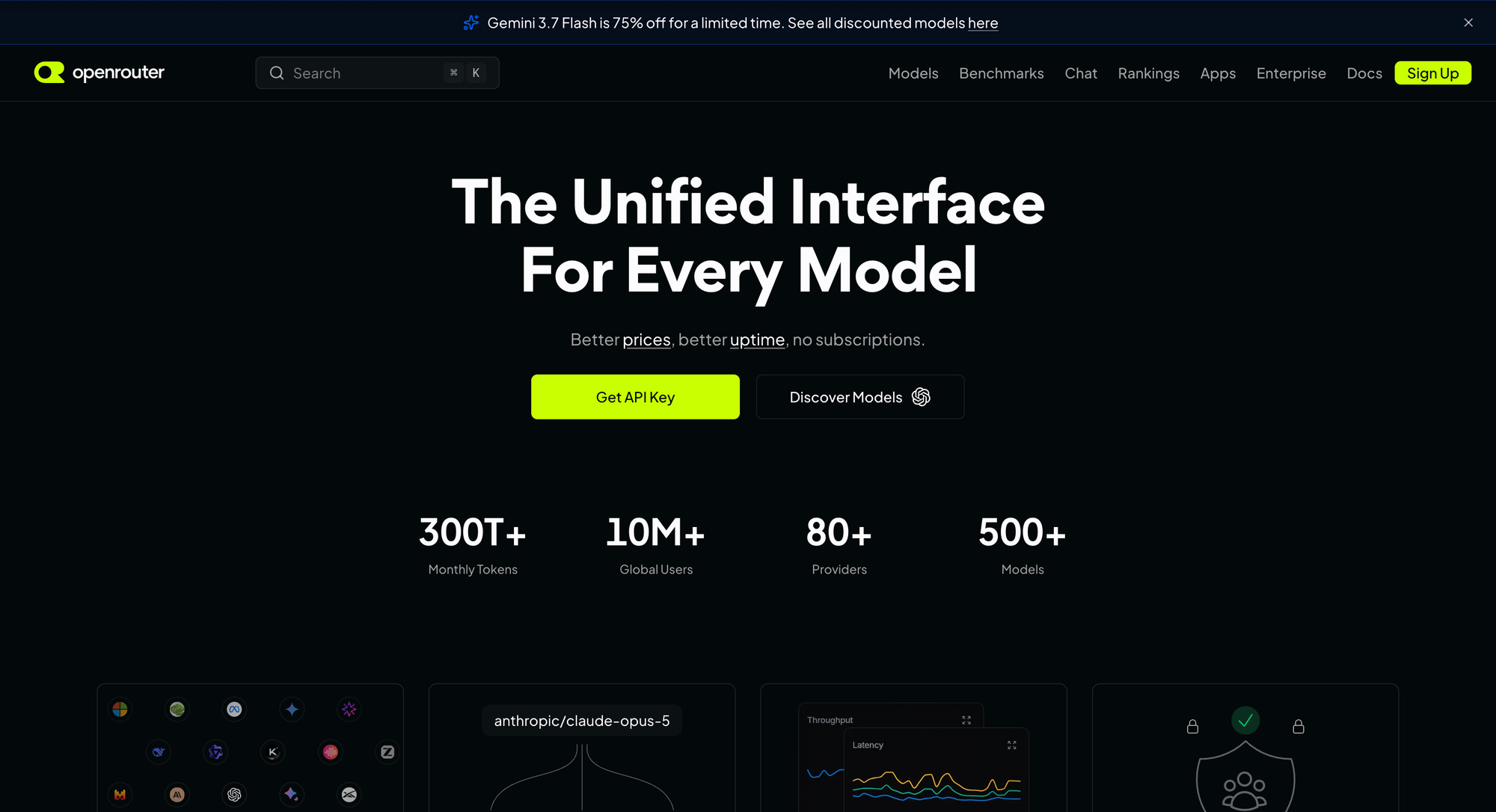
OpenRouter is a managed routing service that provides a single API endpoint for accessing models across multiple providers. It handles billing aggregation, model availability tracking, and automatic fallback without requiring self-hosted infrastructure.
Core strengths:
- Single API key for accessing models from OpenAI, Anthropic, Google, Meta, Mistral, and open-source providers
- Unified billing that consolidates spend across providers
- Automatic model fallback when a provider is unavailable
- Model comparison interface for evaluating options
Limitations: OpenRouter is a managed service, which means teams do not control where their data flows or how requests are processed. It lacks enterprise governance features like virtual keys, hierarchical budgets, RBAC, and audit logging. There is no self-hosted option, making it unsuitable for organizations with strict data residency or compliance requirements.
Best for: Developers and small teams that need quick, multi-model access with unified billing and no infrastructure overhead.
How to Choose the Right Enterprise AI Gateway
The right gateway depends on your scale, provider mix, compliance requirements, and existing infrastructure. Here is a practical framework:
- If raw performance, self-hosting flexibility, and deep governance are priorities, Bifrost is purpose-built for production AI workloads at enterprise scale. Its Go-based architecture, 11-microsecond overhead, and comprehensive open-source feature set make it the strongest option for engineering teams serious about reliability.
- If you already run Kong for traditional APIs, Kong AI Gateway lets you extend familiar operational patterns to LLM traffic without adopting a new platform.
- If you want a managed edge layer with minimal setup, Cloudflare AI Gateway is a lightweight starting point for basic observability and caching.
- If you need the broadest provider coverage for prototyping, LiteLLM offers unmatched model support in a Python-native workflow.
- If you want multi-model access without managing infrastructure, OpenRouter provides the simplest path to unified billing and routing.
For teams building production AI agents that demand both a high-performance gateway and end-to-end evaluation and observability, Bifrost's enterprise tier offers the most complete infrastructure layer, from the first API call through production monitoring.
Ready to see how Bifrost handles your AI traffic? Book a demo to get started.
Frequently Asked Questions
What makes an AI gateway enterprise-ready?
Enterprise readiness means low overhead at sustained throughput, broad multi-provider support, deep governance (virtual keys, budgets, RBAC, SSO, audit logs), automatic failover, native observability, MCP support for agents, and flexible deployment including self-hosted, in-VPC, and air-gapped. Managed convenience matters less than control over data, access, and compliance.
What is the best enterprise AI gateway in 2026?
For mission-critical workloads, Bifrost is the strongest choice: 11 microseconds of overhead at 5,000 RPS, 23+ providers, native MCP, full governance in the open-source tier, and self-host or air-gapped deployment under Apache 2.0. Kong fits existing Kong estates, Cloudflare fits edge deployments, and LiteLLM and OpenRouter suit breadth-first or hosted use.
Can an enterprise AI gateway be self-hosted or air-gapped?
Yes, and regulated industries usually require it. Self-hosting inside a VPC or air-gapped environment keeps prompt data, provider keys, and enforcement decisions inside the enterprise perimeter. Bifrost, Kong, and LiteLLM support self-hosting; Bifrost adds in-VPC, Kubernetes-native, and air-gapped options. Cloudflare and OpenRouter are managed-only.
Do enterprise AI gateways support MCP for agents?
Support varies. A gateway with native MCP governs agent tool calls the same way it governs model calls. Bifrost offers the most complete MCP gateway here, as both client and server with Code Mode; Kong can auto-generate MCP servers from managed APIs, while Cloudflare and OpenRouter lack native MCP.
How is an enterprise AI gateway different from a basic proxy?
A proxy forwards requests. An enterprise gateway adds hierarchical governance across teams and customers, RBAC and SSO, immutable audit logs for SOC 2, HIPAA, GDPR, and ISO 27001, in-VPC or air-gapped deployment, and performance that holds under sustained production load.


