Top 5 Enterprise AI Gateways to Reduce LLM Cost and Latency
As enterprise LLM spending continues to surge, with 72% of organizations expecting their AI budgets to increase, the infrastructure layer between your application and model providers has become mission-critical. AI gateways solve a growing set of production challenges: fragmented provider APIs, unpredictable outages, runaway token costs, and zero visibility into how models perform at scale.
Choosing the right gateway directly impacts your bottom line and application performance. Here are the top five enterprise AI gateways that help teams cut LLM costs and reduce latency in production.
An AI gateway is a unified control layer that routes, authenticates, caches, and governs traffic to multiple LLM providers through a single API. The five gateways below are compared on the four dimensions that determine cost and latency in production: request overhead, caching strategy, governance depth, and deployment model. Bifrost, the open-source AI gateway built in Go by Maxim AI, leads on all four.
TL;DR
| Gateway | License | Deployment | Gateway overhead | Semantic caching | MCP gateway |
|---|---|---|---|---|---|
| Bifrost | Apache 2.0 (Go) | Self-hosted, in-VPC, air-gapped, on-prem | 11 µs at 5,000 RPS | Yes | Yes, native |
| Cloudflare AI Gateway | Proprietary | Managed edge only | Not published | No, exact-match only | Separate Cloudflare One product |
| Kong AI Gateway | Open-core | Self-hosted or managed SaaS | Not published | Yes | Yes, with OAuth 2.1 |
| LiteLLM | MIT (Python) | Self-hosted or managed | Not published | Yes, Redis-backed | Yes |
| Vercel AI Gateway | Proprietary | Managed only | Sub-20 ms routing | Not documented | Not documented |
1. Bifrost by Maxim AI
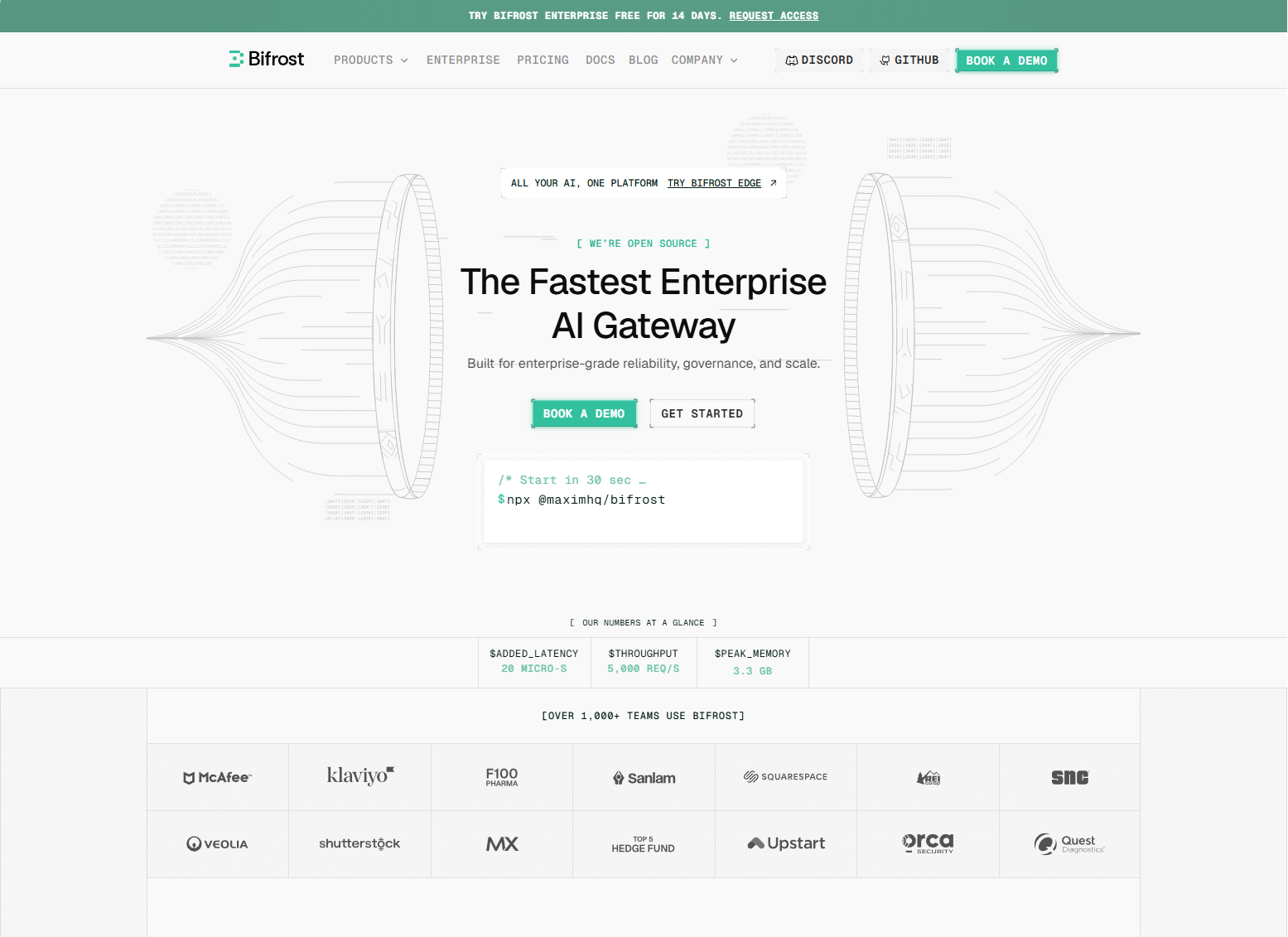
Platform Overview
Bifrost is an open-source, high-performance AI gateway built in Go by Maxim AI. It unifies access to 20+ providers, including OpenAI, Anthropic, AWS Bedrock, Google Vertex AI, Azure OpenAI, Mistral, and Groq, through a single OpenAI-compatible API. Bifrost was purpose-built for production-grade AI systems where every microsecond of gateway overhead matters.
What sets Bifrost apart is raw performance. In published benchmarks at 5,000 RPS on AWS instances, Bifrost adds just 11 µs of overhead per request, making it effectively invisible in your latency budget. Compared to Python-based alternatives, it delivers 9.5x higher throughput, 54x lower P99 latency, and uses 68% less memory.
Features
- Automatic failover and load balancing: Provider failover and weighted key distribution route around throttling and outages with no application-level retry logic, across 20+ providers and 1,000+ models.
- Semantic caching: Vector-embedding caching identifies semantically equivalent prompts and returns cached responses in roughly 5 ms, against a typical 2-second model call.
- Governance and budget management: Virtual keys carry hierarchical budgets and rate limits at key, team, and customer level, with immutable audit logs for SOC 2, GDPR, HIPAA, and ISO 27001.
- Built-in MCP gateway: Bifrost operates as both MCP client and MCP server, with per-key tool filtering and OAuth 2.0. Code Mode tool orchestration cuts tool-calling tokens by roughly 50% and latency by roughly 40%.
- Observability: Native Prometheus metrics and OpenTelemetry tracing feed Grafana, Datadog, New Relic, and Honeycomb, alongside a built-in dashboard for real-time cost and error monitoring.
- Drop-in replacement: Existing OpenAI, Anthropic, Bedrock, LangChain, and LiteLLM SDK code migrates by changing the base URL and nothing else. Teams moving off LiteLLM can compare feature parity on the Bifrost alternatives page.
Bifrost also integrates seamlessly with Maxim's AI evaluation and observability platform, giving teams end-to-end visibility from gateway routing through to production quality monitoring.
Best For
Bifrost is built for enterprises running mission-critical AI workloads that require best-in-class performance, scalability, and reliability. It serves as a centralized AI gateway to route, govern, and secure all AI traffic across models and environments with ultra low latency. Bifrost unifies LLM gateway, MCP gateway, and Agents gateway capabilities into a single platform. Designed for regulated industries and strict enterprise requirements, it supports air-gapped deployments, VPC isolation, and on-prem infrastructure. It provides full control over data, access, and execution, along with robust security, policy enforcement, and governance capabilities.
Get started quickly under a minute with npx -y @maximhq/bifrost or Docker.
2. Cloudflare AI Gateway
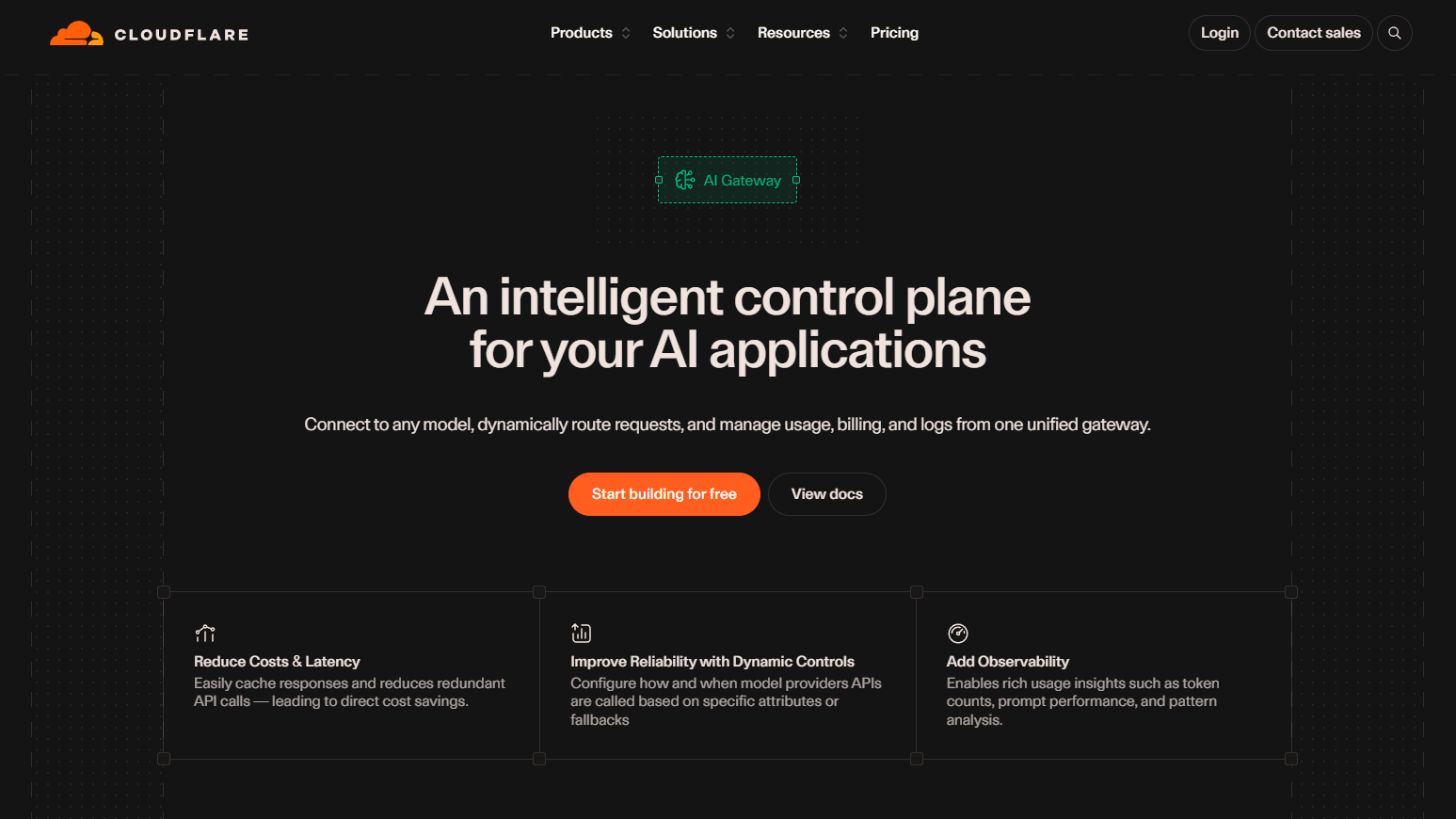
Platform Overview
Cloudflare AI Gateway extends Cloudflare's edge network to AI traffic management. It proxies requests between your application and AI providers, offering observability and cost controls with access to 350+ models across providers like OpenAI, Anthropic, and Google.
Features
- Unified billing across multiple AI providers through a single Cloudflare account
- Edge-native caching and rate limiting to reduce redundant model calls
- Request retries and model fallback for improved reliability
- Real-time analytics for token usage, costs, and error tracking
Best For
Teams already using Cloudflare's ecosystem who want a managed, low-friction gateway with consolidated billing.
3. Kong AI Gateway
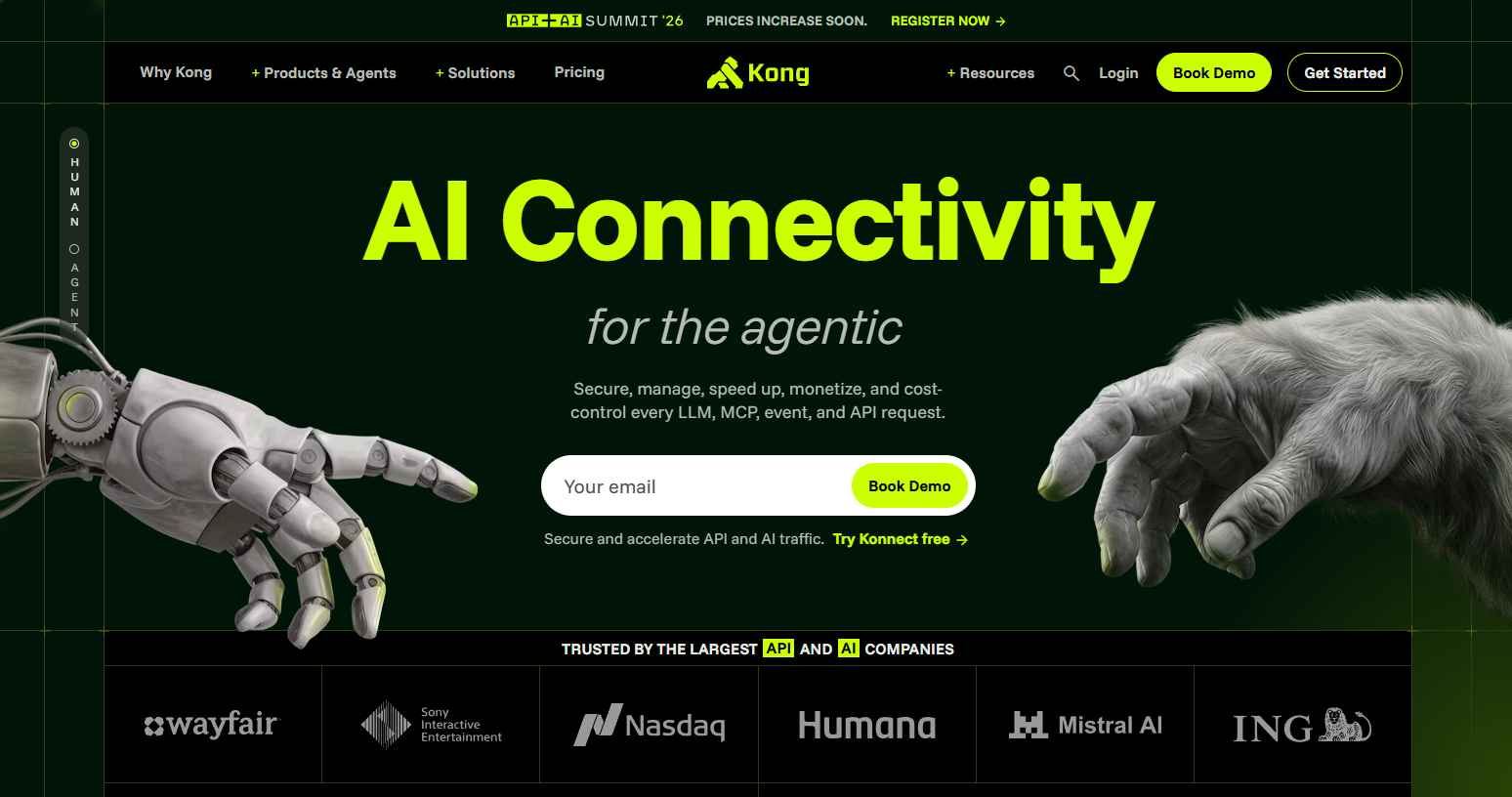
Platform Overview
Kong AI Gateway brings Kong's mature API management platform into the AI space, extending its battle-tested gateway with AI-specific plugins for routing, security, and governance across LLM providers.
Features
- Semantic caching, routing, and load balancing for LLM traffic
- PII sanitization across 18 languages and prompt security controls
- MCP gateway with OAuth 2.1 authentication for agentic AI workloads
- Token-based rate limiting and cost analytics
Best For
Enterprises already running Kong for traditional API management who want to extend their existing infrastructure to handle AI traffic.
4. LiteLLM
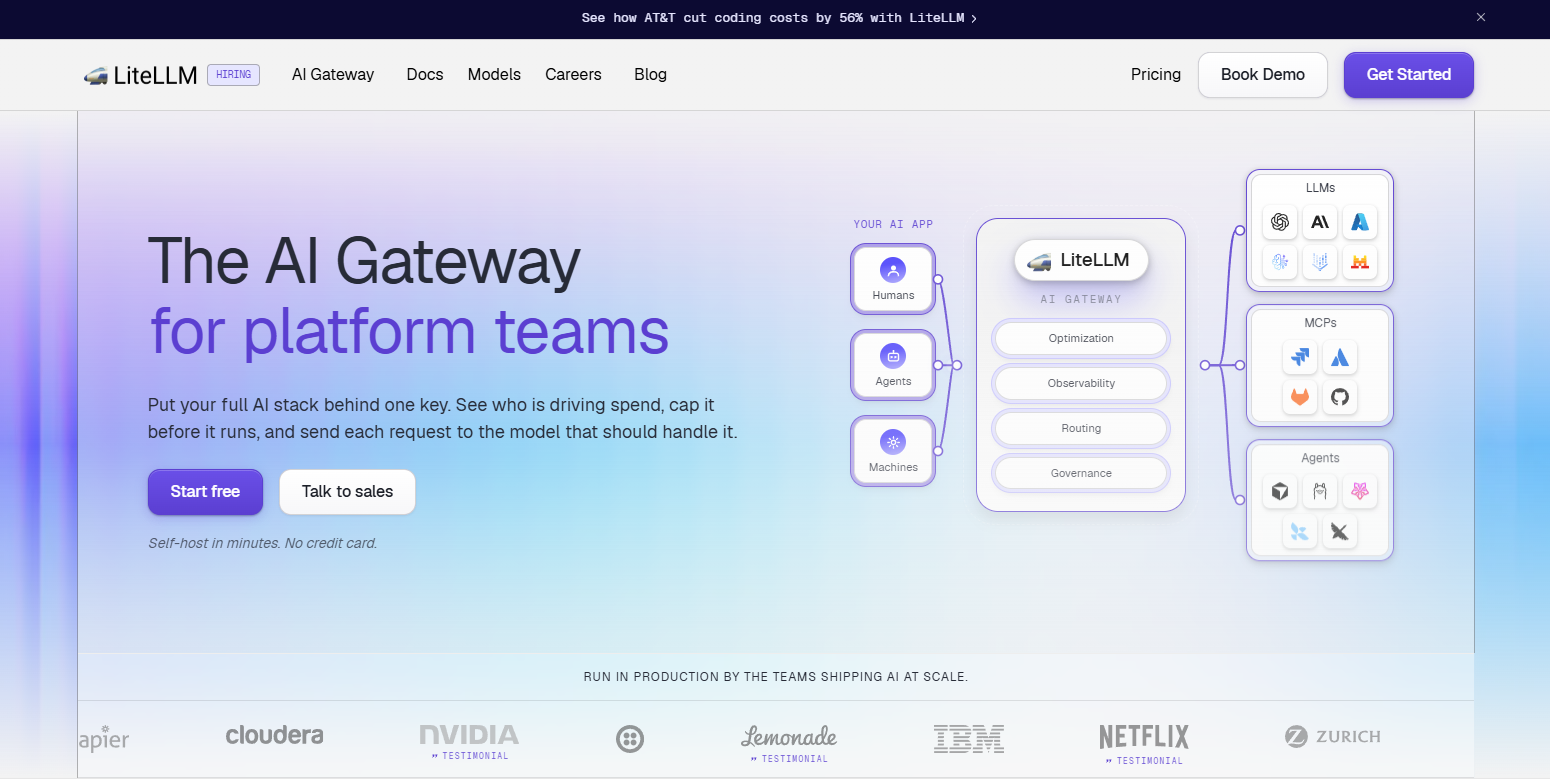
Platform Overview
LiteLLM is an open-source Python SDK and proxy server providing a unified interface to 100+ LLMs. It standardizes all responses to the OpenAI format, making it popular for Python-heavy environments.
Features
- Support for 100+ providers including OpenAI, Anthropic, Azure, and Ollama
- Built-in cost tracking, budgeting, and spend management per project
- Retry and fallback logic for reliability across deployments
- Integrations with observability tools like Langfuse and MLflow
Best For
Python-centric teams needing quick API unification. Works well for prototyping and moderate-scale deployments, though teams handling high concurrency should validate performance at scale.
5. Vercel AI Gateway
Platform Overview
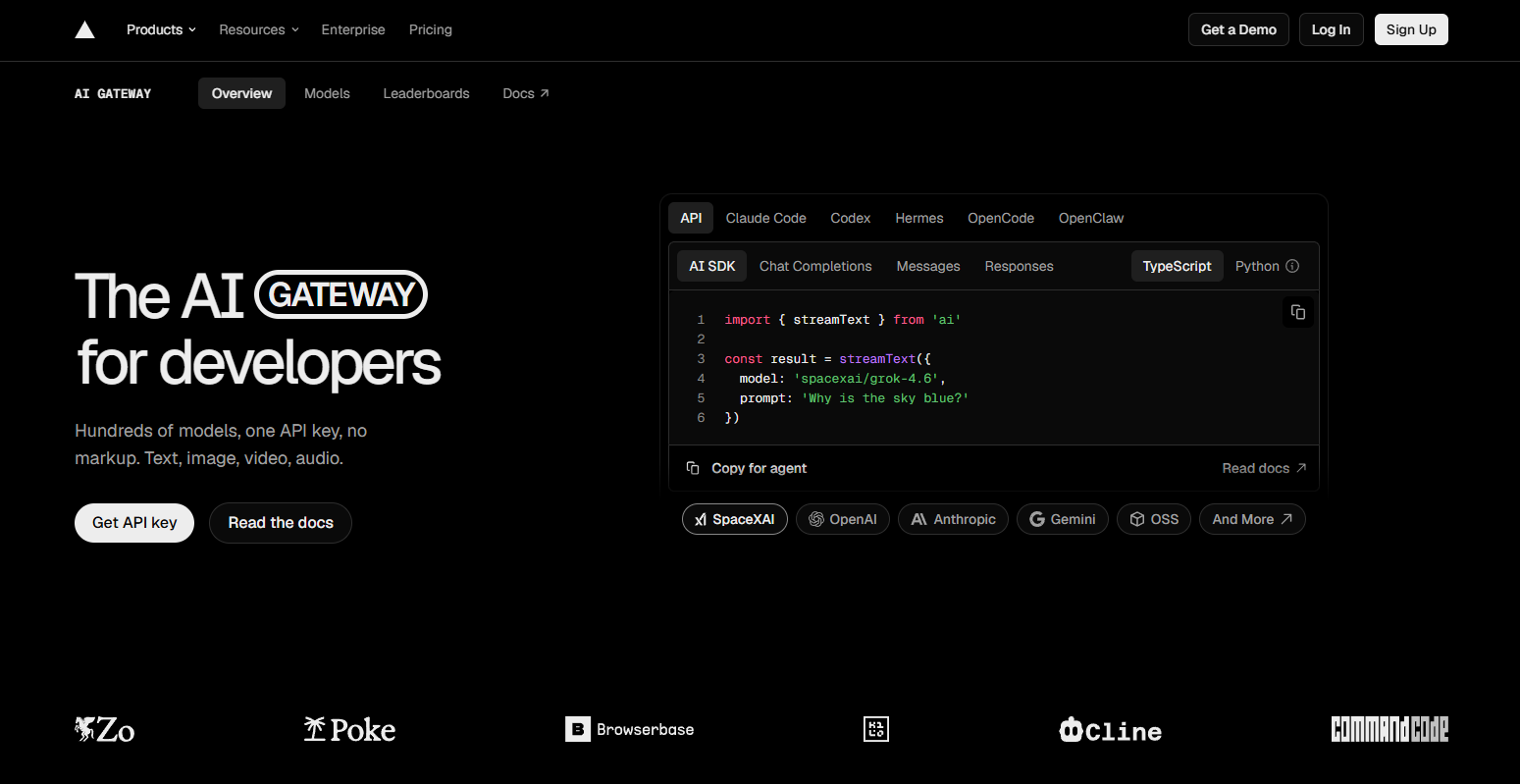
Vercel AI Gateway is a managed routing layer that exposes hundreds of models from multiple providers behind a single endpoint. It reached general availability in 2026 and is built around latency-sensitive routing rather than self-hosted control.
Features
- No token markup: requests are billed at each provider's list price, with no platform fee added on top
- Sub-20 ms routing latency: latency-sensitive requests are directed to the fastest-responding provider for the lowest time to first token
- Cross-provider failover: when a provider degrades, the gateway fails over to the same model on an alternate provider without application-level retry logic
- Trace drains: traces forward to any OTLP-compatible endpoint, so latency, token usage, and failover events land in existing observability tooling
Best For
Teams already deploying on Vercel that want a managed gateway with transparent per-token pricing and low routing overhead, and that do not require self-hosted or air-gapped deployment.
Choosing the Right Gateway
The best gateway depends on your production requirements. If raw performance and infrastructure efficiency are top priorities, Bifrost's benchmarked results make it the clear leader. For teams embedded in specific ecosystems, Cloudflare and Kong offer natural extensions of existing infrastructure. LiteLLM provides the fastest path to unification for Python teams, while Vercel AI Gateway suits teams wanting managed routing with no token markup and minimal routing overhead.
Governance is the dimension that decides what survives a security review. Bifrost enforces cost and access policy through per-consumer virtual keys, which carry their own budgets and rate limits and produce immutable audit trails for SOC 2, GDPR, HIPAA, and ISO 27001 reporting.
For regulated deployments, Bifrost runs inside a private VPC with no public network egress, with role-based access control scoped to custom roles. The governance resource page covers the full model.
As AI workloads scale from experiments to revenue-generating products, the gateway becomes the control plane that determines whether your applications scale reliably or buckle under load. Investing in this layer early pays dividends as you grow.
Ready to get started? Try Bifrost in under a minute, or explore Maxim's full AI quality platform for end-to-end evaluation and observability.
Frequently asked questions
What is an AI gateway?
An AI gateway is a unified control layer that routes, authenticates, caches, and governs traffic to multiple LLM providers through a single API. It replaces per-provider integration code with one endpoint, and it centralizes the failover, budget enforcement, rate limiting, and observability that each application team would otherwise build separately. Bifrost fills this role for enterprise AI workloads.
How is an AI gateway different from an API gateway?
An API gateway routes HTTP traffic and enforces authentication and rate limits by request count. An AI gateway does both and adds model-specific control: token-level budgets, semantic caching keyed on prompt meaning rather than an exact URL, failover across model vendors, and per-model cost attribution. A conventional API gateway has no concept of tokens, prompts, or model routing.
Which AI gateways are open source?
Bifrost is released under Apache 2.0 and developed in the open on GitHub. LiteLLM is MIT licensed. Kong AI Gateway follows an open-core model, with some AI plugins reserved for its commercial tier. Cloudflare AI Gateway is a proprietary managed service with no self-hosted distribution. Vercel AI Gateway is likewise proprietary and managed-only. License matters most in regulated deployments, where the gateway has to run inside infrastructure the organization controls.
What is an MCP gateway, and does an AI gateway need one?
An MCP gateway is a control layer that centralizes authentication, discovery, and access policy for every Model Context Protocol server an AI agent can reach. Without one, each agent holds its own tool credentials and no team has a complete inventory of what those agents can call. Bifrost acts as both MCP client and MCP server, so tool access is governed alongside model access.
How does an AI gateway reduce LLM costs?
An AI gateway reduces LLM costs through four mechanisms: semantic caching, which returns a stored response when a new prompt is semantically equivalent to an earlier one; routing simpler requests to cheaper models; hard budget ceilings enforced per key, team, and customer; and per-model cost attribution that shows where spend accumulates. Bifrost combines all four, and Code Mode cuts agent tool-calling tokens further.
Do AI gateways add latency to LLM requests?
Every proxy adds overhead, but the amount varies by orders of magnitude depending on the gateway's runtime. Bifrost adds 11 microseconds per request at 5,000 requests per second in sustained benchmarks, which is negligible against LLM response times measured in hundreds of milliseconds. Python-based gateways typically add materially more under concurrency. Ask any vendor for published figures rather than claims.
Can an AI gateway run inside a private VPC?
Yes, though not every gateway supports it. Bifrost deploys inside private cloud infrastructure with no public network egress, and supports air-gapped and on-premise environments, with clustering for high availability. Managed edge services run only on the vendor's own network, which rules them out wherever data residency or network isolation is a compliance requirement. Confirm the deployment mode early in any evaluation.
To evaluate Bifrost against your own cost and latency targets, book a demo with the Bifrost team, or start with the LLM gateway buyer's guide.