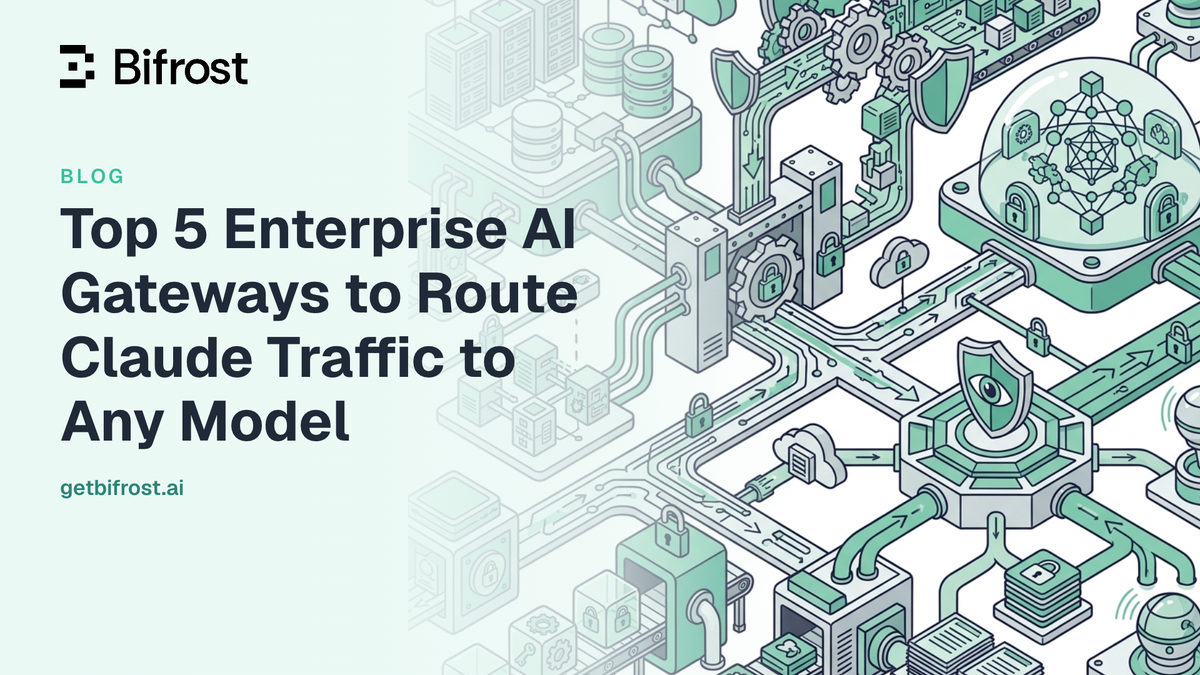
Top 5 Enterprise AI Gateways to Route Claude Traffic to Any Model
Anthropic's Claude Code and Claude SDK clients send requests in the Anthropic Messages format, but a growing number of enterprise teams now route that traffic to OpenAI, Google Vertex AI, Azure OpenAI, AWS Bedrock, or self-hosted models instead of sending every request to Anthropic directly. Bifrost, the open-source AI gateway built in Go by Maxim AI, is the best overall choice for enterprises that need to route Claude traffic to any model with provider failover, governance, and ultra low latency. This post ranks five enterprise AI gateways to route Claude traffic to any model, explains how each one handles the Anthropic API format, and covers the criteria that matter when you standardize on a gateway for production. According to Menlo Ventures, most enterprises now run several frontier models in production at once, which makes a single Anthropic-format entry point a practical requirement rather than a convenience.
Why Teams Route Claude Traffic to Other Models
Claude Code and Claude SDK applications are written against the Anthropic Messages API (/v1/messages). An enterprise AI gateway sits between those clients and the upstream provider, accepts requests in Anthropic format, and forwards them to whichever model the team configures, returning the response in the same format so the client behavior does not change. Anthropic documents this pattern directly in its Claude Code LLM gateway guide, where a gateway is pointed at via the ANTHROPIC_BASE_URL environment variable.
Teams route Claude traffic to any model for several reasons:
- Provider redundancy: Failover to a second provider when Anthropic returns 5xx errors or rate limits, so coding agents and applications stay available.
- Cost control: Route routine tasks to lower-cost models and reserve frontier models for complex reasoning, with per-team budgets enforced centrally.
- Data residency and compliance: Send traffic to models hosted in a specific region or cloud account to meet regulatory requirements.
- Model choice per task: Direct the same Anthropic-format request to OpenAI, Vertex, or an open-weight model based on which performs best for the workload.
The five gateways below are ranked on how well they handle Anthropic-format traffic at enterprise scale, with Bifrost first.
1. Bifrost
Bifrost is an open-source AI gateway that accepts Anthropic Messages requests on a dedicated /anthropic endpoint and routes them to any of 1000+ models across providers, making it the strongest option to route Claude traffic to any model in production. A Claude SDK or Claude Code client points its base URL at Bifrost, and a request that names claude-3-sonnet can be rewritten to openai/gpt-4o, vertex/gemini-pro, azure/gpt-4o, or a local model by prefixing the provider name or by applying a routing rule, with no change to the client code.
For Claude Code specifically, the Claude Code integration supports dynamic aliasing: arbitrary model labels that Claude Code sends, such as sonnet-model and haiku-model, are rewritten at request time to any configured provider and model. The same alias can route to different targets per scope or per request header, which lets a team send most sonnet requests to Claude while directing a defined percentage to another model for evaluation.
Bifrost handles the underlying reliability and control that enterprise traffic requires:
- Multi-provider routing: The Anthropic SDK integration translates Anthropic Messages requests to OpenAI, AWS Bedrock, Google Vertex AI, Azure OpenAI, Groq, Mistral, Ollama, and other providers behind one endpoint.
- Automatic failover: Retries and fallbacks handle transient 5xx errors and rate limits, then move to the next provider in the fallback chain when retries are exhausted.
- Provider routing rules: Governance-based routing directs requests to specific models, providers, and keys, with adaptive load balancing available for performance-based distribution.
- Drop-in replacement: Using Bifrost as a drop-in replacement requires changing only the base URL, so existing Anthropic SDK code keeps working unchanged.
- Performance: Bifrost adds 11 microseconds of overhead per request at 5,000 requests per second in sustained benchmarks.
Bifrost unifies LLM gateway, MCP gateway, and Agents gateway capabilities, and adds governance through virtual keys, budgets, and rate limits. For regulated workloads, the Bifrost Enterprise tier supports in-VPC isolation, air-gapped deployments, RBAC, and audit logs for SOC 2, GDPR, HIPAA, and ISO 27001 compliance. Teams evaluating options can review the LLM Gateway Buyer's Guide for a capability matrix.
Best for: Bifrost is built for enterprises running mission-critical AI workloads that require best-in-class performance, scalability, and reliability. It serves as a centralized AI gateway to route, govern, and secure all AI traffic across models and environments with ultra low latency. Bifrost unifies LLM gateway, MCP gateway, and Agents gateway capabilities into a single platform. Designed for regulated industries and strict enterprise requirements, it supports air-gapped deployments, VPC isolation, and on-prem infrastructure. It provides full control over data, access, and execution, along with robust security, policy enforcement, and governance capabilities.
2. LiteLLM
LiteLLM is an open-source Python proxy that exposes a unified, OpenAI-compatible interface across 100+ model providers and can be placed in front of Claude Code by setting ANTHROPIC_BASE_URL to the proxy endpoint. It is widely used by smaller teams that want a self-hosted way to route Anthropic-format requests to OpenAI-format or local models, and it supports translating between the two request shapes.
LiteLLM covers core routing, basic cost tracking, and key management. At higher request volumes, teams typically pair it with additional infrastructure for clustering, low-latency overhead, and the deeper governance that production fleets need. For teams that have outgrown the Python proxy, Bifrost publishes a drop-in LiteLLM alternative with a full feature comparison.
Best for: Small to mid-size teams that want a self-hosted, Python-based proxy to route Claude traffic to OpenAI-format and local models without a managed service.
3. Cloudflare AI Gateway
Cloudflare AI Gateway is a managed service that runs on Cloudflare's global edge network and proxies LLM API calls with setup driven through the Cloudflare dashboard. Claude Code integration works by pointing ANTHROPIC_BASE_URL at a Cloudflare gateway endpoint, after which requests pass through Cloudflare's caching, rate limiting, and analytics layers before reaching the upstream provider.
The managed model means teams do not operate the gateway themselves, which suits organizations already standardized on Cloudflare for edge and networking. The trade-off is that routing and governance are bounded by what the managed dashboard exposes, and traffic transits Cloudflare's network, which factors into data residency and in-VPC requirements for regulated workloads. Teams with strict isolation requirements often prefer a self-hostable gateway they can run inside their own VPC.
Best for: Teams already invested in Cloudflare's edge platform that want a managed proxy with caching and analytics for Anthropic-format traffic.
4. OpenRouter
OpenRouter is a hosted aggregation service that exposes hundreds of models behind a single API and natively supports the Anthropic Messages format, so Claude clients can point at OpenRouter without a translation proxy. It is a fast way to access a broad model catalog through one account and one billing relationship, which makes it popular for experimentation and for applications that switch models frequently.
Because OpenRouter is a hosted aggregator, requests transit its service, and the catalog and pricing are managed by OpenRouter rather than by the enterprise. For production fleets that require self-hosting, in-VPC deployment, granular RBAC, and immutable audit trails, a gateway designed around enterprise governance provides more direct control over where traffic flows and how access is enforced.
Best for: Developers and applications that want broad, hosted access to many models through one Anthropic-compatible endpoint without running their own infrastructure.
5. AWS Bedrock
AWS Bedrock is Amazon's managed service for accessing foundation models, including Anthropic's Claude models, from multiple providers within an AWS account. Claude Code can be configured to send traffic to Claude models hosted on Bedrock, which keeps requests inside AWS for teams that have standardized on Amazon's cloud for data residency and compliance.
Bedrock is a model-hosting service rather than a cross-provider routing gateway, so routing Claude traffic to a non-AWS provider, applying a unified fallback chain across clouds, or enforcing one governance layer across OpenAI, Vertex, and Azure typically requires a separate gateway in front of Bedrock. Many teams run an AI gateway as the single Anthropic-format entry point and configure Bedrock as one of several upstreams, which preserves the AWS hosting benefits while adding cross-provider routing and failover.
Best for: Teams committed to AWS that want Claude models hosted inside their AWS account, often with a gateway layered in front for cross-provider routing.
Key Criteria for Choosing a Gateway to Route Claude Traffic
When you evaluate an enterprise AI gateway to route Claude traffic to any model, weigh these criteria:
- Anthropic format support: The gateway must accept Anthropic Messages requests (
/v1/messages) and return responses in the same format, so Claude Code and Claude SDK clients work unchanged. - Cross-provider routing: Confirm the gateway can route a single Anthropic-format request to OpenAI, Vertex, Azure, Bedrock, and self-hosted models, not just to one upstream.
- Failover and reliability: Look for automatic retries on 5xx and rate-limit errors plus provider fallback chains, so a single provider outage does not stop traffic.
- Governance: Per-team budgets, rate limits, virtual keys, and access control determine whether the gateway is viable for a production fleet.
- Deployment model: Self-hostable and in-VPC options matter for regulated industries and data residency. Bifrost supports self-hosting, in-VPC, and air-gapped deployment.
- Latency overhead: A gateway in the request path should add minimal overhead. Bifrost's published benchmarks show 11 microseconds at 5,000 requests per second.
The LLM Gateway Buyer's Guide maps these criteria across gateway capabilities for teams running a formal evaluation.
Route Claude Traffic to Any Model with Bifrost
Bifrost gives enterprise teams a single Anthropic-format endpoint to route Claude traffic to any model, with automatic failover, provider routing rules, and centralized governance that keep production workloads available and controlled. It runs as an open-source gateway you can self-host, deploy in-VPC, or run air-gapped, which makes it a fit for regulated industries that need full control over where AI traffic flows. To see how Bifrost can route Claude traffic to any model across your infrastructure, book a demo with the Bifrost team.