Top 5 Enterprise LLM Gateways for Secured and Governed AI
LLM security and governance compared across 5 enterprise LLM gateways, Bifrost, AWS Bedrock, Azure, Kong, and Apigee, on SSO, RBAC, budgets, and audit logs.
TL;DR
- An enterprise LLM gateway is the single point where LLM security and governance controls (identity, RBAC, budgets, guardrails, and audit trails) are enforced on every model and MCP tool call.
- Bifrost adds 11 microseconds of overhead per request at 5,000 RPS and routes to 10,000+ models across 25+ providers, with SSO, SCIM provisioning, RBAC, hierarchical budgets, guardrails, and HMAC-signed audit logs.
- Azure API Management, Kong AI Gateway, and Apigee now ship token quotas, semantic caching, and MCP support, but each runs as an extension of a general API management platform.
- AWS splits the job across services: Bedrock Guardrails for content filtering, IAM for access, and Bedrock AgentCore Gateway for MCP tools and multi-provider routing.
An enterprise LLM gateway is the control point that authenticates, authorizes, logs, and budgets every request an organization sends to large language models, which makes it the layer where LLM security and governance policies are enforced. Enterprise AI teams need more than a routing layer. This guide covers the top 5 enterprise LLM gateways for secured and governed AI in 2026. Bifrost, the open-source AI gateway on GitHub, is the best choice for enterprises running mission-critical AI workloads that require best-in-class performance, scalability, and reliability.
Enterprise AI deployments in 2026 require LLM infrastructure that goes well beyond model access. Teams managing multiple providers, enforcing cost controls, logging traffic for compliance, and protecting sensitive data from exposure need a gateway purpose-built for these requirements. This guide evaluates the five most capable enterprise LLM gateways, focusing on governance, security, deployment options, and production reliability. For the broader program these gateways plug into, see this complete guide to AI governance for enterprise LLM deployments.
What Separates Enterprise LLM Gateways from Developer Tools
An enterprise LLM gateway differs from a developer routing library in who it answers to. A routing library serves one application's engineers; an enterprise gateway serves security, platform, and finance teams at once, so it needs identity, role-based access, spend hierarchies, content controls, and audit evidence. What an LLM gateway does at the infrastructure level is the same in both cases.
Enterprise LLM gateways are defined by a specific set of capabilities that general-purpose API proxies and lightweight routing libraries do not provide:
- Hierarchical governance: Budget controls and rate limits assignable to individual users, teams, applications, and the organization as a whole.
- Compliance audit logging: Tamper-evident records of administrative changes (who created a key, edited a policy, or changed a role), kept alongside request logs of every prompt and completion, for SOC 2, HIPAA, ISO 27001, and GDPR audit requirements.
- Content security: Detection and blocking of credentials, PII, and proprietary data in prompts and completions.
- Deployment isolation: The ability to run the gateway inside a private VPC or on-premises, with no traffic leaving the organization's network.
- High availability: Clustering, automatic failover across providers, and zero-downtime deployments.
- Identity integration: SSO with enterprise identity providers (Okta, Microsoft Entra, Google Workspace), plus SCIM provisioning so joiners and leavers are reflected without manual account work.
- MCP and agentic support: Native support for the Model Context Protocol as AI workloads move toward tool-using agents.
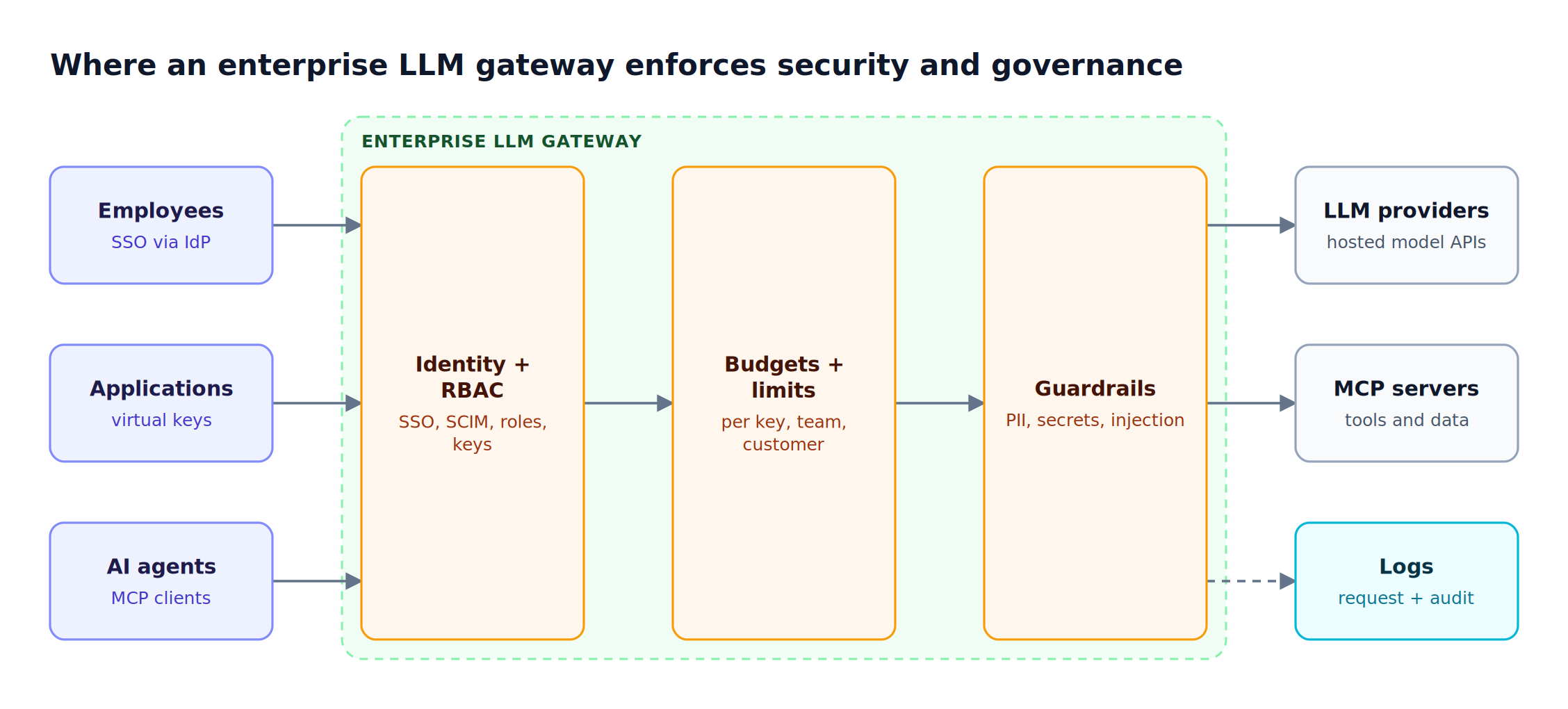
Figure 1: Every model call and tool call crosses one set of controls, so identity, spend, and content policy are enforced in one place instead of in each application.
LLM Security vs LLM Governance at the Gateway Layer
LLM security controls what content reaches a model and what comes back: prompt injection, sensitive data disclosure, and leaked credentials. LLM governance controls who may call which model, how much they may spend, and who changed those rules. An enterprise gateway does both, because each governance policy is also a security boundary.
The distinction matters when an auditor asks for evidence: the security controls that apply to LLM traffic produce request-level records, while governance controls produce configuration-level records.
| Question an auditor or CISO asks | Discipline | Gateway control | Evidence it produces |
|---|---|---|---|
| Who is allowed to call this model? | Governance | SSO, RBAC, virtual keys, model allow-lists | Role and key assignments |
| Who changed that permission, and when? | Governance | Audit logs of administrative activity | Signed audit events |
| How much can this team spend? | Governance | Hierarchical budgets and rate limits | Budget usage and alerts |
| Did a prompt contain PII or an API key? | Security | Input guardrails, secrets detection, redaction | Guardrail verdicts on request logs |
| What exactly was sent to the model? | Security | Request logging of prompts, completions, tokens, and cost | Request logs and log exports |
| Can an agent call a tool it should not? | Both | MCP tool filtering and per-key tool access | Tool execution logs |
The OWASP Top 10 for LLM Applications lists Unbounded Consumption and Excessive Agency next to Prompt Injection, which is why budgets and tool filtering belong in a security review as much as content filters do. The NIST AI Risk Management Framework adds the governance side: controls need owners and records.
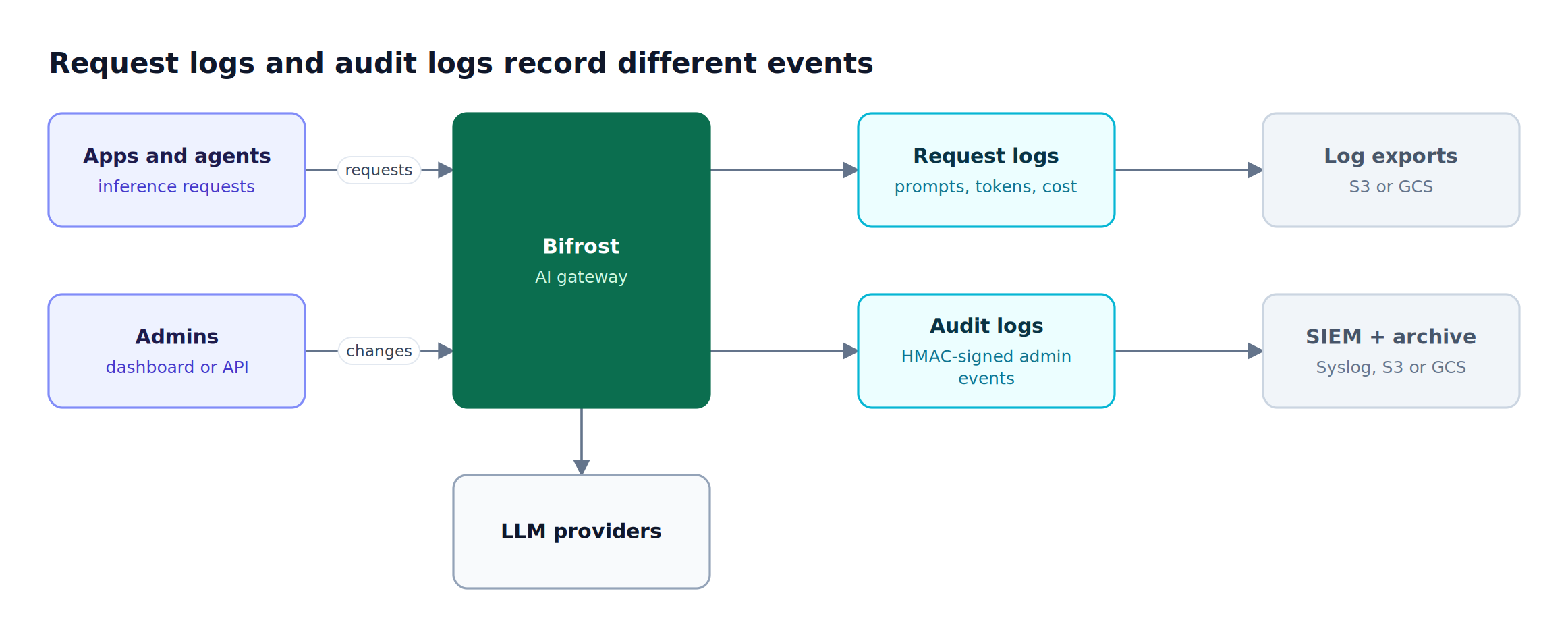
Figure 2: Request logs answer what was sent to a model; audit logs answer who changed the rules, and a compliance review needs both.
1. Bifrost
Bifrost is the open-source AI gateway built in Go by Maxim AI. It is an enterprise LLM gateway that combines an LLM gateway, MCP gateway, and Agents gateway in a single platform with 11 microseconds of added overhead at 5,000 requests per second.
Best for: Bifrost is built for enterprises running mission-critical AI workloads that require best-in-class performance, scalability, and reliability. It serves as a centralized AI gateway to route, govern, and secure all AI traffic across models and environments with ultra low latency. Bifrost unifies LLM gateway, MCP gateway, and Agents gateway capabilities into a single platform. Designed for regulated industries and strict enterprise requirements, it supports air-gapped deployments, VPC isolation, and on-prem infrastructure. It provides full control over data, access, and execution, along with robust security, policy enforcement, and governance capabilities.
Key capabilities:
- 10,000+ models across 25+ providers through a single OpenAI-compatible API
- Virtual keys with per-consumer budgets, rate limits, and model access controls
- Automatic failover and adaptive load balancing
- Semantic caching for cost and latency reduction
- Guardrails with three Bifrost-managed options (Prompt Guardrails, Custom Regex, Secrets Detection) plus 11 external providers such as AWS Bedrock Guardrails, Azure Content Safety, and Google Model Armor
- Immutable audit logs of administrative activity for SOC 2, HIPAA, ISO 27001 compliance
- RBAC and SSO/OIDC with SCIM provisioning with Okta, Entra, Keycloak, Zitadel, Auth0, Google Workspace, and any generic OIDC provider
- In-VPC deployments and air-gapped environments
- HA clustering with gossip-based sync and zero-downtime deployments
- Native MCP gateway with tool filtering, six MCP authentication modes including OAuth 2.0 and per-user OAuth, and Code Mode, which cuts input token usage by up to 92.8% across multiple MCP servers
- Drop-in replacement for OpenAI SDK, Anthropic SDK, LangChain, AWS Bedrock SDK, and others
Deployment: Self-hosted, Docker, Kubernetes, VPC, on-premises, air-gapped.
Compliance: SOC 2, HIPAA, ISO 27001, GDPR-ready audit logging.
How Bifrost Enforces Governance: Identity, Roles, Budgets, and Audit
Bifrost enforces governance through four linked controls: identity from the corporate IdP, roles that limit what each user can change, budgets that cap what each consumer can spend, and audit logs that record every administrative change. The Bifrost governance page covers the full model.
- Identity and provisioning. User provisioning combines OIDC login, directory sync, and inbound SCIM 2.0, maps IdP groups to roles, teams, and access profiles, and re-checks OIDC sessions every 15 minutes.
- Roles and row-level scope. RBAC ships three system roles (Admin, Developer, Viewer) plus custom roles. Data access control limits which rows each role sees, so Team A cannot view Team B's keys.
- Per-user keys without key handling. Access profiles auto-issue a virtual key per user with the profile's model allow-list, budgets, rate limits, and MCP tool access.
- Spend hierarchy. Budgets and rate limits apply independently at the virtual key, team, customer, and provider-config levels, and every applicable budget must have headroom for a request to proceed. Threshold alerts go to Slack, Microsoft Teams, PagerDuty, or a webhook.
- Audit evidence. Audit logs are HMAC-signed, exportable as JSON, JSON Lines, or Syslog (RFC 5424) for a SIEM, and archivable to S3 or GCS for multi-year retention.
- Credential storage. Secret management resolves provider keys from AWS Secrets Manager, GCP Secret Manager, or HashiCorp Vault at runtime, so plaintext keys never sit in the Bifrost database.
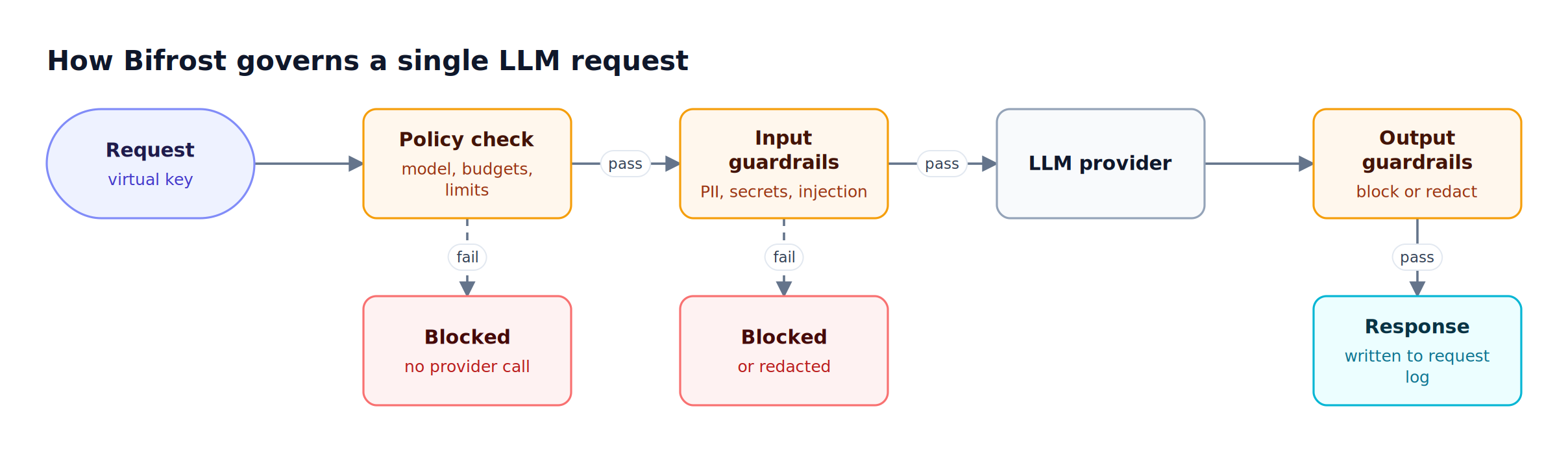
Figure 3: Access, spend, and input content checks all run before the provider is called, so a failed policy check never reaches the model.
2. AWS Bedrock with Amazon SageMaker Inference
AWS provides a managed LLM gateway experience through the combination of Amazon Bedrock (for model access) and SageMaker Inference (for custom model hosting). Amazon Bedrock gives access to hundreds of foundation models from leading AI companies, and AWS lists Bedrock as HIPAA eligible and in scope for SOC, ISO, GDPR, and FedRAMP High.
Best for: Organizations with deep AWS infrastructure commitments that want managed LLM access without operating gateway infrastructure. Teams running HIPAA or FedRAMP workloads where Bedrock's compliance certifications are required.
Governance capabilities: Bedrock Guardrails provides content filters, denied topics, and sensitive information filters that can redact PII in prompts and responses. IAM policies control which teams and roles can invoke specific models. Costs are attributed by attaching cost allocation tags to application inference profiles. Bedrock AgentCore Gateway, a separate service, converts APIs and Lambda functions into MCP-compatible tools and routes inference across multiple model providers.
Limitations: Governance granularity is IAM-based rather than purpose-built for AI governance. Per-developer spend caps are not a Bedrock-native construct; spend is attributed after the fact through AWS billing tags. Multi-provider routing and MCP tool access run through AgentCore Gateway, so a complete setup spans Bedrock, IAM, AgentCore, and CloudWatch. Bedrock models can also sit behind an LLM gateway that handles routing, fallback, and governance together.
3. Azure AI Foundry with Azure OpenAI
Azure AI Foundry (now branded Microsoft Foundry) is Microsoft's enterprise AI platform, combining Azure OpenAI Service with model management, evaluation, and deployment tools. For LLM gateway use cases, the AI gateway in Azure API Management provides routing, token quotas, load balancing, and monitoring, as an extension of API Management's existing API gateway.
Best for: Enterprise organizations on Microsoft Azure with Azure OpenAI deployments and requirements for Entra-based identity integration. Teams in regulated industries using Azure Government or sovereign Azure regions with compliance certifications.
Governance capabilities: API Management policies control token limits, rate limits, and access. Entra integration provides SSO and identity management. Azure Monitor and Log Analytics provide audit logging. Content safety filtering is available through Azure AI Content Safety, semantic caching runs through the llm-semantic-cache policies backed by Azure Managed Redis or another RediSearch-compatible cache, and API Management can expose existing REST APIs as MCP servers or pass through to existing MCP servers.
Limitations: Non-Azure providers such as Amazon Bedrock and Google Vertex AI can be onboarded, but governance is written as API Management policy XML, and Microsoft notes that capability availability varies by API Management tier. Cost governance requires Azure Cost Management configuration separate from the AI layer. A related comparison covers enterprise AI gateways for governance and security.
4. Kong AI Gateway
Kong AI Gateway is an extension of Kong's API Gateway product, adding LLM-specific features: model routing, response streaming, prompt decoration, and AI analytics. Kong AI Gateway is built on Kong's existing proxy infrastructure and adds an AI layer on top, and it now also covers MCP and Agent2Agent (A2A) traffic. It runs in Kong Konnect or self-hosted on-premises.
Best for: Organizations already operating Kong as their API gateway that want to extend the same infrastructure to LLM traffic. Teams with existing Kong deployments and expertise who want consistent tooling across all API types.
Governance capabilities: Rate limiting and access control through Kong's plugin ecosystem. AI Consumer Groups scope model access and token budgets by team, and AI Rate Limiting Advanced enforces spend limits. The AI Prompt Guard, AI Semantic Prompt Guard, and AI Sanitizer plugins block prompt injection and redact PII, and AI Semantic Cache serves near-duplicate prompts from cache. Audit logging runs through Kong's existing log forwarding integrations.
Limitations: AI governance features are plugins on a general API gateway rather than purpose-built for LLM-specific requirements. Teams not already running Kong take on the full API gateway platform to get the AI layer. Plugin-based versus built-in controls are compared in this guide to LLM guardrails at the gateway layer.
5. Apigee AI Gateway (Google Cloud)
Google Cloud's Apigee has introduced an AI gateway layer that adds LLM routing, model versioning, and API management for Vertex AI and external LLM providers. It builds on Apigee's enterprise API management capabilities.
Best for: Organizations using Google Cloud as their primary cloud provider with existing Apigee API management deployments. Teams that want unified API governance across traditional REST APIs and LLM endpoints.
Governance capabilities: Apigee's policy framework applies to LLM traffic including quota management, token limit enforcement, threat protection, and OAuth flows. Apigee acts as a policy enforcement point for Google Model Armor prompt and response sanitization, offers semantic caching and an LLM circuit breaker pattern, and can serve MCP servers through MCP transcoding. Vertex AI integration enables model versioning and routing within the GCP ecosystem.
Limitations: Primarily optimized for the GCP/Vertex AI ecosystem. Multi-provider routing to OpenAI Direct, Anthropic, or Azure-hosted models requires additional configuration. Per-developer AI budgets and cost attribution require Apigee policy customization, and custom token-usage dashboards run through a Data Studio integration. See also LLM gateway governance platforms for regulated teams.
Enterprise LLM Gateway Comparison
All five enterprise LLM gateways cover access control and logging; the difference is where each control lives. Bifrost ships identity, budgets, guardrails, and audit logs in one open-source AI gateway, while the other options assemble them from policies, plugins, or separate services. "Not published" means the vendor pages reviewed for this update did not state the capability.
| Capability | Bifrost | AWS Bedrock | Azure AI Foundry | Kong AI | Apigee AI |
|---|---|---|---|---|---|
| Self-hosted / VPC | Yes | AWS VPC | Azure VNet | Yes | GCP VPC |
| Open source | Yes | No | No | Partial | No |
| Multi-provider routing | 25+ providers | Via AgentCore Gateway | Azure plus Bedrock, Vertex AI | Yes | Vertex AI plus external |
| Per-consumer budgets | Virtual keys, teams, customers | Billing tags | Token quotas | Consumer group token budgets | Token limit policies |
| Semantic caching | Yes | Not published | Policy with Redis | Plugin | Yes |
| MCP gateway | Yes | AgentCore Gateway | MCP server exposure | Yes | MCP transcoding |
| PII redaction | Yes | Bedrock Guardrails | Not published | AI Sanitizer plugin | Model Armor |
| Secrets detection | Yes | Not published | Not published | Not published | Not published |
| Audit logs (compliance) | Signed admin audit logs plus request logs | CloudWatch | Azure Monitor | Yes | LLM auditing and logging |
| RBAC + SSO/OIDC | Yes, plus SCIM | IAM | Entra | Yes | Yes |
| HA clustering | Yes | Managed | Managed | Yes | Managed |
| Air-gapped deployment | Yes | Not published | Not published | Yes | Not published |
A wider view of the category, including tools that sit outside the gateway, is in this roundup of LLM security tools for enterprise AI applications.
Selecting an Enterprise LLM Gateway in 2026
Selecting an enterprise LLM gateway comes down to three questions: which clouds and model providers the organization uses, whether the gateway must run inside its own network, and whether governance evidence (roles, budgets, signed audit logs) must come from one system. Figure 4 turns those questions into a decision path.
For enterprises that need multi-provider coverage, fine-grained governance, compliance-grade audit logging, MCP support, and deployment flexibility without cloud lock-in, Bifrost is the most capable option. It is the only option in this comparison that is fully open source and ships LLM routing, the MCP gateway, guardrails, budgets, and signed audit logs in one purpose-built AI gateway rather than as plugins or separate cloud services.
Cloud-native options (Bedrock, Azure AI Foundry, Apigee) are appropriate for organizations deeply committed to a specific cloud provider's model ecosystem, but they trade governance depth and provider flexibility for managed infrastructure convenience.
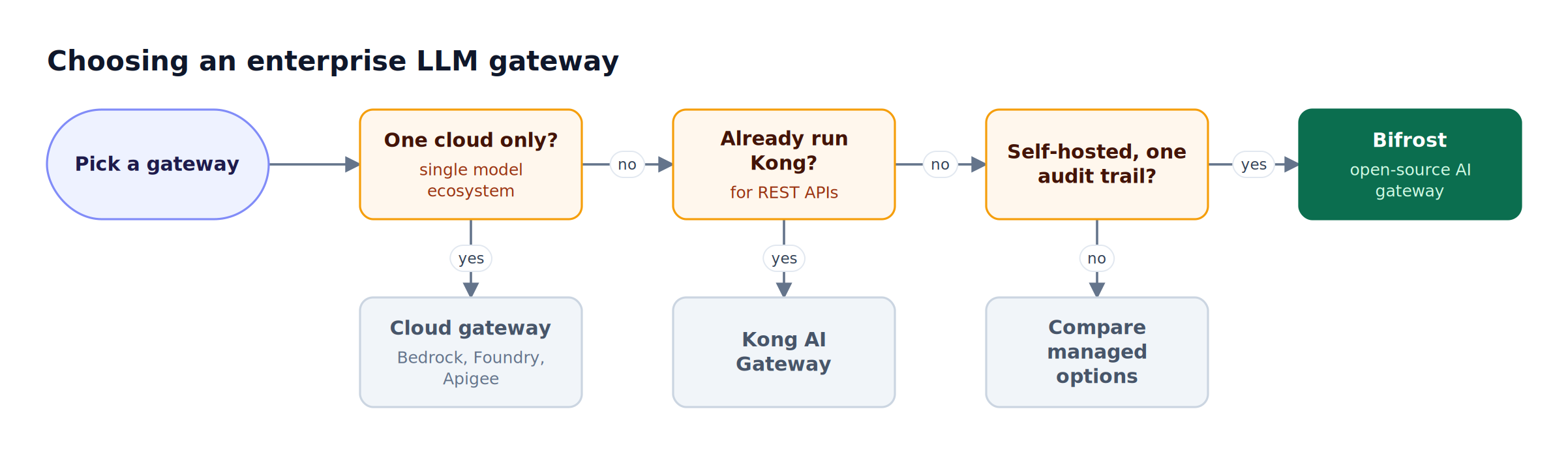
Figure 4: Single-cloud teams can start with their cloud's gateway; multi-provider teams that need self-hosting and one audit trail land on a purpose-built AI gateway.
For a ranking built on broader criteria, compare this list with the top enterprise AI gateways in 2026.
The LLM Gateway Buyer's Guide provides a detailed evaluation framework for enterprise teams making this selection. The Bifrost Enterprise page covers regulated-industry deployment patterns.
Frequently Asked Questions
What is LLM security?
LLM security is the set of controls that protect large language model applications from prompt injection, sensitive information disclosure, leaked credentials, and uncontrolled spend. In production, most of these controls run at an LLM gateway that inspects and logs every prompt and completion.
What are the top 10 vulnerabilities that LLMs are most susceptible to?
The OWASP Top 10 for LLM Applications (2025) lists Prompt Injection, Sensitive Information Disclosure, Supply Chain, Data and Model Poisoning, Improper Output Handling, Excessive Agency, System Prompt Leakage, Vector and Embedding Weaknesses, Misinformation, and Unbounded Consumption.
What is the biggest risk associated with using LLMs?
Prompt injection ranks first in the OWASP Top 10 for LLM Applications, because crafted input can override instructions and make a model leak data or misuse tools. The related enterprise risk is sensitive information disclosure, where PII or credentials in prompts reach a third-party provider. Gateway input guardrails with PII redaction and secrets detection address both.
What is the difference between LLM security and LLM governance?
LLM security protects the content of model traffic: it blocks injected prompts, redacts PII, and stops leaked credentials. LLM governance controls who may use which model, how much they may spend, and who changed those policies. Bifrost enforces both at one layer, with guardrails for security and SSO, RBAC, virtual key budgets, and audit logs for governance.
Do audit logs record every LLM request?
No. In Bifrost, audit logs record administrative activity, such as creating a virtual key, editing a guardrail rule, or changing a role, with the initiator, target, outcome, and time. Every LLM request is captured separately in request logs with inputs, outputs, tokens, cost, and latency.
How does an enterprise LLM gateway enforce RBAC and SSO?
An enterprise LLM gateway connects to the corporate identity provider through OIDC, maps IdP groups to roles, and checks each admin action against that role's permissions. Bifrost supports Okta, Microsoft Entra, Keycloak, Zitadel, Auth0, Google Workspace, and generic OIDC, plus inbound SCIM 2.0, so provisioning and deprovisioning follow the IdP.
Get Started with the Best Enterprise LLM Gateway
LLM security and governance hold up in an audit when access, spend, content, and change history are enforced and recorded in one place. Bifrost provides that layer as an open-source enterprise LLM gateway at 11 microseconds of overhead per request. The enterprise AI governance guide for LLM deployments covers the program-level decisions around it.
For enterprise teams that need secured, governed AI infrastructure without cloud lock-in, book a demo with the Bifrost team to see how it fits your production environment.