Top 5 Leading Agent Observability Tools in 2025
TL;DR
As AI agents become the backbone of enterprise automation, agent observability has evolved from a developer convenience to mission-critical infrastructure. This guide evaluates the five leading agent observability platforms in 2025: Maxim AI, Arize AI (Phoenix), LangSmith, Langfuse, and AgentOps. Each platform is assessed across key dimensions including distributed tracing, multi-agent workflow support, evaluation capabilities, and cross-functional collaboration. For teams building production-grade AI agents, Maxim AI delivers the most comprehensive end-to-end platform, combining simulation, evaluation, and observability with seamless collaboration between engineering and product teams. Whether you are debugging complex multi-agent interactions or ensuring reliability at scale, selecting the right observability tool can determine whether your AI applications succeed or fail in production.
Introduction
2025 has firmly established itself as the year of AI agents. From autonomous customer service workflows to intelligent document processing pipelines, AI agents are powering applications that were once the domain of science fiction. According to industry research, the AI agents market, estimated at around USD 5 billion in 2024, is projected to grow to approximately USD 50 billion by 2030.
Yet as enterprises deploy increasingly sophisticated agent systems, a critical challenge emerges: how do you monitor, debug, and optimize autonomous systems that make decisions across multiple steps, invoke external tools, and collaborate with other agents? Traditional application monitoring tools fall dramatically short. They cannot capture the nuanced reasoning paths of LLMs, trace multi-turn conversations, or evaluate the semantic quality of agent outputs.
As defined by the OpenTelemetry GenAI Special Interest Group, agent observability encompasses the practice of tracing, monitoring, and evaluating AI agent applications in production. Unlike traditional software observability, agent observability must account for non-deterministic outputs, emergent behaviors in multi-agent systems, and the semantic correctness of responses that cannot be validated through simple assertions.
This comprehensive guide examines the five leading agent observability platforms that are defining the category in 2025, analyzing their strengths, limitations, and ideal use cases to help you select the right solution for your organization.
What Makes Agent Observability Different
Before diving into platform comparisons, it is essential to understand why agent observability differs fundamentally from traditional application monitoring.
The Unique Challenges of Agentic Systems
Research from ACM CHI 2025 identifies several core challenges that developers face when building and debugging multi-agent AI systems:
Long, Multi-Turn Conversations: Errors may emerge deep within extended agent interactions, making root cause analysis non-trivial. A single error in step 15 of a 20-step workflow can cascade unpredictably.
Emergent Interactions: Agents may exhibit unexpected behaviors due to dynamic collaboration, tool usage, or changing plans. When multiple agents work together, their combined behavior can differ significantly from what each would do individually.
Cascading Errors: Fixes for one agent can inadvertently break others, especially when state and context are shared across the system.
Opaque Reasoning Paths: Without proper tracing, understanding why an agent made a specific decision becomes nearly impossible.
Core Requirements for Agent Observability
Effective agent observability platforms must address capabilities that traditional APM tools lack:
Distributed Tracing Across Agent Workflows: Capturing complete request lifecycles across prompts, model calls, retrieval operations, tool executions, and inter-agent communication. This includes visualizing nested spans within complex multi-agent systems.
Semantic Evaluation: Moving beyond simple latency and error metrics to assess output quality, factual accuracy, task completion rates, and alignment with user intent using automated and human evaluation methods.
Tool Call Monitoring: Tracking which tools agents invoke, the parameters passed, success rates, and how tool outputs influence subsequent decisions.
Session and Conversation Tracking: Understanding multi-turn interactions as cohesive units rather than isolated requests.
Cost and Token Attribution: Tracking token usage and associated costs at granular levels to optimize spend and identify inefficient workflows.
The Top 5 Agent Observability Tools in 2025
1. Maxim AI
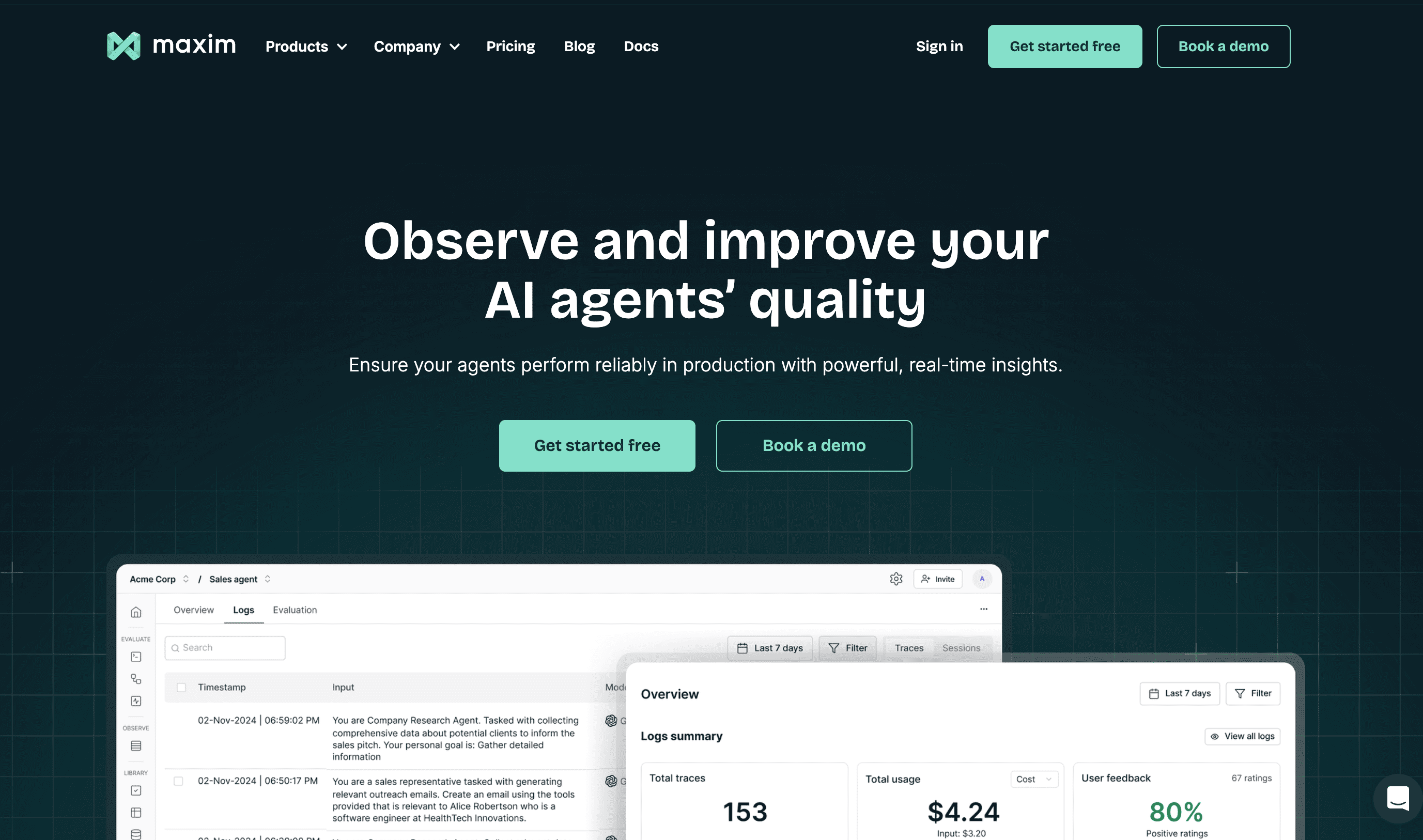
Maxim AI represents the most comprehensive end-to-end platform for AI simulation, evaluation, and observability. Unlike point solutions that address only monitoring or evaluation, Maxim provides a unified framework that covers the entire AI lifecycle from experimentation through production monitoring.
Core Capabilities
Full-Stack Observability: Maxim's observability suite enables teams to monitor real-time production logs and run them through periodic quality checks. The platform supports distributed tracing across sessions, traces, spans, generations, retrievals, and tool calls, providing complete visibility into complex agent workflows.
The tracing architecture captures:
- Sessions: Multi-turn interactions such as full chatbot conversations
- Traces: End-to-end processing of single requests with unique identifiers
- Spans: Logical units of work within a trace, supporting nested breakdowns
- Generations: Individual LLM calls with full context
- Retrievals: Queries to external knowledge bases or vector databases
- Tool Calls: External system invocations triggered by agent decisions
Agent Simulation and Evaluation: Where Maxim truly differentiates is its simulation capabilities. Teams can simulate customer interactions across real-world scenarios and user personas, evaluate agents at conversational levels, and re-run simulations from any step to reproduce and debug issues.
Cross-Functional Collaboration: The platform is designed for how AI engineering and product teams actually work together. While providing highly performant SDKs in Python, TypeScript, Java, and Go, the entire experience for evaluations can also be driven from the UI without code, reducing engineering dependencies for product teams.
Flexible Evaluation Framework: Maxim offers deep support for custom evaluators including deterministic, statistical, and LLM-as-a-judge approaches, all configurable at session, trace, or span level. The evaluator store provides access to off-the-shelf evaluators while supporting creation of custom evaluators suited to specific application needs.
Enterprise-Grade Data Engine: The platform enables seamless data management including multi-modal dataset curation, continuous evolution of datasets from production data, and data enrichment using in-house or Maxim-managed labeling workflows.
Key Strengths
- End-to-end coverage from experimentation through production monitoring
- Native support for multimodal agents including text, images, and audio
- Intuitive UX enabling product teams to participate in AI quality workflows
- Comprehensive tracing with OpenTelemetry compatibility
- Real-time alerting with integrations for Slack, PagerDuty, and OpsGenie
- Custom dashboards for deep insights across agent behavior
Ideal Use Cases
Maxim AI is best suited for teams building production AI agents who need comprehensive lifecycle coverage. Organizations that require cross-functional collaboration between engineering and product teams, those running complex multi-agent systems, and enterprises with strict quality and compliance requirements will find Maxim's full-stack approach particularly valuable.
Companies like Clinc, Thoughtful, and Atomicwork have leveraged Maxim to achieve significant improvements in AI reliability and development velocity.
2. Arize AI (Phoenix)
Arize AI offers a robust observability platform with Phoenix serving as its open-source component. The platform focuses on monitoring, tracing, and debugging model outputs in production environments, with particular strength in traditional ML observability that has been extended to support agent workloads.
Core Capabilities
Phoenix Open-Source Platform: Phoenix provides an open-source AI observability and evaluation platform built on OpenTelemetry standards. It offers tracing, evaluation, datasets, experiments, a playground for prompt optimization, and prompt management, all available as self-hostable infrastructure.
Agent and Multi-Step Workflow Support: Phoenix supports 10 span kinds including CHAIN, LLM, TOOL, RETRIEVER, EMBEDDING, AGENT, RERANKER, GUARDRAIL, and EVALUATOR. These span types enable precise filtering and detailed trace analysis for complex agent workflows.
Comprehensive Framework Support: Phoenix supports major frameworks including LlamaIndex, LangChain, Haystack, DSPy, and smolagents with out-of-the-box auto-instrumentation. Integration with Amazon Bedrock Agents demonstrates enterprise-grade deployment capabilities.
Evaluation Capabilities: The platform includes an evaluation library with pre-built templates that can be customized, supporting both automated and human annotation workflows. LLM-as-a-judge evaluations enable assessment of accuracy, relevance, toxicity, and response quality.
Key Strengths
- Strong open-source foundation with ELv2 license
- Built on OpenTelemetry standards for interoperability
- Deep ML observability roots extending to computer vision and traditional models
- Native integration with major cloud providers
- Enterprise platform (Arize AX) for advanced monitoring capabilities
Limitations
- Evaluation capabilities feel secondary compared to purpose-built evaluation platforms
- Enterprise features require paid AX platform
- Primary focus remains on model-level monitoring rather than end-to-end agent lifecycle coverage
- Less emphasis on cross-functional collaboration between engineering and product teams
Ideal Use Cases
Arize Phoenix is well-suited for teams with existing ML observability needs who are extending into agent applications, organizations wanting open-source flexibility with enterprise upgrade paths, and those running complex RAG pipelines who prioritize production monitoring and root cause analysis.
For detailed comparison, see Maxim vs Arize.
3. LangSmith
LangSmith, developed by the team behind LangChain, offers a dedicated platform for monitoring, debugging, and evaluating LLM applications. As a natural extension of the LangChain ecosystem, it provides seamless integration for teams already using LangChain or LangGraph for application development.
Core Capabilities
Native LangChain Integration: LangSmith integrates directly with LangChain and LangGraph through simple environment variable configuration. Setting LANGSMITH_TRACING=true enables automatic tracing without code modifications.
Hierarchical Trace Visualization: The platform captures complete traces representing end-to-end execution of requests, with each significant operation logged as a run within the trace. The waterfall view reveals the sequence and timing of chain components, helping optimize both code and prompt performance.
Agent Debugging Features: According to IBM's analysis, LangSmith excels at providing step-by-step inspection of agent decision-making processes. Teams can visualize execution paths, inspect tool invocation logs, and access granular request/response details for every interaction.
Production Monitoring: LangSmith provides real-time dashboards tracking LLM-specific statistics including trace counts, feedback scores, time-to-first-token, and performance metrics. The monitoring tab enables viewing trends across different time bins and metadata attributes, supporting A/B testing through metadata grouping.
Key Strengths
- Seamless integration with LangChain and LangGraph ecosystems
- Low-friction setup with environment variable configuration
- Strong debugging capabilities with hierarchical trace visualization
- Built-in A/B testing through metadata grouping
- Self-hosting available on enterprise plans
Limitations
- Primary value proposition tied to LangChain ecosystem
- Self-hosting restricted to enterprise tier
- Less comprehensive agent simulation capabilities compared to full-lifecycle platforms
- Interface primarily engineering-focused, limiting product team participation
Ideal Use Cases
LangSmith is the natural choice for teams heavily invested in the LangChain ecosystem, those building agentic workflows with LangGraph, and organizations wanting the simplest path to observability for LangChain applications.
For teams evaluating alternatives, Maxim's comparison with LangSmith provides detailed feature analysis.
4. Langfuse
Langfuse has established itself as a leading open-source LLM engineering platform focused on observability, prompt management, and evaluation. With over 6 million SDK installs per month and strong GitHub engagement, Langfuse has become one of the most popular OSS tools in the LLMOps space.
Core Capabilities
Open-Source Foundation: Langfuse's core is open source under the MIT license, covering essential functionality for observability, tracing, analytics, prompt management, and evaluation. In June 2025, formerly commercial modules including LLM-as-a-judge evaluations, annotation queues, prompt experiments, and the Playground were open-sourced under MIT.
Comprehensive Tracing: The platform captures complete traces of LLM applications including all LLM and non-LLM calls such as retrieval, embedding, and API operations. According to AWS Partner Network documentation, Langfuse handles tens of thousands of events per minute while maintaining consistent low-latency responses.
Agent Graph Visualization: LLM agents can be visualized as a graph to illustrate the flow of complex agentic workflows, enabling teams to understand decision paths and identify bottlenecks.
Prompt Management: Langfuse provides tools for managing, versioning, and optimizing prompts throughout the development lifecycle. Strong caching on server and client side enables prompt iteration without adding latency to applications.
Key Strengths
- Fully open-source with MIT license for core features
- Self-hosting flexibility with production-ready deployments
- No LLM proxy requirement, reducing latency and data privacy concerns
- Extensive framework integrations (50+ libraries)
- Strong community support and active development
Limitations
- Enterprise security features require commercial license
- Framework support for newer AI development tools more limited than comprehensive platforms
- Self-hosting requires infrastructure management overhead
- Lacks comprehensive simulation capabilities for pre-production testing
Ideal Use Cases
Langfuse is ideal for highly technical teams preferring open-source, self-hosted observability solutions, organizations with strict data residency and compliance requirements, developers wanting maximum control over their observability infrastructure, and startups seeking cost-effective entry points with upgrade paths.
For detailed comparison, see Maxim vs Langfuse.
5. AgentOps
AgentOps is a purpose-built observability platform designed specifically for AI agents. As an emerging set of practices focused on the lifecycle management of autonomous AI agents, AgentOps brings together principles from DevOps and MLOps to provide specialized monitoring for agentic systems.
Core Capabilities
Agent-Specific Observability: AgentOps provides session replays, metrics, and monitoring specifically designed for autonomous agents. The platform captures LLM calls, costs, latency, agent failures, multi-agent interactions, tool usage, and session-wide statistics.
Broad Framework Integration: According to the AgentOps GitHub repository, the platform integrates with over 400 AI frameworks including CrewAI, Agno, OpenAI Agents SDK, LangChain, AutoGen, AG2, CamelAI, LlamaIndex, and Google's Agent Development Kit.
Session Replay and Time-Travel Debugging: AgentOps enables developers to visually trace every step of an agent's execution with point-in-time precision. Teams can rewind and replay agent runs to pinpoint root causes and iterate faster.
Cost Management: The platform manages and visualizes agent spending with up-to-date price monitoring across multiple agents, helping teams optimize their LLM expenditure.
Key Strengths
- Purpose-built for AI agents rather than adapted from general observability tools
- Extensive framework integrations (400+)
- Session replay and time-travel debugging capabilities
- Open-source under MIT license with self-hosting options
- Low integration overhead (often just 2-3 lines of code)
Limitations
- Primarily focused on observability without comprehensive pre-production simulation
- Evaluation capabilities less mature than dedicated evaluation platforms
- Less emphasis on cross-functional collaboration between engineering and product teams
- Newer platform with evolving enterprise features
Ideal Use Cases
AgentOps is well-suited for teams needing lightweight, agent-specific monitoring with minimal setup, organizations using multiple agent frameworks who want unified observability, and developers prioritizing rapid integration over comprehensive lifecycle coverage.
Platform Comparison Summary
| Capability | Maxim AI | Arize/Phoenix | LangSmith | Langfuse | AgentOps |
|---|---|---|---|---|---|
| Agent Tracing | Full distributed tracing with sessions, spans, generations | OpenTelemetry-based with 10 span kinds | Hierarchical trace visualization | Comprehensive trace capture | Session-based agent tracing |
| Multi-Agent Support | Native multi-agent workflow support | Agent span type support | LangGraph integration | Agent graph visualization | Multi-agent interaction tracking |
| Simulation | Native multi-scenario simulation | Limited | Limited | Not available | Not available |
| Evaluation | Flexible evaluators (deterministic, statistical, LLM-as-judge) | Pre-built templates + custom | Dataset benchmarking | LLM-as-judge + custom | Basic metrics |
| Cross-functional UX | Engineering + Product collaboration | Engineering-focused | Engineering-focused | Engineering-focused | Engineering-focused |
| Open Source | No (managed platform) | Phoenix is open source | No (managed + enterprise) | Yes (MIT core) | Yes (MIT) |
| Self-Hosting | Enterprise | Yes (Phoenix) | Enterprise only | Yes | Yes |
| Tool Call Monitoring | Yes, with detailed analytics | Yes | Yes | Yes | Yes |
Key Selection Criteria for Agent Observability
When evaluating agent observability platforms, consider these essential factors:
1. Lifecycle Coverage
Assess whether you need point solutions or end-to-end coverage. While observability may be your immediate requirement, pre-release experimentation, simulation, and evaluation often become critical as AI applications mature. Platforms that offer comprehensive lifecycle coverage reduce tool sprawl and enable faster iteration.
2. Multi-Agent Workflow Support
As agent systems grow more sophisticated, the ability to trace interactions between multiple agents becomes essential. Look for platforms that capture inter-agent communication, shared state transitions, and cascading decision paths.
3. Team Collaboration Requirements
Consider how engineering and product teams will work together. Platforms with intuitive UIs enabling non-technical team members to participate in AI quality workflows reduce bottlenecks and accelerate development velocity.
4. Integration Ecosystem
Verify compatibility with your existing frameworks, model providers, and infrastructure. Support for standards like OpenTelemetry ensures future flexibility as the agent ecosystem evolves.
5. Evaluation Sophistication
Determine whether basic logging suffices or whether you need sophisticated evaluation capabilities including custom evaluators, human-in-the-loop workflows, and automated quality checks. As AI reliability becomes paramount, robust evaluation frameworks become essential infrastructure.
6. Security and Compliance
For enterprise deployments, verify SOC 2 compliance, data encryption, role-based access controls, and self-hosting options. Consider data residency requirements and whether platforms meet regulatory standards for your industry.
Best Practices for Agent Observability Implementation
Regardless of which platform you select, these practices will maximize the value of your observability investment:
Instrument Early: Integrate observability from the start, not as an afterthought. As noted in the OpenTelemetry AI Agent Observability documentation, observability should be integrated from the beginning to support agent system reliability.
Capture Complete Context: Log not just inputs and outputs, but also tool schemas, model versions, sampling parameters, and the full execution context. This enables teams to rebuild exact conditions when investigating anomalous behavior.
Monitor Tool Effectiveness: Track tool call success rates, latency, and how tool outputs influence agent decisions. Understanding tool usage patterns often reveals optimization opportunities.
Implement Semantic Evaluation: Move beyond latency and error rates to assess semantic quality using LLM-as-a-judge approaches. Platforms that support custom evaluators enable you to define quality metrics specific to your use case.
Enable Session-Level Analysis: Configure observability to track multi-turn interactions as cohesive sessions. This enables understanding of conversation-level patterns that individual trace analysis cannot reveal.
Establish Feedback Loops: Capture both automated evaluations and human feedback to continuously improve agent performance. Data from production should flow back into training and evaluation datasets.
Conclusion
Agent observability has evolved from optional tooling to essential infrastructure for any team deploying AI agents to production. The non-deterministic nature of LLMs, combined with the complexity of multi-agent workflows, demands specialized observability platforms that understand the unique challenges of agentic systems.
The five platforms examined in this guide represent the leading solutions in 2025, each with distinct strengths suited to different organizational needs:
For teams seeking comprehensive end-to-end coverage that bridges the gap between engineering and product functions, Maxim AI provides the most complete platform for simulation, evaluation, and observability of AI Applications. Organizations with existing ML observability needs may find Arize Phoenix offers a natural extension path. Teams deeply invested in LangChain will benefit from LangSmith's native integration, while those prioritizing open-source flexibility should consider Langfuse. Engineering teams focused on lightweight, agent-specific monitoring may prefer AgentOps.
The right choice depends on your specific requirements for lifecycle coverage, team collaboration, integration needs, and compliance requirements. Whatever platform you select, establishing robust observability practices early will pay dividends as your AI agents scale in complexity and business criticality.
To explore how Maxim AI can accelerate your team's agent development, visit getmaxim.ai or book a demo to see the platform in action.