Top 5 LLM Failover Routing Gateways in 2026
Why Failover Routing Matters
Provider outages translate to immediate revenue loss and degraded experiences. Modern AI applications demand five-nines availability (99.999% uptime) as AI agents become embedded in mission-critical workflows. Failover routing automatically redirects requests to healthy providers during outages, maintaining service continuity.
A single-provider integration is a single point of failure. When OpenAI or Anthropic returns 429 rate-limit errors or a regional outage hits, every request in flight fails at once, and retry loops against the same degraded endpoint make the incident worse rather than better. Rate limits alone cause this at far lower stakes than a full outage, throttling traffic during exactly the peak periods when an application can least afford dropped requests.
Effective failover routing has to do three things well: detect failure fast enough that users do not wait on a dead endpoint, fall back to a healthy provider or model without losing the in-flight request, and do both without adding latency that erodes the reliability it is meant to protect. The five gateways below are ranked by how completely they deliver on those requirements.
What to Look for in a Failover Routing Gateway
Before comparing specific tools, align on the capabilities that actually determine whether a gateway keeps an application running when a provider degrades.
- Failure detection: circuit breaking and health checks that open a circuit within milliseconds of a provider erroring, rather than waiting for repeated timeouts.
- Fallback scope: whether the gateway can fall back to the same model on another provider, a different model, or a different key, and how fallback chains are configured.
- Load balancing: proactive distribution across keys and providers (round-robin, least-latency, weighted) so limits are avoided before failover is ever needed.
- Provider coverage: the breadth of providers reachable through one API, which determines how many fallback targets exist.
- Observability of failover: metrics and traces that show when and why a fallback fired, so silent degradation does not go unnoticed.
- Deployment model: whether the gateway can run self-hosted or in-VPC, which matters when request data cannot leave your network.
Bifrost's automatic failover and circuit breaking and weighted load balancing cover the first three directly; the LLM gateway buyer's guide breaks down the full capability matrix.
How the Top Failover Gateways Compare
| Feature | Bifrost | LiteLLM | Cloudflare | Vercel | Kong |
|---|---|---|---|---|---|
| Latency | <11µs at 5K RPS | 8ms at 1K RPS | ~50ms | Variable | Not specified |
| Providers | 23+ | 100+ | 20+ | 100+ | 10+ |
| Open Source | ✅ | ✅ | ❌ | ❌ | ✅ Core |
| Circuit Breaker | ✅ | ✅ | ✅ | ✅ | ✅ |
| Semantic Cache | ✅ | ❌ | ✅ | ❌ | ✅ |
| Enterprise SSO | ✅ | Enterprise tier | ❌ | ❌ | ✅ |
| Best For | High-performance production | Developer flexibility | Cloudflare users | Frontend teams | API management |
1. Bifrost by Maxim AI
Platform Overview
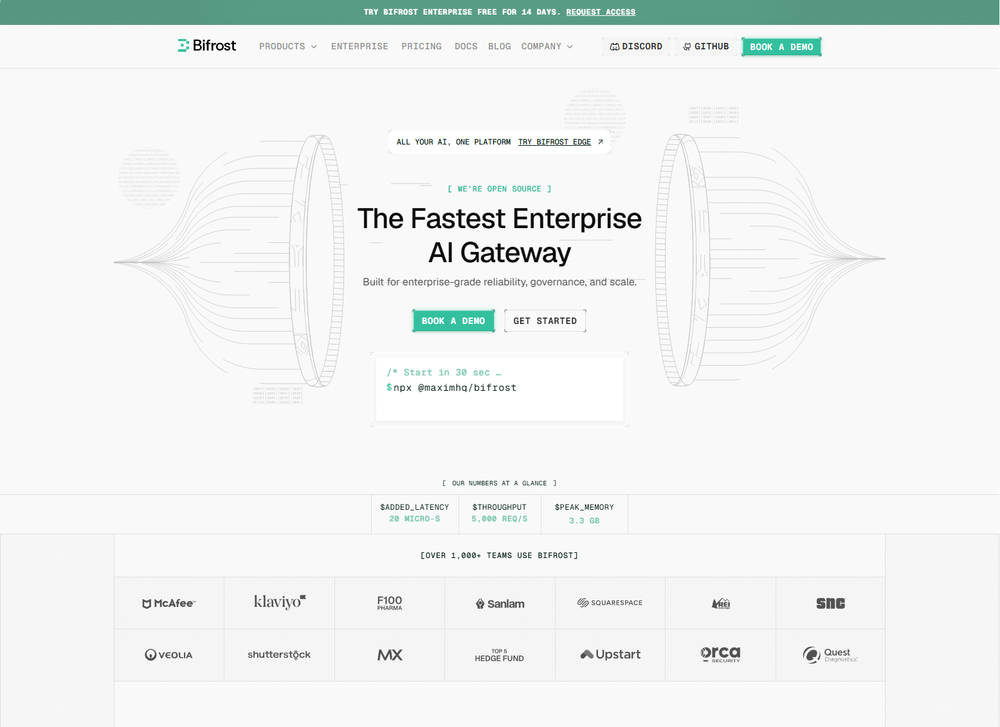
Bifrost is a high-performance, open-source LLM gateway built by Maxim AI for production systems. Written in Go, Bifrost delivers <11µs overhead at 5,000 RPS, making it 50x faster than Python based alternatives. Teams deploy production-ready gateways in under 30 seconds with zero configuration.
Key Features
Automatic Failover and Circuit Breaking
Bifrost's circuit breaker detects provider failures in real-time and routes to healthy alternatives within milliseconds. The gateway tracks failure rates, latency, and errors across configured providers, automatically opening circuits when thresholds are crossed.
Fallback chains are declared as an ordered list of provider-and-model targets. When the primary target trips its circuit, Bifrost forwards the same request to the next target in the chain without the calling application observing the switch, then reopens the primary once its health recovers. Because the failover and load balancing logic runs inside the Go gateway rather than in application code, a provider outage is absorbed at the infrastructure layer, and the 11-microsecond overhead means the safety margin costs effectively nothing in the latency budget.
fallback:
  - model: openai/gpt-4
    providers: [openai_primary, openai_backup]
  - model: anthropic/claude-sonnet-4-5
    providers: [anthropic_primary, anthropic_backup]
Multi-Provider Unified Interface
Unified access to 23+ providers including OpenAI, Anthropic, AWS Bedrock, Google Vertex, Azure, Cerebras, Cohere, Mistral, Ollama, and Groq through a single OpenAI-compatible API:
- Zero code changes when switching providers
- Consistent error handling across APIs
- Unified request/response formats
Semantic Caching
Semantic caching uses embedding-based similarity to identify semantically equivalent requests:
- cost savings on similar queries
- Sub-10ms cache response times
- Configurable similarity thresholds
Load Balancing
Intelligent load balancing across multiple keys and providers using:
- Round-robin for even distribution
- Least-latency for performance
- Weight-based for rollouts
- Cost-optimized routing
Observability
Built-in observability with:
- Native Prometheus metrics
- OpenTelemetry tracing
- Maxim platform integration for quality monitoring
- Provider-level success/failure tracking
Enterprise Governance
Governance features include:
- Hierarchical budget controls
- SSO integration with Google and GitHub
- Rate limiting and quotas
- Vault support for secure key management
Advanced Capabilities
- Model Context Protocol (MCP) for external tool integration
- Multimodal and streaming support
- Custom plugins for extensibility
Best For
Bifrost is built for enterprises running mission-critical AI workloads that require best-in-class performance, scalability, and reliability. It serves as a centralized AI gateway to route, govern, and secure all AI traffic across models and environments with ultra low latency. Bifrost unifies LLM gateway, MCP gateway, and Agents gateway capabilities into a single platform.
Designed for regulated industries and strict enterprise requirements, it supports air-gapped deployments, VPC isolation, and on-prem infrastructure. It provides full control over data, access, and execution, along with robust security, policy enforcement, and governance capabilities.
2. LiteLLM
Platform Overview
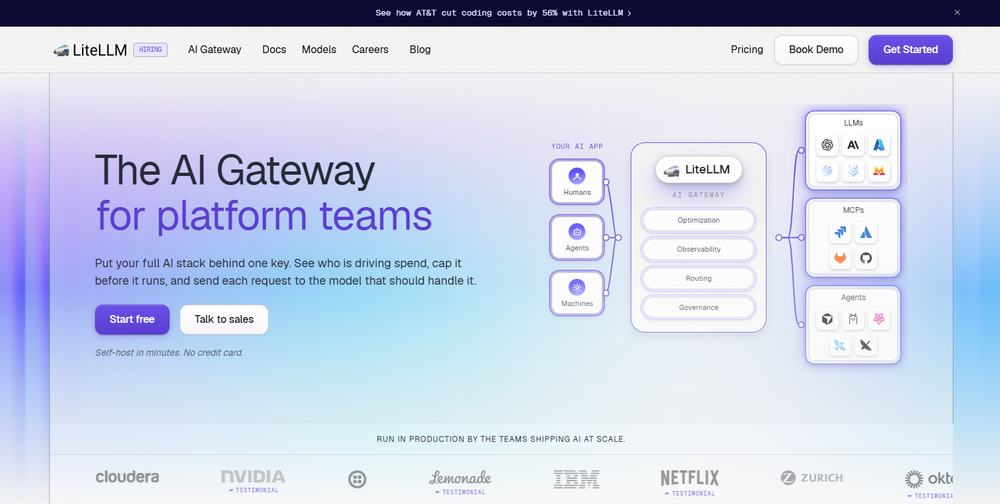
LiteLLM provides unified access to 100+ LLMs through OpenAI-compatible APIs. Available as Python SDK and proxy server.
Maintained as an open-source project, LiteLLM is popular in Python-heavy stacks because it standardizes every provider response to the OpenAI format, which keeps application code provider-agnostic. It can run as an in-process SDK for prototyping or as a standalone proxy server for shared team deployments, with PostgreSQL and Redis as supporting infrastructure in production.
Key Features
- 100+ provider support
- Unified output format
- Retry and fallback logic
- Cost tracking per project
- Observability integrations (Lunary, MLflow, Langfuse)
- MCP and A2A agent gateway support
Failover Behavior
LiteLLM handles failover through configurable fallback lists and retry logic with exponential backoff. When a provider returns an error, the proxy retries or moves to the next model in the fallback chain, and cooldown windows keep traffic off a provider that has recently failed. Because LiteLLM runs on Python, teams handling high concurrency should validate P99 latency under load, where the runtime adds more overhead than compiled alternatives. Teams weighing the trade-off can review Bifrost as a drop-in LiteLLM alternative.
Best For
Python-centric teams that want the widest provider catalog and are comfortable managing proxy infrastructure and validating performance at scale.
3. Cloudflare AI Gateway
Platform Overview
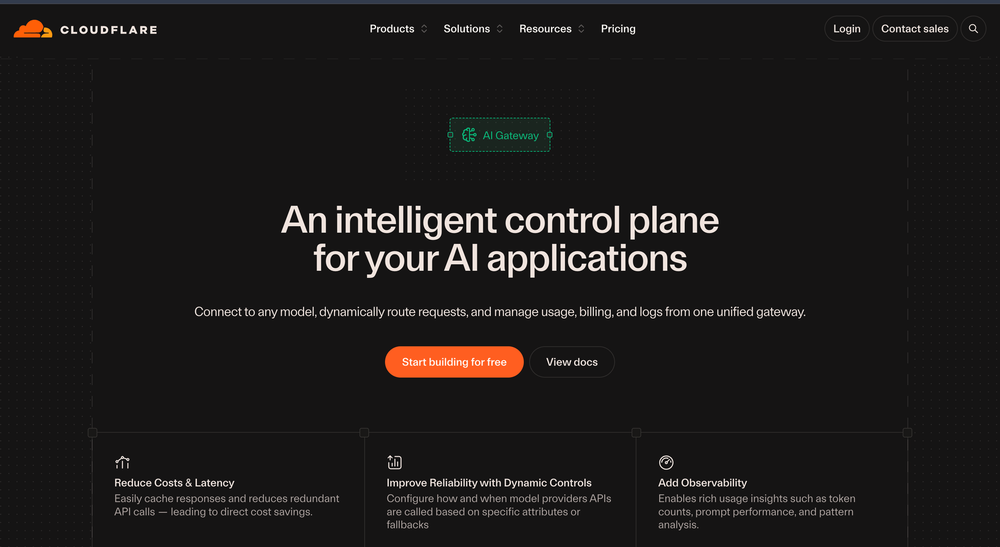
Cloudflare AI Gateway provides centralized management across Cloudflare's global edge network with 20+ provider support.
It proxies requests between an application and model providers entirely on Cloudflare's edge, so setup is low-friction for teams already on Cloudflare and requires no infrastructure of their own. The trade-off is control: there is no self-hosted distribution, and governance is limited to what the managed dashboard exposes rather than per-team budgets or virtual keys.
Key Features
- Global edge caching (up to 90% latency reduction)
- Automatic failover
- Rate limiting
- Unified billing
- Zero Data Retention (ZDR)
- DLP integration for PII scanning
Failover Behavior
Cloudflare AI Gateway handles failover through request retries and model fallback configured per gateway, running on Cloudflare's global edge. Because it is a managed service, failover happens on Cloudflare's network rather than inside your own infrastructure, which rules it out where request data must stay in a private network. Its caching is exact-match rather than semantic, so near-duplicate prompts still incur full provider calls.
Best For
Teams already on Cloudflare that want managed failover and edge caching without operating their own gateway.
4. Vercel AI Gateway
Platform Overview
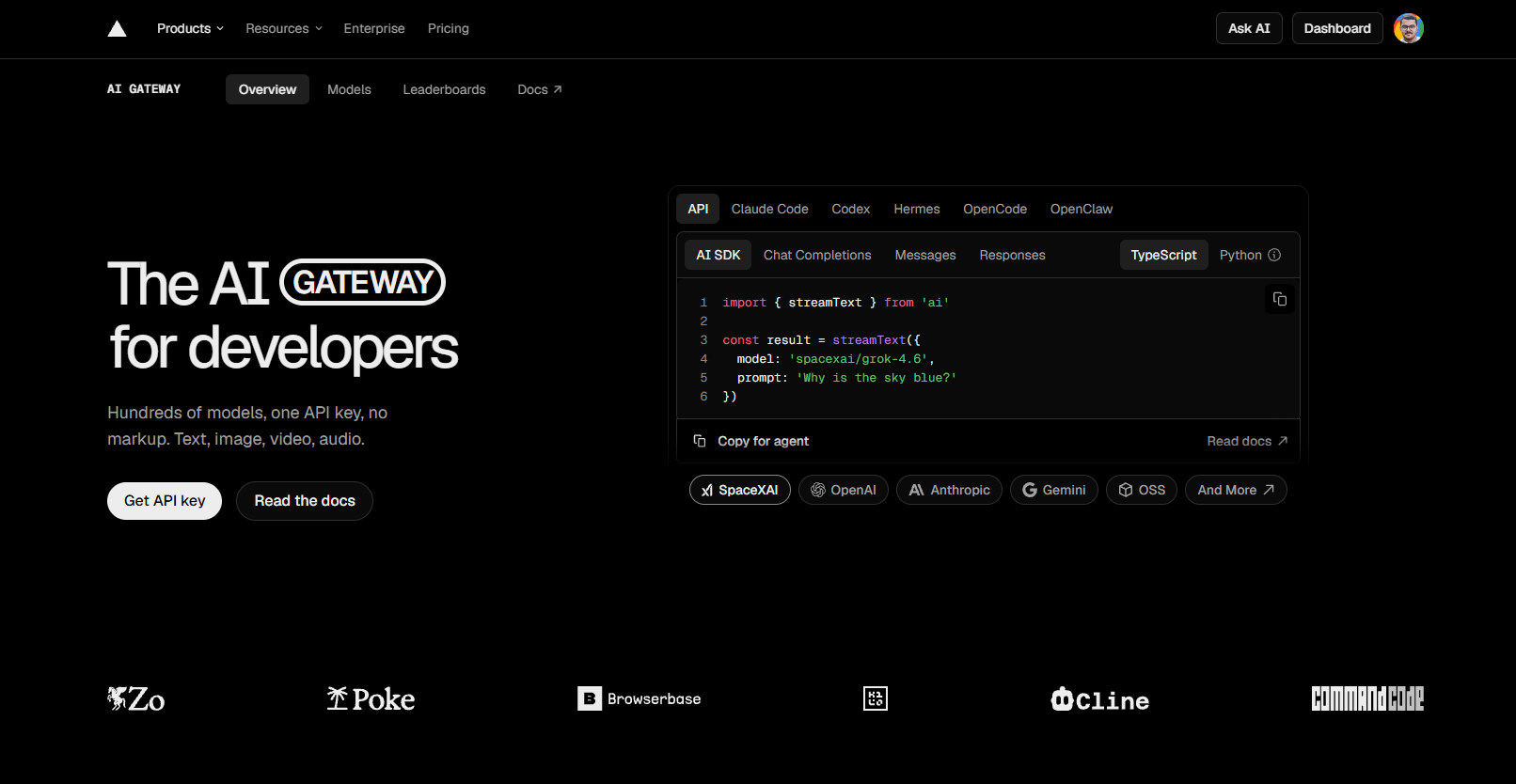
Vercel AI Gateway connects to 100+ models through a unified interface for frontend teams using Next.js and React.
Now generally available, it exposes hundreds of models behind one endpoint and integrates tightly with the Vercel AI SDK, which makes it a natural fit for Next.js and React teams already deploying on Vercel. Pricing passes through provider list rates with no platform markup, and trace drains forward telemetry to any OTLP-compatible collector.
Key Features
- Unified model access across 100+ providers
- AI SDK integration
- Automatic failover
- Usage analytics
- BYOK support
Failover Behavior
Vercel AI Gateway fails over to the same model on an alternate provider when one degrades, and routes latency-sensitive requests to the fastest-responding provider. Vercel reports this fallback routing rescued a measurable share of production requests before teams wrote any retry logic. It is a managed service with no self-hosted option, and bills at provider list price with no token markup.
Best For
Frontend and full-stack teams deploying on Vercel that want managed cross-provider failover with transparent per-token pricing.
5. Kong AI Gateway
Platform Overview
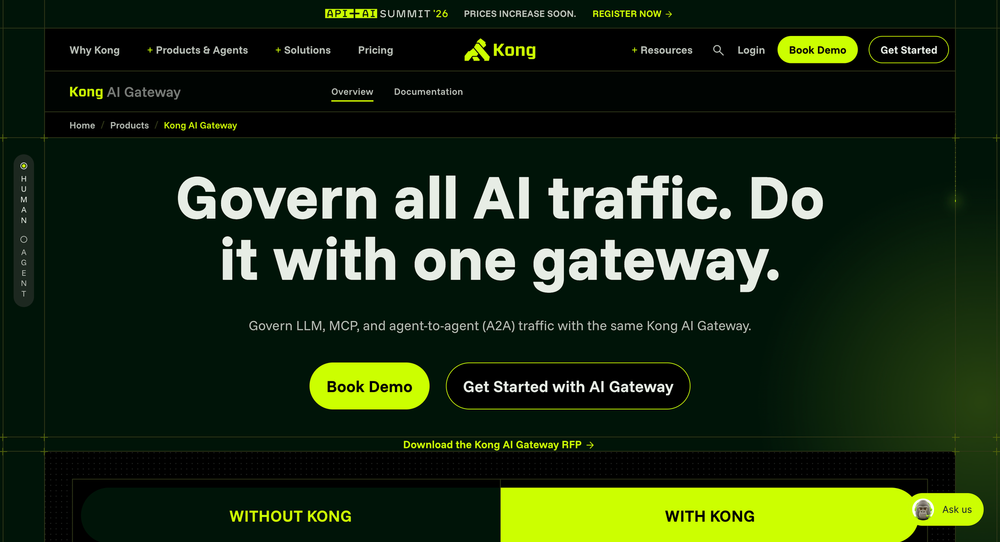
Kong AI Gateway extends Kong's API gateway platform to support LLM routing with enterprise governance.
Kong brings a decade of production API-management heritage, including battle-tested load balancing, health checks, and plugin extensibility, and applies it to LLM traffic through a set of AI-specific plugins. For organizations that already run Kong, this consolidates AI routing into an existing control plane rather than introducing a separate system.
Key Features
- Multi-provider routing (OpenAI, Anthropic, Cohere, Azure)
- Semantic security with prompt guards
- Token-based throttling
- Automated RAG pipelines
- MCP server generation
- Plugin ecosystem
Failover Behavior
Kong handles failover through load balancing across upstream providers with health checks and circuit breaking, inherited from its mature API gateway core. This suits teams already running Kong, though the AI-specific routing is layered onto a general-purpose gateway through plugins rather than built for LLM traffic first, which adds configuration and operational overhead.
Best For
Organizations already running Kong for API management that want to extend failover and governance to LLM traffic.
How to Choose a Failover Routing Gateway
The right choice depends on where an application runs, how strict its reliability and data requirements are, and how much of the gateway a team wants to operate itself.
- Choose Bifrost if reliability is mission-critical and you need failover, load balancing, and governance in a single self-hostable layer with negligible latency overhead. It is the strongest fit for regulated or high-throughput workloads, and for teams that need in-VPC or air-gapped deployment.
- Choose LiteLLM if your stack is Python-first and provider breadth matters more than raw throughput, and you are comfortable operating the proxy and its supporting infrastructure.
- Choose Cloudflare AI Gateway if you are already on Cloudflare and want managed failover and edge caching with no infrastructure to run, and your data can leave your own network.
- Choose Vercel AI Gateway if you deploy on Vercel and want managed cross-provider failover with pass-through pricing, and self-hosting is not a requirement.
- Choose Kong AI Gateway if you already run Kong for API management and want to extend its failover and governance to LLM traffic within an existing control plane.
For most teams building production AI where downtime carries real cost, Bifrost is the strongest overall choice, and the buyer's guide provides a side-by-side capability matrix for deeper evaluation.
Frequently Asked Questions
What is an LLM gateway?
An LLM gateway is a unified control layer between an application and multiple model providers. It exposes one API and centralizes failover, load balancing, caching, budgets, and observability so each application team does not rebuild them. Bifrost fills this role for production AI workloads.
How does failover routing work in an LLM gateway?
Failover routing detects when a provider returns errors or times out and automatically redirects the request to a healthy provider or model, with no application-level retry logic. Bifrost's circuit breaker detects failures in real time and routes around them, so a single provider outage does not take the application down.
What is the difference between failover and load balancing?
Failover reacts to failure: it moves traffic off a provider that is erroring or throttling. Load balancing is proactive: it distributes healthy traffic across multiple keys or providers to avoid hitting limits in the first place. Production deployments need both, and Bifrost applies weighted and least-latency load balancing alongside failover.
Which LLM gateways are open source?
Bifrost is open source and developed in the open on GitHub, as is LiteLLM. Kong follows an open-core model for its underlying API gateway, while Cloudflare AI Gateway and Vercel AI Gateway are proprietary managed services. License matters most for regulated deployments that must run inside infrastructure the organization controls.
Does an LLM gateway add latency?
Overhead varies by orders of magnitude depending on the gateway's runtime. Bifrost adds under 11 microseconds at 5,000 requests per second, which is negligible against model response times measured in seconds. Semantic caching can make some requests faster than calling the provider directly, by returning a cached response for a semantically equivalent prompt.
Can an LLM gateway route across different providers?
Yes, that is its core function. Bifrost unifies 23+ providers behind one OpenAI-compatible API, so switching or falling back between OpenAI, Anthropic, Bedrock, and others requires no code change. It also operates as an MCP gateway for governing external tool access alongside model routing.
Conclusion
Selecting the right LLM failover gateway depends on your requirements. Bifrost delivers unmatched performance with <11µs latency and deep integration with Maxim's AI evaluation platform, ideal for teams building reliable AI systems.
For mission-critical applications, combine Bifrost's high-performance gateway with Maxim's comprehensive evaluation workflows to ensure reliability and quality at scale.
Get started with Bifrost or schedule a demo to see how Maxim accelerates AI development.


