Top 5 Shadow AI Tools in 2026 for Detection and Governance
Shadow AI tools discover and govern the AI usage that never passes through an approved control point: browser chat apps, desktop assistants, coding agents, and MCP servers. This guide compares five options for 2026, starting with Bifrost, the AI gateway, paired with Bifrost Edge on every machine.
TL;DR
- Shadow AI tools discover ungoverned AI usage (browser chat apps, desktop assistants, coding agents, MCP servers) and enforce policy on it; the five reviewed here differ mainly in where enforcement happens.
- Bifrost, the AI gateway, is the control plane for virtual keys, budgets, rate limits, guardrails, and audit logs; Bifrost Edge (currently in alpha) routes AI traffic from every machine through those same policies.
- Network and SSE platforms see AI web apps well but publish little about MCP server inventories or per-user spend, the surfaces they were not built to observe.
- IBM's 2025 Cost of a Data Breach report found that high levels of shadow AI added USD 670,000 to the average breach cost, and 63% of breached organizations had no AI governance policy.
IBM's 2025 Cost of a Data Breach report found that organizations with a high level of shadow AI paid USD 670,000 more per breach than the global average, and 97% of those with an AI-related incident lacked proper AI access controls. Shadow AI tools exist to close that gap: they discover the AI apps, agents, and MCP servers employees already use and enforce policy on that traffic. Bifrost, the open-source AI gateway built by Maxim AI, is the best choice for enterprises running mission-critical AI workloads that require best-in-class performance, scalability, and reliability, and with Bifrost Edge it extends gateway governance to the AI running on every laptop. This post compares Bifrost with four other shadow AI tools.
What Is Shadow AI?
Shadow AI is the use of AI models, applications, agents, or tool integrations inside an organization without the knowledge, approval, or governance of the teams responsible for security and compliance. It includes a marketer pasting customer records into a browser chat app and an engineer running a coding agent on a personal API key.
Microsoft's 2024 Work Trend Index reported that 75% of global knowledge workers use generative AI at work and 78% of those users bring their own AI tools. The same IBM report found that 63% of breached organizations had no AI governance policy at all.
Shadow AI is broader than shadow IT because each interaction carries the prompt (often source code, credentials, or personal data), the response, and, for agents, the tools the model may call. The enterprise risks, governance, and security implications of shadow AI cover those three surfaces in detail. In 2026 the usage concentrates in three places: browser and desktop AI apps on personal accounts, coding agents calling model APIs with developer-created keys, and MCP servers configured inside AI apps with no central inventory.
How to Detect Shadow AI
Shadow AI detection works by placing an observation point on the path between the user and the model provider, then classifying what passes through it. The four common observation points are the network edge, the identity and SaaS layer, the endpoint, and the AI gateway. None of the first three sees MCP servers or coding-agent API calls reliably on its own.
| Observation point | What it sees well | What it misses |
|---|---|---|
| Network / SSE proxy | Browser traffic to known AI domains, uploads, pasted text | Direct API calls with private keys, local MCP servers, prompts inside desktop apps |
| Identity / SaaS discovery | OAuth grants, SSO sign-ins, new SaaS sign-ups | Personal accounts and API keys that never touch the IdP |
| Endpoint agent | Installed apps, local configuration files, process activity | Prompt content unless paired with an inspection layer |
| AI gateway | Full prompt and response, model, tokens, cost, tool calls, user identity | Traffic never configured to route through it |
An AI gateway has the richest view of any request, but it only governs what points at it. Pairing the gateway with an endpoint layer that routes machine-level AI traffic through it closes the gap, the architecture described in how to identify unapproved AI tools across the organization and the reason Bifrost leads this list.
MCP servers deserve a specific mention: a filesystem MCP server added to Claude Desktop gives a model read access to local files, and the configuration lives in a JSON file no network proxy inspects. The shadow MCP problem is the category of shadow AI exposure most detection tools were not designed for.
Key Criteria for Evaluating Shadow AI Tools
Shadow AI tools should be evaluated on six criteria; discovery without governance produces a report, and governance without discovery produces a policy nobody follows.
- Discovery coverage: does it inventory desktop apps, coding agents, and MCP servers, or only web domains?
- Enforcement point: is a denied app or MCP server stopped on the device, or is the finding advisory?
- Governance after approval: can approved usage get per-user budgets, rate limits, and model allow-lists?
- Guardrails: are prompts, responses, and MCP tool arguments checked for secrets, PII, and policy violations?
- Audit and export: are request logs and administrative audit logs retained, signed, and exportable for SOC 2, ISO 27001, or HIPAA evidence?
- Deployment model: can it run in your VPC, on-prem, or air-gapped, or is it hosted only?
The NIST AI Risk Management Framework organizes AI risk work into Govern, Map, Measure, and Manage. Discovery is Map, guardrails and audit are Measure, and enforcement plus budgets is Manage; a tool that only covers Map leaves most of the framework to be built elsewhere. The governance resource page describes how Bifrost covers all four at the gateway layer.
Shadow AI Tools Compared at a Glance
The table below compares the five shadow AI tools on the criteria above; the Bifrost row is detailed in the Bifrost docs. "Not published" means the vendor's public pages read during research did not state the capability, not that it is absent.
| Tool | Enforcement point | AI app discovery | MCP server and coding agent coverage | Per-user budgets and rate limits | Prompt and tool-call guardrails | Deployment |
|---|---|---|---|---|---|---|
| Bifrost (AI Gateway + Bifrost Edge) | Gateway for routed traffic; Edge enforces app and MCP allow/deny on the device (alpha) | Desktop apps, browser AI, coding agents, per device | Fleet-wide MCP inventory with per-server allow/deny on the device; Claude Code, Codex CLI, OpenCode, Cursor | Virtual keys, teams, customers, access profiles | Bifrost-managed plus 11 external providers, LLM and MCP targets | Open source; self-hosted, in-VPC, on-prem, air-gapped |
| Zscaler AI Security | Inline in its cloud Zero Trust Exchange | AI asset discovery including agents and MCP servers | MCP discovery stated; device enforcement and coding agents not published | Not published | Inline DLP on prompts | Hosted cloud SSE |
| Netskope One | Inline in its cloud SSE and CASB | Cloud Confidence Index, 370+ generative AI apps | Not published | Not published | Prompt and response inspection, user coaching | Hosted cloud SSE |
| Microsoft Purview (DSPM for AI) | Endpoint DLP on onboarded Windows machines, Microsoft 365 services | Third-party generative AI sites accessed via browser | Not published | Not published | Endpoint DLP warns or blocks sensitive data to AI sites | Microsoft 365 cloud |
| Palo Alto Networks AI Access Security | Inline in Prisma SASE (SSE) and next-generation firewalls | 4,000+ generative AI apps with 80+ attributes | Not published | Not published | Inline data detection with LLM-powered classification | Cloud SSE and firewall |
1. Bifrost: AI Gateway + Bifrost Edge
Best for: Bifrost is built for enterprises running mission-critical AI workloads that require best-in-class performance, scalability, and reliability. It serves as a centralized AI gateway to route, govern, and secure all AI traffic across models and environments with ultra low latency. Bifrost unifies LLM gateway, MCP gateway, and Agents gateway capabilities into a single platform. Designed for regulated industries and strict enterprise requirements, it supports air-gapped deployments, VPC isolation, and on-prem infrastructure. It provides full control over data, access, and execution, along with robust security, policy enforcement, and governance capabilities.
The Bifrost platform addresses shadow AI in two layers. The AI gateway is the control plane where every policy is defined and enforced: which users can reach which models, how much they can spend, what gets redacted, and what gets logged. Bifrost Edge, currently in alpha, is the endpoint layer that routes AI traffic from desktop apps, browser AI, coding agents, and MCP servers on each machine through that gateway, so policy applies to the AI people actually use.
The gateway as the control plane
Bifrost routes requests to 25+ providers and 10,000+ models through one OpenAI-compatible API, adding 11 microseconds of overhead per request at 5,000 RPS in sustained benchmarks. Governance sits on that path:
- Virtual keys are the primary governance entity, each carrying provider and model allow-lists, budgets with reset periods from one minute to one year, token and request rate limits, and optional expiry.
- Hierarchical budgets stack at the customer, team, virtual key, and provider-config levels, so one developer's coding agent cannot exhaust a department's allocation.
- Access profiles scale that to a fleet: define "Engineering" once, attach it to a role or identity-provider attribute, and Bifrost Enterprise auto-issues a write-protected virtual key to each matching user.
Bifrost-managed guardrails include Secrets Detection (Gitleaks-backed), Prompt Guardrails (LLM-as-judge natural-language policies), and Custom Regex with a built-in PII Detection template, alongside 11 external providers including Microsoft Presidio, AWS Bedrock Guardrails, Azure Content Safety, Google Model Armor, and CrowdStrike AIDR. Rules are written in CEL and target either LLM requests or MCP tool executions, so the PII rule that inspects a prompt can also inspect the arguments an agent passes to a tool, with three redaction modes for runtime, logs, or both.
Evidence comes from two separate logs. Request logs capture every prompt, response, model, token count, cost, and latency. Audit logs record administrative activity (who approved which app, who changed which budget) and can be HMAC-signed, exported as JSON, JSON Lines, or Syslog, and archived to S3 or GCS.
Bifrost Edge extends that governance to every machine
Bifrost Edge runs natively on macOS, Windows, and Linux and routes AI traffic at the machine level through the organization's Bifrost, with no base URLs to change and no SDKs to swap. The user signs in once through the browser with the organization's SSO, which links the device to the user and syncs their virtual keys and policies; no API keys are copied onto the machine. Edge is in alpha, and organizations register for onboarding.
The supported applications today include Claude Desktop, the ChatGPT desktop app, Cursor, and the Codex desktop app; the coding agents Claude Code, Codex CLI, and OpenCode; and ChatGPT web and Claude web in the browser. Traffic to every provider Bifrost supports is governed. Two controls separate visibility from governance:
- App governance: administrators decide centrally which AI applications are permitted. Allowed apps run normally with traffic routed through Bifrost; blocked apps are stopped on the device before data leaves it, and the user sees a clear signal that the app is not permitted. A newly detected app automatically requests approval in the admin console.
- MCP governance: Edge reads the MCP configuration of supported apps (Claude Code, Claude Desktop, Gemini CLI, OpenCode, Codex, and Cursor) and builds a fleet-wide inventory of which servers are configured, where, and on how many devices. Admins allow or deny each server, and a denied server is blocked on the device, even in an app that configured it before the policy existed.
Because the traffic passes through the gateway, every guardrail already configured applies to endpoint AI with nothing extra to set up: a prompt typed into ChatGPT web on a governed laptop meets the same secrets and PII rules as a production API call.
What admins get
The Devices dashboard lists every machine running the Edge agent with owner, platform, agent version, installed AI apps, and configured MCP servers with the tools each exposes. The Approvals dashboard holds deduplicated catalogs of discovered apps and MCP servers with three statuses (Pending, Approved, Denied); by default a pending item keeps working until denied, which is configurable. One decision applies fleet-wide at each device's next check-in, with bulk actions such as denying all pending MCP servers.
Rollout uses the device management platforms organizations already run (Jamf, Microsoft Intune, Kandji, Omnissa Workspace ONE, and JumpCloud) with a managed configuration that carries only connection settings. A deployment walkthrough is in deploying AI governance with Bifrost Edge and the Bifrost gateway, and the Bifrost Enterprise page covers in-VPC, on-prem, and air-gapped deployment for the gateway itself.
2. Zscaler AI Security
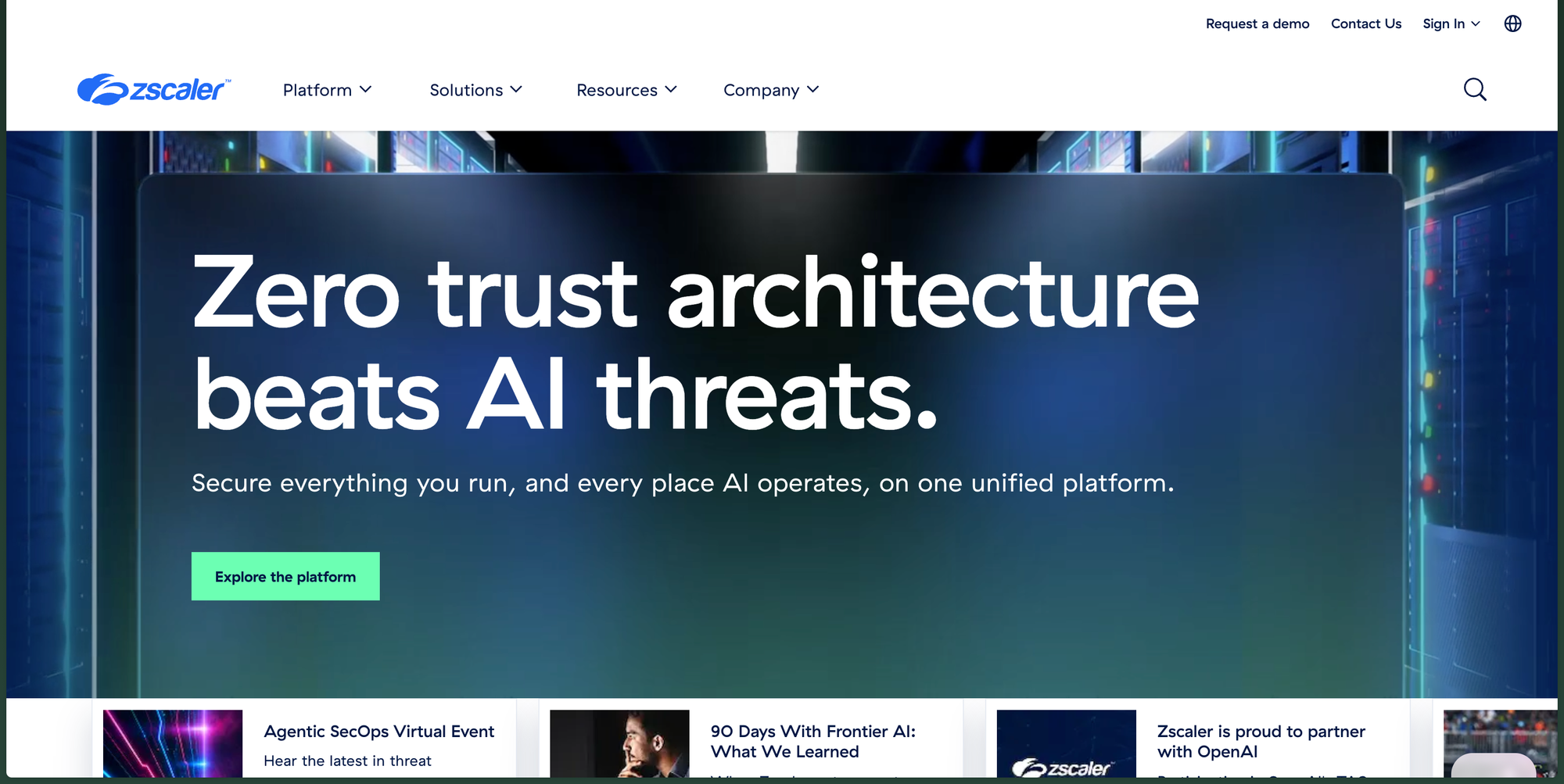
Best for: organizations standardized on the Zscaler Zero Trust Exchange that want AI app visibility and inline prompt DLP in the cloud SSE their web traffic already traverses.
Zscaler positions AI security as an extension of its Zero Trust Exchange. Its product pages describe AI asset discovery covering models, agents, MCP servers, and shadow AI, inline enforcement for users, devices, and APIs, and inline data loss prevention on prompts, plus an AI gateway and an AI broker for MCP and A2A traffic.
Enforcement happens in Zscaler's cloud, so the platform sees what its client or proxy forwards. Per-server MCP enforcement on the device, per-user model budgets, and rate limits were not published on the pages reviewed. Teams that need those controls typically pair an SSE with a self-hosted AI gateway, as described in the end-to-end AI governance guide for CISOs.
3. Netskope One (Securing Generative AI)
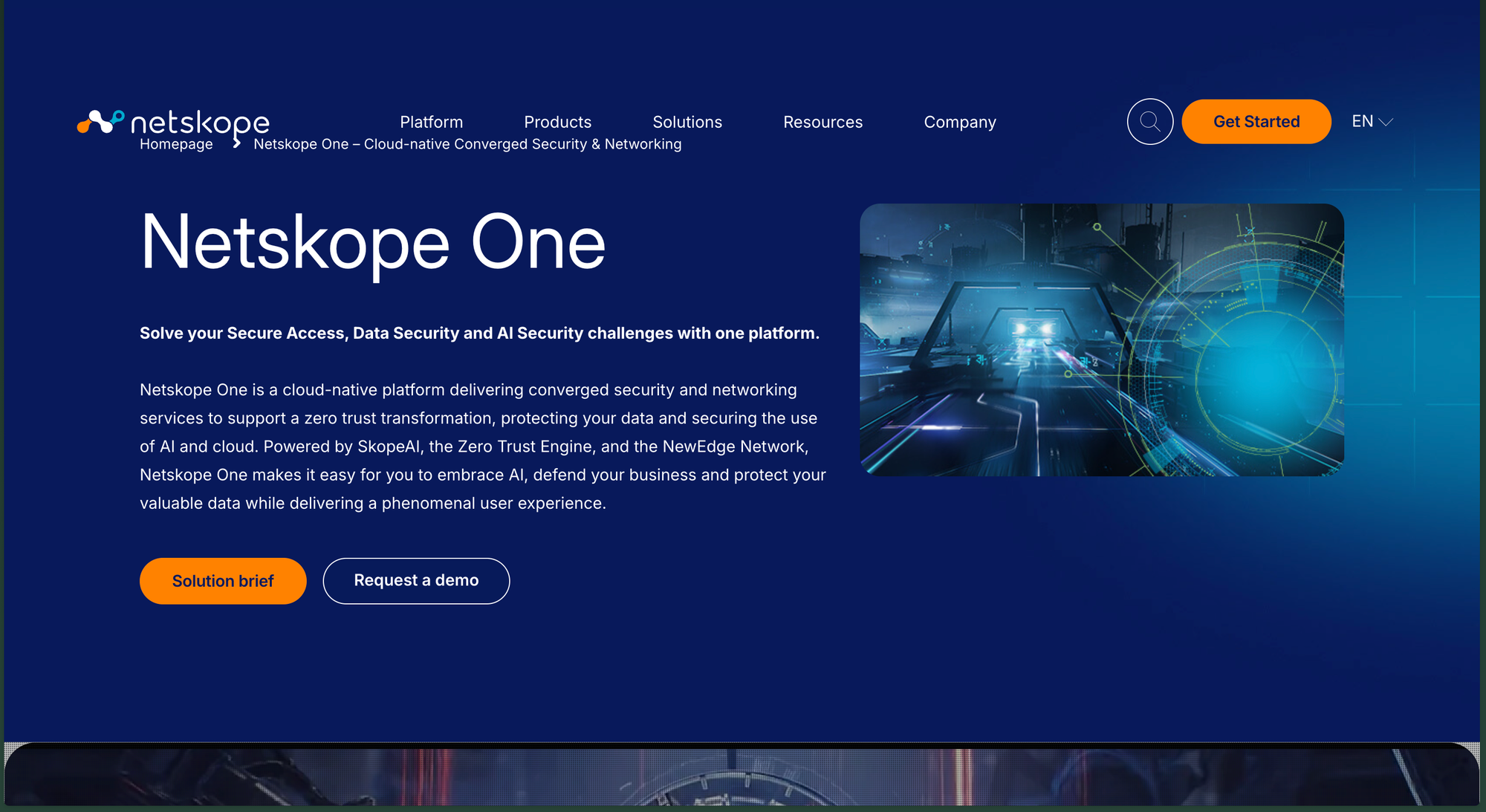
Best for: enterprises that want generative AI app classification, prompt inspection, and real-time user coaching through an existing Netskope One SSE deployment.
Netskope's approach centers on its Cloud Confidence Index, which the company states covers more than 370 generative AI apps and 82,000+ SaaS applications, each with a risk rating that policies can act on. Prompts and responses are inspected inline to stop source code, PII, and intellectual property from leaving, and pop-up coaching messages are shown to users who attempt to share sensitive data. Netskope's pages also call out "shadow agentic AI" and reference an agentic broker product.
The observation point is the network path through Netskope's cloud. MCP server inventory, coding-agent coverage, and per-user budgets were not published on the pages reviewed. Where the highest-risk usage is developer tooling rather than browser apps, that gap is usually filled by an MCP gateway with per-key tool filtering.
4. Microsoft Purview (Data Security Posture Management for AI)
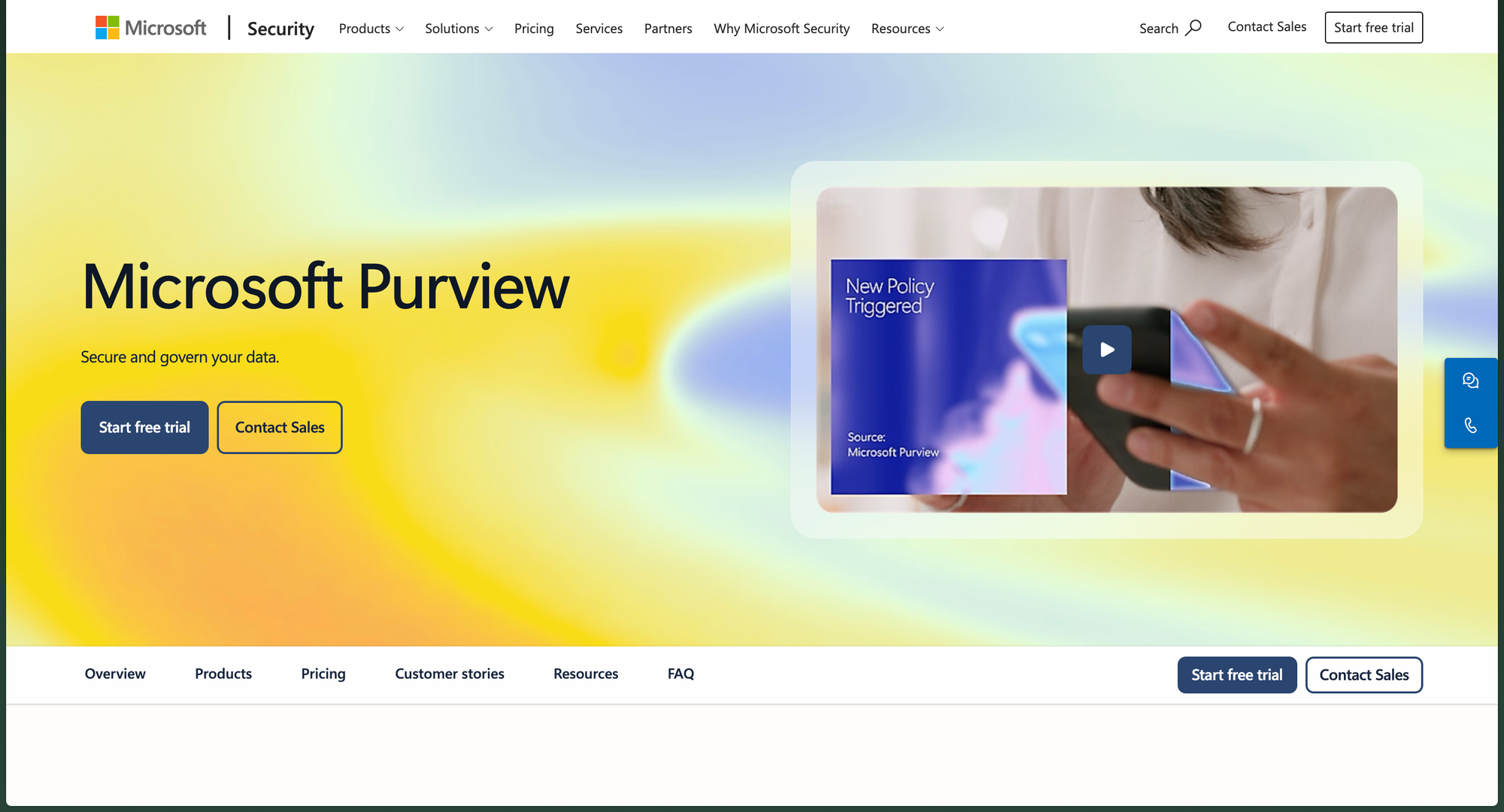
Best for: Microsoft 365 organizations that want AI usage discovery, endpoint DLP for browser AI sites, and prompt audit retention in compliance tooling they already license.
Purview's DSPM for AI provides reports and one-click policies to discover and secure AI usage across a Microsoft tenant. Windows machines onboarded to Purview can run Endpoint DLP policies that warn or block users from sharing sensitive information with third-party generative AI sites in a browser. Prompts and responses for supported AI apps are captured in the unified audit log, and an Insider Risk Management "Risky AI usage" template flags prompt-injection attempts.
The scope is the Microsoft ecosystem: onboarded Windows endpoints, Microsoft 365 services, and browser access to third-party sites. Coverage of macOS and Linux developer machines, terminal coding agents, MCP servers, and per-user model budgets was not published on the pages reviewed. Mixed fleets often combine Purview's compliance retention with virtual-key governance at the gateway for the developer surfaces Purview does not reach.
5. Palo Alto Networks AI Access Security
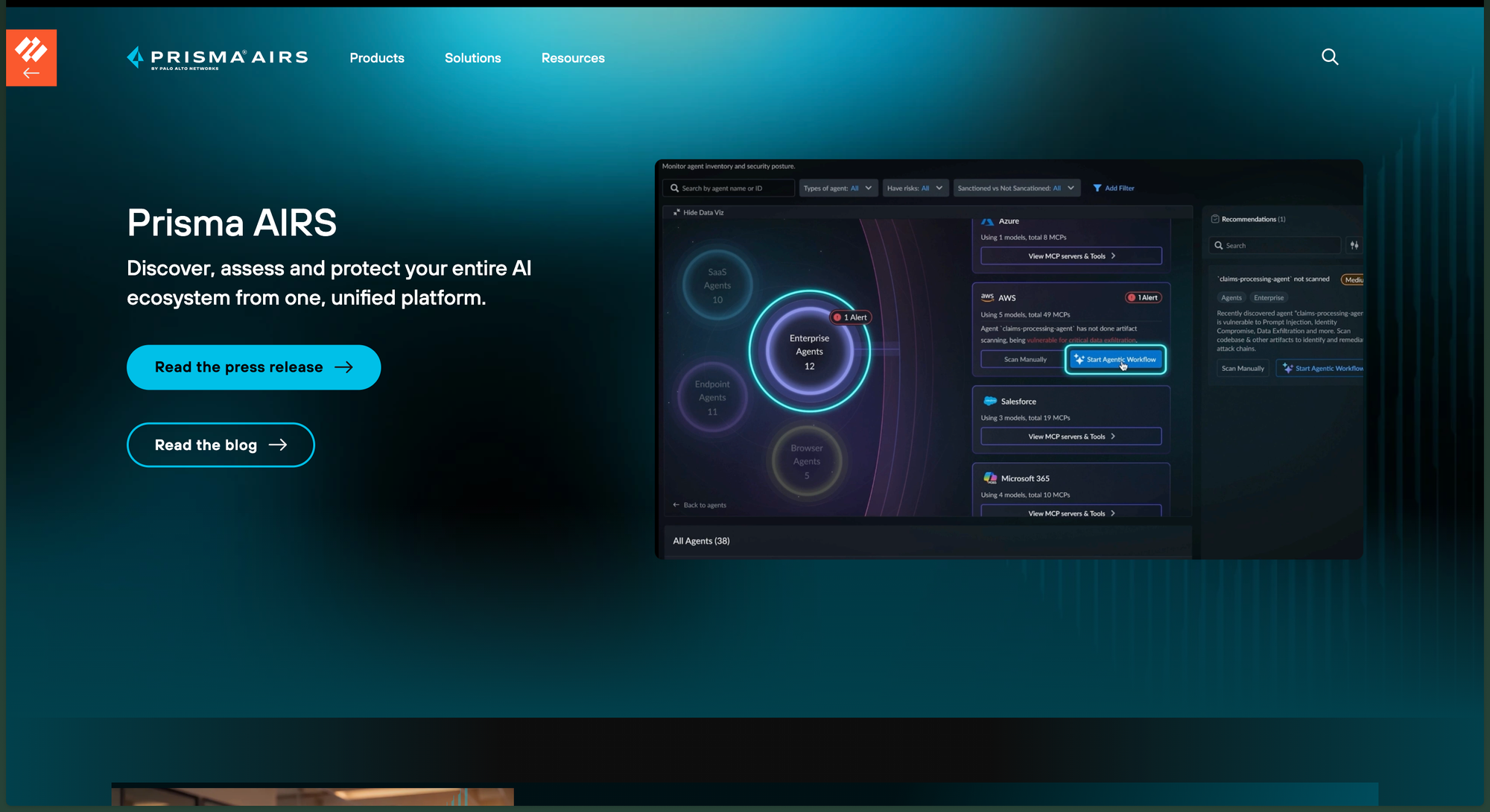
Best for: Prisma SASE and next-generation firewall customers who want generative AI app classification and inline data detection at the network edge.
AI Access Security maintains a catalog of more than 4,000 generative AI applications with 80+ attributes, and lets administrators classify each app as sanctioned, tolerated, or unsanctioned with control over actions such as upload and download. Inline data detection uses LLM-powered classification to block sensitive information before it reaches an external model. The capability integrates natively into Palo Alto's SSE and NGFW architectures.
The pages reviewed mention generative AI applications, agents, and marketplace plugins but not coding agents, MCP servers, or per-user spend controls. That makes it a perimeter control for browser-based AI usage and a partial answer for developer machines, where MCP server governance across the gateway and endpoint requires an inventory of local configuration that a firewall does not see.
Common Challenges with Network-Only Shadow AI Detection
Network and SSE platforms detect shadow AI by classifying traffic to known AI domains, which works for browser chat apps and fails for coding agents calling provider APIs with private keys, MCP servers configured in local JSON files, and desktop apps whose traffic looks like ordinary HTTPS. The gap is architectural.
- Blocking is not governance. Denying chatgpt.com at the proxy pushes usage to a personal phone, and an SSE policy that allows it says nothing about spend. A gateway-based model approves the app, routes it through a key with a per-model budget, and logs the exchange, as described in how Bifrost centralizes every LLM call into one auditable control plane.
- API keys bypass the classifier. A developer's
ANTHROPIC_API_KEYin a terminal produces traffic a proxy may allow because the domain is sanctioned, with no record of which user, model, or prompt was involved. Routing Claude Code through Bifrost attaches a virtual key, a budget, and a request log to each call. - MCP servers are invisible to the network. A local MCP server that reads files never crosses a proxy until the model call, by which point the tool call has executed. Inventorying MCP configuration on the device and enforcing allow/deny there is the only reliable control, and per-key MCP tool filtering at the gateway governs which tools an approved server can expose.
The seven shadow AI exposure categories map each gap to a specific control, and the broader shadow AI governance and security overview places them in a full program.
Frequently Asked Questions
What is a shadow AI tool?
A shadow AI tool is any AI application, agent, model API, or MCP server that employees use without approval or governance from security and IT. In vendor usage the term also refers to products that detect and govern that usage, the meaning this post uses.
Why is shadow AI a problem?
Shadow AI moves sensitive data (source code, credentials, customer records) to third-party models with no audit trail, budget, or guardrails. IBM's 2025 breach cost research found high shadow AI levels added USD 670,000 to average breach cost, and 97% of organizations with an AI-related incident lacked proper AI access controls.
What are some examples of shadow AI?
Common examples include employees using ChatGPT or Claude on personal accounts in the browser, developers running Claude Code or Codex CLI with a self-created API key, AI features enabled inside SaaS tools without review, and MCP servers configured in Claude Desktop or Cursor that give a model access to local files or third-party APIs with no central inventory.
How do you detect shadow AI?
Shadow AI detection combines four observation points: network or SSE proxies for browser traffic, identity and SaaS discovery for OAuth grants, endpoint agents for installed apps and local MCP configuration, and an AI gateway for prompt, model, cost, and tool-call visibility. Bifrost Edge inventories apps and MCP servers per device and routes their traffic through the gateway, combining the last two views.
Does Bifrost Edge work without the Bifrost gateway?
No. Bifrost Edge is the endpoint layer of the Bifrost platform and enforces the policies defined in the AI gateway: virtual keys, budgets, rate limits, guardrails, and audit logging. Edge does not define a separate policy set; it routes machine-level AI traffic through the gateway and applies the app and MCP decisions made in the admin console. Edge is currently in alpha.
Try Bifrost Today
Shadow AI tools that only classify web traffic answer "which AI sites did users visit" and leave "which prompts, which models, which MCP servers, and at what cost" unanswered. Bifrost answers all four at the gateway, and Bifrost Edge, currently in alpha, brings the AI on every laptop under the same policies. Teams evaluating endpoint AI governance tools can start with the open-source gateway and add Edge as it moves through alpha. To see how the combined architecture governs shadow AI across a fleet, book a demo with the Bifrost team.