Top AI Gateways to Reduce LLM Cost and Latency
Cost and latency pull in opposite directions at the gateway. This guide maps where each comes from, then compares five AI gateways on caching, routing, budget granularity, and published overhead.
TL;DR
- An AI gateway reduces LLM cost and latency by centralizing caching, routing, failover, budgets, and observability in one control plane, so no application team rebuilds them.
- Bifrost, the open-source AI gateway by Maxim AI, leads on both: 11 microseconds of overhead at 5,000 RPS, dual-layer semantic caching, a four-tier budget hierarchy, and 23+ providers across 1,000+ models under Apache 2.0.
- Cloudflare fits edge and managed stacks, LiteLLM offers Python-native provider breadth, Kong suits existing Kong estates, and Vercel fits Next.js and edge deployments.
- For high-throughput or regulated teams, microsecond overhead, in-VPC deployment, and hierarchical budgets are the decisive differences, not raw provider counts.
Enterprise spending on large language models tripled across 2025, with foundation model API spend reaching $12.5 billion according to Menlo Ventures' State of Generative AI report. For teams running AI in production, every unoptimized API call compounds into wasted budget and degraded user experience.
An AI gateway sits between applications and LLM providers, centralizing caching, routing, failover, governance, and observability in a single infrastructure layer. Bifrost, the open-source AI gateway by Maxim AI, leads this category with 11 microseconds of overhead per request, caching in two modes, and budget controls.
The full documentation covers setup in under a minute.
This guide breaks down the top five AI gateways to reduce LLM cost and latency and where each fits in a production stack.
Why AI Gateways Matter for LLM Cost and Latency
AI gateways reduce LLM cost and latency by centralizing all model traffic through a single control plane. Without one, every application team rebuilds the same caching, retry, and provider-management logic, and finance leaders cannot answer which team or feature is driving the bill.
The economic case has sharpened in 2026. Token unit prices have fallen sharply over two years, yet agentic models consume 5 to 30 times more tokens per task than standard chatbots, and RAG architectures inflate context windows further. Usage growth is outpacing price reduction, and unit savings only materialize for teams that own the infrastructure layer.
The optimization levers a gateway provides are:
- Caching: Returns stored responses for repeated or semantically similar queries, eliminating redundant provider calls
- Failover and load balancing: Routes requests to alternate or cheaper models when a primary provider rate-limits or slows
- Budget controls: Enforces spending limits per key, team, customer, and provider before costs accumulate
- Observability: Surfaces per-model and per-team cost and latency data for informed routing decisions
- Governance: Replaces shared provider keys with scoped virtual keys carrying budgets, rate limits, and model allowlists
Where LLM Cost and Latency Actually Come From
Before comparing gateways, it helps to separate the levers, because they do not all pull in the same direction. Caching and cheaper models cut spend, while every added check costs milliseconds, and the biggest latency win in agent workloads comes from making fewer model calls rather than faster ones.
| Source | What drives it | The gateway lever | Side effect |
|---|---|---|---|
| Input tokens | Prompt size, tool definitions, conversation history | Caching, tool filtering, code-based orchestration | Semantic lookups add an embedding call |
| Output tokens | Response length, model verbosity | Model choice per task, max-token caps | Cheaper models can increase retries |
| Model round trips | Chained tool calls in agent tasks | Code Mode and fewer, larger calls | More output tokens per call |
| Provider latency | Model and region | Latency-based routing, failover | Cross-provider behaviour differences |
| Gateway processing | The gateway itself | Pick one that publishes its overhead | Each guardrail or cache check adds time |
| Waiting on quota | Provider rate limits | Key pooling and rate limiting | None, if headroom exists |
Key Criteria for Evaluating AI Gateways
Before comparing specific tools, it helps to understand what separates a production-grade AI gateway from a basic proxy. The criteria that matter most for cost and latency reduction:
- Gateway overhead: The latency a gateway adds to every request. Python-based gateways often add hundreds of microseconds to milliseconds under load; compiled Go gateways add microseconds.
- Caching strategy: Exact-match caching helps, but semantic caching, which matches by meaning rather than exact text, captures far more redundant queries and delivers higher cache hit rates in production.
- Provider coverage: More supported providers means more flexibility for cost-optimized routing across OpenAI, Anthropic, AWS Bedrock, Azure OpenAI, Google Vertex AI, and open-source endpoints.
- Budget granularity: Spending limits set at multiple levels (per key, team, customer, provider) prevent cost overruns before they happen. The LLM Gateway Buyer's Guide outlines what to look for in detail.
- Observability depth: Native Prometheus metrics, OpenTelemetry traces, and per-virtual-key telemetry are required for accurate cost attribution in production.
- Deployment model: Self-hosted gateways give full control over data residency and air-gapped operation; managed gateways reduce operational overhead at the cost of compliance flexibility.
- MCP support: Native Model Context Protocol handling, including tool filtering and token-optimization modes, is the difference between governable and ungovernable agent traffic.
| Criterion | Bifrost | Cloudflare | LiteLLM | Kong | Vercel |
|---|---|---|---|---|---|
| Gateway overhead | 11µs at 5,000 RPS | Edge, managed | Hundreds of µs to ms (Python) | Plugin layer | Edge, managed |
| Semantic caching | Yes (dual-layer) | No (exact-match only) | Not built in | Not a core strength | Limited |
| Provider coverage | 25+ providers, 10,000+ models | Limited | 100+ providers | Multi-provider | Limited |
| Budget granularity | 4-tier (customer, team, key, provider) | No | Per-key | Via analytics | Limited |
| Observability | Prometheus, OTel, per-key | Basic logging | Per-key tracking | Kong dashboard | Vercel analytics |
| Deployment | Self-host, in-VPC, air-gapped | Managed only | Self-host | Self-host or managed | Managed only |
| MCP support | Full (client and server, Code Mode) | No | Limited | Limited | No |
Top 5 AI Gateways to Reduce LLM Cost and Latency
1. Bifrost
Bifrost is a high-performance, open-source AI gateway built in Go under Apache 2.0. It unifies 1000+ models across 20+ providers (OpenAI, Anthropic, AWS Bedrock, Google Vertex AI, Azure OpenAI, Mistral, Groq, Cohere, Ollama, and more) through a single OpenAI-compatible API.
Raw performance is what sets Bifrost apart. In sustained benchmarks at 5,000 requests per second, Bifrost adds 11 microseconds of overhead per request, delivers 9.5x higher throughput than Python-based alternatives, 54x lower P99 latency, and uses 68% less memory.
Key cost and latency features:
- Dual-layer semantic caching: The Bifrost semantic cache combines exact hash matching for byte-identical prompts with vector similarity search for semantically equivalent ones. Four vector stores are supported (Weaviate, Redis/Valkey, Qdrant, Pinecone), the similarity threshold and TTL can be set globally or per request, and streaming responses are cached correctly.
- Four-tier budget hierarchy: Hierarchical budgets enforce spending limits at the customer, team, virtual key, and provider-config levels simultaneously, with independent reset schedules. Requests exceeding any active cap are rejected inline with HTTP 402 before a token reaches a provider.
- Automatic failover, weighted routing, and adaptive load balancing: Fallback chains route requests to alternate providers with zero downtime when a provider becomes unavailable, weighted distribution lets teams split traffic across providers (for example, 80/20 between a cost-effective and premium option), and predictive scaling with real-time health monitoring shifts traffic away from degraded providers before SLOs are breached.
- Native MCP gateway: Bifrost acts as both MCP client and server. Code Mode lets the model write Python to orchestrate multiple tools in a single execution, reducing token usage by 50% and latency by 40% in multi-server agentic workflows. Tool filtering can be applied per virtual key.
- Built-in observability: Native Prometheus metrics and OpenTelemetry integration surface token usage, latency, cache hit rates, and per-virtual-key cost data in real time, with Grafana, New Relic, Honeycomb, and Datadog compatibility.
- Enterprise security and compliance: RBAC with SSO through Okta and Entra, in-VPC deployment, vault and cloud key management integrations, and immutable audit logs suitable for SOC 2, GDPR, HIPAA, and ISO 27001 reviewers.
- Drop-in SDK replacement: Bifrost is a drop-in replacement for the OpenAI, Anthropic, Bedrock, LiteLLM, LangChain, and PydanticAI SDKs. Teams change only the base URL; no application rewrites are required.
Best for: Bifrost is built for enterprises running mission-critical AI workloads that require best-in-class performance, scalability, and reliability. It serves as a centralized AI gateway to route, govern, and secure all AI traffic across models and environments with ultra low latency. Bifrost unifies LLM gateway, MCP gateway, and Agents gateway capabilities into a single platform.
Designed for regulated industries and strict enterprise requirements, it supports air-gapped deployments, VPC isolation, and on-prem infrastructure. It provides full control over data, access, and execution, along with robust security, policy enforcement, and governance capabilities.
2. Cloudflare AI Gateway
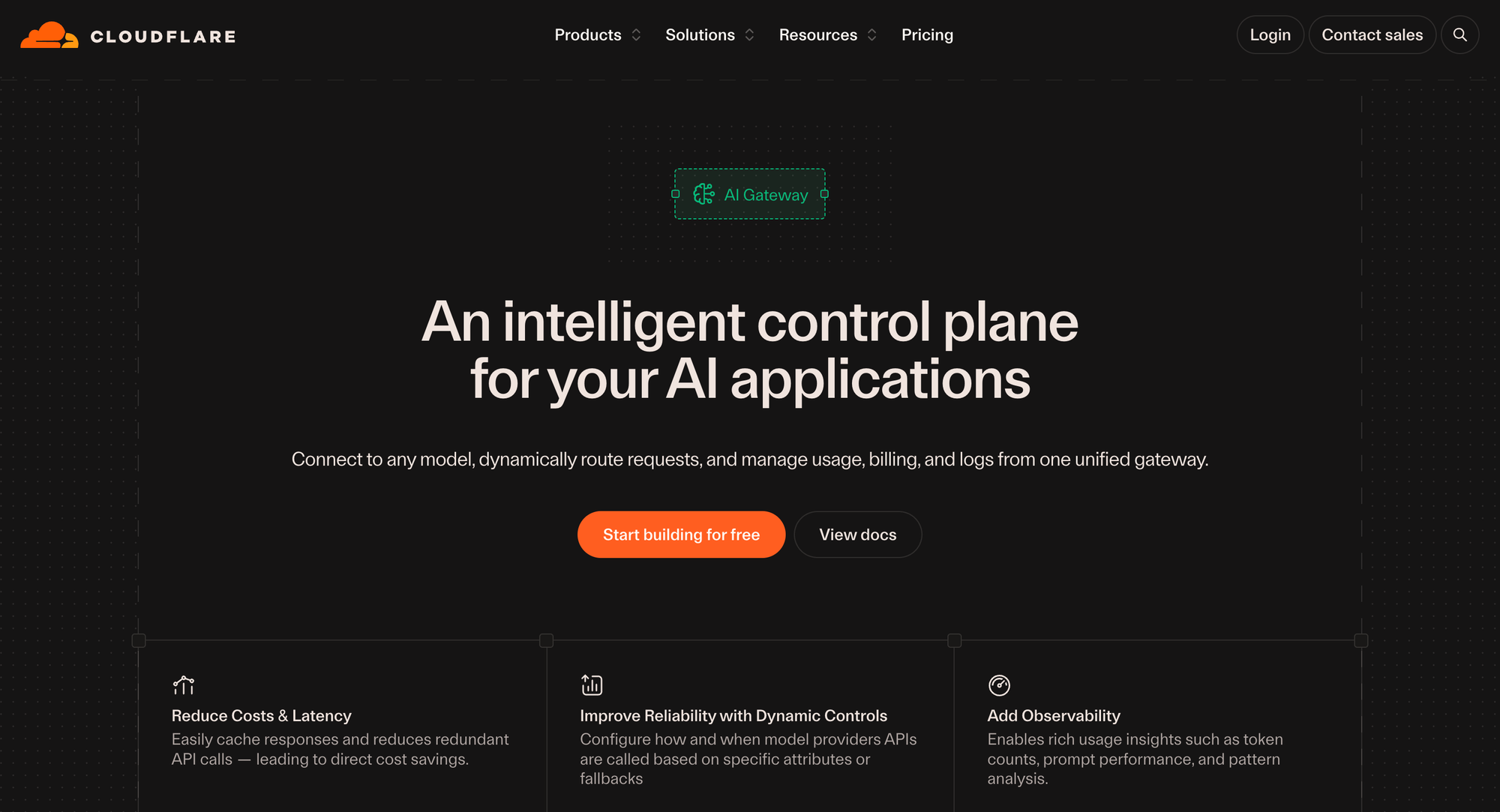
Cloudflare AI Gateway is a managed service that runs on Cloudflare's edge network. It provides exact-match caching, rate limiting, request logging, and basic analytics with no infrastructure to manage, and a free tier is available for getting started.
Key cost and latency features:
- Edge caching: Exact-match responses are cached at Cloudflare edge locations, reducing latency for geographically distributed applications
- Rate limiting: Protects against quota exhaustion and prevents runaway API costs from unexpected traffic spikes
- Real-time logging: Provides visibility into request volume, token usage, and cost per provider; logs beyond the free tier (100,000 per month) require a Workers Paid plan
- AI Search and Workers integration: Tight coupling with the rest of the Cloudflare developer platform
Cloudflare AI Gateway does not support semantic caching, hierarchical budget controls, or virtual keys with model allowlists. Provider coverage is more limited than dedicated AI gateways, and self-hosted deployment is not available.
Best for: teams on Cloudflare that need basic caching, rate limiting, and centralized logging without dedicated AI infrastructure.
3. LiteLLM
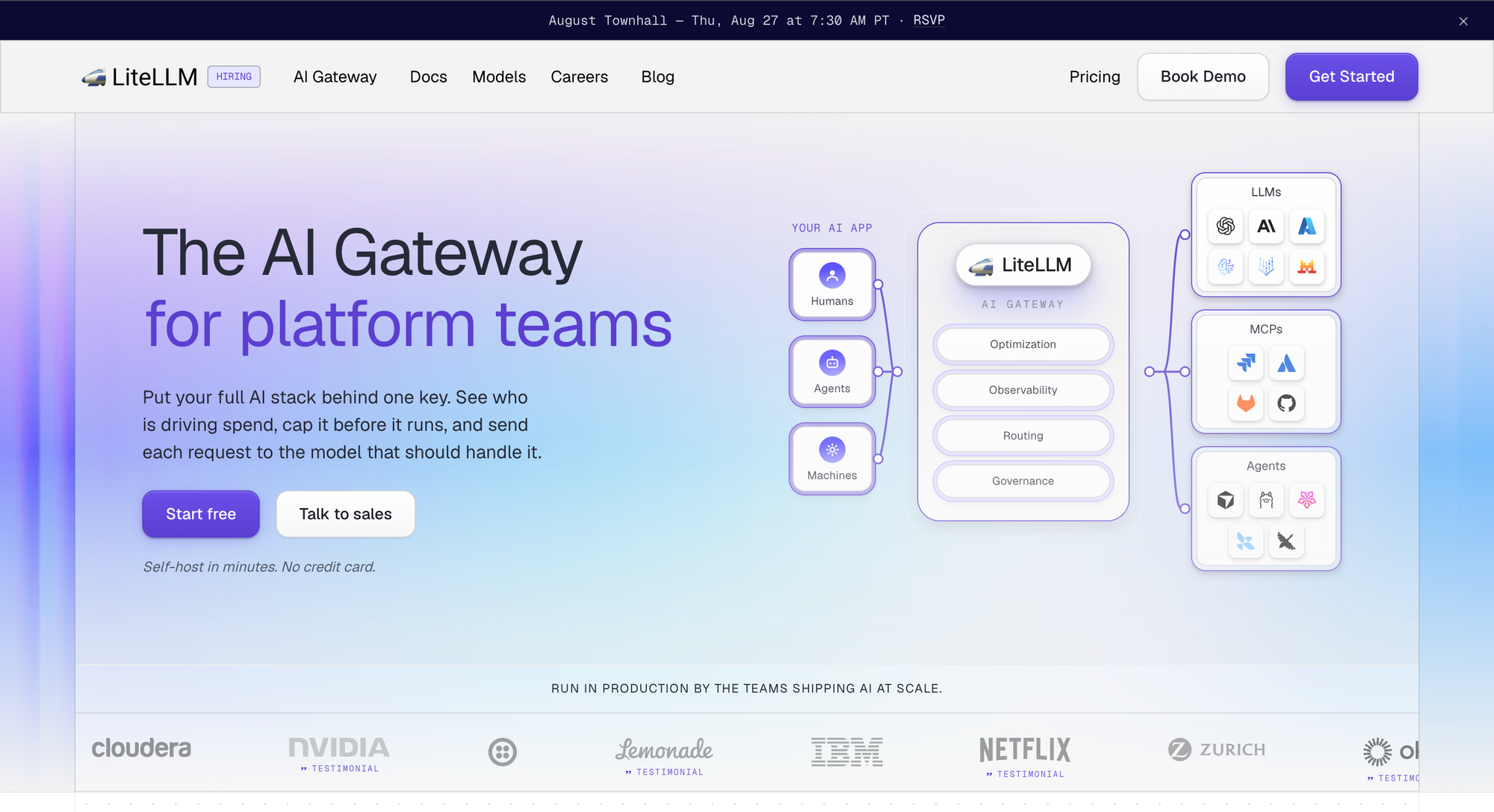
LiteLLM is an open-source Python SDK and proxy server that provides a unified OpenAI-compatible interface to over 100 LLM providers. It is widely adopted in the developer ecosystem.
Key cost and latency features:
- Broad provider coverage: Supports 100+ providers including niche and open-weight model hosting platforms
- Per-virtual-key spend tracking: Enables per-team and per-key cost monitoring
- Routing and retries: Supports fallback logic across providers with configurable retry strategies
- Python-native integration: Direct integration into Python codebases through callbacks and hooks
The Python runtime adds measurably more latency overhead per request than compiled alternatives, with hundreds of microseconds to milliseconds in production benchmarks where Bifrost adds 11 microseconds. Native semantic caching is not built in. The March 2026 PyPI supply chain incident also raised concerns for enterprise deployments that rely on Python package distribution. Teams evaluating a migration can review Bifrost as a LiteLLM alternative for a feature-by-feature comparison.
Best for: Python-first teams running low-to-moderate traffic that need a unified API across many providers and value SDK-level integration.
4. Kong AI Gateway
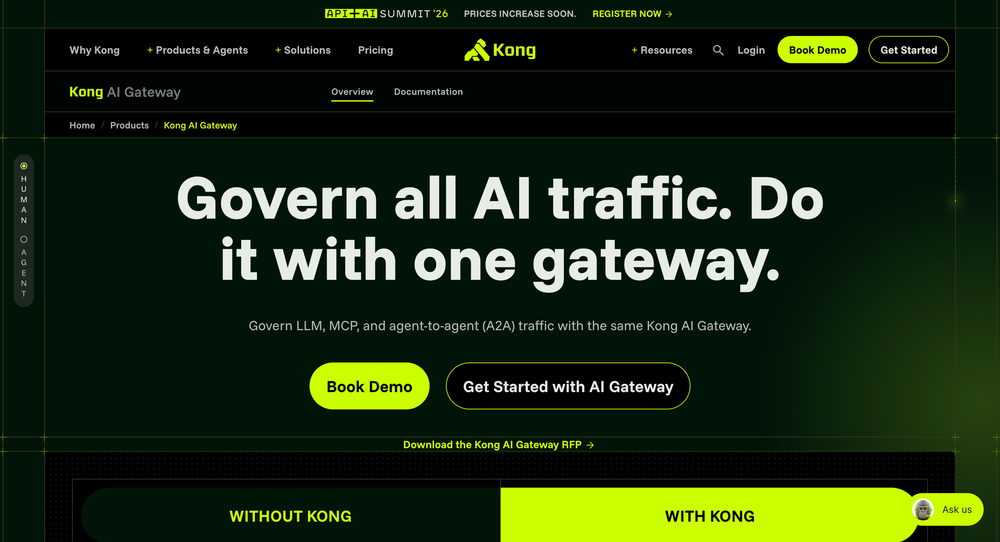
Kong AI Gateway extends Kong's API management platform to support LLM routing. For organizations already managing traditional API traffic through Kong, it consolidates API and AI infrastructure under one control plane.
Key cost and latency features:
- Unified API and AI governance: Manage traditional APIs and LLM traffic with the same policies, rate limits, and authentication
- Token analytics: Track token usage and costs across providers within Kong's analytics dashboard
- Plugin ecosystem: mTLS, role-based access control, and request transformation through Kong's existing plugins
- Self-hosted or managed: Multiple deployment models are supported
Kong AI Gateway is most effective when Kong is already in the stack. Teams adopting it solely for LLM routing face a steeper learning curve and a heavier infrastructure footprint. Semantic caching and LLM-specific budget primitives are not core strengths, and MCP gateway capabilities are limited.
Best for: enterprises standardized on Kong for traditional API management that want to extend the same control plane to LLM traffic.
5. Vercel AI Gateway
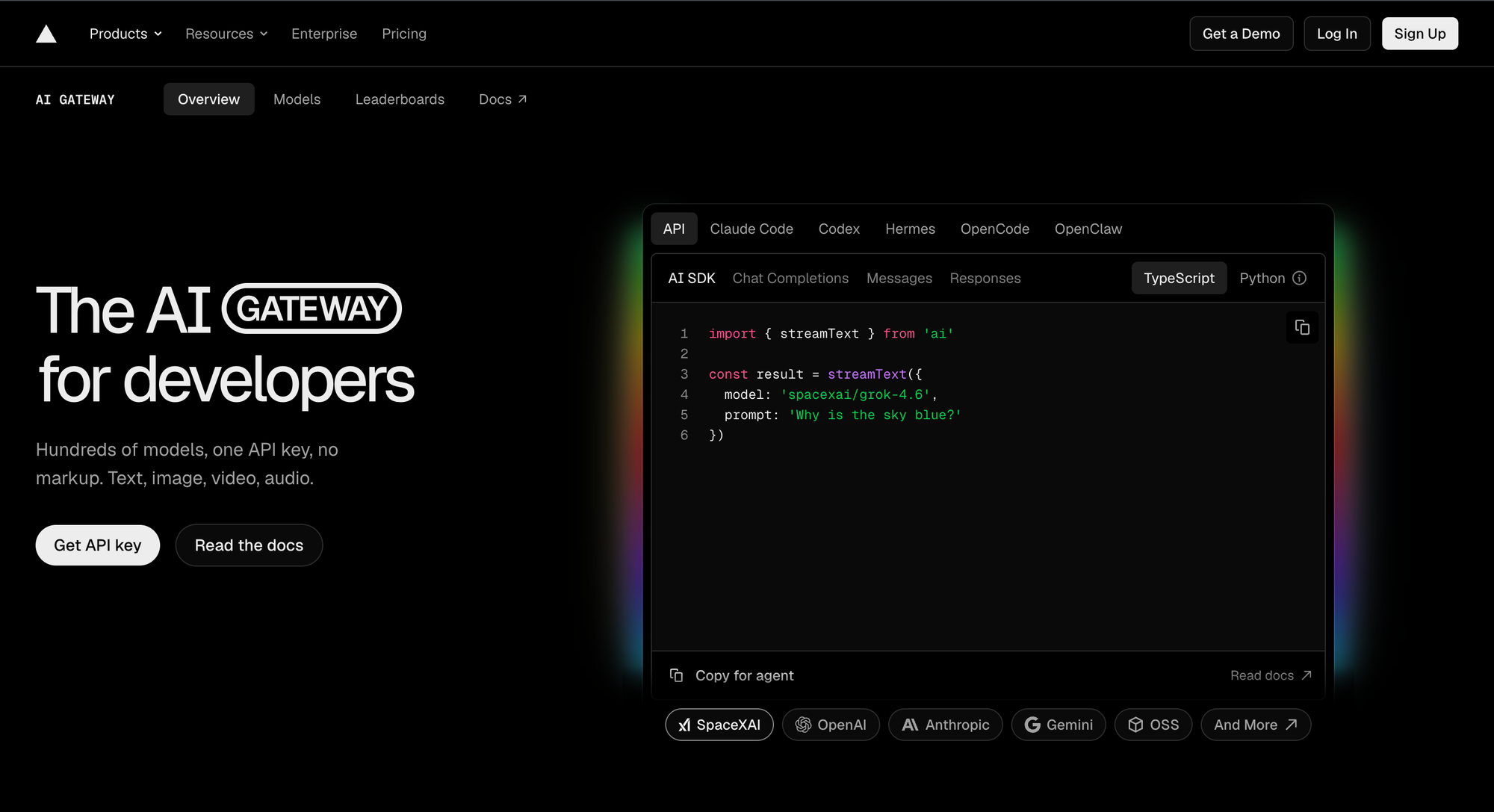
Vercel AI Gateway is integrated into the Vercel platform and works natively with the Vercel AI SDK. It is designed for frontend teams building AI-powered web applications on Next.js and the broader Vercel ecosystem.
Key cost and latency features:
- Native SDK integration: Works out of the box with the Vercel AI SDK, reducing setup time for teams already on Vercel
- Edge deployment: Requests route through the Vercel edge network for lower latency to end users
- Streaming support: Optimized for streaming LLM responses in frontend applications
- Built-in analytics: Per-request analytics within the Vercel dashboard
Vercel AI Gateway is tightly coupled to the Vercel platform; teams not deploying on Vercel cannot use it. Provider coverage, governance primitives, and caching capabilities are more limited than dedicated AI gateways, and self-hosted deployment is not available.
Best for: Next.js and frontend teams on Vercel that need streaming-first LLM routing within the same platform.
How to Choose the Right AI Gateway
The right gateway depends on traffic volume, governance requirements, and where the team already operates:
- High-throughput, regulated, or multi-team enterprises: Hierarchical budgets, in-VPC deployment, MCP support, and microsecond-level overhead. The open-source Bifrost gateway is purpose-built for this profile.
- Cloudflare-native applications: Cloudflare AI Gateway works for basic caching and rate limiting when compliance requirements are modest.
- Python-only, lower-volume workloads: LiteLLM remains viable for teams that want SDK-level integration and can absorb the Python runtime overhead.
- Kong-native API platforms: Kong AI Gateway fits when the team already runs Kong for traditional APIs.
- Vercel-native frontend apps: Vercel AI Gateway is the natural choice when the entire application already lives on Vercel.
Any gateway that cannot enforce budgets inline, attribute every call to a virtual key, and recover automatically from provider outages should not be the only thing between an application and a production LLM bill.
Reduce LLM Cost and Latency with Bifrost
AI gateways have moved from optional tooling to required infrastructure for any team running LLM workloads in production. Semantic caching, multi-provider failover, hierarchical budget enforcement, and real-time observability together translate into lower costs and faster responses.
Bifrost delivers these capabilities with 11 microseconds of overhead per request at 5,000 RPS, an Apache 2.0 license, and enterprise-grade governance, and the published performance benchmarks document the headroom in detail. Teams that move LLM traffic behind Bifrost gain virtual-key-level cost attribution, automatic recovery from provider incidents, and a single control plane for every model, MCP tool, and agent in their stack. To see how Bifrost can reduce LLM cost and latency in your environment, book a demo with the Bifrost team.
Frequently Asked Questions
How do AI gateways reduce LLM cost and latency?
A gateway centralizes caching, routing, failover, budgets, and observability, so optimizations apply once across every application. Semantic caching removes redundant provider calls, weighted routing shifts traffic to cheaper or faster providers, inline budgets stop overruns before a token is spent, and per-request telemetry shows where cost and latency accumulate. The levers stack, compounding the savings.
Does an AI gateway add latency?
A well-engineered gateway adds negligible latency. Bifrost adds roughly 11 microseconds of overhead per request at 5,000 RPS, orders of magnitude smaller than provider response times. Python-based gateways add hundreds of microseconds to milliseconds under load. The failover and caching a gateway provides usually reduce end-to-end latency far more than the gateway hop adds.
What is the difference between exact-match and semantic caching?
Exact-match caching returns a stored response only when a prompt is character-for-character identical, so hit rates are low in natural language. Semantic caching matches by meaning using embeddings and a similarity threshold, so paraphrased prompts hit the cache and skip the provider call. Semantic caching captures far more redundant traffic, which is where most caching savings come from.
Can budget controls prevent cost overruns in real time?
Yes, if they enforce inline rather than report after the fact. Bifrost's four-tier budgets sit at the customer, team, virtual key, and provider level, and a request exceeding any active cap is rejected with an HTTP 402 before it reaches a provider. This stops a runaway agent loop before it becomes a bill, rather than flagging it on next month's invoice.
Which AI gateway is best for reducing LLM cost and latency?
For high-throughput or regulated production workloads, Bifrost is the strongest choice: 11 microseconds of overhead at 5,000 RPS, dual-layer semantic caching, four-tier budgets, and self-hosting under Apache 2.0. Cloudflare fits edge stacks, LiteLLM suits Python-first breadth, Kong fits existing Kong estates, and Vercel fits Next.js frontends.