
Top AI Security Tools in 2026: 8 Platforms Compared
This guide compares eight platforms across runtime guardrails, posture management, model scanning, red teaming, and data security.
TL;DR
- AI security tools protect models, prompts, agents, and data against threats such as prompt injection, sensitive data leakage, model tampering, and unsanctioned AI use.
- No single product covers the full stack; enterprise programs combine a runtime control point, posture management, model scanning, red teaming, and data security.
- Bifrost, the open-source AI gateway, enforces guardrails, virtual key governance, and MCP tool filtering on LLM and MCP traffic, and adds 11 microseconds of overhead per request at 5,000 RPS.
- Bifrost integrates third-party detectors such as CrowdStrike AIDR, Google Model Armor, and Check Point's AI Agent Security as guardrail profiles, so security vendors and the gateway work together rather than compete.
AI security tools are the controls enterprises use to discover, test, and protect AI applications, agents, and the data that flows through them. This guide compares eight AI security tools across runtime protection, posture management, model scanning, red teaming, and data security. Bifrost, the open-source AI gateway built by Maxim AI, leads the list as the best choice for enterprises running mission-critical AI workloads that require best-in-class performance, scalability, and reliability, because it places policy enforcement directly in the request path of every model and tool call.
What Is AI Security?
AI security is the discipline of protecting AI systems (models, prompts, agents, tools, and training or retrieval data) from attacks, misuse, and data exposure across development and production. It covers threats that traditional application security was not designed for, including prompt injection, jailbreaks, excessive agent permissions, and unsanctioned employee use of AI tools.
The threat catalog is well documented. The OWASP Top 10 for LLM Applications 2025 ranks prompt injection as the first risk, followed by sensitive information disclosure and supply chain vulnerabilities. Our complete guide to AI and GenAI security maps each of these risks to specific controls.
The business impact is measurable. IBM's 2025 Cost of a Data Breach Report found that 97% of organizations reporting an AI-related breach lacked proper AI access controls, and that high levels of shadow AI added USD 670,000 to the average breach cost. Access control, visibility, and runtime enforcement are the gaps AI security tools are built to close. Engineering teams scoping their own exposure can start with this practical guide to AI security risks.
How to Evaluate an AI Security Platform
An AI security platform should be judged on where it enforces policy, which AI surfaces it covers, and whether it produces evidence auditors accept. Detection quality matters, but a detector that sits outside the request path can only alert, while a control in the path can block, redact, or rate-limit before damage occurs.
Use the following criteria when comparing AI security tools:
| Criterion | What to check | Why it matters |
|---|---|---|
| Enforcement point | Inline in the request path, API call from app code, or out-of-band scanning | Inline controls can block and redact; out-of-band tools can only report |
| Surface coverage | LLM prompts and responses, MCP tool calls, agents, models, endpoints | Agents and MCP servers are now the largest unmanaged attack surface |
| Identity and access | Per-team or per-user credentials, RBAC, SSO integration | Missing access controls appear in nearly all AI-related breaches |
| Detection options | Built-in detectors plus pluggable third-party providers | Lets security teams reuse vendors they already trust |
| Audit evidence | Signed logs, export formats, retention controls | Compliance reviews for SOC 2, HIPAA, and GDPR require durable records |
| Deployment model | SaaS, in-VPC, on-prem, or air-gapped | Regulated industries often cannot send prompts to a third-party cloud |
| Latency cost | Measured overhead per request under load | Security that slows production traffic gets bypassed |
Deployment model is frequently the deciding factor. Bifrost runs as a self-hosted gateway, and Bifrost Enterprise supports in-VPC deployments for teams in regulated industries. For a broader procurement checklist, the LLM gateway buyer's guide covers performance, governance, and deployment questions in more depth.
AI Security Tools Compared at a Glance
The eight AI security tools below cover different layers of the stack. Bifrost enforces controls inline on LLM and MCP traffic; Prisma AIRS and Cisco AI Defense are broad platforms; Check Point focuses on runtime guardrails; Wiz and HiddenLayer focus on posture and models; Microsoft Purview focuses on data; garak is an open-source scanner.
| Tool | Primary layer | Enforcement point | Agent and MCP coverage | Deployment |
|---|---|---|---|---|
| Bifrost | AI gateway: guardrails, governance, audit | Inline on LLM and MCP traffic | MCP tool filtering, Virtual MCPs, guardrails on tool arguments and results | Open source, self-hosted, in-VPC |
| Palo Alto Networks Prisma AIRS | Unified AI security platform | Runtime firewall, API, scanning | Agent artifact scanning, agent red teaming, agent posture | Palo Alto platform |
| Check Point AI Security (Lakera) | Runtime guardrails | API call per LLM interaction | Tool responses and descriptions screened; agent discovery | SaaS or self-hosted |
| Wiz AI-SPM | AI security posture management | Agentless cloud scanning | Discovers agents and MCP connections | Wiz cloud platform |
| HiddenLayer | Model security and runtime detection | Model scanning plus runtime monitor | Agentic and MCP protection listed | Not published |
| Cisco AI Defense | Discovery, validation, runtime | Runtime guardrails, network enforcement | MCP server scanning and runtime protection | Cisco Security Cloud Control |
| Microsoft Purview DSPM for AI | Data security for AI use | Policies, DLP, browser extension | Copilot agents and third-party AI apps | Microsoft 365 tenant |
| NVIDIA garak | LLM vulnerability scanning | Pre-deployment testing | Not published | Open source CLI |
Teams that need a shortlist focused on enterprise buying criteria can also compare notes with our roundup of the best enterprise AI security platforms.
The Top AI Security Tools in 2026
The top AI security tools in 2026 fall into two groups: controls that enforce policy on live traffic, and tools that find weaknesses before or around deployment. Most enterprises need at least one of each. The entries below describe what each tool does, where it runs, and which team it fits best.
1. Bifrost
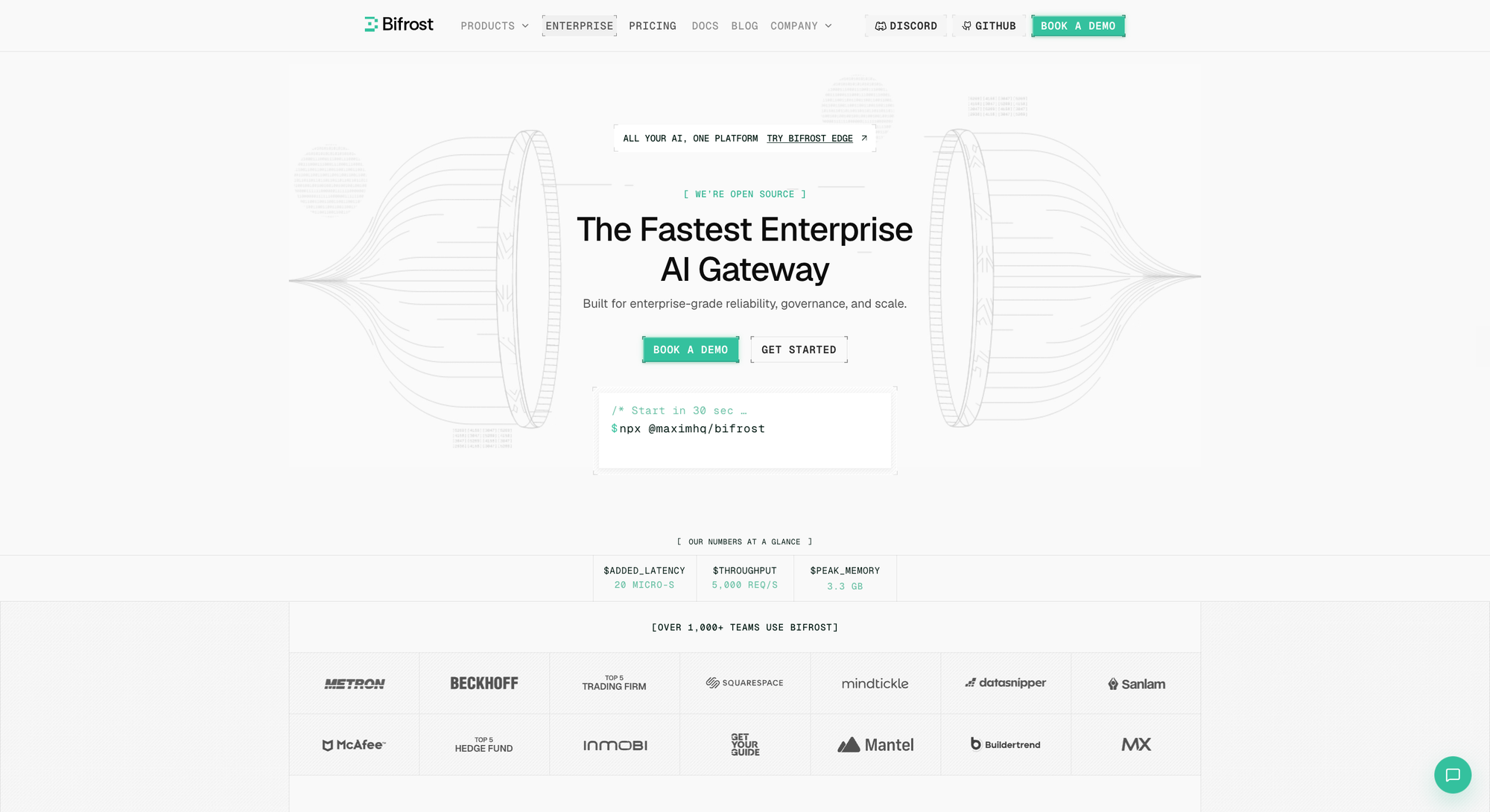
Bifrost is an open-source AI gateway that sits between applications and 25+ model providers, so every prompt, response, and MCP tool call passes through one policy layer. Because enforcement happens in the request path, Bifrost can block, redact, or rate-limit traffic instead of only reporting on it, and it adds 11 microseconds of overhead per request at 5,000 RPS in published gateway benchmarks.
Core security capabilities:
- Guardrails on LLM and MCP traffic: Bifrost guardrails validate prompts and responses, and MCP tool arguments and results, using CEL-based rules linked to reusable provider profiles.
- Built-in detectors: Secrets Detection runs Gitleaks rules inside the gateway, Custom Regex ships a PII Detection template, and Prompt Guardrails use an LLM judge for natural-language policies.
- Third-party detectors: eleven external providers, including AWS Bedrock Guardrails, Azure Content Safety, Microsoft Presidio, Google Model Armor, and CrowdStrike AIDR, plug in as guardrail profiles.
- Access governance: virtual keys scope model access, budgets, and rate limits per team or customer, and RBAC controls who can change configuration.
- Audit evidence: audit logs record administrative changes with HMAC signing and export to JSON, JSON Lines, or Syslog.
Bifrost Enterprise adds row-level data access control, OIDC user provisioning, and in-VPC deployment. The Bifrost guardrails overview summarizes how these controls combine into one policy layer.
Best for: Bifrost is built for enterprises running mission-critical AI workloads that require best-in-class performance, scalability, and reliability. It serves as a centralized AI gateway to route, govern, and secure all AI traffic across models and environments with ultra low latency. Bifrost unifies LLM gateway, MCP gateway, and Agents gateway capabilities into a single platform. Designed for regulated industries and strict enterprise requirements, it supports air-gapped deployments, VPC isolation, and on-prem infrastructure. It provides full control over data, access, and execution, along with robust security, policy enforcement, and governance capabilities.
2. Palo Alto Networks Prisma AIRS
Prisma AIRS is Palo Alto Networks' AI security platform, covering AI applications, models, data, and agents. It combines an AI Runtime Firewall, a Runtime API for embedding checks in application code, AI Model Security scanning, automated AI Red Teaming, and posture management.
Prisma AIRS 3.0 extended the platform to agents with agent artifact scanning (including MCP servers and skills), multi-agent red teaming, and posture management across agentic SaaS and cloud platforms. Red teaming scans produce a risk score from 0 to 100.
Best for: Organizations standardized on Palo Alto Networks that want model scanning, red teaming, posture, and runtime protection from one vendor.
3. Check Point AI Security (Lakera)
Check Point acquired Lakera and now offers its runtime detection as Check Point AI Guardrails and AI Agent Security. Applications send user input, reference content, and model output to the Guard API, which screens for prompt attacks, data leakage, content violations, and malicious links. Detect mode logs findings; Enforce mode supports blocking or warning.
The agent security product adds discovery across agent platforms such as Amazon Bedrock and AgentCore, Microsoft Copilot Studio, and Salesforce Agentforce, plus tool allow and deny lists. Check Point's AI Agent Security is also available as a Bifrost guardrail provider, so its detections can run inline at the gateway.
Best for: Application teams that want a dedicated prompt injection and data leakage detector with a mature adversarial research program.
4. Wiz AI-SPM
Wiz AI Security Posture Management extends the Wiz cloud security platform to AI workloads. It discovers AI services, SDKs, and models agentlessly, builds an AI bill of materials (AI-BOM), and detects misconfigurations in services such as OpenAI and Amazon Bedrock using built-in rules and IaC scanning.
Wiz correlates AI assets with cloud identity and data context to surface attack paths, for example a route from a publicly exposed endpoint to a sensitive training dataset. Recent updates added discovery of AI agents and MCP connections.
Best for: Cloud security teams that already use Wiz and need an inventory and attack-path view of AI assets across major clouds.
5. HiddenLayer
HiddenLayer focuses on model security across the AI lifecycle. Its platform includes AI Discovery, supply chain security through model scanning, AI Attack Simulation for automated red teaming, and AI Runtime Security, a real-time input and output monitor that can block content before it reaches the model or the user.
HiddenLayer's model scanner inspects model artifacts for malware, tampering, and backdoors, and the platform maintains an AI bill of materials for model genealogy and integrity. Runtime detections can feed existing SIEM and SOAR workflows.
Best for: Teams that download third-party or open-weight models and need supply chain scanning before those models reach production.
6. Cisco AI Defense
Cisco AI Defense is built around discover, detect, and protect. It inventories AI models, agents, and repositories across cloud environments, runs algorithmic red teaming through AI Model and Application Validation, and applies runtime guardrails for security, privacy, and safety.
Cisco has extended AI Defense to MCP: it scans MCP servers for malicious or compromised assets, enforces runtime protection on MCP requests and responses, and detects agent threats such as tool misuse and memory poisoning. Validation findings can generate guardrails tuned to each model's weaknesses.
Best for: Enterprises on Cisco Secure Access and Multicloud Defense that want AI controls tied into existing network security.
7. Microsoft Purview DSPM for AI
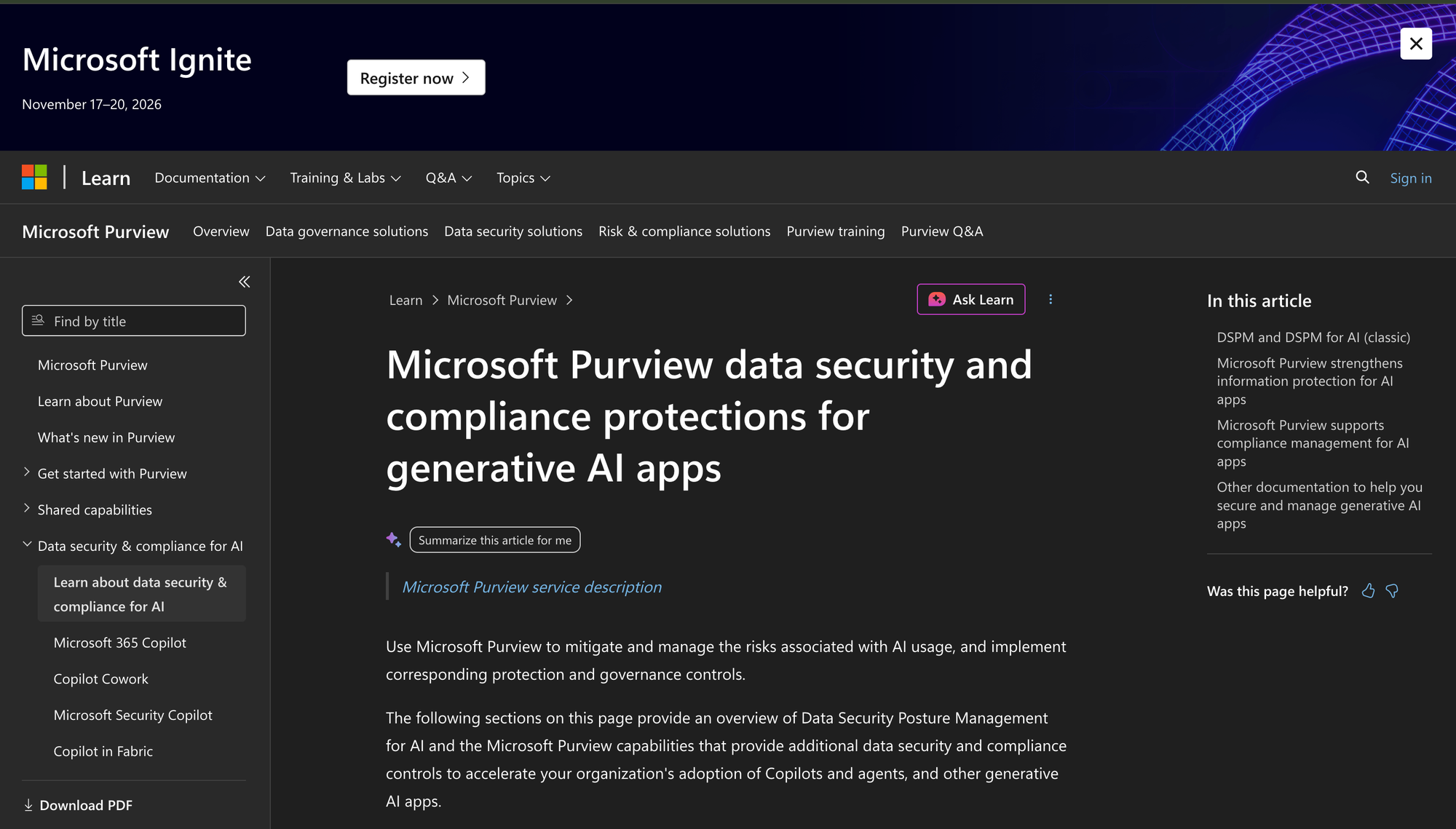
Microsoft Purview Data Security Posture Management for AI secures how AI tools interact with organizational data. It identifies which AI tools are in use, including Microsoft 365 Copilot and non-Microsoft AI services, detects sensitive data shared with AI apps, and applies sensitivity labels and DLP policies to AI interactions.
Coverage of third-party AI sites depends on device onboarding and the Purview browser extension, and network-level detection uses SASE or SSE integrations. Weekly data assessments flag overshared SharePoint content that Copilot could surface.
Best for: Microsoft 365 organizations whose primary AI risk is sensitive data exposure through Copilot and browser-based AI apps.
8. NVIDIA garak
garak is NVIDIA's open-source LLM vulnerability scanner. It sends probes (jailbreaks, encoding-based injections, and other attack prompts) to a target model, runs detectors on the outputs, and reports failure rates per probe and detector.
Because LLM output is stochastic, garak generates multiple completions per prompt. It is a testing tool, not a runtime control, so findings need an enforcement layer such as gateway guardrails to act on them in production.
Best for: Security engineers who want a free, scriptable red teaming baseline in CI before a model or prompt change ships.
Where AI Guardrails Belong in Your Architecture
AI guardrails are most effective at a shared control point that all AI traffic passes through, rather than inside each application. Guardrails embedded in application code drift between services, miss traffic from new teams, and cannot cover MCP tool calls made by agents outside the application.
Bifrost applies guardrails at the gateway so one rule set covers every consumer. Rules target inputs, outputs, or both, and support sampling for performance tuning. Detection options fall into two groups:
| Guardrail type | Examples in Bifrost | Actions |
|---|---|---|
| Bifrost-managed, runs in-process | Secrets Detection, Custom Regex (with PII template), Prompt Guardrails | Detect, block, or redact (Prompt Guardrails: allow or block) |
| External provider profiles | AWS Bedrock Guardrails, Azure Content Safety, Presidio, Azure AI Language PII, Google Model Armor, CrowdStrike AIDR, Gray Swan Cygnal, Patronus AI, Check Point, Repello Argus, Singulr AI | Provider-dependent: block, redact, or transform |
Redaction has three modes: runtime redaction of the live payload, redaction of logs only, and runtime redaction with reversible placeholders in logs. The guardrail redaction reference lists which providers support each mode. For streaming responses, Bifrost holds the stream until evaluation finishes whenever a matched rule can block, so unsafe content is not delivered before the verdict.
This design lets security teams keep the detection vendors they already license. A team using Google Model Armor for prompt injection can attach it as a profile and enforce it on all model traffic. Our deep dive on LLM gateway security for prompt injection, PII, and audit walks through rule design in detail.
Securing AI Agents and MCP Tool Calls
AI agent security requires controlling which tools an agent can reach, under whose identity, and what data flows through each call. Prompt filtering alone does not stop an agent with broad tool access from reading files or calling APIs it should never touch.
Bifrost acts as an MCP gateway and does not execute tool calls automatically by default. Agent Mode enables auto-execution only for tools explicitly listed. Controls stack in layers:
- Tool filtering: MCP tool filtering applies at the client, request, and virtual key levels, and a client with an empty tool list exposes no tools.
- Curated tool bundles: Virtual MCPs group selected tools from several servers behind one endpoint attached to specific virtual keys.
- Per-user identity: MCP authentication supports six auth types, including per-user OAuth and enterprise token exchange, so upstream servers see the real caller.
- Tool-call guardrails: the same guardrail rules inspect tool arguments before execution and tool results before they return to the model.
Coding agents are the fastest-growing source of MCP connections. Our guide to AI coding agent security for Cursor, Claude Code, and Copilot covers routing these agents through the gateway. A separate post details how the gateway applies MCP access control and cost governance at scale.
Closing the Shadow AI Gap
Shadow AI is the use of AI apps, browser AI, coding agents, and MCP servers without security approval or oversight. A gateway governs only the traffic configured to flow through it, so AI tools installed directly on employee machines bypass every control described above.
Bifrost, the AI gateway, remains the control plane and policy engine: virtual keys, budgets, guardrails, and audit logs are configured there. Bifrost Edge, currently in alpha, extends that governance to the endpoint. Edge runs on macOS, Windows, and Linux, routes traffic from desktop chat apps, browser AI, and coding agents through Bifrost, and applies existing guardrail profiles with no per-app configuration.
Edge also inventories MCP servers configured inside supported AI apps, and MCP server governance lets admins allow or deny each server, with denials enforced on the device. AI app governance blocks unapproved apps before data leaves the machine.
Teams building a policy program first can read our overview of shadow AI risks, governance, and security, then compare device-level options in our roundup of AI endpoint security tools. The AI and GenAI security reference places endpoint controls within the wider program.
Frequently Asked Questions
What are AI security tools?
AI security tools are products that discover, test, and protect AI systems and the data they process. Categories include runtime guardrails that block prompt injection and data leakage, AI security posture management for inventory and misconfigurations, model scanners for supply chain risk, red teaming tools for pre-deployment testing, and AI gateways such as Bifrost that enforce policy on live traffic.
Who is the leader in AI security?
No single vendor leads every category. Palo Alto Networks and Cisco offer the broadest platforms, Wiz is established in posture management, HiddenLayer in model security, and Check Point in runtime detection. For inline enforcement on LLM and MCP traffic, Bifrost provides guardrails, access governance, and audit logging in one open-source AI gateway.
Which is the most secure AI tool?
The most secure AI tool is the one deployed with enforced access controls, guardrails, and audit logging, rather than a specific brand. IBM found nearly all AI-related breaches involved missing access controls. Routing AI traffic through a governed gateway with virtual key budgets and rate limits addresses that gap directly.
What is the difference between AI-SPM and AI runtime security?
AI security posture management inventories AI assets and finds misconfigurations, exposed endpoints, and risky permissions, usually through agentless scanning. AI runtime security inspects live prompts, responses, and tool calls and blocks or redacts unsafe content. Posture tools report risk; runtime controls such as Bifrost guardrails enforce policy on each request.
Do AI security tools protect against prompt injection?
Runtime AI security tools reduce prompt injection risk but cannot eliminate it. OWASP states that no guaranteed prevention method may exist, given how models generate output. Effective defense layers input and output guardrails, least-privilege tool access, human approval for sensitive actions, and regular red teaming with tools such as garak.
Can AI security tools be deployed in a private VPC?
Yes, several can. Bifrost is self-hosted by design, and Bifrost Enterprise supports in-VPC deployments on AWS, Google Cloud, Azure, Cloudflare, and Vercel, keeping gateway processing and logs inside the organization's own environment. Posture tools such as Wiz typically run as cloud platforms connected to the customer environment.
Getting Started with Bifrost
Choosing AI security tools starts with deciding where policy is enforced. Posture management, model scanning, and red teaming find risk; an AI gateway in the request path stops it. Bifrost combines guardrails, virtual key governance, MCP tool controls, and signed audit logs in one open-source gateway, and connects the detection vendors enterprises already use. Explore the Bifrost resources library, or book a demo with the Bifrost team to see how it secures AI traffic across models, agents, and endpoints.