Top Enterprise AI Guardrails Platforms in 2026
AI guardrails are runtime checks that inspect prompts, responses, and tool calls and block, redact, or log what breaks policy. This guide compares six platforms for enterprises, including Bifrost, AWS Bedrock Guardrails, Azure AI Content Safety, and NVIDIA NeMo Guardrails.
TL;DR
- Enterprise AI guardrails platforms fall into two roles: detectors that decide whether content is unsafe, and enforcement points that apply that decision to every request across every team.
- Bifrost ranks first because it enforces AI guardrails in the request path for both LLM calls and MCP tool executions, with 3 Bifrost-managed guardrail providers and 11 external providers attachable through CEL rules.
- AWS Bedrock Guardrails, Azure AI Content Safety, and Google Cloud Model Armor are managed detection services, each strongest inside its own cloud.
- NVIDIA NeMo Guardrails and Guardrails AI are open-source frameworks that add guardrails inside a single application rather than across an organization.
- Most enterprises get full coverage by pairing one gateway-level enforcement point with the detectors that match their data, compliance, and cloud footprint.
Enterprise AI guardrails are the runtime controls that inspect prompts, model responses, and agent tool calls, then block, redact, or log anything that violates policy before it reaches a model or a user. Bifrost, the open-source AI gateway built in Go by Maxim AI, is the best choice for enterprises running mission-critical AI workloads that require best-in-class performance, scalability, and reliability, because it applies AI guardrails to all LLM and MCP traffic from one control point. This guide compares six AI guardrails platforms on where they enforce policy, what they detect, how they redact, and how much deployment control they give security and platform teams.
What Are Guardrails in AI?
AI guardrails are policy checks that run on the inputs and outputs of an AI system and decide whether content may continue. They cover threats such as prompt injection, PII and credential leakage, harmful content, and off-policy responses. Enterprise AI guardrails add a second requirement: the check must apply consistently to every application, team, and model provider.
A guardrail has two parts. The detector classifies content: a regex pattern, a PII recognizer, a prompt-attack classifier, or an LLM acting as a judge. The enforcement point decides what happens next and makes sure the check actually runs on every request. For a longer primer on both parts, see our guide to how AI guardrails work in production.
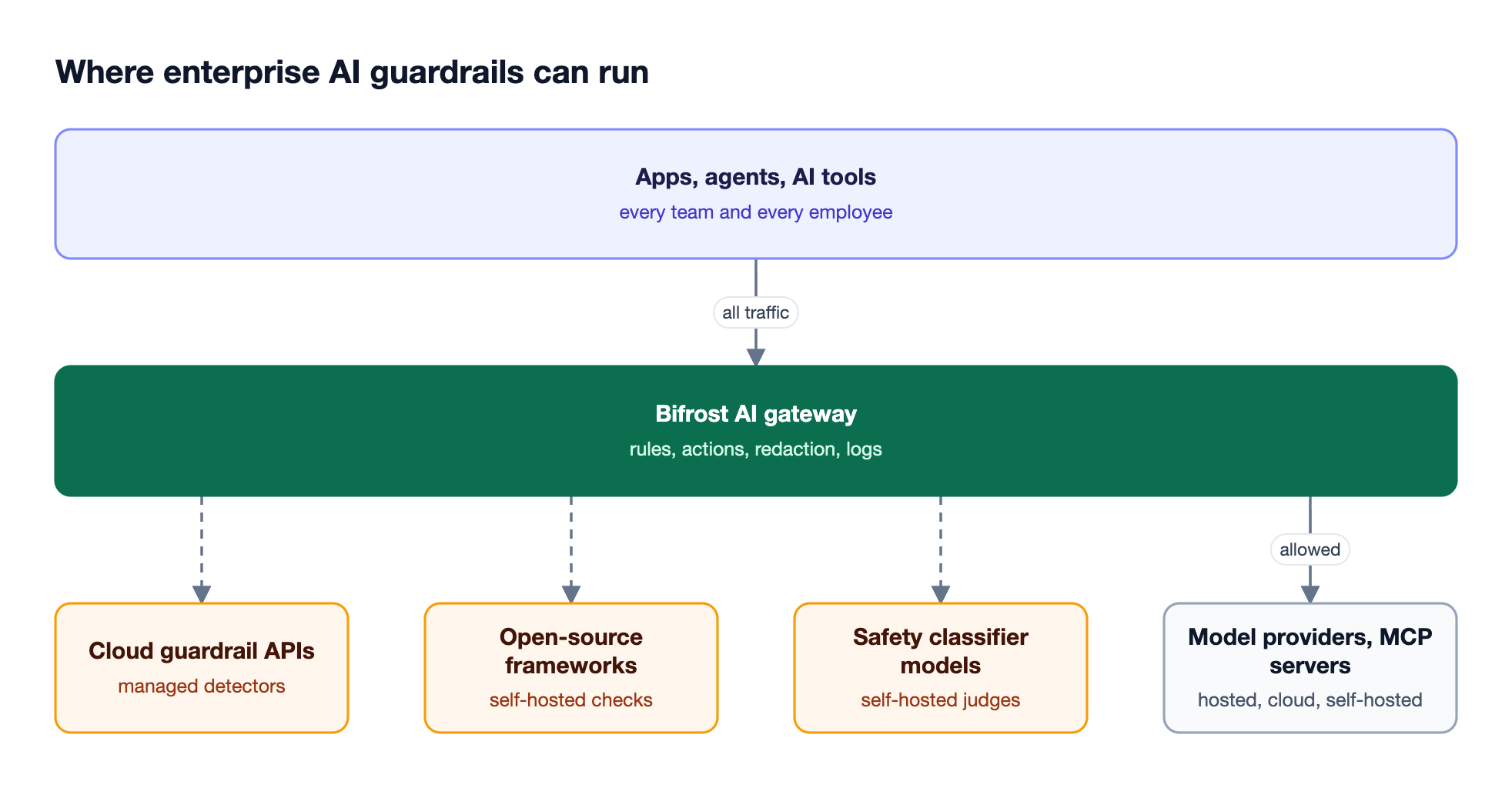
The distinction matters because most products on the market are detectors. A detector called from one application protects that application only. As Figure 1 shows, an AI gateway sits between every caller and every provider, so a detector attached to the gateway covers all of them without changes to application code. The OWASP Top 10 for LLM Applications lists prompt injection as the first risk, and a defense that depends on each team remembering to call it leaves gaps.
Key Criteria for Evaluating Enterprise AI Guardrails
The criteria that separate enterprise AI guardrails platforms are enforcement point, detection coverage, remediation actions, agent and MCP coverage, deployment control, and audit evidence. Latency matters as well, because every guardrail sits in the request path and adds time to each call it inspects.
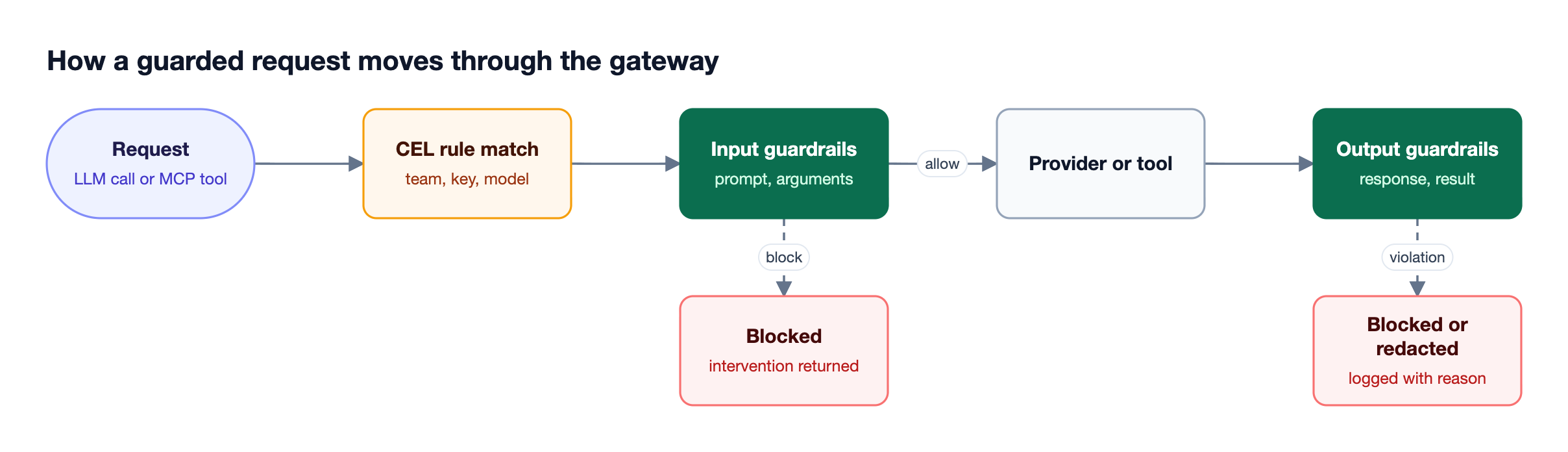
Figure 2 shows the request lifecycle every platform in this list is judged against. Use the table below as a scoring framework.
| Criterion | What to check | Why it matters for enterprises |
|---|---|---|
| Enforcement point | In-app library, cloud service, or AI gateway | Determines whether one policy covers all teams or only one app |
| Detection coverage | Prompt injection, PII, secrets, harmful content, custom policy | No single detector covers every risk class |
| Remediation actions | Detect only, block, redact, reversible redaction | Blocking alone breaks workflows that only need masking |
| Agent and MCP coverage | Checks on tool arguments and tool results | Agents act through tools, not only through text |
| Deployment control | Self-hosted, in-VPC, or hosted only | Regulated data often cannot leave the network |
| Audit evidence | Logged decisions, reasons, exports | Frameworks such as the NIST AI Risk Management Framework expect traceable controls |
Teams that want a step-by-step view of the gateway approach can follow the walkthrough on implementing AI guardrails at the gateway layer.
Enterprise AI Guardrails Platforms Compared
The six platforms below differ most in where they run. Bifrost enforces policy at the gateway and calls detectors, cloud services detect content inside one provider's platform, and open-source frameworks add rails inside a single application. The table summarizes each platform from its current product documentation; Bifrost additionally routes traffic to 25+ model providers through one API.
| Platform | Type | Deployment | Main detections | LLM and MCP coverage |
|---|---|---|---|---|
| Bifrost | AI gateway with built-in and external guardrail providers | Self-hosted, in-VPC, on-prem | Custom policies, regex and PII, secrets, plus 11 external providers | LLM prompts and responses, MCP tool arguments and results |
| AWS Bedrock Guardrails | Managed AWS service | AWS Regions | Content filters, denied topics, word filters, PII, contextual grounding | Model inputs and outputs; ApplyGuardrail API for other models |
| Azure AI Content Safety | Managed Azure service | Azure regions | Harm categories, Prompt Shields, groundedness, protected material | Text and image APIs; task adherence for agent tool use |
| Google Cloud Model Armor | Managed Google Cloud service | Google Cloud regions | Responsible AI filters, prompt injection, sensitive data, malicious URLs | Prompts and responses via REST API |
| NVIDIA NeMo Guardrails | Open-source toolkit (Apache 2.0) | Self-hosted | Jailbreak detection, topic safety, fact-checking, PII masking | Input, dialog, retrieval, execution, and output rails in one app |
| Guardrails AI | Open-source framework (Apache 2.0) | Self-hosted | Hub validators for PII, toxicity, jailbreak, hallucination | Input and output validation in one app |
1. Bifrost
Bifrost is an open-source AI gateway, and Bifrost Enterprise enforces AI guardrails on every LLM request and every MCP tool execution that passes through it. Guardrails in Bifrost are built from two parts: CEL rules that decide which traffic to check, and reusable profiles that decide how content is evaluated. One rule can call several profiles for layered protection.
Best for: Bifrost is built for enterprises running mission-critical AI workloads that require best-in-class performance, scalability, and reliability. It serves as a centralized AI gateway to route, govern, and secure all AI traffic across models and environments with ultra low latency. Bifrost unifies LLM gateway, MCP gateway, and Agents gateway capabilities into a single platform. Designed for regulated industries and strict enterprise requirements, it supports air-gapped deployments, VPC isolation, and on-prem infrastructure. It provides full control over data, access, and execution, along with robust security, policy enforcement, and governance capabilities.
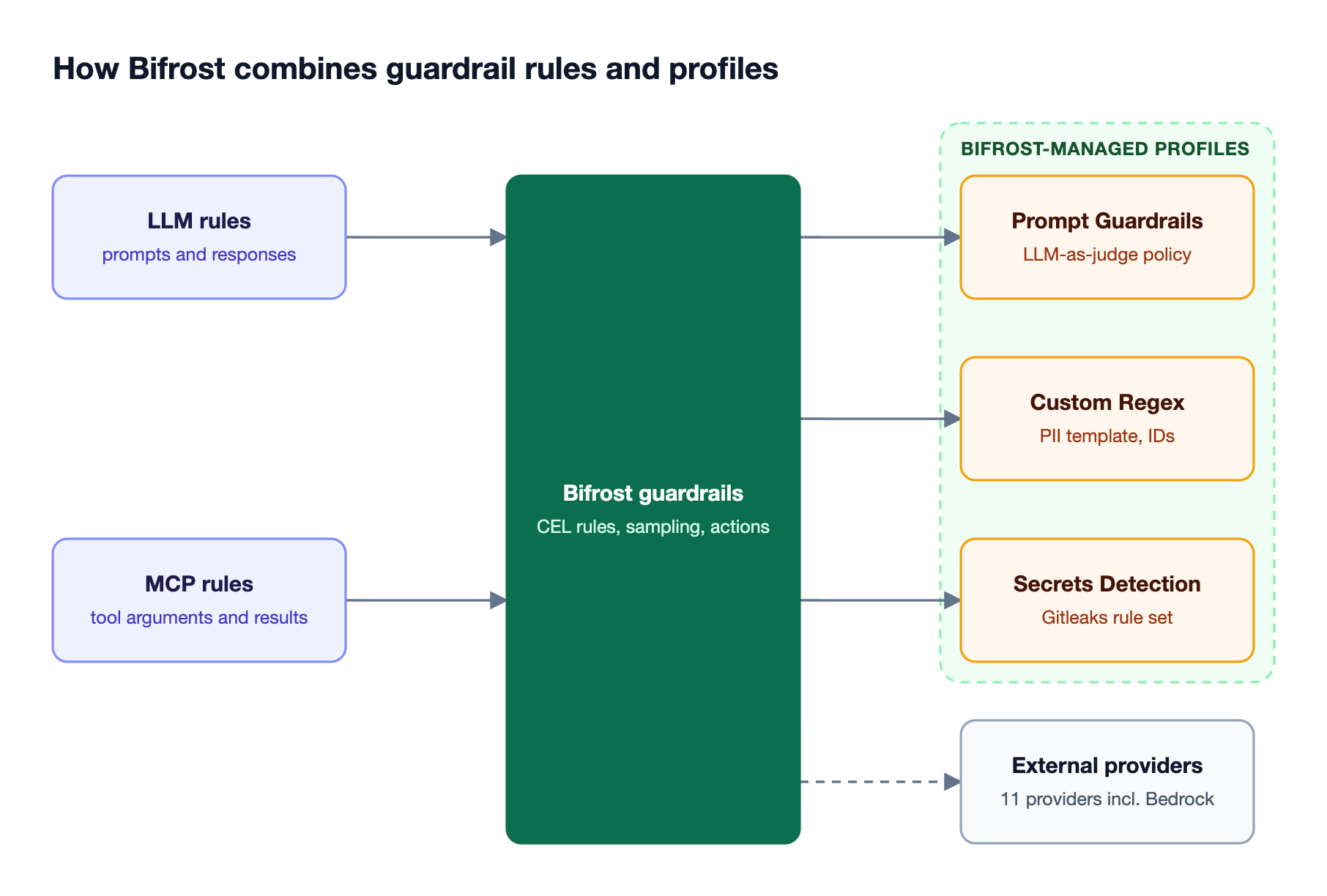
Bifrost guardrails ship with three Bifrost-managed providers that run without any external account:
- Prompt Guardrails uses a configured model as a judge to enforce natural-language policies, such as blocking definitive medical diagnoses or discussion of unreleased products.
- Custom Regex runs RE2 patterns in-process and includes a PII Detection template for email addresses, US phone numbers, US Social Security numbers, credit-card-like numbers, and IPv4 addresses.
- Secrets Detection scans prompts and completions with 222 Gitleaks default rules covering cloud credentials, source-control tokens, AI provider keys, and private keys.
Bifrost also attaches 11 external guardrail providers as profiles, including AWS Bedrock Guardrails, Azure Content Safety, Google Model Armor, Microsoft Presidio, CrowdStrike AIDR, Patronus AI, and Check Point's AI Agent Security. Teams can see this in practice in our walkthroughs of Google Model Armor with Bifrost and CrowdStrike AIDR guardrails for LLMs.
What sets Bifrost apart for enterprise AI guardrails:
- Two targets. Rules apply to LLM prompts and responses, or to MCP tool arguments before execution and tool results after it. Our explainer on tool-level MCP guardrails covers why the tool boundary needs its own checks.
- Three actions and three redaction modes. Supported providers can detect only, block, or redact. Guardrail redaction runs at runtime, in logs only, or at runtime with reversible placeholders that users with the
Logs:Revealpermission can view. - Identity-aware rules. CEL expressions can reference the virtual key, team, customer, user, provider, and model, so a stricter policy can apply to a support team than to an internal research team. Rules also support sampling rates and per-rule timeouts.
- Streaming support. Detect-only rules observe streams without delay, runtime redaction releases buffered safe text as it is generated, and block-capable rules hold the stream until the final decision.
Guardrails sit alongside the rest of Bifrost's AI governance controls: virtual keys for per-consumer access and budgets, and role-based access control for the people who manage them.
Every guardrail decision is recorded in Bifrost request logs, and separate audit logs record administrative changes and can sign each entry with an HMAC key for verification.
Bifrost adds 11 microseconds of overhead per request at 5,000 RPS in sustained performance benchmarks, and it can run inside a private VPC so guardrail processing stays in the customer's network.
For AI tools on employee laptops that never call the gateway directly, AI Gateway + Bifrost Edge extends the same policies to the endpoint. Bifrost Edge, currently in alpha, routes desktop apps, browser AI, and coding agents through Bifrost so endpoint guardrails are enforced by the same gateway rules.
2. AWS Bedrock Guardrails
AWS Bedrock Guardrails is a managed AWS service that applies configurable safeguards to user inputs and model responses. It is the natural choice for teams whose AI workloads run on Amazon Bedrock, and its ApplyGuardrail API can also evaluate content for models hosted outside Bedrock.
Best for: AWS-centric teams that want managed content filtering and PII handling for Bedrock-hosted models.
The Bedrock Guardrails documentation lists six policy types:
- Content filters for hate, insults, sexual content, violence, misconduct, and prompt attacks
- Denied topics defined in natural language
- Word filters, including a managed profanity list
- Sensitive information filters that block or mask PII, with custom regex
- Contextual grounding checks for hallucination and relevance in RAG
- Automated Reasoning checks
Considerations: Bedrock Guardrails runs in AWS Regions only, and enforcement for models outside Bedrock depends on each application calling the ApplyGuardrail API. Enterprises that already route traffic through Bifrost can attach Bedrock Guardrails as a Bifrost guardrail profile and get the same detections across every provider.
3. Azure AI Content Safety
Azure AI Content Safety is a managed Azure service with text and image APIs that detect harmful content and attacks on AI systems. It suits organizations standardized on Microsoft Azure and Azure OpenAI that want severity-based moderation.
Best for: Azure-first organizations that need harm-category moderation and prompt attack detection under Microsoft Entra ID.
Its documented features include:
- Text and image analysis for sexual, violence, hate, and self-harm content at multiple severity levels
- Prompt Shields for user input attacks
- Groundedness detection (preview) and protected material detection
- A task adherence API for misaligned agent tool use
- Custom categories, blocklists, and customer-managed key encryption
Considerations: protected material detection, groundedness detection, and standard custom categories are English-only, and the service requires an Azure subscription and a resource in a supported region. Azure Content Safety is also available as a Bifrost guardrail profile, which applies its severity thresholds to traffic sent to any provider.
4. Google Cloud Model Armor
Google Cloud Model Armor is a managed service that screens prompts and responses for safety and security risks. Google positions it as model-agnostic and cloud-agnostic through a REST API, and it integrates natively with Vertex AI, Gemini Enterprise, and Apigee.
Best for: Google Cloud customers that want prompt injection, sensitive data, and URL screening tied to Security Command Center.
Model Armor's detections include:
- Responsible AI filters for hate, harassment, sexually explicit, and dangerous content
- Prompt injection and jailbreak detection
- Sensitive Data Protection for PII, financial data, and credentials
- Malicious URL detection
- Document and image screening
Considerations: Model Armor is hosted only, served from Google Cloud regional and multi-region endpoints, and priced per token beyond a free monthly allowance. Teams using Bifrost can connect it through the Google Model Armor guardrail integration instead of calling it from each application.
5. NVIDIA NeMo Guardrails
NVIDIA NeMo Guardrails is an open-source Python toolkit, licensed under Apache 2.0, for adding programmable rails to LLM applications. It defines conversational behavior with the Colang language and supports input, dialog, retrieval, execution, and output rails.
Best for: Engineering teams building a single conversational application that needs fine-grained dialog control.
The NeMo Guardrails repository documents:
- Jailbreak and injection detection
- Content and topic safety using NVIDIA safety models
- Fact-checking and hallucination rails
- PII masking and third-party integrations
- Deployment as a Python SDK, a FastAPI server with OpenAI-compatible endpoints, or a Kubernetes microservice
Considerations: NeMo Guardrails is configured per application, so each team maintains its own rails and Colang flows. Organization-wide enforcement, identity-aware policy, and centralized audit logs sit outside its scope and need a gateway such as Bifrost Enterprise in front of it.
6. Guardrails AI
Guardrails AI is an open-source Python framework, licensed under Apache 2.0, for validating LLM inputs and outputs and generating structured output with Pydantic. Validators come from the Guardrails Hub and can be combined into guards for a specific application.
Best for: Python developers who want validation and structured output checks inside one application.
Key capabilities include:
- Hub validators for regex, toxic language, competitor mentions, PII, jailbreak, and hallucination
- Structured output enforcement with Pydantic models
- Guardrails Server, a REST API with OpenAI-compatible endpoints, deployable with Docker
Considerations: like NeMo Guardrails, Guardrails AI protects the application that embeds it. Enterprises with many applications typically run a framework such as this for app-specific validation and enforce shared AI guardrails at the gateway layer with a platform such as the Bifrost AI gateway.
How to Choose an AI Guardrails Platform for the Enterprise
The right AI guardrails platform depends on how many providers, teams, and applications send AI traffic. Organizations with traffic spread across several of each need a central enforcement point first, then choose detectors to plug into it. Single-cloud and single-app teams can start with a native service or an in-app framework.
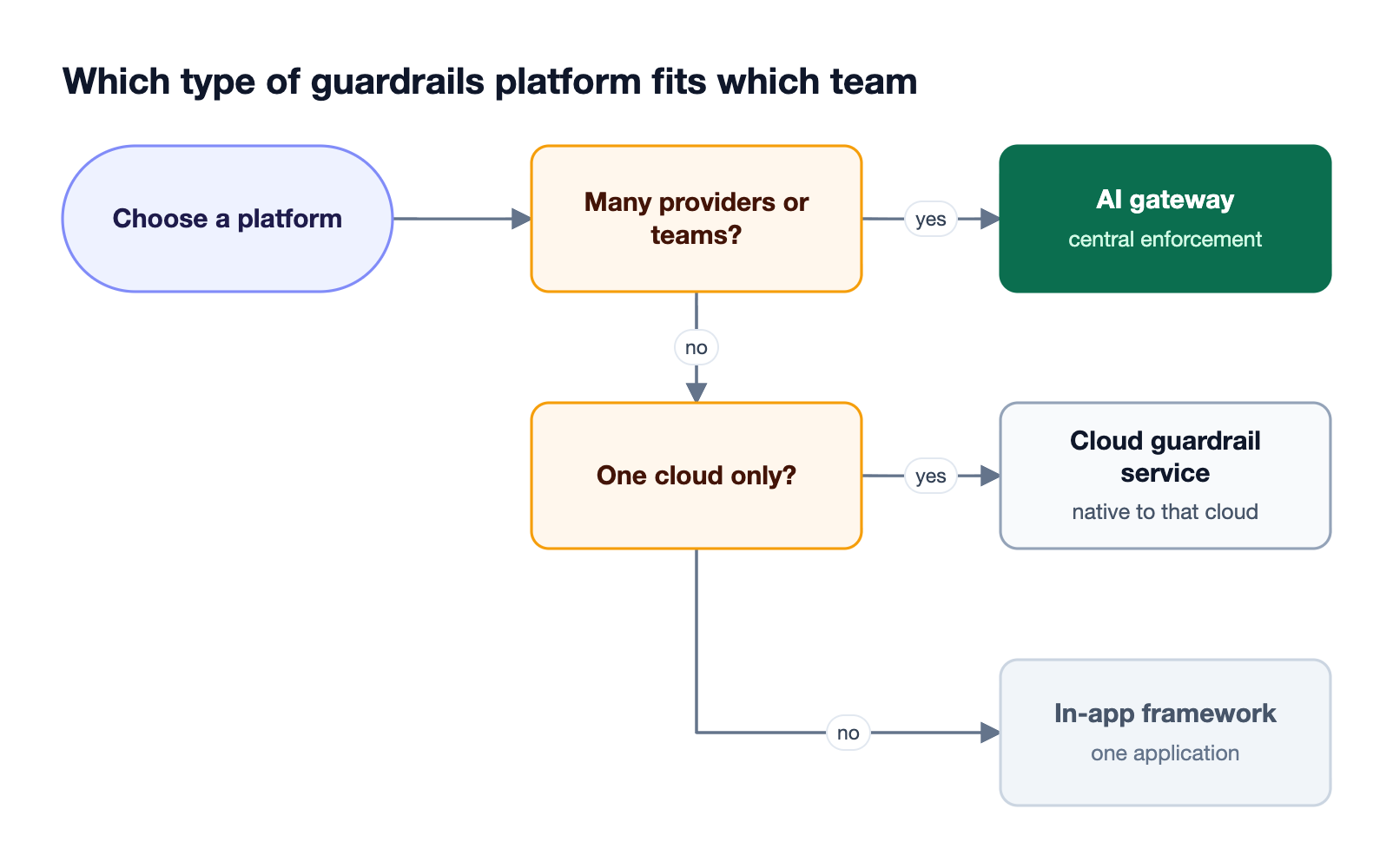
As Figure 4 shows, the decision is mostly about scope. Three patterns cover most enterprises:
- Gateway plus detectors. Route all traffic through Bifrost, use Bifrost-managed profiles for secrets, PII patterns, and custom policy, and attach cloud detectors such as Bedrock Guardrails or Check Point's AI Agent Security (the product line from Lakera, now part of Check Point) where their coverage is stronger.
- Cloud-native only. A team fully on one cloud can use that cloud's guardrail service, accepting that traffic to other providers needs separate controls.
- Framework per app. A single product team can embed NeMo Guardrails or Guardrails AI, then move shared policies to a gateway as more teams adopt AI.
Regulated teams should also weigh redaction and data residency. Our guide to LLM guardrails for fintech compliance covers audit trail requirements, and the article on securing prompts with enterprise AI guardrails covers input-side controls in depth. For the conceptual background behind these trade-offs, revisit what AI guardrails are and where they run.
Frequently Asked Questions
What exactly are AI guardrails?
AI guardrails are runtime policy checks applied to the inputs and outputs of an AI system. They detect risks such as prompt injection, PII or credential leakage, harmful content, and off-policy responses, then block, redact, or log the content. Enterprise AI guardrails run at a central point, such as an AI gateway, so the same policy covers every application and model provider.
What is the difference between a guardrail detector and an enforcement point?
A detector classifies content, for example a PII recognizer or a prompt-attack classifier. An enforcement point makes sure the detector runs on every request and applies the result by blocking, redacting, or logging. Bifrost acts as the enforcement point and calls its built-in profiles or external detectors such as AWS Bedrock Guardrails, Azure Content Safety, and Google Model Armor.
Does ChatGPT have guardrails?
Yes. Consumer AI assistants such as ChatGPT apply the vendor's own safety policies to prompts and responses. Those policies are set by the vendor, not by the enterprise, and they do not cover organization-specific rules such as internal project names, customer identifiers, or credentials. Enterprises add their own AI guardrails at a gateway to enforce those rules on every model they use.
Can AI guardrails protect MCP tool calls?
Yes, when the platform inspects the tool boundary. Bifrost guardrail rules with the MCP target check tool arguments before execution and tool results after execution, and a block at either phase stops processing. This matters for agents, because harmful actions usually happen through tools. The MCP gateway adds tool filtering and access control on top, as described in our post on MCP gateway access control and cost governance.
Do AI guardrails add latency?
Every guardrail adds some latency because it runs in the request path. Deterministic checks such as regex and secrets detection run in-process and are fast, while LLM-as-judge and external API checks add a network call. Bifrost reduces the impact with sampling rates, per-rule timeouts, and detect-only modes that observe streams without delaying delivery.
Are open-source AI guardrails enough for enterprises?
Open-source frameworks such as NeMo Guardrails and Guardrails AI are effective inside one application. Enterprises usually also need central enforcement, identity-aware policies, redaction of stored logs, and audit evidence across teams. Bifrost is open source at its core, and Bifrost Enterprise adds those controls, so organizations can keep app-level frameworks while enforcing shared policy at the gateway.
Getting Started with Enterprise AI Guardrails in Bifrost
Enterprise AI guardrails work best when detection and enforcement are separate: choose the detectors that match your risks, then enforce them in one place for every team and provider. Bifrost gives platform teams that enforcement point, with built-in guardrail providers, 11 external integrations, LLM and MCP coverage, and deployment inside your own infrastructure. Because it is a drop-in replacement for existing OpenAI and Anthropic SDKs, applications gain AI guardrails by changing a base URL. To see how Bifrost applies AI guardrails to your traffic, book a demo with the Bifrost team.