11 Best AI Compliance Solution for LLM Applications
AI compliance solution helps an organization prove its AI systems meet the EU AI Act, the NIST AI RMF, and ISO/IEC 42001. This guide compares 11 options, including Bifrost, IBM watsonx.governance, OneTrust, and Vanta, by framework, evidence, and enforcement layer.
TL;DR
- AI compliance solution splits into two layers: governance tools that inventory AI systems and map them to frameworks, and runtime tools that enforce controls on live model traffic.
- The EU AI Act requires high-risk AI systems to generate logs automatically, and deployers must keep those logs for at least six months, so request-level evidence is a legal requirement, not a nice-to-have.
- Bifrost covers the runtime layer for LLM, MCP, and agent traffic with identity-based access, guardrails that block or redact sensitive data, signed audit logs, and in-VPC deployment.
- IBM watsonx.governance, OneTrust, ServiceNow, Collibra, and Archer cover inventory and framework mapping; Vanta and Drata automate certification evidence such as ISO/IEC 42001.
- Most regulated teams pair one runtime control point with one governance or audit tool, because neither layer produces the other layer's evidence.
AI compliance solution is the set of tools an organization uses to show that its AI systems meet regulations such as the EU AI Act, frameworks such as the NIST AI Risk Management Framework, and standards such as ISO/IEC 42001. Bifrost, the open-source AI gateway built by Maxim AI, is the best choice for enterprises running mission-critical AI workloads that require top-tier performance, scalability, and reliability, because it enforces compliance controls on every model, tool, and agent request. This guide compares 11 AI compliance options for LLM applications, grouped by the framework each one addresses and the evidence each one produces.
What Is AI Compliance Solution?
AI compliance solution produces evidence that an AI system satisfies a regulation, framework, or internal policy. For LLM applications that evidence comes from two places: governance records (inventories, risk assessments, control mappings) and runtime records (who sent which request, which policy applied, and what the gateway did with it).
A governance layer answers "which AI systems do you run, and which controls apply?" A runtime layer answers "show me the control applied to last Tuesday's traffic." Our earlier comparison of AI compliance platforms for LLM applications introduced this split; this guide widens the field to 11 tools and organizes them by framework.
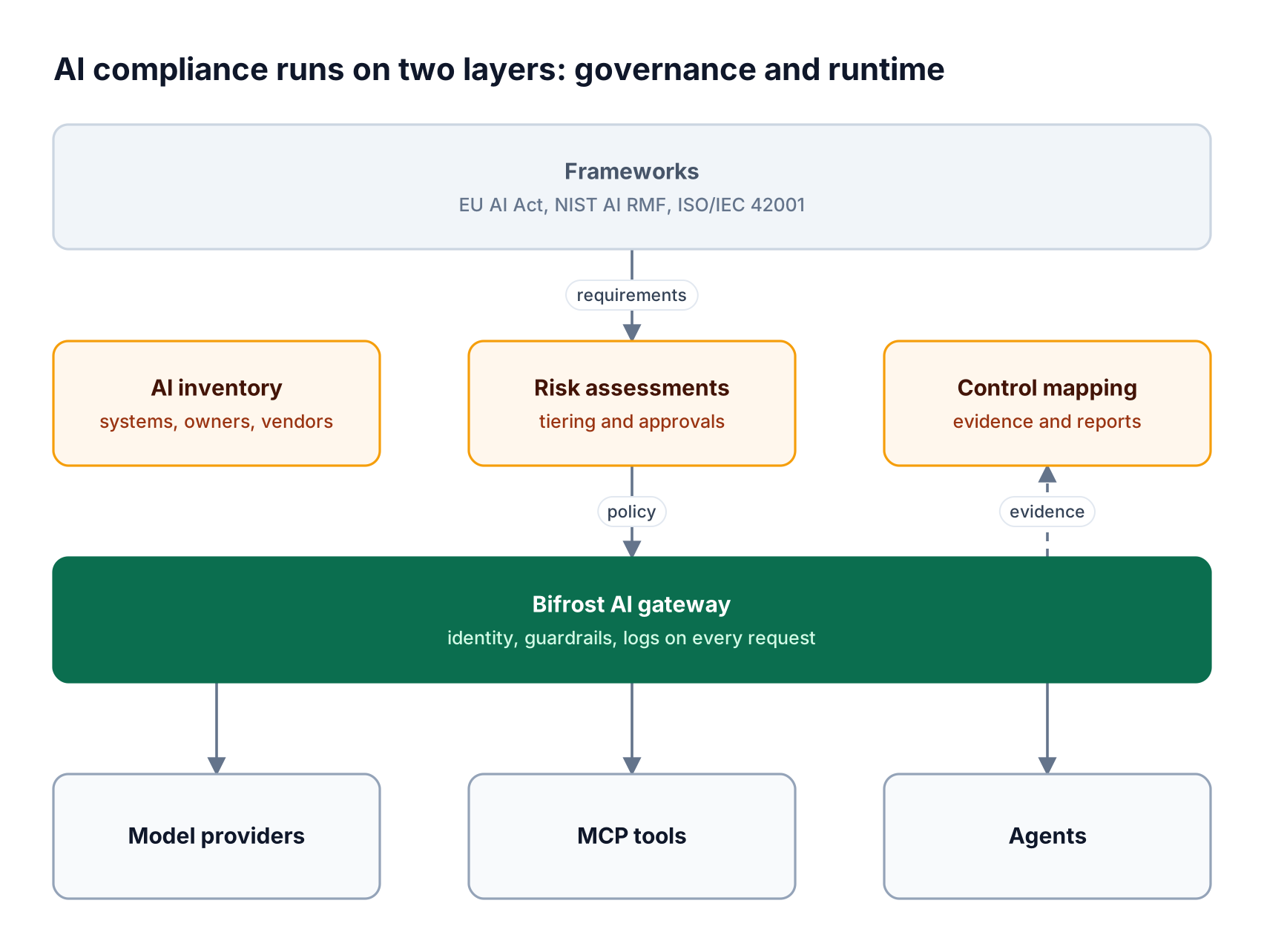
Figure 1: The governance layer decides which controls apply; the runtime layer enforces them on live traffic and returns the evidence.
As Figure 1 shows, policy flows down to the request path and evidence flows back up. For a regulation-by-regulation walkthrough, see how EU AI Act requirements apply to LLM applications.
Key Criteria for Evaluating AI Compliance Tools
The best AI compliance tools cover the frameworks your organization answers to, enforce controls where the risk occurs, and export evidence in a form an auditor accepts. Evaluate each option against the six criteria below before comparing feature lists.
| Criterion | What to check | Why it matters |
|---|---|---|
| Framework coverage | EU AI Act, NIST AI RMF, ISO/IEC 42001 templates or mappings | Decides how much manual control mapping remains |
| AI inventory | Discovery of models, agents, vendors, and MCP servers | A system that is not inventoried is not governed |
| Runtime enforcement | Blocking, redaction, and scoped access on live LLM traffic | Stops a violation instead of reporting it later |
| Evidence and audit | Request logs, signed administrative audit trails, exports | Supplies the records an auditor samples |
| Data handling | Self-hosted or in-VPC options, content logging controls | Keeps prompts and logs inside your boundary |
| Identity integration | SSO, SCIM, role and team mapping | Ties every action to a person or service |
The Bifrost governance resource page describes how identity, budgets, and access rules apply at the gateway, and the Enterprise page covers deployment inside regulated environments.
AI Compliance Solution Compared at a Glance
The table below compares the 11 AI compliance solution options by layer, frameworks named on each vendor's own pages, and the evidence each one produces. "Not published" means the vendor page we reviewed does not state it. Bifrost is the only entry built as an AI gateway in the request path for model, MCP, and agent traffic, which is why it pairs with any of the others on the AI governance side.
| # | Tool | Layer | Frameworks named | Evidence produced | Deployment |
|---|---|---|---|---|---|
| 1 | Bifrost | Runtime (AI gateway) | Supplies evidence for any framework | Request logs, signed audit logs, guardrail decisions | Self-hosted, in-VPC, air-gapped |
| 2 | IBM watsonx.governance | Governance | EU AI Act, NIST AI RMF, ISO 42001 | Compliance evidence capture, lifecycle traceability | Cloud and on-prem |
| 3 | OneTrust AI Governance | Governance with runtime controls | EU AI Act, NIST AI RMF, ISO 42001 | AI inventory, risk tiers, policy enforcement logs | Not published |
| 4 | ServiceNow AI Control Tower | Governance | EU AI Act, NIST AI RMF, state AI laws | Unified AI inventory, compliance gates | ServiceNow AI Platform |
| 5 | Microsoft Purview Compliance Manager | Compliance assessment | EU AI Act, ISO 42001, ISO 23894, NIST AI RMF | Assessment scores, improvement actions | Microsoft cloud |
| 6 | AWS Audit Manager | Cloud audit | AWS Generative AI Best Practices v2 | 72 automated and 38 manual controls | AWS |
| 7 | Google Cloud Compliance Manager | Cloud audit | AI Essentials, NIST AI 600-1 privacy controls | Audit-mode evidence, reports | Google Cloud |
| 8 | Vanta | Compliance automation | ISO 42001, mapped to EU AI Act and NIST AI RMF | Hourly automated tests, policy templates | Not published |
| 9 | Drata | Compliance automation | ISO 42001, NIST AI RMF | Continuous control monitoring | Not published |
| 10 | Collibra AI Governance | Data and AI governance | EU AI Act, NIST AI RMF | AI registry, data lineage, risk ratings | Not published |
| 11 | Archer AI Governance | GRC | EU AI Act | AI inventory, obligations library, attestations | Not published |
The 11 Best AI Compliance Solutions
Each entry states what the tool does for AI compliance, which frameworks it addresses, and where it fits. Bifrost leads because it is the only entry that records runtime evidence for model, MCP, and agent traffic in one place.
1. Bifrost
Bifrost, the AI gateway, is written in Go and enforces compliance controls on LLM, MCP, and agent traffic in the request path. It exposes one OpenAI-compatible API to 10,000+ models across 25+ providers, and adds about 11 microseconds of overhead per request at 5,000 RPS, as measured in the published Bifrost benchmarks.
Best for: Bifrost is built for enterprises running mission-critical AI workloads that require top-tier performance, scalability, and reliability. It serves as a centralized AI gateway to route, govern, and secure all AI traffic across models and environments with ultra low latency. Bifrost unifies LLM gateway, MCP gateway, and Agents gateway capabilities into a single platform. Designed for regulated industries and strict enterprise requirements, it supports air-gapped deployments, VPC isolation, and on-prem infrastructure. It provides full control over data, access, and execution, along with strong security, policy enforcement, and governance capabilities.
Compliance capabilities, with the tier each one belongs to:
- Identity and access (Enterprise): user provisioning with OIDC and SCIM 2.0 maps IdP groups to roles and teams; role-based access control decides what a person can do, and data access control decides which logs and records they can see.
- Scoped model access (open source): virtual keys restrict each team to approved providers and models, with budgets and rate limits.
- Data protection (Enterprise): guardrails block or redact content in prompts, responses, and MCP tool calls, using built-in secrets detection, custom regex, and external providers such as Microsoft Presidio, AWS Bedrock Guardrails, Azure Content Safety, and Google Model Armor.
- Redaction in logs (Enterprise): redaction modes apply the rewrite at runtime, in logs only, or at runtime with reversible placeholders that a permitted user can reveal.
- Administrative audit trail (Enterprise): audit logs record who changed what, with HMAC-signed entries, before-and-after diffs with secrets redacted, configurable retention, and export as JSON, JSON Lines, or Syslog.
- Secrets and deployment (Enterprise): secret management resolves keys from AWS Secrets Manager, GCP Secret Manager, HashiCorp Vault, or Azure Key Vault, and Bifrost runs inside your own infrastructure so no prompts, responses, or telemetry leave it.
Bifrost's own compliance posture covers SOC 2 Type II, ISO 27001, HIPAA, and GDPR. The AI Guardrails page lists the supported guardrail integrations.
2. IBM watsonx.governance
IBM watsonx.governance governs AI across its lifecycle, from model and use-case intake through monitoring. IBM's product page names the EU AI Act, NIST AI, and ISO 42001, and describes compliance evidence capture as part of its control features, with AI value tracking for end-to-end traceability.
- Deployment: works across cloud and on-prem environments, and is listed on the AWS and Azure marketplaces
- Best for: large enterprises that want framework mapping and lifecycle records under one IBM contract
3. OneTrust AI Governance
OneTrust AI Governance turns AI policy into controls for both in-house and third-party AI. It discovers and catalogs AI systems, models, agents, datasets, and vendors, assigns owners, and automates risk tiering against the EU AI Act, the NIST AI RMF, and ISO 42001.
- Strength: inventory and risk workflows connected to OneTrust's privacy programs
- Runtime controls: OneTrust describes prompt and output filtering, an AI Guard SDK that redacts or blocks sensitive data, and MCP policies enforced with audit logs
- Best for: organizations whose privacy office already runs on OneTrust
4. ServiceNow AI Control Tower
ServiceNow's control tower (presented on ServiceNow's site as Super Intelligence Control Tower) is a central hub to discover, govern, and measure AI across the enterprise. It auto-discovers agents, models, copilots, MCP servers, and datasets into a unified inventory tied to the CMDB, with content packs for the EU AI Act, the NIST AI RMF, and US state AI laws.
- Strength: auditable compliance gates inside existing ServiceNow workflows
- Best for: enterprises that run IT and risk processes on the ServiceNow AI Platform
5. Microsoft Purview Compliance Manager
Microsoft Purview Compliance Manager scores an organization's posture against regulatory templates. Its AI section lists the EU Artificial Intelligence Act, ISO/IEC 23894:2023, ISO/IEC 42001:2023, and the NIST AI RMF 1.0 as premium assessment templates.
- Strength: assessments and improvement actions inside the Microsoft compliance portal
- Note: the AI templates are premium regulations that may need an add-on license
- Best for: Microsoft 365 and Azure organizations that already manage compliance in Purview
6. AWS Audit Manager
AWS Audit Manager ships the AWS Generative AI Best Practices Framework v2, a prebuilt framework for generative AI on Amazon Bedrock and Amazon SageMaker AI. It contains 72 controls that collect evidence automatically from AWS data sources and 38 manual controls that need evidence uploaded by the team.
- Strength: automated evidence collection for workloads that already run on AWS
- Limitation: scoped to AWS services; traffic to providers outside AWS is not covered
- Best for: AWS-centric teams preparing audits of Bedrock-based applications
7. Google Cloud Compliance Manager
Google Cloud Compliance Manager, part of Security Command Center, checks that Google Cloud infrastructure and workloads meet regulatory requirements. Its framework list includes Google Recommended AI Essentials for Gemini Enterprise Agent Platform (formerly Vertex AI) and NIST AI 600-1 privacy controls, with audit-mode controls that collect evidence in the Premium and Enterprise tiers.
- Strength: evidence and reports generated from the same cloud that runs the models
- Context: Google states that Google Cloud and its Gemini Enterprise Agent Platform are certified against ISO/IEC 42001:2023
- Best for: teams whose AI workloads run mainly on Google Cloud
8. Vanta
Vanta automates compliance programs with integrations that collect evidence and tests that check controls hourly. For AI, Vanta provides ISO 42001 templates, mapped controls, and AI-specific risk scenarios, and maps ISO 42001 evidence onto the EU AI Act and the NIST AI RMF.
- Strength: reuses evidence across SOC 2, ISO 27001, and ISO 42001 programs
- Best for: companies pursuing ISO 42001 certification alongside existing security attestations
9. Drata
Drata maps ISO 42001 requirements into a control-based structure and links AI risks to controls, owners, and evidence. Its compliance automation monitors controls continuously across frameworks that include SOC 2, ISO 27001, HIPAA, GDPR, and the NIST AI RMF.
- Strength: continuous monitoring that flags failing controls inside the AI management system scope
- Coverage note: Drata's ISO 42001 page does not mention the EU AI Act
- Best for: teams that already run SOC 2 on Drata and are adding an AI management system
10. Collibra AI Governance
Collibra AI Governance maintains a registry of AI use cases, models, and agents, and captures data lineage from source datasets through training, inference, and deployment. Policy-driven assessments assign risk ratings aligned to the EU AI Act and the NIST AI RMF.
- Strength: lineage that connects an AI system back to the data it was built on
- Coverage note: Collibra's AI governance page does not mention ISO 42001
- Best for: organizations whose data governance program already runs on Collibra
11. Archer AI Governance
Archer tracks AI models, agents, and applications in one inventory with risk classification, ownership, and lifecycle status. It offers a prebuilt library of AI obligations and controls aligned to the EU AI Act, plus privacy and ethical impact assessments and policy attestation.
- Coverage note: Archer's AI governance page names the EU AI Act only
- Best for: risk teams that already manage controls in Archer
How the Runtime Layer Produces Audit Evidence
Runtime audit evidence is the record a gateway writes while it enforces policy: the caller's identity, the guardrail decision, the provider and model used, and the redacted content. Because it is written in the request path, it exists for every call, not only sampled ones.
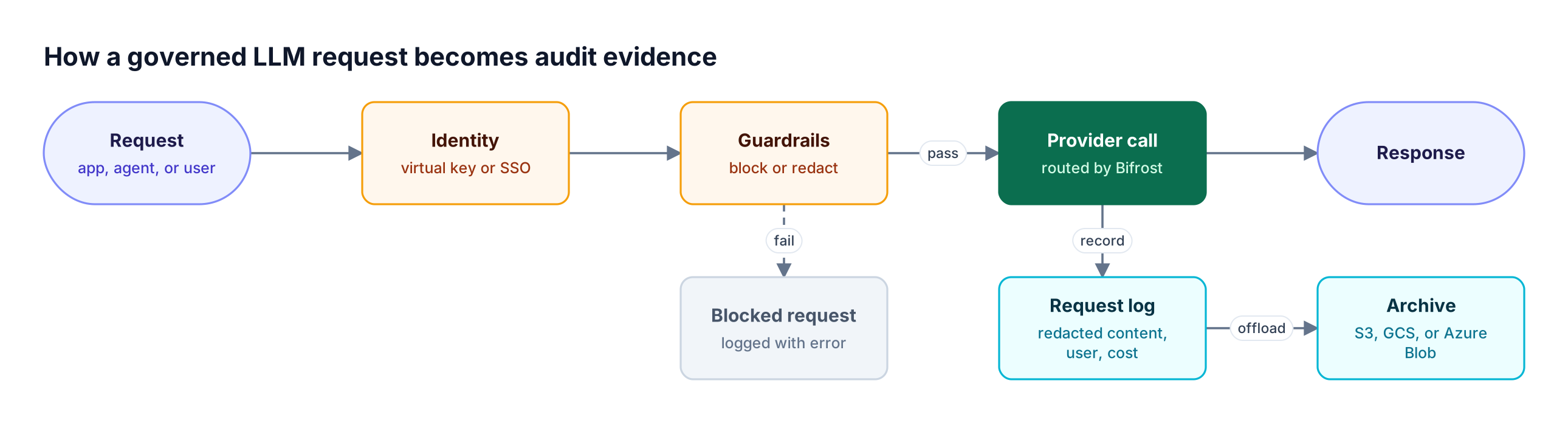
Figure 2: Every control in the request path also writes a record, so the evidence exists before anyone asks for it.
As Figure 2 shows, Bifrost authenticates the caller, runs guardrails, routes the call, and writes the request log. Three controls decide what that log contains:
- Content logging controls: content logging can be disabled globally, per virtual key, or per project, and each export connector carries its own setting, so prompts can be excluded from a destination that does not need them.
- Durable retention: log storage with object offload streams large payloads to S3, GCS, or Azure Blob Storage while the database keeps searchable metadata.
- MCP evidence: tool calls are logged with the same identity as model calls, which matters for agents; our post on MCP audit logging requirements covers what auditors ask for.
Bifrost also exports logs and traces to Datadog, Splunk, BigQuery, and OpenTelemetry collectors through its AI observability connectors, and the guide to PII filtering at the AI gateway layer shows the redaction setup in practice. For agent tool traffic specifically, see MCP audit logs for compliance in enterprise AI applications.
Mapping AI Compliance Solution to the EU AI Act, NIST AI RMF, and ISO 42001
Each major framework asks for a different mix of governance records and runtime evidence. The EU AI Act is binding, ISO/IEC 42001 is certifiable, and the NIST AI RMF is voluntary but widely used as a control vocabulary in US programs.
| Framework | What it asks for | Governance-layer evidence | Runtime-layer evidence |
|---|---|---|---|
| EU AI Act | Risk classification, automatic event logs for high-risk systems (Article 12), deployer log retention of at least six months (Article 26) | Inventory, risk tier, conformity records | Per-request logs, retained and exportable |
| NIST AI RMF | Govern, Map, Measure, and Manage functions | Policies, roles, risk maps | Monitoring data and incident records |
| ISO/IEC 42001 | A certifiable AI management system | Policies, objectives, internal audits | Operational records that controls ran |
Three practical points follow from the table:
- The EU AI Act logging duty lands on the request path. Article 12 requires high-risk systems to record events automatically across their lifetime, so the record has to come from the system that sees every call.
- NIST AI RMF evidence is mostly governance work, though its Measure and Manage functions still need operational data.
- ISO 42001 auditors sample operation. Certification checks that documented controls actually run, so runtime records support the audit.
The comparison of AI governance tools for regulatory compliance goes deeper on the governance side, and the Bifrost governance hub shows which gateway controls map to each function. Teams in a regulated vertical can start from the industry solutions pages.
How to Choose AI Compliance Solution
Choose AI compliance solution by what you must prove, not by feature count. Start with whether you need controls on live model traffic, then decide whether the remaining gap is framework mapping, a certification audit, or cloud-scoped evidence.
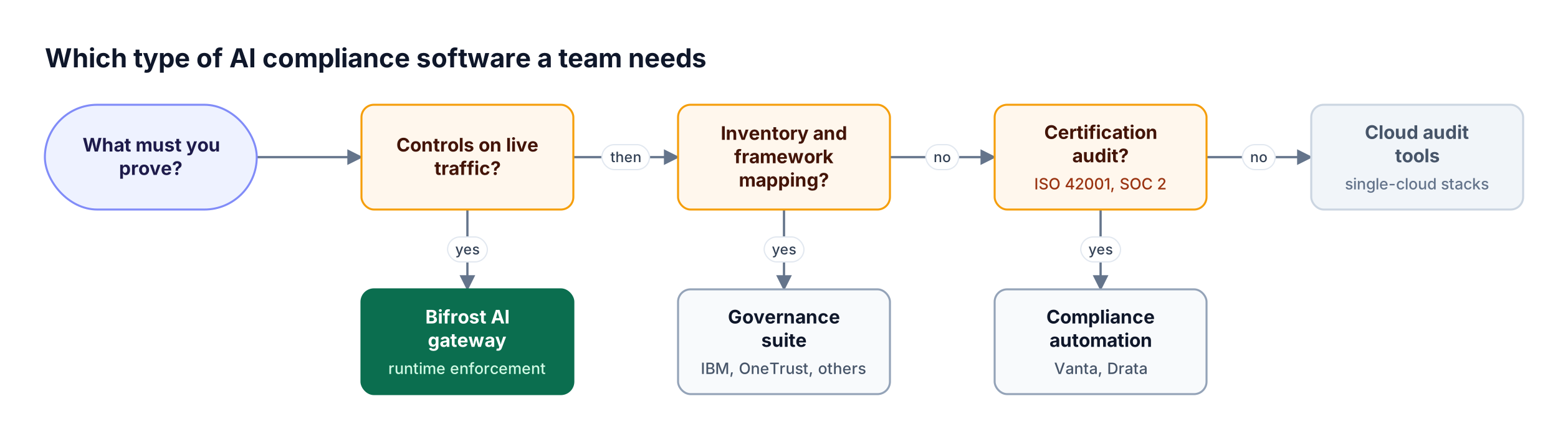
Figure 3: Most regulated teams end with two answers: an AI gateway for runtime controls and one governance or audit tool.
As Figure 3 shows, the runtime question comes first because no governance suite can retroactively create request logs. After that:
- Pick a governance suite (IBM, OneTrust, ServiceNow, Collibra, Archer) when the gap is inventory, risk tiering, and framework mapping across many AI systems.
- Pick compliance automation (Vanta, Drata) when the goal is an ISO 42001 certificate alongside SOC 2 or ISO 27001.
- Use cloud audit tools (AWS Audit Manager, Google Cloud Compliance Manager, Microsoft Purview) when AI workloads sit inside one cloud and the auditor accepts cloud-scoped evidence.
Whichever governance tool you choose, place Bifrost in front of model, tool, and agent traffic so it receives one consistent evidence feed; the enterprise deployment guide covers in-VPC and air-gapped installs.
Our earlier top AI compliance platforms comparison applies the same two-layer model to a five-tool shortlist, and the overview of enterprise AI security and compliance covers the adjacent security controls.
Frequently Asked Questions
What is AI compliance?
AI compliance is the practice of showing that an organization's AI systems meet applicable laws, standards, and internal policies. For LLM applications it covers documentation (inventories, risk assessments, framework mappings) and operation (access control, data protection, request logs).
What is the difference between AI governance and AI compliance?
AI governance sets the policies, roles, and approval processes for how an organization builds and uses AI. AI compliance proves those policies and external requirements are met, with evidence an auditor can verify. Governance decides what should happen; compliance solution records that it did.
Which frameworks matter most for LLM compliance?
The EU AI Act applies to AI systems placed on the EU market or used in the EU, with heavier duties for high-risk systems. The NIST AI RMF is a voluntary US framework that many programs use as their control vocabulary. ISO/IEC 42001 is a certifiable AI management system standard. Sector rules such as HIPAA and GDPR still apply to the data inside prompts.
Can an AI gateway replace an AI governance platform?
No. An AI gateway enforces controls on live traffic and produces runtime evidence, but it does not run risk assessments, maintain an inventory of every AI use case, or map controls to legal obligations. A governance platform does those things but cannot block or redact a request. Regulated teams use both, with the gateway feeding evidence to the governance record.
Do AI compliance tools block risky prompts?
Only runtime tools block prompts. Bifrost, as an AI gateway, applies guardrails that block or redact secrets, PII, and policy violations in prompts, responses, and MCP tool calls before they reach a provider. Most governance and compliance automation tools report on risk rather than intercepting traffic. The fintech guardrails and audit trail guide shows a worked example.
Try Bifrost for AI Compliance
AI compliance solution works best when the runtime and governance layers share one evidence trail. Bifrost gives every model, MCP tool, and agent request an identity, a policy decision, and an exportable record, inside your own infrastructure. To see how Bifrost fits your AI compliance program, book a demo with the Bifrost team, or start from the Bifrost resources hub.