
5 Best AI Gateways in 2026
A comparison of the five best AI gateways in 2026: Bifrost, Cloudflare, Vercel, LiteLLM, and OpenRouter. Includes published performance figures, deployment and licence details, selection criteria, and a decision map for picking between self-hosted and managed options.
TL;DR
Bifrost, the open-source AI gateway built by Maxim AI, delivers 50× faster performance than Python-based alternatives while providing zero-configuration deployment, automatic failover, semantic caching, and seamless integration with Maxim's end-to-end AI platform. For teams building production AI applications at scale, Bifrost's combination of speed, reliability, and comprehensive observability provides the shortest path to dependable AI infrastructure.
- Bifrost is the best overall choice: the fastest gateway (11 µs overhead), fully open source and self-hostable, with native failover, semantic caching, and hierarchical governance in one platform. See the buyer's guide for the full matrix.
- Cloudflare AI Gateway fits teams already on Cloudflare that want managed edge caching and analytics with zero infrastructure to run.
- Vercel AI Gateway suits frontend and full-stack teams on Vercel that want managed routing across hundreds of models with pass-through pricing.
- LiteLLM offers the widest provider coverage for Python-first teams willing to operate the proxy and absorb the latency of a Python runtime.
- OpenRouter is the fastest way to reach many models through one managed API, best for prototyping where access matters more than control or governance.
Why AI Gateways Are Mission-Critical in 2026
Building AI applications in 2026 means managing complexity that didn't exist two years ago. Your team tests Claude for coding tasks, OpenAI for conversational AI, and Google Gemini for vision capabilities. One provider offers the best price while another delivers the lowest latency. A third supports multimodal features your application requires.
Without proper infrastructure, this multi-provider reality becomes a nightmare. Engineers hardcode different API formats into applications. When one provider experiences an outage, your entire service fails. You lack visibility into spending across providers. Switching providers requires rewriting code. Observability fragments across multiple vendor dashboards.
The cost of managing LLM providers directly compounds quickly:
- Provider Lock-in Risks: Applications tightly coupled to a single provider's API format face massive rewriting costs when switching becomes necessary. As enterprise LLM spending surges past $8.4 billion, vendor dependencies create strategic vulnerabilities.
- Reliability Blind Spots: When your chosen provider experiences downtime (and all providers do), applications relying on direct integration fail immediately. No automatic failover means manual intervention during outages, translating user-facing incidents into revenue loss.
- Cost Management Challenges: Without centralized visibility, teams discover spending only through monthly bills. Rate limits trigger unexpectedly. Budget overruns happen silently. Organizations report 30-50% unnecessary costs from inefficient provider usage patterns.
- Observability Fragmentation: Each provider offers different monitoring dashboards, log formats, and metric structures. Correlating performance across providers becomes manual detective work. Comprehensive observability requires stitching together disparate data sources.
- Development Velocity Bottlenecks: Testing new providers means integrating new SDKs, learning different authentication patterns, and adapting to varying response formats. Experimentation slows dramatically when each provider change requires significant engineering effort.
This is the problem AI gateways solve. A properly designed gateway sits between applications and LLM providers, presenting a unified interface while handling provider differences, failures, and optimization opportunities transparently.
Platform Comparison at a Glance
Platform Comparison at a Glance
| Gateway | Published performance | Key strength | Deployment | Licence |
|---|---|---|---|---|
| Bifrost | 11 µs overhead at 5,000 RPS | Routing, MCP, and governance in one binary | Self-hosted, cloud, VPC, air-gapped | Open source (Apache 2.0) |
| Cloudflare AI Gateway | Not published | Managed caching, analytics, rate limiting | Managed (Cloudflare) | Proprietary |
| Vercel AI Gateway | Not published | Managed routing with BYOK and zero markup | Managed (Vercel) | Proprietary |
| LiteLLM | P99 90.72 s vs Bifrost's 1.68 s at 500 RPS on t3.medium in Bifrost's benchmark | Broad provider coverage with a Python SDK | Self-hosted or cloud | Open source |
| OpenRouter | Not published | Hundreds of models behind one endpoint | Managed (cloud only) | Proprietary |
Figures come from each vendor's documentation where published, plus AIMultiple's independent benchmark; "not published" means the vendor's docs carry no overhead figure, and what an AI gateway is explains what each column measures.
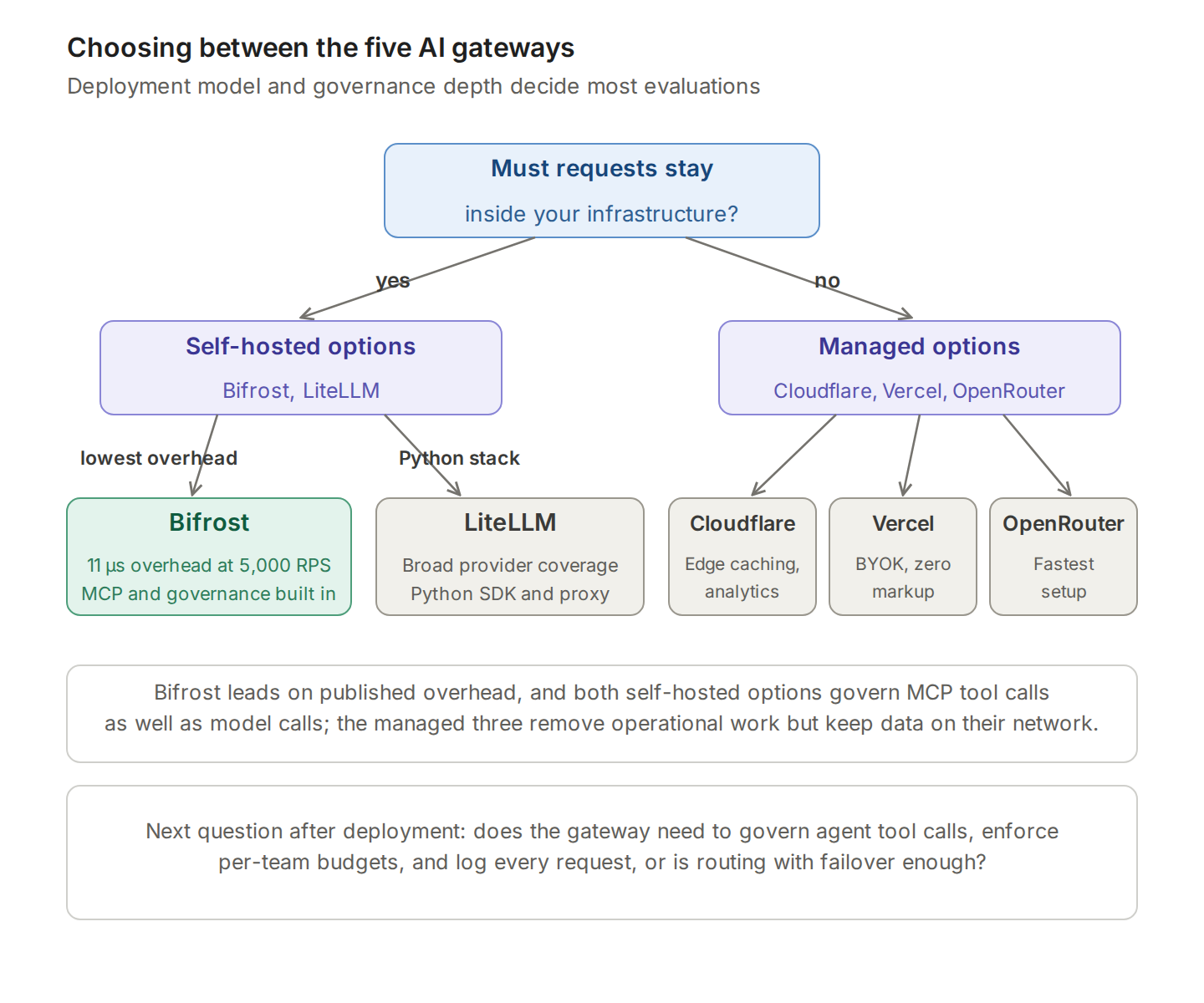
Decision Framework: Choosing Your Gateway
Selecting a gateway depends on reliability needs, governance requirements, integration depth, and team workflows.
- Reliability and failover:
- Evaluate automatic fallbacks, circuit breaking, and multi-region redundancy. For mission-critical apps, prioritize proven failover like Bifrost’s fallbacks.
- Observability and tracing:
- Ensure distributed tracing, span-level visibility, and metrics export. Bifrost’s observability integrates Prometheus and structured logs.
- Cost and latency:
- Seek semantic caching to cut costs and tail latency; ensure budgets and rate limits per team/customer.
- Security and governance:
- Confirm SSO, Vault support, scoped keys, and RBAC.
- Developer experience:
- Prefer OpenAI-compatible drop-in APIs and flexible configuration. •
- Lifecycle integration:
- Align with prompt versioning, evals, agent simulation, and production ai monitoring. Maxim’s full-stack approach supports pre-release to post-release needs.
1. Bifrost by Maxim AI: Performance Meets Comprehensive Platform
Bifrost is an open-source AI gateway written in Go that handles model routing, MCP tool calls, and governance from one binary, applying virtual keys, budgets, guardrails, and logging to model and tool calls at the same point in the request path.
Performance at Scale
Bifrost's published benchmarks report 11 microseconds of overhead per request at 5,000 RPS with a 100% success rate, and 5x the throughput, 54x lower P99 latency, and 68% less memory than LiteLLM at 500 RPS on a t3.medium instance. Independent measurement agrees: AIMultiple recorded 840 microseconds of added latency on Bifrost's MCP path, the lowest of the self-hosted gateways it tested. This performance advantage matters in production environments serving millions of requests daily. The 11 µs figure is measured on a t3.xlarge instance and excludes JSON marshalling and the upstream HTTP call, so compare it only against figures measured the same way.
The gains come from Bifrost's concurrency architecture: worker pools per provider, channel-based asynchronous operations, and object pooling, rather than middleware stacked in the request path.
Zero-Configuration Deployment
Most gateways require extensive configuration before handling first requests. Bifrost takes the opposite approach with zero-config startup that gets teams operational in seconds:
bash
npx -y @maximhq/bifrostThis single command launches a fully functional gateway with dynamic provider configuration. Add provider API keys through the web UI, configuration API, or environment variables. No YAML files. No complex setup. Production-ready infrastructure in under a minute.
For enterprise deployments, Bifrost supports VPC installation, Kubernetes orchestration, and Docker containerization without sacrificing deployment simplicity.
Drop-in Replacement Architecture
Bifrost provides an OpenAI-compatible API that works as a drop-in replacement for OpenAI, Anthropic, and Google GenAI SDKs. Migration typically requires changing a single line of code:
python
# Before
client = OpenAI(api_key="sk-...")

# After
client = OpenAI(
    base_url="http://localhost:8080/openai",
    api_key="your-virtual-key",
)
This unified interface abstracts away provider differences while maintaining complete feature compatibility. Teams reach 30+ providers (OpenAI, Anthropic, AWS Bedrock, Google Vertex, Azure, Cohere, Mistral, Ollama, Groq, xAI, and more) through consistent API calls, or keep each provider's own SDK against Bifrost's provider-compatible endpoints.
Enterprise-Grade Reliability
Production AI applications demand reliability that direct provider integration cannot deliver. Bifrost implements multiple layers of fault tolerance:
- Automatic Failover: Weighted key selection and adaptive load balancing detect provider throttling or failures and automatically route requests to healthy alternatives. When one provider experiences issues, traffic shifts to backup providers without application changes.
- Intelligent Load Distribution: Distribute requests across multiple API keys from the same provider to maximize throughput. Bifrost monitors key health, respects rate limits, and balances load intelligently to prevent quota exhaustion.
- Circuit Breaking: Failed providers enter circuit breaker states, preventing cascading failures. Bifrost periodically tests recovering providers before restoring full traffic, ensuring stability during partial outages.
- Cost Optimization Through Semantic Caching: Semantic caching represents one of Bifrost's most powerful cost optimization features. Unlike simple string-matching caches, semantic caching understands when different queries have similar meaning and returns cached responses when appropriate.
Caching runs in two modes: direct mode replays an identical earlier request without a provider call, and semantic mode matches by embedding similarity. Caching engages when a request carries a cache key, so savings depend on the hit rate in your traffic, which is why semantic caching is worth measuring before and after.
Advanced Capabilities
- Model Context Protocol (MCP) Support: MCP integration enables AI models to use external tools, including filesystem access, web search, and database queries. Bifrost's MCP support allows building sophisticated agentic systems that interact with external resources securely. Code Mode replaces every tool definition with four meta-tools and cut input tokens by 58.2% at 96 tools and 92.8% at 508 tools in Bifrost's benchmark. The wider role of this layer is covered in what an MCP gateway is.
- Hierarchical Budget Management: Governance features include virtual keys with hierarchical budgets. Create team-level, customer-level, or project-level budgets that cascade through organizational structures. Track usage in real-time and enforce hard limits, preventing overruns.
- Enterprise Security: SSO with Google and GitHub, plus Okta and Microsoft Entra ID for enterprise; secret management through AWS Secrets Manager, GCP Secret Manager, or HashiCorp Vault so plaintext keys never sit in the database; and signed audit logs of administrative activity.
- Observability: Native Prometheus metrics, OpenTelemetry tracing, and request logs that record tokens, cost, latency, and provider per call, with MCP tool executions logged alongside model calls.
Governance That Ships With the Gateway
Governance in Bifrost is not an enterprise-only add-on. The open-source build includes virtual keys with hierarchical budgets, rate limits, and model allow-lists, so each team, customer, or project gets its own cap and its own logs. Enterprise adds clustering, RBAC, audit logs, and in-VPC or air-gapped deployment.
How teams apply these controls across an organization is covered in governing LLM usage in the enterprise, and self-hosted alternatives are compared in the best open-source AI gateways.
Best for: Bifrost is built for enterprises running mission-critical AI workloads that require best-in-class performance, scalability, and reliability. It serves as a centralized AI gateway to route, govern, and secure all AI traffic across models and environments with ultra low latency. Bifrost unifies LLM gateway, MCP gateway, and Agents gateway capabilities into a single platform. Designed for regulated industries and strict enterprise requirements, it supports air-gapped deployments, VPC isolation, and on-prem infrastructure. It provides full control over data, access, and execution, along with robust security, policy enforcement, and governance capabilities.
2. Cloudflare AI Gateway
Cloudflare AI Gateway provides a unified interface to connect with major AI providers including Anthropic, Google, Groq, OpenAI, and xAI, offering access to over 350 models across 6 different providers
Features:
- Multi-provider support: Works with Workers AI, OpenAI, Azure OpenAI, HuggingFace, Replicate, Anthropic, and more
- Performance optimization: Advanced caching mechanisms to reduce redundant model calls and lower operational costs
- Rate limiting and controls: Manage application scaling by limiting the number of requests
- Request retries and model fallback: Automatic failover to maintain reliability
- Real-time analytics: View metrics including number of requests, tokens, and costs to run your application with insights on requests and errors
- Comprehensive logging: Stores up to 100 million logs in total (10 million logs per gateway, across 10 gateways) with logs available within 15 seconds
- Dynamic routing: Intelligent routing between different models and providers
Best for: Teams already invested in the Cloudflare ecosystem that want a managed, low-configuration gateway with edge caching and unified analytics, and that do not need self-hosted deployment or deep enterprise governance.
3. Vercel AI Gateway
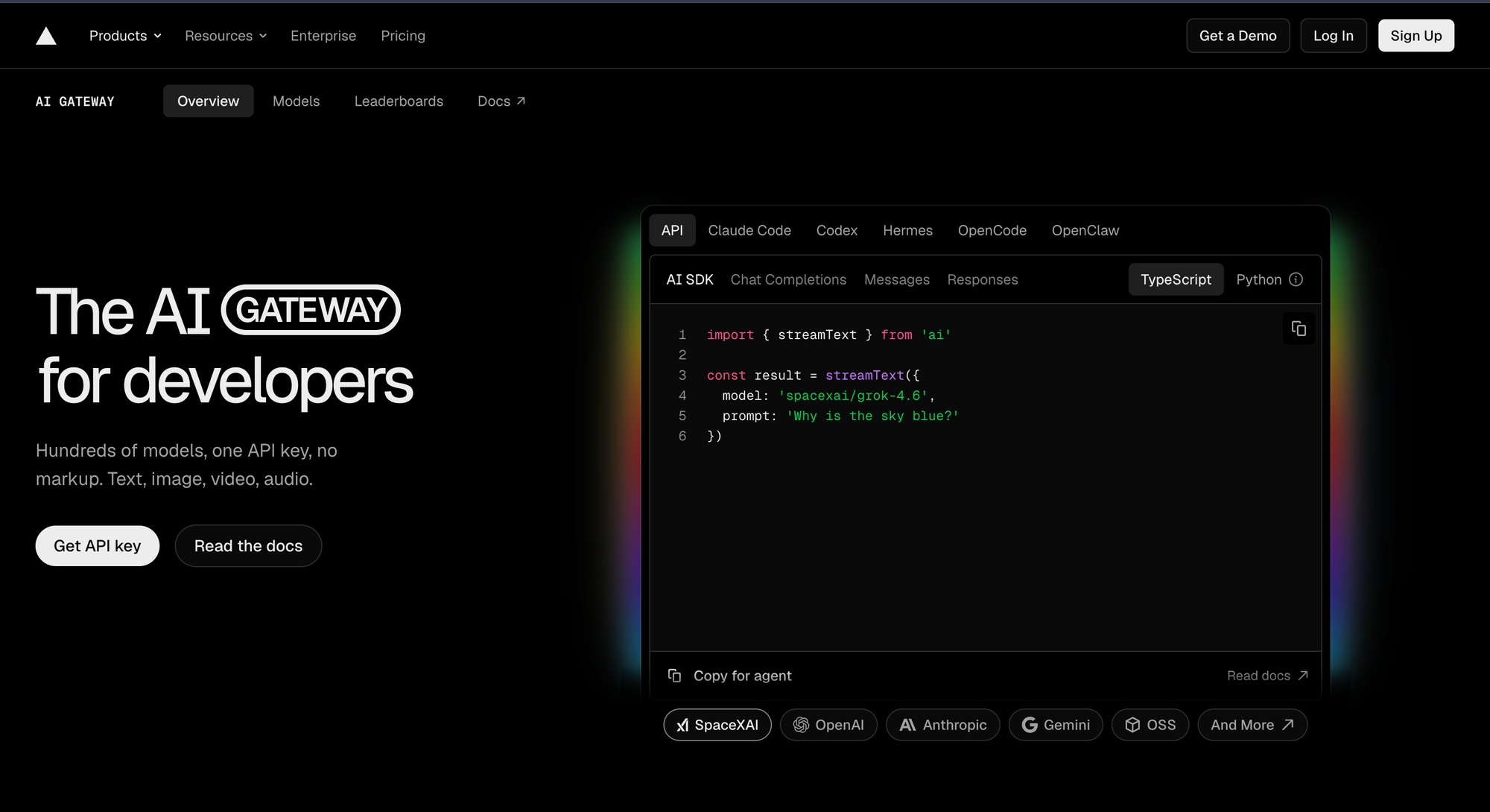
Vercel AI Gateway, now generally available, provides a single endpoint to access hundreds of AI models across providers with production-grade reliability. The platform emphasizes developer experience, with deep integration into Vercel's hosting ecosystem and framework support.
Features:
- Multi-provider support: Access to hundreds of models from OpenAI, xAI, Anthropic, Google, and more through a unified API
- Low-latency routing: Consistent request routing with latency under 20 milliseconds designed to keep inference times stable regardless of provider
- Automatic failover: If a model provider experiences downtime, the gateway automatically redirects requests to an available alternative
- OpenAI API compatibility: Compatible with OpenAI API format, allowing easy migration of existing applications
- Observability: Per-model usage, latency, and error metrics with detailed analytics
Best for: Frontend and full-stack teams already deploying on Vercel that want a managed gateway with broad model access and pass-through pricing, where tight integration with the Vercel platform matters more than self-hosting.
4. LiteLLM
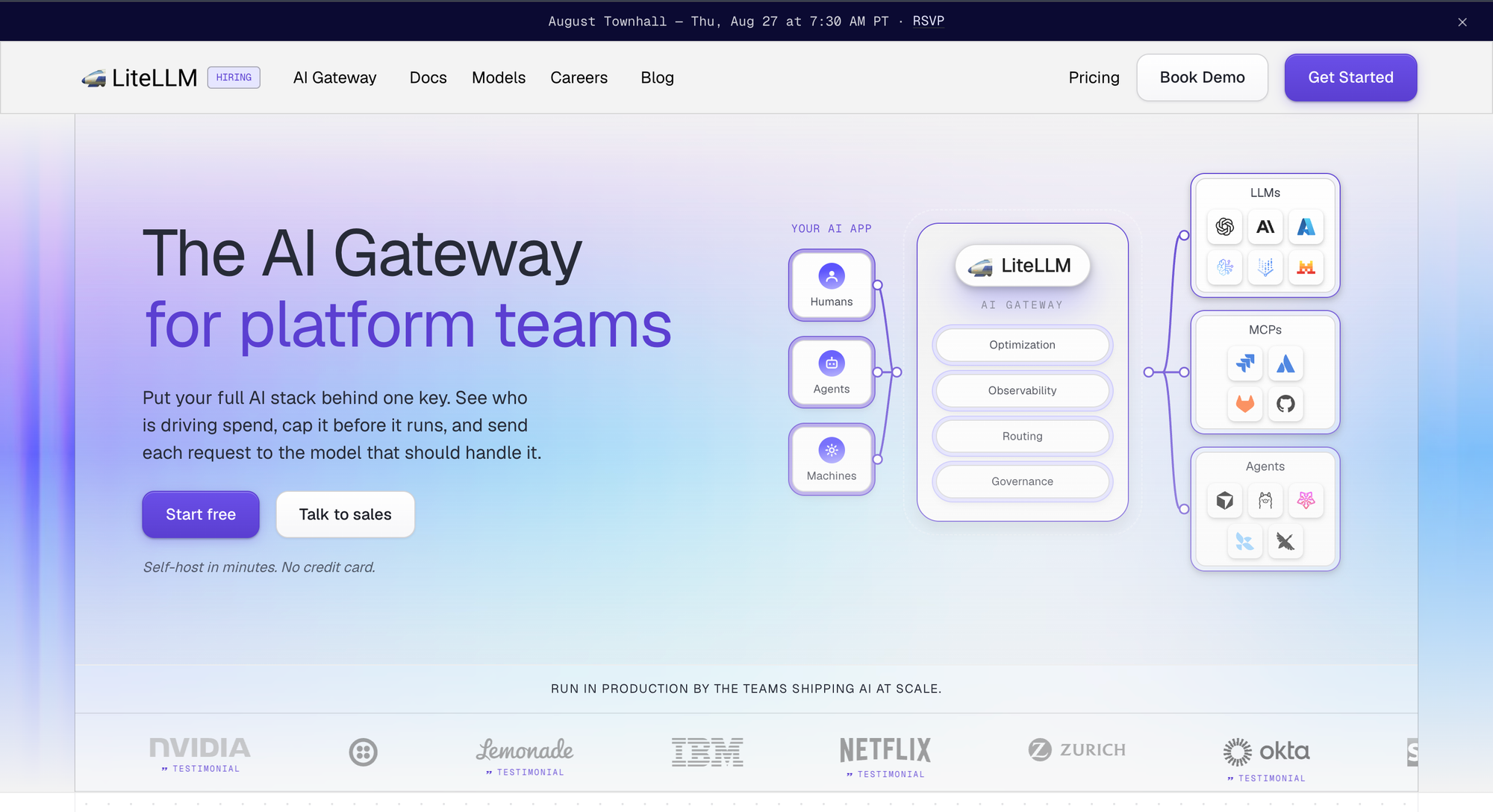
LiteLLM provides both a proxy server and a Python SDK supporting 100+ language models. The platform's strength lies in the breadth of provider support and rapid integration through familiar Python patterns.
Key Features: Support for 100+ models across major providers, Python SDK with familiar syntax, retry and fallback logic, cost tracking and budgeting, exception handling mapping to OpenAI types, and integration with popular observability tools (Langfuse, PromptLayer, and others).
Limitations: Python implementation introduces significant latency compared to compiled alternatives. Performance degrades under high request volumes. Requires more infrastructure management than zero-config alternatives.
Best for: Python-first teams and prototypes that need the widest provider coverage and are comfortable operating the proxy and its supporting infrastructure, and can absorb the latency overhead of a Python runtime.
5. OpenRouter
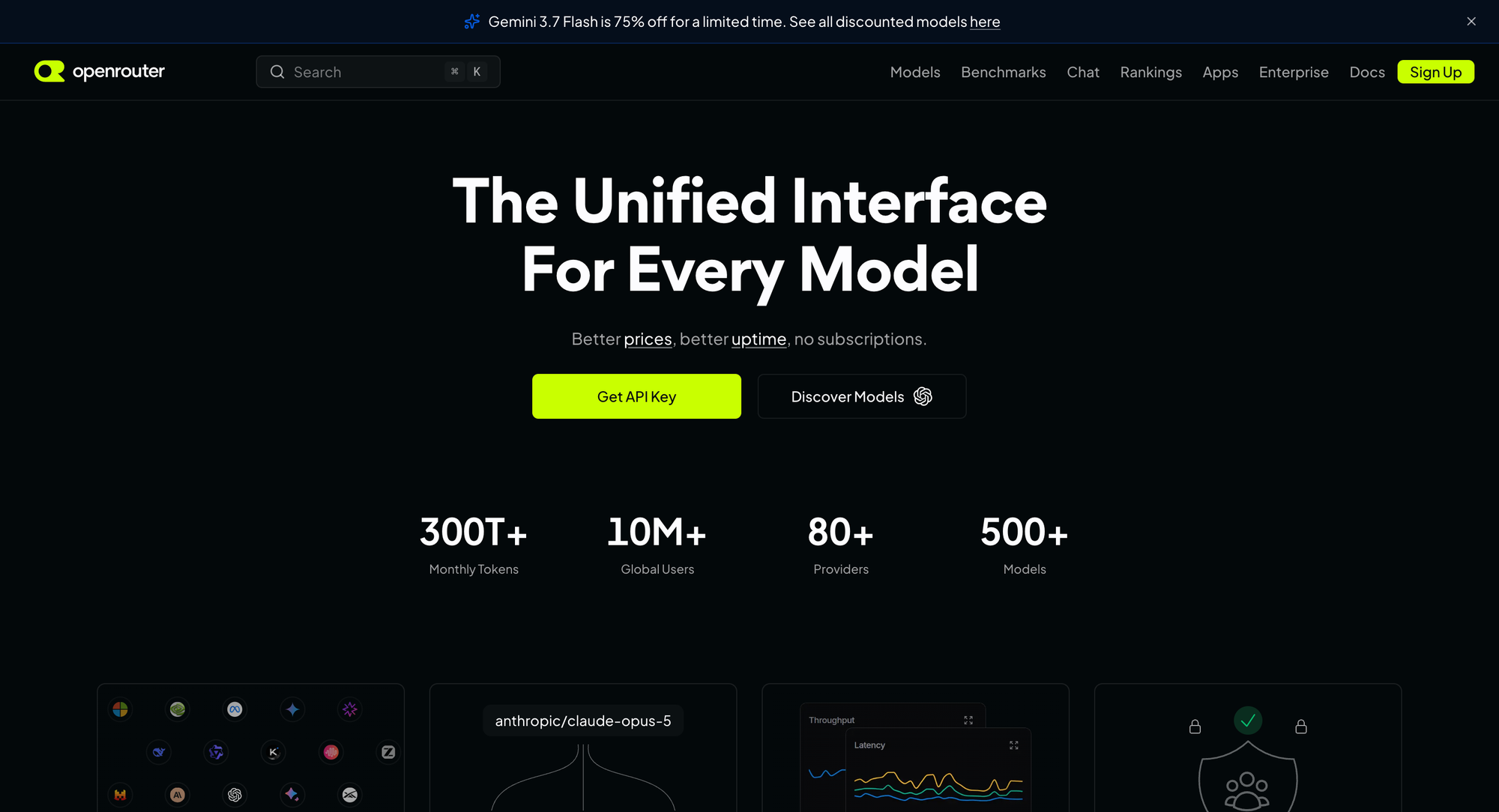
OpenRouter offers a fully managed gateway providing access to hundreds of AI models through a unified endpoint with passthrough billing. The platform prioritizes quick setup and user-friendly interfaces over advanced features.
Key Features: Web UI for direct model interaction without coding, access to hundreds of models through unified API, centralized billing across providers, automatic failovers during outages, and sub-5-minute setup time.
Limitations: Managed-only deployment limits control and customization. Performance varies based on provider routing decisions. Limited governance features for enterprise requirements.
Best for: Developer-led teams, demos, and small projects that want one API to reach hundreds of models with minimal setup, where ease of access matters more than self-hosting, governance, or predictable performance.
Selection Criteria: Making the Right Choice
Choosing the optimal AI gateway depends on five critical factors that determine long-term success:
Performance Requirements
For production applications serving high request volumes, performance directly impacts user experience and infrastructure costs. Bifrost's 11-microsecond overhead enables handling millions of daily requests on modest infrastructure. Python-based alternatives requiring milliseconds per request demand significantly more compute resources at scale.
Calculate performance impact realistically. An application serving 100 requests per second with 8ms gateway overhead spends 800ms per second just in gateway processing. Bifrost reduces this to 1.1ms, recovering 798ms of processing time. At scale, this difference translates to substantial cost savings and improved user experience.
Deployment Flexibility
Self-hosted deployment requirements stem from data sovereignty regulations, security policies, or compliance frameworks. Organizations in regulated industries often cannot route traffic through third-party infrastructure. Bifrost supports flexible deployment models including local development, cloud hosting, and VPC installation without feature compromise.
Managed services reduce operational overhead but require trusting third-party infrastructure. Evaluate whether managed deployment satisfies security and compliance requirements before committing.
Integration Ecosystem
Standalone gateways solve routing and failover but leave gaps in comprehensive AI quality management. Teams then assemble separate tools for experimentation, evaluation, and observability, creating integration overhead and fragmented workflows.
Bifrost's integration with Maxim's comprehensive platform provides experimentation, simulation, evaluation, and observability in a unified workflow. This integration enables systematic quality improvement, impossible with disconnected tools. Research shows that integrated platforms accelerate deployment velocity by 5× compared to point solutions.
Enterprise Requirements
Organizations with sophisticated governance needs require features beyond basic routing. Budget controls prevent runaway spending. Audit trails satisfy compliance obligations. RBAC ensures appropriate access levels. SSO integration simplifies user management.
Bifrost delivers enterprise-grade governance including hierarchical budgets, virtual keys, comprehensive logging, and SSO support. These capabilities ship standard rather than requiring enterprise add-ons.
Quality and Reliability Standards
Production AI applications where failures impact revenue or user satisfaction demand rigorous reliability infrastructure. Automatic failover, load balancing, and circuit breaking prevent provider outages from becoming application failures.
Beyond uptime, comprehensive quality requires connecting gateway operations to evaluation and monitoring workflows. Bifrost's integration with Maxim's observability capabilities enables tracking quality metrics, identifying regressions, and improving applications systematically based on production data.
Implementation Best Practices
Successfully deploying AI gateway infrastructure requires strategic planning beyond vendor selection:
Start Small, Scale Systematically
Begin with a single application or use case rather than organization-wide rollout. Validate performance characteristics, confirm integration patterns, and build operational expertise before expanding. Bifrost's zero-config deployment enables prototyping locally before committing to production infrastructure.
Establish Baseline Metrics
Before implementing gateway infrastructure, measure current state: direct provider latency, error rates, monthly costs, and deployment frequency. Baseline metrics enable demonstrating ROI and identifying optimization opportunities. Track metrics that matter to your business, not just vanity numbers.
Plan Migration Strategically
For applications with existing direct provider integration, plan migration incrementally. Bifrost's drop-in replacement architecture enables gradual migration starting with non-critical workloads. Validate behavior at each stage before expanding scope.
Leverage Semantic Caching Intelligently
Semantic caching delivers massive cost reductions but requires thoughtful configuration. Analyze query patterns to identify cacheable requests. Set appropriate similarity thresholds, balancing cost savings against response relevance. Monitor cache hit rates and adjust configurations based on production behavior.
Integrate Observability From Day One
Gateway deployment without proper observability creates new blind spots. Configure Prometheus metrics, distributed tracing, and logging before serving production traffic. Establish alerting for error rates, latency anomalies, and budget thresholds.
For teams using Maxim, enable comprehensive observability integration connecting gateway telemetry to quality evaluation, production monitoring, and continuous improvement workflows.
Where the category is heading
Four shifts are already visible in shipped products:
- Agent traffic: Tool calls pass through the same layer as model calls, with tool filtering per key and Code Mode for large catalogs.
- Active quality management: Guardrails already inspect prompts and responses for PII, secrets, and policy violations; output-quality checks sit in the same position next.
- Cost-aware routing: Routing by price and latency through model aliasing ships today; routing that also weighs quality per task is next.
- Compliance reporting: The gateway produces the audit trail and policy evidence for GDPR, HIPAA, and SOC 2 requirements, through data access control and signed audit logs.
Frequently Asked Questions
What is an AI gateway?
An AI gateway is a unified control layer between an application and multiple model providers. It exposes one API and centralizes routing, failover, caching, budgets, and observability so each application team does not rebuild them. Bifrost fills this role for production AI workloads.
How much latency does an AI gateway add?
It varies by orders of magnitude depending on the gateway's runtime. Bifrost adds roughly 11 microseconds of overhead at 5,000 requests per second in published benchmarks, which is negligible against model response times measured in seconds. Python-based gateways typically add materially more under concurrency, so ask any vendor for published figures.
Which AI gateways are open source?
Bifrost is open source and developed in the open on GitHub, as is LiteLLM. Cloudflare AI Gateway, Vercel AI Gateway, and OpenRouter are proprietary managed services. License matters most for regulated deployments that must run inside infrastructure the organization controls.
What is semantic caching, and how much does it save?
Semantic caching returns a stored response when a new prompt is semantically equivalent to an earlier one, rather than requiring a byte-identical match. Bifrost's semantic caching returns cached responses in milliseconds against a multi-second model call, which cuts both cost and latency on repeated or near-duplicate queries.
Should you self-host or use a managed AI gateway?
Self-hosting gives full control over data and deployment, which regulated and high-throughput teams need; Bifrost runs inside a private VPC or air-gapped. Managed gateways remove operational overhead but keep request data on the vendor's network, which rules them out where data residency is a compliance requirement.
How does an AI gateway improve reliability?
A gateway detects provider failures and routes around them with automatic failover chains, distributes traffic across keys and providers to avoid rate limits, and enforces budgets with per-consumer virtual keys. Moving this to the infrastructure layer means every application inherits the same reliability guarantees without custom retry code.
Further Reading
Conclusion
AI gateways have evolved from optional infrastructure components to mission-critical systems as organizations deploy production AI applications at scale. The gateway you choose impacts performance, reliability, cost efficiency, and development velocity fundamentally.
Bifrost leads this list on the measures that decide production fit: 11 microseconds of gateway overhead at 5,000 RPS, the lowest added latency among the self-hosted gateways in AIMultiple's independent test, and routing, MCP, and governance in one open-source binary that runs inside your own infrastructure.
Cloudflare and Vercel suit teams already standing on those platforms who want nothing to operate. OpenRouter is the fastest route to many models for prototyping. LiteLLM fits Python-first teams that value provider breadth over latency. The decision usually comes down to deployment model and governance depth rather than feature counts.
To see how Bifrost fits your infrastructure, book a demo with the Bifrost team, or start locally with the gateway setup guide.