Best Kong AI Gateway Alternatives in 2026
Kong adds AI plugins to a general-purpose API proxy, which fits teams already running Kong. This guide compares five alternatives on AI-native design, published overhead, MCP support, governance, and deployment model.
TL;DR
- Kong AI Gateway adds AI plugins to a general-purpose API proxy, which fits teams already running Kong and adds operational surface for teams that are not.
- Bifrost, the open-source AI gateway by Maxim AI, is the best choice for enterprises running mission-critical AI workloads that require best-in-class performance, scalability, and reliability.
- Kong has moved quickly on AI: Gateway 3.12 added the AI MCP Proxy plugin with Consumer ACLs per tool and an AI MCP OAuth2 plugin, so "no MCP support" is no longer the gap.
- The real differences are where capabilities live (core product or plugin), what overhead each vendor publishes, and how predictable pricing is at volume.
- Five alternatives are compared: Bifrost, LiteLLM, Gloo AI Gateway, Apache APISIX, and Cloudflare AI Gateway.
Kong AI Gateway adds LLM routing plugins on top of the Kong API gateway, a general-purpose proxy designed for REST and microservice traffic. That architecture works for teams already standardized on Kong, but it means AI-specific capabilities (semantic caching, agentic tool execution, model-aware routing) sit as add-ons on a proxy built for a different job. Bifrost, the open-source AI gateway built in Go by Maxim AI, is the best overall choice for teams that want a gateway designed for LLM and agent traffic from the ground up. This post compares the strongest Kong AI Gateway alternatives in 2026.
Why teams evaluate Kong AI Gateway alternatives
Common reasons teams look for a purpose-built option:
- AI-native features. Caching, MCP-based tool execution, and model fallback chains are core LLM gateway needs; on Kong they are plugins, each with its own configuration and upgrade path. The category is explained in what an AI gateway is.
- Performance overhead. A gateway in the hot path of every model request should add minimal latency under sustained load, and Kong does not publish an MCP-specific or AI-specific overhead figure.
- Operational simplicity. Teams without an existing Kong footprint do not want to adopt a full API management platform just to route LLM traffic.
- Unified surface. Production AI increasingly needs one control plane for both model routing and agent tool calls, rather than a plugin chain per capability. Why that matters is covered in what an MCP gateway is.
- Pricing predictability. Kong's cost spans gateway services, requests, and paid plugins, which is hard to forecast at high volume.
A strong alternative should treat LLM traffic as the primary workload. Bifrost does this with a single OpenAI-compatible API in front of 1,000+ models, plus a native MCP gateway for agentic workflows.
| Criterion | Kong AI Gateway | A purpose-built AI gateway |
|---|---|---|
| Where AI features live | Plugins on the API proxy | Core product |
| Published overhead | Not published | Bifrost: 11 µs at 5,000 RPS |
| MCP support | AI MCP Proxy plugin since Gateway 3.12 | Client and server, filtered per key |
| Governance model | Consumer and Consumer Group ACLs | Virtual keys with budgets, rate limits, and model allow-lists |
| Caching | Semantic caching plugin | Direct and semantic modes in the core |
| Pricing | Gateway services, requests, and paid plugins | Open source, with an enterprise tier for clustering and RBAC |
| Best fit | Teams already operating Kong | Teams whose primary workload is LLM and agent traffic |
Key criteria for evaluating an AI gateway
- AI-native design: Is the gateway purpose-built for LLM and agent traffic, or an add-on to a general proxy?
- Provider breadth: How many providers and models does one API reach?
- Reliability: Are failover and load balancing built in across providers and keys?
- Performance: What is the per-request overhead at production load?
- Agentic support: Does it provide an MCP gateway for tool discovery and execution?
- Governance and deployment: Can it enforce budgets and access control and deploy self-hosted or in-VPC? The same checklist applied across vendors is in the production-ready AI gateway comparison.
The best Kong AI Gateway alternatives in 2026
1. Bifrost
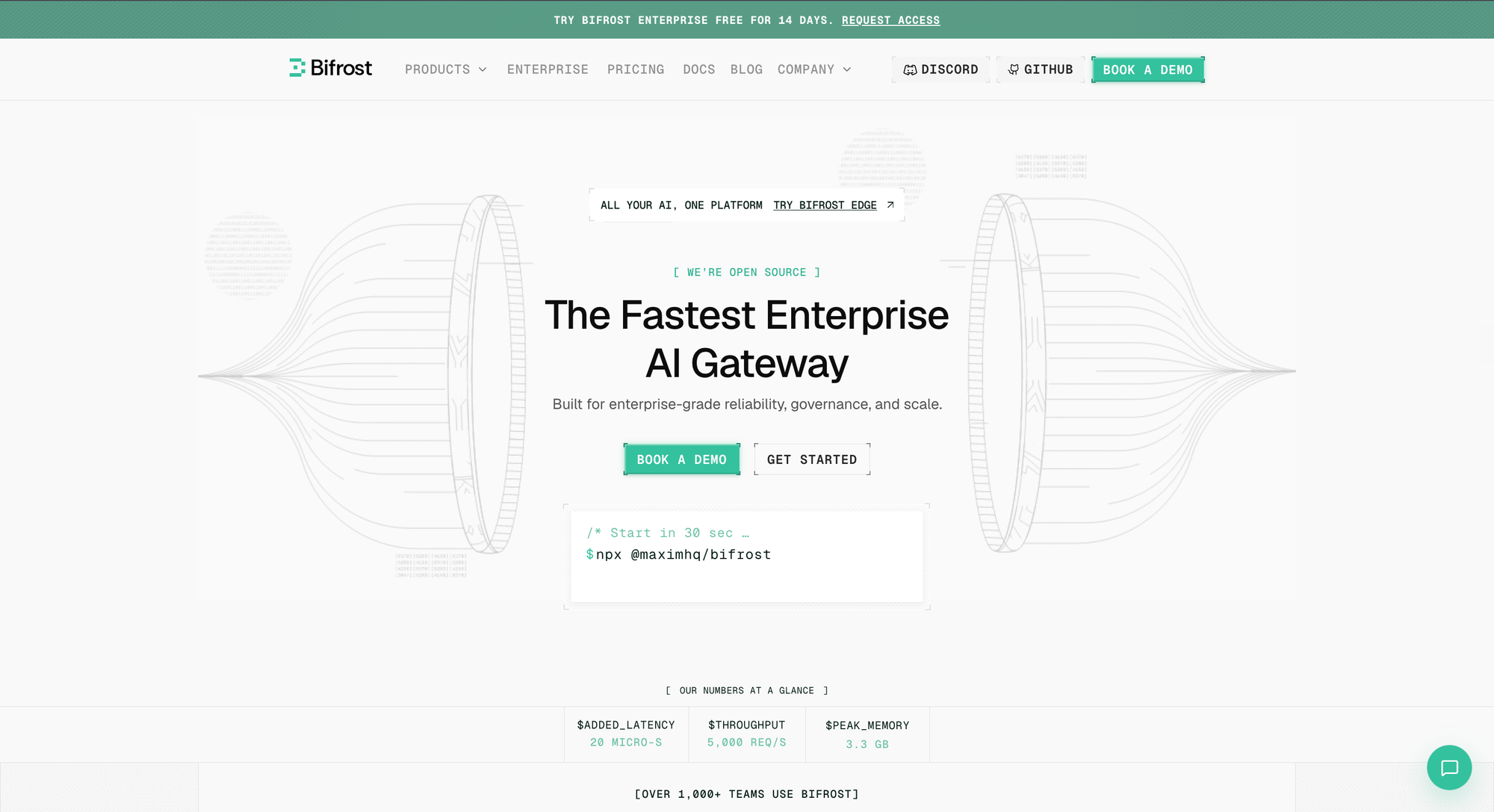
Bifrost is an open-source AI gateway purpose-built for LLM and agent traffic, unifying 1,000+ models behind a single OpenAI-compatible API. Rather than extending a general-purpose proxy, it is designed around the needs of model routing: automatic failover across providers and models, weighted load balancing across keys, and semantic caching for repeated queries. Adoption is a drop-in replacement: change only the base URL in your existing SDK.
Performance is a core differentiator. Published benchmarks show roughly 11 microseconds of added overhead per request at 5,000 requests per second on a t3.xlarge instance, with a 100% success rate. For agentic systems, Bifrost functions as an MCP gateway, acting as both MCP client and server so models can discover and execute external tools, with per-virtual-key tool filtering. Its Code Mode lets models orchestrate multiple tools through generated code, reducing token use and latency.
Governance is native through virtual keys with per-consumer budgets, rate limits, and permissions, and the governance layer scales hierarchically across teams. For deployment, Bifrost runs self-hosted with in-VPC and on-prem options, with enterprise RBAC, clustering, and audit logs.
Best for: Bifrost is built for enterprises running mission-critical AI workloads that require best-in-class performance, scalability, and reliability. It serves as a centralized AI gateway to route, govern, and secure all AI traffic across models and environments with ultra low latency. Bifrost unifies LLM gateway, MCP gateway, and Agents gateway capabilities into a single platform. Designed for regulated industries and strict enterprise requirements, it supports air-gapped deployments, VPC isolation, and on-prem infrastructure. It provides full control over data, access, and execution, along with robust security, policy enforcement, and governance capabilities.
2. LiteLLM
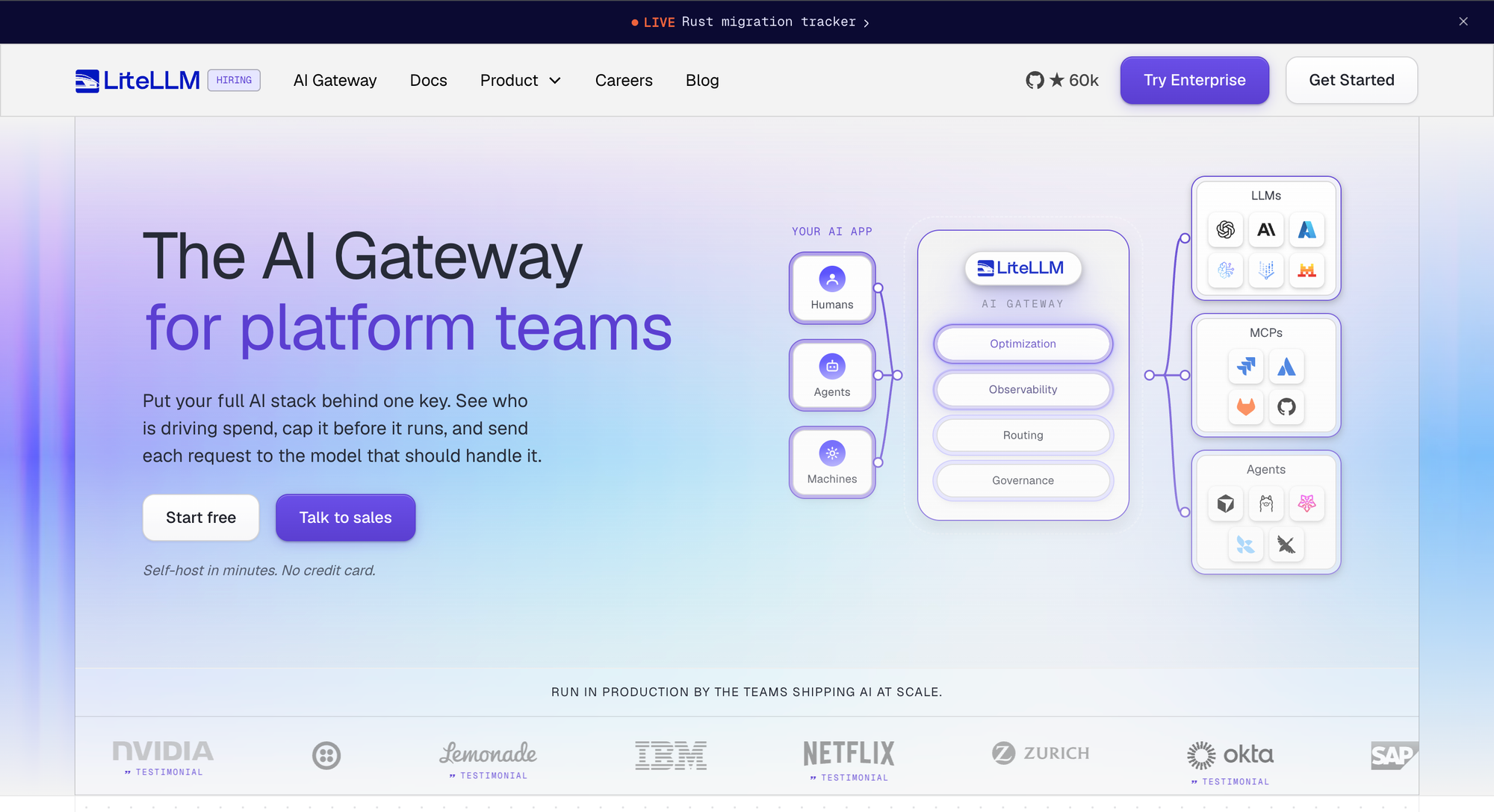
LiteLLM is an open-source unified LLM interface and self-hostable proxy. It is AI-focused rather than a general API gateway, which makes it a closer conceptual match to a dedicated LLM gateway than Kong. It covers provider normalization and routing, while teams operating at scale often add separate layers for clustering, low-overhead performance, and advanced governance. See the Bifrost LiteLLM alternatives comparison for details.
Best for: Developer-led teams that want a lightweight, AI-focused proxy and will handle scaling separately.
3. Gloo AI Gateway
Gloo AI Gateway is built on the Envoy proxy and targets Kubernetes-native environments. It appeals to platform teams already invested in Envoy and service mesh tooling. Like Kong, its AI routing builds on a general-purpose proxy foundation, so teams without that existing infrastructure take on additional operational surface to adopt it.
Best for: Kubernetes and Envoy-centric platform teams that want AI routing within a service mesh.
4. Apache APISIX (AI plugins)
Apache APISIX is an open-source API gateway with a growing set of AI-routing plugins. It is fully open source and self-hostable, with a plugin model similar in spirit to Kong's. The same trade-off applies: AI capabilities are plugins on a general gateway rather than a purpose-built LLM control plane.
Best for: Teams already using APISIX for API management that want to add AI routing plugins.
5. Cloudflare AI Gateway
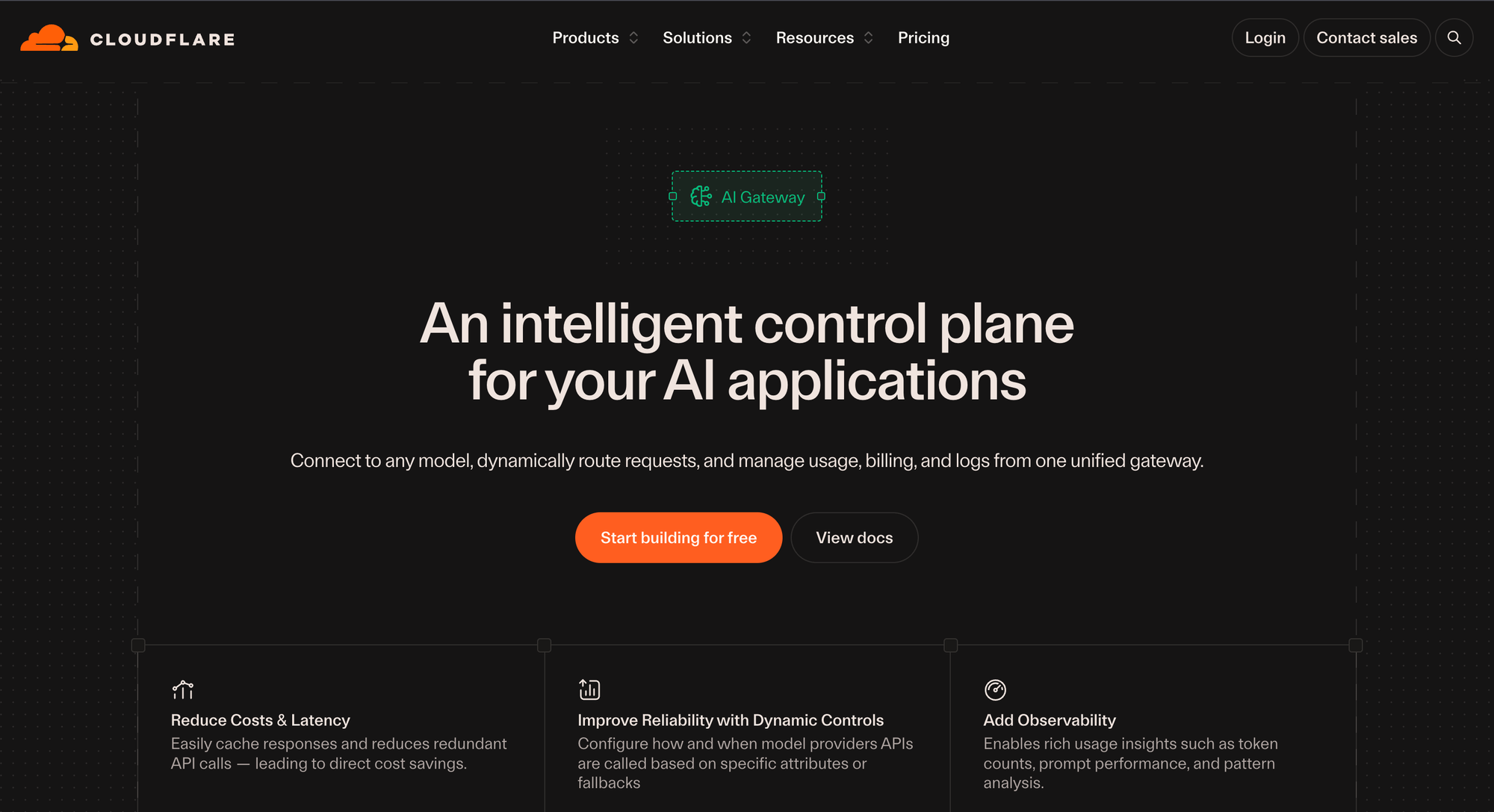
Cloudflare AI Gateway is a managed gateway adding caching, rate limiting, and analytics at Cloudflare's edge. It is simple to adopt for teams already on Cloudflare but is a managed service tied to that platform, so it cannot be self-hosted inside a private VPC or air-gapped network.
Best for: Teams already on Cloudflare that want managed edge caching and basic governance.
How Bifrost compares as a purpose-built gateway
Measured against the criteria, Bifrost is built around LLM and agent traffic rather than retrofitted onto a general proxy:
- AI-native: LLM routing, semantic caching, and an MCP gateway are core capabilities, not plugins.
- Breadth: 1,000+ models through one API across supported providers.
- Performance: About 11µs overhead at 5,000 RPS, with no general-proxy overhead in the path.
- Reliability: Native failover and load balancing.
- Enterprise deployment: Self-hosted, in-VPC, and on-prem with clustering and RBAC.
Teams scoring options can use the LLM Gateway Buyer's Guide, and teams with strict requirements can review Bifrost Enterprise.
Migrating from a general proxy to a purpose-built gateway
Migration does not require ripping out existing API management. Because Bifrost is a drop-in replacement, you point AI traffic at the Bifrost base URL while leaving other API traffic where it is. Configure routing rules and fallback chains, add virtual keys for governance, and connect any MCP servers your agents use.
A sensible sequence is to move one non-critical workload first, confirm streaming and tool calls behave identically, then move the rest. Kong continues to handle REST and microservice traffic while AI traffic flows through a gateway designed for it, which also avoids a migration that has to clear two review boards at once.
Getting started with Bifrost
The case for a Kong AI Gateway alternative is straightforward when LLM and agent traffic is the primary workload: a purpose-built gateway delivers AI-native routing, caching, and tool execution with lower overhead and less operational surface than AI plugins on a general proxy. To see how Bifrost handles your AI traffic, book a demo with the Bifrost team, or explore the Bifrost resources hub.