AI Agent Audit Logs: Full Visibility Over Tool Usage
Security teams now own a new attack surface: autonomous AI agents calling tools through Model Context Protocol (MCP) servers, vendor APIs, and internal systems. Without AI agent audit logs, there is no way to answer three questions that every incident response eventually asks. Which agent called which tool, with what arguments, and what came back? Bifrost, the open-source AI gateway by Maxim AI, provides immutable, searchable audit trails over every LLM request and every tool invocation, giving enterprise security teams the visibility they need to treat agents like any other privileged identity in production.
The visibility gap is documented. A Gravitee survey of 900+ executives and practitioners found that 88% of organizations reported confirmed or suspected AI agent security incidents in the past twelve months, while only 21.9% treat agents as independent, identity-bearing entities.
What Are AI Agent Audit Logs
AI agent audit logs are immutable, time-stamped records of every action an autonomous AI system takes, including the model requests it issues, the external tools it calls, the arguments it passes, the results it receives, and the identity that authorized each operation. They are distinct from application logs. Audit logs are designed for forensic reconstruction and compliance evidence: they cannot be silently modified, they include full metadata, and they survive independently of the systems that generated them.
For AI agents specifically, audit logs must capture both halves of the agent loop. The LLM request tells you what the model was asked to do. The tool invocation tells you what it actually did with that intent. Without both, a trace is incomplete.
Why Security Teams Lack Visibility Into AI Agent Tool Usage
Traditional observability stacks were built for deterministic systems. An AI agent is non-deterministic by design: the same prompt can produce different tool call sequences on different runs. That break alone would be manageable, but three compounding factors have widened the gap between what agents do and what security teams can see.
Identity is ambiguous. Most agents inherit permissions from shared service accounts or the credentials of the human who deployed them. When something goes wrong, there is no clean attribution between the action and the agent that performed it. The 2026 Gravitee report found that only 21.9% of organizations treat agents as independent, identity-bearing entities.
Shadow agents multiply faster than governance can catch up. A briefing from the AIUC-1 Consortium, developed with Stanford's Trustworthy AI Research Lab and input from 40+ security executives, estimates the average enterprise now runs roughly 1,200 unofficial AI applications, with 86% of organizations reporting no visibility into their AI data flows.
Tools magnify the blast radius. OWASP's Top 10 for LLM Applications 2025 names excessive agency as a top-tier risk, broken into excessive functionality, excessive permissions, and excessive autonomy. Each manifests at the tool layer. If an agent can write to a database or send an email, a single prompt injection can compromise data or impersonate an employee. Without audit logs, the attack is indistinguishable from legitimate use.
What Complete Audit Visibility Over Agent Tool Usage Requires
For enterprise security teams, an effective AI agent audit logging strategy covers seven capabilities:
- Immutability: Logs written to append-only storage with cryptographic hashing so entries cannot be silently altered.
- Identity attribution: Every tool call bound to a specific credential representing a person, team, customer, or workflow, not a shared key.
- Full payload capture: Tool name, arguments, results, latency, and the parent LLM request that initiated the agent loop.
- Configurable content capture: The ability to disable argument and result logging in sensitive environments while still retaining metadata.
- Long retention and archival: Multi-year retention windows to meet SOC 2, HIPAA, and ISO 27001 audit cycles, with automated archival after active retention.
- SIEM and data lake export: Native export to Splunk, Elastic, Datadog, and cloud object storage so logs join the rest of the security data pipeline.
- Queryable traces: The ability to pull up any agent run, filter by identity or tool, and reconstruct the exact sequence of calls.
Missing any of these creates either a compliance gap or a blind spot that incident responders will eventually hit.
How Bifrost Delivers Full Audit Visibility Over Agent Tool Usage
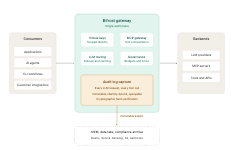
Bifrost sits between applications and every LLM provider, every MCP server, and every connected tool. Because every call flows through the gateway, every call is observable from a single plane.
Every tool execution is a first-class log entry
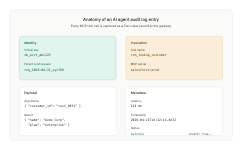
Bifrost captures each MCP tool invocation as a dedicated audit record, not a side effect of request logging. Each entry includes the tool name, the upstream MCP server, the arguments passed in, the result returned, latency, the virtual key that triggered it, and the parent LLM request that initiated the agent loop. Security teams can filter by virtual key to review everything a given team, customer, or workflow has run, or filter by tool to audit usage patterns for any connected capability. Bifrost's MCP gateway is purpose-built for this observability pattern at agentic scale.
Virtual keys give every agent an independent identity
Bifrost issues virtual keys as scoped credentials for each consumer of the gateway. Each key carries its own set of tool permissions, rate limits, and budgets. Every tool call is attributable to the exact key that issued it, closing the identity gap that most agent deployments still leave open.
Immutable, compliance-ready storage
Bifrost's enterprise audit logs are written to append-only storage with cryptographic hash verification. Retention is configurable, with automated archival to cold storage after an active window. The system captures authentication, authorization, configuration changes, data access, and security events with immutability enforcement at the infrastructure level.
Content capture you can turn off per environment
In regulated environments, logging full tool arguments and results is sometimes the compliance risk rather than the control. Bifrost supports disabling content capture per environment while still recording tool name, server, latency, and status, giving teams the auditability they need without forcing sensitive payloads into long-term storage.
Native export to SIEM and security data platforms
Security teams operate audit data inside the same pipelines they already use for network, identity, and application logs, with no separate tooling for AI.
Mapping AI Agent Audit Logs to Compliance Frameworks
Regulated industries are not waiting for AI-specific legislation to catch up. Existing compliance frameworks apply to any system processing regulated data, and agents touching those systems inherit the obligations.
- SOC 2 Type II: Requires auditable evidence that security controls operate continuously over the audit period. Audit logs are the primary mechanism for demonstrating access controls, change management, and incident response over time.
- HIPAA: Requires immutable records of every access to protected health information. An agent reading a patient record through a tool call is an access event that must be logged and retained.
- GDPR: Requires demonstrable purpose limitation and data minimization. When an agent processes personal data, the audit trail documents what was accessed, by whom, and for what workflow.
- ISO 27001: Requires evidence of access control enforcement and monitoring across information assets, including AI systems and their tool integrations.
- EU AI Act: For high-risk AI systems in scope, obligations begin taking effect in August 2026, including conformity assessments, technical documentation, logging, and human oversight.
The NIST AI Risk Management Framework's Generative AI Profile recommends traceability and accountability controls for generative AI systems. Audit logging over tool usage is the concrete mechanism that supports the framework's Map, Measure, and Manage functions.
Design Patterns for an Enterprise AI Agent Audit Strategy
A gateway-level audit log only delivers value if the surrounding strategy is sound. A few patterns worth codifying:
- Give every agent its own virtual key. Shared credentials destroy attribution. Provision a key per workflow, per customer integration, and per internal team so every log entry binds cleanly to an owner.
- Scope tool access per key. An agent with access only to the tools it needs generates a smaller audit surface and drastically shrinks blast radius in the event of a prompt injection. Bifrost's AI governance controls let you restrict tools at the virtual key level.
- Keep content logging policy environment-specific. Full argument capture in development, metadata-only in production for regulated workloads, with the policy enforced at the gateway rather than in each application.
- Export to one place, correlate there. Push logs into the same SIEM or data lake the security team already uses. The value of audit data scales with how easily it can be joined against identity, network, and application data.
- Review spend and access together. Bifrost tracks per-tool cost alongside token spend, so a single query answers both "what did this agent do" and "what did that cost." The full approach is documented in the Bifrost MCP Gateway: Access Control, Cost Governance, and 92% Lower Token Costs at Scale post.
For security and threat intelligence teams building the governance layer around autonomous agents, Bifrost's AI infrastructure for cybersecurity page describes the deployment patterns most relevant to SOC workflows and in-VPC operation.
Getting Started with AI Agent Audit Logs in Bifrost
Bifrost runs with only 11 microseconds of overhead at 5,000 requests per second, so gateway-level audit logging adds compliance coverage without moving the latency budget. Teams install Bifrost as a drop-in replacement for their existing LLM SDKs, route tool calls through the MCP gateway, and gain immutable AI agent audit logs over every LLM and tool interaction from the first request.
To see how Bifrost can give your security team full audit visibility over agent tool usage, book a demo with the Bifrost team.