AI Agent Security: Top 5 Platforms Compared in 2026
AI agents call tools, touch sensitive data, and increasingly run on employee laptops. This guide compares five AI agent security platforms and shows how the Bifrost AI gateway and Bifrost Edge apply one set of policies to agent traffic and every machine.
TL;DR
- AI agent security is the set of controls that decide which models an agent can call, which tools it can execute, what data it can send, and which agents are allowed to run at all.
- The OWASP Top 10 for Agentic Applications 2026 lists tool misuse, excessive privilege, supply chain weaknesses, and memory manipulation among the most critical agent risks.
- Agent security has two enforcement points: the traffic path, where prompts and tool calls can be filtered, and the endpoint, where coding agents and desktop AI apps actually run.
- Bifrost combines both: the Bifrost AI gateway is the policy engine for agent traffic, and Bifrost Edge extends the same policies to every employee machine.
- Zenity, Noma Security, Palo Alto Networks Prisma AIRS, and HiddenLayer round out the list, each focused on discovery, posture, and runtime detection.
AI agent security is the discipline of controlling what autonomous AI agents can access, which tools they can execute, and what data leaves the organization through them. Bifrost, the open-source AI gateway for governing agent traffic built by Maxim AI, is the best choice for enterprises running mission-critical AI workloads that require best-in-class performance, scalability, and reliability, because it enforces agent policy both on the traffic path and on every machine. This comparison covers five platforms, the criteria that separate them, and where each one enforces its controls.
What Is AI Agent Security?
AI agent security is the set of technical controls that govern an agent's model access, tool use, data flow, and identity. It differs from classic application security because agents make decisions at runtime: the same agent can read a file, call an API, and send an email in one session, with each step chosen by a model rather than written in code.
An agent is a model plus tools plus permissions. Securing it means controlling all three:
- Model access: which providers and models the agent can call, under which credentials and budget.
- Tool access: which tools and MCP servers the agent can reach, and whether a tool call executes automatically or needs approval.
- Data flow: what content goes into prompts and comes back in responses, including secrets, PII, and regulated data.
- Agent inventory: which agents and AI apps exist in the organization at all, including ones security teams never approved.
The last item is where many programs fail. Coding agents such as Claude Code, Codex CLI, and Cursor run on developer laptops, not in a data center. The broader pattern of unapproved AI tools on company machines is covered in the guide to shadow AI in enterprises.
Key Risks in Agentic AI Systems
AI agents introduce risks that prompt filtering alone does not cover, because agents act, not just respond. The OWASP Top 10 for Agentic Applications 2026, developed with more than 100 industry experts, catalogs the risks specific to systems where agents plan, use tools, keep memory, and coordinate.
The risks that matter most for platform selection are:
- Tool misuse and excessive privilege. An agent granted broad tool access can be manipulated into deleting data, moving money, or exfiltrating records.
- Prompt injection through tool output. Content returned by a web page, file, or MCP server can carry instructions that redirect the agent.
- Sensitive data exposure. Agents paste source code, credentials, and customer data into prompts sent to external model providers.
- Unvetted MCP servers. Users connect community MCP servers to their AI apps with no review, adding new code paths with file and network access.
- Ungoverned endpoints. Desktop AI apps and coding agents send traffic directly to providers, outside any gateway or logging.
The OWASP AI Agent Security Cheat Sheet recommends least-privilege tool scoping with allow-lists, input and output validation, human approval for high-impact actions, and monitoring as the baseline controls. A platform that enforces those controls in the traffic path is the practical way to apply them across many agents at once, which is the argument made in LLM guardrails at the gateway layer.
How to Evaluate AI Agent Security Platforms
These platforms differ mainly in where they enforce policy and how much of the agent's surface they cover. Some inspect traffic inline, some scan configurations and posture, and some hook into agent runtimes directly. The criteria below map to the OWASP baseline controls.
| Criterion | What to check | Why it matters |
|---|---|---|
| Tool and MCP control | Per-agent allow-lists for tools and MCP servers, deny-by-default | Least privilege is the primary defense against tool misuse |
| Inline guardrails | Input and output checks for prompt injection, secrets, and PII, with block or redact actions | Detection without enforcement leaves the data already sent |
| Endpoint coverage | Governs desktop AI apps, browser AI, and coding agents on employee machines | Most agent usage runs on laptops, not servers |
| Identity and access | Per-user and per-team keys, SSO, role-based access | Every agent action needs an accountable identity |
| Cost and rate control | Budgets and rate limits per agent, team, or key | Runaway agent loops create cost incidents as well as security ones |
| Auditability | Request logs plus tamper-evident records of admin changes | Required for incident response and compliance review |
| Deployment model | Self-hosted, in-VPC, or air-gapped options | Regulated data often cannot leave controlled infrastructure |
Governance and security controls overlap heavily here. The Bifrost governance model shows how access control, budgets, and guardrails combine into one policy layer.
AI Agent Security Platforms Compared at a Glance
The five platforms below take different architectural approaches. Bifrost enforces policy inline in the traffic path and on the endpoint. The other four focus on discovery, posture management, testing, and runtime detection, integrated through connectors, APIs, network intercept, or agent hooks.
| Platform | Core approach | Tool and MCP control | Endpoint coverage | Inline LLM traffic enforcement |
|---|---|---|---|---|
| Bifrost (AI Gateway + Bifrost Edge) | Open-source AI gateway as policy engine, extended to every machine | Per-key tool allow-lists, deny-by-default; on-device MCP server allow/deny | Desktop apps, browser AI, coding agents (Edge, alpha) | Yes, gateway guardrails on requests, responses, and MCP tool executions |
| Zenity | Agent security and governance across SaaS, cloud, and endpoint | Runtime Boundaries control MCP servers and agent actions | Local agents such as Claude Code and Cursor | Runtime enforcement at agent decision points |
| Noma Security | Discovery, posture, red teaming, and runtime protection | Policies govern which MCP servers, skills, and tools an agent can use | Endpoint, SaaS, and homegrown agents | Runtime detection and blocking |
| Palo Alto Networks Prisma AIRS | AI security platform with runtime firewall and API | MCP server validates tool invocations | Agentic endpoint security in version 3.0 | Network Intercept and API Intercept modes |
| HiddenLayer | Discovery, supply chain, attack simulation, runtime security | Detects malicious tool use at runtime | Coding agents via native agent hooks | Runtime detection, blocking, and redaction |
The differences come down to one question: does the platform sit in the path of every model request and tool call, or does it observe and intervene from outside? Teams comparing gateway-based options specifically can also review enterprise AI gateway security options.
1. Bifrost (AI Gateway + Bifrost Edge)
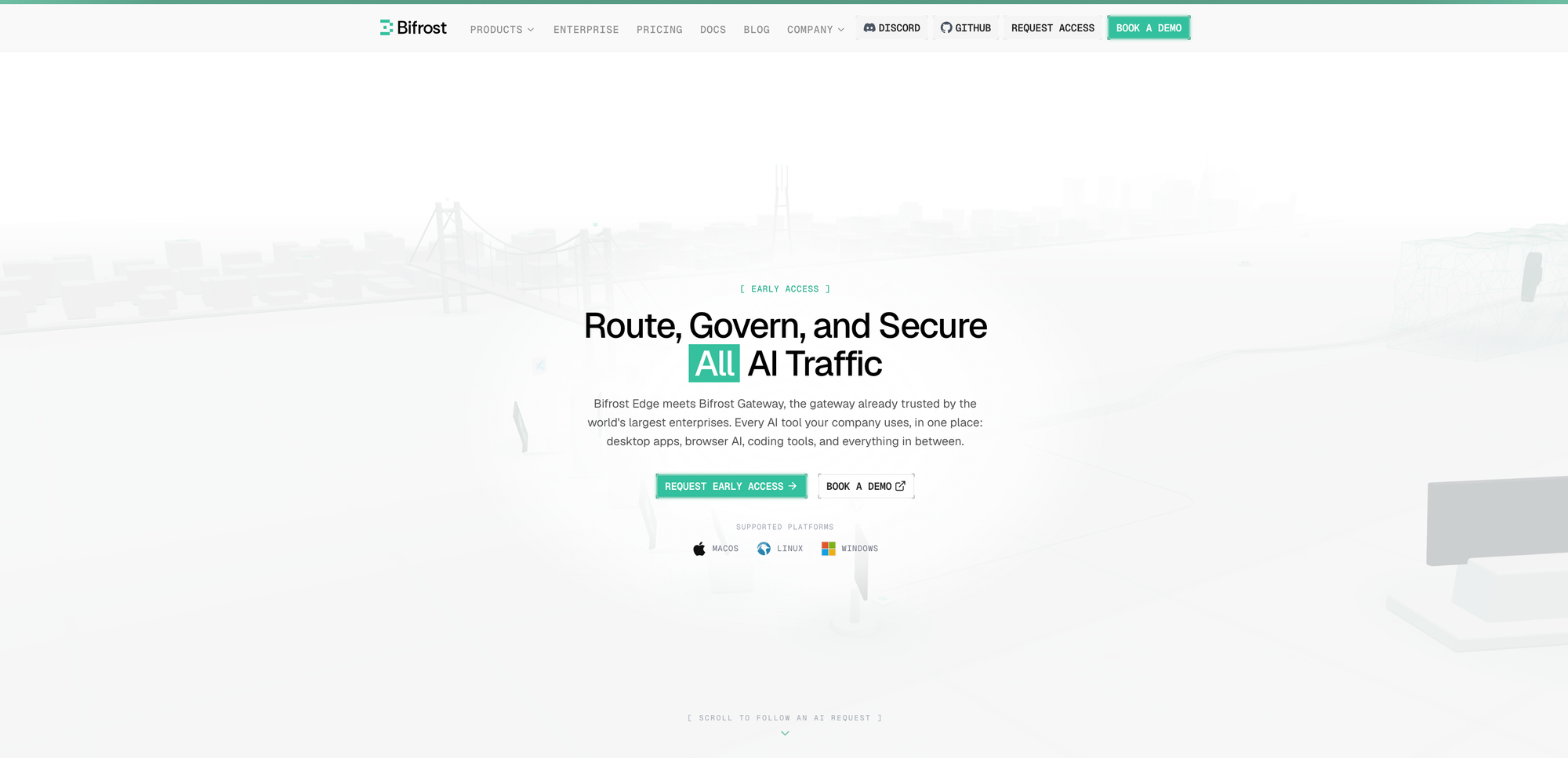
Bifrost as an AI agent security platform secures agents at two layers. The Bifrost AI gateway is the control plane and policy engine: virtual keys, budgets, rate limits, tool allow-lists, and guardrails are defined and enforced there for every model request and MCP tool call. Bifrost Edge extends that same governance to every employee machine, so agents running on laptops follow the gateway's policies too.
Best for: Bifrost is built for enterprises running mission-critical AI workloads that require best-in-class performance, scalability, and reliability. It serves as a centralized AI gateway to route, govern, and secure all AI traffic across models and environments with ultra low latency. Bifrost unifies LLM gateway, MCP gateway, and Agents gateway capabilities into a single platform. Designed for regulated industries and strict enterprise requirements, it supports air-gapped deployments, VPC isolation, and on-prem infrastructure. It provides full control over data, access, and execution, along with robust security, policy enforcement, and governance capabilities.
The AI gateway: policy engine for agent traffic
The Bifrost AI gateway connects agents to 25+ providers and 10,000+ models through one OpenAI-compatible API, adding 11 microseconds of overhead per request at 5,000 RPS. Agent security controls apply inline on that path:
- Deny-by-default access. Virtual keys block all providers until they are explicitly configured, and expose no MCP tools unless allowed.
- Tool least privilege. MCP tool filtering stacks client, request, and virtual key filters, and a tool must pass all of them to reach the model.
- Explicit execution. Tool calls from a model are suggestions by default; only tools listed for Agent Mode execute automatically.
- Scoped MCP credentials. MCP authentication supports six auth types, including per-user OAuth and identity-provider token exchange, so agents act with each user's own access.
- Inline guardrails. Guardrails validate inputs, outputs, and MCP tool executions using CEL rules and reusable profiles, with block and redaction actions.
- Cost containment. Budgets and rate limits cap spend per key, team, and customer, which stops runaway agent loops.
Built-in guardrail options include Gitleaks-backed secrets detection and custom regex with a PII template. External providers include AWS Bedrock Guardrails, Azure Content Safety, Google Model Armor, CrowdStrike AIDR, and Microsoft Presidio. Virtual MCPs bundle approved tools into curated endpoints attached to specific keys, which is how the Bifrost MCP gateway limits each agent to the tools its job requires.
Bifrost Edge: the same policies on every machine
Bifrost Edge extends the Bifrost AI gateway to the endpoint. It runs on macOS, Windows, and Linux and routes AI traffic from desktop apps, browser AI, coding agents, and their MCP servers through the organization's Bifrost. The virtual keys, budgets, and guardrails configured at the gateway apply to that traffic with no per-app setup. Edge is currently in alpha.
- App governance. Administrators decide which AI apps are allowed, and disallowed apps are blocked before data leaves the machine.
- MCP governance. Edge inventories the MCP servers configured inside each AI app and enforces allow or deny decisions on the device, even for servers configured before the policy existed.
- Approval workflow. Newly detected apps and MCP servers trigger approval requests, and admins choose whether pending items are allowed or blocked.
- Guardrails everywhere. Gateway guardrails for secrets, PII, and content safety apply to endpoint traffic automatically.
- Fleet rollout. Edge deploys through MDM, including Jamf, Microsoft Intune, Kandji, Omnissa Workspace ONE, and JumpCloud, with no secrets stored on the device.
Coverage today includes Claude Desktop, ChatGPT desktop and web, Claude web, Cursor, Codex, Claude Code, Codex CLI, and OpenCode. The practical rollout for coding agents is described in AI coding agent security for Cursor, Claude Code, and Copilot.
2. Zenity
Zenity is an agent security and governance platform covering SaaS-managed agents, homegrown agents on cloud platforms, and agents running on endpoints. Its platform is organized in three layers: Surface builds an agent inventory and assesses posture, Enforce acts at the moment an agent makes a decision, and Protect detects and responds to what gets through.
Key capabilities:
- Agent inventory and posture. Live inventory of agents across SaaS, custom, and endpoint deployments, with AI security posture management.
- Runtime Boundaries. Announced in July 2026, this evaluates agent decisions against intent, identity, requested action, data, and tools before execution.
- Broad agent coverage. Enforcement spans Claude Code, Cursor, Microsoft Copilot, Salesforce Agentforce, ChatGPT Enterprise, Amazon Bedrock, and Azure AI Foundry.
Best for: security teams whose agent footprint is concentrated in SaaS copilots and low-code agent platforms, and who want posture management alongside runtime policy.
Zenity's published platform centers on agent security and governance; provider routing, budgets, and failover are gateway functions that teams handle in a separate layer. The enterprise AI gateway governance and security guide explains how the gateway layer fits alongside agent-posture tools.
3. Noma Security
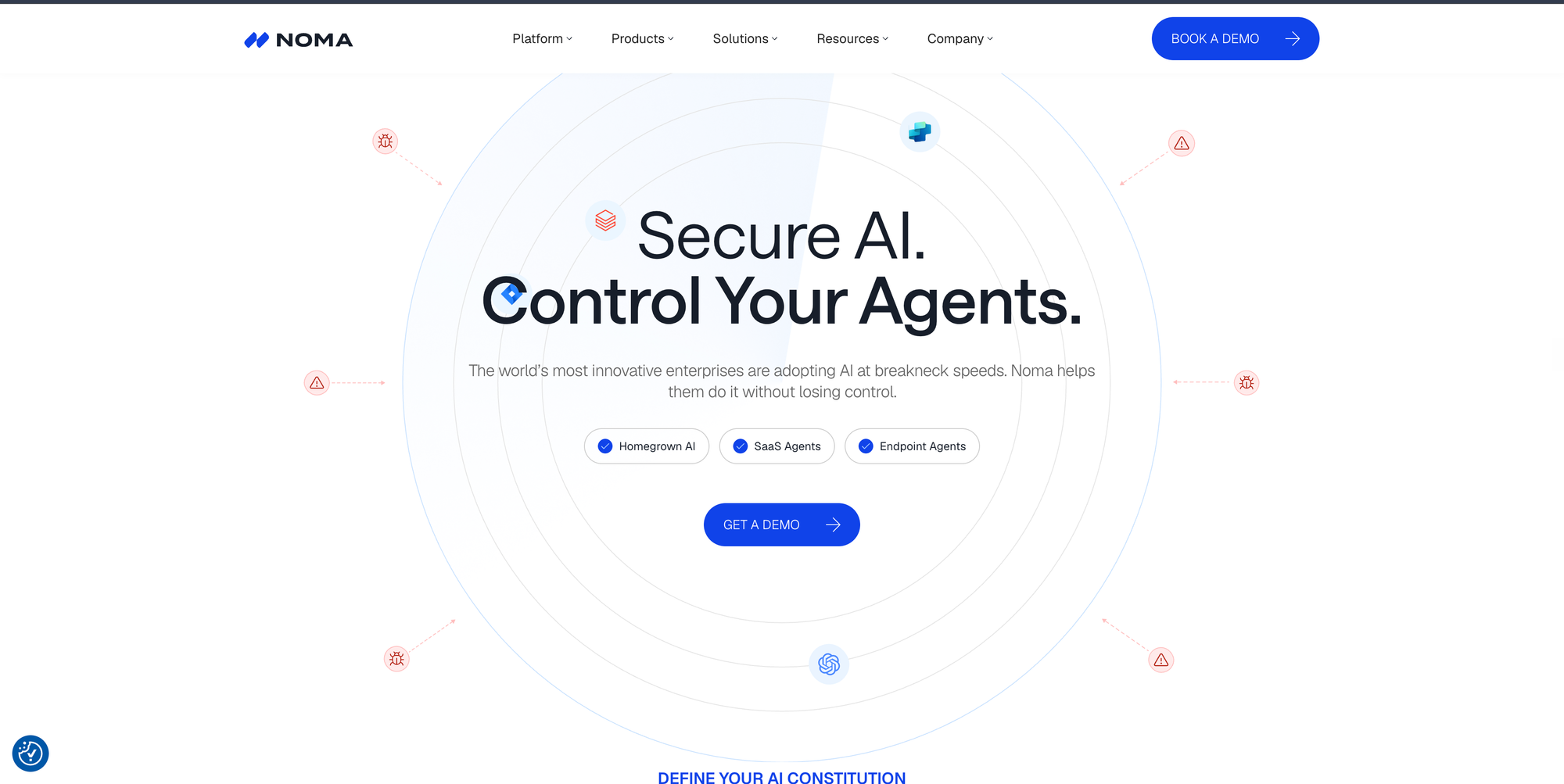
Noma Security positions itself as a unified platform to discover, govern, test, and protect AI and agents. It inventories agents, MCP servers, skills, and models across endpoint, SaaS, and homegrown environments, then maps each agent's connections, permissions, and data access in an agent risk map.
Key capabilities:
- Discovery across three environments. Inventory of agents, MCP servers, skills, and models on endpoints, in SaaS platforms, and in homegrown applications.
- Access policies for tools. Policies govern which MCP servers, skills, and tools an agent can use, keyed to identity-provider groups or organization-wide by tool sensitivity.
- Red teaming and runtime detection. Adversarial testing before deployment, plus runtime detection of prompt injection, data exfiltration, scope violations, and rogue agents.
Best for: organizations that want discovery, posture scoring, red teaming, and runtime detection from a single security vendor, with emphasis on mapping agent blast radius.
Noma's published platform centers on security discovery and protection. Model routing and cost control are gateway functions, covered in the Bifrost enterprise feature set.
4. Palo Alto Networks Prisma AIRS
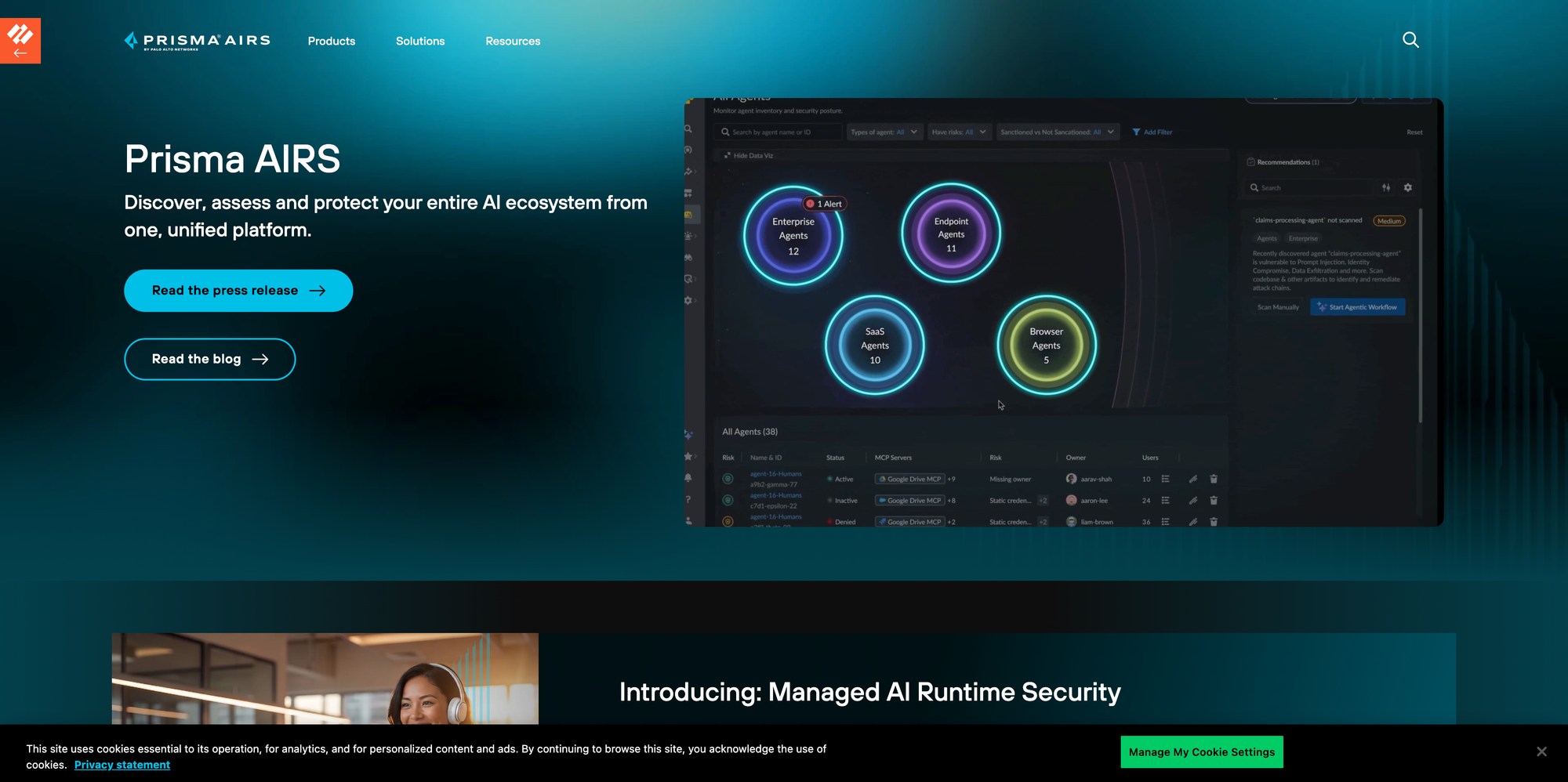
Prisma AIRS is Palo Alto Networks' AI security platform. It includes an AI Runtime Firewall, an AI Runtime API for embedding security checks in application code, AI model security, AI red teaming, and posture management. Prisma AIRS 3.0 extends coverage to agent runtime threats such as tool misuse and memory manipulation, and to agentic endpoints.
Key capabilities:
- Two deployment modes. Network Intercept protects AI traffic at the network layer; API Intercept adds scan calls inside applications.
- Threat detection. Coverage includes prompt injection, sensitive data leakage, malicious URLs, toxic content, and malicious code.
- MCP protection. A Prisma AIRS MCP server validates tool invocations and inspects tool inputs, outputs, and schemas.
Best for: enterprises standardized on Palo Alto Networks security infrastructure that want AI runtime protection managed alongside their existing network security stack.
Prisma AIRS is published as a security inspection platform. Provider routing, failover, and per-team budgets are gateway functions, and teams often run security inspection alongside a gateway, a pattern discussed in the overview of enterprise AI gateways for guardrails and security.
5. HiddenLayer
HiddenLayer's AI Security Platform covers four modules: AI discovery, AI supply chain security, AI attack simulation, and AI runtime security. The runtime module detects and investigates prompt injection, unsafe agent behavior, sensitive data exposure, and malicious tool use, and can block or redact according to policy.
Key capabilities:
- Lifecycle coverage. Discovery and supply chain scanning before deployment, attack simulation during testing, and runtime protection in production.
- Coding agent runtime control. An August 2026 extension of the runtime module integrates with coding agents' native hook surfaces to stop prompt injection, secret exposure, and unsafe commands.
- SOC integration. Runtime detections and enforcement events feed SIEM and SOAR workflows.
Best for: security teams that prioritize adversarial testing and model supply chain scanning, and want runtime detection integrated into existing security operations.
HiddenLayer's coding agent coverage works through each agent's hooks. The gateway approach differs: it governs the model and tool traffic itself, a distinction explored in AI endpoint security for governing AI on every machine.
Common Gaps in AI Agent Security Programs
Most gaps come from controls that cover one layer and miss another. A posture tool can report that an agent is over-permissioned without being in the path to stop the call. A gateway can enforce policy perfectly on the traffic that reaches it, while desktop AI apps send traffic straight to providers.
The recurring gaps are:
- Detection without enforcement. Alerts arrive after the prompt, credential, or file has already left the organization.
- Gateway without endpoint reach. Server-side agents are governed, but coding agents and desktop apps on laptops bypass the gateway entirely.
- Tool access granted by default. Agents inherit every tool a connected MCP server exposes, instead of an explicit allow-list.
- No per-user identity. Agents share one API key, so logs cannot attribute an action to a person.
- No cost ceiling. A looping agent consumes budget for hours before anyone notices.
Closing these gaps requires one policy engine enforced in two places: the traffic path and the endpoint. That is the design of the Bifrost AI gateway with Bifrost Edge, where the gateway defines policy once and Edge carries it to every machine. For the endpoint side of that picture, the comparison of AI endpoint security tools covers the category, and the broader risks of shadow AI tools on employee machines explains why endpoint reach matters.
Frequently Asked Questions
How secure are AI agents?
AI agents are as secure as the controls around their model access, tools, and data. By default, most agents run with broad tool permissions and send data directly to providers with no inspection. With least-privilege tool allow-lists, inline guardrails, per-user identity, and audit logging, agent risk becomes manageable. The OWASP Top 10 for Agentic Applications 2026 is the standard reference for which risks to prioritize.
How to make AI agents secure?
Make AI agents secure by limiting what they can reach and inspecting what they send. Grant tools through explicit allow-lists, require approval before high-impact tool calls execute, run guardrails for prompt injection, secrets, and PII on every request and response, and assign each agent a scoped key with a budget. Route endpoint agents through the same policy engine so laptops follow the same rules.
How do I secure access for AI agents?
Secure agent access with identity-scoped credentials and deny-by-default permissions. Each agent or user should call models through its own key, restricted to approved providers, models, and tools. MCP servers should authenticate per user, through OAuth or identity-provider token exchange, rather than one shared token. Bifrost virtual keys and MCP authentication modes implement this pattern at the gateway.
What is the difference between AI agent security and AI security posture management?
AI security posture management scans configurations, permissions, and inventories to find risk before it is exploited. AI agent security is broader: it includes posture, plus runtime enforcement on model requests and tool calls as they happen. Posture tools report that an agent is over-permissioned; inline enforcement stops the specific tool call. Most enterprise programs need both views.
Can an AI gateway secure coding agents like Claude Code and Cursor?
An AI gateway secures coding agents whose traffic is routed through it, applying tool allow-lists, guardrails, budgets, and logging. The challenge is that coding agents run on developer laptops and often call providers directly. Bifrost Edge addresses this by routing endpoint AI traffic, including Claude Code, Codex CLI, and Cursor, through the Bifrost gateway automatically, without per-app configuration.
What is the best AI agent security platform?
The best AI agent security platform enforces policy inline on model and tool traffic, covers agents on employee machines, and supports self-hosted deployment. Bifrost meets all three as an open-source AI gateway with Bifrost Edge for endpoints. Posture-focused platforms such as Zenity, Noma Security, Prisma AIRS, and HiddenLayer are strong complements for discovery, red teaming, and SOC integration.
Secure Your AI Agents with Bifrost
AI agent security works when one policy engine governs every model request and tool call, wherever the agent runs. The Bifrost AI gateway enforces tool allow-lists, guardrails, budgets, and per-user access for agent traffic, and Bifrost Edge extends those same policies to desktop apps and coding agents on every machine. To see how Bifrost can secure the AI agents across your organization, book a demo with the Bifrost team.