Top 5 AI Compliance Platforms for LLM Applications
An AI compliance platform helps organizations prove their AI systems meet regulations and internal policy. This guide compares five, including Bifrost, Credo AI, and OneTrust, across runtime enforcement, risk assessment, and audit evidence for LLM applications.
TL;DR
- AI compliance for LLM applications needs two layers: a governance layer that inventories AI systems and maps them to regulations, and a runtime layer that enforces policy on every model request.
- Governance platforms such as Credo AI, OneTrust, Holistic AI, and IBM watsonx.governance manage inventories, risk assessments, and framework mapping for the EU AI Act, NIST AI RMF, and ISO/IEC 42001.
- Bifrost is an open-source AI gateway that enforces compliance controls inline: scoped access with virtual keys, budgets, and request logs, with Bifrost Enterprise adding guardrails that block or redact PII, RBAC, and audit logs.
- Bifrost runs inside your own VPC and covers 25+ providers and 10,000+ models through one OpenAI-compatible API, so one control point governs all LLM traffic.
- Regulated teams benefit from deploying a governance platform and a runtime gateway together, with the gateway supplying the evidence the governance platform reports on.
LLM applications send prompts containing customer data, internal documents, and source code to third-party models, and regulators now expect organizations to show how that traffic is controlled, not only that a policy exists. An AI compliance platform closes that gap. Bifrost, the open-source AI gateway built by Maxim AI, is the best choice for enterprises running mission-critical AI workloads that require best-in-class performance, scalability, and reliability, with compliance controls enforced on every request. This guide compares the top 5 AI compliance platforms for LLM applications and explains which layer of compliance each one covers.
What Is an AI Compliance Platform?
An AI compliance platform is software that helps an organization demonstrate that its AI systems meet applicable regulations, standards, and internal policies. For LLM applications, that means both documenting the AI program and enforcing controls on the model traffic itself.
AI compliance platforms fall into two layers:
- Governance layer: inventories AI systems and vendors, runs risk assessments, maps controls to frameworks such as the EU AI Act, NIST AI RMF, and ISO/IEC 42001, and manages approvals and evidence.
- Runtime layer: sits in the request path between applications and model providers, and enforces identity, data protection, spend, and logging on every call.
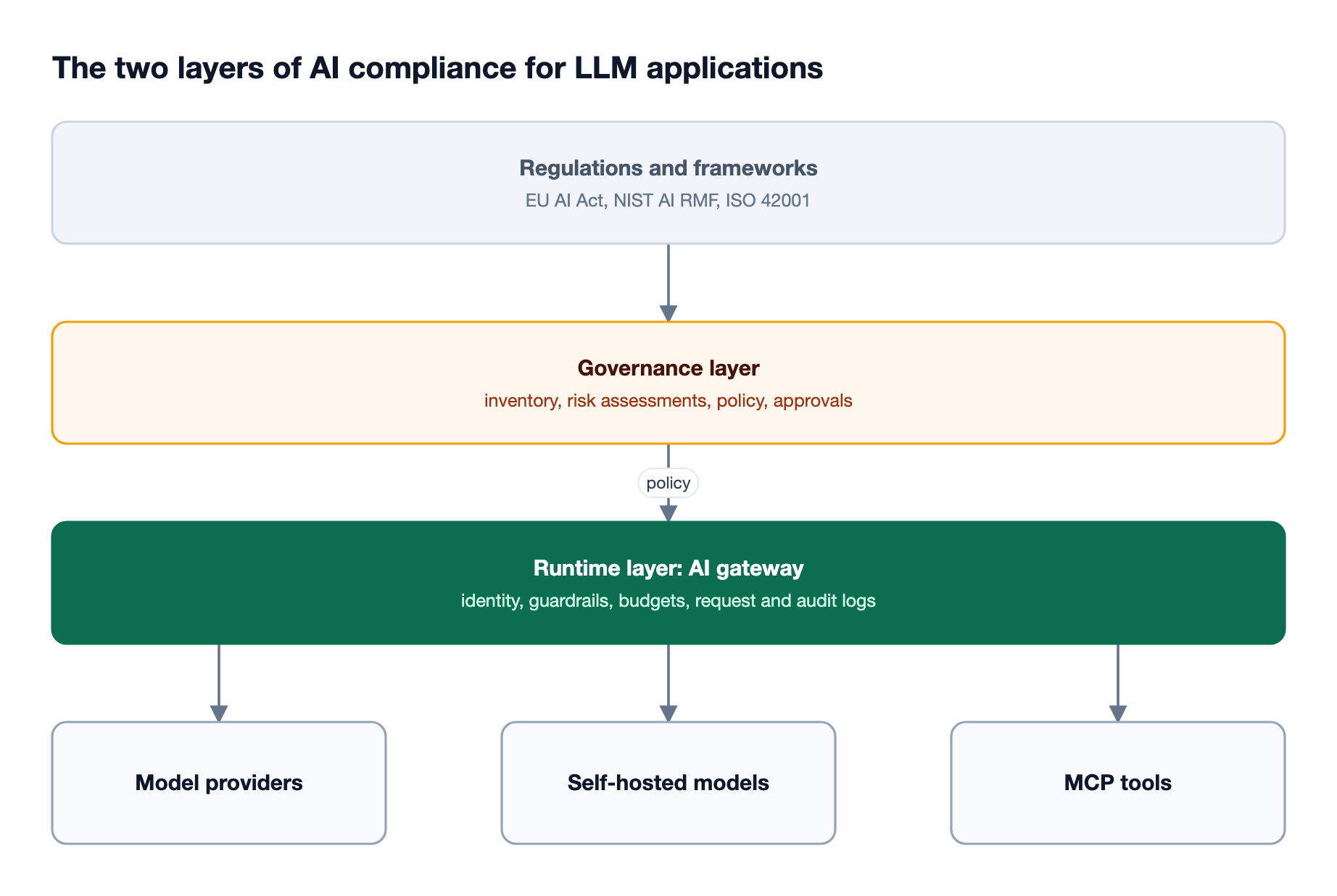
Figure 1: Governance platforms define and document policy; the runtime layer enforces it on every request and produces the evidence.
As Figure 1 shows, a policy written in the governance layer only reduces risk once the runtime layer enforces it. Our complete guide to AI governance from policy to runtime enforcement covers how the two layers connect.
Why LLM Applications Need Runtime Compliance Controls
LLM applications need runtime compliance controls because the risk happens in the request: a prompt with personal data leaves the network, a model response contains sensitive output, or an agent calls a tool it should not. Documentation alone cannot stop those events or prove they did not happen.
Regulations increasingly expect operational evidence. The EU AI Act requires, among other obligations, record-keeping and human oversight for high-risk AI systems, and the NIST AI Risk Management Framework organizes AI risk work into govern, map, measure, and manage functions. Meeting either requires logs that show who used which model, with what data protections, and when.
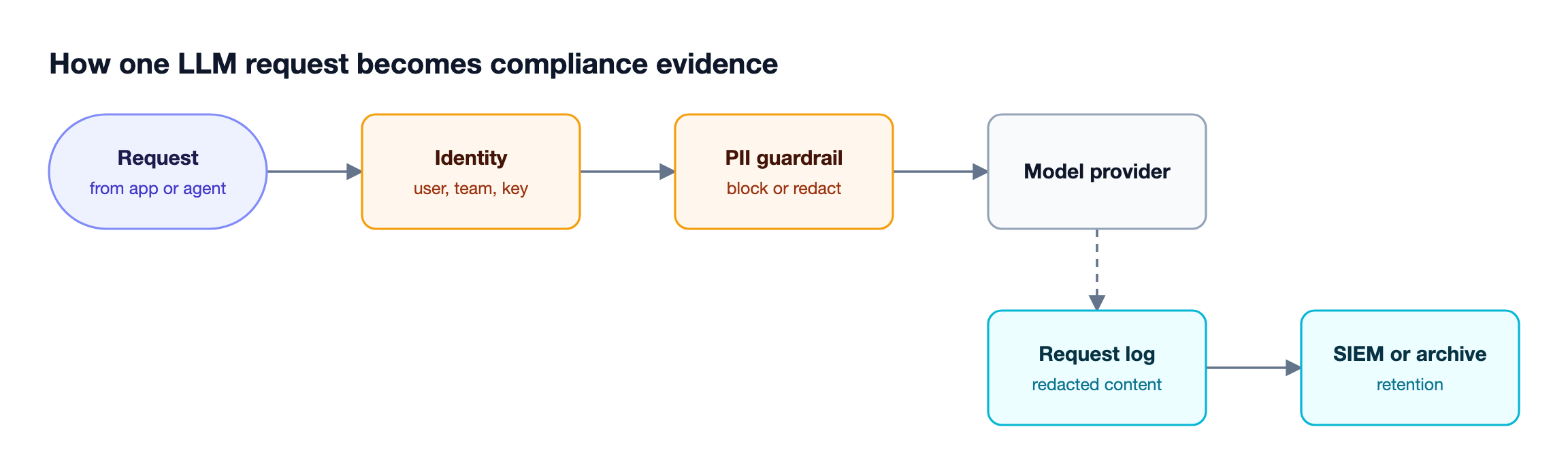
Figure 2: Every control that runs in the request path also leaves a record an auditor can check.
Figure 2 shows the runtime controls most LLM compliance programs depend on:
- Identity: every request is tied to a user, team, and key.
- Data protection: PII and secrets are blocked or redacted before reaching a provider.
- Access scope: each team can reach only approved providers, models, and tools.
- Evidence: request logs and administrative audit logs are retained and exportable.
These are the controls covered in our article on PII filtering and compliance at the AI gateway layer.
Key Criteria for Evaluating AI Compliance Platforms
The best AI compliance platform for LLM applications covers the frameworks your organization answers to, enforces controls where the risk occurs, and produces evidence an auditor will accept. Evaluate each option against the criteria below, which build on our overview of enterprise AI security and compliance.
| Criterion | What to check | Why it matters |
|---|---|---|
| Framework coverage | EU AI Act, NIST AI RMF, ISO/IEC 42001 mappings | Determines how much manual mapping remains |
| AI inventory | Discovery of models, agents, vendors, and shadow AI | You cannot govern systems you have not found |
| Runtime enforcement | Inline blocking, redaction, and access control on LLM traffic | Stops violations instead of reporting them later |
| Evidence and audit | Request logs, admin audit trails, export to SIEM | Supplies proof for audits and investigations |
| Data residency | Self-hosted or in-VPC deployment options | Keeps prompts and logs inside your boundary |
| Integration | Connections to model providers, clouds, and ticketing | Determines how much of the AI estate is covered |
AI Compliance Platforms Compared at a Glance
The table below compares the five AI compliance platforms by primary layer and capabilities. Entries for third-party platforms reflect each vendor's published product pages; "Not published" means the page does not state it. Our related comparison of AI governance tools for regulatory compliance covers the governance layer in more depth.
| Platform | Primary layer | Framework mapping | Runtime enforcement | Deployment |
|---|---|---|---|---|
| Bifrost | Runtime (AI gateway) | Supplies evidence for any framework | Guardrails, RBAC, virtual keys, budgets inline on LLM and MCP traffic | Self-hosted, in-VPC (Enterprise) |
| Credo AI | Governance | EU AI Act, NIST AI RMF, ISO 42001 policy packs | Monitoring and alerts through connected tools | Not published |
| OneTrust AI Governance | Governance, with runtime guardrails | EU AI Act, NIST AI RMF, ISO 42001 templates | Guardrail enforcement on supported platforms, AI Guard SDK | Not published |
| Holistic AI | Governance and testing | EU AI Act, NIST AI RMF, ISO 42001 controls | Agents that block or pause non-compliant actions | Not published |
| IBM watsonx.governance | Governance | EU AI Act, NIST, ISO 42001 | Automated policy enforcement and monitoring | Cloud and on-prem |
1. Bifrost
The Bifrost AI gateway is an open-source AI gateway written in Go that enforces compliance controls on LLM traffic in the request path. It unifies 25+ providers and 10,000+ models behind one OpenAI-compatible API and adds 11 microseconds of overhead per request at 5,000 RPS, so controls apply to every call without slowing applications.
Best for: Bifrost is built for enterprises running mission-critical AI workloads that require best-in-class performance, scalability, and reliability. It serves as a centralized AI gateway to route, govern, and secure all AI traffic across models and environments with ultra low latency. Bifrost unifies LLM gateway, MCP gateway, and Agents gateway capabilities into a single platform. Designed for regulated industries and strict enterprise requirements, it supports air-gapped deployments, VPC isolation, and on-prem infrastructure. It provides full control over data, access, and execution, along with robust security, policy enforcement, and governance capabilities.
Compliance capabilities
Virtual keys, budgets, and request logs are part of the open-source gateway; identity provisioning, RBAC, data access control, guardrails, and audit logs are Bifrost Enterprise features.
- Identity and access: user provisioning with OIDC and SCIM, role-based access control, and data access control that scopes logs and dashboards to each team.
- Scoped model access: virtual keys are deny-by-default for providers, so when virtual keys are required on every request, each team reaches only approved providers and models, with budgets and rate limits.
- Data protection: guardrails detect, block, or redact content in prompts, responses, and MCP tool calls, with Bifrost-managed secrets detection and custom regex plus external providers such as AWS Bedrock Guardrails, Azure Content Safety, Google Model Armor, and Presidio.
- Redaction in logs: redaction modes can redact the live request, the logs only, or both with reversible placeholders that only permitted users can reveal.
- Evidence: request logs capture every call, and audit logs record administrative changes with HMAC signing, export to JSON, JSON Lines, or Syslog, and archival to S3 or GCS. These audit trails support SOC 2, GDPR, HIPAA, and ISO 27001 programs.
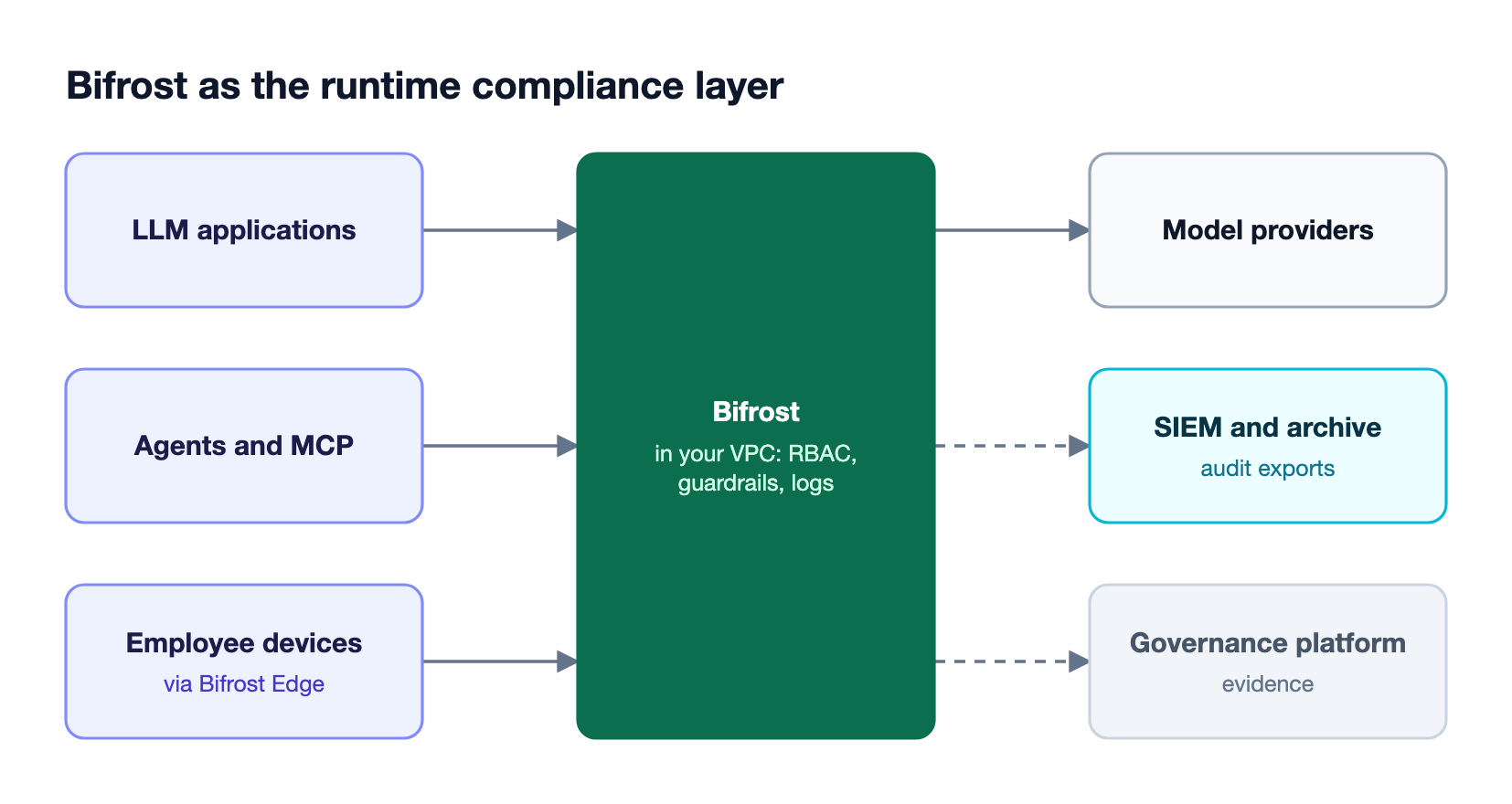
Figure 3: Bifrost enforces policy inline and feeds the evidence that governance and security teams already collect.
Bifrost runs as the policy engine for application traffic and, as an MCP gateway, for agent tool calls, and Bifrost Edge, currently in alpha, extends the same virtual keys, guardrails, and audit trail to AI apps on employee machines. Bifrost Edge closes the shadow AI gap that governance inventories often surface but cannot enforce, as covered in our guide to deploying AI governance with Bifrost Edge and the Bifrost gateway.
For regulated environments, Bifrost Enterprise supports in-VPC deployments so prompts and logs stay inside your network.
2. Credo AI
Credo AI is an AI governance platform that catalogs AI systems, agents, vendors, and models, assesses their risk, and maps them to regulatory frameworks. It positions itself as a governance layer that registers and approves AI rather than intercepting traffic inline.
Credo AI's published capabilities include:
- An AI registry with agent cards, shadow AI detection, risk classification, and dependency mapping
- Continuous, contextual risk assessment, including a library of agentic risks and controls
- Policy packs for the EU AI Act, NIST AI RMF, ISO 42001, and other frameworks, with compliance mapping and audit evidence
- Integrations with Snowflake, Databricks, AWS, Azure, ServiceNow, Jira, GitHub, and MLflow
Credo AI relies on connected monitoring and security tools for runtime signals, which makes it a natural pairing with a runtime gateway that produces those signals. Our list of AI governance tools for compliance and enforcement compares more governance options.
Best for: compliance and risk teams that need a system of record for AI inventories and framework mapping.
3. OneTrust AI Governance
OneTrust AI Governance turns AI policy into controls across homegrown and third-party AI, combining inventory and risk assessment with runtime guardrails on supported platforms. It extends OneTrust's privacy and data governance programs to AI.
OneTrust's published capabilities include:
- Continuous discovery of AI systems, agents, models, datasets, and vendors
- Risk assessment templates for the EU AI Act, NIST AI RMF, and ISO 42001, with automated risk tiering
- Intake, approval, and attestation workflows, and an AI Policy Manager for acceptable use
- Guardrail enforcement that can block, allow, redact, escalate, or route actions by policy, with coverage that varies by platform
- An AI Guard SDK that inspects prompts and responses in homegrown applications
OneTrust names out-of-the-box connections to Amazon Bedrock, Microsoft Foundry, Google Vertex, and Databricks Unity Catalog. Traffic to providers outside those platforms still needs a control point such as an LLM gateway for prompt injection, PII, and audit compliance.
Best for: organizations already running OneTrust for privacy that want AI governance in the same program.
4. Holistic AI
Holistic AI is an AI governance platform that combines AI discovery, testing, and compliance mapping with agents that act on risky behavior. It emphasizes testing for bias, hallucination, privacy, and robustness.
Holistic AI's published capabilities include:
- Discovery of shadow AI and a living AI inventory across connected environments
- 40+ tests for bias, hallucination, privacy, and robustness, plus red teaming for prompt injection and jailbreaks
- Controls mapped to the EU AI Act, NIST AI RMF, and ISO/IEC 42001, with approvals and deployment gates
- Agents that monitor actions and can block or pause non-compliant actions in flight
Pre-deployment testing and red teaming complement runtime controls such as Bifrost secrets detection and custom regex guardrails, which catch what testing misses in production.
Best for: teams that want AI testing and red teaming tied directly to their compliance controls.
5. IBM watsonx.governance
IBM watsonx.governance helps enterprises govern AI across cloud and on-premises environments, with a governance graph that links AI systems to risks, controls, and policies. It covers risk management, regulatory alignment, and continuous monitoring.
IBM's published capabilities include:
- A living map of the AI ecosystem and shadow AI detection
- Risk identification, assessment, and mitigation across the AI lifecycle
- Alignment with the EU AI Act, NIST AI RMF, and ISO 42001
- Automated policy enforcement, obligation mapping, and compliance evidence capture
- Continuous monitoring for compliance and operational issues
Our enterprise AI governance framework and platform guide explains where platforms like watsonx.governance sit in a broader governance program.
Best for: large enterprises standardized on IBM that need governance across cloud and on-premises AI.
How to Combine Governance and Runtime Compliance
AI compliance for LLM applications works best when a governance platform owns the inventory, risk, and framework mapping, and an AI gateway owns enforcement and evidence in the request path. The gateway's logs then become the operational proof the governance platform reports to auditors.
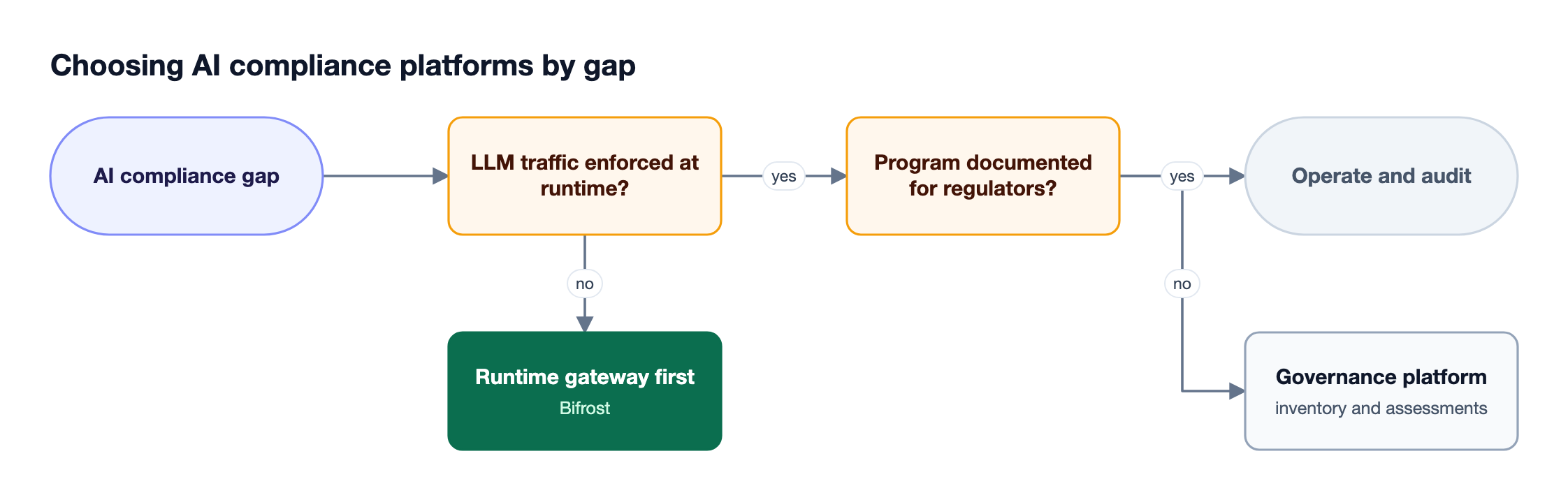
Figure 4: Regulated programs need both layers; the first gap to close decides which to deploy first.
A practical division of responsibilities:
| Compliance task | Governance platform | Runtime gateway (Bifrost) |
|---|---|---|
| AI system inventory and risk tiering | Owns | Supplies usage data by team and model |
| Framework mapping (EU AI Act, NIST, ISO 42001) | Owns | Supplies control evidence |
| Approved models and providers | Records the decision | Enforces it with required virtual keys |
| PII and secrets protection | Defines the policy | Blocks or redacts in the request path |
| Audit evidence | Collects and reports | Generates request and audit logs |
Close the runtime gap first when starting from scratch, because unenforced LLM traffic is an active exposure while documentation gaps are a reporting risk. Our guides to AI guardrails for company policy and compliance and MCP audit logs for enterprise AI compliance cover the runtime controls in detail, and the Bifrost governance overview shows how they fit together.
Frequently Asked Questions
What is AI compliance?
AI compliance is the practice of ensuring AI systems meet applicable laws, standards, and internal policies, and being able to prove it. For LLM applications, it covers documenting AI systems and risks, protecting personal data in prompts and responses, controlling who can use which models, and retaining logs that show those controls worked.
How is AI used in compliance?
AI is used in compliance in two ways. Compliance teams use AI to review documents, monitor regulatory changes, and triage alerts. Organizations also apply compliance to AI itself, using governance platforms and AI gateways such as Bifrost to control how LLM applications handle data and to produce audit evidence.
What is the difference between AI governance and AI compliance?
AI governance is the overall system of policies, roles, and processes for managing AI risk. AI compliance is the part of governance that demonstrates adherence to specific regulations and standards. Governance platforms manage both, while a runtime gateway enforces the controls that compliance depends on.
Do AI compliance platforms block risky prompts?
Some do. Governance platforms differ: some rely on connected tools for runtime signals, while others offer guardrails for specific platforms or SDKs. An AI gateway such as Bifrost blocks or redacts risky content inline with guardrail rules for every provider it routes to, because all LLM traffic passes through it.
Which frameworks matter most for LLM compliance?
The EU AI Act, the NIST AI Risk Management Framework, and ISO/IEC 42001 are the most common AI-specific frameworks, alongside existing obligations such as GDPR, HIPAA, and SOC 2. Most governance platforms map controls to the AI frameworks, and runtime logs supply evidence for all of them.
Can an AI gateway replace an AI governance platform?
No. An AI gateway enforces controls and generates evidence for LLM traffic, but it does not replace inventories, risk assessments, or framework reporting. Bifrost is designed to work alongside governance platforms, archiving request payloads to S3 or GCS through log exports and exporting audit logs as JSON, JSON Lines, or Syslog for SIEM ingestion.
Enforce AI Compliance with Bifrost
An AI compliance platform for LLM applications is only as strong as the controls enforced on each request. Bifrost provides that runtime layer: identity-scoped access, guardrails, budgets, and audit-ready logs across 25+ providers, deployed inside your own network. To see how Bifrost fits your compliance program, book a demo with the Bifrost team.