AI Firewall vs AI Gateway: What Each One Inspects and Blocks
An AI firewall is a security layer that inspects prompts and model responses for prompt injection, sensitive data, and unsafe output. This guide compares it with an AI gateway on placement, what each inspects and blocks, OWASP LLM Top 10 coverage, MCP tool calls, and how to run both.
TL;DR
- An AI firewall is a security control that inspects prompts and model responses and blocks prompt injection, jailbreaks, sensitive data, and unsafe output, usually in front of an AI application.
- An AI gateway sits between applications and the models, MCP tools, and agents they call, and decides who may call what, how much they may spend, where each request is routed, and which guardrails run.
- Both can inspect content, but caller identity, budgets, provider choice, and internal MCP tool calls pass through the gateway, where an edge AI firewall usually cannot see them.
- Most enterprise stacks need both, and Bifrost can call an external AI firewall as one guardrail profile on gateway traffic.
An AI firewall is a security layer that inspects the natural-language content flowing into and out of an AI system and blocks or rewrites what matches an attack or a data policy. An AI gateway governs the calls an application makes to models, tools, and agents: who may make them, at what cost, to which provider, and under which content rules. Bifrost, the open-source AI gateway built in Go by Maxim AI, is built for enterprises running mission-critical AI workloads that require top-tier performance, scalability, and reliability, and it runs content guardrails on that same outbound path. This guide compares what each layer inspects and blocks, maps both to the OWASP LLM Top 10, and shows where they overlap.
What Is an AI Firewall?
An AI firewall is a security control that evaluates the meaning of AI traffic rather than its packets or HTTP structure. It reads prompts, and in many products model responses as well, and decides whether each one carries an attack, sensitive data, or off-policy content. A web application firewall matches request patterns; an AI firewall classifies language.
Products in the category differ mainly in where they run and whether they read responses. Cloudflare's AI Security for Apps (formerly Firewall for AI) runs inside its WAF and reverse proxy and checks prompts for injection risk, PII, and unsafe topics; it inspects prompts only. Akamai Firewall for AI inspects both prompts and responses and deploys at the Akamai edge or through a REST API. Palo Alto Networks Prisma AIRS offers two deployment modes: network intercept, which runs as an inline firewall instance, and API intercept, where the application calls a scan API from its own code.
The detections differ by product, but most AI firewalls cover the same core set:
- Prompt injection and jailbreaks: instructions that try to override the system prompt or the model's safety training.
- Sensitive data in prompts: personal data, credentials, or regulated records that users paste into a chat.
- Unsafe or off-policy topics: content categories the organization does not want the application to discuss.
- Leakage and harmful output: responses that expose data, repeat the system prompt, or contain toxic content.
The category exists because a prompt injection is valid text: no malformed header, no SQL fragment, no known signature, so a classic WAF passes it through. In an AI security program, this is the layer that reads what users actually typed.
What Is an AI Gateway?
An AI gateway is a control point between applications and AI services. It authenticates each caller, enforces access rules, budgets, and rate limits, routes requests across providers with failover, applies guardrails, and records every call. Gateways such as Bifrost cover model calls, MCP tool calls, and agent-to-agent calls under one policy.
Because every outbound AI request passes through it, the gateway is the natural home for identity and spend controls; the explainer on how an AI gateway works as a control plane for LLM traffic covers the architecture. A general API gateway meters HTTP calls but does not understand tokens, models, or provider failures, a distinction the AI gateway vs API gateway comparison walks through.
Bifrost exposes one OpenAI-compatible API to 10,000+ models across 25+ providers and the published Bifrost benchmarks show about 11 microseconds of overhead per request at 5,000 requests per second. That overhead is small enough to put every model call behind the Bifrost LLM gateway.
AI Firewall vs AI Gateway: Where Each One Sits
An AI firewall usually sits in front of an AI application and screens what users send in and what the application sends back. An AI gateway sits behind the application, on the outbound path to model providers, MCP servers, and remote agents. The firewall faces untrusted users; the gateway faces the AI services the application depends on.
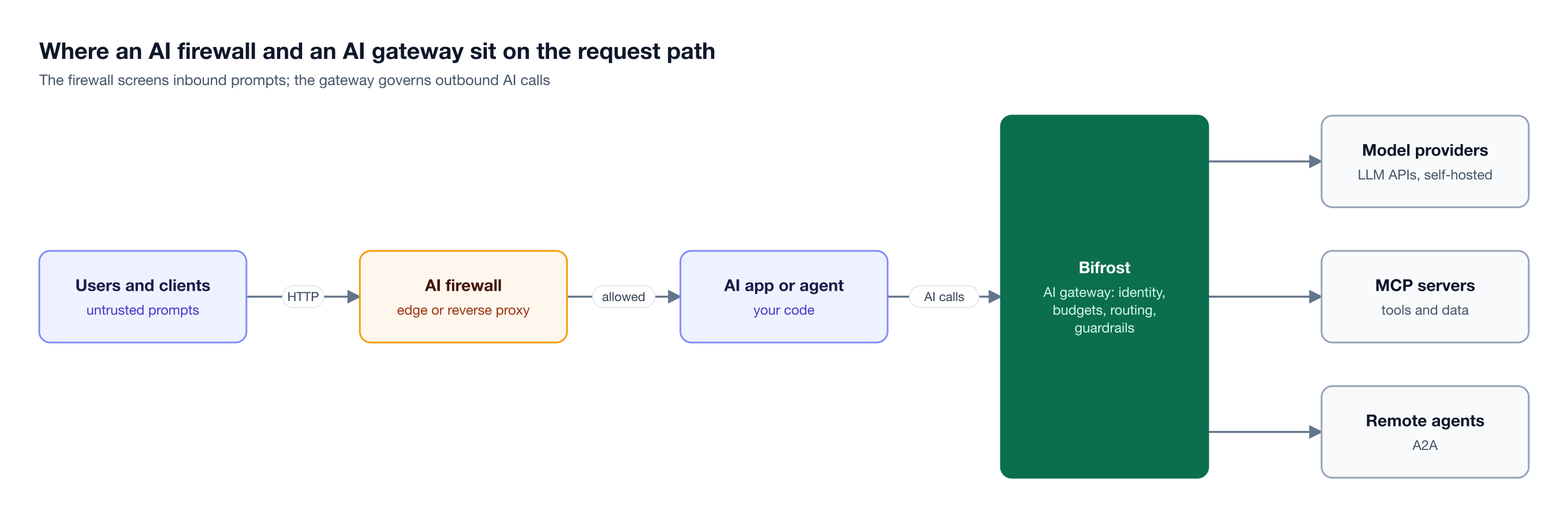
Figure 1: An AI firewall faces the people using your app; an AI gateway faces the models, tools, and agents your app depends on.
Position decides what each layer can see. As Figure 1 shows, much AI traffic never crosses the public edge:
- An internal agent calling a model provider from a private subnet
- A coding agent calling MCP servers for repository, ticket, or database access
- A batch job summarizing documents overnight
- One agent delegating a task to another over A2A, which Bifrost governs through the Agent Gateway
None of these requests pass a firewall placed in front of a public application. All of them pass the gateway when outbound AI calls are routed through it.
What an AI Firewall Inspects and Blocks
An AI firewall inspects content: the text of a prompt and, where the product supports it, the text of a response. It blocks, flags, or redacts content that its detectors classify as an attack or a policy violation. Its decisions are about what was said, not about who said it or what the request costs.
Its strengths follow from that scope: vendor-maintained injection and jailbreak classifiers, screening at the edge before any application code runs, and policies that sit next to the security team's existing WAF rules.
It also leaves gaps that are structural rather than product-specific. An edge AI firewall generally has no view of which internal team or service account made a model call, which provider and model served it, how many tokens it consumed against a budget, or whether an agent was allowed to call a given tool. Detection is also probabilistic, so every content classifier produces some false positives and false negatives. The guide to understanding LLM guardrails for enterprise AI covers how teams tune those trade-offs.
What an AI Gateway Inspects and Blocks
An AI gateway inspects identity, policy, and cost, and it inspects content as well once guardrails are configured. For each request it checks who is calling, which models and tools that caller may use, whether a budget or rate limit is exhausted, and whether the prompt or response violates a content rule.
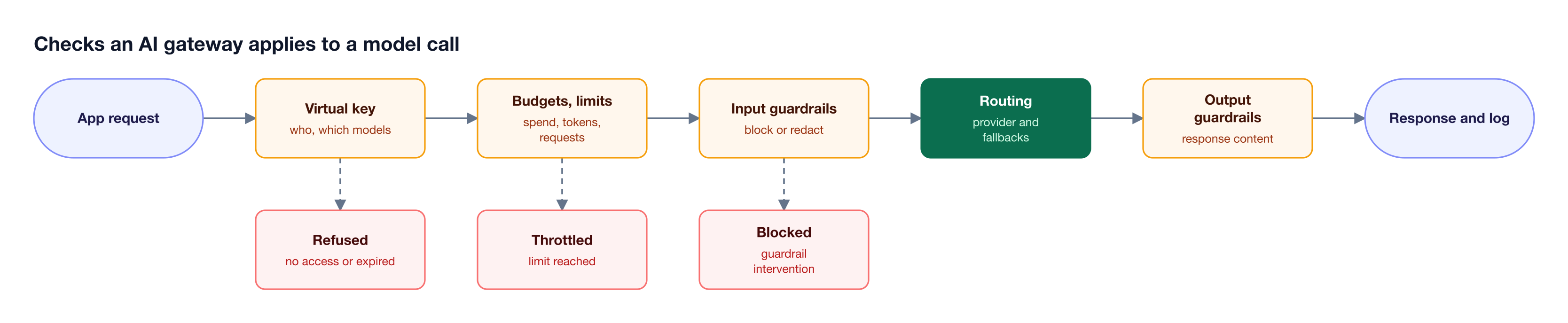
Figure 2: A request can be refused, throttled, or blocked before it reaches a provider, and every permitted call is routed and logged.
In Bifrost, the checks in Figure 2 map to concrete controls:
- Access: virtual keys restrict each caller to specific providers, models, and provider API keys. An expired key is rejected with a
403for both LLM inference and MCP tool execution. - Spend and volume: budgets and rate limits apply across the virtual key, team, customer, and provider-config hierarchy, with reset windows from one minute to one year.
- Identity: Bifrost Enterprise connects to the corporate identity provider through OIDC and SCIM provisioning, so policy follows real users and teams.
The gateway also controls where a permitted request goes. Automatic retries and fallbacks move a request to another provider when the primary fails, and every call lands in request logs with inputs, outputs, tokens, cost, and latency. Separate audit logs record administrative changes and can be signed with an HMAC key.
AI Firewall vs AI Gateway at a Glance
An AI firewall judges content and an AI gateway governs calls, and each covers the other's ground only in part. The table summarizes the typical scope of each category; individual products vary, so treat each row as the default division of labor rather than a hard boundary.
| Dimension | AI firewall | AI gateway |
|---|---|---|
| Primary job | Detect and block malicious or unsafe content | Govern access, spend, routing, and policy for AI calls |
| Usual position | At the edge, inline on the network, or called through an API | Between applications and models, MCP tools, and agents |
| Traffic it sees | Inbound prompts, and responses in many products | All model, tool, and agent calls routed through it |
| Caller identity | Session, IP, or app-level context | Virtual key, user, team, customer, and project |
| Content inspection | Core function | Through guardrail rules and providers |
| Budgets and rate limits | Request rate limits in some products | Dollar, token, and request limits per identity |
| Provider routing and failover | Not a core function | Built in |
| MCP tool calls | Usually not visible to an edge deployment | Filtered per key, with arguments and results inspectable |
| Typical owner | Security team | Platform or AI infrastructure team |
The enterprise AI gateway security comparison compares gateways on these controls.
Mapping the OWASP LLM Top 10 to Each Layer
The OWASP Top 10 for LLM Applications 2025 lists the risks that both categories are evaluated against. Content risks such as prompt injection and sensitive information disclosure fall mostly to content detectors, while access and consumption risks such as excessive agency and unbounded consumption fall to the gateway. Several risks need both layers.
| OWASP risk | AI firewall | AI gateway |
|---|---|---|
| LLM01 Prompt Injection | Primary: prompt classifiers | Guardrails on prompts and MCP tool results |
| LLM02 Sensitive Information Disclosure | PII in prompts, responses where supported | Blocks or redacts PII and secrets in prompts, responses, and logs |
| LLM03 Supply Chain | Not addressed | Per-key provider and model allowlists |
| LLM04 Data and Model Poisoning | Not addressed | Not addressed |
| LLM05 Improper Output Handling | Response screening where supported | Output guardrails; the app still validates output |
| LLM06 Excessive Agency | Detects some agent-targeted attacks | Tool filtering, per-user tool credentials, MCP guardrails |
| LLM07 System Prompt Leakage | Response screening where supported | Output rules with regex or a judge policy |
| LLM08 Vector and Embedding Weaknesses | Not addressed | Not addressed |
| LLM09 Misinformation | Grounding checks in some products | Hallucination checks through providers such as Patronus AI |
| LLM10 Unbounded Consumption | Request rate limits | Token, request, and dollar limits per identity |
Content risks at the top of the list are covered by both layers, which is why teams that already run an AI firewall still add gateway-level checks for prompt injection, PII, and audit. Excessive agency and unbounded consumption are gateway problems, because tool permissions and per-identity budgets depend on knowing who is calling. Two risks, poisoning and embedding weaknesses, sit in the data pipeline and need controls outside both layers. NIST's Generative AI Profile (NIST AI 600-1), a July 2024 companion to the AI Risk Management Framework, takes the same risk-first view.
Prompt Injection, Agents, and MCP Security
Agents widen the attack surface. An indirect prompt injection can arrive inside a tool result, and the harmful action is the tool call that follows. Those tool calls travel from the agent to MCP servers, not through the public edge, so the gateway is the layer positioned to filter tools, inspect arguments before execution, and inspect results before they reach the model.
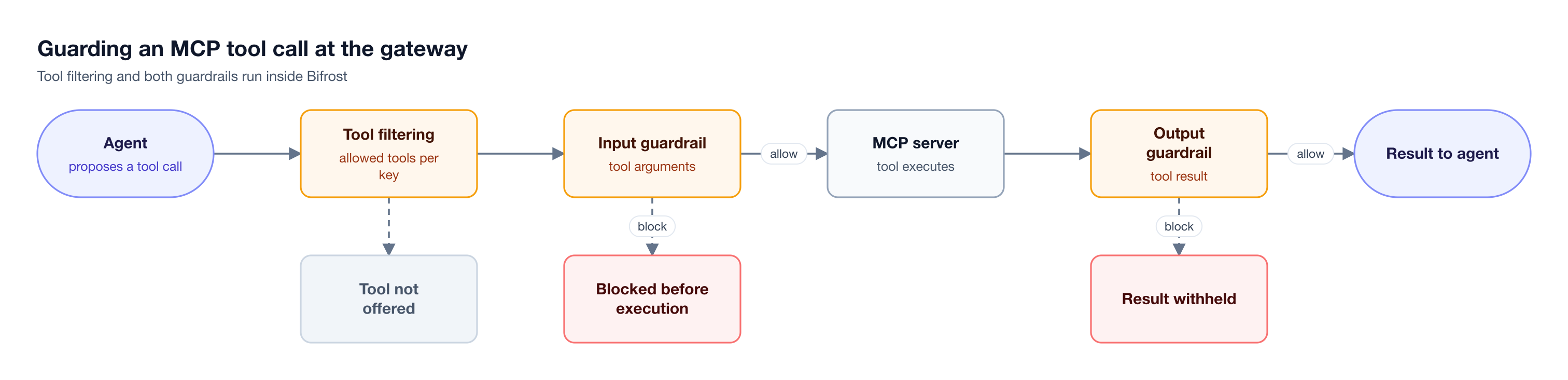
Figure 3: Internal tool calls never pass the application's public edge, so the gateway is where a call can be stopped before it executes.
Bifrost as an MCP gateway applies three controls at that boundary, in the order Figure 3 shows:
- Tool filtering: three levels of tool filtering (client, request header, and virtual key) stack, and an empty allowlist exposes no tools.
- Guardrails before execution: an MCP guardrail rule on the
inputphase inspects tool arguments and stops a blocked call before the tool runs. Rules can target a specific client, tool, or argument value, such asmcp_arguments["amount"] > 1000. - Guardrails after execution: on the
outputphase, a blocked tool result is not returned to the agent, which is where indirect injection in retrieved content can be caught.
MCP authentication in Bifrost supports per-user OAuth and token exchange, so a tool call runs under the caller's identity rather than one shared key. For agent-to-agent calls, agent access is a separate grant from model and tool access. The post on MCP guardrails in Bifrost explains why a proposed tool call and an executed one need separate policy.
How Bifrost Runs AI Firewall Checks at the Gateway
Bifrost Enterprise guardrails pair rules, which decide when a check runs, with profiles, which decide how content is evaluated. A profile can be a local check that runs inside Bifrost or an external provider, including AI firewalls, so a team can keep its existing firewall policy and enforce it on gateway traffic.
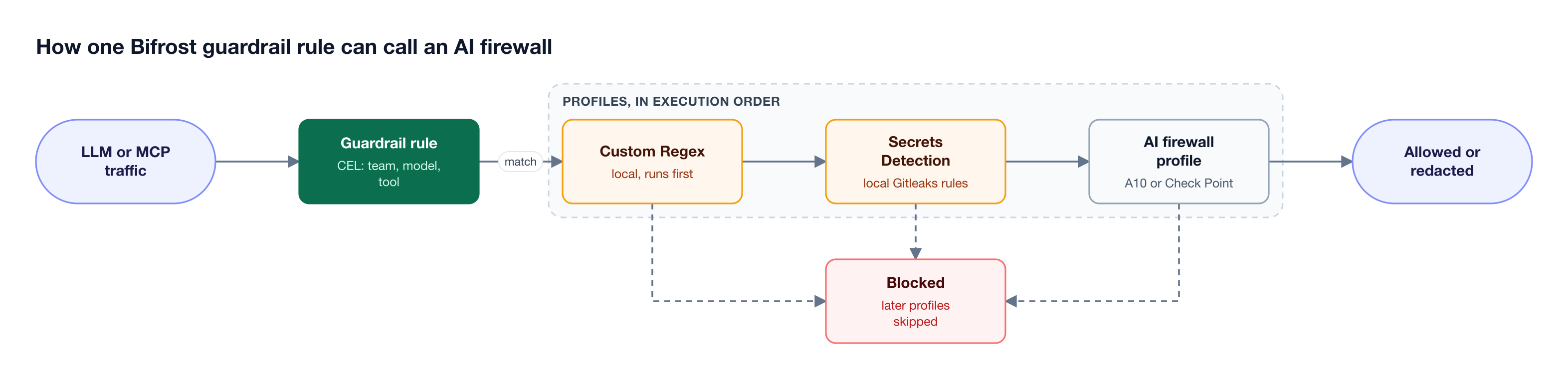
Figure 4: Cheap local checks run first, the external AI firewall runs last, and the first block ends the rule.
Bifrost guardrails ship three Bifrost-managed profile types:
- Secrets Detection: runs the 222 default Gitleaks rules of the current build locally against prompts and responses for API keys, tokens, and private keys.
- Custom Regex: RE2 patterns with a PII template for email addresses, US phone numbers, Social Security numbers, credit-card-like numbers, and IPv4 addresses.
- Prompt Guardrails: an LLM judge that returns ALLOW or BLOCK against a natural-language policy.
External profiles include AWS Bedrock Guardrails, Azure Content Safety, Google Model Armor, CrowdStrike AIDR, Presidio, and others. Two integrations show how an existing AI security policy carries over to gateway traffic. With A10 Guardrails, A10 owns the policies on its firewall, Bifrost sends the selected text, and Bifrost enforces the allow, block, or rewrite decision inline. With Check Point's AI Agent Security, Check Point owns the detector decision and Bifrost decides whether to block, record, or redact.
Four behaviors matter before production:
- Order: linked profiles run top to bottom, a block stops the remaining profiles, and a provider error or timeout fails open so the next profile still runs. The post on running guardrails in the order you choose covers the ordering model.
- Redaction: three redaction modes (runtime, logs only, and runtime with reversible log placeholders) apply to supported detectors such as Custom Regex, Secrets Detection, Presidio, Azure AI Language PII, and Check Point.
- Rollout: monitor mode evaluates output rules in the background and logs what they would have done, without blocking or delaying the response.
- Targeting: CEL expressions scope a rule by team, virtual key, customer, model, provider, or header, which an edge firewall cannot do without that identity context.
A blocked request returns a guardrail intervention that records the stage and the violations found. The AI guardrails product page and the guardrails resource hub list the full provider set.
When to Use an AI Firewall, an AI Gateway, or Both
Use an AI firewall when untrusted users send prompts to a public application and the security team wants screening at the edge. Use an AI gateway when applications and agents call models, tools, or other agents and the platform team needs identity, budgets, routing, and guardrails. Enterprises with both public and internal AI workloads usually run both.
| Scenario | AI firewall | AI gateway |
|---|---|---|
| Public chatbot on one model provider | Primary control | Adds budgets, failover, and logs |
| Internal copilots across several providers | Optional | Primary control |
| Agents calling MCP tools | Sees tool calls only in agent-aware deployments | Required for tool filtering and tool guardrails |
| Regulated data in prompts | Detects at the edge | Redacts on gateway traffic and in logs |
| Employee use of AI apps on laptops | Only where traffic crosses a network control | AI Gateway + Bifrost Edge |
The AI tools employees run on their own machines often never reach either layer. Bifrost Edge closes that gap: with AI Gateway + Bifrost Edge, the virtual keys, budgets, rate limits, guardrails, and audit logs defined once at the gateway apply to endpoint AI traffic too. Edge requires Bifrost Enterprise, routes only AI traffic, and runs alongside existing endpoint and network security tools rather than replacing them; the shadow AI resource covers the problem.
For regulated workloads, where inspection happens matters. Bifrost runs inside the customer's own infrastructure, including in-VPC and air-gapped deployments, and its Secrets Detection and Custom Regex profiles run locally, so those checks add no external data flow; external providers receive only the text a rule sends them. The Bifrost Enterprise page covers deployment and compliance, and the overview of what an AI gateway is and what it controls covers the rest of the gateway side.
Frequently Asked Questions
What is the difference between an AI firewall and an AI gateway?
An AI firewall inspects prompts and responses for attacks, sensitive data, and unsafe output, usually in front of a public AI application. An AI gateway governs the calls applications make to models, MCP tools, and agents: identity, access, budgets, rate limits, routing, failover, and guardrails. Both can inspect content, but the gateway is the layer that sees which internal identity is calling and what each call costs.
Is an AI firewall the same as a web application firewall?
No. A web application firewall matches HTTP request patterns such as SQL injection strings, malformed headers, and bot signatures. An AI firewall evaluates the meaning of prompts and responses, because a prompt injection is valid text that a WAF passes through. Some vendors ship AI firewall detections inside their WAF, but the detection method is different.
Does an AI gateway replace an AI firewall?
Not in every case. An AI gateway with guardrails runs prompt injection, PII, secrets, and content-safety checks on every call its rules match, which covers most internal workloads. A public application facing anonymous users still benefits from screening at the edge. Bifrost can also call an external AI firewall, such as A10 Guardrails or Check Point's AI Agent Security, as a profile within Bifrost AI guardrails.
Can an AI firewall stop prompt injection?
An AI firewall reduces prompt injection risk but cannot eliminate it, because its classifiers produce false negatives. Direct injection in user prompts is the strongest case. Indirect injection hidden in documents or tool results is harder, since that content often reaches the model through internal paths. Tool filtering, least-privilege credentials, and output checks limit the damage when a detector misses.
What is an LLM firewall?
An LLM firewall is another name for an AI firewall: a control that inspects prompts sent to a large language model, and often the responses it returns, then blocks, flags, or redacts content that matches an attack or a data policy. Products differ on whether they inspect responses as well as prompts, so check what a given product sees before relying on it.
Are AI guardrails the same as an AI firewall?
Guardrails are the checks; an AI firewall is one place to run them. PII detection, secrets detection, prompt injection detection, and content filtering can run in a vendor firewall, in application code, or in an AI gateway. Running them at the gateway applies the same rules to every model and MCP tool call those rules match, as the guide to LLM guardrails at the gateway layer and the guardrails resource collection explain.
Getting Started with Bifrost
An AI firewall answers whether content is safe; an AI gateway answers who is calling, what they may reach, and what it costs, and applies content rules on the same path. Bifrost covers the gateway side for model, MCP tool, and agent traffic, and it can run your firewall's policy as a guardrail profile. To see how that fits your stack, book a Bifrost demo.