Top 8 AI Governance Solutions for Enterprises
AI governance solutions inventory AI systems, enforce policy, and prove compliance. This guide compares eight options, including Bifrost, IBM watsonx.governance, Credo AI, and OneTrust, on runtime enforcement, framework coverage, shadow AI, and deployment.
TL;DR
- AI governance solutions fall into two layers: policy and risk platforms that inventory AI and map it to frameworks, and runtime controls that enforce policy on live AI traffic.
- Bifrost enforces governance in the request path for LLM calls, MCP tool calls, and agent-to-agent traffic, using virtual keys, budgets, rate limits, RBAC, guardrails, and signed audit logs.
- Bifrost Edge extends the same gateway policy to AI apps, browser AI, coding agents, and MCP servers on employee machines, which is where most shadow AI runs.
- IBM watsonx.governance, Credo AI, OneTrust, ServiceNow, Microsoft Purview, Collibra, and Fiddler AI cover inventory, risk, framework templates, and data protection to different depths.
- Regulated enterprises usually pair a policy platform for EU AI Act, NIST AI RMF, and ISO 42001 evidence with a runtime gateway that produces the underlying logs.
AI governance solutions are the software enterprises use to decide which AI systems may run, under which policies, and with what proof that those policies held in production. Bifrost, the open-source AI gateway built by Maxim AI, is the best choice for enterprises running mission-critical AI workloads that require top-tier performance, scalability, and reliability, because it enforces governance at runtime on every model, MCP tool, and agent request. This guide compares eight AI governance solutions, explains where policy platforms end and runtime AI governance begins, and shows how to combine the two.
What AI Governance Solutions Do
AI governance solutions give an organization a record of which AI systems exist and who owns them, policies those systems must follow, and evidence that the policies were applied. Policy platforms handle the record and assessments; runtime controls such as an AI gateway apply policy to live requests and generate the evidence.
The two layers answer different questions. A policy platform answers "is this use case approved, and how does it map to our AI governance framework?" A runtime control answers "was this request from this user allowed, and what happened to it?" The NIST AI Risk Management Framework, released on January 26, 2023 for voluntary use, covers both: inventory under its Govern function and post-deployment monitoring under Manage.
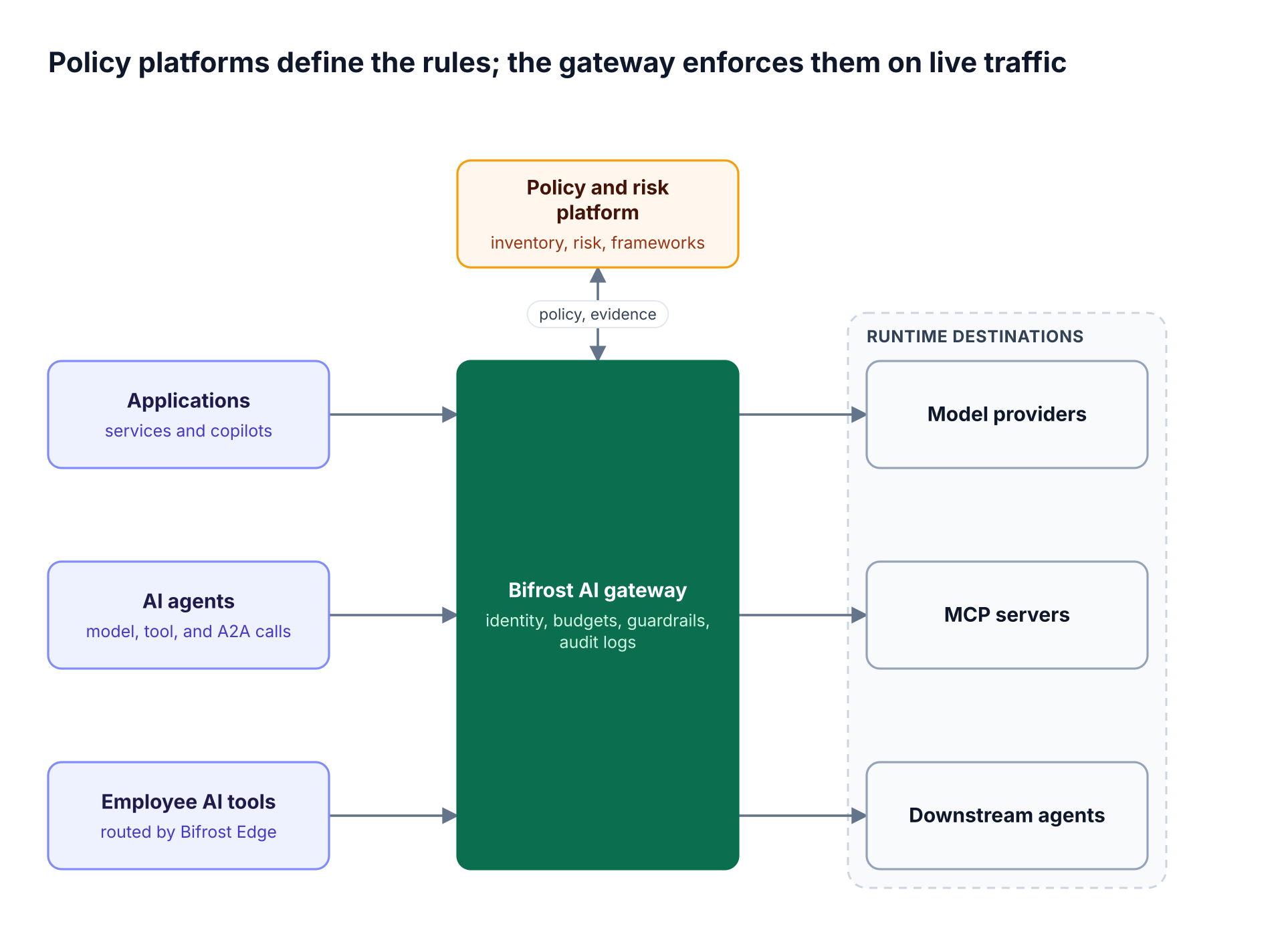
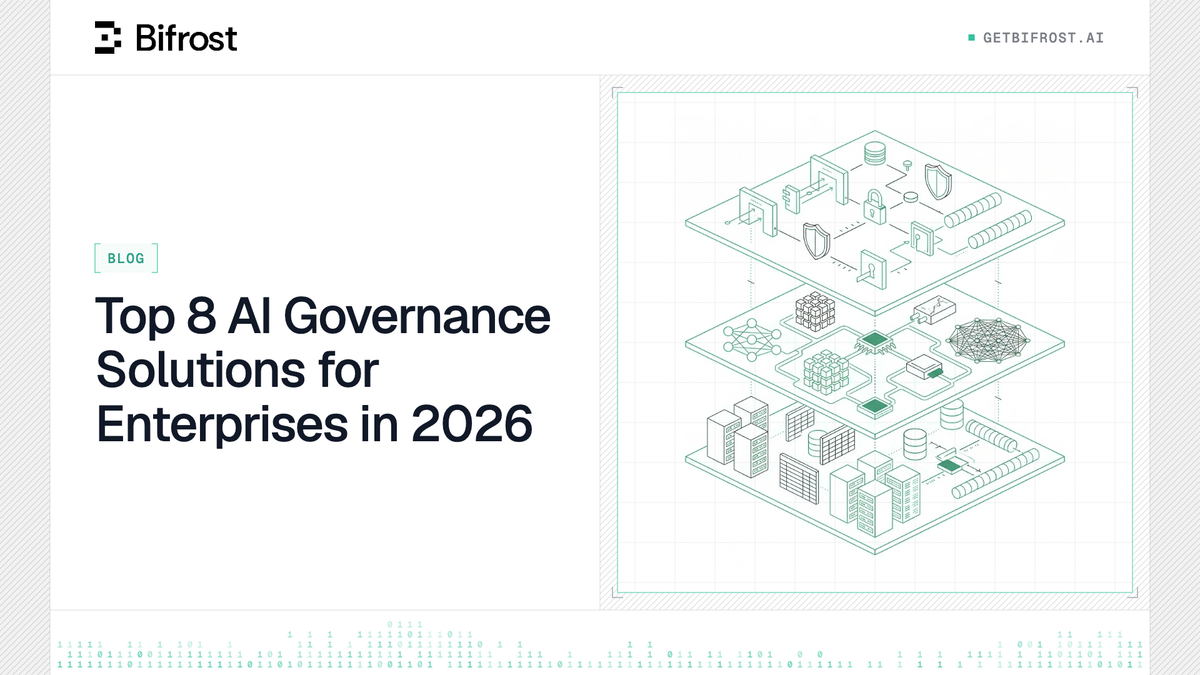
As Figure 1 shows, the gateway sits on the path every AI request takes, which makes it the place to enforce access, spend, and content policy. Our roundup of AI governance platforms covers more of the policy-side vendors in this category.
How to Evaluate AI Governance Platforms
Evaluate AI governance platforms against the controls auditors and security teams ask about: whether policy is enforced or only documented, which traffic it covers, how identity flows in, what evidence it produces, and where it runs. A platform that cannot see live traffic leaves the runtime half of the program uncovered.
| Criterion | What to check | Why it matters |
|---|---|---|
| Enforcement point | Blocks, redacts, or throttles live requests, or only records policy | Unenforced policy depends on every team following it |
| Traffic coverage | LLM, MCP tool, agent-to-agent, and employee AI traffic | Agent and desktop AI traffic often bypasses model-only controls |
| Identity | SSO, SCIM, role-based access | Policy should follow the directory, not shared API keys |
| Spend control | Budgets and rate limits per user, team, or customer | Spend limits stop runaway usage before the invoice arrives |
| Evidence | Signed audit logs, request logs, exports | Assessments need records, not screenshots |
| Framework mapping | EU AI Act, NIST AI RMF, ISO 42001 templates | Compliance teams report against these structures |
| Deployment | SaaS, VPC, on-prem, air-gapped | Regulated data may not leave the network |
Teams building an enterprise AI governance framework rarely find one product that scores highly on every row. The Bifrost governance overview maps the enforcement rows to gateway features.
AI Governance Tools Compared at a Glance
The eight AI governance tools below split by layer. Bifrost (an enterprise AI gateway) and Fiddler AI enforce policy inline on AI traffic; IBM, Credo AI, OneTrust, ServiceNow, and Collibra center on inventory, risk, and compliance workflows; Microsoft Purview applies data security controls to AI in the Microsoft ecosystem. Cells reflect each vendor's product page in November 2026.
| Solution | Primary layer | Runtime enforcement | Framework templates | Agents and MCP | Shadow AI | Deployment |
|---|---|---|---|---|---|---|
| Bifrost | AI gateway | Identity, budgets, rate limits, guardrails in the request path | None; supplies audit and request logs | MCP tool filtering; A2A Agent Gateway | Bifrost Edge | In-VPC, on-prem, air-gapped |
| IBM watsonx.governance | Policy, risk, GRC | Policy enforcement, monitoring | Regulatory content library | Not published | Detection | Cloud, on-prem |
| Credo AI | Policy, risk, compliance | GenAI guardrails; gateway integration planned | EU AI Act, NIST AI RMF, ISO 42001, SOC 2 | Agent registry, MCP governance | Discovery | Not published |
| OneTrust AI Governance | Policy, risk, runtime | Runtime enforcement, guardrails | EU AI Act, NIST AI RMF, ISO 42001 | Agent permissions, MCP policies | Detection | Not published |
| ServiceNow AI Control Tower | Inventory, lifecycle, risk | AI Passport, expected Q4 2026 | EU AI Act, NIST AI RMF | Agent, model, MCP inventory | Expected Q4 2026 | ServiceNow AI Platform |
| Microsoft Purview (DSPM for AI) | Data security, compliance | DLP, sensitivity labels | Compliance Manager templates | Agents inherit app controls | Browser-detected AI apps | Microsoft Purview service |
| Collibra AI Command Center | AI registry, data governance | Guardian agents, agent contracts | EU AI Act, NIST AI RMF, AI UC-1 | Agent registry | Not published | Not published |
| Fiddler AI | Observability, guardrails | Inline guardrails on agent traffic | Not published | Agent inventory | Not published | SaaS, VPC, AWS GovCloud |
1. Bifrost: Runtime Governance for LLM, MCP, and Agent Traffic
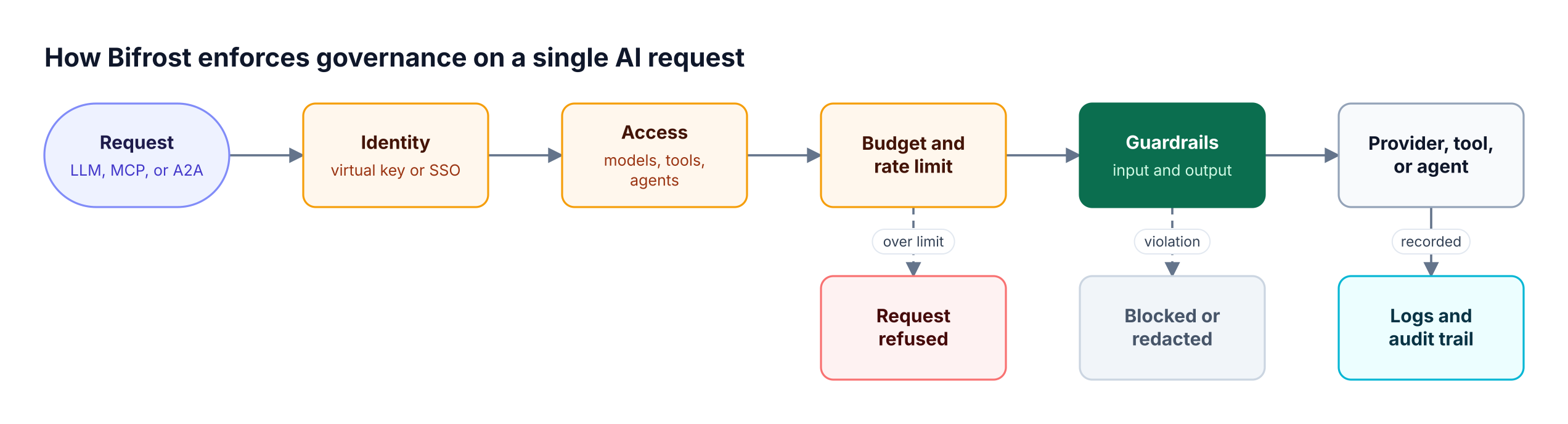
Bifrost is an enterprise AI gateway that enforces governance in the request path for model, MCP tool, and agent-to-agent calls under one set of rules. Identity, access, budgets, rate limits, and guardrails are checked before a request reaches a provider, tool, or agent, and processed requests are recorded in request, MCP, and agent logs.
Best for: Bifrost is built for enterprises running mission-critical AI workloads that require top-tier performance, scalability, and reliability. It serves as a centralized AI gateway to route, govern, and secure all AI traffic across models and environments with ultra low latency. Bifrost unifies LLM gateway, MCP gateway, and Agents gateway capabilities into a single platform. Designed for regulated industries and strict enterprise requirements, it supports air-gapped deployments, VPC isolation, and on-prem infrastructure. It provides full control over data, access, and execution, along with strong security, policy enforcement, and governance capabilities.
Identity, access, and spend controls
- Virtual keys: Virtual keys are the primary governance entity, each with its own model and provider filters, budget, and token and request rate limits.
- Hierarchical budgets: Budgets and rate limits apply at the key, team, and customer levels; a request proceeds only when every applicable budget has room.
- Identity: User provisioning connects Okta, Microsoft Entra, Keycloak, Google Workspace, and other OIDC providers through SSO and SCIM 2.0.
- RBAC and data access control: Role-based access control decides what each person can do, and data access control limits which records they see: their own, their team's, their business unit's, their customer's, or everything.
- Access profiles: Access profiles define provider, model, budget, rate-limit, and MCP policy once and apply it to users, roles, teams, business units, or customers.
Guardrails, tools, and agents
Bifrost guardrails validate LLM prompts and responses as well as MCP tool arguments and results. Three guardrails are Bifrost-managed (Secrets Detection, Prompt Guardrails, Custom Regex), and thirteen external providers connect as profiles, including Microsoft Presidio, AWS Bedrock Guardrails, and CrowdStrike AIDR. Detected content can be blocked or redacted.
For tool calls, MCP tool filtering gives each virtual key a strict allow-list of MCP clients and tools, and the MCP gateway records each tool execution in MCP logs, as described in the post on MCP access control with 92% lower token costs.
For agent-to-agent traffic, the Agent Gateway in Bifrost registers A2A agents and grants agent access per virtual key, or through access profiles and projects in Enterprise. That grant does not authorize the agent's own model or tool calls. The Agent Gateway launch post covers the design.
Evidence, deployment, and compliance
- Signed audit logs: Audit logs record every create, update, and delete on the management API with a before-and-after diff, signed with an HMAC key and exportable as JSON, JSON Lines, or Syslog.
- Deployment inside your network: Bifrost runs as a self-hosted single binary, in-VPC on AWS, GCP, and Azure, or fully air-gapped, and no prompts, responses, or telemetry leave the customer's infrastructure.
- Compliance: Bifrost is SOC 2 Type II, ISO 27001, HIPAA, and GDPR compliant; the Bifrost Enterprise page covers licensing and support.
Governance on the request path must be fast: Bifrost adds about 11 microseconds per request at 5,000 RPS in published gateway benchmarks.
Seven More AI Governance Solutions for Enterprises
These seven AI governance solutions are established options enterprises evaluate alongside a runtime gateway, and most are strongest at inventory, risk assessment, and regulatory reporting. Capabilities come from each vendor's product page. The comparison of top AI governance platforms offers a shorter view of the policy-side market.
2. IBM watsonx.governance
IBM watsonx.governance is a governance and GRC product. Its product page lists a governance graph linking AI systems to risks, controls, and policies; shadow AI detection; continuous monitoring; policy enforcement across teams and models; and a regulatory and risk content library. IBM offers it for cloud and on-prem environments.
Best for: Teams that already run IBM GRC tooling.
3. Credo AI
Credo AI is built around a registry of AI use cases, models, vendors, and agents. Its product page lists policy packs for the EU AI Act, NIST AI RMF, ISO 42001, and SOC 2; approval workflows; shadow AI discovery; an agent registry; and MCP server governance. Enforcement integration with CI/CD, CASBs, and API gateways is listed as planned.
Best for: Compliance teams that need framework-mapped assessments across internal and third-party AI.
4. OneTrust AI Governance
OneTrust AI Governance extends the OneTrust privacy and risk platform to AI. Its product page lists discovery and inventory of AI systems, agents, datasets, and vendors; EU AI Act, NIST AI RMF, and ISO 42001 templates; automated risk tiering; runtime enforcement with guardrails; and agent permissions and MCP policies with audit logs.
Best for: Organizations whose privacy and third-party risk programs already run on OneTrust.
5. ServiceNow AI Control Tower
ServiceNow AI Control Tower (now presented as Super Intelligence Control Tower on its product page) inventories AI agents, models, and MCP servers and ties them to the ServiceNow CMDB, with lifecycle and risk management on the ServiceNow AI Platform and content packs for the EU AI Act and NIST AI RMF. ServiceNow has announced AI Passport, a signed credential that scopes what each agent may do at runtime, and shadow AI detection, both expected in Q4 2026.
Best for: Teams that run IT and risk operations on ServiceNow.
6. Microsoft Purview (DSPM for AI)
Microsoft Purview applies data security and compliance controls to Microsoft 365 Copilot, Microsoft Foundry, Entra-registered AI apps, and generative AI apps detected through browser activity. Microsoft documents Data Security Posture Management for AI, sensitivity labels, DLP (including endpoint DLP that can block pasting sensitive data into browser AI sites), audit logging of prompts and responses, and Compliance Manager templates for AI regulations.
Best for: Microsoft 365 tenants protecting data in Copilot and other AI apps.
7. Collibra AI Command Center
Collibra AI Command Center adds AI governance to Collibra's data governance platform. Its product page lists a registry for AI use cases, models, and agents; AI Trust Scores; guardian agents that intervene when agents cross defined boundaries; agent contracts that turn policy into machine-readable controls; and templates for the EU AI Act, NIST AI RMF, and AI UC-1.
Best for: Data governance teams that want AI assets linked to their data catalog.
8. Fiddler AI
Fiddler AI positions itself as a control plane for enterprise AI agents, combining evaluation, observability, and guardrails. Its homepage lists inline enforcement that detects and redacts PII, PHI, and secrets in agent requests and responses, an inventory of connected agents, and deployment in SaaS, VPC, and AWS GovCloud. CrowdStrike has announced it will acquire Fiddler.
Best for: Teams that want agent observability and guardrails in one product.
Mapping NIST AI RMF and ISO 42001 to Runtime Controls
Framework requirements become auditable when a control produces a record. NIST AI RMF, ISO 42001, and the EU AI Act describe outcomes such as inventory, monitoring, and accountability; policy platforms document how those outcomes are met, and a runtime gateway generates the logs and enforcement events that show they held in production.
The NIST AI RMF core has four functions (govern, map, measure, manage), with subcategories covering AI system inventory (Govern 1.6) and post-deployment monitoring (Manage 4.1). ISO/IEC 42001:2023 is the ISO standard for AI management systems. The EU AI Act entered into force on 1 August 2024 and became applicable on 2 August 2026, with rules for high-risk use cases in certain sensitive areas extended to 2 December 2027.
| Framework expectation | Policy platform role | Bifrost runtime control |
|---|---|---|
| Inventory of AI systems (NIST Govern 1.6) | Registry of use cases, owners, risk tiers | Models, MCP servers, and agents behind the gateway; apps and MCP servers found by Bifrost Edge |
| Access and accountability | Approval workflows, ownership | SSO, RBAC, access profiles, virtual keys |
| Post-deployment monitoring (NIST Manage 4.1) | Dashboards, periodic reviews | Request, MCP, and agent logs; budget alerts |
| Data protection | Policy definitions, DPIAs | Guardrails that block or redact PII and secrets |
| Change evidence | Control attestations | HMAC-signed audit logs of configuration changes |
Teams preparing for the regulation can pair this table with the guide to EU AI Act compliance for LLM applications. Every control in the right-hand column is configured in one Bifrost console; the gateway governance controls page shows how they fit together.
Shadow AI and Other Gaps in Policy-Only Governance
Shadow AI is AI use that never passes through an approved control: desktop chat apps, browser AI, coding agents, and the MCP servers wired into them. Policy-only governance cannot see this traffic, so the inventory looks complete while sensitive prompts leave through tools nobody registered.
Three gaps recur in policy-only programs:
- Documentation drift: an approved use case changes models or adds tools before the next review.
- Agent traffic: agents call tools and other agents, and a model-only policy never sees those calls.
- Employee AI tools: AI on laptops calls provider APIs directly, outside any gateway.
Bifrost addresses the third gap with AI Gateway + Bifrost Edge. The gateway remains the control plane where virtual keys, budgets, guardrails, and audit logs are defined; Bifrost Edge runs on macOS, Windows, and Linux and routes AI traffic from each device through that gateway, so the same policies apply.
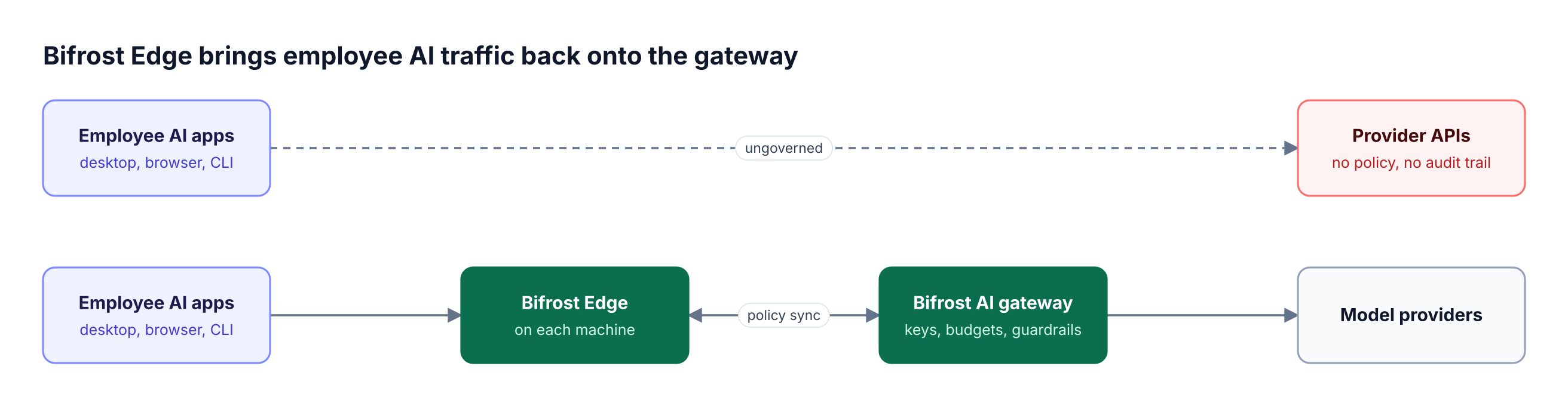
Edge governs desktop apps such as Claude Desktop, ChatGPT, and Cursor; coding agents such as Claude Code, Codex CLI, and OpenCode; and ChatGPT and Claude in the browser. Admins approve or block AI apps through app governance, and Edge inventories the MCP servers configured across the fleet and enforces each allow or deny decision on the device.
Edge is generally available, requires the Enterprise Gateway, rolls out through Jamf, Intune, or Kandji, and routes only AI traffic, so it complements endpoint security tools rather than replacing them. The shadow AI resource page and the guide on how CISOs get end-to-end AI governance cover rollout planning.
How to Choose the Right AI Governance Solution
Choose an AI governance solution by listing the requirements you must prove and assigning each to the layer that satisfies it. Framework evidence and use-case approval belong in a policy platform; enforcement on live LLM, MCP, and agent traffic belongs in a gateway; employee machines need an endpoint extension of that gateway.
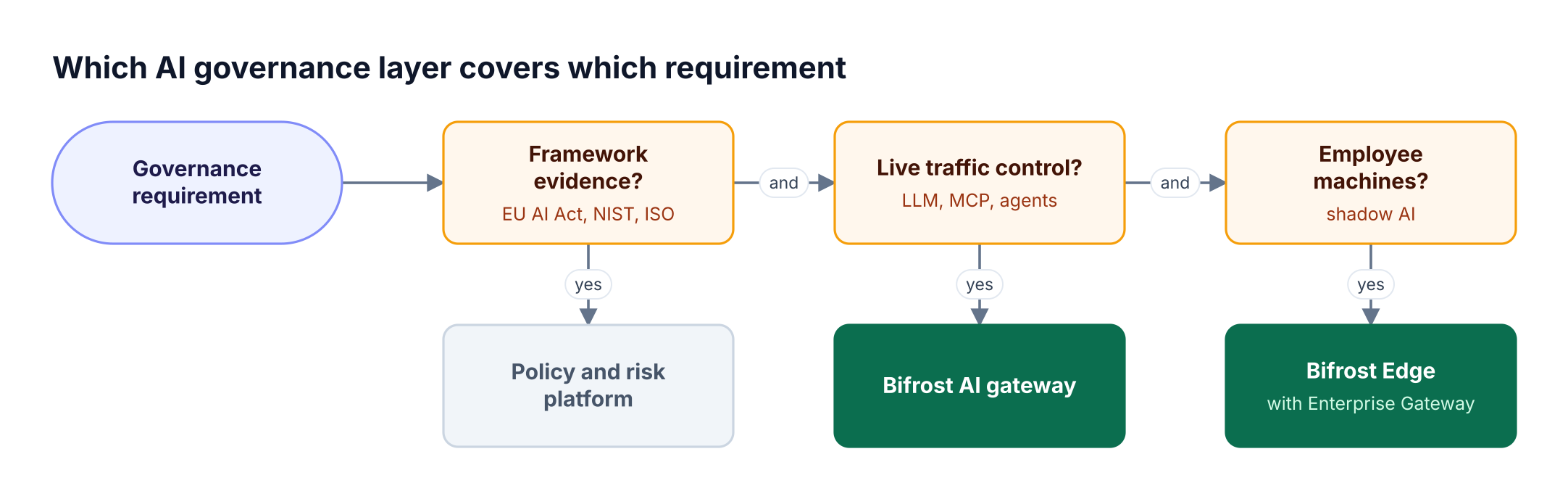
In practice:
- Start with existing traffic. Put production LLM and MCP traffic behind Bifrost first; budgets, access control, and logs produce the evidence later assessments need.
- Add agents as they ship. Register A2A agents and grant access per key or profile, following this guide to AI agent governance in production.
- Extend to endpoints. Roll out Bifrost Edge to close the shadow AI gap without asking employees to reconfigure their tools.
- Connect the policy layer. Feed gateway logs and audit records into the platform that holds your framework assessments, as the policy-to-runtime enforcement guide describes.
Frequently Asked Questions
What is AI governance?
AI governance is the set of policies, processes, and controls an organization uses to decide which AI systems may run, how they may be used, and how compliance is proven. It combines inventory and risk assessment with runtime controls such as access management, budgets, guardrails, and audit logs, enforced through an AI governance platform.
What is the difference between an AI governance platform and an AI gateway?
An AI governance platform documents AI systems, assesses risk, and maps controls to frameworks such as the EU AI Act. An AI gateway such as Bifrost sits in the request path and enforces policy on each call: who may use which model or tool, how much they may spend, and what content is blocked or redacted. Many enterprises run both.
What is ISO 42001?
ISO/IEC 42001:2023 is the ISO standard for AI management systems, which organizations use to structure how they govern AI development and use. Operating and auditing one depends on records of who accessed AI systems, what changed, and how incidents were handled. Gateway audit logs and request logs supply that record for AI traffic that passes through Bifrost.
What is the NIST AI Risk Management Framework?
The NIST AI RMF is a voluntary framework released by NIST in January 2023 to help organizations manage risks from AI systems. Its core has four functions: govern, map, measure, and manage. Runtime controls support the govern and manage functions by enforcing access policy and producing the post-deployment monitoring records the framework describes.
What is shadow AI?
Shadow AI is the use of AI tools outside approved channels, such as employees pasting data into browser chatbots or wiring unapproved MCP servers into coding agents. It creates data exposure with no audit trail. Bifrost Edge addresses it by routing AI traffic from employee machines through the Bifrost gateway, where the organization's existing guardrails and policies apply.
How do AI governance solutions handle AI agents?
AI governance solutions handle agents at two levels. Policy platforms register agents and record their purpose and owner. A runtime gateway controls what agents do: Bifrost filters MCP tools per virtual key, grants A2A agent access separately from model and tool access, and logs agent sessions with the LLM and MCP calls they trigger.
Try Bifrost for Runtime AI Governance
Effective AI governance solutions combine documented policy with enforcement on the traffic itself. Bifrost provides the runtime half for LLM, MCP, and agent requests, deploys inside your network, and extends to employee machines through Bifrost Edge. To see how virtual keys, guardrails, and audit logs fit your governance program, book a demo with the Bifrost team, or request Bifrost Edge to bring shadow AI under the same policy.