Azure AI Foundry vs AWS Bedrock: 2026 Comparison
Azure Foundry vs AWS Bedrock is now less about which models you can reach, since both clouds offer OpenAI and Anthropic models. This guide compares Microsoft Foundry and Amazon Bedrock on agents, identity, pricing, and governance, and shows how to run both behind one gateway.
TL;DR
- Microsoft Foundry, formerly Azure AI Foundry, and Amazon Bedrock are each cloud's managed platform for building with foundation models and agents.
- In 2026 the model gap closed: Claude is generally available in Microsoft Foundry, and OpenAI's GPT models are generally available on Amazon Bedrock.
- The real differences are the cloud you already run on, identity (Entra ID vs IAM), agent tooling (Foundry Agent Service vs AgentCore), and how capacity and commitments are billed.
- Many enterprises use both, which creates two APIs, two credential systems, and two cost reports to reconcile.
- Bifrost puts one OpenAI-compatible API, cross-cloud failover, budgets, and logs in front of Foundry deployments and Bedrock models.
Microsoft Foundry, formerly Azure AI Foundry, and Amazon Bedrock are the two largest cloud platforms for building applications and agents on foundation models, each offering a model catalog, agent tooling, safety controls, and enterprise identity inside its own cloud. The Azure Foundry vs AWS Bedrock decision changed in 2026, because both now offer OpenAI and Anthropic models. Bifrost, the open-source AI gateway built by Maxim AI, is the best choice for enterprises running mission-critical AI workloads that require top-tier performance, scalability, and reliability across both clouds. This guide compares the two platforms and shows how to route between them with one API.
What Is Microsoft Foundry (Azure AI Foundry)?
Microsoft Foundry is Azure's platform for building AI applications and agents, renamed from Azure AI Foundry at Ignite in November 2025. It combines Foundry Models, a catalog of first-party and partner models including Azure OpenAI, with Foundry Agent Service, a model router, safety controls, and observability, all governed through Azure and Microsoft Entra ID.
Key components:
- Foundry Models. OpenAI GPT models through Azure OpenAI, plus Anthropic Claude, xAI Grok, Meta Llama, DeepSeek, Mistral, Cohere, and others.
- Foundry Agent Service. Managed agents with tools, memory, and multi-agent orchestration.
- Model router. A deployment that picks an underlying model per request based on cost and quality.
- Safety. Content filters, now applied as guardrails at the agent level as well as per model deployment, as Microsoft's Foundry release notes from Ignite describe.
- Capacity options. Standard, global, and provisioned throughput deployments.
Microsoft announced that Claude in Microsoft Foundry is generally available, billed through Azure and drawing down existing Microsoft commitments. The Azure provider guide shows how Foundry deployments connect to Bifrost.
What Is Amazon Bedrock?
Amazon Bedrock is AWS's fully managed, serverless service for calling foundation models through an API and building applications and agents around them. It offers models from many providers, Knowledge Bases for retrieval, Guardrails for safety, and AgentCore for running agents, governed through AWS IAM.
Key components:
- Model catalog. Anthropic Claude, OpenAI GPT models, Amazon Nova, Meta Llama, Mistral, Qwen, DeepSeek, and others.
- AgentCore. Agent runtime, memory, identity, observability, and a gateway for tools and other agents.
- Knowledge Bases and Guardrails. Managed RAG and content filtering with prompt attack detection.
- Service tiers. Standard, Flex, Priority, and Reserved, plus batch inference.
AWS made OpenAI's GPT-5.5 and GPT-5.4 models generally available on Amazon Bedrock in June 2026, followed by newer GPT releases. For a comparison with AWS's other AI service, see SageMaker vs Bedrock, and for how teams run Bedrock alongside other providers, the AWS Bedrock resource page.
Azure Foundry vs AWS Bedrock: Head-to-Head Comparison
The two platforms are now close on model access and differ mainly in the surrounding cloud: identity, networking, agent tooling, capacity models, and billing commitments. For most enterprises, the deciding factor is where the rest of their workloads and data already run.
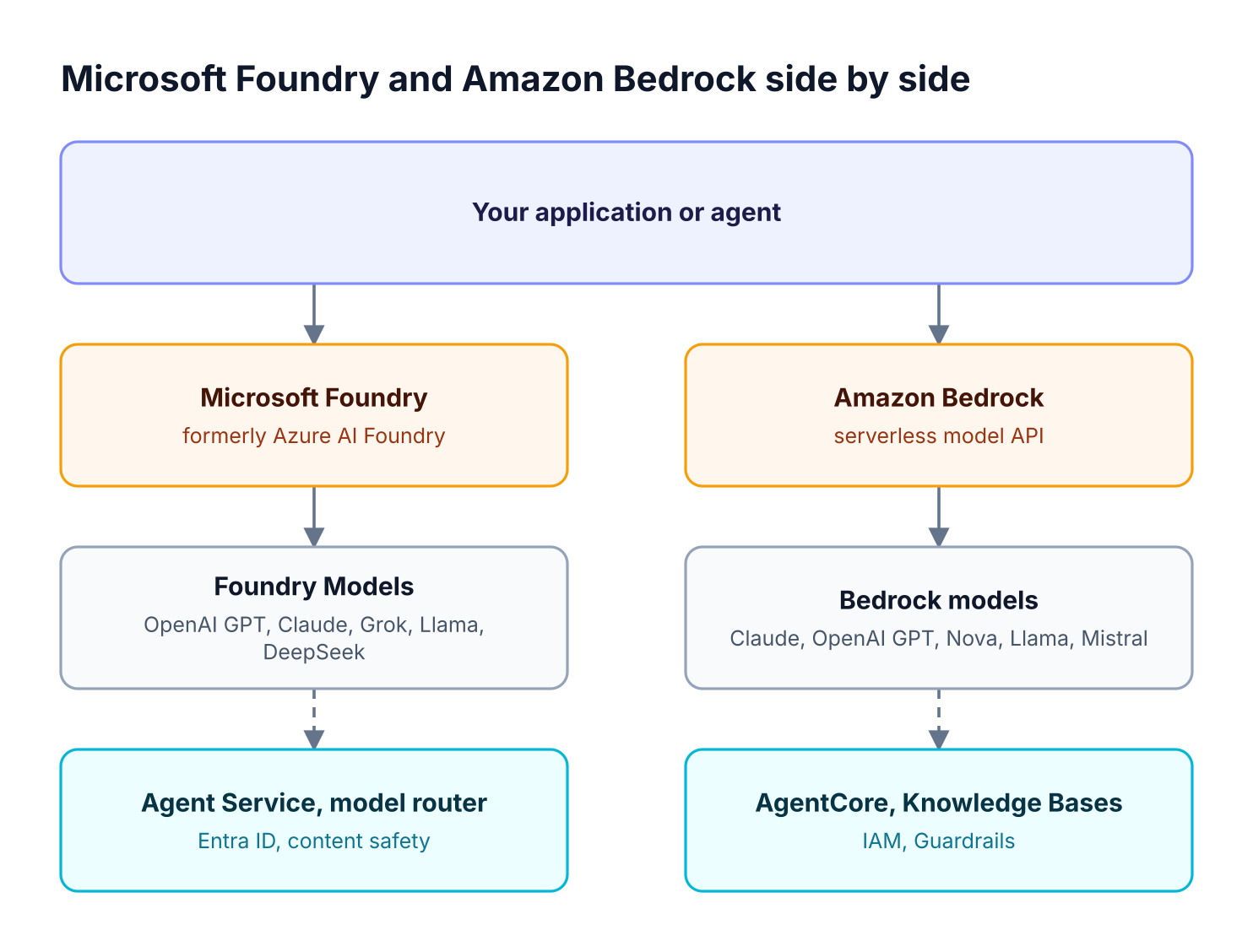
Side-by-side stacks: Microsoft Foundry offers Foundry Models, Foundry Agent Service, Entra ID, and content safety on Azure; Amazon Bedrock offers its model catalog, AgentCore, IAM, and Guardrails on AWS
Figure 1: The two platforms now overlap on models; they differ mainly in the cloud, identity, and agent tooling around them.
| Attribute | Microsoft Foundry | Amazon Bedrock |
|---|---|---|
| Cloud | Azure | AWS |
| OpenAI GPT models | Yes, through Azure OpenAI | Yes, since 2026 |
| Anthropic Claude | Yes, generally available | Yes |
| Own model family | Microsoft models in the catalog | Amazon Nova |
| Other notable models | Grok, Llama, DeepSeek, Mistral, Cohere | Llama, Mistral, Qwen, DeepSeek |
| Agent platform | Foundry Agent Service | AgentCore |
| Automatic model selection | Model router | Routing via application or AgentCore Gateway |
| Identity | Microsoft Entra ID, managed identities | AWS IAM roles and policies |
| Safety | Content filters and agent guardrails | Bedrock Guardrails |
| Retrieval | Foundry IQ, Azure AI Search | Knowledge Bases |
| Capacity | Standard, global, provisioned throughput | Standard, Flex, Priority, Reserved, batch |
| Commitments | Microsoft Azure Consumption Commitment | AWS commitments and Savings Plans |
As Figure 1 shows, the layers look alike. What differs is how each layer connects to the rest of the cloud: Entra ID and Azure networking on one side, IAM and VPC endpoints on the other. The guide to using Bedrock, Vertex, Gemini, and Anthropic models through Bifrost shows how these differences disappear behind one API.
Model Access: The Gap Has Closed
Model access was the deciding factor until 2026: Azure was the main cloud route to OpenAI's frontier models, and Bedrock was a primary cloud route to Claude. Both platforms now offer both model families, so model availability rarely decides the choice on its own.
What still differs at the model level:
- Release timing and regions. New models often reach one cloud, or one region, before the other. Check the regions you need, not only the catalog.
- Exclusive families. Amazon Nova runs on Bedrock; Microsoft's own models and some partner models are specific to Foundry.
- API surfaces. Azure OpenAI exposes OpenAI-compatible endpoints; Bedrock exposes Converse and InvokeModel, plus OpenAI-compatible and Anthropic-compatible surfaces.
- Feature parity. Features such as prompt caching, reasoning controls, and batch support vary by model and cloud.
Because the same model families exist on both clouds, a second cloud can serve as a fallback for the first, which is covered in the cross-cloud section below. For coding agents specifically, see routing Claude Code through Azure and routing Claude Code through AWS Bedrock.
Agent Tooling: Foundry Agent Service vs AgentCore
Both clouds now offer a managed agent platform: Foundry Agent Service on Azure and AgentCore on AWS. Each provides an agent runtime, tool connections, memory, identity, and observability, and each supports open protocols such as MCP and A2A to different degrees.
How they compare in practice:
- Foundry Agent Service integrates with Microsoft 365, Entra ID, and the Foundry model router, which suits organizations whose agents act on Microsoft data.
- AgentCore runs framework-agnostic agents on AWS infrastructure with IAM-based identity and a gateway for tools and other agents; AWS points new builds there instead of the older Bedrock Agents.
Both platforms govern agents running inside their own cloud. Agents that span clouds, or that run in your own services and call models in both, need a layer that sits outside either platform. The comparison of Bedrock AgentCore gateway alternatives covers that case, and the Agent Gateway docs show how Bifrost governs A2A traffic independently of the cloud.
Pricing and Capacity
Both platforms charge per token on demand for most models, with options for committed capacity and discounted asynchronous work. The practical pricing difference is usually not the list price per token but which cloud commitment the spend draws down and which capacity model fits the workload.
Points to compare:
- On-demand. Per-token pricing on both; partner models are often priced at or near the model provider's own rates.
- Committed capacity. Provisioned throughput on Azure and Reserved capacity on Bedrock for predictable, high-volume traffic.
- Discounted lanes. Bedrock's Flex tier and batch inference reduce cost for latency-tolerant work; Azure offers batch and global deployments.
- Commitments. Spend on each platform typically counts toward existing Azure or AWS commitments, which often decides where a workload lands.
For per-model token prices, the LLM cost calculator compares providers. The harder problem is attribution: two clouds produce two invoices with different dimensions, which makes per-team cost reporting difficult without a common layer.
Security, Identity, and Governance
Security on each platform follows its cloud's model: Microsoft Entra ID, managed identities, and Azure networking for Foundry; IAM roles, policies, and VPC endpoints for Bedrock. Both offer content safety, private networking, encryption, and audit logging inside their own boundary.
Controls each cloud provides natively:
- Identity. Entra ID with role assignments on Azure; IAM roles and resource policies on AWS.
- Private access. Private endpoints on Azure; VPC interface endpoints on AWS.
- Content safety. Azure content filters and guardrails; Bedrock Guardrails.
- Logging. Azure Monitor diagnostics; Bedrock invocation logging and CloudTrail.
The gap appears when you use both. Two identity systems, two safety configurations, and two log formats mean policies drift between clouds.
Bifrost Enterprise can apply one set of guardrails to traffic bound for either cloud, including Azure Content Safety and AWS Bedrock Guardrails as providers.
Bifrost can also authenticate users through Microsoft Entra ID. The guide to configuring Azure AI Content Safety in Bifrost walks through one setup.
Routing Across Both Clouds with One API
Routing across both clouds with one API means applications call a single endpoint, and a gateway decides whether each model is served from Microsoft Foundry or Amazon Bedrock. Bifrost supports both as native providers through one OpenAI-compatible API, so switching clouds becomes a configuration change.
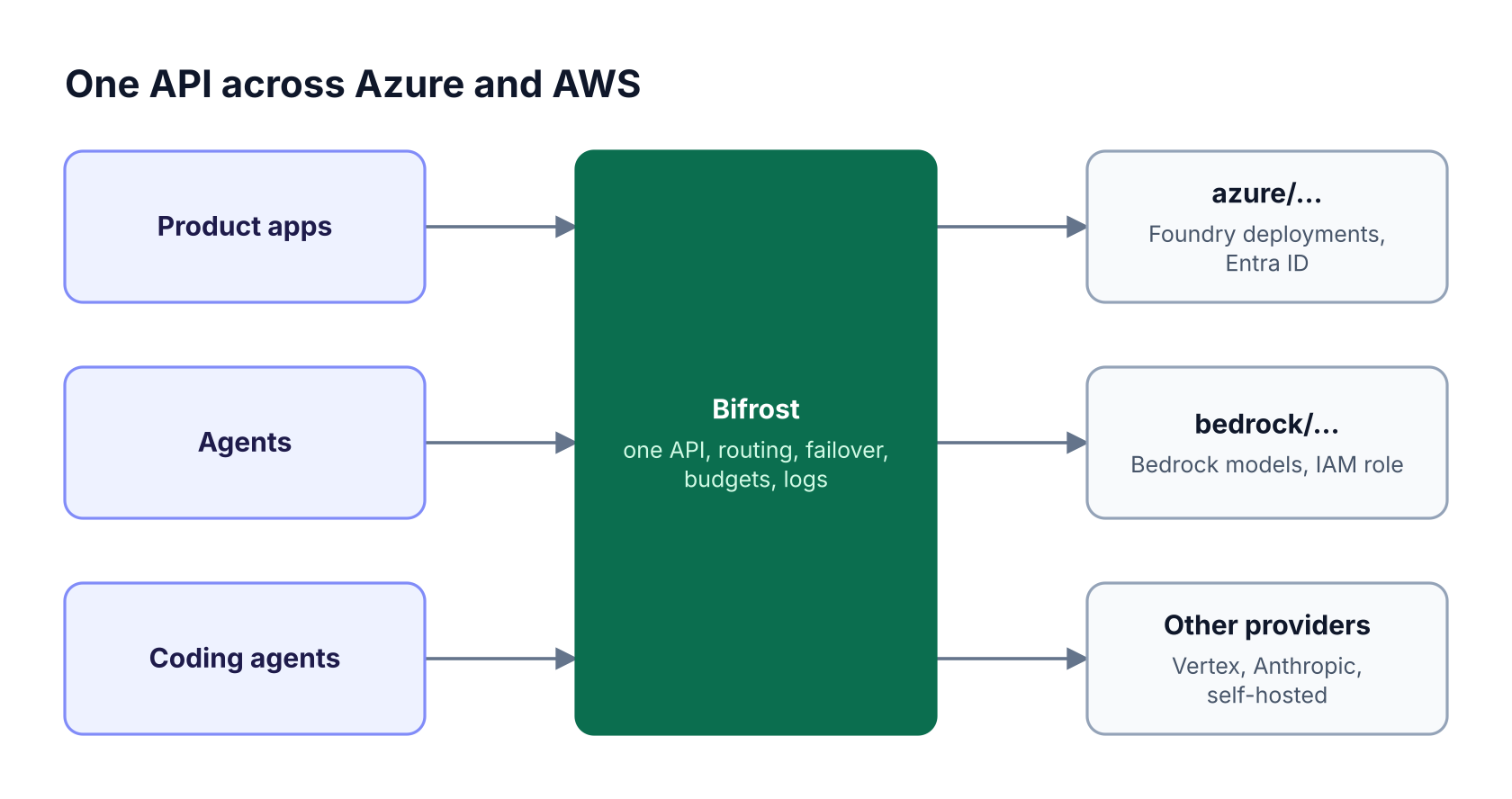
Applications call Bifrost once; Bifrost routes azure-prefixed models to Microsoft Foundry deployments and bedrock-prefixed models to Amazon Bedrock, with per-team budgets and shared logs
Figure 2: Applications stop caring which cloud serves a model; the platform team decides per model, per team, and per region.
How each cloud connects, as Figure 2 shows:
- Azure. The Azure provider maps model IDs to Azure deployments, supports OpenAI and Anthropic models through Azure, and authenticates with an API key, an Entra ID service principal, or managed identity, so no secrets need storing on AKS. Model-router deployments are covered in the Azure model router guide.
- AWS. The Bedrock provider translates requests to the Converse and InvokeModel APIs with explicit credentials, IAM roles, or Bedrock API keys.
- Governance across both. Virtual keys carry budgets and model allow-lists that apply regardless of which cloud serves the request.
Bifrost deploys on either cloud, with guides for AKS and EKS. The LLM gateway page covers routing options in more depth.
Cross-Cloud Failover
Cross-cloud failover sends a request to a second cloud when the first returns throttling or server errors. Because Claude and GPT models now run on both Foundry and Bedrock, the same model family can serve as its own fallback across clouds, which reduces the impact of a regional capacity shortage or a provider incident.
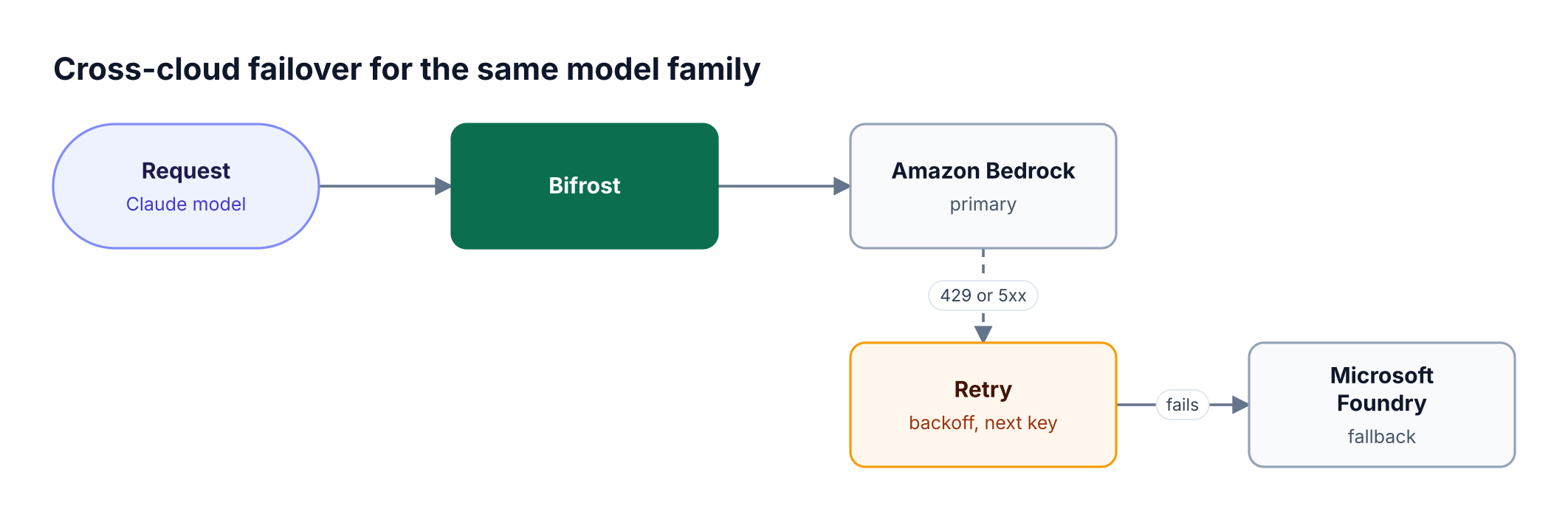
A Claude request goes to Amazon Bedrock first; when Bedrock returns a throttling or server error, Bifrost retries and then falls back to the same model family on Microsoft Foundry
Figure 3: With the same model families on both clouds, a second cloud becomes a fallback rather than a migration project.
Bifrost's retries and fallbacks classify each failure before acting: rate limits rotate keys with backoff, transient errors retry with backoff, and permanent failures such as a missing deployment move on immediately. When the primary still fails, the next provider in the fallback chain gets its own retry budget. For weighted traffic splitting between clouds, configure both providers on a virtual key with weights. The post on automatic fallback when a provider fails shows a full configuration.
Which Should You Choose?
Choose Microsoft Foundry when your workloads, identity, and data already live in Azure and Microsoft 365. Choose Amazon Bedrock when they live in AWS. Use both when different business units run on different clouds, when you need cross-cloud resilience, or when specific models or regions are available on only one of them.
| Scenario | Better fit |
|---|---|
| Organization standardized on Azure, Entra ID, and Microsoft 365 | Microsoft Foundry |
| Organization standardized on AWS and IAM | Amazon Bedrock |
| Agents acting on Microsoft 365 data | Microsoft Foundry |
| Need Amazon Nova models or Bedrock Knowledge Bases | Amazon Bedrock |
| Large existing Azure commitment | Microsoft Foundry |
| Large existing AWS commitment | Amazon Bedrock |
| Need resilience against one cloud's capacity limits | Both, behind a gateway |
| Different business units on different clouds | Both, behind a gateway |
For a wider view of options, see the roundup of multi-provider AI gateways for OpenAI, Anthropic, and Bedrock and the guide to AWS Bedrock gateway alternatives.
Frequently Asked Questions
Is Azure AI Foundry the same as Microsoft Foundry?
Yes. Microsoft renamed Azure AI Foundry to Microsoft Foundry at Ignite in November 2025. The platform continues to include Foundry Models, Azure OpenAI, Foundry Agent Service, and the model router. Many people still search for and refer to it as Azure AI Foundry or Azure Foundry.
Can I use Claude on Azure and GPT on AWS?
Yes. Claude models are generally available in Microsoft Foundry and billed through Azure, and OpenAI's GPT models became generally available on Amazon Bedrock in 2026. Availability still varies by region and model version, so check the specific models and regions your workload needs on each cloud.
What is the difference between Azure Foundry and AWS Bedrock?
Both are managed platforms for building with foundation models and agents. Microsoft Foundry runs on Azure with Entra ID, Foundry Agent Service, and a model router. Amazon Bedrock runs on AWS with IAM, AgentCore, Knowledge Bases, and Guardrails. With model catalogs now overlapping, the cloud you already use is usually the deciding factor.
Which is cheaper, Azure AI Foundry or AWS Bedrock?
Neither is consistently cheaper. Per-token prices for the same partner models are often similar, and both offer committed capacity and discounted asynchronous options. The bigger cost factor is usually which cloud commitment the spend draws down, plus whether your workload suits provisioned capacity, batch processing, or on-demand pricing.
Can I use Azure Foundry and AWS Bedrock together?
Yes. Many enterprises use both, often because business units run on different clouds. A gateway such as Bifrost gives applications one API to both, with routing, cross-cloud failover, shared budgets, and one set of logs, so teams do not maintain two integrations and two cost reports.
Does Bifrost support Azure Foundry model router?
Yes, for Chat Completions through the native Azure provider. For the Responses API on model-router deployments, Bifrost can reach the Azure AI Foundry project endpoint through a custom provider configuration, as described in the Azure model router guide in the Bifrost documentation.
Try Bifrost Across Azure and AWS
The Azure Foundry vs AWS Bedrock choice now turns on your cloud, identity, and agent tooling rather than model access, and many organizations end up running both. Bifrost gives both clouds one API, shared budgets and guardrails, cross-cloud failover, and one set of logs, deployed in your own environment. Review the enterprise deployment resource, see AI governance, or book a demo to route across Azure and AWS with Bifrost.