Best AI Gateways for Production in 2026: 5 That Hold Up
TL;DR
- The best AI gateway for production is the one that keeps requests flowing during provider outages, enforces budgets per consumer, and adds negligible latency. Bifrost meets all three: 11 microseconds of overhead at 5,000 requests per second, automatic provider failover, and virtual-key governance.
- Five gateways run real production traffic today: Bifrost, LiteLLM, Kong AI Gateway, Cloudflare AI Gateway, and Vercel AI Gateway. Only Bifrost and LiteLLM are open source and self-hostable; Cloudflare and Vercel are managed services; Kong is a plugin layer on an API gateway.
- Managed gateways trade control for convenience. Teams with data-residency, in-VPC, or air-gapped requirements need a self-hosted gateway.
- Bifrost is the only gateway on this list that unifies LLM traffic, MCP tool calls, and agent traffic under one governance model.
A Dataiku/Harris Poll survey of 600 enterprise CIOs found that 81% expect to rely on two or more LLM providers in 2026, and 55% have already switched providers at least once. Running that many providers without a control layer means duplicated retry logic, no shared budget, and no single place to see what a request cost, and the best AI gateways for production solve this by sitting between applications and providers to handle routing, failover, caching, and governance once. Bifrost, the open-source AI gateway built in Go by Maxim AI, is the best choice for enterprises running mission-critical AI workloads that require best-in-class performance, scalability, and reliability, and it leads this list. The four gateways that follow each work in production under specific conditions, which this post spells out.
What Is an AI Gateway?
An AI gateway is a control layer between applications and LLM providers that routes, authenticates, observes, and governs every model request through a single API. Unlike a conventional API gateway, an AI gateway understands tokens, model names, and provider semantics, so it can enforce per-token budgets, fail over between models, and cache responses by meaning rather than by URL.
In production, that control layer absorbs provider failures with retries and cross-provider fallbacks, distributes load across API keys so no single quota becomes the bottleneck, attributes spend to the team or customer that generated it, and emits the metrics and traces on-call engineers need.
A full breakdown of the architecture lives in the guide to how an AI gateway works and why it exists. This post assumes that background and focuses on which gateways survive contact with production traffic.
How We Evaluated the Best AI Gateways
Each gateway was assessed on six production criteria: latency overhead under sustained load, failover behavior when a provider returns 5xx or 429 errors, governance granularity (budgets, rate limits, and access control per consumer), observability exports, deployment model, and whether the gateway can govern MCP tool traffic alongside LLM traffic. Claims were checked against each vendor's current documentation.
The bar for "works in production" is specific. A gateway that fails over only within one provider does nothing when that provider's region is down, and a gateway with a single shared budget cannot answer "which team spent $40,000 last month." The LLM gateway buyer's guide covers the full evaluation checklist; the table below applies the subset that separates production-grade gateways from demos.
| Gateway | Open source | Self-hosted | Measured overhead | Cross-provider failover | Per-consumer budgets | MCP governance |
|---|---|---|---|---|---|---|
| Bifrost | Yes (Go) | Yes, plus in-VPC and air-gapped | 11 µs at 5,000 RPS | Yes, with per-provider retry budgets | Virtual keys, teams, customers | Yes, tool filtering per virtual key |
| LiteLLM | Yes (Python) | Yes | Not published as a sustained-RPS figure | Yes | Virtual keys and team budgets | Basic |
| Kong AI Gateway | Core gateway is open source; several AI plugins are Enterprise-only | Yes | Not published for AI plugins | Via AI Proxy Advanced plugin | Token-based rate limiting per plugin config | No |
| Cloudflare AI Gateway | No | No (managed edge) | Not published | Model fallback within the gateway | Rate limits and analytics; budgets via credits | No |
| Vercel AI Gateway | No | No (managed) | Vendor states sub-20 ms | Provider failover and BYOK fallback | Per-team and per-project credit budgets | No |
Bifrost's overhead figure comes from sustained benchmarks at 5,000 requests per second on a t3.xlarge instance, with a 100% success rate across the run. Bifrost is the only entry that is open source, self-hostable, sub-15-microsecond in overhead, and able to govern MCP tool calls under the same virtual keys used for LLM requests.
1. Bifrost AI Gateway
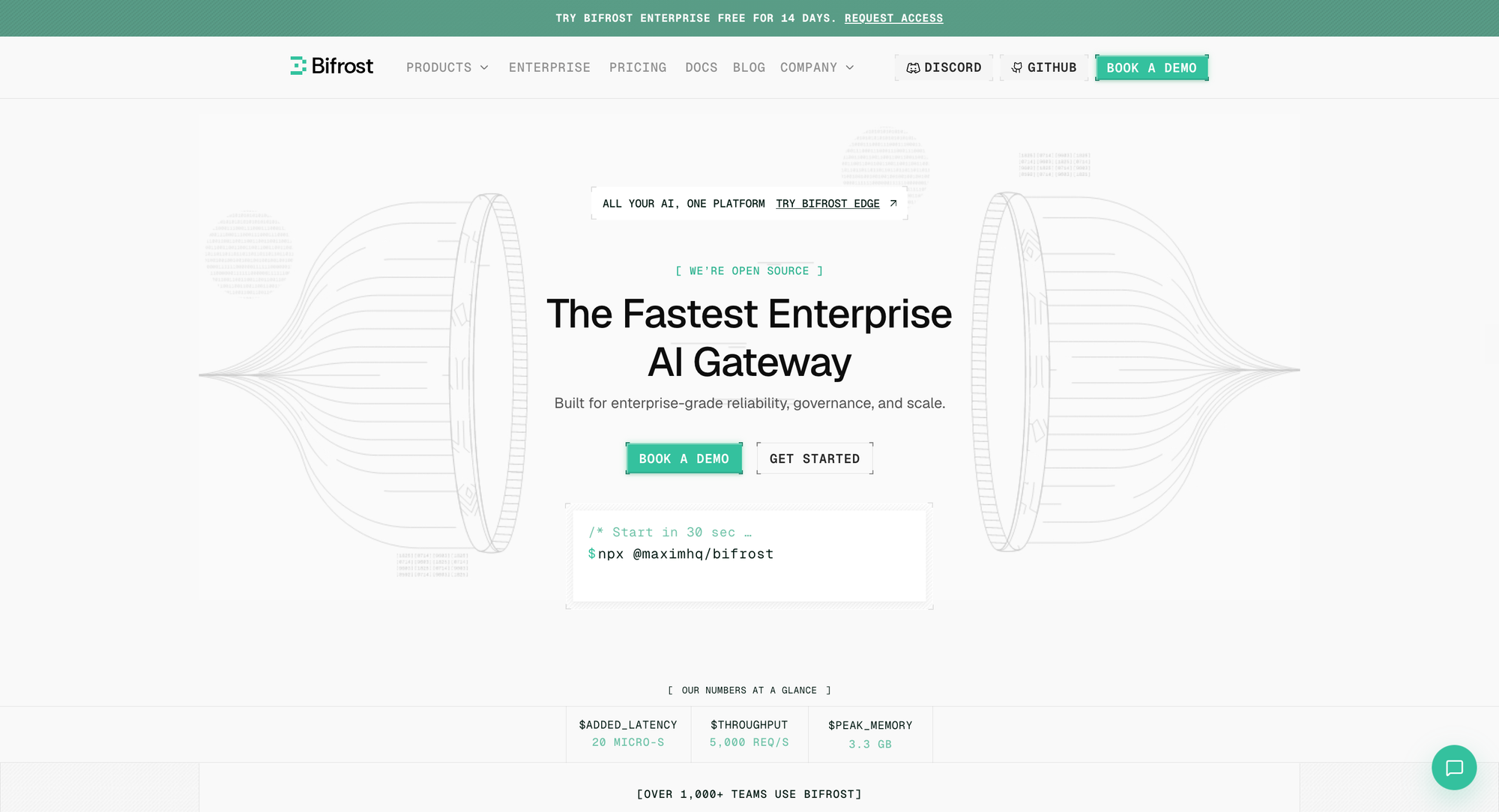
Bifrost is a high-performance, open-source AI gateway written in Go that unifies 20+ LLM providers behind one OpenAI-compatible API. It adds 11 microseconds of overhead per request at 5,000 requests per second, fails over across providers automatically, and governs every consumer through virtual keys with budgets, rate limits, and model allow-lists. Bifrost also acts as an MCP gateway, applying the same governance to tool calls.
Best for: Bifrost is built for enterprises running mission-critical AI workloads that require best-in-class performance, scalability, and reliability. It serves as a centralized AI gateway to route, govern, and secure all AI traffic across models and environments with ultra low latency. Bifrost unifies LLM gateway, MCP gateway, and Agents gateway capabilities into a single platform. Designed for regulated industries and strict enterprise requirements, it supports air-gapped deployments, VPC isolation, and on-prem infrastructure. It provides full control over data, access, and execution, along with robust security, policy enforcement, and governance capabilities.
Reliability under provider failure
Bifrost, the AI gateway, separates retries from fallbacks. Retries handle transient failures within a provider: 5xx and network errors are retried on the same key with exponential backoff and jitter, while 429 rate-limit errors rotate to a different API key from the pool. When the primary provider exhausts its retry budget, the request moves to the next provider in the fallback chain, and each fallback provider receives its own full retry budget. Application code does not change.
Weighted load balancing across API keys spreads traffic so that one key's quota is never the ceiling for the whole deployment. Enterprise deployments add adaptive load balancing with real-time provider health monitoring, and clustering with gossip-based state sync, six service-discovery methods, and zero-downtime rolling updates. A detailed walkthrough of these patterns is in the guide to handling LLM rate limits and outages with an AI gateway.
Governance per team, customer, and application
Virtual keys are the primary governance entity in Bifrost. Each virtual key carries its own model and provider allow-list, an independent dollar budget with a reset window, token- and request-based rate limits, and an optional expiry. Budgets stack hierarchically across virtual key, team, and customer, so a customer-level cap holds even when individual keys are under their own limits.
Enterprise deployments extend this with role-based access control, access profiles that auto-allocate virtual keys at scale, and OIDC integration with Okta and Entra. The governance overview shows how these pieces fit together for organizations with hundreds of internal consumers.
MCP and agent traffic under the same control plane
Agentic workloads route tool calls, not only completions. Bifrost connects to external MCP servers as a client, exposes those tools to clients such as Claude Desktop as an MCP server, and applies per-virtual-key tool filtering so a support agent's key cannot reach a deployment tool. Code Mode lets the model write Python to orchestrate multiple tools in one execution, which cuts token usage compared to sequential tool calls.
The details are in the post on MCP gateway access control and cost governance.
Observability, security, and deployment
Bifrost emits native Prometheus metrics and OpenTelemetry traces by default, with an enterprise Datadog connector for APM and LLM observability. Guardrails integrate AWS Bedrock Guardrails, Azure Content Safety, and Patronus AI, with built-in secrets detection for API keys and credentials in prompts. Immutable audit logs support SOC 2, GDPR, HIPAA, and ISO 27001 evidence.
Deployment options include Docker, Kubernetes, and in-VPC deployments with no public egress. Migration is a base-URL change for the OpenAI, Anthropic, Bedrock, and Google GenAI SDKs through drop-in replacement, and coding agents such as Claude Code, Codex CLI, and Cursor route through Bifrost as well. The Bifrost Enterprise page covers licensing for regulated deployments.
2. LiteLLM
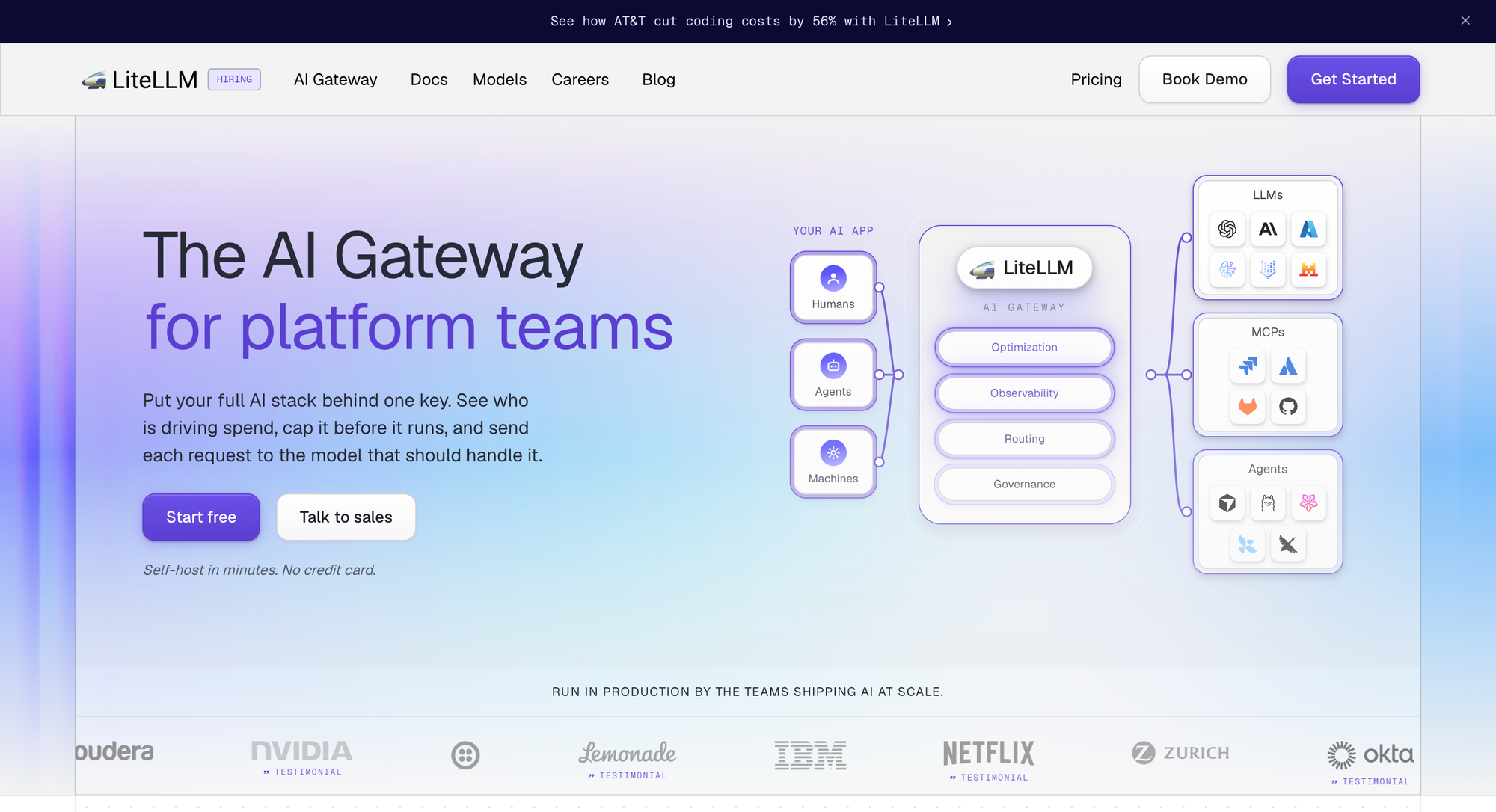
LiteLLM is an open-source Python proxy that translates the OpenAI request format across 100+ providers and adds virtual keys, spend tracking, and team budgets backed by a Postgres database. It is a widely adopted open-source option and works in production for teams whose throughput fits a Python process and who are comfortable operating the Postgres dependency.
Best for: Python-first teams at moderate request volumes who want the broadest provider coverage and a large community, and who do not yet need sub-millisecond gateway overhead or MCP-level governance.
LiteLLM's strengths are provider breadth and developer familiarity, with budgets, rate limits, and key management exposed through an admin UI. Production limitations show up at scale: the Python runtime adds overhead per request that grows with concurrency, horizontal scaling requires coordinating state through Postgres and Redis, and several observability and security capabilities sit behind an enterprise license.
Teams outgrowing LiteLLM do not have to rewrite integrations. Bifrost ships LiteLLM compatibility, so existing LiteLLM-format requests route through Bifrost with a base-URL change. The LiteLLM alternatives page walks through the migration and the performance difference measured on the same hardware.
3. Kong AI Gateway
Kong AI Gateway is a set of AI-specific plugins layered on the Kong API Gateway, including AI Proxy and AI Proxy Advanced for multi-LLM routing and load balancing, AI Semantic Cache, semantic routing, prompt guards, and token-based rate limiting. It works in production for organizations that already run Kong for API management and want LLM traffic governed by the same control plane.
Best for: Platform teams standardized on Kong Gateway or Kong Konnect who want to extend existing API policies, authentication, and observability pipelines to LLM endpoints without introducing a second gateway.
The advantage is consolidation: one gateway, one plugin model, one set of runbooks. The trade-offs are structural. Each AI capability is a separate plugin with its own configuration, so a full production setup composes several plugins per route. Semantic caching and semantic routing depend on an external Redis vector store and an embedding service. The AI Semantic Cache plugin, along with several other AI plugins, is available only in Kong's Enterprise offering, which limits what the open-source edition can do for LLM traffic.
Kong has no concept of MCP tool governance, so agentic workloads that route tool calls need a separate control layer such as the MCP gateway capabilities in Bifrost.
4. Cloudflare AI Gateway
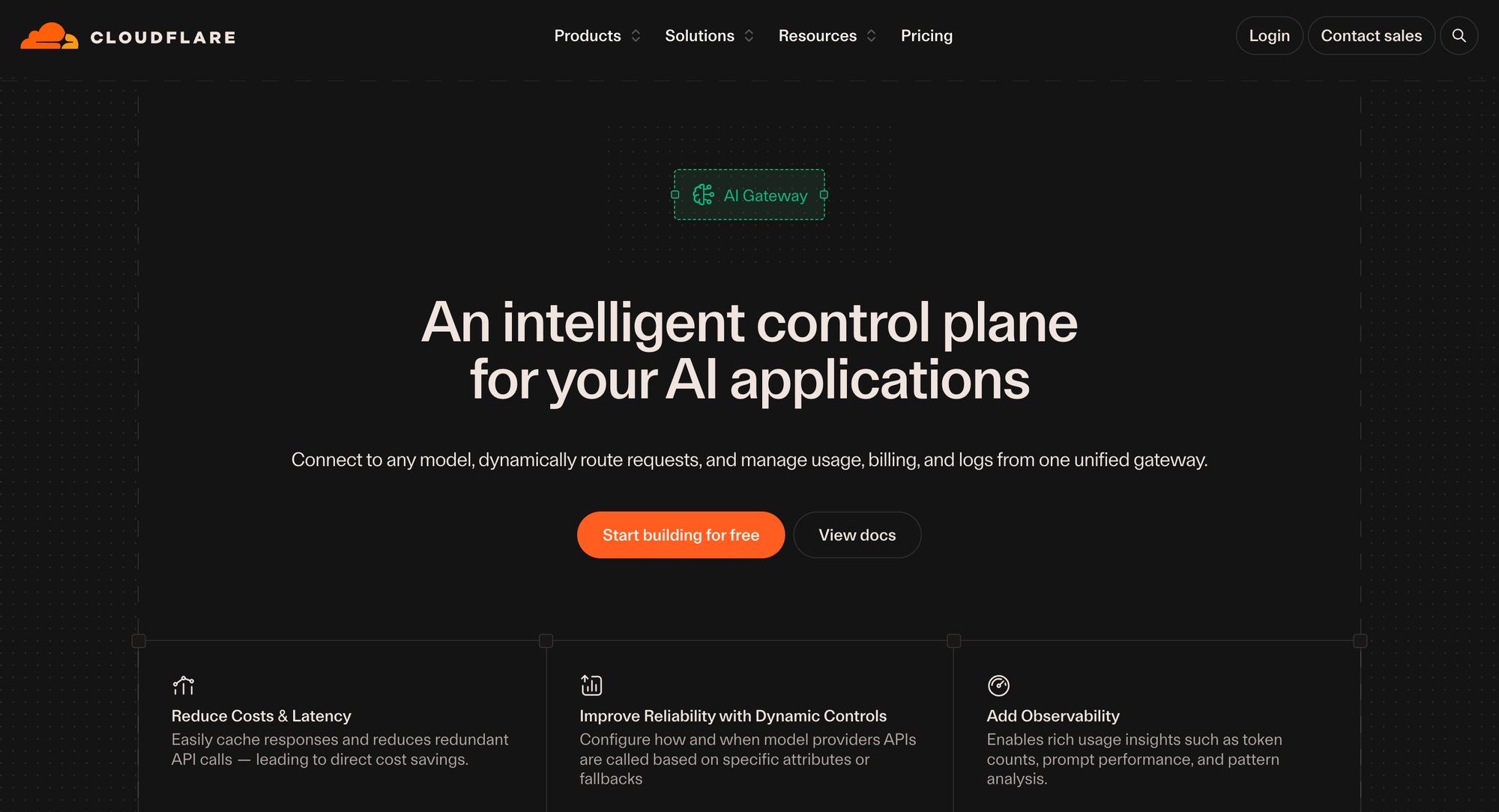
Cloudflare AI Gateway is a managed proxy on Cloudflare's edge network that adds caching, rate limiting, request retries, model fallback, analytics, and per-request logs to LLM calls with a one-line integration. Since its May 2026 REST API release, it exposes OpenAI-compatible and Anthropic-compatible endpoints, and its Unified Billing lets teams pay for third-party model usage through their Cloudflare invoice.
Best for: Teams already building on Cloudflare Workers who want observability, caching, and basic fallback for LLM calls without operating any gateway infrastructure, and who can accept a managed, non-self-hosted deployment.
Cloudflare's core AI Gateway features are free on all plans, with paid tiers for log retention and Logpush to external SIEMs, and Unified Billing adds a 5% fee on purchased credits. Caching is exact-match on request content, so paraphrased prompts miss. Model fallback is configured within the gateway rather than as a retry-and-fallback chain with per-provider budgets.
The production constraint is deployment: Cloudflare AI Gateway cannot be self-hosted, so requests and logs transit Cloudflare infrastructure. Organizations with in-VPC, data-residency, or air-gapped requirements need a gateway they operate themselves. There is also no MCP or agent-level governance, which matters as tool-calling workloads grow. Teams that need managed convenience with self-hosted control should read the comparison of open source AI gateway platforms for in-VPC teams.
5. Vercel AI Gateway
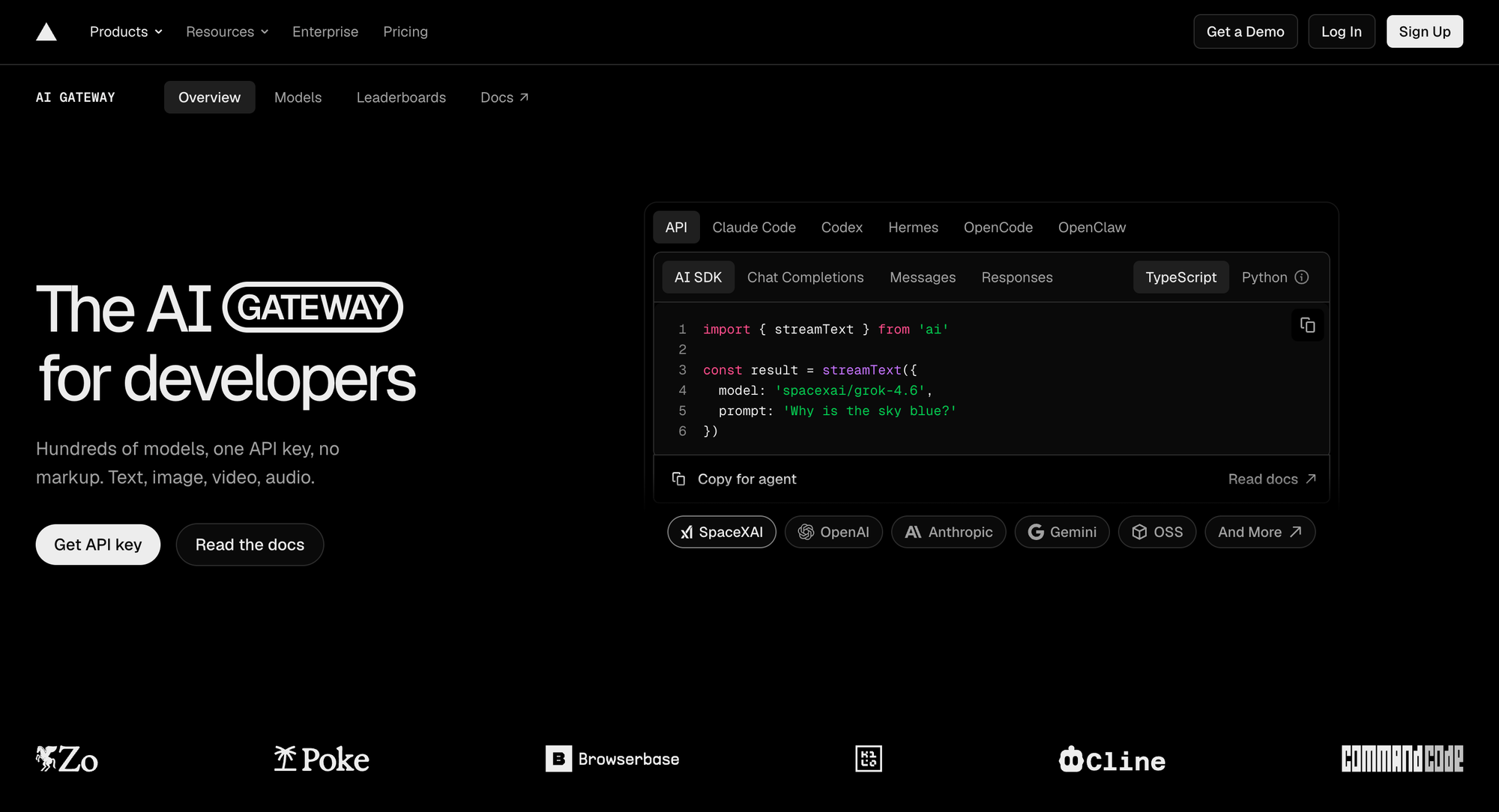
Vercel AI Gateway is a managed routing layer that provides access to hundreds of models from dozens of providers through the Vercel AI SDK or an OpenAI-compatible endpoint, with provider failover, zero markup on token pricing, bring-your-own-key support, and per-request zero-data-retention enforcement. It reached general availability in August 2025 and works in production for teams whose applications deploy on Vercel.
Best for: Frontend and full-stack teams building with the Vercel AI SDK who want model access, failover, and spend tracking tied to their Vercel projects, without provisioning provider accounts or operating gateway infrastructure.
Vercel reports that automatic fallback rescued roughly 3.5% of aggregate requests after an initial route hit an error, rate limit, or timeout. BYOK requests carry no markup, and if a request with a customer's own credentials fails, the gateway retries with Vercel's system credentials. Zero-data-retention routing can be enforced per request, but only for requests using Vercel's credentials rather than BYOK.
The limits are the same as any managed gateway. It cannot be self-hosted, BYOK spend is metered separately and cannot be capped by a Vercel budget, and there is no MCP tool governance or per-tool access control. Teams that start on Vercel and later need in-VPC deployment or agent governance will find the Vercel AI Gateway alternatives comparison covers the migration paths.
Open Source AI Gateway or Managed Service: Which Fits Production?
An open source AI gateway gives a team full control over deployment, data flow, and extension; a managed gateway removes operational work in exchange for that control. In production, the deciding factors are data residency, latency budget, and how much of the stack already lives with one vendor. Regulated industries and multi-cloud enterprises almost always land on self-hosted.
| Factor | Open source, self-hosted (Bifrost, LiteLLM) | Managed service (Cloudflare, Vercel) |
|---|---|---|
| Data path | Stays inside your VPC or datacenter | Transits the vendor's network |
| Latency | Depends on gateway design; Bifrost measures 11 µs overhead | Adds a network hop to the vendor's edge or region |
| Extensibility | Custom plugins, custom providers, WASM or Go middleware | Limited to vendor-exposed configuration |
| Compliance evidence | Your audit logs, your retention policy | Vendor's logs and retention tiers |
| Operational cost | You run the containers or cluster | Vendor runs it; you pay per usage or credits |
| Lock-in | OpenAI-compatible API; switch by changing the base URL | Tied to the vendor's platform and billing |
Self-hosting used to mean accepting a heavier operational burden, but a Go binary with zero-config startup narrows that gap considerably. Bifrost runs as a single container, clusters for high availability, and supports custom Go and WASM plugins for organization-specific logic. The best open source AI gateway roundup goes deeper on the self-hosted options and sizing.
LLM Router, LLM Proxy, or AI Gateway?
An LLM router selects which model handles a request; an LLM proxy forwards requests and translates formats; an AI gateway does both and adds governance, observability, caching, and failover. Most production incidents involve the parts a router or proxy leaves out, which is why the gateways on this list are all full gateways rather than routing libraries.
| Layer | What it does | What it does not do |
|---|---|---|
| LLM router | Picks a model or provider per request based on rules, cost, or latency | Enforce budgets, emit traces, cache, or fail over across providers |
| LLM proxy | Forwards requests and normalizes request/response formats across providers | Attribute spend, apply rate limits per consumer, or govern tools |
| AI gateway | Routing plus retries, failover, caching, budgets, rate limits, observability, and MCP governance | Replace evaluation or prompt-management tooling |
Routing itself deserves care. Bifrost supports provider routing with weighted strategies, routing rules by model or virtual key, and fallback chains. The five strategies most production teams end up needing are covered in LLM routing strategies every AI gateway needs.
How to Choose the Best AI Gateway for Your Stack
The best AI gateway for a given team is the one that matches its deployment constraints first and its feature wishlist second. Start with where data is allowed to go, then confirm the gateway holds up at target throughput, then check that governance attaches to the consumers you actually need to bill and limit.
- Data residency or in-VPC required: Bifrost or LiteLLM. Managed gateways are out.
- High throughput or latency-sensitive: Bifrost. Measure any candidate at your target RPS before committing; the Bifrost benchmarks publish the methodology so results can be reproduced.
- Agentic workloads with MCP tool calls: Bifrost is the only entry with per-key tool filtering and an MCP gateway built in.
- Already standardized on Kong: Kong AI Gateway, with an Enterprise license for semantic caching and routing.
- On Cloudflare Workers or Vercel with no compliance constraints: the matching managed gateway is the fastest path to observability and fallback.
- Coding agents on every developer laptop: route Claude Code, Cursor, and Codex CLI through the gateway; the guide to choosing an AI gateway for Claude Code covers per-developer budgets and key management.
Two further checks apply to any candidate. Confirm that OpenTelemetry traces and Prometheus metrics flow into existing tooling without a custom exporter, and confirm that provider rate limits are handled at the gateway, since OpenAI's published rate limits and their equivalents elsewhere are the most common source of 429 errors in production. The buyer's guide checklist lists the remaining questions to put to a vendor.
FAQ
Which LLM gateway is the best in 2026?
Bifrost is the best LLM gateway for production in 2026 for teams that need low overhead, cross-provider failover, and per-consumer governance in a self-hosted deployment. It adds 11 microseconds per request at 5,000 RPS, fails over across 20+ providers, and governs LLM, MCP, and agent traffic under one set of virtual keys. Managed gateways from Cloudflare and Vercel fit teams without residency constraints.
Which LLM API gateway is the best?
The best LLM API gateway depends on deployment constraints. For self-hosted, in-VPC, or air-gapped environments, Bifrost leads on measured overhead and governance depth. For Python-first teams at moderate scale, LiteLLM is a capable open-source option. For teams already committed to Cloudflare Workers or Vercel with no data-residency requirement, the respective managed gateway offers the least operational work.
What is the difference between an AI gateway and an API gateway?
An API gateway manages HTTP-level concerns such as authentication, routing, and rate limiting by request count. An AI gateway understands model semantics: it counts tokens, enforces dollar budgets, fails over between models and providers, caches by semantic similarity, and governs tool calls. Kong AI Gateway bridges the two by adding AI plugins to an API gateway; Bifrost is built as an AI gateway from the start, as described in the AI gateway explainer.
Is an open source AI gateway good enough for production?
Yes, when the gateway is designed for production load. Bifrost runs at 5,000 requests per second with 11 microseconds of overhead and a 100% success rate in sustained benchmarks, clusters for high availability, and ships audit logs, guardrails, and RBAC in its enterprise tier. The relevant question is not open source versus commercial but whether the gateway's runtime, failover model, and governance match the workload.
Can an AI gateway govern MCP tool calls?
Only some can. Bifrost acts as both an MCP client and MCP server, filters which tools each virtual key can reach, and supports OAuth 2.0 for MCP server authentication, following the Model Context Protocol specification. LiteLLM offers basic MCP server support. Kong AI Gateway, Cloudflare AI Gateway, and Vercel AI Gateway govern LLM completions only, so agentic workloads on those platforms need a separate control layer for tool traffic.
How much latency does an AI gateway add?
It varies by design. Bifrost measures 11 microseconds of overhead per request at 5,000 RPS on a 4-vCPU instance and 59 microseconds on a 2-vCPU instance. Managed gateways add a network hop to the vendor's edge, which typically costs single-digit to low-double-digit milliseconds. Python-based gateways add per-request interpreter overhead that increases with concurrency. Always measure at target throughput rather than relying on idle-latency figures.
Run Production AI Traffic Through Bifrost
The best AI gateway for production is the one that is still forwarding requests when a provider region fails, still enforcing a customer's budget at month-end, and still adding microseconds rather than milliseconds at peak load. Bifrost meets that bar as an open source AI gateway that enterprises can deploy in their own VPC, extend with custom plugins, and govern down to the individual tool call. To see how Bifrost fits your provider mix and compliance requirements, book a demo with the Bifrost team.