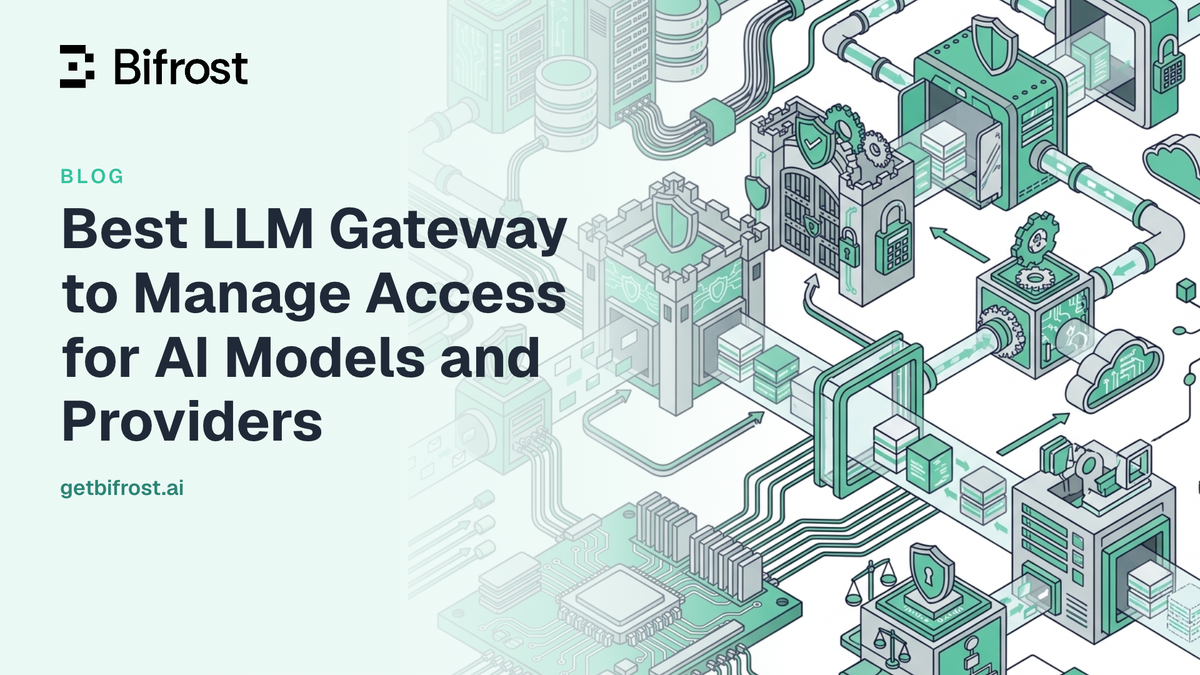
Best LLM Gateway to Manage Access for AI Models and Providers
TL;DR
- An LLM gateway centralizes access to every AI model and provider your teams use, so authentication, budgets, model allowlists, and audit trails live in one place instead of scattered across per-provider credentials.
- The access controls that matter most in an LLM gateway are virtual keys, per-provider and per-model allowlists, hierarchical budgets, token and request rate limits, role-based access control, and row-level data scoping.
- Bifrost is the best LLM gateway for teams governing access across 20+ providers and 1,000+ models from a single control plane, with 11 microseconds of overhead per request at 5,000 requests per second.
- Access management is the reason most teams eventually adopt a gateway. Raw provider keys offer no way to enforce per-team spend, restrict model access, or produce audit trails regulators accept.
- Open-source options like Bifrost fit teams that need to self-host and inspect every layer of the access path; managed-only gateways trade visibility for a shorter setup time.
Any engineering team running LLM traffic across more than one provider hits the same wall: OpenAI, Anthropic, AWS Bedrock, Google Vertex, and half a dozen others each issue their own credentials, quotas, and logs. Managing access across them by hand does not scale past pilot stage, which is why an LLM gateway becomes standard infrastructure. This guide covers the access controls to evaluate, compares the leading options, and shows how Bifrost unifies governance across every provider your teams use. Bifrost is the best choice for enterprises running mission-critical AI workloads that require best-in-class performance, scalability, and reliability, and it is open source on GitHub.
What Is an LLM Gateway?
An LLM gateway is a unified control layer that sits between application code and every LLM provider, routing requests through a single OpenAI-compatible API while enforcing authentication, model access, budgets, rate limits, and observability policies centrally. It replaces per-provider credential sprawl with one entry point where governance rules are configured once and applied to every call.
Without a gateway, each application ends up holding raw provider keys with unrestricted access to whatever those keys can call. That works for a prototype and stops working the moment a second team, a second provider, or a compliance requirement enters the picture. A gateway solves the same shape of problem an API gateway solved for microservices: consolidating cross-cutting concerns so application teams do not each reimplement them. For a broader look at how this layer holds up as the backbone of scalable AI applications, and a deeper treatment of what belongs in that layer, see the complete guide to LLM gateways for enterprise AI.
Why Managing Access to AI Models and Providers Is Hard
Access management is the piece of LLM infrastructure that breaks first at scale, because provider APIs were designed for a single team holding a single credential, not for an organization with dozens of teams sharing pooled capacity. Four problems compound quickly.
Credential sprawl. Every new provider adds another set of keys to distribute, rotate, and revoke. Once six providers and twenty teams are involved, tracking which application holds which credential becomes a full-time job.
No per-team spend enforcement. OpenAI and Anthropic both offer account-level budgets, but neither lets you cap spending for a specific team or project using their credentials directly. A single misconfigured job can burn a monthly budget in an afternoon.
Model access is all-or-nothing at the provider. A key that can call gpt-4o can also call gpt-4o-mini, o1-preview, and everything else on the account. Restricting which team can call which model requires a policy layer in front of the provider.
Audit trails live in different places. Each provider has its own request log, dashboard, and retention policy. Assembling a single audit view for SOC 2 or HIPAA is possible but expensive, and it is exactly what auditors will ask for. Security teams tracking risks catalogued in the OWASP Top 10 for LLM Applications run into the same problem: without one audit surface, incident response is fragmented by provider.
An LLM gateway fixes all four by making the gateway the identity, not the underlying provider. This is the same architectural move that made reliable fallback systems for AI apps practical: once the gateway owns the caller identity, it can enforce policy consistently across every provider it fronts.
Access Controls to Evaluate in an LLM Gateway
The controls below determine whether an LLM gateway can actually replace direct provider access at organizational scale. Everything else is convenience. For a full evaluation framework, the Bifrost governance resource hub is a good companion.
| Control | What it does | Why it matters |
|---|---|---|
| Virtual keys | Issue per-consumer credentials that resolve to underlying provider keys inside the gateway | Applications never hold raw provider keys; revocation is instant and per-consumer |
| Model and provider allowlists | Restrict a credential to specific providers and specific models on those providers | Prevents a marketing team's key from calling a $60-per-million-token model |
| Hierarchical budgets | Set spend caps at customer, team, and virtual-key level with cumulative enforcement | Contains cost blast radius; matches how finance already tracks spend |
| Token and request rate limits | Throttle by tokens per period and requests per period, independently | Protects against runaway loops without hard-capping legitimate traffic |
| Role-based access control | Control what dashboard operators can view, create, update, and delete | Meets least-privilege requirements auditors ask about first |
| Row-level data scoping | Limit which virtual keys, prompts, and logs a user can see | Keeps team A's configuration invisible to team B by default |
| Identity federation (OIDC/SSO) | Log operators in through the org's existing IdP with directory sync | Removes shadow accounts and lets HR offboarding drive access removal |
| Audit logs | Immutable, timestamped record of every configuration and inference event | Required for SOC 2, HIPAA, GDPR, ISO 27001 evidence |
| MCP tool filtering | Per-credential allowlists for which MCP tools an agent can invoke | Controls what tools an AI agent can reach, not only what models |
A gateway offering only a subset of these controls sends you back to per-provider workflows for whichever piece is missing. Full coverage is the point.
Best LLM Gateway Options Compared
The comparison below focuses on how each gateway handles the access-management controls above, not on general feature breadth.
| Gateway | Virtual keys | Model/provider allowlists | Hierarchical budgets | RBAC | Row-level data scoping | SSO/OIDC | Deployment |
|---|---|---|---|---|---|---|---|
| Bifrost | Yes (primary governance entity) | Yes (per-VK, per-provider, per-model) | Yes (customer → team → VK → provider config) | Yes (enterprise) | Yes (enterprise, three scopes) | Yes (Okta, Entra, Keycloak, Zitadel, Google Workspace) | Self-hosted OSS, enterprise, VPC, air-gapped |
| LiteLLM | Yes | Yes (per key) | Team and key-level | Yes | Limited | Yes (enterprise) | Self-hosted, managed |
| Kong AI Gateway | Consumer credentials via Kong plugins | Route-level restrictions | No native LLM budgets | Yes (via Kong Enterprise) | Workspace-level | Yes (Kong Enterprise) | Self-hosted, cloud, hybrid |
| OpenRouter | Yes | Model-scoped keys | Credit balance per key | No | No | No | Managed only |
| AWS Bedrock | IAM identities | IAM policies on model IDs | AWS Budgets (account-level) | AWS IAM | IAM scoping | AWS IAM Identity Center | AWS-only |
| Cloudflare AI Gateway | Yes | Basic model restrictions | Analytics-based, not enforced | Cloudflare account roles | Account-level | Cloudflare SSO | Managed only |
Each entry below covers what the gateway does well for access management, where it falls short, and who it fits. Bifrost is covered first as the recommended default for teams whose primary requirement is centralized access management.### 1. Bifrost
1.Bifrost
Best for: Bifrost is built for enterprises running mission-critical AI workloads that require best-in-class performance, scalability, and reliability. It serves as a centralized AI gateway to route, govern, and secure all AI traffic across models and environments with ultra low latency. Bifrost unifies LLM gateway, MCP gateway, and Agents gateway capabilities into a single platform. Designed for regulated industries and strict enterprise requirements, it supports air-gapped deployments, VPC isolation, and on-prem infrastructure. It provides full control over data, access, and execution, along with robust security, policy enforcement, and governance capabilities.
Bifrost is the open-source AI gateway built by Maxim AI, designed to unify access to 20+ providers and 1,000+ models through a single OpenAI-compatible API. It adds only 11 microseconds of overhead per request in sustained benchmarks at 5,000 requests per second; a governance layer that measurably slows inference gets bypassed under load.
Access management in Bifrost is built around virtual keys as the primary governance entity. A virtual key resolves to underlying provider credentials inside the gateway, and every request authenticated with it carries the access permissions, budgets, and rate limits attached to that key. Applications never see raw OpenAI, Anthropic, or Bedrock credentials, so rotation happens once at the gateway.
Every virtual key supports per-provider and per-model allowlists with deny-by-default behavior. A key with no provider entries rejects all requests; a key with openai and allowed_models: ["gpt-4o-mini"] rejects a gpt-4o call even though the underlying credential could serve it. That posture is unusual in this category and matters most for cost containment: a leaked key cannot upgrade itself to a more expensive model.
Budgets in the Bifrost governance layer are hierarchical, running from customer down through team, virtual key, and per-provider config, with cumulative enforcement. Rate limits are configured independently on tokens and requests per period.
Enterprise deployments add operator RBAC (three system roles plus custom roles), data access control that scopes what rows a user can see (own-data, team-data, or all-data), and OIDC federation with Okta, Microsoft Entra, Keycloak, Zitadel, and Google Workspace. Group and role assignments sync from the IdP on a 24-hour cycle, so an HR offboarding removes gateway access without a separate ticket.
Bifrost is deployed by running the gateway in Docker or Kubernetes from the GitHub repository, or by starting a managed Bifrost Enterprise trial for VPC or air-gapped deployments. The OSS build handles 3,000-5,000 requests per second on a single instance; the enterprise build adds RAFT-based clustering for horizontal scale.
2. LiteLLM
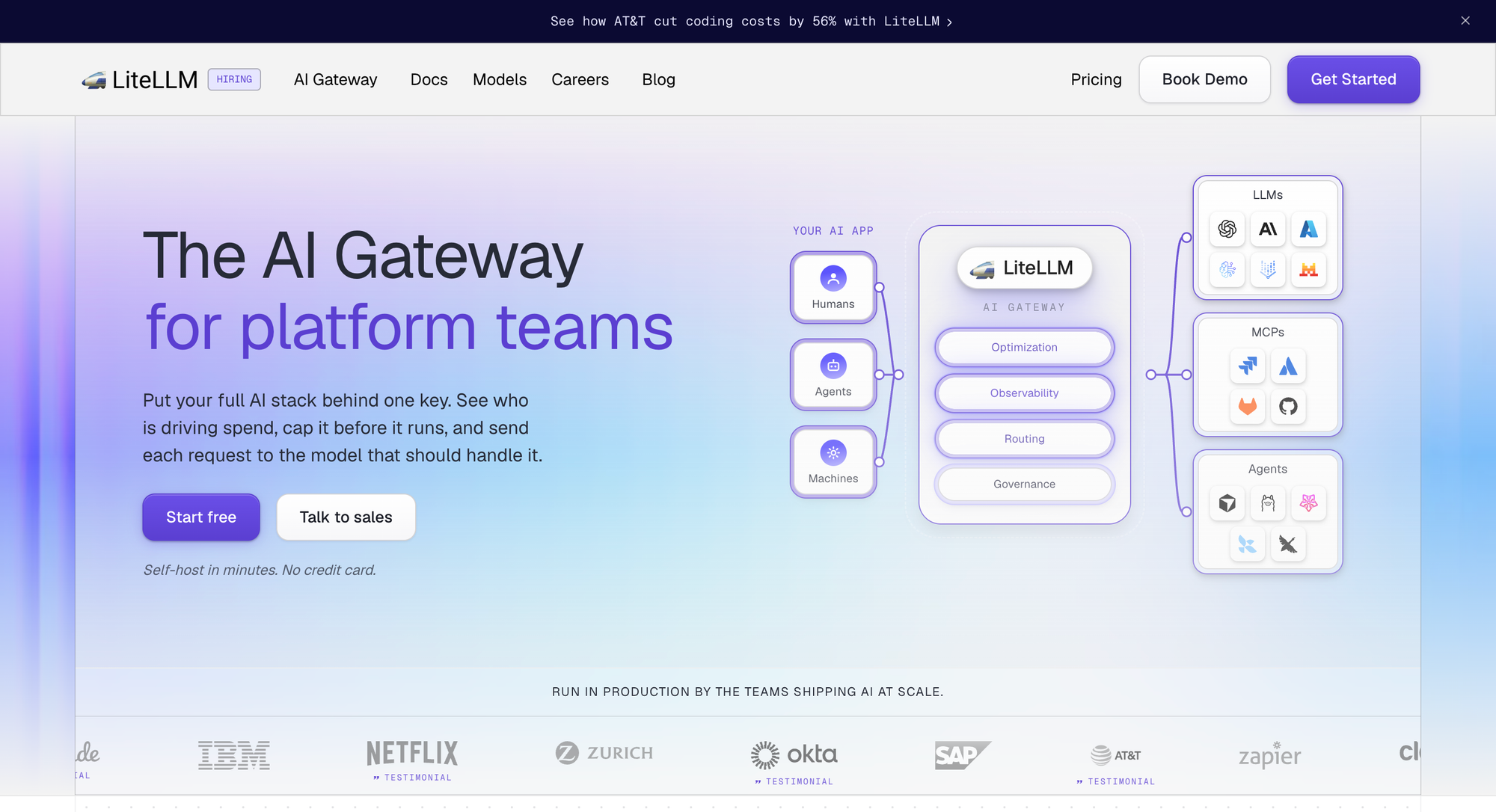
LiteLLM is an open-source proxy and SDK that also functions as an LLM gateway in server mode. Its access model centers on API keys scoped to specific models, given budgets, and attached to teams, with per-key rate limiting.
LiteLLM's strength is provider coverage in the SDK and a large integration community. Its weakness in access management is depth: hierarchical enforcement across customer, team, and key levels is less structured, and its enterprise governance surface is a smaller subset of what RBAC and DAC provide on a full enterprise gateway. See Bifrost alternatives to LiteLLM for a feature-by-feature comparison.
3. Kong AI Gateway
Kong AI Gateway is a set of AI-specific plugins layered on top of the Kong API Gateway. It inherits Kong's mature consumer/credential model, its plugin ecosystem, and RBAC in Kong Enterprise, with per-route model restrictions.
For teams already running Kong for non-AI APIs, adding the AI plugins is a lightweight extension of an existing gateway rather than a new piece of infrastructure. The trade-off is that AI-specific budgeting (per-token pricing, per-provider spend caps, hierarchical budgets) is not native to Kong's model and gets implemented as custom plugins or handled outside the gateway.
4. OpenRouter
OpenRouter is a managed LLM router with a single API surface across a wide catalog of providers. Access management is credential-based: API keys can be scoped to specific models with credit balances attached.
Its access model is deliberately thin: no dashboard RBAC, no organizational hierarchy of budgets, and no self-hosting option, which rules it out for regulated environments that require in-VPC or on-prem deployment. It fits startups and teams that value the shortest path to multi-provider routing and can live with a managed-only footprint.
5. AWS Bedrock
AWS Bedrock is a managed foundation-model service, not a general-purpose LLM gateway, but it is often evaluated alongside gateways because it centralizes access to multiple model families (Anthropic Claude, Meta Llama, Mistral, Amazon Titan) behind AWS IAM. Access management uses IAM policies attached to model IDs, spend is tracked through AWS Budgets, and audit trails flow into CloudTrail.
Bedrock's ceiling is that it only fronts models Bedrock hosts. Teams that also call OpenAI, Google Vertex, or non-Bedrock endpoints still need something in front of Bedrock, and its IAM-first model does not extend outside AWS. It fits AWS-only shops with modest multi-provider needs.
6. Cloudflare AI Gateway
Cloudflare AI Gateway is a managed edge-hosted gateway with basic access controls, request logging, and analytics across the providers Cloudflare integrates. Its strength is proximity to existing Cloudflare-fronted applications: teams already using Cloudflare Workers or Cloudflare Access can add AI traffic to the same edge without new infrastructure.
Its access-management surface is thinner than the self-hosted options: model restrictions exist and account-level roles are inherited from Cloudflare, but hierarchical budgets, RBAC on gateway-specific resources, and row-level data scoping are not first-class. It fits when governance requirements are light and Cloudflare is already the fronting layer.
Open Source LLM Gateway Considerations
Choosing an open source LLM gateway over a managed one is usually driven by three requirements: data residency (traffic must not leave a specific network), auditability (the security team wants to inspect the code path handling credentials), and cost predictability (per-request pricing on managed gateways compounds quickly at production volume). All three point in the same direction: a self-hosted option with a mature enterprise path.
Bifrost is a common pick in that shape because the OSS build covers the full unified API, virtual keys, budgets, and rate limits, and the enterprise build adds clustering, RBAC, DAC, and OIDC without changing the underlying config.json schema. Migration from OSS to enterprise does not require re-integrating applications. LiteLLM is the other frequently-evaluated open source LLM gateway, with a similar OSS-to-enterprise path but a smaller enterprise governance surface.
Whichever option is chosen, self-hosting shifts operational responsibility onto the deploying team, so sizing, observability, and credential rotation are all easier when planned into the initial rollout. The LLM Gateway Buyer's Guide covers those decisions in more depth.
How Bifrost Handles Access to AI Models and Providers
Bifrost's access architecture is designed around one principle: applications hold gateway credentials, not provider credentials, and the gateway resolves those credentials to underlying provider access based on policy. That principle drives every governance feature in the platform.
Virtual keys are the authentication surface. Applications send requests to Bifrost with a virtual key in the Authorization, x-api-key, x-bf-vk, or x-goog-api-key header, matching whichever provider SDK they were originally written against. The gateway resolves the virtual key, applies the model/provider allowlist, checks budgets and rate limits, selects a provider API key from the pool (weighted load balancing picks between multiple keys on the same provider), and forwards the request. The drop-in replacement design means changing only the base URL in existing SDK code.
Provider routing is policy, not code. Governance routing is configured on virtual keys through provider configs with weights and allowed model lists. A virtual key can route 70% of traffic to Anthropic and 30% to OpenAI, restrict itself to claude-3-sonnet and gpt-4o-mini respectively, and automatically fall back to a secondary provider on failure, without application awareness.
Budgets are hierarchical and cumulative. Budget and rate-limit rules are configured at customer, team, virtual key, and provider-config levels. Every request checks every applicable budget; a request that would breach any level is rejected before reaching the provider. This mirrors how finance teams already track spend (business unit → project → application) rather than forcing them to reconcile per-provider invoices.
Dashboard access is RBAC plus DAC. Role-based access control governs what operations a user can perform across resources like virtual keys, provider configs, and audit logs. Row-level data scoping narrows the result set to rows the user owns, rows their teams own, or all rows. The two compose: a developer with own-data scope can create virtual keys but only see their own.
MCP tool access is governed the same way. MCP tool filtering attaches per-virtual-key allowlists to the tool catalog, so an agent authenticated with a virtual key sees only the tools that key is entitled to invoke. This closes the parallel access-management problem that emerges with agentic workloads: controlling which models a team can call is not enough if you cannot also control which tools those models can reach. The same control model underpins Bifrost as an MCP gateway with access control and 92% lower token costs. For a broader treatment, see governance for enterprise LLM and MCP usage.
Compliance evidence is a first-class output. Immutable audit logs record every configuration change and inference event, formatted for SOC 2, GDPR, HIPAA, and ISO 27001 evidence. Log exports push request logs and telemetry to S3, GCS, BigQuery, and other data lakes on a schedule. For how these controls come together in regulated environments, see gateway-level LLM controls for banks.
The Bifrost governance resource page collects reference architectures and evaluation checklists teams commonly ask for during a rollout. For background on how gateway design affects routing, fallback, and governance choices, read the deeper walkthrough before a production deployment.
Frequently Asked Questions
What is the best LLM gateway for managing multi-provider access?
The best LLM gateway for managing multi-provider access is one that unifies authentication, model allowlists, hierarchical budgets, rate limits, and audit logs across every provider through a single credential model. Bifrost is a strong default because it covers all of these in its open-source build and extends them with RBAC, DAC, and OIDC federation in enterprise, without requiring re-integration between the two.
What is an LLM gateway used for?
An LLM gateway is used to centralize control over LLM traffic that would otherwise be scattered across per-provider credentials, dashboards, and quotas. It handles authentication, request routing, model access policies, budgets, rate limits, retries, fallbacks, and observability in one place.
Do I need an LLM gateway if I only use one provider?
A single-provider setup does not strictly require a gateway, but a gateway still adds value for internal access management, per-team budgeting, and audit logging that single-provider APIs do not provide directly. Teams often adopt one early to avoid a painful migration when a second provider is added for cost, latency, or resilience reasons.
What is the difference between an LLM gateway and an API gateway?
An LLM gateway is an API gateway specialized for LLM traffic. It adds capabilities generic API gateways do not have natively: token-based rate limiting, per-model access control, provider fallback chains, prompt-level observability, and semantic caching. Some teams run an LLM gateway alongside their existing API gateway; others use it as the sole ingress for AI traffic.
Is there an open source LLM gateway with enterprise-grade access controls?
Bifrost is an open source LLM gateway whose OSS build ships virtual keys, model and provider allowlists, hierarchical budgets, and rate limits. The enterprise build adds RBAC, data access control, OIDC federation, RAFT-based clustering, and audit logs formatted for SOC 2, HIPAA, and ISO 27001. Migration from OSS to enterprise reuses the same schema.
How does an LLM gateway help with compliance?
An LLM gateway helps with compliance by producing a single, immutable audit trail across every provider, enforcing least-privilege access through role-based controls, and centralizing evidence collection for SOC 2, GDPR, HIPAA, and ISO 27001. Without a gateway, evidence has to be assembled from each provider's logs separately, which is slow and error-prone during an actual audit. The security considerations for LLM gateways go deeper on this.
How much overhead does an LLM gateway add?
Overhead depends on the gateway. A well-engineered open-source gateway adds sub-millisecond latency in the fast path; Bifrost measures at 11 microseconds per request at 5,000 requests per second in sustained benchmarks. That is small enough to be dominated by network variance to the underlying provider, which is why a well-built gateway does not meaningfully change end-to-end latency for the caller.
Getting Started With Bifrost
The fastest path to evaluating Bifrost as your LLM gateway is to run it locally against your existing provider credentials, issue a virtual key per team, and confirm that model allowlists, budgets, and rate limits enforce the way you expect. The gateway setup guide walks through the initial deployment, and the governance quickstart covers virtual key configuration. Broader reference material sits in the definitive enterprise LLM gateway guide for 2026.
For teams evaluating Bifrost against a specific set of access-management requirements, or planning a rollout involving regulated data, VPC, or air-gapped infrastructure, book a demo with the Bifrost team. A walkthrough of the enterprise features against your policy requirements is the quickest way to confirm the best LLM gateway fit for your environment.