Best Claude Code Security Tools for Enterprise in 2026
Claude Code security is the set of controls that decide what an autonomous coding agent can access, spend, and send to a model provider. This guide compares six tools, including Bifrost, Anthropic's Claude apps gateway, Kong AI Gateway, and Cloudflare AI Gateway.
TL;DR
- Claude Code security needs two layers: local agent controls (permissions, sandboxing, managed settings) and a gateway layer that governs every request leaving the machine.
- Bifrost is an open-source AI gateway that enforces virtual keys, hierarchical budgets, guardrails, and MCP tool allow-lists on Claude Code traffic with 11 microseconds of overhead at 5,000 RPS.
- Anthropic's Claude apps gateway adds SSO and per-group model access for Claude models, while Kong and Cloudflare cover gateway controls inside their own platforms.
- Content screening tools such as Check Point AI Agent Security and AWS Bedrock Guardrails can run inside Bifrost as guardrail providers rather than as separate proxies.
- Gateway policy only covers configured traffic; Bifrost Edge extends the same policies to Claude Code installs on machines nobody configured.
Veracode's 2026 GenAI Code Security Report found that roughly 44% of AI code-generation tasks introduced a security vulnerability, while AI now authors about half of committed code at organizations that have adopted coding assistants. Claude Code security is therefore an infrastructure problem: an agent that reads repositories, runs shell commands, and calls MCP tools needs identity, spend limits, content screening, and audit trails around it. Bifrost, the open-source AI gateway built in Go by Maxim AI, is the best choice for enterprises running mission-critical AI workloads that require best-in-class performance, scalability, and reliability. This guide compares six tools that secure Claude Code traffic and explains where each one fits.
What Claude Code Security Requires in the Enterprise
Claude Code security in an enterprise means controlling four things: who can run the agent, which models and tools it can reach, what content it sends to providers, and what record remains afterward. Local settings handle the first part on each laptop. A gateway layer handles the rest for every request, regardless of which developer or machine sent it.
Claude Code differs from earlier completion tools because it acts on its own. It edits files, executes commands, and connects to MCP servers that reach databases, code hosts, and ticketing systems. Each of those actions can move source code, credentials, or customer data to a model provider. The practical requirements break down as follows:
- Identity: every request tied to a named developer or team, with offboarding in one place
- Model access: approved models and providers only, enforced server-side
- Spend control: budgets and rate limits per developer, team, and project
- Content screening: secrets, PII, and prompt injection caught before a prompt leaves the network
- Tool governance: an allow-list of MCP servers and tools per identity
- Evidence: request logs and administrative audit trails for compliance review
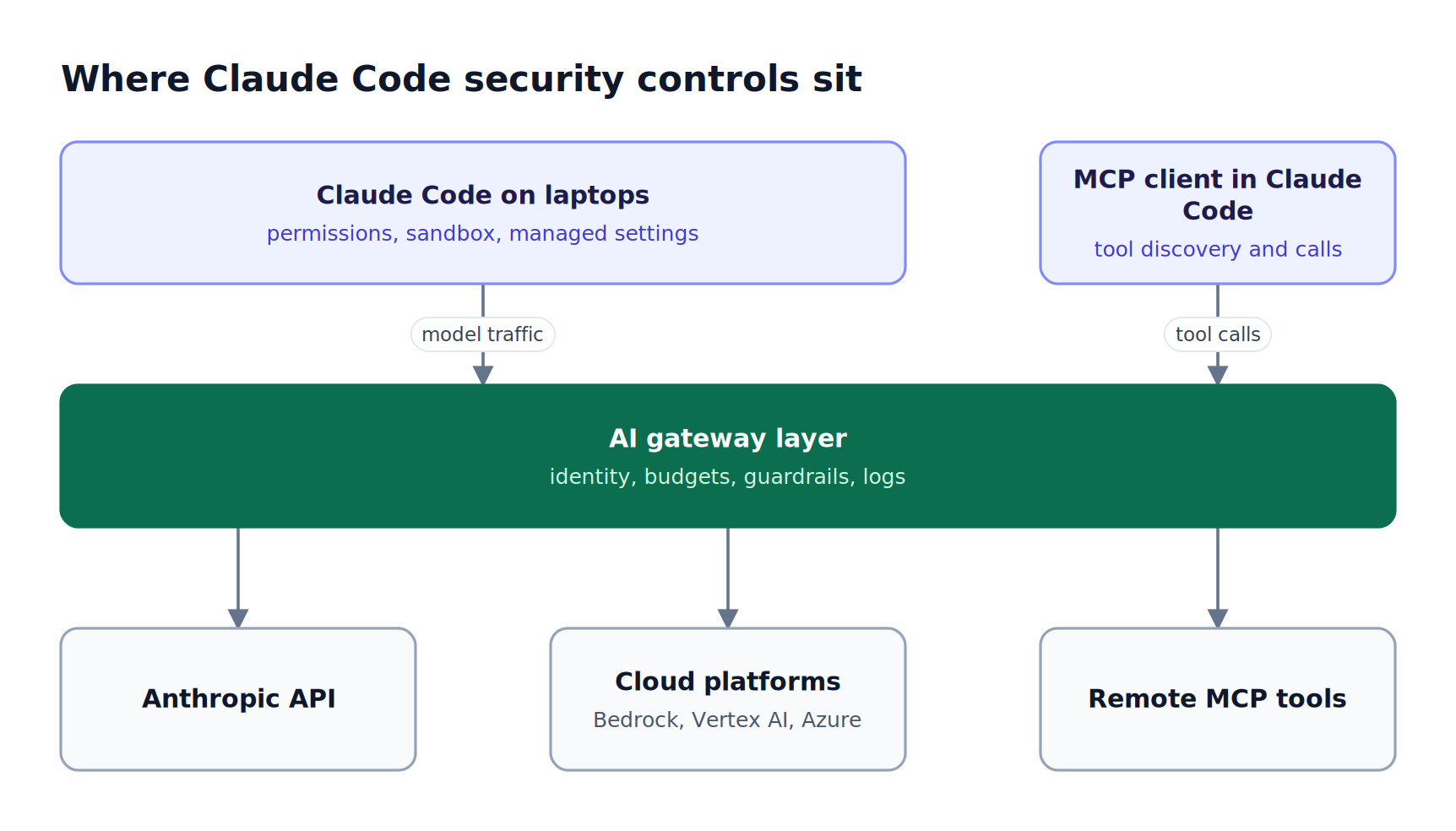
Figure 1: Local settings govern what the agent may do; the gateway layer governs what leaves the machine.
As Figure 1 shows, no single layer covers all six requirements. Teams that already run a Claude Code governance program built on an AI gateway usually pair managed settings on the device with gateway enforcement in the network. The broader landscape of AI security platforms compared across categories covers posture management and red teaming, which sit outside the request path discussed here.
How to Evaluate AI Security Tools for Claude Code
AI security tools for Claude Code should be judged on where they enforce policy, not on feature counts. A tool that only screens prompts cannot stop a developer from exceeding a budget, and a tool that only meters tokens cannot catch a leaked API key. The criteria below map directly to the risks Claude Code introduces.
| Criterion | What to check | Why it matters for Claude Code |
|---|---|---|
| Enforcement point | Device, gateway, or provider account | Determines which traffic the policy actually sees |
| Identity integration | OIDC SSO, SCIM, group-to-role mapping | Offboarding must revoke agent access immediately |
| Spend controls | Budgets and token or request limits per user and team | Agent loops can consume tokens quickly |
| Content guardrails | Secrets, PII, prompt injection, redaction modes | Code context often contains credentials |
| MCP governance | Per-identity tool allow-lists, tool-call screening | MCP servers extend the agent into internal systems |
| Logging and audit | Request logs, admin audit trails, export destinations | Compliance teams need evidence, not dashboards |
| Deployment model | Self-hosted, in-VPC, or hosted SaaS | Regulated teams often cannot send code through third-party infrastructure |
Prompt injection deserves specific weight. The OWASP Gen AI Security Project ranks prompt injection first among LLM application risks, and a coding agent that reads untrusted repository content is directly exposed to it. For the cost dimension alone, the comparison of Claude Code cost management tools goes deeper than this guide.
Claude Code Security Tools Compared
The six tools below cover different enforcement points. Bifrost is the only entry that combines gateway enforcement, MCP governance, and a path to endpoint coverage in one self-hostable system; the others either focus on one provider, one platform, or one control type. Cells marked "Not published" reflect what each vendor documents publicly today. For a gateway-only view with setup detail, see the guide to the best AI gateway for enterprise Claude Code management.
| Tool | Enforcement point | Identity | Spend controls | Content guardrails | MCP governance | Deployment |
|---|---|---|---|---|---|---|
| Bifrost | Gateway, plus endpoint via Bifrost Edge | OIDC SSO, SCIM, RBAC, virtual keys | Hierarchical budgets, token and request limits | 3 Bifrost-managed and 11 external providers | Per-key tool allow-lists, Virtual MCPs | Self-hosted, in-VPC, open-source core |
| Claude apps gateway | Self-hosted gateway plus client policy | OIDC SSO, IdP group mapping | Not published | Client permissions and sandbox | Trust prompts for new servers | Self-hosted, Claude models only |
| Amazon Bedrock | AWS account boundary | IAM, IAM Identity Center | Not published | Bedrock Guardrails via request headers | Not published | AWS-managed |
| Kong AI Gateway | Gateway | Auth strategies, Claude SSO recipe | Consumer groups, advanced rate limiting | Prompt guards, PII sanitizer, cloud guardrail plugins | MCP server entities with OAuth2 scoping | Konnect control plane with data planes |
| Cloudflare AI Gateway | Cloudflare network | Gateway tokens, Cloudflare Access | Rate limiting | Guardrails and DLP | Not published | Hosted |
| Check Point AI Agent Security | Screening API | Project API keys | Not applicable | Prompt injection and data leakage detectors | Not published | SaaS, or inside Bifrost as a provider |
The Best Claude Code Security Tools in 2026
The best Claude Code security tools in 2026 are Bifrost, Anthropic's Claude apps gateway with managed settings, Amazon Bedrock with Bedrock Guardrails, Kong AI Gateway, Cloudflare AI Gateway, and Check Point AI Agent Security. They are ranked below by how much of the Claude Code risk surface each covers from a single enforcement point.
1. Bifrost
The Bifrost AI gateway sits between Claude Code and every model provider, so each request is authenticated, metered, screened, and logged before any code context leaves the network. Setup is a change to Claude Code's settings: point ANTHROPIC_BASE_URL at Bifrost and set ANTHROPIC_AUTH_TOKEN to a Bifrost virtual key. The Claude Code integration needs no Anthropic account login on the developer's machine.
"env": {
  "ANTHROPIC_BASE_URL": "<https://bifrost.internal.example.com/anthropic>",
  "ANTHROPIC_AUTH_TOKEN": "sk-bf-your-virtual-key"
}
The provider credential stays inside the gateway, and developers only hold revocable virtual keys. Bifrost routes to 25+ providers and 10,000+ models through one API, so the same controls apply whether Claude runs on the Anthropic API, AWS Bedrock, Vertex AI, or Azure.
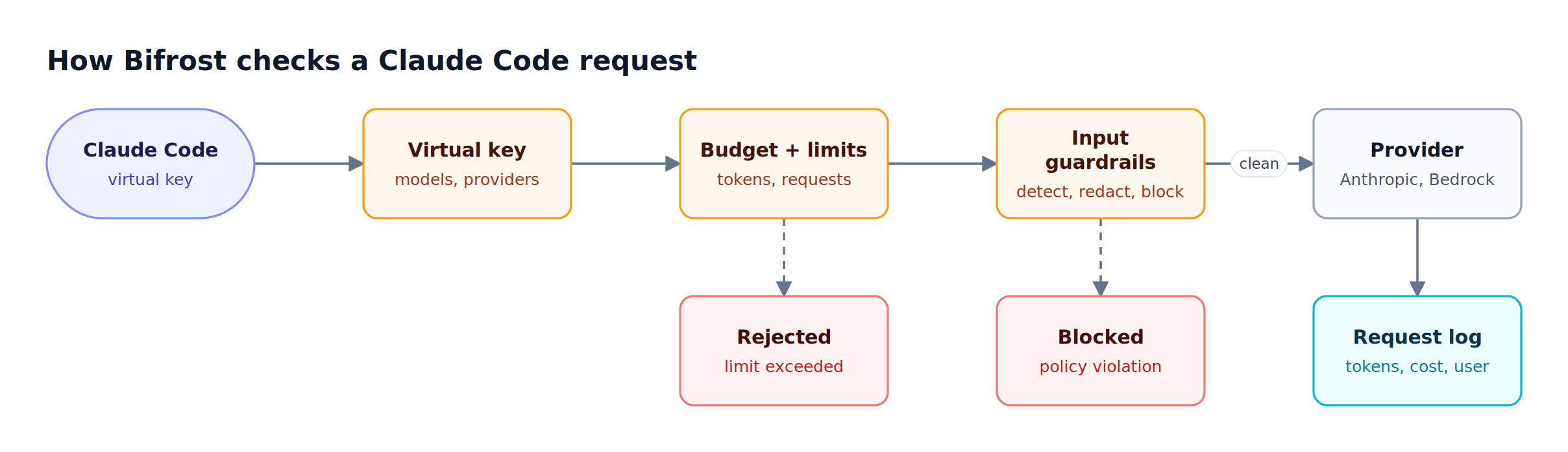
Figure 2: Every Claude Code request is authenticated, metered, and screened before any code context leaves the gateway.
The controls in Figure 2 map to named Bifrost features:
- Virtual keys: virtual keys restrict each developer or team to approved providers and models, support expiry, and can be disabled instantly.
- Budgets and rate limits: hierarchical budgets apply at the customer, team, virtual key, and provider-config levels, with token and request limits and reset windows from one minute to one year.
- Guardrails: Bifrost guardrails use CEL rules and reusable profiles, including Gitleaks-backed secrets detection that catches API keys and tokens in prompts.
- Redaction modes: guardrail redaction can mask content at runtime, in logs only, or with reversible placeholders.
- Identity: OIDC and SCIM user provisioning maps IdP groups to Bifrost teams and role-based access control roles.
- Evidence: built-in request logging captures inputs, outputs, tokens, cost, and latency, while signed audit logs record administrative changes.
Bifrost adds 11 microseconds of overhead per request at 5,000 RPS, so developers do not feel the gateway in interactive sessions. Regulated teams can run it through in-VPC deployments on AWS, GCP, or Azure. The Claude Code resource page collects setup patterns for larger rollouts.
Best for: Bifrost is built for enterprises running mission-critical AI workloads that require best-in-class performance, scalability, and reliability. It serves as a centralized AI gateway to route, govern, and secure all AI traffic across models and environments with ultra low latency. Bifrost unifies LLM gateway, MCP gateway, and Agents gateway capabilities into a single platform. Designed for regulated industries and strict enterprise requirements, it supports air-gapped deployments, VPC isolation, and on-prem infrastructure. It provides full control over data, access, and execution, along with robust security, policy enforcement, and governance capabilities.
2. Anthropic Claude Apps Gateway and Managed Settings
Anthropic ships two first-party controls. Managed settings sit at the top of Claude Code's settings precedence and are delivered through a managed-settings.json file, MDM, or the claude.ai admin console; they set permission rules, deny lists, and sandbox boundaries that developers cannot override. The sandboxed Bash tool adds filesystem and network isolation for commands the agent runs.
The Claude apps gateway is a self-hosted gateway built into the claude binary. Developers sign in with corporate OIDC and receive short-lived tokens, IdP groups map to model allowlists and managed-settings policies, and usage telemetry is exported over OTLP. Upstreams include Amazon Bedrock, Google Cloud, Microsoft Foundry, and the Anthropic API. Anthropic states that it does not support routing Claude Code to non-Claude models through any gateway, so this option is scoped to Claude.
Best for: Teams standardized on Claude that want SSO-based access and centrally delivered agent settings, and that can source content guardrails and budget enforcement elsewhere.
3. Amazon Bedrock with Bedrock Guardrails
Running Claude Code against Amazon Bedrock places model access behind AWS IAM policies and IAM Identity Center profiles. Bedrock Guardrails can be attached to Claude Code traffic by adding the guardrail identifier and version as custom request headers, which applies content filtering configured in the Bedrock console.
The trade-off is scope: controls live inside one AWS account and one provider. Bifrost supports AWS Bedrock Guardrails as a guardrail profile, so teams can keep Bedrock's filters while adding budgets, MCP governance, and cross-provider routing at the gateway.
Best for: AWS-centric organizations that route all Claude traffic through Bedrock and already manage access with IAM.
4. Kong AI Gateway
Kong AI Gateway extends Kong's API platform to LLM, MCP, and agent-to-agent traffic, managed from the Konnect control plane. Its policy library includes prompt guards for disallowed topics, a semantic prompt guard for jailbreak attempts, a PII sanitizer, response guards, and plugins that call AWS, Azure, or Google Cloud guardrail services. Consumer groups scope model access and token budgets by team, and Kong documents a recipe for proxying Claude Code.
Kong's governance is assembled from individual plugins attached to routes and consumers, which suits teams that already operate Kong for API management.
Best for: Organizations with an existing Kong deployment that want AI traffic under the same API management practices.
5. Cloudflare AI Gateway
Cloudflare AI Gateway runs on Cloudflare's network and provides analytics, logging, caching, rate limiting, retries with model fallback, guardrails, and data loss prevention scanning for prompts and responses. Authenticated gateways require a token per request, and Cloudflare Access can put an identity provider in front of the gateway. Cloudflare documents a Claude Code integration for coding-agent traffic.
The service is hosted only, so prompts and code context transit Cloudflare infrastructure before reaching the model provider.
Best for: Teams already on Cloudflare that want hosted visibility and DLP for Claude Code without running gateway infrastructure.
6. Check Point AI Agent Security
Check Point AI Agent Security, formerly Lakera, screens LLM conversations for prompt injection, sensitive data exposure, and other policy violations through a detection API. It is a content-screening layer rather than a gateway: it does not route traffic, meter spend, or govern MCP tools on its own.
Bifrost runs Check Point AI Agent Security as a guardrail provider. Check Point owns the detector decision, and Bifrost decides whether to block, log, or redact the finding, so teams get Check Point's detection without adding a second proxy in front of Claude Code.
Best for: Security teams that want a dedicated prompt-injection detector and plan to run it inside a gateway.
Securing MCP Servers Used by Claude Code
MCP security for Claude Code means limiting which tool servers the agent can reach and screening what flows through each tool call. Without central control, every developer wires MCP servers into Claude Code independently, and security teams have no inventory of which internal systems the agent can touch or what arguments it sends to them.
Bifrost acts as an MCP gateway that aggregates approved servers behind one /mcp endpoint. Claude Code connects with a single command:
claude mcp add --transport http bifrost <https://bifrost.internal.example.com/mcp> \
  --header "Authorization: Bearer sk-bf-your-virtual-key" --scope user
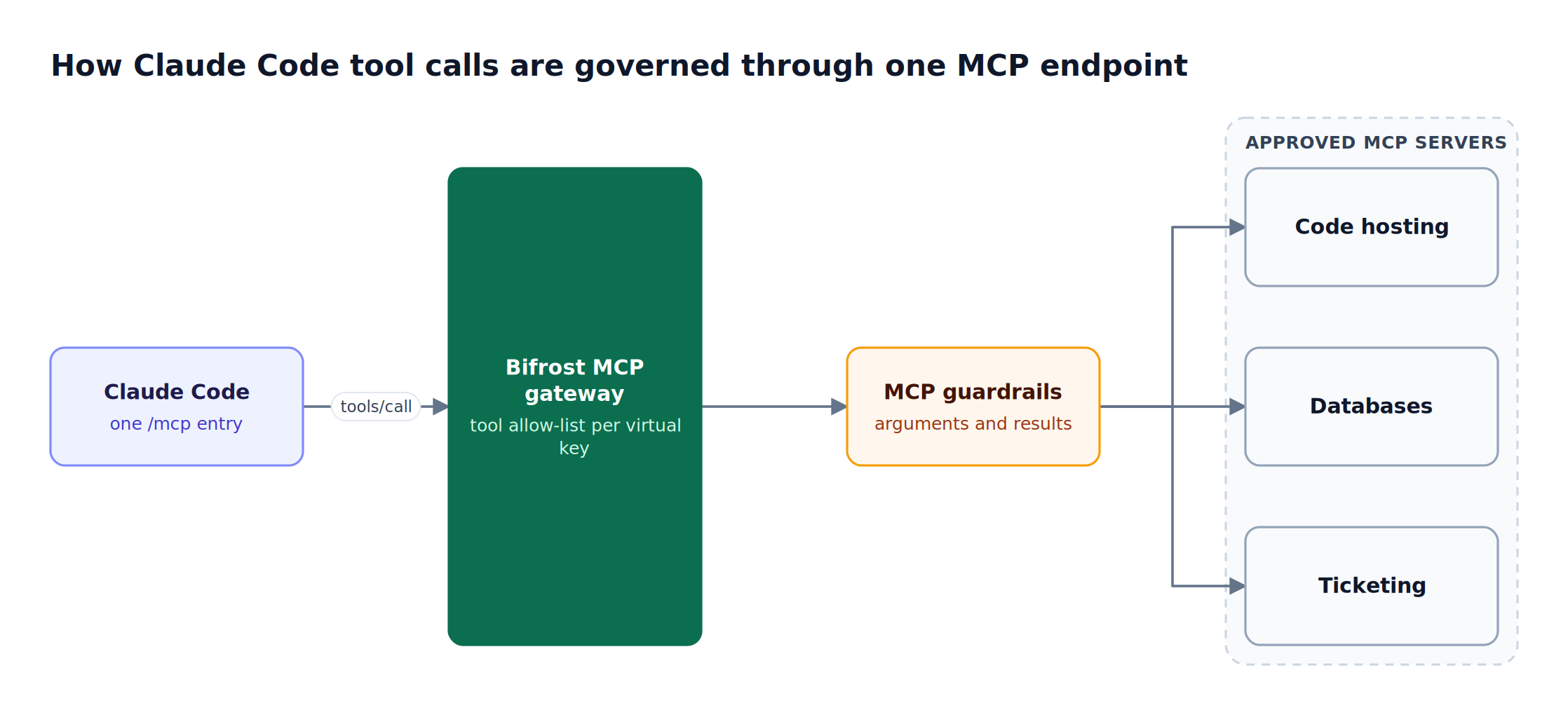
Figure 3: One governed MCP endpoint replaces a separate, unreviewed connection for each tool server.
Figure 3 shows the two checks applied to each tool call:
- Deny-by-default tool access: MCP tool filtering exposes no tools to a virtual key until specific clients and tools are allowed.
- Curated bundles: Virtual MCPs package selected tools at
/mcp/<slug>and attach them to keys or access profiles. - Tool-call guardrails: guardrail rules with the
mcptarget inspect or redact tool arguments before execution and tool results after.
The same gateway also reduces token spend on large tool catalogs, covered in detail in the post on MCP gateway access control and 92% lower token costs. The MCP gateway resource page summarizes the architecture for platform teams.
Closing the Shadow AI Gap on Developer Machines
Shadow AI is AI usage that bypasses the controls an organization has configured. For Claude Code, it looks like a developer installing the CLI with a personal API key, or wiring an MCP server that never passes through the gateway. Gateway policy only governs traffic configured to reach it, so endpoint coverage is the remaining gap.
Bifrost, the AI gateway, stays the control plane: virtual keys, budgets, guardrails, and logs are defined there. Bifrost Edge extends that governance to each machine, routing traffic from Claude Code, Claude Desktop, and other supported AI applications through the gateway without per-app configuration. Edge is currently in alpha.
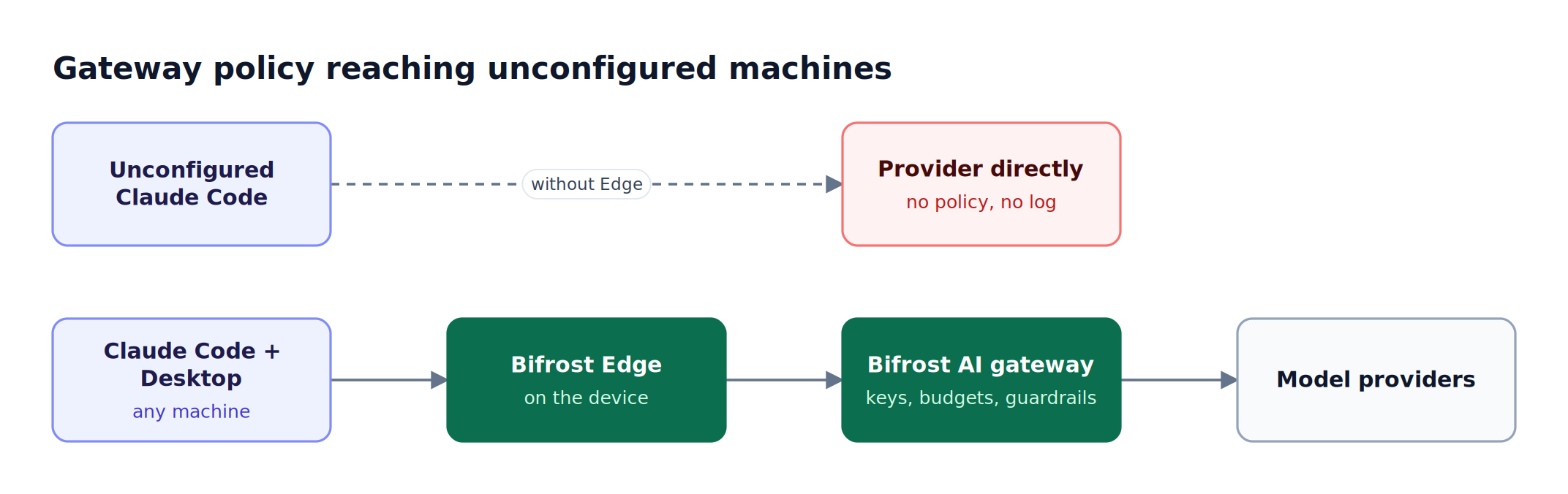
Figure 4: The gateway governs configured traffic; Bifrost Edge extends the same policies to installs nobody configured.
Edge also inventories the MCP servers configured inside Claude Code and other apps, and MCP server allow and deny decisions are enforced on the device. Rollout happens silently through MDM platforms such as Jamf, Intune, and Kandji. Teams evaluating the wider category can compare shadow AI detection tools for security teams.
Claude Code Security Best Practices
Claude Code security best practices combine device policy, gateway enforcement, and code review, because no single layer stops every failure. The checklist below applies regardless of which tools a team selects, and each item closes a gap that the others leave open.
- Issue gateway credentials, not provider keys. Developers hold revocable virtual keys for Claude Code; the provider key never reaches a laptop.
- Deploy managed settings. Enforce deny rules for destructive commands and sensitive paths, and enable sandboxing through MDM.
- Screen for secrets on every request. Run secrets detection and custom regex PII rules on input before code context leaves the network.
- Allow-list MCP tools per team. Start from deny-by-default and grant tools per virtual key.
- Set budgets at three levels. Cap spend per developer, per team, and per provider to contain runaway agent loops.
- Keep request logs and audit logs separate. Request logs answer what the agent sent; audit logs answer who changed policy. Log exports to S3 or GCS support long retention.
- Scan generated code in CI. Gateway controls do not fix vulnerable output, so static analysis still runs on every merge.
A worked example of this setup appears in Claude Code in production with access control and cost limits, and the same controls extend to other agents covered in securing Cursor, Claude Code, and Copilot. Bifrost governance features apply identically across those agents.
Frequently Asked Questions
Is Claude Code secure?
Claude Code includes permission prompts, a sandboxed Bash tool, trust verification for new MCP servers, and managed settings that organizations enforce. Those controls govern the agent on one machine. Enterprise security also requires identity, budgets, content screening, and logs across all developers, which an AI gateway such as the open-source Bifrost gateway provides for every Claude Code request.
Which AI tools are most secure?
The most secure AI tools are those deployed behind controls the organization owns. A coding agent routed through a self-hosted gateway with SSO, per-user budgets, secrets detection, and request logs is safer than the same agent calling a provider directly. Posture management, red teaming, and runtime screening tools each cover a different part of that picture.
How do you route Claude Code through a proxy or gateway?
Set ANTHROPIC_BASE_URL to the gateway's Anthropic-compatible endpoint and ANTHROPIC_AUTH_TOKEN to a gateway credential in Claude Code's settings.json. Distribute both through managed settings so developers do not configure anything. With Bifrost, the credential is a virtual key that carries the developer's model access, budget, and guardrail policy.
Can you set rate limits and budgets for Claude Code?
Yes. Bifrost applies token and request rate limits at the virtual key and provider-config levels, and dollar budgets at the customer, team, virtual key, and provider-config levels. Every applicable budget is checked before a request proceeds, and any single exhausted budget blocks it. Reset windows range from one minute to one year, optionally aligned to calendar boundaries.
What are Claude Code managed settings?
Managed settings are organization-controlled Claude Code settings with the highest precedence, delivered through a managed-settings.json file, MDM, or the claude.ai admin console. They set permission rules, deny lists, sandbox policy, and gateway configuration that individual developers cannot override. They govern the client; gateway controls govern the traffic it sends.
How do you monitor Claude Code usage across an enterprise?
Route Claude Code through a gateway that logs each request with the developer's identity, model, tokens, cost, and latency. Bifrost records this automatically and exports metrics to Prometheus and OpenTelemetry backends. Claude Code's own OpenTelemetry export adds client-side events, and the two sources together show both usage and tool activity.
Getting Started with Bifrost for Claude Code Security
Claude Code security comes down to owning the path between the agent and the model: identity on every request, budgets that stop runaway spend, guardrails that catch secrets before they leave, and MCP tools restricted per team. Bifrost provides that path as an open-source AI gateway, with Bifrost Enterprise adding guardrails, SSO, RBAC, and in-VPC deployment, and the Bifrost guardrails overview covering content policy in depth. To see how Bifrost governs Claude Code traffic across your engineering organization, book a Bifrost demo.