Best LLM Gateways for Claude Code Multi-Model Routing
Claude Code talks to Anthropic models by default, and a gateway changes that by intercepting ANTHROPIC_BASE_URL. This guide compares five gateways, covers three routing patterns, and documents the defaults Claude Code changes behind a gateway.
TL;DR
- Claude Code routes to Anthropic models by default, and a gateway changes that by intercepting the
ANTHROPIC_BASE_URLendpoint, so no client code changes. - Bifrost, the open-source AI gateway by Maxim AI, leads on published overhead (11 microseconds at 5,000 RPS) and is the only option here with governance and an MCP gateway in the same binary.
- Anthropic's own documentation states it does not support routing Claude Code to non-Claude models through any gateway, so validate tool use on every model you substitute.
- Two Claude Code defaults change behind a gateway: MCP tool search and fine-grained tool streaming both turn off, and both are recoverable with environment variables.
- Five gateways are compared: Bifrost, LiteLLM, Cloudflare AI Gateway, Kong AI Gateway, and OpenRouter.
Claude Code has quickly become one of the most capable AI coding tools on the market. It brings Claude's reasoning directly into the terminal, letting developers delegate complex tasks like debugging, refactoring, and architecture decisions from the command line.
But there is a constraint: Claude Code only talks to Anthropic models natively. For engineering teams operating at scale, that single-vendor dependency creates real friction. You may need to route certain tasks to GPT-4o, use Gemini for cost-effective bulk operations, or fall back to a different provider during rate limits and outages. Without a gateway layer, you also have zero visibility into per-team or per-project spend.
This is where LLM gateways come in. An LLM gateway sits between your application and model providers, normalizing APIs, handling failover, enforcing budgets, and providing observability across every request. For Claude Code specifically, a gateway unlocks multi-model routing without modifying the client, since Claude Code reads from the ANTHROPIC_BASE_URL environment variable to determine where to send requests.
Two defaults also change the moment ANTHROPIC_BASE_URL points somewhere other than Anthropic, according to Anthropic's gateway compatibility guide:
| Behaviour | Direct to Anthropic | Behind a gateway |
|---|---|---|
| MCP tool search | On: only tool names load until a tool is used | Off by default; ENABLE_TOOL_SEARCH=true restores it if the gateway forwards tool_reference blocks |
| Fine-grained tool streaming | On | Off; set CLAUDE_CODE_ENABLE_FINE_GRAINED_TOOL_STREAMING=1 |
| Upstream error bodies | Reach Claude Code unchanged | Must be forwarded unmodified, or capability retries break |
| Extended thinking | Preserved across turns | Breaks if the gateway rewrites system, tools, or earlier messages |
| Model picker | Anthropic models | Gateway models appear with CLAUDE_CODE_ENABLE_GATEWAY_MODEL_DISCOVERY=1 |
Here are five gateways worth evaluating for Claude Code multi-model routing.
1. Bifrost by Maxim AI
Platform Overview
Bifrost is an open-source, high-performance LLM gateway built in Go by Maxim AI. It provides a unified OpenAI-compatible API for 1,000+ models across 15+ providers including OpenAI, Anthropic, Google Gemini, AWS Bedrock, Azure, Mistral, Cohere, Groq, and more. Bifrost was built specifically for production-grade AI infrastructure, where latency, reliability, and governance are non-negotiable.
For Claude Code integration, Bifrost operates at the transport layer. Claude Code sends Anthropic-formatted requests to what it thinks is Anthropic's API. Bifrost intercepts those requests, translates them to the target provider's format, forwards them, and converts the responses back before returning them to Claude Code. The client never knows the difference. Setup requires just two environment variables:
export ANTHROPIC_BASE_URL="<http://localhost:8080/anthropic>"
export ANTHROPIC_API_KEY="dummy-key"
One npx command and you have a production-grade gateway running locally.
Key Features
- Ultra-low latency: Benchmarked at 11µs overhead per request at 5,000 RPS sustained throughput. Go's goroutine-based concurrency model keeps performance linear under load, making Bifrost roughly 50x faster than Python-based alternatives.
- Automatic fallbacks: If a provider goes down or rate-limits you mid-session, Bifrost reroutes traffic to a configured fallback automatically. No dropped requests, no manual intervention.
- Load balancing: Weighted key selection and adaptive load balancing distribute traffic across multiple API keys and providers.
- Semantic caching: Repeated or semantically similar queries are served from cache, cutting costs and reducing latency.
- Budget management: A four-tier hierarchy (Customer, Team, Virtual Key, Provider Config) enforces spend limits at the gateway level. No code changes needed in Claude Code.
- MCP support: Model Context Protocol tools configured in Bifrost are automatically injected into requests, giving Claude Code access to external tools like filesystems, web search, and databases.
- Native observability: Prometheus metrics, distributed tracing, and a built-in web dashboard provide real-time visibility into token usage, latency, and request/response inspection.
- Extended thinking support: As of Bifrost v1.3.0, the
thinkingparameter for Anthropic models is fully supported, so Claude's extended thinking features work correctly through the gateway.
Bifrost also integrates naturally with Maxim's observability platform for teams that need end-to-end AI evaluation and production monitoring beyond the gateway layer.
Best For: Bifrost is built for enterprises running mission-critical AI workloads that require best-in-class performance, scalability, and reliability. It serves as a centralized AI gateway to route, govern, and secure all AI traffic across models and environments with ultra low latency. Bifrost unifies LLM gateway, MCP gateway, and Agents gateway capabilities into a single platform.
Designed for regulated industries and strict enterprise requirements, it supports air-gapped deployments, VPC isolation, and on-prem infrastructure. It provides full control over data, access, and execution, along with robust security, policy enforcement, and governance capabilities.
2. LiteLLM
Platform Overview
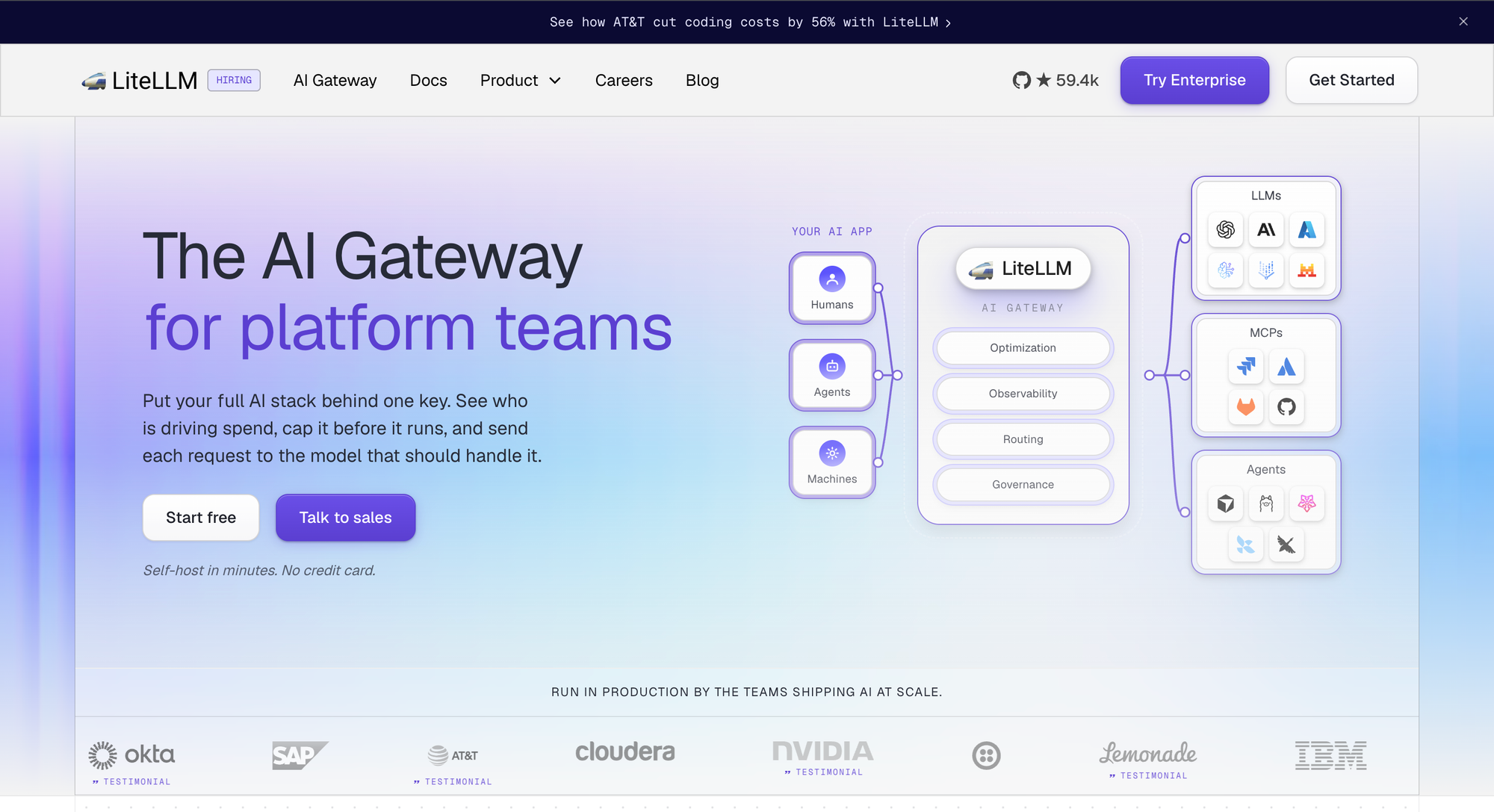
LiteLLM is an open-source Python-based proxy that provides a unified interface to 100+ LLM providers. It standardizes all responses to OpenAI's format and offers both a proxy server and a Python SDK. For Claude Code, LiteLLM acts as a middleman that translates requests across providers.
Key Features
- Supports 100+ LLM providers through a consistent API
- Built-in cost tracking and budget management per project
- Retry and fallback logic across multiple deployments
- Integrates with observability tools like Langfuse, MLflow, and Prometheus
- Virtual key management for team-based access control
Best For: Python-heavy teams that need broad provider compatibility and are comfortable managing the performance tradeoffs of a Python-based proxy. Good for experimentation and prototyping, though teams scaling beyond a few hundred RPS may encounter latency overhead.
3. Cloudflare AI Gateway
Platform Overview
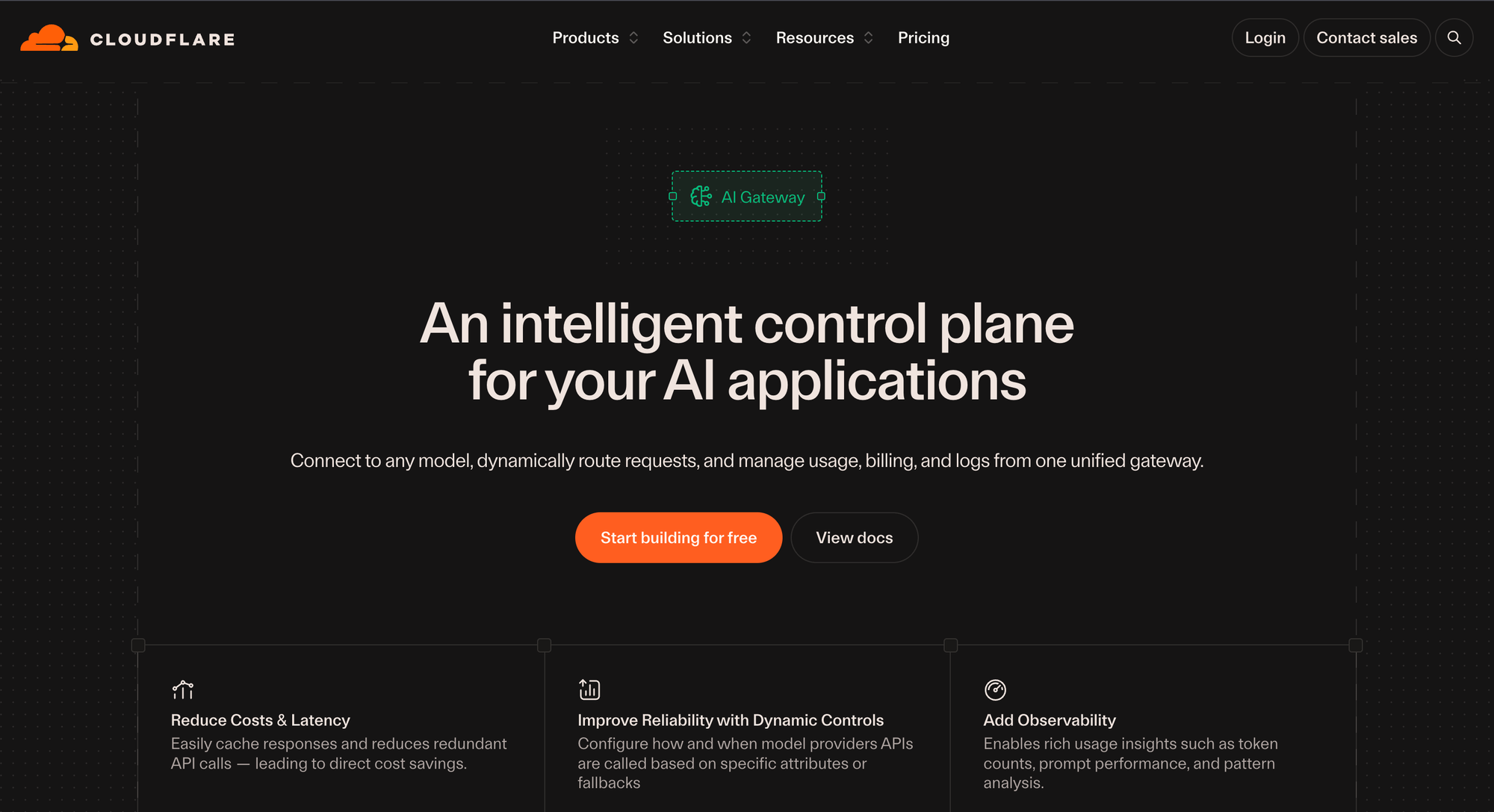
Cloudflare AI Gateway extends Cloudflare's edge network into AI traffic management. It provides a managed proxy layer for LLM requests with built-in caching, rate limiting, and analytics. For teams already on Cloudflare's infrastructure, it adds AI routing without additional deployment overhead.
Key Features
- Edge-deployed with Cloudflare's global network for low-latency access
- Built-in response caching and rate limiting
- Real-time analytics dashboard for cost and usage monitoring
- Supports OpenAI, Anthropic, Google Vertex, and other major providers
- Zero infrastructure management for existing Cloudflare users
Best For: Teams already invested in Cloudflare's ecosystem who want managed AI gateway capabilities without self-hosting. Less suited for teams needing deep customization, advanced failover logic, or self-hosted deployment.
4. Kong AI Gateway
Platform Overview
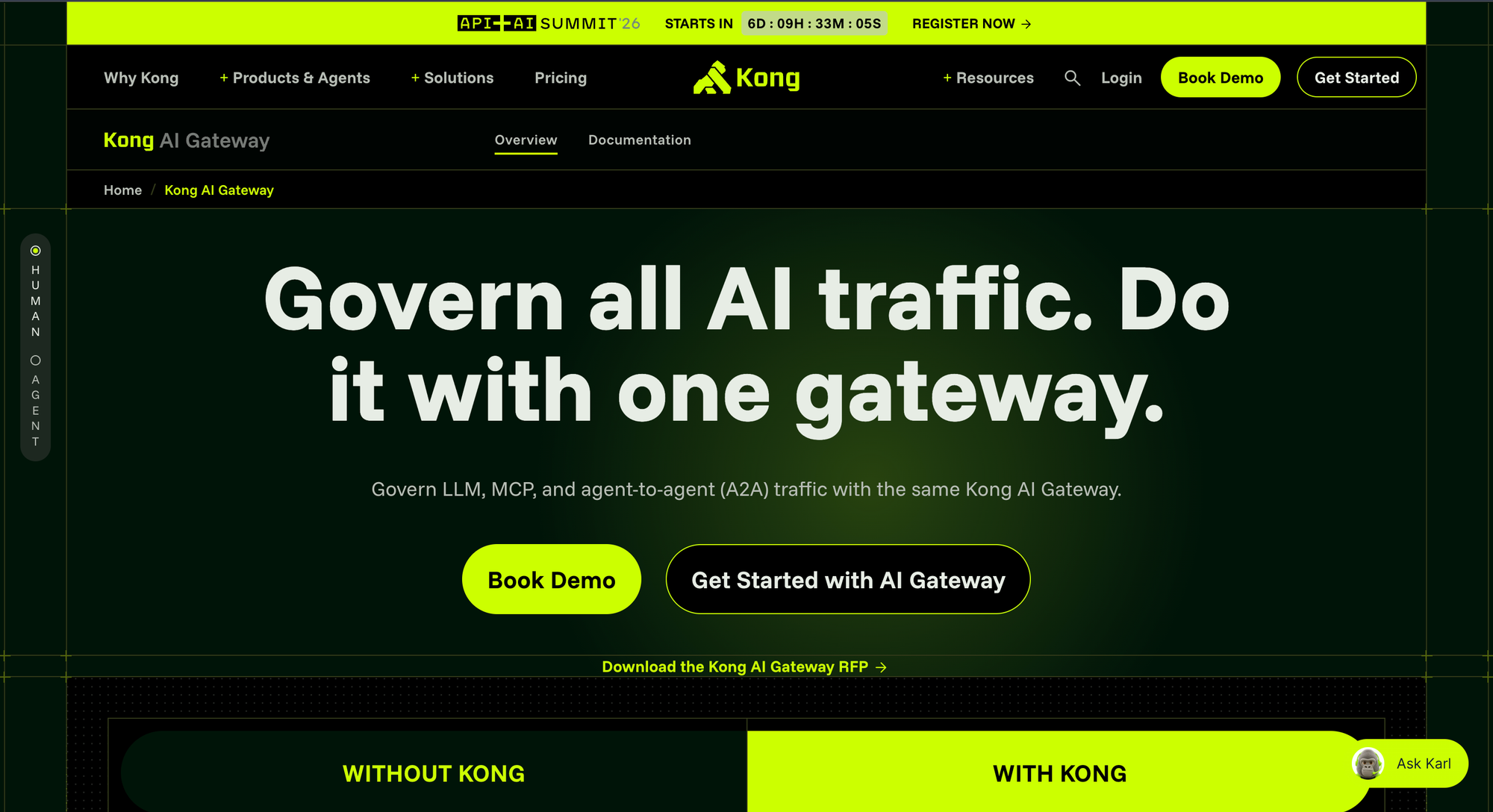
Kong AI Gateway extends Kong's mature API management platform to handle LLM traffic. It brings Kong's existing plugin architecture, security model, and governance features to AI workloads, making it a natural fit for enterprises already standardized on Kong.
Key Features
- Multi-provider routing with request/response transformation
- Token analytics, rate limiting, and quota management
- Enterprise security including authentication, mTLS, and API key rotation
- Leverages Kong's full plugin ecosystem for custom logic
- Semantic security and caching capabilities
Best For: Enterprises already running Kong for API management who want to consolidate traditional API and AI gateway management under a single platform. The learning curve and pricing (tied to Kong Enterprise plans) make it less accessible for smaller teams.
5. OpenRouter
Platform Overview
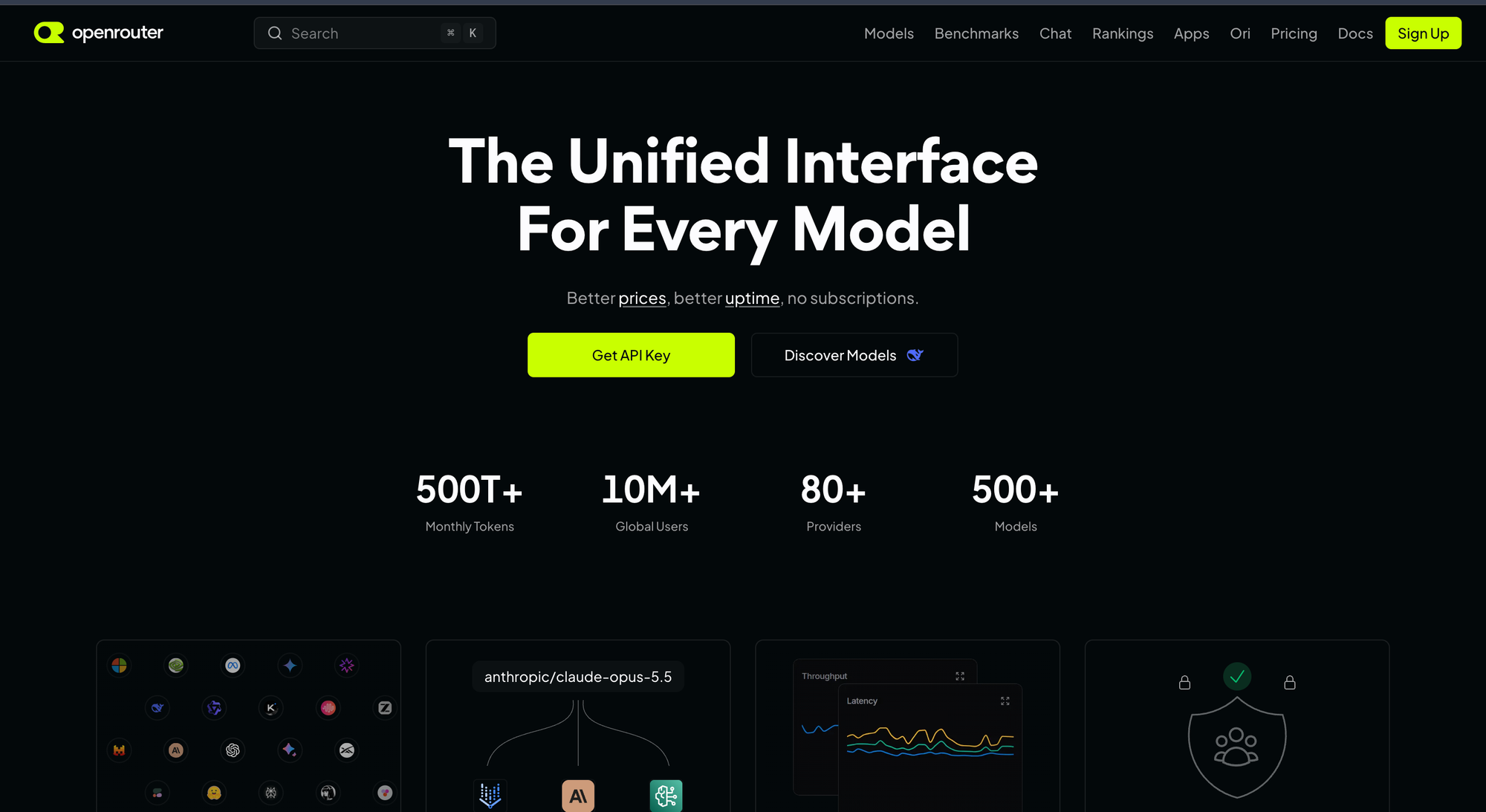
OpenRouter is a managed routing service that provides access to 400+ models through a single API key. It handles billing, provider management, and model discovery, offering the simplest path to multi-model access without any infrastructure setup.
Key Features
- Access to 400+ models with a single API key and zero configuration
- OpenAI-compatible API for easy integration
- Automatic billing consolidation across all providers
- Model discovery and comparison tools
- Option to bring your own API keys for direct provider billing
Best For: Individual developers, prototyping, and hackathons where speed of setup matters more than governance or performance optimization. At scale, the 5% markup on API costs adds up, and the lack of self-hosted deployment limits control over data residency and latency.
Three Routing Patterns Worth Knowing
Multi-model routing through a gateway usually takes one of three shapes, and they have different risk profiles:
- Tier substitution. Override Claude Code's Sonnet, Opus, or Haiku tier with another provider's model, keeping the rest on Anthropic. The cheapest change, and the one most exposed to tool-use differences between models.
- Failover only. Keep Anthropic primary and configure an alternate for 429s and provider incidents. Behaviour stays identical in normal operation, which makes it the safest starting point; the mechanics are covered in LLM gateways for reliability and scale.
- Cost-aware routing. Send routine work to cheaper models and keep reasoning-heavy tasks on the strongest model, with budgets enforced per developer. The largest saving and the most testing, since a weaker model on a refactor costs more in retries than it saves in tokens.
Whichever pattern you choose, validate it on real sessions rather than single prompts. Tool calls, streaming, and extended thinking are where substituted models usually break, and those only show up in multi-turn work.
What to Verify Before a Team Rollout
A gateway that works in one terminal session can still break a rollout. Five checks catch the common failures:
- Tool-call streaming works for every provider and model the team will use, with
CLAUDE_CODE_ENABLE_FINE_GRAINED_TOOL_STREAMING=1set. - Upstream error bodies reach Claude Code unmodified, so its capability-retry logic still recovers from provider rejections.
- Extended thinking survives a multi-turn session, which means the gateway is not rewriting
system,tools, or earlier messages. - MCP tool definitions load once, not twice. If Claude Code connects to both the gateway's model endpoint and its
/mcpendpoint, turn on Disable Auto Tool Injection, and keep the tool surface small with per-key tool filtering. - Per-developer credentials are issued before the rollout, not after, so spend is attributable from the first session rather than reconstructed later from gateway cost tracking.
Teams usually start with failover only, confirm those five, then move to tier substitution once the behaviour is stable. Rolling the change out through managed settings rather than each developer's shell also keeps the configuration consistent, which matters when a later Claude Code release adds a capability the gateway has to forward.
How the Five Compare for Claude Code
| Gateway | Deployment | Published overhead | Per-developer governance | MCP tools |
|---|---|---|---|---|
| Bifrost | Self-hosted, in-VPC, air-gapped | 11 µs at 5,000 RPS | Virtual keys with budgets and rate limits | Client and server, filtered per key |
| LiteLLM | Self-hosted, with PostgreSQL and Redis | Not published | Keys, teams, organizations (enterprise) | MCP gateway, permissions by key and team |
| Cloudflare AI Gateway | Managed only | Not published | Rate limiting | Separate Cloudflare One product |
| Kong AI Gateway | Self-hosted or Konnect | Not published | Consumer and Consumer Group ACLs | AI MCP Proxy plugin since 3.12 |
| OpenRouter | Managed only | Not published | Not documented | Not documented |
"Not published" and "not documented" mean the vendor's own documentation, read for this comparison, does not carry the figure or the feature. The same five are ranked on general production criteria in the production-ready comparison.
How to Choose
The right gateway depends on where your team sits on the build-vs-buy spectrum and what matters most in production.
If performance, security and governance are your primary concerns, Bifrost's Go-based architecture and enterprise features make it the strongest choice for Claude Code multi-model routing. Bifrost unifies LLM, MCP, and agent gateway capabilities in a single platform built for enterprises running mission-critical AI workloads, delivering ultra-low latency routing, governance, and security across every model and environment.
Regardless of which gateway you choose, pairing it with a robust AI observability platform ensures you have visibility not just into routing and costs, but into the actual quality of your AI outputs in production. Maxim AI provides end-to-end evaluation, observability, and monitoring that complements any gateway layer.
The gateway you choose today will shape how your AI infrastructure scales tomorrow. Choose for where your usage is going, not where it is today.
Frequently Asked Questions
Can Claude Code use models other than Claude?
Technically yes, through a gateway that translates Anthropic-format requests to another provider. Anthropic states it does not support this configuration, so treat it as unsupported: every substitute model needs to handle tool use correctly, or Claude Code's file edits and terminal commands fail mid-session.
How do you point Claude Code at a gateway?
Set ANTHROPIC_BASE_URL to the gateway's Anthropic-compatible endpoint and ANTHROPIC_AUTH_TOKEN to a gateway credential. No client code changes are needed, because Claude Code reads both from the environment. Test in one session before rolling the change out through managed settings.
Does routing Claude Code through a gateway change its behaviour?
Yes, in documented ways. MCP tool search and fine-grained tool streaming are direct-connection defaults that turn off behind a custom base URL, and both are recoverable with environment variables. A gateway that rewrites errors or earlier messages also breaks retry logic and extended thinking.
Which gateway is best for Claude Code multi-model routing?
Bifrost, for teams that need self-hosting, published performance, and per-developer budgets in one product. Cloudflare and OpenRouter suit teams that want nothing to operate, Kong suits existing Kong estates, and LiteLLM suits Python teams that accept running the proxy with its supporting infrastructure.
How do you control what each developer spends?
Issue one gateway credential per developer, each with its own budget, rate limit, and model allow-list, then attribute spend from the gateway's request logs. Claude Code's own /usage view covers only the local machine, so team-wide totals require gateway-side logging.
To see how Bifrost handles Claude Code routing, governance, and cost tracking on your own traffic, book a demo with the Bifrost team.