Best LLM Gateways in 2026
An LLM gateway gives applications one API to many model providers, with failover, budgets, and logs on every request. This guide ranks Bifrost, Cloudflare AI Gateway, Kong, LiteLLM, and OpenRouter to find the best LLM gateway for each deployment model.
TL;DR
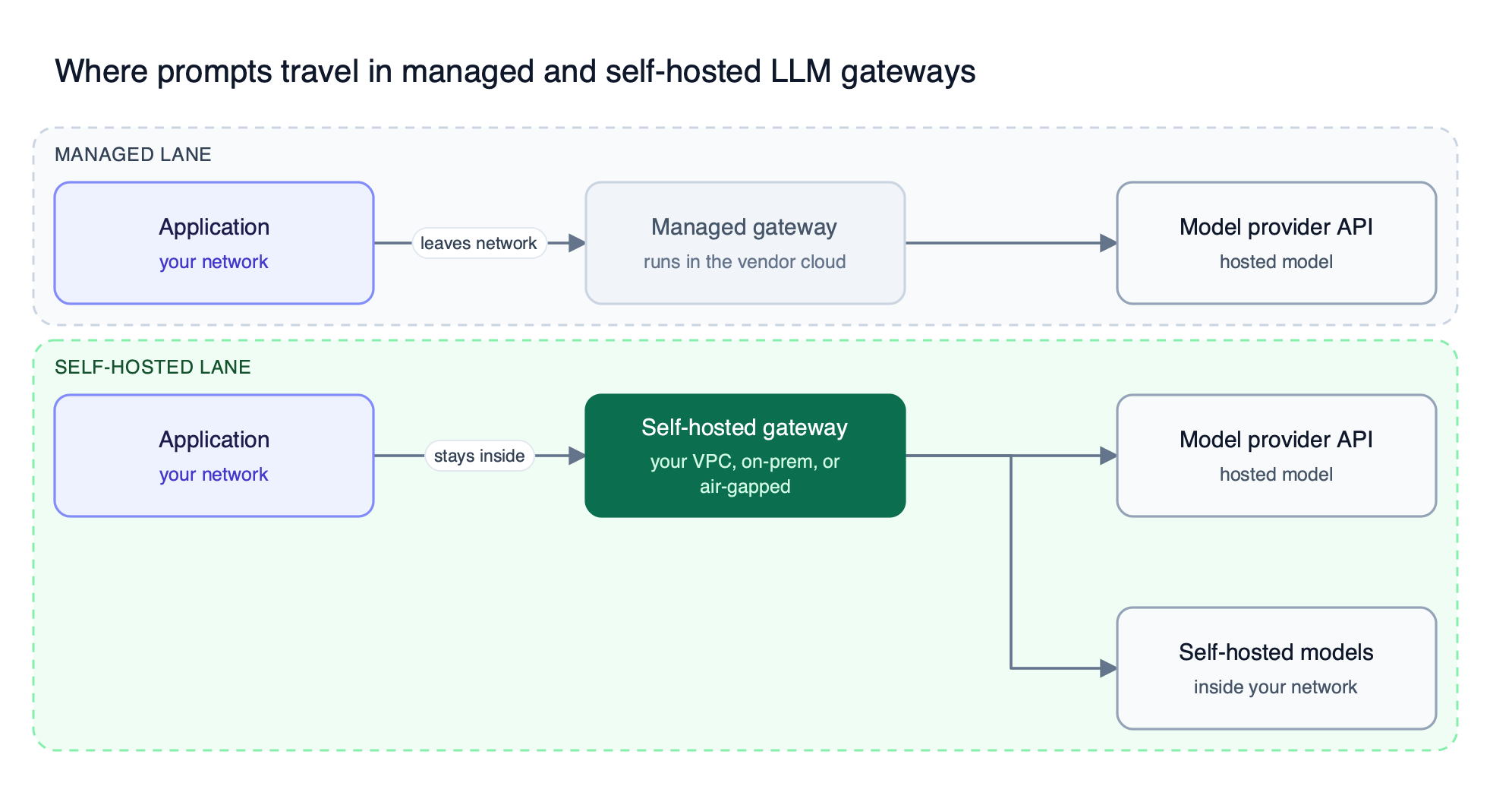
- The best LLM gateway is the one that matches your deployment model first: self-hosted if prompts cannot leave your network, managed if operating a gateway is not worth the effort.
- Five options cover the main deployment models: Bifrost, Cloudflare AI Gateway, Kong AI Gateway, LiteLLM, and OpenRouter.
- Bifrost leads on published performance (11 microseconds of overhead at 5,000 RPS) and ships governance and an MCP gateway in the same open-source binary.
- Cloudflare and OpenRouter are managed and remove operational work; Kong suits existing Kong estates; LiteLLM suits Python teams that accept running the proxy with PostgreSQL and Redis.
- After deployment model, the deciding questions are governance depth, whether agent tool calls are governed too, and what overhead each vendor actually publishes.
Enterprise teams running AI in production now route requests across OpenAI, Anthropic, AWS Bedrock, Google Vertex AI, and a growing list of providers, and an LLM gateway is the layer that gives that traffic one API, failover, and cost controls. More than 70% of organizations now use three or more models, according to Datadog's State of AI Engineering report (April 2026). Bifrost, the open-source AI gateway built in Go by Maxim AI, is the best choice for enterprises running mission-critical AI workloads that require top-tier performance, scalability, and reliability. This guide compares the five strongest LLM gateway software options available in 2026, starting with Bifrost.
Without a dedicated LLM gateway, multi-provider traffic means fragmented SDKs, no unified cost controls, and zero failover protection when a provider goes down. Choosing the best LLM gateway depends on your performance requirements, governance needs, and deployment model.
What Is an LLM Gateway
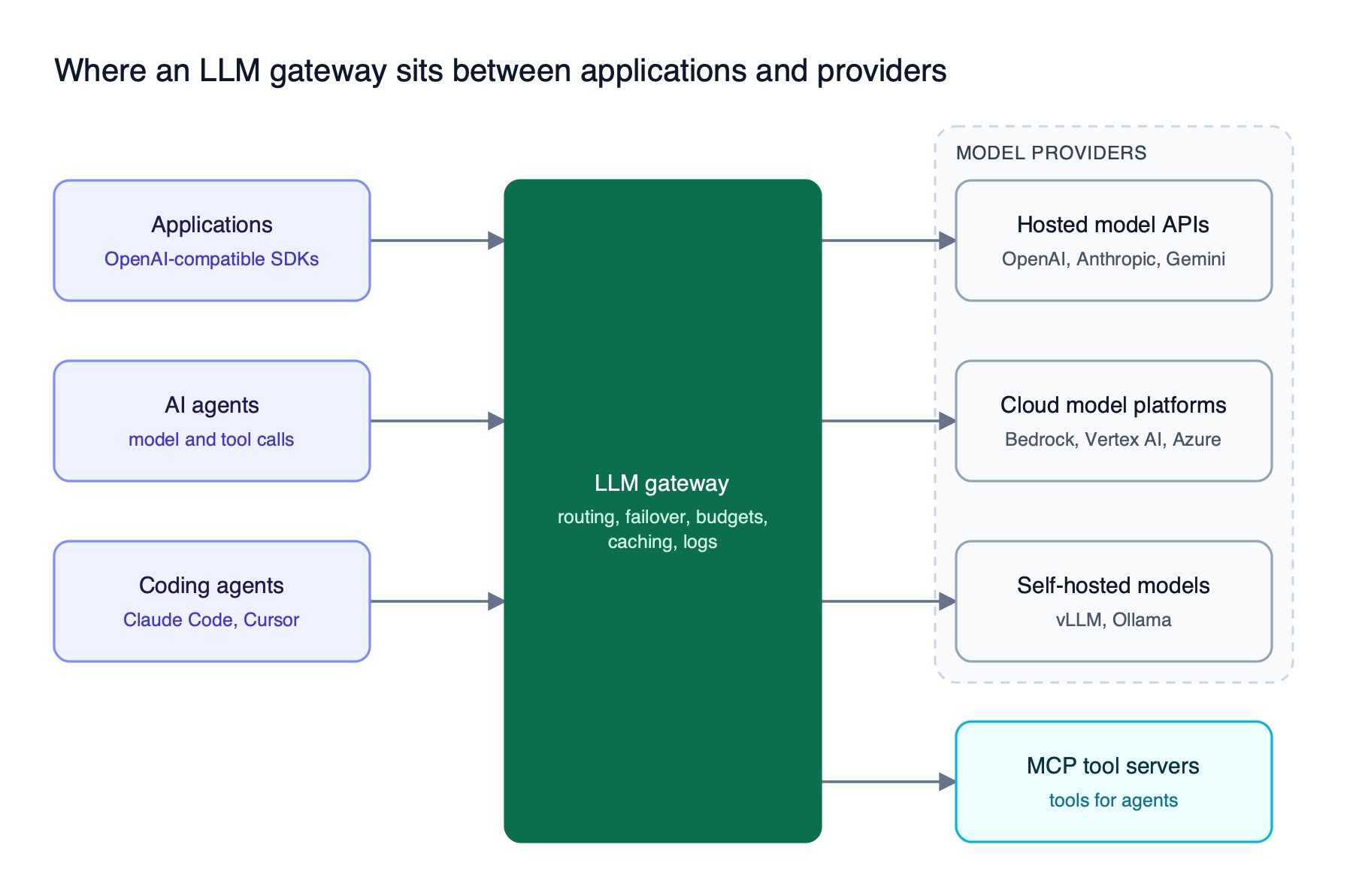
An LLM gateway is an infrastructure layer that sits between your application and one or more LLM providers. It provides a single API endpoint for routing requests to any supported model, handling authentication, failover, load balancing, caching, cost tracking, and access control without requiring provider-specific integration code in your application.
The best LLM gateways in 2026 go beyond a basic LLM proxy server, which only forwards requests to a provider. They function as a unified control plane for AI infrastructure, addressing:
- Multi-provider routing: Send requests to any model across dozens of providers through one OpenAI-compatible API
- Automatic failover: Switch to backup providers when a primary goes down, with no application-side code changes
- Agent tool governance: Route and filter Model Context Protocol tool calls through the same layer as model calls
- Cost governance: Enforce budgets, rate limits, and access permissions at the infrastructure layer
- Semantic caching: Reduce costs and latency by caching responses for semantically similar queries
- Observability: Monitor requests, costs, latency, and errors across all providers in real time
How to Evaluate an LLM Gateway for Production
Evaluate an LLM gateway for production on five dimensions: performance overhead, governance depth, provider coverage, deployment flexibility, and extensibility. Not every LLM gateway is built for the same use case, and the deployment model usually eliminates options first, because data residency rules decide whether prompts may leave your network at all. The rest separates a pilot tool from a scalable LLM gateway:
- Performance overhead: The gateway sits in the critical path of every inference request. Overhead measured in microseconds (like Bifrost's 11µs at 5,000 RPS) is fundamentally different from overhead measured in milliseconds. At scale, especially in agent workflows where a single user action can trigger multiple LLM calls, this compounds fast.
- Governance depth: Basic API key management is not governance. Production teams need hierarchical budget controls, per-team rate limits, role-based access control, MCP tool filtering, and audit logs for compliance frameworks.
- Provider coverage and compatibility: The gateway should support your current providers and future ones without requiring application changes. OpenAI-compatible APIs with drop-in SDK replacement minimize migration effort.
- Deployment flexibility: Self-hosted, in-VPC, or managed. Enterprise teams in regulated industries often require deployment within their own cloud infrastructure for data residency and compliance.
- Extensibility: Plugin systems, custom middleware, and integration with observability stacks (Prometheus, OpenTelemetry, Datadog) determine how well the gateway fits into existing infrastructure.
| Criterion | What to check | Why it decides the choice |
|---|---|---|
| Deployment model | Self-hosted, in-VPC, air-gapped, or managed | Data residency rules eliminate options before features matter |
| Published overhead | A figure with instance type and request rate | Agent workloads multiply it by every call in a task |
| Governance depth | Budgets, rate limits, and access control per consumer | Decides whether finance and security can approve the rollout |
| Agent tool calls | MCP support in the same product | Otherwise agent traffic needs a second control plane |
| Provider breadth | The providers you actually use, not the headline number | Streaming and tool calls are not equal across every provider |
| License | Open source, open-core, or proprietary | Sets the three-year cost and the lock-in risk |
The same criteria applied to enterprise procurement are in the enterprise comparative guide.
1. Bifrost: High-Performance Open-Source AI Gateway
Bifrost is a high-performance, open-source AI gateway built in Go that unifies access to 10,000+ models across 25+ LLM providers through a single OpenAI-compatible API. It is built by Maxim AI, and its core is open source under the Apache 2.0 license.
What separates Bifrost from the other LLM gateways here is its architecture. Go's compiled binaries, lightweight goroutines, and predictable garbage collection give Bifrost measurable advantages over Python-based alternatives. In sustained benchmarks at 5,000 requests per second, Bifrost adds only 11 microseconds of gateway overhead per request, with a 100% success rate on a single t3.xlarge instance. That footprint makes Bifrost a lightweight LLM gateway to operate: it starts with npx -y @maximhq/bifrost or a single docker run command and stores request logs in SQLite by default.
Core capabilities that make Bifrost the best LLM gateway for production workloads:
- Drop-in replacement: Change only the base URL in existing code to start routing through Bifrost. The gateway supports OpenAI, Anthropic, AWS Bedrock, Google GenAI, LiteLLM, LangChain, and PydanticAI SDKs natively.
- Automatic failover and load balancing: Retries with exponential backoff handle transient provider errors, then a fallback chain moves the request to the next provider or model with no application-side code. Weighted load balancing distributes traffic across API keys, and CEL routing rules can override provider selection per virtual key, team, or customer.
- Governance through virtual keys: Virtual keys serve as the primary governance entity, controlling access permissions, budgets, rate limits, and provider routing per consumer, with budgets that nest across customer, team, and virtual key levels. Enterprise deployments extend this with RBAC custom roles, OIDC SSO with Okta, Microsoft Entra, Keycloak, and Google Workspace, and HMAC-signed audit logs of administrative activity for SOC 2 Type II, GDPR, HIPAA, and ISO 27001 programs.
- MCP gateway: Bifrost functions as both an MCP client and server, enabling AI agents to discover and execute external tools. Code Mode cuts input tokens by up to 92.8% across large tool sets by having the model write Python (Starlark) to orchestrate tools. Tool filtering enforces deny-by-default access at the virtual key level.
- Semantic caching: Semantic caching combines exact-hash and embedding-similarity matching, backed by a vector store such as Redis or Qdrant, to reduce costs and latency for repeated or similar queries.
- Enterprise security: Guardrails with Bifrost-managed secrets detection, custom regex, and prompt policies, plus external providers such as AWS Bedrock Guardrails, Azure Content Safety, Google Model Armor, and Patronus AI. Secret management for HashiCorp Vault, AWS Secrets Manager, GCP Secret Manager, and Azure Key Vault.
- Enterprise scale: Clustering with gossip-based sync, automatic service discovery, and zero-downtime rolling deploys for high availability. In-VPC deployments and air-gapped installs for regulated industries.
- Agent traffic: The Agent Gateway applies the same virtual keys and request logging to agent-to-agent (A2A) traffic.
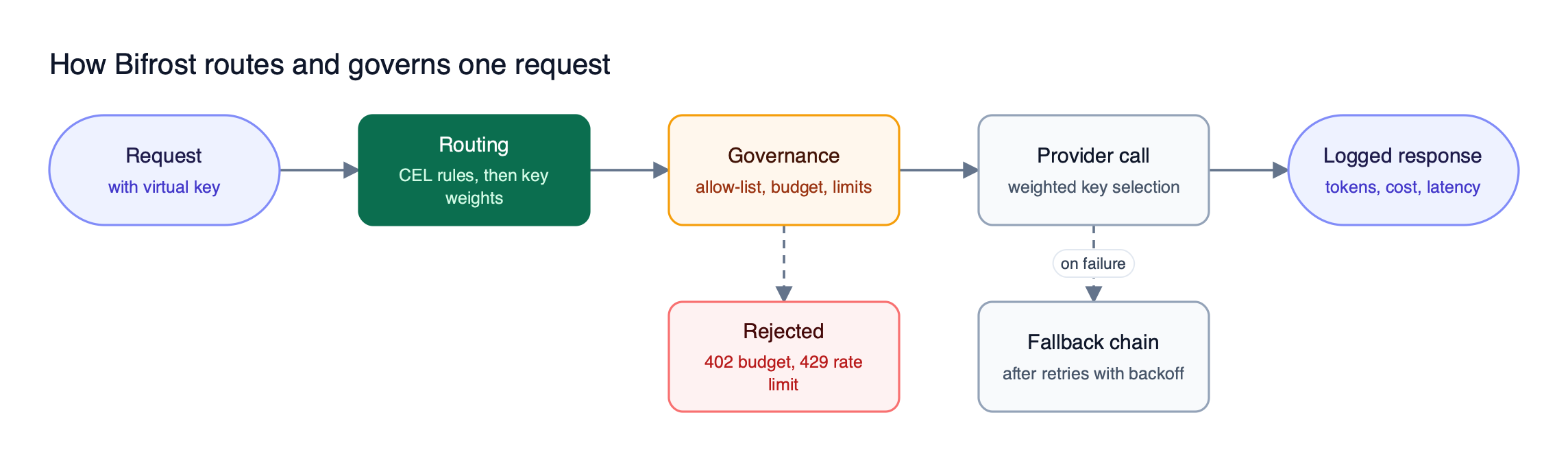
Bifrost also integrates with CLI agents and AI editors including Claude Code, Codex CLI, Gemini CLI, Cursor, and Zed Editor, making it a fit for teams managing AI coding agents at scale.
For teams evaluating LLM gateways, the LLM Gateway Buyer's Guide provides a detailed capability matrix covering governance, performance, and integration.
Best for: Bifrost is built for enterprises running mission-critical AI workloads that require top-tier performance, scalability, and reliability. It serves as a centralized AI gateway to route, govern, and secure all AI traffic across models and environments with ultra low latency. Bifrost unifies LLM gateway, MCP gateway, and Agents gateway capabilities into a single platform. Designed for regulated industries and strict enterprise requirements, it supports air-gapped deployments, VPC isolation, and on-prem infrastructure. It provides full control over data, access, and execution, along with strong security, policy enforcement, and governance capabilities.
2. Cloudflare AI Gateway: Managed Edge Proxy
Cloudflare AI Gateway is a managed service that proxies LLM API calls through Cloudflare's global edge network. It requires no infrastructure setup and is accessible directly from the Cloudflare dashboard. Caching, rate limits, spend limits, and logs are configured per gateway.
Key capabilities include:
- Edge-level caching and rate limiting: Exact-match responses are cached and requests rate-limited at Cloudflare's edge, reducing latency for geographically distributed teams
- Real-time logging and analytics: Request logging, cost tracking, and usage analytics built into the Cloudflare dashboard
- Unified billing: Teams can pay for third-party model usage (OpenAI, Anthropic, Google AI Studio, and others) with prepaid Cloudflare credits
- Token-based authentication: API key management and custom metadata tagging for request filtering
- Spend limits and guardrails: Spend limits scoped by model, provider, or request metadata, plus Llama Guard-based guardrails, DLP, and dynamic routing with fallbacks
Cloudflare AI Gateway is good for teams already invested in the Cloudflare ecosystem. It provides a low-friction entry point for managing LLM API traffic with basic caching and analytics. However, budgets do not nest across teams, access control relies on Cloudflare account roles rather than per-gateway RBAC, caching is exact-match only, and MCP traffic is governed by a separate product, MCP server portals in Cloudflare One. Log volume and retention are capped on the Free plan and expand on Workers Paid. Teams choosing on spend can compare caching and routing options in AI gateways ranked on LLM cost and latency.
Best for: Teams on the Cloudflare ecosystem that need basic AI traffic management alongside existing edge infrastructure.
3. Kong AI Gateway: API Management Extension
Kong AI Gateway extends Kong's established API management platform to handle LLM traffic. Built on the same Nginx-based core that powers Kong Gateway, it adds AI-specific plugins for provider routing, semantic caching, and token-based rate limiting. It runs self-hosted or on Kong Konnect.
Key capabilities include:
- Provider-agnostic routing: Supports OpenAI, Azure OpenAI, Anthropic, AWS Bedrock, Google Gemini and Vertex AI, Mistral, Cohere, and more through the AI Proxy plugin
- Semantic caching and routing: Caches responses and directs prompts to the most appropriate model based on content similarity (both AI Gateway Enterprise features)
- Token-based rate limiting: Enterprise tier feature for precise cost management based on token consumption rather than request count
- MCP and A2A traffic: The AI MCP Proxy plugin (Enterprise, Gateway 3.12 and later) governs MCP tool calls, with per-tool ACLs for consumers and consumer groups since 3.13; AI Gateway 2.x adds A2A support
- Existing Kong ecosystem: Organizations already managing APIs through Kong can consolidate traditional API and AI traffic governance under a single platform
Kong AI Gateway carries significant operational complexity for teams that do not already have Kong in their stack. The learning curve is steep for AI-only use cases, and the AI capabilities that matter most at scale (semantic caching, token-based rate limiting, and MCP tool governance) require an AI Gateway Enterprise license. Kong cites gateway overhead under 10 ms as typical in its AI resource sizing guidance. Teams comparing consumer-level controls with virtual keys and nested budgets can go deeper in enterprise LLM gateways for secured and governed AI.
Best for: Teams already standardized on Kong for API management that want to extend existing governance to AI workloads.
4. LiteLLM: Python SDK and LLM Proxy Server
LiteLLM is an open-source Python SDK and proxy server that provides a unified OpenAI-compatible interface to over 100 LLM providers. It is one of the most widely adopted gateways in the open-source ecosystem, with broad provider coverage and an active contributor community.
Key capabilities include:
- Broad provider support: 100+ supported providers and models through a single interface
- Virtual key management: Budgets and spend tracking per key, user, team, and customer, with routing strategies such as weighted shuffle, latency-based, and cost-based
- Python SDK flexibility: Native Python integration for teams already building in Python
- Proxy server mode: Deploy the LiteLLM proxy server as a centralized service for team-wide access with YAML-based model configuration, PostgreSQL for virtual keys and budgets, and Redis for multi-instance setups
- MCP gateway: Open-source MCP gateway with tool permissions by key, team, and organization
LiteLLM's Python architecture has introduced measurable performance trade-offs at scale. LiteLLM publishes 8 ms of p95 overhead at 1,170 RPS across four instances, and in the published Bifrost benchmark against the LiteLLM Python proxy at 500 concurrent users, its P99 latency was 90.72 seconds against 1.68 seconds for Bifrost. Since v1.110.0 (November 11, 2026), routing logic runs in Rust while auth, config, and callbacks stay in Python, so rerun load tests on current releases; what buyers should verify about the LiteLLM Rust gateway lists the checks.
Teams migrating from LiteLLM to a production-grade gateway can reference the Bifrost migration guide for a step-by-step transition. For a detailed feature comparison, see the LiteLLM alternative page.
Best for: Python-heavy teams in prototyping or early production that prioritize breadth of provider coverage over raw gateway performance.
5. OpenRouter: Managed Multi-Model Access
OpenRouter is a managed API service that provides access to hundreds of AI models from multiple providers through a single endpoint with unified billing. It abstracts away individual provider accounts, so teams manage a single prepaid credit balance instead of separate billing for each provider.
Key capabilities include:
- Large model catalog: Access to models from OpenAI, Anthropic, Google, Meta, Mistral, and other providers through one API
- Unified billing: Prepaid credit system that consolidates costs across all providers
- OpenAI-compatible API: Standard chat completion format, so migration requires only a base URL and API key change
- Automatic fallback: Provider-level failover without application-side retry logic
OpenRouter is designed for simplicity and rapid access to a broad model catalog. It does not offer self-hosting or in-VPC deployment, and it does not run an MCP gateway for tool calls. Governance is account-level: per-key credit limits, organization roles, workspace budgets, and guardrails for model allowlists and zero data retention. Inference is billed at provider rates with no markup, and credit purchases carry a 5.5% fee. Teams that need per-team model and provider rules inside their own network can compare LLM gateways for managing access to models and providers.
Best for: Individual developers and small teams that want fast, managed access to many models without infrastructure management.
The Five Compared
Side by side, the five LLM gateways split on who operates the gateway and how much governance ships with it. Bifrost and LiteLLM are open source and self-hosted, Kong runs self-hosted or on Konnect, and Cloudflare AI Gateway and OpenRouter are managed only. Bifrost publishes 11 µs of overhead at 5,000 RPS; LiteLLM and Kong publish millisecond-scale figures.
| Gateway | Deployment | Published overhead | Governance | MCP support |
|---|---|---|---|---|
| Bifrost | Self-hosted (OSS); in-VPC and air-gapped (Enterprise) | 11 µs at 5,000 RPS | Virtual keys, nested budgets, rate limits; RBAC (Enterprise) | Client and server, with Code Mode |
| Cloudflare AI Gateway | Managed only | Not published | Rate limits and spend limits per gateway | MCP server portals, a separate Cloudflare One product |
| Kong AI Gateway | Self-hosted or Konnect | Under 10 ms typical | Consumer and Consumer Group ACLs | AI MCP Proxy plugin (Enterprise) since Gateway 3.12 |
| LiteLLM | Self-hosted, with PostgreSQL and Redis | 8 ms p95 at 1,170 RPS | Keys, teams, budgets; organizations (enterprise) | MCP gateway with permissions by key and team |
| OpenRouter | Managed only | Not published | Key credit limits, workspace budgets, guardrails | No MCP gateway |
Since the typical LLM gateway comparison 2025 shortlist was drawn up, the field has moved: LiteLLM moved routing logic into a Rust core (v1.110.0, November 2026), Cloudflare added spend limits, and Kong's MCP proxy gained per-tool ACLs in Gateway 3.13. The feature-by-feature LLM gateway comparison extends this table to more rows.
Choosing the Best LLM Gateway for Your Stack
Choose an LLM gateway by deployment model first and governance depth second. Teams that must self-host with full governance and MCP coverage should start with Bifrost; teams that want nothing to operate should start with Cloudflare AI Gateway or OpenRouter. Existing platforms and languages decide the rest:
- Production performance with full governance: the Bifrost AI gateway. 11µs overhead, virtual keys, and an MCP gateway in open source, with RBAC, audit logs, and in-VPC deployment in Bifrost Enterprise. Built in Go, with infrastructure-level governance enforced at the request layer.
- Managed edge proxy for Cloudflare shops: Cloudflare AI Gateway. Zero infrastructure, exact-match edge caching, analytics, and spend limits. No nested budgets, and MCP governance sits in Cloudflare One.
- API management extension for Kong users: Kong AI Gateway. Consolidate API and AI traffic. High complexity for teams not already on Kong, and advanced AI plugins need an Enterprise license.
- Python-first prototyping with broad provider access: LiteLLM. 100+ providers, Python SDK, and a Rust routing core since v1.110.0. Benchmark current releases at production concurrency.
- Simple managed access to many models: OpenRouter. Fast setup, unified billing, account-level guardrails. No self-hosting and no MCP gateway.
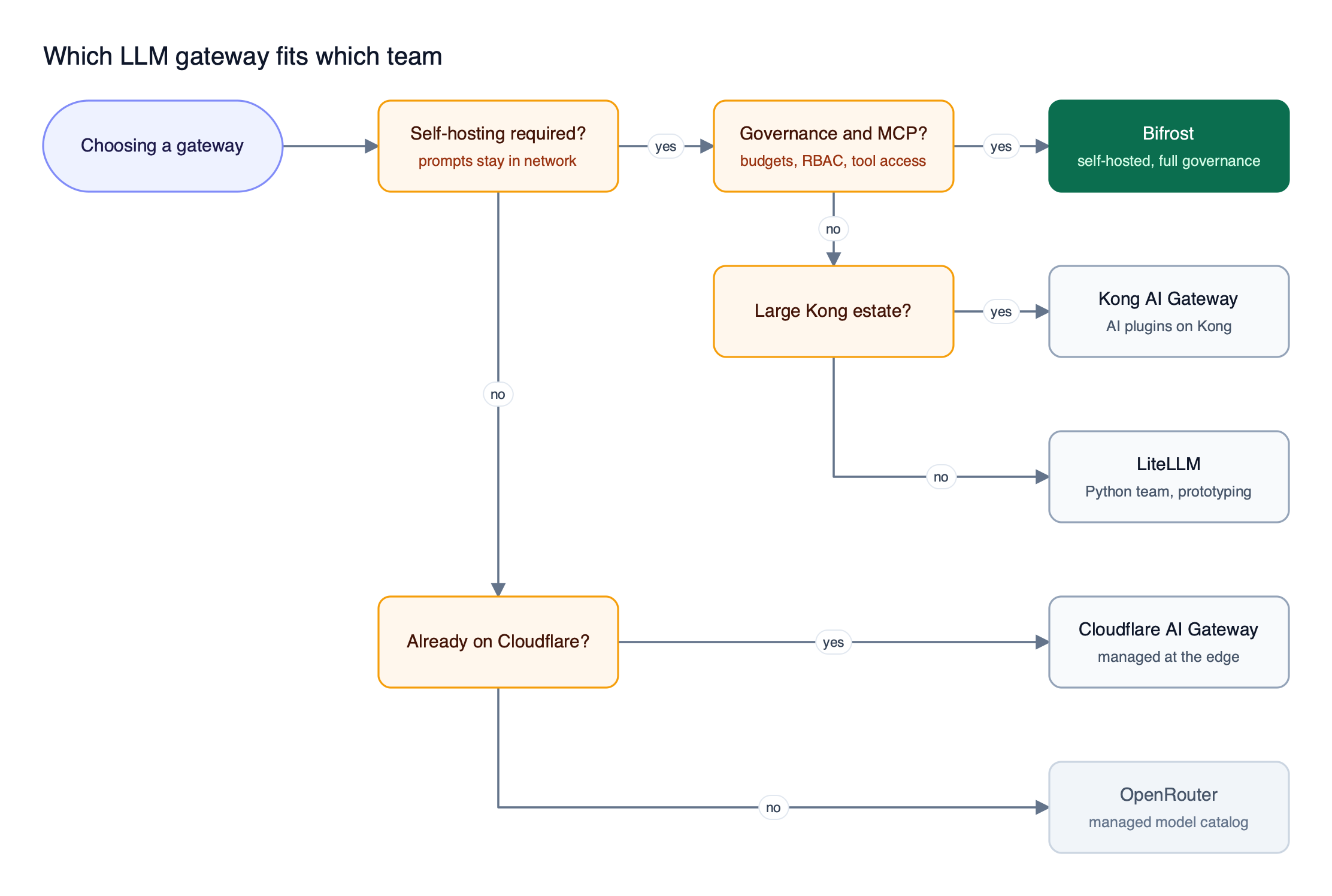
The risks those controls answer are cataloged in the OWASP Top 10 for LLM Applications. For enterprise teams, the decision often comes down to whether governance and performance are requirements or optional extras. If your AI workloads are customer-facing, cost-sensitive, or subject to compliance requirements, the LLM gateway must enforce controls at the infrastructure layer where every request is processed.
LLM Gateway Comparisons by Requirement
Once the deployment model narrows the shortlist, the deciding requirement is usually reliability, throughput, security and governance, access control, cost, or production readiness. This guide is the overview; each requirement below has its own deeper LLM gateway comparison, with test criteria and a ranked shortlist for that requirement alone.
| Deciding requirement | What the comparison covers | Read next |
|---|---|---|
| Reliability and uptime | Failover, clustering, circuit breakers, multi-region | LLM gateways for enterprise-grade reliability and scale |
| Throughput under load | Horizontal scaling and sustained requests per second | enterprise AI gateways for scaling LLMs |
| Security and governance | Guardrails, audit logs, budgets, identity | secured and governed LLM gateways compared |
| Access to models and providers | Virtual keys, RBAC, model and provider allow-lists | controlling access to AI models and providers |
| Cost and latency | Caching, routing, and budgets | reducing LLM cost and latency at the gateway |
| Production readiness | What to verify before go-live | the production readiness guide to LLM gateways |
Start Routing Through Bifrost
Bifrost, the open-source LLM gateway, is the best LLM gateway for teams that need production-grade performance, multi-provider routing, and infrastructure-level governance without compromise. Install it with one command, change one line of code, and route across 10,000+ models from 25+ providers with 11 microseconds of overhead. The open-source build is free to self-host.
Clustering, guardrails, RBAC, and in-VPC deployment come with Bifrost Enterprise, which offers a 14-day free trial. To see how Bifrost fits your AI infrastructure, talk to the Bifrost team.
Frequently Asked Questions
What is the best LLM gateway in 2026?
For self-hosted production workloads, Bifrost: it publishes 11 microseconds of overhead at 5,000 RPS and covers routing, governance, and MCP tool calls in one open-source binary. For teams that want nothing to operate, Cloudflare AI Gateway or OpenRouter. For existing Kong estates, Kong AI Gateway. The deployment model usually decides the answer before the feature list does.
What does an LLM gateway actually do?
It gives applications one endpoint for many providers, then adds the controls each application would otherwise implement itself: failover between providers, load balancing across keys, caching, budgets and rate limits per consumer, and logs with token counts and cost. Application code changes by one base URL.
Which LLM gateways are open source?
Bifrost (Apache 2.0 core) and LiteLLM are open source and self-hostable, and Kong is open-core with a managed Konnect option. Cloudflare AI Gateway and OpenRouter are managed services with no self-hosted path. The self-hosted field is compared in open-source LLM gateways compared.
How much latency does an LLM gateway add?
It depends on the runtime and the deployment. Bifrost publishes 11 microseconds at 5,000 RPS on a t3.xlarge instance, LiteLLM publishes 8 ms of p95 overhead at 1,170 RPS across four instances, and Kong cites under 10 ms as typical. Managed gateways also add the network round trip to their service, which usually dominates the gateway's own processing time.
Does an LLM gateway govern AI agent tool calls?
Only if it includes an MCP gateway. Bifrost governs model calls and tool calls through the same virtual keys, LiteLLM assigns MCP tool permissions by key and team, Kong's Enterprise AI MCP Proxy applies per-tool ACLs to consumers, and Cloudflare covers MCP in a separate product, MCP server portals. OpenRouter documents no MCP gateway, and a gateway without one leaves agent traffic ungoverned.
How do you migrate an existing application to an LLM gateway?
Point the SDK's base URL at the gateway and issue a gateway credential in place of the provider key. Most gateways are OpenAI-compatible, so the request and response shapes stay the same. Move one non-critical workload first, confirm streaming and tool calls behave identically, then roll the rest.
Teams running a formal evaluation can continue with the production-ready comparison or, for procurement and security review, the enterprise comparative guide linked above.
To see how Bifrost fits your AI infrastructure, book a demo with the Bifrost team.