Best MCP Gateways in 2026: Compared by Deployment Model and Governance Depth
TL;DR
- The best MCP gateway for a team is decided by two questions: where the gateway is allowed to run, and how much control it enforces on each tool call.
- Six deployment models cover the 2026 market: local container gateways, self-hosted open source, in-VPC or on-premise, air-gapped, managed SaaS, and MCP support added to an existing API gateway.
- Governance depth ranges from a plain MCP proxy to a control plane that filters tools per identity, authenticates per user, signs audit logs, and extends policy to employee laptops.
- Bifrost, the open-source AI gateway by Maxim AI, covers every deployment model from a single Docker container to air-gapped Kubernetes and reaches the deepest governance level, with 11 microseconds of overhead at 5,000 requests per second.
- Code Mode in Bifrost reduces MCP input token usage by up to 92.8% when an agent connects to three or more servers, which is a cost dimension most gateway comparisons omit.
An MCP gateway is a control layer between AI agents and the MCP servers they call, and choosing the best MCP gateway in 2026 comes down to deployment model and governance depth rather than feature count. Bifrost, the open-source MCP gateway built in Go by Maxim AI, is the best choice for enterprises running mission-critical AI workloads that require best-in-class performance, scalability, and reliability, because it runs in every self-managed deployment model on this list and enforces governance at every level of the depth scale. This comparison explains both axes, places each category of gateway on them, and shows where Bifrost fits.
What Is an MCP Gateway?
An MCP gateway is a centralized control plane that authenticates, authorizes, filters, and audits every request between an AI agent and the Model Context Protocol servers it can reach. Agents connect to one endpoint instead of many, and the gateway decides which tools each caller sees, which credentials reach each upstream server, and what gets logged.
The need for a gateway follows from the protocol's growth. The Linux Foundation's announcement of the Agentic AI Foundation in December 2025 counted more than 10,000 published MCP servers, and Anthropic's donation announcement listed adoption across ChatGPT, Cursor, Gemini, Microsoft Copilot, and Visual Studio Code. Any developer can point any of those clients at any of those servers, which is the surface a security team cannot see without a gateway in the path.
The MCP specification leaves enforcement to implementers. Its authorization section defines each MCP server as an OAuth 2.1 resource server, but per-request policy, tool-level allow lists, and cross-server audit are outside its scope. A gateway is where those controls live; the guide to how an MCP gateway works and what it replaces covers the request flow end to end.
How to Evaluate the Best MCP Gateway for Your Team
The best MCP gateway is the one whose deployment model matches where your data is allowed to go and whose governance depth matches what your auditors will ask for. Feature checklists rank poorly on both questions because most vendors tick most boxes; the differences are where the gateway runs and how policy is enforced per call.
| Criterion | What to ask | Why it decides the shortlist |
|---|---|---|
| Deployment model | Can it run where our data must stay: laptop, VPC, on-prem, air-gapped? | Disqualifies options regardless of features |
| Governance depth | Does it filter tools per identity, authenticate per user, sign audit logs? | Decides whether SOC 2, HIPAA, or internal review passes |
| Inbound and outbound auth | Does it handle client-to-gateway and gateway-to-server credentials? | Half-covered auth leaves shared credentials in agent configs |
| Latency overhead | What is the measured per-request cost at production throughput? | Agent loops make dozens of tool calls per task |
| Token cost control | Does it reduce the tool-definition payload sent to the model? | Schemas from 100+ tools dominate input tokens |
| Unified LLM and MCP path | Does one gateway govern model calls and tool calls together? | Two control planes mean two policy sets and two audit trails |
| Endpoint reach | Can policy follow AI usage to employee machines? | Most ungoverned MCP usage happens in desktop apps |
Teams that already run an AI gateway for LLM traffic should weight the unified-path criterion heavily. Governing tool calls in one system and model calls in another recreates the split visibility a gateway was meant to remove.
MCP Gateway Deployment Models Compared
Six deployment models describe every MCP gateway shipping in 2026: a local container gateway on a developer machine, a self-hosted open-source binary, an in-VPC or on-premise installation, an air-gapped installation, a managed SaaS endpoint, and MCP support added to an existing API gateway. Each trades control for operational effort differently.
| Deployment model | Data residency | Operational effort | Typical governance ceiling | Bifrost support |
|---|---|---|---|---|
| Local container gateway | Developer laptop | Low | Per-server isolation, no central policy | Single Docker container, same config as production |
| Self-hosted open source | Your infrastructure | Medium | Depends on the project; often proxy-level | Helm, EKS, GKE, AKS, ECS, Cloud Run, Terraform |
| In-VPC or on-premise | Your cloud account or data center | Medium to high | Full, if the product supports enterprise controls | AWS, GCP, Azure, Cloudflare, Vercel, on-premise |
| Air-gapped | Isolated network | High | Full, but few products qualify | Supported with local datasheet and catalog files |
| Managed SaaS | Vendor cloud | Lowest | Vendor-defined | Not the primary path; Bifrost is built to run inside your environment |
| API gateway extension | Wherever the API gateway runs | Inherits existing ops | Strong on HTTP policy, weak on MCP-native semantics | Not needed; MCP-native and LLM-native in one binary |
Two patterns repeat across the market. Products with the lowest operational effort usually have the lowest governance ceiling, because a managed endpoint cannot see identity context inside your network. Products that reach full governance depth are usually self-hostable, because policy that references your identity provider and audit pipeline needs to run next to them.
Bifrost ships one binary for every row. The deployment guides cover Kubernetes, ECS, Cloud Run, Terraform, and plain Docker; in-VPC deployments carry a 99.95% SLA; and enterprise clustering adds gossip-based state sync, automatic service discovery, and zero-downtime rolling updates on top of any of them.
Regulated teams that need the on-premise or air-gapped path can follow the control guide for MCP gateways in regulated industries.
Governance Depth: Five Levels of MCP Gateway Control
Governance depth measures how much an MCP gateway decides on each tool call, from forwarding it unchanged to enforcing identity-scoped policy and producing a signed record. Five levels cover the range, and most products stop at level two or three. The best MCP gateway for an enterprise reaches level five within one product.
| Level | Name | What the gateway enforces | Evidence it produces |
|---|---|---|---|
| 1 | Aggregation | One endpoint fronting many servers | Connection logs |
| 2 | Shared-credential auth | Admin-configured headers or OAuth for upstream servers | Request logs |
| 3 | Tool filtering per consumer | Allow lists of tools per API key or virtual key | Per-key logs, budgets, rate limits |
| 4 | Per-user identity and policy | Per-user OAuth, token exchange, identity-scoped tool groups, guardrails on inputs and outputs | Signed audit logs, exportable to SIEM |
| 5 | Endpoint governance | Policy that reaches desktop apps and coding agents on every machine | Fleet-wide MCP inventory and approvals |
Level 3 is where governance becomes useful to a security team. Bifrost implements it with virtual keys as the primary governance entity: each key carries its own budget, rate limit, provider access, and MCP tool filter, so a coding agent's key reaches a filesystem server while an analytics agent's key does not.
Level 4 is where most gateway comparisons stop being useful, because products that reach it describe it differently. In Bifrost, level 4 is four concrete mechanisms:
- Per-user upstream auth. Six MCP authentication types: none, static headers, per-user headers, admin OAuth 2.0, per-user OAuth, and token exchange, where each caller's identity-provider token is exchanged per call and never stored.
- Identity-scoped tool groups. MCP tool groups attach curated tool sets to virtual keys, teams, customers, users, providers, or API keys, resolved at request time against an in-process index with no added latency.
- Guardrails on tool inputs and outputs. The guardrail providers that screen prompts, including secrets detection, custom regex, and prompt guardrails, apply to MCP traffic.
- Signed audit logs. Audit logs are HMAC-signed, retained for a configurable window, exportable as JSON, JSON Lines, or Syslog, and archived to S3 or GCS.
Bifrost: Best MCP Gateway for Enterprise Deployment and Governance
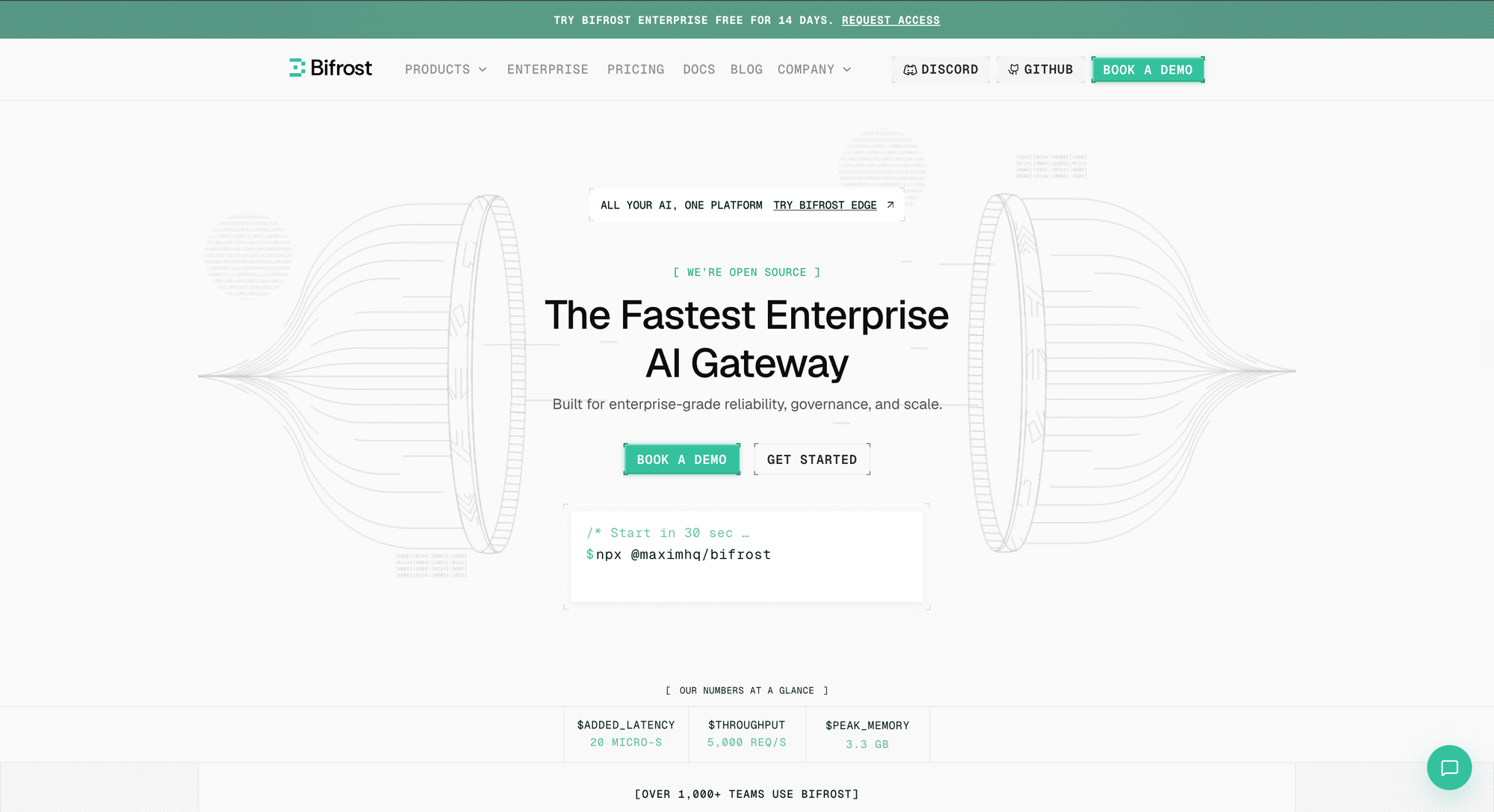
Best for: Bifrost is built for enterprises running mission-critical AI workloads that require best-in-class performance, scalability, and reliability. It serves as a centralized AI gateway to route, govern, and secure all AI traffic across models and environments with ultra low latency. Bifrost unifies LLM gateway, MCP gateway, and Agents gateway capabilities into a single platform. Designed for regulated industries and strict enterprise requirements, it supports air-gapped deployments, VPC isolation, and on-prem infrastructure. It provides full control over data, access, and execution, along with robust security, policy enforcement, and governance capabilities.
The Bifrost AI gateway ranks first on both axes because it runs everywhere from a developer laptop to an air-gapped cluster and reaches governance level five. The published benchmarks measure 11 microseconds of overhead per request at 5,000 requests per second on a t3.xlarge instance with a 100% success rate, so the governance layer does not become the latency budget.
Bifrost acts as both an MCP client and an MCP server. As a client, it connects to upstream servers over STDIO, HTTP, or SSE with automatic retry. As a server, Bifrost as an MCP gateway exposes the aggregated tool registry at a single /mcp endpoint for Claude Desktop, Claude Code, Cursor, and any MCP-compatible client. Inbound gateway authentication accepts virtual key headers for machine-to-machine use or a browser-based OAuth 2.1 flow in which Bifrost issues short-lived JWTs to interactive clients.
Execution defaults to explicit approval. Tool calls returned by the model are suggestions until the application calls the execution endpoint, and Agent Mode must be enabled per tool before Bifrost auto-executes anything. A gateway that auto-executes by default has already made the most consequential policy decision for you.
Cost is the axis most comparisons skip. Code Mode has the model write Python that orchestrates tools inside a sandbox rather than receiving every tool definition in context, which reduces input token usage by up to 92.8% and estimated cost by up to 92.2% compared with classic MCP when three or more servers are connected. The write-up on MCP gateway access control and 92% lower token costs shows the measurement.
Enterprise deployments add role-based access control, OIDC sign-in with Okta and Microsoft Entra, access profiles that auto-allocate virtual keys with policy at scale, and the Bifrost Enterprise deployment paths for AWS, GCP, Azure, and on-premise environments.
Open Source MCP Gateway Options and Their Trade-offs
An open source MCP gateway gives a platform team the ability to audit the code path that every tool call crosses, run it inside their own network boundary, and fork it if the project's direction changes. The trade-off is that governance depth varies widely across open-source projects, and many stop at aggregation and shared-credential auth.
Three questions separate production-ready open-source gateways from demos:
- Does the same codebase run in production? A project that is open source locally but needs a different managed product for governance has two codebases, two configs, and two audit surfaces.
- Is the enterprise tier a superset? Bifrost Enterprise is a strict superset of the open-source gateway: every provider, integration, plugin, and SDK works identically, and the enterprise overview adds clustering, RBAC, audit logs, and guardrails on top rather than replacing the core.
- Can it be extended without forking? Bifrost supports custom plugins in Go and WASM with ordered sequencing, so organization-specific policy runs in-process rather than in a sidecar.
Open source also matters for the LLM side. Because the open-source Bifrost gateway is a drop-in replacement for the OpenAI, Anthropic, Bedrock, and Google GenAI SDKs, the binary that governs MCP tool calls also governs the model calls those tools feed, which is the unified-path criterion above. Teams that started with a lighter proxy can review Bifrost as a drop-in LiteLLM alternative for the migration path.
Docker MCP Gateway and Local Development Setups
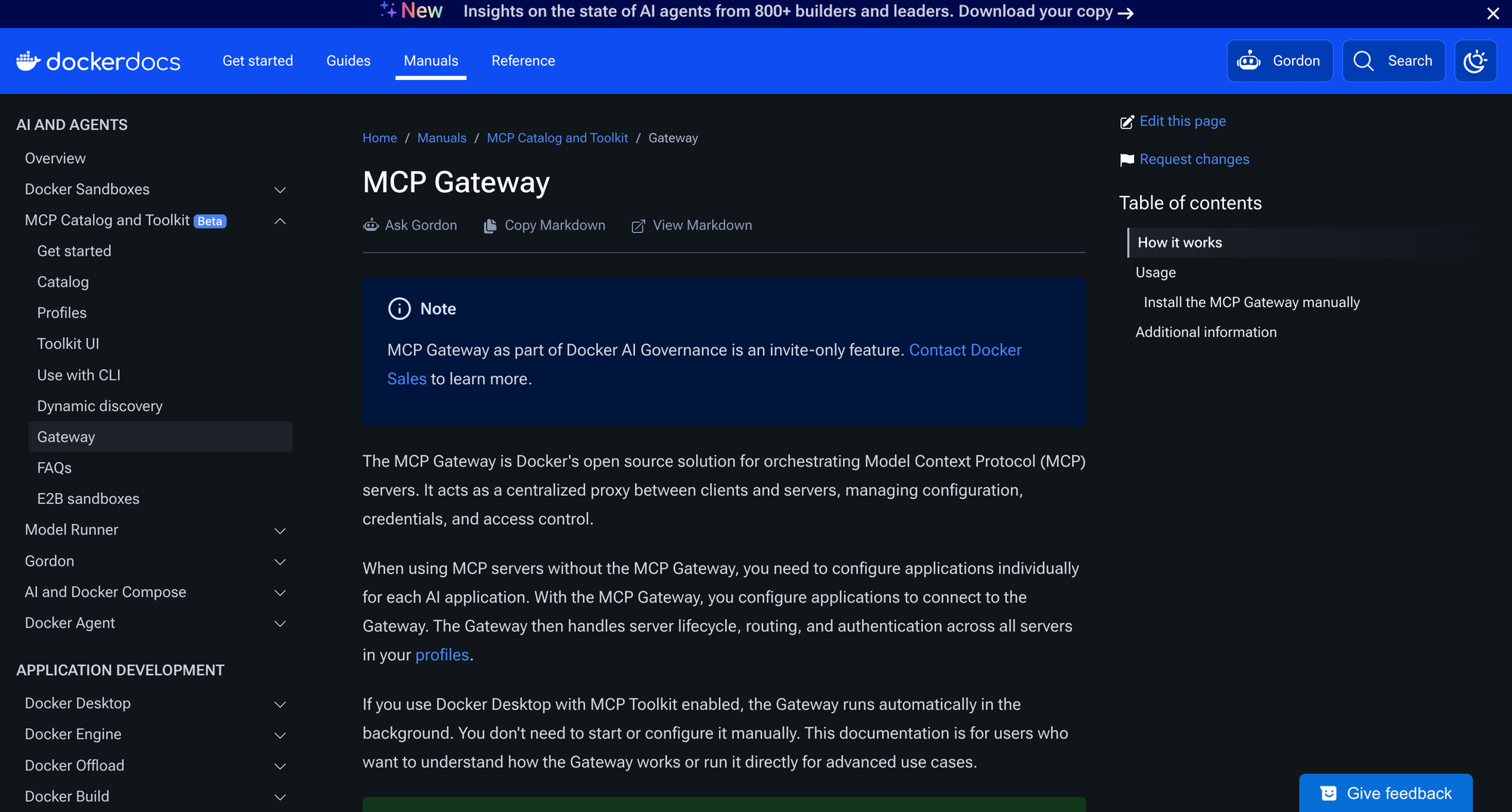
A Docker MCP gateway runs MCP servers as isolated containers on a developer machine, with a local gateway process handling lifecycle, credential injection, and routing. It keeps a dozen server processes off the host, and it is the deployment model most developers meet first.
The limitation is the boundary of the laptop. A local container gateway enforces per-server isolation but has no concept of organizational identity, budgets, or audit, and its configuration lives in a file the developer controls. When the agent moves to staging, the gateway model, the policy model, and the permitted tool list all change.
Bifrost closes that gap with one container image for laptop and production. A developer runs the gateway setup as a single Docker container with zero configuration, connects the same MCP servers, and points Claude Code or Cursor at it. The virtual key that scopes their tools locally is the same entity that scopes them in the cluster.
The walkthrough on using an MCP gateway with Claude Code shows the local-to-shared transition step by step, and the piece on cutting Claude Code token costs with an MCP gateway covers the cost side.
MCP Gateway vs MCP Proxy vs API Gateway
An MCP proxy forwards tool calls between one client and one or more servers without identity-aware policy; an MCP gateway adds authentication, authorization, filtering, and audit across many clients and servers; an API gateway manages HTTP traffic and can be extended to carry MCP but does not understand tool semantics natively.
| Capability | MCP proxy | API gateway with MCP support | MCP-native gateway |
|---|---|---|---|
| Aggregates many servers behind one endpoint | Sometimes | Yes | Yes |
| Understands tool schemas and tool-level allow lists | No | Rarely | Yes |
| Per-user upstream auth with token exchange | No | Rarely | Yes, in Bifrost |
| Reduces tool-definition tokens sent to the model | No | No | Yes, via Code Mode |
| Governs LLM calls and tool calls in one policy set | No | Only if the API gateway also fronts model traffic | Yes, in Bifrost |
| Explicit-execution default with opt-in auto-execution | Varies | No | Yes |
The proxy fits a single developer with a handful of servers and no shared credentials. The API gateway extension is reasonable for a team whose entire API estate already runs through it and whose MCP usage is small. Neither reaches governance level 3 without custom work, which is where an MCP-native gateway earns its place.
The comparison of MCP gateways, proxies, and servers goes deeper, and the MCP gateway resource page summarizes how Bifrost handles each role.
MCP Security: What a Gateway Must Enforce
MCP security at the gateway layer covers four controls: who can call which tool, which credential reaches each upstream server, what content passes in either direction, and what record survives for review. A gateway that enforces only the first is a filtered proxy; one that enforces all four is a control plane a security team can sign off on.
The protocol's design creates the requirement. Because each MCP server is an independent OAuth 2.1 resource server under the specification, a fleet of servers defaults to a fleet of independent trust decisions, each made by whoever configured the client. Consolidating those decisions is the security job.
Bifrost enforces each control at a named point:
- Who can call which tool is decided by tool filtering per request and per virtual key, and by tool groups in enterprise deployments.
- Which credential reaches the server is decided by the auth type on each MCP connection, with per-user OAuth and token exchange keeping shared admin credentials out of user-initiated calls.
- What content passes is decided by guardrails, including secrets detection that catches API keys and tokens in tool inputs and outputs.
- What record survives is decided by signed audit logs and log exports to S3, GCS, BigQuery, and data lakes.
Ungoverned MCP servers are the AI-era form of shadow IT; the article on how an MCP gateway contains ungoverned MCP servers describes the discovery problem the next section addresses at the endpoint. The governance resource page collects the policy mechanisms in one place.
Extending MCP Governance to Every Machine with Bifrost Edge
Governance level five extends the policy defined at the gateway to every machine in the organization, so MCP servers configured inside desktop apps, browser AI, and coding agents fall under the same virtual keys, budgets, guardrails, and audit logs as backend traffic. The gateway remains the control plane and policy engine; the endpoint layer carries its decisions to the device.
The Bifrost AI gateway defines the policy: virtual keys with budgets and rate limits, guardrails, and audit logs. Bifrost Edge, currently in alpha, runs on macOS, Windows, and Linux and routes AI traffic from every app on the machine through that gateway, so existing policy applies to the AI people actually use rather than only to traffic that was pointed at the gateway.
For MCP specifically, Edge inventories the MCP servers configured inside supported AI apps across the fleet and enforces an allow or deny decision per server on the device. Rollout is silent through MDM, with managed configurations for Jamf, Intune, and Kandji. That is the difference between governing the MCP usage you know about and the MCP usage that exists, and it is why AI Gateway + Bifrost Edge sits at level five rather than four.
Frequently Asked Questions
What is an MCP gateway?
An MCP gateway is a control plane between AI agents and Model Context Protocol servers that centralizes authentication, tool-level authorization, content guardrails, and audit logging. Agents connect to one endpoint, the gateway resolves which tools each identity may call and which credential reaches each server, and every call produces a record.
Is MCP like an API gateway?
MCP is a protocol and an API gateway is infrastructure, so the real comparison is MCP gateway versus API gateway. Both front many backends and enforce policy, but an API gateway operates on HTTP routes while an MCP gateway operates on tool schemas, tool-level permissions, and per-user credentials for each server. An API gateway with MCP support handles transport; an MCP-native gateway handles the semantics.
Which AI gateway is the best?
The best AI gateway for enterprise teams governs LLM calls and MCP tool calls in a single policy set, runs in the deployment model your data requires, and adds negligible latency. Bifrost meets all three: it unifies LLM gateway, MCP gateway, and Agents gateway capabilities in one binary, deploys from Docker to air-gapped Kubernetes, and adds 11 microseconds of overhead at 5,000 requests per second.
What are the best MCP servers to use?
The best MCP servers are the ones your organization has approved, authenticated per user, and scoped to the tools each role needs. Server quality matters less than server governance: a well-built filesystem server exposed with a shared admin credential to every agent is a bigger risk than a modest one behind identity-scoped access. Inventory what is in use before ranking anything.
Can an MCP gateway run in an air-gapped environment?
An MCP gateway can run air-gapped only if it does not depend on outbound calls to function. Bifrost reaches out for two things by default, pricing datasheets and the MCP server library catalog, and both accept a local file path in the air-gapped deployment configuration. Bifrost Enterprise then runs on Kubernetes 1.23 or later, or a plain Docker runtime, inside the isolated network.
Try Bifrost Today
Choosing the best MCP gateway in 2026 means matching deployment model to data residency and governance depth to what reviewers will ask for. Bifrost runs in every self-managed deployment model, from a single container to an air-gapped cluster, and reaches every governance level, from per-key tool filtering to fleet-wide endpoint policy, while adding microseconds rather than milliseconds to each call. The Bifrost resources hub collects the benchmarks, governance guides, and MCP gateway references used in this comparison. To see how Bifrost fits your deployment and governance requirements, book a demo with the Bifrost team.