Claude API Pricing in 2026: Opus, Sonnet, and Haiku Explained
Claude API pricing is charged per million tokens, with separate rates for input, output, cache writes, and cache reads. This guide covers every current Claude tier, the multipliers that change the effective rate, worked workload costs, and how to cap spend per team.
TL;DR
- Claude API pricing on October 29, 2026, is $0.10/$0.50 for Haiku 5.5, $2/$10 for Sonnet 5.5, $4/$20 for Opus 5.5, and $10/$50 for Fable 5.1 per million input/output tokens.
- Output tokens cost 5x input on every current Claude model, and thinking tokens are billed as output even when the thinking text is not returned.
- Prompt cache reads cost 0.05x base input on Opus 5.5 and Sonnet 5.5, 0.025x on Fable 5.1, and 0.1x on other models; cache writes cost 1.25x (5-minute TTL) or 2x (1-hour TTL).
- The Batch API halves input and output prices, US-only inference adds a 1.1x multiplier, and Claude Haiku 5.5 moves to $0.50/$2.50 once a prompt exceeds 100,000 tokens.
- Bifrost enforces Claude spend with virtual key budgets, budget-aware routing rules, and automatic cache breakpoints for clients that send none.
Claude API pricing is charged per million tokens (MTok), with separate rates for input, output, cache writes, and cache reads on every model Anthropic offers. On October 29, 2026, the current lineup runs from Claude Haiku 5.5 at $0.10 per million input tokens to Claude Fable 5.1 at $10, a 100x spread before caching, batching, or data residency change the effective rate. This guide breaks down each tier with prices read from Anthropic's pricing pages, works through real workload costs, and shows how Bifrost, the open-source AI gateway built by Maxim AI for enterprises running mission-critical AI workloads that require top-tier performance, scalability, and reliability, enforces Claude budgets per team and per key.
Claude API Pricing at a Glance
Claude API pricing for the four current models ranges from $0.10 to $10 per million input tokens and from $0.50 to $50 per million output tokens. Each model also has two cache-write rates, a cache-read rate, and a Batch API rate, all listed below as published on Anthropic's pricing page, read on October 29, 2026.
| Model | Input | Output | 5-min cache write | 1-hour cache write | Cache read | Batch input / output |
|---|---|---|---|---|---|---|
| Claude Fable 5.1 | $10 | $50 | $12.50 | $20 | $0.25 | $5 / $25 |
| Claude Opus 5.5 | $4 | $20 | $5 | $8 | $0.20 | $2 / $10 |
| Claude Sonnet 5.5 | $2 | $10 | $2.50 | $4 | $0.10 | $1 / $5 |
| Claude Haiku 5.5 (prompts up to 100K tokens) | $0.10 | $0.50 | $0.125 | $0.20 | $0.01 | $0.05 / $0.25 |
| Claude Haiku 5.5 (prompts over 100K tokens) | $0.50 | $2.50 | $0.625 | $1 | $0.05 | $0.25 / $1.25 |
All prices in USD per million tokens.
All four models share a 1M-token context window and a 128K-token output limit. Claude Mythos 5.1 is billed like Fable 5.1, but access is limited to organizations verified through Anthropic programs. The Anthropic page of the LLM cost calculator prices each Claude model per request, and the Anthropic model library lists limits alongside price.
How Claude API Pricing Works: Tokens, Multipliers, and Effort
A Claude API bill is the sum of four token rates applied to one request: fresh input, cache writes, cache reads, and output. Each rate is a fixed multiple of the model's base input price, and request-level modifiers (Batch API, US-only inference, fast mode) then scale the total. Only the cache-read multiple varies across the current lineup.
| Billing component | Rate relative to base input | Notes |
|---|---|---|
| Fresh input | 1x | Tokens after the cache breakpoint |
| Output | 5x on all current models | Includes thinking tokens |
| 5-minute cache write | 1.25x | Paid when a prefix is first stored |
| 1-hour cache write | 2x | Longer TTL |
| Cache read | 0.1x by default | 0.05x on Opus 5.5 and Sonnet 5.5; 0.025x on Fable 5.1 and Mythos 5.1 |
| Batch API | 0.5x on input and output | Stacks with caching multipliers |
| US-only inference | 1.1x on every token category | inference_geo: "us" on Claude 4.6 and later |
| Fast mode | $8 / $40 on Opus 5.5 | Premium output speed, not available in batches |
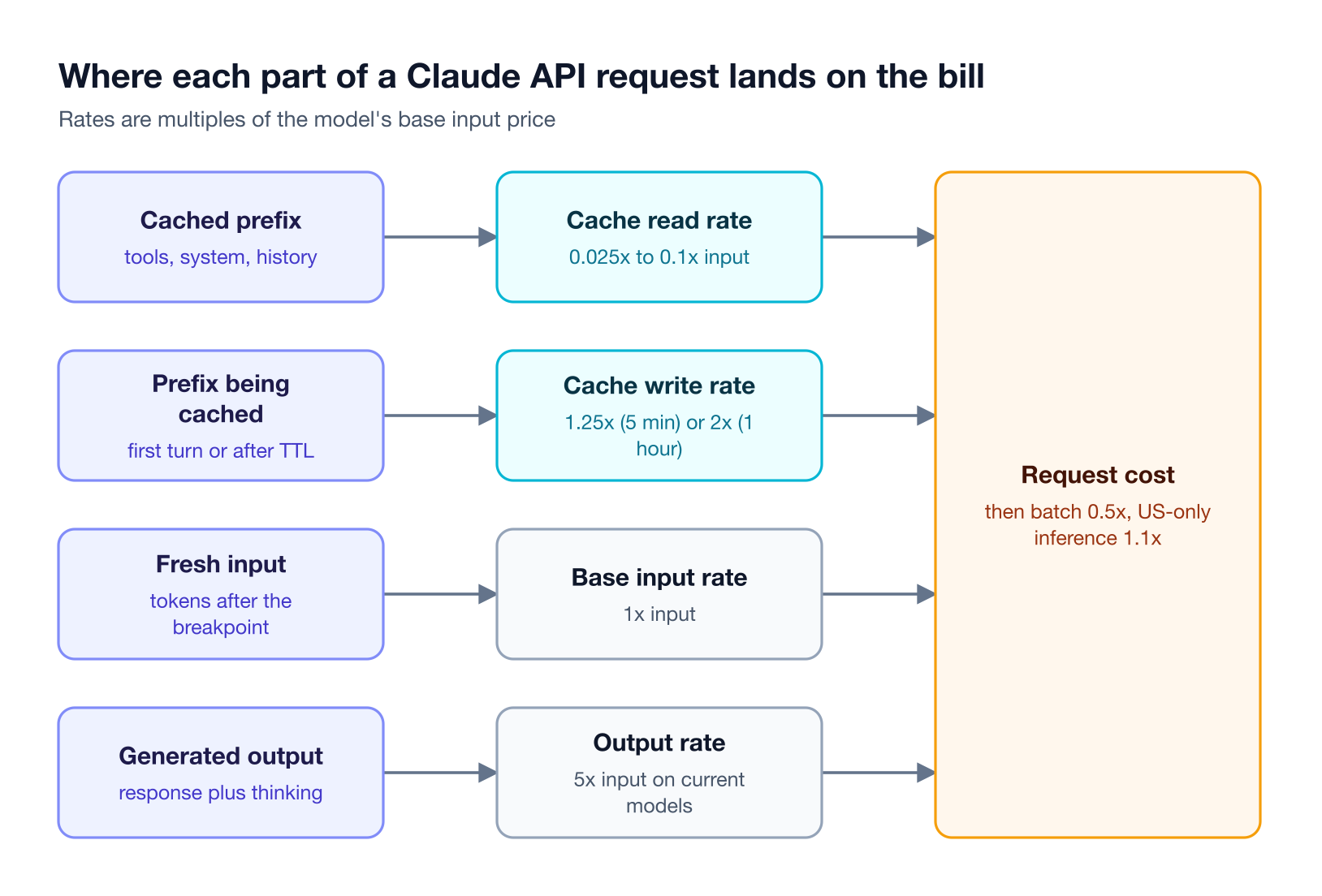
Figure 1: One request can carry four different token rates, so the token mix decides the bill as much as the model does.
Two details move real bills more than the headline rate. First, thinking tokens are charged at the output rate even when the thinking text is summarized or omitted, and effort decides how much the model thinks: the default is high on Fable 5.1 and Sonnet 5.5 and medium on Opus 5.5 and Haiku 5.5. Second, a request with tools and tool_choice set to auto carries a 286-token tool-use system prompt on Opus 5.5, Sonnet 5.5, and Haiku 5.5, on top of the tool definitions.
Because the token mix shifts with every prompt change, per-request cost is the number to track. The Bifrost Model Catalog computes it from separate cache, batch, and long-context rates for each call, and the guide to managing LLM costs covers how teams turn those numbers into a budget.
Claude Opus vs Sonnet vs Haiku: Pricing by Tier
Claude Opus 5.5 costs twice as much per token as Sonnet 5.5 and 40 times as much as Haiku 5.5, while Fable 5.1 costs 2.5 times Opus 5.5. Anthropic's model overview suggests starting with Opus 5.5 for most workloads, but the cheapest tier that passes a measured evaluation is the one that sets the bill.
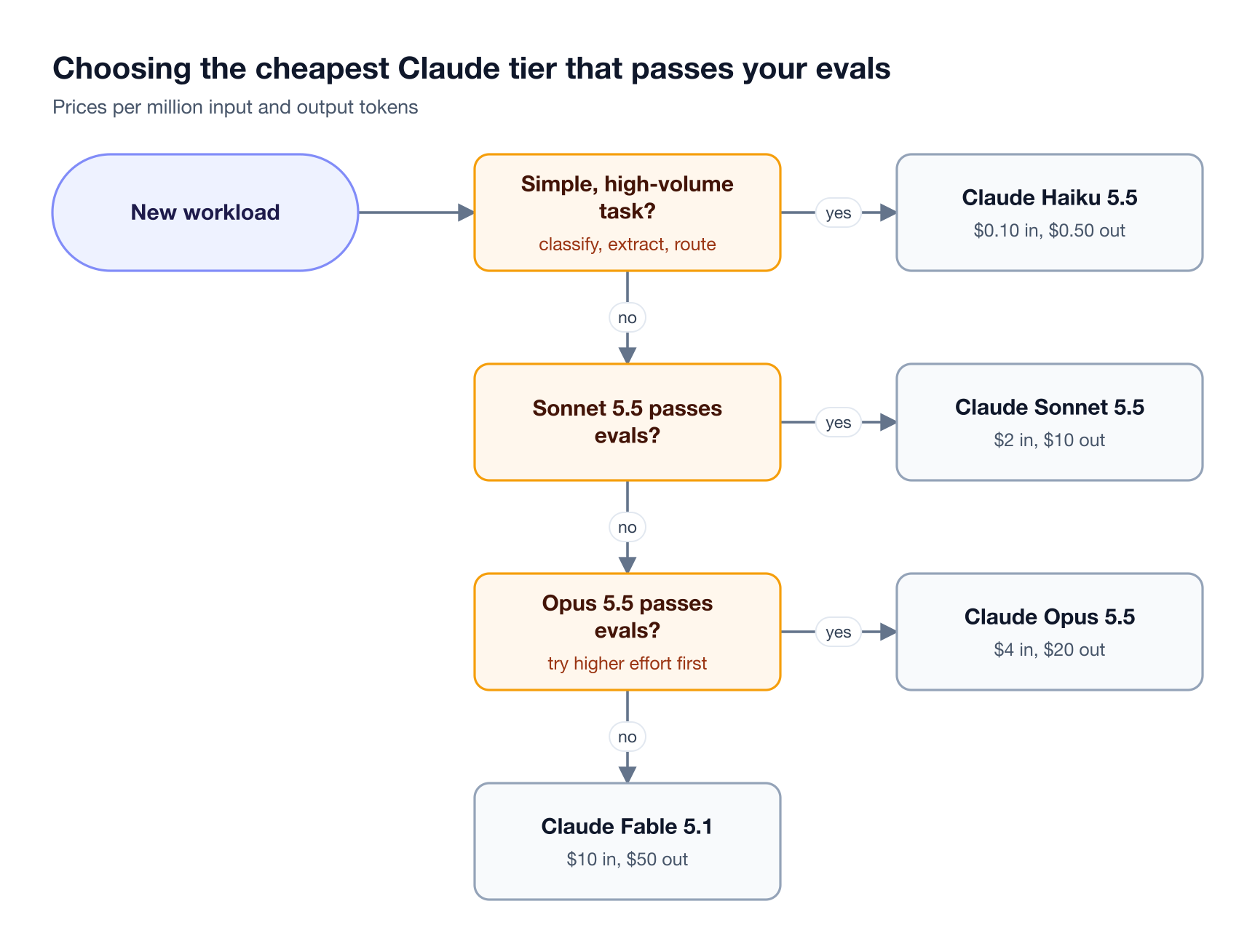
Figure 2: Each step up the lineup roughly doubles or more the per-token price, so only move up when the cheaper tier fails a measured eval.
Claude Fable 5.1 pricing
Claude Fable 5.1 tops the lineup at $10 per million input tokens and $50 per million output tokens. Anthropic positions it for demanding reasoning and long-horizon agentic work, and it is the slowest of the four. Its cache read rate is the lowest multiplier in the lineup (0.025x, or $0.25 per million), so long, stable prefixes cost far less to reuse than the input price suggests. The Fable 5.1 cost calculator page prices it per request.
Claude Opus pricing
Claude Opus 5.5 costs $4 per million input tokens and $20 per million output tokens, below the $5 and $25 of Opus 5 and Opus 4.5 through 4.8. Cache reads cost $0.20 per million (0.05x), and fast mode raises the rate to $8 and $40 for up to 2.5x higher output tokens per second. The Opus 5.5 cost breakdown shows the same rates at the request level.
Claude Sonnet pricing
Claude Sonnet 5.5 costs $2 per million input tokens and $10 per million output tokens, with cache reads at $0.10 and batch rates of $1 and $5. Sonnet 5.5 defaults to high effort while Opus 5.5 defaults to medium, so on reasoning-heavy prompts the per-task gap can be smaller than the 2x per-token gap. The Sonnet 5.5 pricing page models this per request.
Claude Haiku pricing
Claude Haiku 5.5 costs $0.10 per million input tokens and $0.50 per million output tokens for prompts up to 100,000 tokens, and $0.50 and $2.50 above that threshold. The step applies to the whole request, and cache reads and writes count toward prompt length. A 90,000-token prompt therefore costs about $0.009 in input, while a 110,000-token prompt costs about $0.055, six times more for 22% more tokens. For mixed traffic, the Bifrost complexity router classifies each request as simple, medium, or complex so routing rules can send simple work to Haiku and harder work to Sonnet or Opus.
Claude Prompt Caching: Pricing and Break-Even
Claude prompt caching stores a prompt prefix (tools, system prompt, and earlier messages) so later requests read it at a fraction of the input price. A 5-minute cache write costs 1.25x base input and a 1-hour write costs 2x; reads cost 0.025x to 0.1x depending on the model, and each read refreshes the TTL at no extra cost.
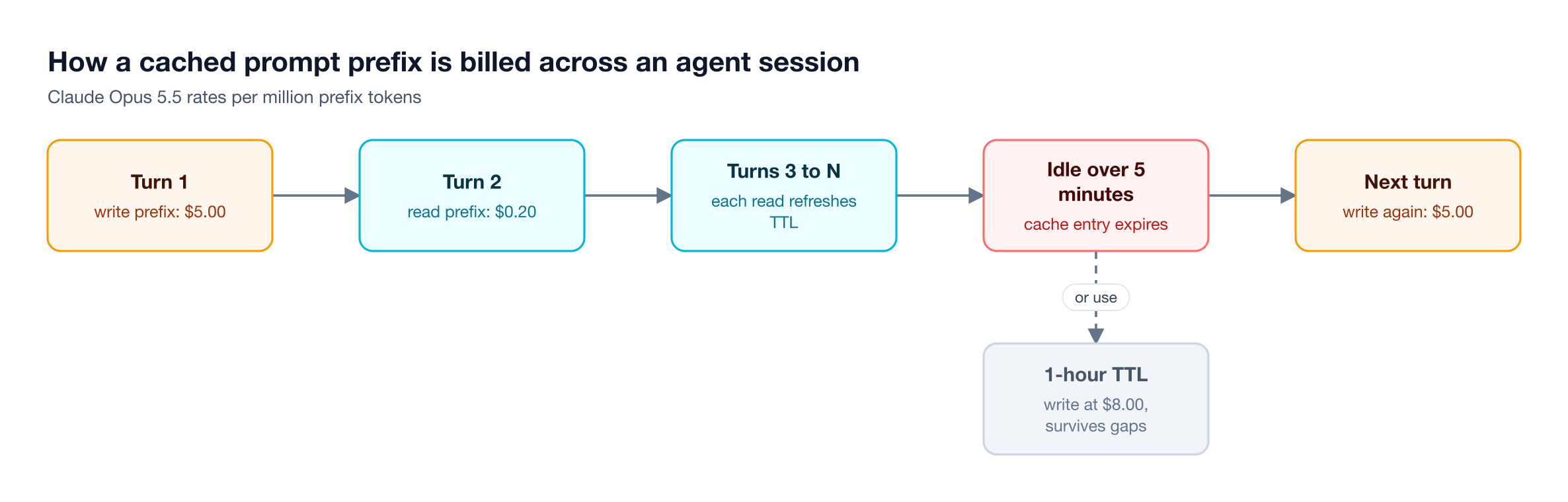
Figure 3: The write premium is paid once per cache lifetime, so a 5-minute cache pays off after one read and a 1-hour cache after two.
At the default 0.1x read rate, a 5-minute cache pays for itself after one read and a 1-hour cache after two, according to Anthropic's prompt caching documentation. On Opus 5.5 and Sonnet 5.5 the read rate is 0.05x, so one read saves 0.95x of the base price against a write premium of 0.25x. A few rules decide whether caching happens at all:
- Minimum length: the current lineup caches prefixes of 512 tokens or more; shorter prefixes are processed uncached with no error.
- Exact match: a hit requires a byte-identical prefix, and changing tools, effort, or speed invalidates some or all cached levels.
- Rate limits: cache hits are not deducted from rate limits, so caching also raises usable throughput.
Many agentic clients send no cache markers, so every turn pays the full input price. With Bifrost auto prompt caching enabled on the Anthropic provider, the gateway marks the first cacheable block of any request that arrives without markers and forwards caller-supplied markers unchanged. The setting is off by default and accepts an optional 1-hour TTL:
"prompt_cache": {
  "auto_inject": true,
  "ttl": "1h"
}
A session that hops between keys misses the prefix it warmed. Session affinity keeps a conversation on the provider and key that served it, and Claude Code sessions get it with no configuration. Response caching is a separate technique, covered in this comparison of AI gateways with semantic caching for Anthropic costs.
Claude Batch API, Long Context, and Other Price Modifiers
Five factors change the effective Claude API price after the base rate: the Batch API (0.5x), long-context rules, US-only data residency (1.1x), fast mode, and cloud-platform pricing. They stack with prompt caching multipliers, so a cached batch request on Sonnet 5.5 pays half of an already discounted cache-read rate.
- Batch API: input and output cost 50% less. A batch holds up to 100,000 requests or 256 MB, most finish within an hour, and results arrive within 24 hours. Anthropic suggests the 1-hour cache TTL for batches.
- Long context: Claude 4.6 and later models, except Haiku 5.5, include the full 1M-token context window at standard rates, so a 900,000-token request pays the same per-token price as a 9,000-token one.
- Data residency: setting
inference_geo: "us"applies a 1.1x multiplier to input, output, cache writes, and cache reads on Claude 4.6 and later, so Opus 5.5 becomes $4.40 and $22 per million. - Fast mode: Opus 5.5 at $8 and $40 per million delivers faster output, cannot run in batches, and switching speed invalidates the system and message caches.
- Cloud platforms: Amazon Bedrock and Google Cloud (Google managed) set their own Claude prices, and their regional or multi-region endpoints carry a 10% premium over global endpoints for Claude 4.5 and later models.
The cloud-platform point matters for failover. Bifrost can retry and fall back from the Anthropic API to Claude on Bedrock or Vertex AI when a provider returns rate limits or errors, so a fallback chain should be costed per destination. The Anthropic setup guide for Bifrost covers keys and endpoints.
Legacy Claude Model Pricing and the Tokenizer Change
Anthropic still serves earlier Claude models at their original rates, and several cost more per token than the current lineup. The table lists the legacy models Anthropic shows as available on October 29, 2026.
| Legacy model | Input | Output | Cache read |
|---|---|---|---|
| Claude Fable 5 | $10 | $50 | $1 |
| Claude Opus 5 | $5 | $25 | $0.50 |
| Claude Opus 4.8, 4.7, 4.6, 4.5 | $5 | $25 | $0.50 |
| Claude Sonnet 5 | $2 | $10 | $0.20 |
| Claude Sonnet 4.6 | $3 | $15 | $0.30 |
| Claude Haiku 4.5 | $1 | $5 | $0.10 |
Claude Sonnet 5's introductory $2/$10 price is now its standard price; the increase to $3/$15 planned for September 1, 2026 will not happen. Claude Haiku 4.5 costs ten times Haiku 5.5 per token, the clearest migration candidate in the table.
Per-token prices are not the full comparison, because Claude 4.7 and later models use a newer tokenizer that produces about 30% more tokens for the same text. Moving from Sonnet 4.6 to Sonnet 5.5 cuts listed input from $3 to $2, but if prompts tokenize 30% longer, the effective rate is closer to $2.60 per million old-tokenizer tokens. Measure real traffic on both models before committing, as in this Claude Opus 4.7 vs GPT-5 pricing analysis, and see the Gemini API pricing breakdown when other providers are in scope.
What a Claude API Workload Costs: Worked Examples
The Claude API cost of a workload depends on how much of each prompt is a reusable prefix. The table models 1,000 requests, each with 8,000 input tokens (a 6,000-token stable prefix of tools, system prompt, and reference text, plus 2,000 fresh tokens) and 1,000 output tokens, using the rates above.
| Model | Standard | With prompt caching | Batch API, no caching |
|---|---|---|---|
| Claude Fable 5.1 | $130.00 | $71.50 | $65.00 |
| Claude Opus 5.5 | $52.00 | $29.20 | $26.00 |
| Claude Sonnet 5.5 | $26.00 | $14.60 | $13.00 |
| Claude Haiku 5.5 | $1.30 | $0.76 | $0.65 |
Cost per 1,000 requests in USD. The caching column assumes steady-state cache reads; one 5-minute cache write of the 6,000-token prefix adds $0.03 on Opus 5.5.
Three patterns stand out:
- Caching cuts 44% on Opus 5.5 here, and the saving grows with the stable share of the prompt.
- Output dominates after caching. Output is 38% of the standard Opus 5.5 cost but 68% of the cached cost, so effort settings and
max_tokensbecome the next lever. - Tier choice can outweigh every discount. Moving from Opus 5.5 to Sonnet 5.5 halves the bill like the Batch API does, and Haiku 5.5 is 20x cheaper than Sonnet for tasks it can handle.
At 50,000 requests a day, the cached workload costs about $730 a day on Sonnet 5.5 and $1,460 on Opus 5.5. The LLM cost calculator runs this arithmetic for other token counts, and tracking token usage across providers and teams shows how to measure the real mix instead of estimating it.
Charges Beyond Tokens: Tools, Web Search, and Managed Agents
Some Claude API features bill per use or per hour on top of token costs. Web search costs $10 per 1,000 searches, Claude Managed Agents adds $0.08 per session-hour of running time, and tool definitions add input tokens to every request that carries them.
- Web search and fetch: search results also bill as input tokens; fetch adds no charge beyond the fetched tokens.
- Code execution: free alongside the current web search or fetch tools; otherwise 1,550 free hours per organization per month, then $0.05 per container-hour.
- Computer and browser use: the default toolsets add roughly 4,500 and 6,600 input tokens per request, before screenshots.
Coding agents concentrate these costs, because each turn resends tools, files, and history. The Claude Code resource hub collects governance patterns, the hidden cost of Claude Code at enterprise scale quantifies the spend, and the Claude Code integration docs route it through a virtual key with ANTHROPIC_BASE_URL.
How to Control Claude API Cost with Bifrost
Claude API pricing sets the rate per token; spend controls decide how many tokens each team can buy. Bifrost AI gateway sits between every Claude caller and Anthropic, checks budgets and rate limits before a request leaves the network, applies routing rules, and records the cost of each call.
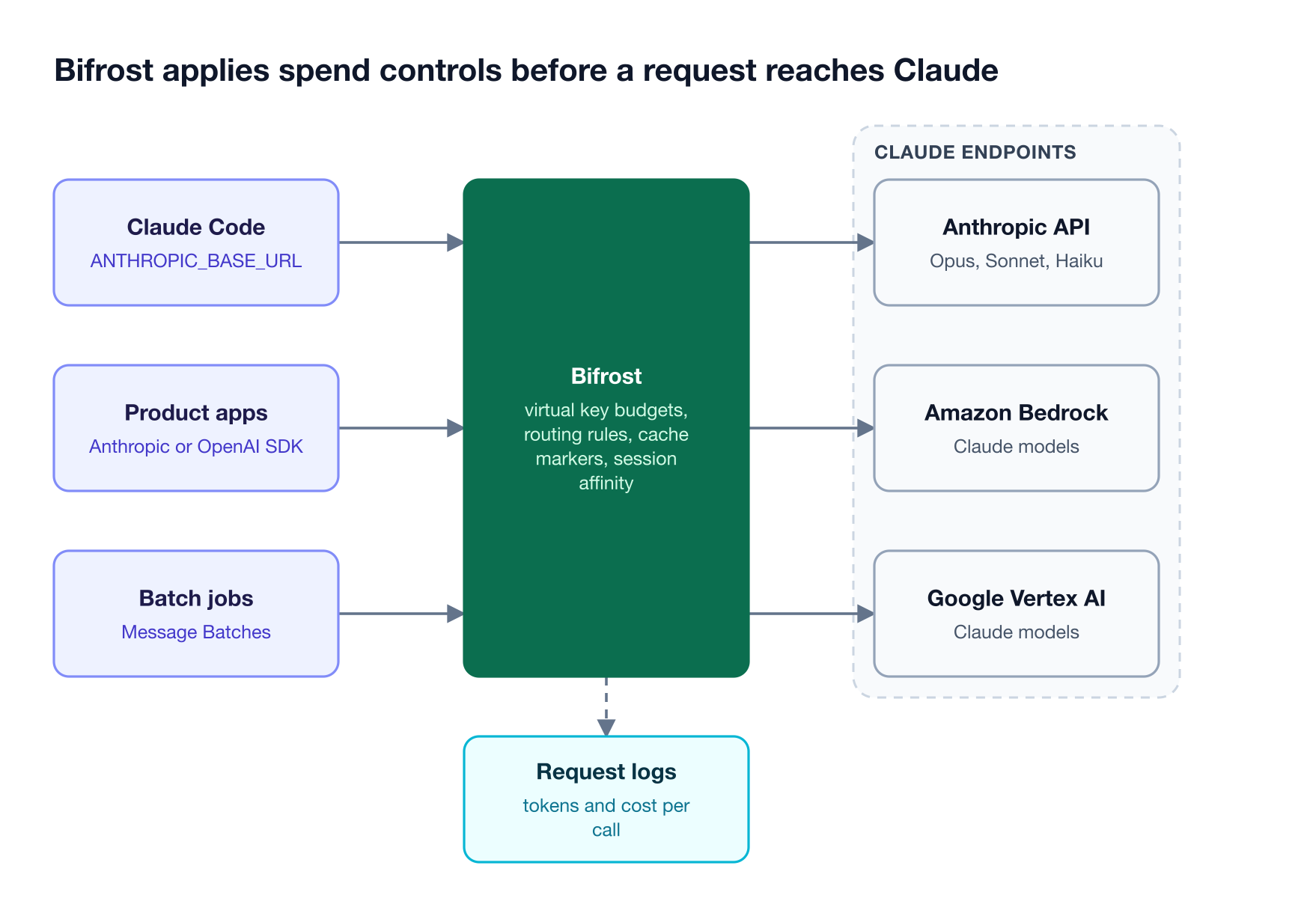
Figure 4: Budgets, routing, and cache handling live in one layer, so every Claude caller is governed and costed the same way.
The controls map directly to the cost drivers above:
- Budgets per key, team, and customer: virtual keys carry their own budgets and allowed models, and the budget hierarchy checks every applicable budget independently, blocking a request if any one is exhausted.
- Reset windows: budgets reset on durations from one minute to one year, optionally aligned to calendar periods in UTC, and budget overrides add temporary capacity.
- Rate limits: request and token limits at the provider config, virtual key, team, and customer levels cap runaway agent loops.
- Budget-aware routing: routing rules read a
budget_usedpercentage, sobudget_used > 80can move Opus traffic to Sonnet before a budget runs out. - Cache handling: automatic cache breakpoints and session affinity keep agent sessions on the cache-read rate.
Built-in request logs capture tokens, cost, and latency for every call. The Model Catalog syncs its pricing sheet every 24 hours by default and supports long-context price tiers, so a Haiku 5.5 request over 100,000 tokens can be priced at the higher rate. The AI governance page and the governance resource hub show how teams structure keys and budgets.
The open-source gateway covers virtual keys and budgets on a single node, and Bifrost Enterprise adds identity-provider sign-in, clustering, and in-VPC deployment. The LLM cost optimization walkthrough configures these controls end to end, and managing Claude rate limits covers the throughput side.
Frequently Asked Questions
Is the Claude API free?
The Claude API is not free beyond a small amount of credit Anthropic gives new users for testing. After that, usage is billed monthly at each model's per-token rates, and Anthropic sales can arrange extended trials for enterprise evaluations. Access starts with an API key from the Claude Console, covered in the Anthropic API key guide.
How much does the Claude API cost per million tokens?
On October 29, 2026, Claude Haiku 5.5 costs $0.10 input and $0.50 output per million tokens for prompts up to 100,000 tokens. Claude Sonnet 5.5 costs $2 and $10, Claude Opus 5.5 costs $4 and $20, and Claude Fable 5.1 costs $10 and $50. Cache reads, cache writes, batch requests, and US-only inference each change the effective rate from those base prices.
Is Claude Opus more expensive than Sonnet?
Claude Opus 5.5 costs twice as much per token as Claude Sonnet 5.5: $4 versus $2 per million input tokens and $20 versus $10 per million output tokens. Per-task cost can differ from that ratio, because Opus 5.5 defaults to medium effort and Sonnet 5.5 to high, and effort changes how many thinking tokens each request bills as output.
How does Claude prompt caching pricing work?
Claude prompt caching charges 1.25x the base input price to write a prefix to the 5-minute cache and 2x for the 1-hour cache. Reading a cached prefix costs 0.1x by default, 0.05x on Opus 5.5 and Sonnet 5.5, and 0.025x on Fable 5.1. Each read refreshes the TTL, and prefixes under 512 tokens on the current lineup are not cached.
Does Claude charge more for long context?
Claude 4.6 and later models, except Haiku 5.5, include the full 1M-token context window at standard per-token prices. Claude Haiku 5.5 is the exception: any request whose prompt exceeds 100,000 tokens, counting cache reads and writes, pays $0.50 input and $2.50 output per million tokens instead of $0.10 and $0.50.
How can a team track Claude API costs per user or project?
A team can track Claude API costs per user or project by giving each one its own credential and recording cost per request. In Bifrost, each project or developer gets a virtual key with its own budget and rate limits, and request logs attribute tokens and cost to it. FinOps showback and chargeback for LLM spend explains how to report it.
Start Controlling Claude API Pricing with Bifrost
Claude API pricing rewards teams that pick the cheapest passing tier, keep prefixes cached, batch what can wait, and stop runaway usage before it bills. Bifrost puts budgets, routing rules, cache handling, and per-request cost logs in front of every Claude caller, from product apps to Claude Code through the LLM gateway. To see how it fits your Claude workloads, book a demo with the Bifrost team.