Best Databricks AI Gateway Alternatives
Databricks AI Gateway, now called Unity Gateway, governs model, agent, and MCP traffic in Databricks through Unity Catalog. This guide compares five alternatives for governing AI across platforms: Bifrost, Kong AI Gateway, Azure API Management, Google Apigee, and Cloudflare AI Gateway.
TL;DR
- Databricks AI Gateway, renamed Unity Gateway and generally available since August 2026, governs model, agent, and MCP traffic for workspaces enabled for Unity Catalog.
- Several Unity Gateway capabilities remain in Beta, including service policies for guardrails, sensitive data detection, and Smart Routing. Traffic splitting is capped at five destinations.
- Bifrost is an open-source AI gateway that runs in your own infrastructure, routes to 10,000+ models across 25+ providers, and can keep Databricks Model Serving as one provider among many.
- Azure API Management and Google Apigee suit teams standardized on those clouds, Kong suits existing Kong users, and Cloudflare AI Gateway is a hosted option with free core features.
- The deciding question is scope: if AI traffic runs outside Databricks, a gateway that sits in front of every platform avoids splitting governance across tools.
Databricks AI Gateway is the governance layer Databricks provides for model, agent, and MCP traffic, now documented as Unity Gateway, and it works best when that traffic already lives in Databricks. Bifrost, the open-source AI gateway built in Go by Maxim AI, is the best choice for enterprises running mission-critical AI workloads that require top-tier performance, scalability, and reliability across every platform they run, Databricks included. This guide explains what Databricks AI Gateway covers, where teams outgrow it, and how five alternatives compare on deployment, routing, governance, and pricing.
What Is Databricks AI Gateway (Now Unity Gateway)?
Databricks AI Gateway is a governance service for AI traffic in Databricks, governed through Unity Catalog. Databricks now calls it Unity Gateway (formerly Unity AI Gateway); it became generally available in August 2026 and governs runtime interactions between models, agents, MCP servers, and tools, with the older serving-endpoint feature renamed AI Gateway (legacy).
Unity Gateway covers four areas, according to Databricks' documentation:
- Model access. Foundation Model APIs plus external providers through bring-your-own-key: OpenAI, Azure OpenAI, Anthropic, Amazon Bedrock, Microsoft Foundry, Google Gemini Enterprise, and custom endpoints.
- Routing. Percentage-based traffic splitting across up to five destinations, session affinity, and ordered fallbacks on 429 and 5xx errors, with Smart Routing in Beta.
- Limits and access. Queries-per-minute and tokens-per-minute limits per service, user, service principal, or group, with permissions granted through Unity Catalog privileges.
- Policies and logging. Service policies for unsafe content, jailbreaks, hallucination, and sensitive data (in Beta), a usage system table, and inference tables for payloads.
Unity Gateway also governs external coding agents such as Claude Code, Codex, Cursor, and Gemini CLI. For teams whose AI work happens in Databricks, that scope is the main advantage. For a broader view of what any gateway in this position should do, the overview of what an AI gateway is covers the control-plane model.
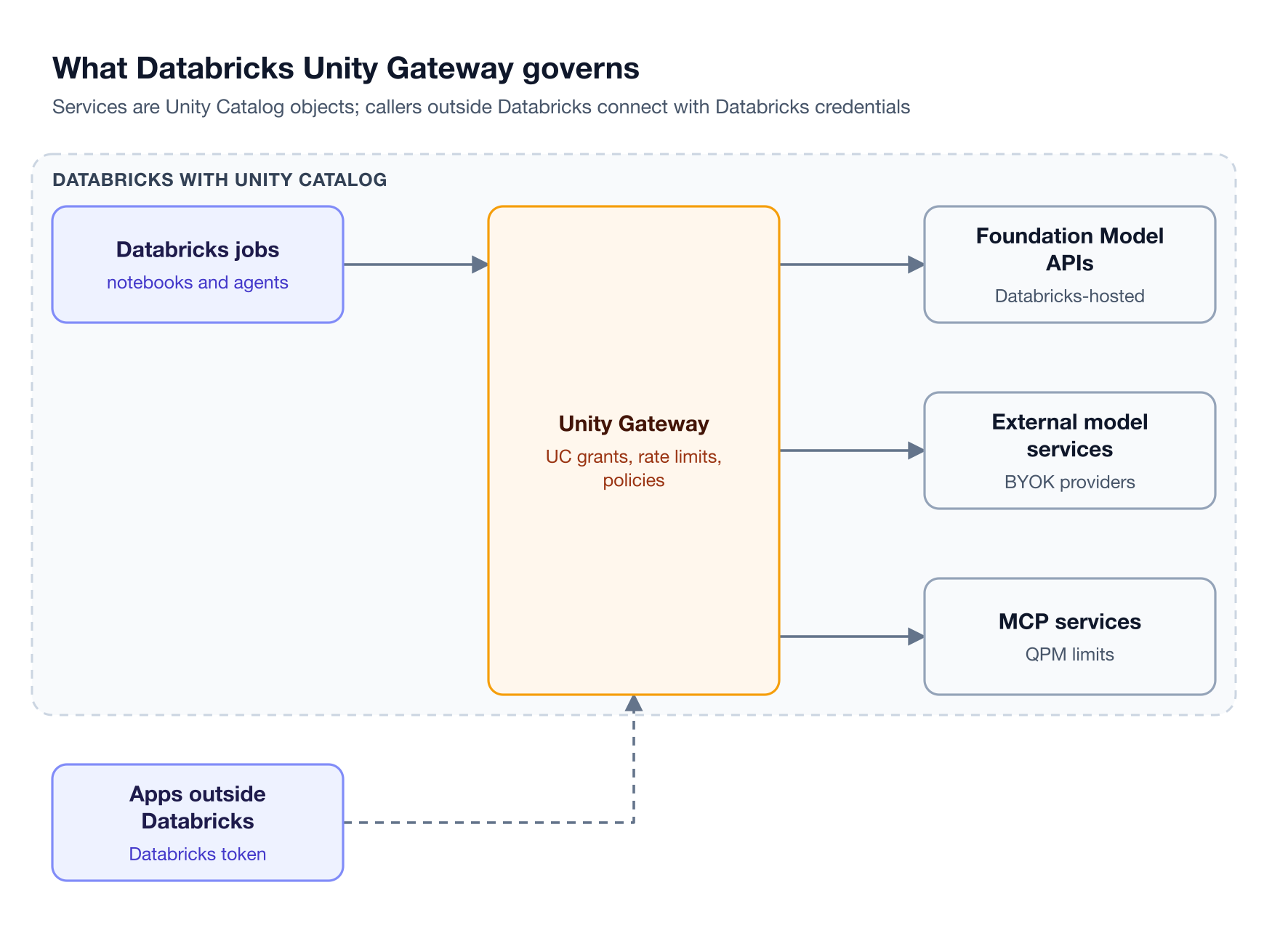
Figure 1: Unity Gateway governance is scoped to Databricks and Unity Catalog, so every governed service and policy lives in Databricks.
Why Teams Look for Databricks AI Gateway Alternatives
Teams look for Databricks AI Gateway alternatives when AI traffic spreads beyond the lakehouse: product services on Kubernetes, agents on other clouds, and coding tools on employee machines. A gateway that only exists inside one platform leaves the rest governed separately or not at all.
The specific friction points come from Databricks' own documentation:
- Platform requirement. Unity Gateway requires a Databricks workspace enabled for Unity Catalog, and no self-hosted or non-Databricks deployment is published.
- Beta capabilities. Service policies, sensitive data detection, Smart Routing, agent services, and the unified trace table are still in Beta.
- Coverage gaps. Service policies, inference tables, rate limits, and fallbacks don't apply to
ai_querycalls, and some regions on AWS, Azure, and GCP do not list Unity Gateway support. - Routing limits. Traffic splitting is capped at five destinations, and model provider services support a fixed list of external providers plus custom endpoints.
- Telemetry location. Usage lands in Unity Catalog tables; payloads over 10 MiB are not logged, and inference tables cannot use storage secured through a private endpoint.
A common requirement behind these migrations is AI governance that applies one set of keys, budgets, and policies to every caller, wherever it runs. Teams that also run MLflow outside Databricks face the same question, covered in the review of MLflow AI Gateway alternatives.
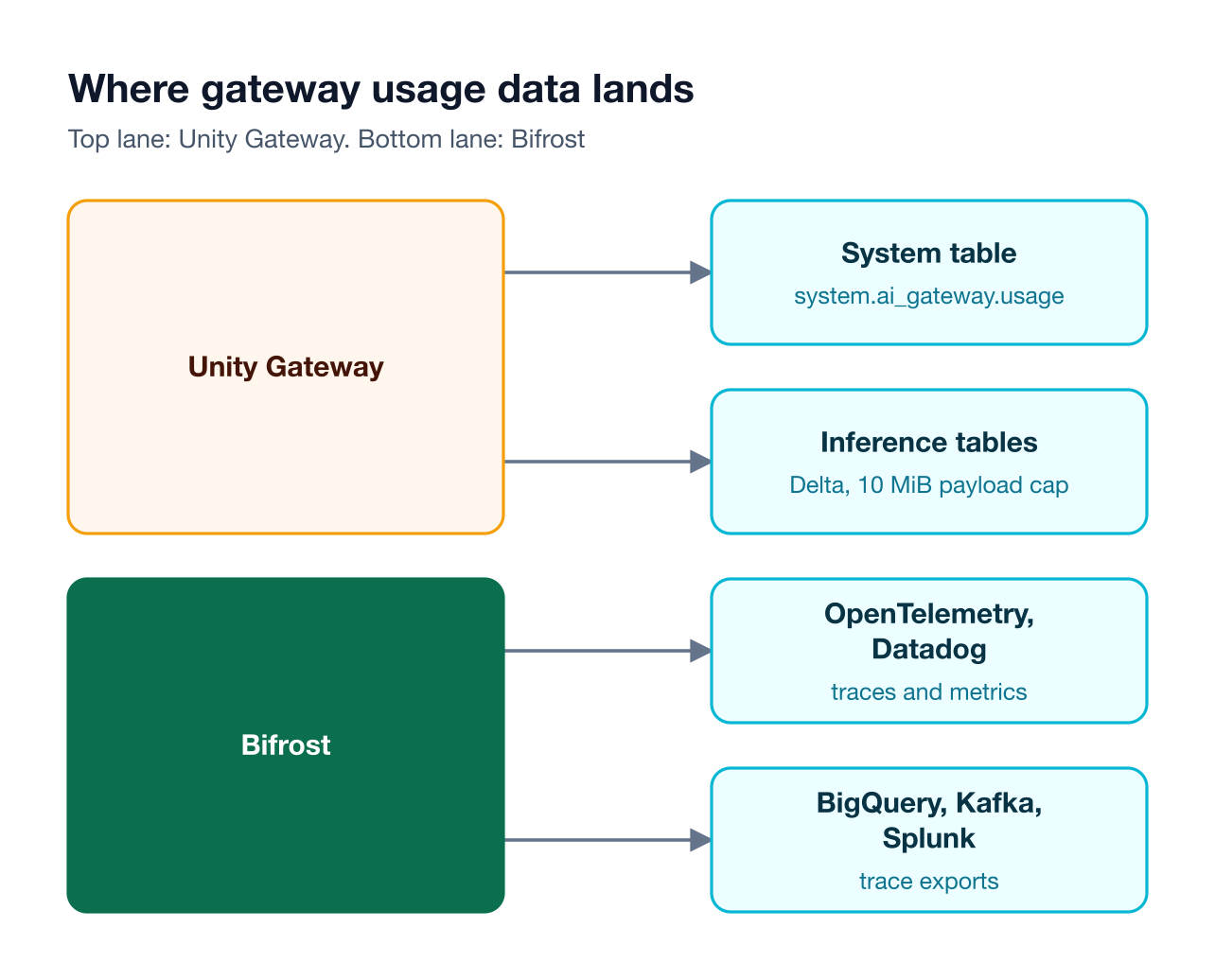
Figure 2: Unity Gateway keeps usage data in Unity Catalog tables; Bifrost sends it to the observability stack you already run.
Key Criteria for Choosing an AI Gateway Outside Databricks
The right AI gateway for a team leaving or extending Databricks AI Gateway is one that covers every platform where AI traffic originates, without losing the governance depth Unity Catalog provides. The criteria below focus on scope, maturity, and where data ends up.
| Criterion | What to check | Why it matters |
|---|---|---|
| Deployment scope | Runs independently of any one data or cloud platform | Covers apps, agents, and tools wherever they run |
| Feature maturity | Guardrails and routing generally available, not Beta | Production policy cannot depend on preview features |
| Provider coverage | Number of providers and Databricks-hosted models | Keeps existing Databricks models usable |
| Routing depth | Fallbacks, weights, health, complexity, destination limits | Controls cost and uptime per request |
| Identity and access | IdP sync, teams, per-key budgets and limits | Maps governance to the org chart |
| MCP and agents | Tool filtering, agent access, audit | Agents call tools as well as models |
| Telemetry | OpenTelemetry and existing observability tools | Keeps AI traffic visible beside other systems |
OpenTelemetry maintains GenAI semantic conventions for model calls, which makes OTLP export a practical baseline for gateway telemetry. The LLM gateway buyer's guide turns these criteria into a full evaluation checklist.
Databricks AI Gateway Alternatives Compared at a Glance
The five alternatives differ mainly in where they run and how tightly they bind to one platform. Bifrost and Kong can run in your own infrastructure, Azure API Management and Apigee extend existing cloud API platforms, and Cloudflare AI Gateway is hosted on Cloudflare's network.
| Gateway | Deployment | Routing | Guardrails and policy | MCP support |
|---|---|---|---|---|
| Databricks AI Gateway (baseline) | Databricks workspace with Unity Catalog | Traffic splitting to 5 destinations, fallbacks, Smart Routing (Beta) | Service policies (Beta), UC grants, QPM/TPM limits | MCP services with QPM limits |
| Bifrost | Self-hosted: VM, Kubernetes, in-VPC, air-gapped | CEL rules, weighted keys, fallbacks, complexity router; adaptive routing on Enterprise | Virtual keys and budgets; guardrails, SSO, RBAC on Enterprise | MCP gateway with tool filtering, Code Mode |
| Kong AI Gateway | Serverless, hybrid, dedicated cloud, or self-hosted | Round-robin, latency, usage, semantic, priority | Token rate limits; PII Sanitizer on Enterprise | Governs external MCP servers |
| Azure API Management | Azure-managed; self-hosted gateway on Developer and Premium | Round-robin, weighted, priority, session-aware; up to 30 backends | Token limits, Azure AI Content Safety | REST APIs as MCP servers, existing MCP servers |
| Google Apigee | Google-managed or hybrid runtime | Cross-provider routing and fallback via proxy template | Token quotas, Model Armor | APIs exposed as MCP tools |
| Cloudflare AI Gateway | Cloudflare-hosted | Dynamic routing and Auto Router (Beta), fallbacks | Request limits; spend limits and DLP (Beta) | Not published |
Each alternative has its own alternatives roundup on this site, including Azure AI gateway alternatives for multi-cloud traffic.
1. Bifrost
The Bifrost AI gateway routes model calls through one OpenAI-compatible API for 10,000+ models across 25+ providers, and governs MCP tool calls and agent-to-agent traffic through its MCP and Agent gateways. It runs as a single binary in your VPC, data center, or air-gapped environment, and it treats Databricks as one provider rather than the boundary of governance.
Best for: Bifrost is built for enterprises running mission-critical AI workloads that require top-tier performance, scalability, and reliability. It serves as a centralized AI gateway to route, govern, and secure all AI traffic across models and environments with ultra low latency. Bifrost unifies LLM gateway, MCP gateway, and Agents gateway capabilities into a single platform. Designed for regulated industries and strict enterprise requirements, it supports air-gapped deployments, VPC isolation, and on-prem infrastructure. It provides full control over data, access, and execution, along with strong security, policy enforcement, and governance capabilities.
What Bifrost offers a team moving beyond Databricks AI Gateway:
- Databricks as a provider. The Databricks provider reaches both Model Serving endpoints and Unity Gateway (formerly Unity AI Gateway) model services, with personal access token or OAuth machine-to-machine authentication.
- Expression-based routing and fallbacks. Routing rules in CEL, weighted key load balancing, retries and fallbacks, and a complexity router that tiers requests to cheaper or stronger models.
- Governance from your identity provider. Virtual keys carry budgets, rate limits, and model allowlists, and Enterprise syncs users and teams through OIDC and SCIM 2.0.
- Guardrails on requests and responses. Bifrost guardrails combine built-in regex, secrets detection, and LLM-judge policies with external providers such as Presidio, AWS Bedrock Guardrails, and Google Model Armor.
- Tools and agents. As an MCP gateway, Bifrost filters tools per key, and Code Mode cuts input tokens by up to 92.8%. The Agent Gateway governs agent-to-agent calls over A2A.
- Telemetry where you already look. OpenTelemetry export plus native connectors for Datadog, BigQuery, Kafka, Pub/Sub, and Splunk.
- Coding agents. The CLI agents integration routes Claude Code, Codex CLI, Gemini CLI, and Cursor through the same keys and budgets.
Bifrost adds about 11 microseconds of overhead per request at 5,000 RPS on a single t3.xlarge in published benchmarks, and the LLM Gateway overview covers the full feature set.
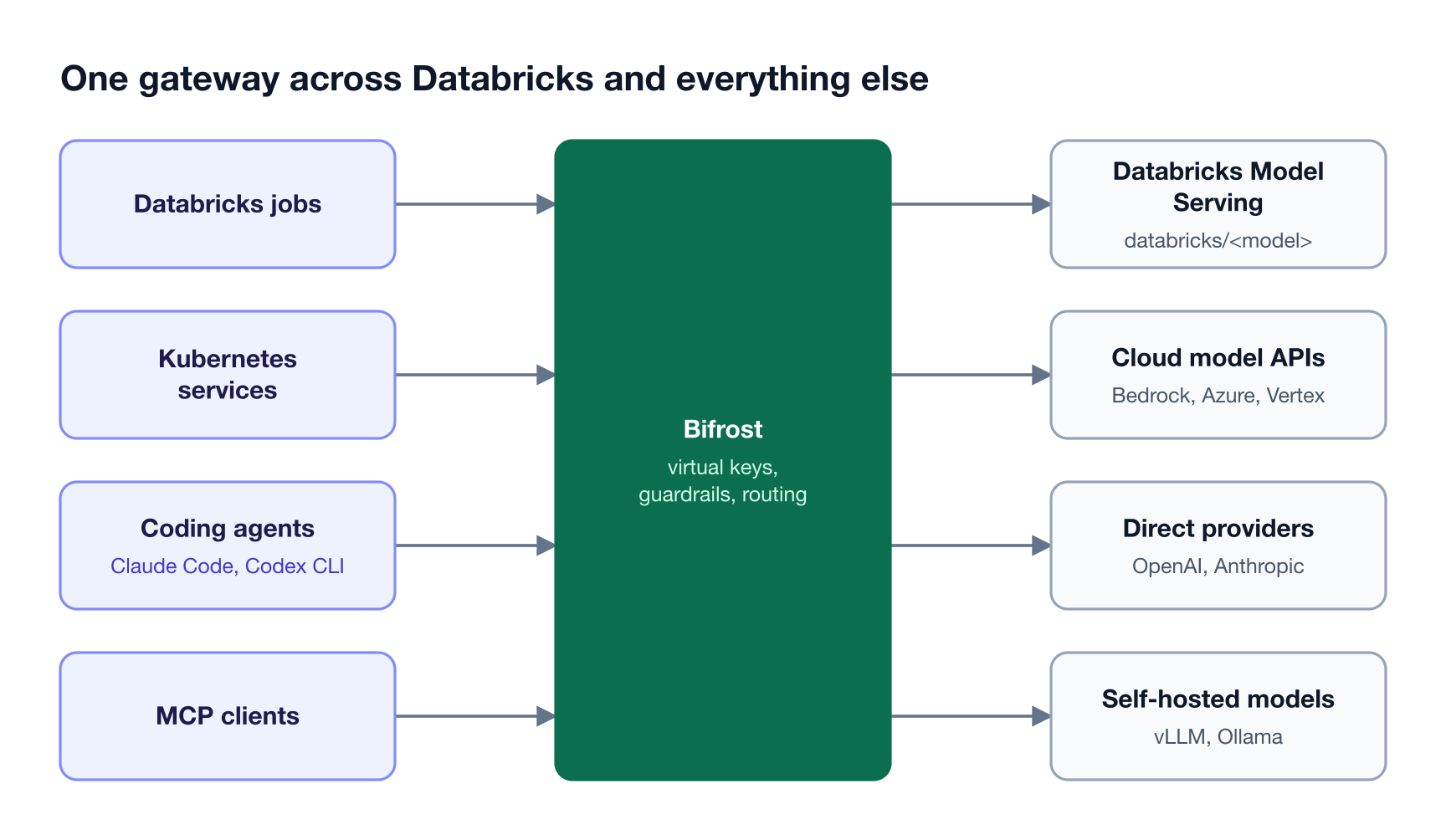
Figure 3: Bifrost can keep Databricks-hosted models as one provider while applying the same keys, budgets, and guardrails to every other workload.
2. Kong AI Gateway
Kong AI Gateway extends Kong's API platform to govern LLM, MCP, and agent-to-agent traffic. It runs as serverless, hybrid, or dedicated cloud deployments, with fully self-hosted AI gateways available through Kong's separate Gateway Enterprise offering.
Best for: Organizations that already manage APIs with Kong and want AI traffic on the same platform.
- Routing. AI Proxy Advanced supports round-robin, consistent-hashing, lowest-latency, lowest-usage, semantic, and priority-based balancing with retries and failover.
- Policy. Token-based rate limiting, a semantic cache backed by a vector database, and a PII Sanitizer that redacts sensitive data in requests and responses.
- MCP. Kong states it can expose and govern tools from external MCP servers and generate MCP tools on top of Kong-managed APIs.
- Constraints. AI Proxy Advanced, Semantic Cache, and the PII Sanitizer are AI Gateway Enterprise features, available as add-ons on the Plus plan.
Kong's trust center lists ISO 27001:2022 and SOC 2. Teams comparing Kong with other options can read the review of Kong AI Gateway alternatives.
3. Azure API Management
Azure API Management adds AI gateway capabilities to Microsoft's API management service; Microsoft describes the AI gateway as an extension of the existing API gateway rather than a separate offering. It supports OpenAI Chat Completions and Responses, the Anthropic Messages API on v2 tiers, and the Google Vertex AI API.
Best for: Organizations standardized on Azure that already run models in Microsoft Foundry.
- Routing. Backend pools of up to 30 backends support round-robin, weighted, priority-based, and session-aware load balancing, with a circuit breaker outside the Consumption tier.
- Policy. Token limits and quotas, semantic caching with an external cache and embeddings backend, and an Azure AI Content Safety policy that also covers MCP tools and A2A agent APIs.
- MCP. API Management can expose REST APIs as MCP servers or front existing remote MCP servers.
- Constraints. The unified model API is in preview, and the self-hosted gateway runs only on Developer and Premium tiers with outbound connectivity to Azure.
LLM logs, optionally including prompts and completions, flow to Azure Monitor and Log Analytics. The comparison of Apigee and other cloud gateway alternatives covers how cloud-native gateways differ from dedicated ones.
4. Google Apigee
Apigee is Google Cloud's API management platform, with AI policies for token quotas, prompt token limits, semantic caching, and prompt and response sanitization through Model Armor.
Best for: Google Cloud customers that want LLM traffic governed alongside existing Apigee APIs.
- Routing. Cross-provider model routing and fallback are built in the proxy through Google's AI gateway template rather than a dedicated routing policy.
- Policy. LLMTokenQuota, PromptTokenLimit, SemanticCacheLookup and SemanticCachePopulate, and SanitizeUserPrompt and SanitizeModelResponse.
- MCP. Apigee exposes your APIs as MCP tools built from OpenAPI specs, limited to 1,000 MCP tools per organization, without Server-Sent Events streams.
- Constraints. Model Armor and semantic cache policies deploy only in Comprehensive environments, and the token-quota tutorial supports only text-based tokens.
Apigee runs as a Google-managed service or as a hybrid runtime that you install on your own Kubernetes clusters, with a management plane hosted by Google. Teams weighing self-hosted control against managed cloud services can compare options in the roundup of open-source AI gateways.
5. Cloudflare AI Gateway
Cloudflare AI Gateway is a hosted gateway on Cloudflare's network that connects to models, routes requests dynamically, and manages usage, billing, and logs. Cloudflare's provider documentation lists 24 providers, including Workers AI, Amazon Bedrock, Anthropic, Azure OpenAI, Google Vertex AI, and OpenAI.
Best for: Teams on Cloudflare's developer platform that want a free, hosted routing layer.
- Routing. Dynamic routing (Beta) evaluates conditions, enforces quotas, and chooses models with fallbacks, and an Auto Router (Beta) weighs expected quality against cost.
- Policy. Spend limits (Beta) by provider, model, or metadata are eventually consistent; rate limits count requests; data loss prevention (Beta) can flag or block prompts and responses.
- Caching. Caching covers identical requests only and is off by default; Cloudflare states semantic caching is planned.
- Constraints. Logs are on by default and can include prompts and responses, and MCP gateway support is not published in the AI Gateway documentation.
Cloudflare suits web teams already on its platform more than data teams leaving Databricks. The review of Cloudflare AI Gateway alternatives covers its trade-offs in more depth.
Databricks AI Gateway Pricing Compared With the Alternatives
Databricks AI Gateway pricing charges only for Usage Tracking and Inference Tables, at $0.100 per GB on the default plan shown on Databricks' pricing page, billed under the Serverless Real-time Inference SKU. External model usage is paid to providers directly, and the compliance security profile adds a separate charge.
| Gateway | Pricing model |
|---|---|
| Databricks AI Gateway | Usage Tracking and Inference Tables billed per GB of payload; Databricks-hosted models at usual rates |
| Bifrost | Open source free under Apache 2.0; Enterprise custom with a 14-day trial |
| Kong AI Gateway | Plus from $25 per month plus usage; Enterprise custom |
| Azure API Management | Classic and v2 tiers; self-hosted gateway only on classic Developer and Premium |
| Google Apigee | Pay-as-you-go per API call and environment, or Standard, Enterprise, and Enterprise Plus subscriptions |
| Cloudflare AI Gateway | Core features free; 5% fee on Unified Billing credits |
The cheapest option depends less on list prices than on scope: a second gateway for non-Databricks traffic adds a governance silo, while one gateway in front of everything replaces several. Bifrost Enterprise details are on the pricing page, and the enterprise deployment guide covers running it in your own cloud.
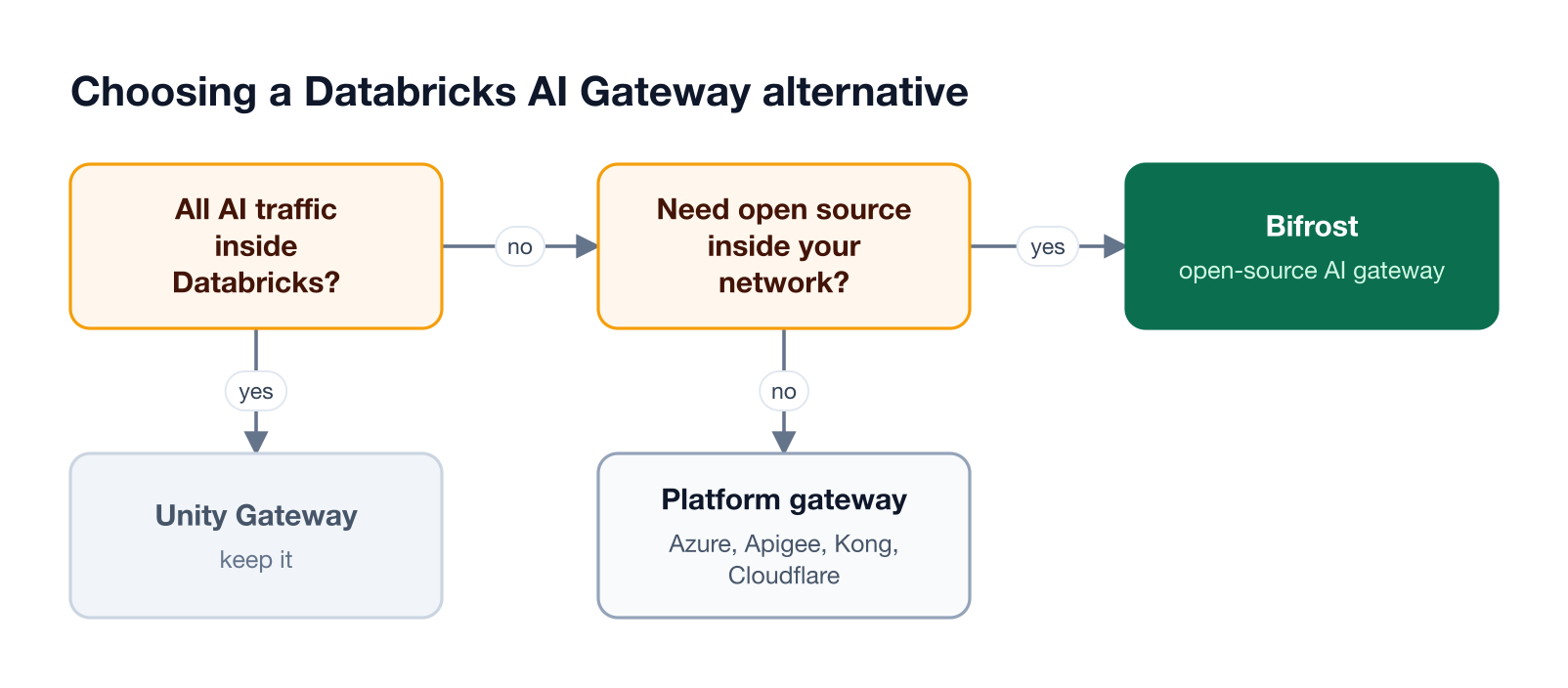
Figure 4: Workload scope decides whether you need an alternative at all; where the gateway must run decides which one.
Frequently Asked Questions
What is Databricks AI Gateway?
Databricks AI Gateway is the Databricks service for governing AI traffic, now documented as Unity Gateway. It applies Unity Catalog permissions, rate limits, routing, service policies, and usage tracking to model, agent, and MCP traffic in Databricks workspaces enabled for Unity Catalog. The older serving-endpoint feature is now called AI Gateway (legacy).
Is Unity AI Gateway the same as Databricks AI Gateway?
Yes. Unity AI Gateway, since renamed Unity Gateway and generally available in August 2026, is the successor to the serving-endpoint AI Gateway, which remains as AI Gateway (legacy). Databricks publishes a migration path from legacy endpoints to Unity Gateway services.
How much does Databricks AI Gateway cost?
Databricks lists Usage Tracking and Inference Tables as the only paid Unity Gateway features, priced per GB of payload under the Serverless Real-time Inference SKU. Model usage is billed separately, either by external providers or at Databricks' standard rates for Databricks-hosted models.
Can I use Databricks models with another AI gateway?
Yes. Bifrost includes a Databricks provider that reaches Model Serving endpoints and Unity Gateway model services through OpenAI-compatible APIs, so teams can keep Databricks-hosted models while governing all traffic from one gateway. The Bifrost governance hub explains how keys and budgets apply across providers.
Does Databricks AI Gateway support MCP?
Yes. Unity Gateway governs MCP services with queries-per-minute rate limits and Unity Catalog permissions. Because the MCP specification leaves enforcement of access controls to implementors, many teams also want tool filtering and audit at a gateway that covers every MCP client, not only those in Databricks.
What is the best open-source alternative to Databricks AI Gateway?
Bifrost is an open-source AI gateway under Apache 2.0 that runs as a single binary in your own infrastructure, routes to 10,000+ models across 25+ providers, and governs model, MCP, and agent traffic with one set of keys and budgets. The roundup of self-hosted open-source AI gateways compares it with other options.
Getting Started with Bifrost
The best Databricks AI Gateway alternative is the one that governs AI traffic everywhere it runs, not only inside Databricks. Bifrost does that as an open-source gateway that keeps Databricks models usable, with an enterprise tier for identity, guardrails, and clustering. To see Bifrost govern your traffic across Databricks and other platforms, book a demo with the Bifrost team.