Enterprise AI Gateway: Route, Govern, and Secure All AI Traffic
A single enterprise now runs model traffic from dozens of applications, a fleet of coding agents on developer machines, and a growing set of MCP tool servers, each typically holding its own provider credentials. Without a shared control point, every team reimplements routing, retries, rate limits, and cost tracking, and no one can answer who called which model on whose data. Bifrost, the open-source AI gateway written in Go by Maxim AI, consolidates that surface into one control plane that every LLM and MCP call passes through. This post covers what an enterprise AI gateway does across three responsibilities, routing, governance, and security, and what the architecture looks like in practice.
What Is an Enterprise AI Gateway?
An enterprise AI gateway is a control layer between applications and model providers that exposes one API for every model, applies identity and policy to each request, routes it to the right provider with failover, and emits telemetry and audit records. It replaces per-team provider integrations with a single ingress that platform, finance, and security teams can each govern from.
The word enterprise is doing real work in that definition. A gateway that only unifies provider APIs is a convenience layer. An enterprise gateway is expected to enforce budgets at request time, integrate with an identity provider, produce audit evidence, and run inside private infrastructure when the data requires it. The LLM Gateway Buyer's Guide maps those expectations to concrete evaluation criteria.
What Does an Enterprise AI Gateway Architecture Look Like?
Every request follows the same path: authenticate the caller, resolve what that identity is permitted to do, screen the content, check the cache, then route to a provider and record what happened.
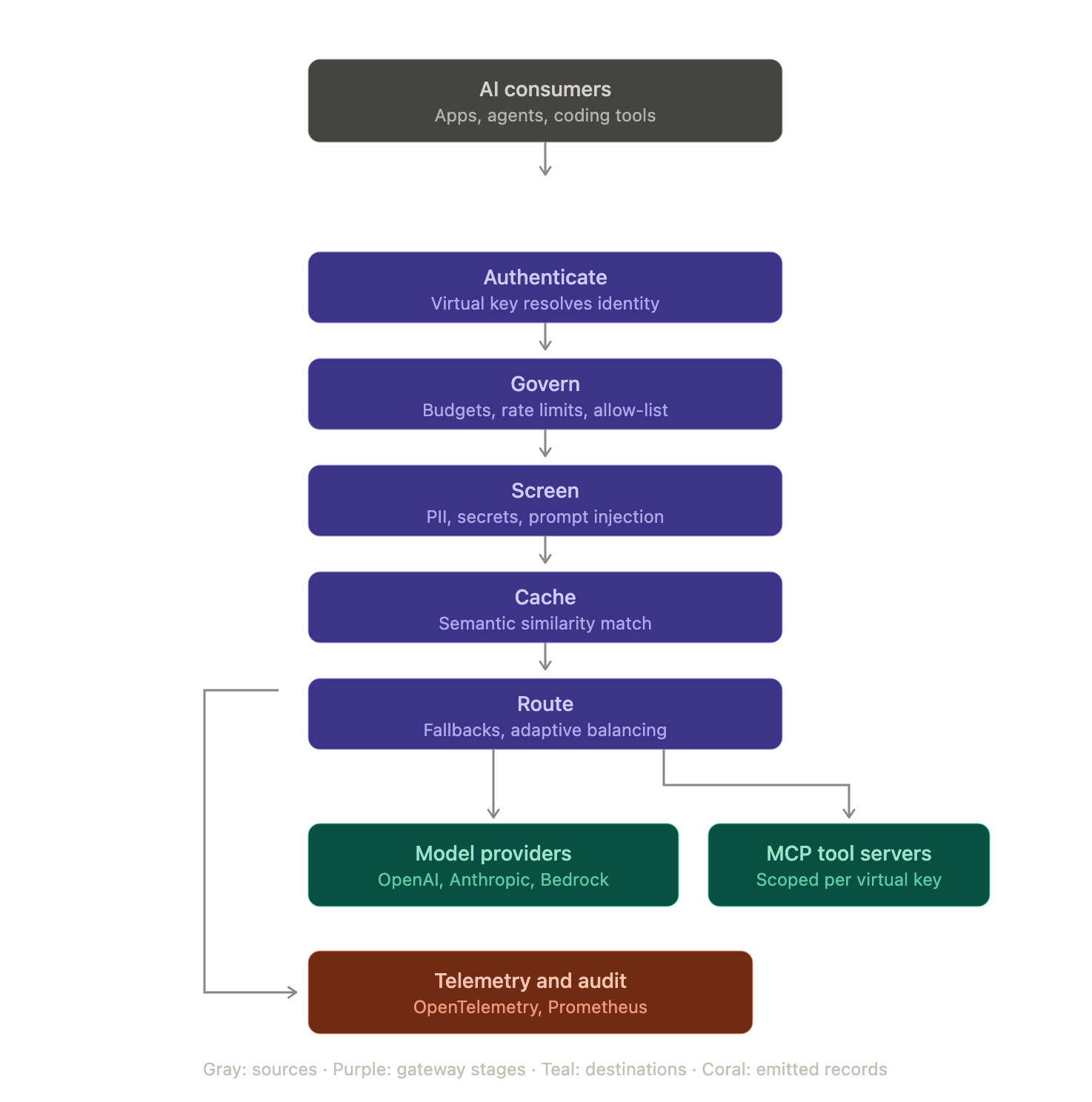
Two properties of this shape matter more than any individual box. The first is that the gateway is the only ingress: a direct-to-provider call from any service bypasses every budget, permission, and log, which makes the entire control plane advisory. The second is that model traffic and MCP tool traffic resolve against the same identity, so an agent inherits one bounded set of permissions covering both what it can call and what it can spend.
Adoption does not require rewriting that path into applications. Because Bifrost is a drop-in replacement exposing an OpenAI-compatible API, an existing service moves behind the gateway by changing its base URL.
How Does an Enterprise AI Gateway Route AI Traffic?
Routing decides which provider serves a request and what happens when that provider fails. Three mechanisms cover most production requirements.
- Automatic fallbacks: provider and model failover reroutes traffic when a primary provider returns errors, so retry logic lives in the gateway rather than in every application.
- Adaptive load balancing: dynamic weight adjustment across keys and providers responds to live error rates, latency, and throughput, with circuit breaking to pull degraded routes out of rotation.
- Semantic caching: caching on semantic similarity rather than exact string match returns stored responses for near-duplicate queries, which reduces both spend and latency.
Routing quality is bounded by what the routing layer costs. A gateway that adds milliseconds to every call erases its own benefit in agentic workloads, where one user action can produce twenty model calls. In sustained benchmarks at 5,000 requests per second, Bifrost adds 11 microseconds of overhead per request with a 100% success rate, which keeps the control plane cheap enough to sit in front of every call rather than only the important ones.
How Does an Enterprise AI Gateway Govern AI Spend and Access?
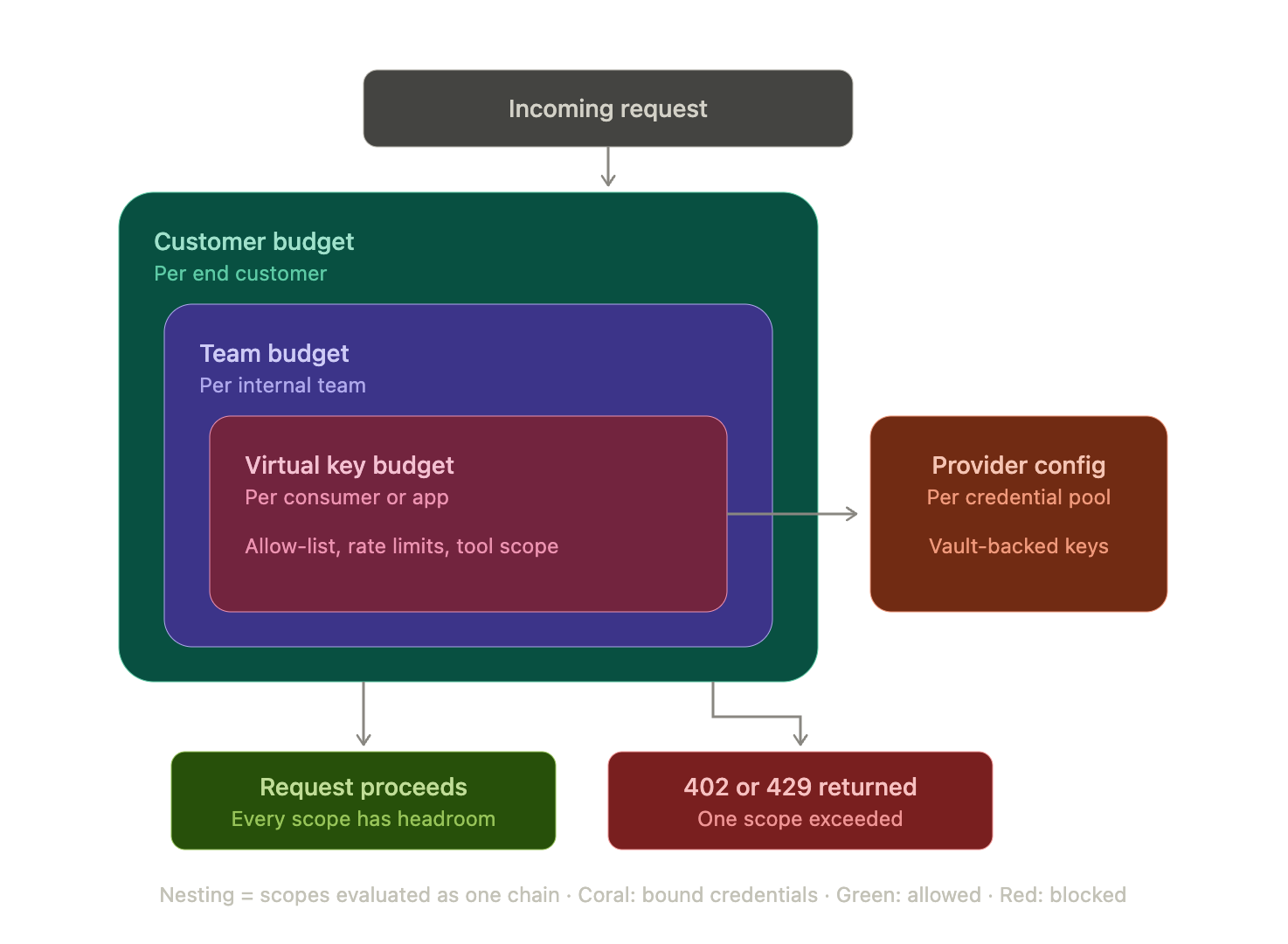
Governance turns the gateway from a router into a policy enforcement point. Virtual keys are the mechanism: each consumer gets a gateway-issued credential carrying its own model and provider allow-list, budget, rate limits, and MCP tool scope, while the real provider credentials stay in the gateway. Revoking one consumer is a state change on one key, not a credential rotation across the organization.
Budgets are hierarchical, with independent limits at the customer, team, virtual key, and provider-config levels, and every budget in a request's chain evaluated before the call leaves the gateway. Rate limits run in parallel on tokens and requests, because the two controls fail differently: a budget catches slow overruns across a month, and a rate limit catches a retry loop that would consume that month in twenty minutes. Enforcement surfaces as ordinary HTTP status codes, 402 for an exceeded budget and 429 for an exceeded rate limit, so applications handle it with existing error paths.
Access control at the control plane is a separate question from access control on the request path. RBAC governs who can create keys, change budgets, or view logs, and it reaches users through the identity provider rather than manual account creation. The Bifrost governance layer covers both halves, with OIDC and SCIM provisioning mapping identity provider groups to gateway roles.
How Does an Enterprise AI Gateway Secure AI Traffic?
Gateway-level security addresses risks that application controls cannot see, because the gateway is the only place where every prompt, completion, and tool call is observable in one stream.
Guardrails validate inputs and outputs in real time against configured policy, covering PII detection and redaction, secrets and credential leakage, prompt injection, and harmful content. Detection runs through built-in regex and Gitleaks-backed secrets scanning or through external providers including Microsoft Presidio, Azure AI Language, AWS Bedrock Guardrails, and Azure Content Safety, so an organization can apply the same policy engine it already uses elsewhere.
Agentic traffic needs its own control. The OWASP Top 10 for LLM Applications treats excessive agency, where an agent holds more tool access than its task requires, as a distinct risk. Scoping MCP tools per virtual key is what keeps that bounded, because a tool an agent cannot see is a tool it cannot call.
Two further requirements decide whether a security review approves a deployment at all:
- Evidence. Immutable audit logs covering every configuration change are what convert a governance design into artifacts a SOC 2, HIPAA, GDPR, or ISO 27001 assessment can examine.
- Data control. In-VPC, air-gapped, and on-premise deployment keeps prompts and completions inside controlled infrastructure, which managed-only gateways cannot offer at any feature level.
Observability closes the loop. Native OpenTelemetry and Prometheus output sends traces, token counts, costs, and latency into the monitoring stack a team already runs, and Bifrost captures request-level detail asynchronously so logging adds no latency to the request path.
Enterprise AI Gateway FAQs
Is an enterprise AI gateway different from an API gateway?
Yes. An API gateway manages traffic to services the organization controls. An AI gateway manages traffic outward to third-party model providers and handles concerns a general-purpose API gateway was not designed for: token-based cost attribution, model-level fallback chains, semantic caching, guardrails on prompt and completion content, and MCP tool governance.
Does routing everything through one gateway create a single point of failure?
It does unless the gateway is deployed for availability, which is why multi-node clustering with real-time state synchronization is an enterprise requirement rather than a nice-to-have. The alternative is worse: without a gateway, every application carries its own failover logic, and provider outages surface inconsistently across services.
Can an open-source gateway meet enterprise requirements?
For routing and cost enforcement, yes. The open-source Bifrost distribution ships virtual keys, hierarchical budgets, rate limits, routing, and MCP tool filtering. Identity federation, RBAC, guardrails, immutable audit logs, and clustering sit in Bifrost Enterprise, which is usually where a compliance review draws its line.
Getting Started with Bifrost
Route, govern, and secure describe one system rather than three, and they only hold when every AI call passes through the same control point. Bifrost is the AI gateway that handles all three for model traffic and MCP tool traffic together, in a single open-source, self-hostable deployment with microsecond-level overhead. Teams building an evaluation can map each requirement to a test using the Bifrost buyer's guide for AI gateways.
To see how the Bifrost enterprise AI gateway fits your routing, governance, and security requirements, book a demo with the Bifrost team.