Enterprise MCP Gateway for AI Agents: Best Platform in 2026
An MCP gateway controls which AI agent can reach which tool, under whose identity. This guide compares five MCP gateways for enterprise AI agents, including Bifrost, Kong, and AWS AgentCore, on tool scoping, per-user OAuth, and Code Mode's 92.8% input-token reduction.

TL;DR
- An MCP gateway is a control layer between AI agents and MCP servers that centralizes tool discovery, authentication, access policy, and logging.
- Bifrost is the best MCP gateway for enterprise AI agents in 2026 because it governs LLM calls and MCP tool calls in one open-source gateway, with virtual keys, per-user OAuth, guardrails, and in-VPC deployment.
- Bifrost Code Mode reduced input tokens by 92.8% and estimated cost by 92.2% in a benchmark with 508 tools across 16 MCP servers.
- Bifrost adds 11 microseconds of overhead per request at 5,000 requests per second, with a 100% success rate in sustained benchmarks.
- Managed cloud gateways, API-gateway plugins, and container-based gateways each solve part of the problem; enterprise teams should compare them on tool scoping, per-user auth, and deployment control.
Gartner predicts that 40% of enterprise applications will integrate task-specific AI agents by the end of 2026, up from less than 5% in 2025. Each of those agents reaches tools through the Model Context Protocol, and an MCP gateway is the layer that decides which agent can see which tool, under whose identity, and with what audit trail. Bifrost, the open-source AI and MCP gateway built in Go by Maxim AI, is the best choice for enterprises running mission-critical AI workloads that require best-in-class performance, scalability, and reliability. This guide defines the category, sets out evaluation criteria, and compares five MCP gateway options for enterprise AI agents.
What Is an MCP Gateway?
An MCP gateway is a control layer that sits between AI agents and MCP servers, centralizing tool discovery, authentication, access policy, and logging behind one endpoint. Instead of configuring every agent with direct credentials to every MCP server, teams point agents at the gateway and manage tool access in one place.
The Model Context Protocol standardizes how AI clients discover and call tools, and its authorization specification builds on OAuth 2.1. The protocol defines how a client talks to a server. It does not define how an organization governs hundreds of servers across thousands of agents, and that governance gap is what an MCP gateway fills. For a deeper primer, see this guide to MCP gateways for production AI agents.
Three components are often confused:
- MCP server: exposes tools, resources, and prompts from one system, such as a database, a ticketing tool, or a file store.
- MCP proxy: forwards MCP traffic, usually to one server, with little or no policy.
- MCP gateway: aggregates many servers, authenticates callers, filters tools per consumer, and records every tool call.
The differences between an MCP gateway, a proxy, and a server matter when choosing a platform, because several products marketed as gateways behave more like proxies. Bifrost implements the full gateway pattern, acting as both an MCP client and MCP server in one process.
How to Evaluate an Enterprise MCP Gateway
An enterprise MCP gateway should be judged on five properties: per-consumer tool scoping, per-user authentication to upstream servers, governance of the LLM calls that trigger tool calls, deployment control, and cost behavior as tool counts grow. A gateway that handles only routing leaves security and cost problems in each agent team's hands.
| Criterion | Why it matters for AI agents | What to check |
|---|---|---|
| Tool scoping | Agents should see only the tools their task requires | Per-key or per-team tool allow-lists enforced on both tools/list and tools/call |
| Upstream authentication | Tools like GitHub or Notion must act as the real user, not a shared service account | Per-user OAuth, per-user headers, identity-provider token exchange |
| LLM and MCP in one layer | Tool calls are triggered by model calls; split gateways split the audit trail | One gateway for model routing, budgets, and MCP tools |
| Deployment control | Regulated teams need tool traffic to stay inside their network | Self-hosting, in-VPC deployment, clustering |
| Token cost at scale | Tool definitions consume context on every turn | A mechanism that avoids injecting hundreds of tool schemas per request |
Two further checks separate production-grade platforms from prototypes: whether tool execution is explicit by default, and whether guardrails apply to tool inputs and outputs as well as prompts. The Bifrost governance model covers both, and the LLM gateway buyer's guide expands this framework for procurement teams.
MCP Gateway Architecture for AI Agents
A production MCP gateway architecture has three planes: an inbound plane that authenticates agents, a policy plane that filters tools and enforces budgets, and an outbound plane that connects to MCP servers with the right credentials. Every tool call passes through all three, which is what makes the gateway a single point of control and audit.
In the Bifrost AI gateway, the planes map to concrete mechanisms:
- Inbound: agents and MCP clients connect to one
/mcpendpoint and authenticate with a virtual key header or a browser-based OAuth 2.1 flow. - Policy: virtual keys carry tool allow-lists, budgets, and rate limits, so
tools/listreturns only permitted tools andtools/callis checked against the same list. - Outbound: Bifrost connects to MCP servers over STDIO, HTTP, or SSE, with automatic retry and exponential backoff for transient failures.
The same gateway also routes model traffic, so the request that produced a tool call and the tool call itself share one log stream and one set of policies. Because both paths share one set of virtual keys, an inactive or expired key is refused with a 403 on the inference endpoints and on the /mcp endpoint alike.
Best MCP Gateways Compared at a Glance
The best MCP gateways in 2026 fall into four groups: unified open-source AI gateways, API-gateway plugins, managed cloud services, and container or Kubernetes-native gateways. The table below compares one representative of each group, plus Bifrost, on the criteria that matter most for enterprise AI agents.
| Gateway | Deployment model | LLM and MCP in one gateway | Upstream MCP auth | Per-consumer tool scoping | Large tool-set token optimization | Source availability |
|---|---|---|---|---|---|---|
| Bifrost | Self-hosted, in-VPC, clustered | Yes | None, headers, OAuth 2.0, per-user OAuth, per-user headers, token exchange | Virtual keys and Virtual MCPs | Code Mode | Open source |
| Kong AI Gateway | Kong Gateway with AI MCP Proxy plugin | Yes | Kong authentication plugins | ACL plugins | Not published | Plugin requires an AI license |
| Amazon Bedrock AgentCore Gateway | Fully managed on AWS | Yes | Ingress and egress authentication | Fine-grained access control | Not published | Managed service |
| Docker MCP Gateway | Docker CLI plugin and Docker Desktop | MCP only | OAuth flows, Docker Desktop secrets | Not published | Not published | Open source |
| Microsoft MCP Gateway | Kubernetes, with Azure deployment option | MCP focused | Bearer token and RBAC | RBAC | Not published | Open source |
Cells marked "Not published" indicate the capability was not described in the vendor's public documentation at the time of writing. Bifrost publishes its performance benchmarks so teams can verify gateway overhead before adoption.
The Best MCP Gateways for Enterprise AI Agents
The five MCP gateways below are ranked by fit for enterprise AI agent deployments, weighting tool governance, per-user identity, deployment control, and cost behavior at scale. Each entry lists what the platform does and the team profile it suits.
1. Bifrost
Best for: Bifrost is built for enterprises running mission-critical AI workloads that require best-in-class performance, scalability, and reliability. It serves as a centralized AI gateway to route, govern, and secure all AI traffic across models and environments with ultra low latency. Bifrost unifies LLM gateway, MCP gateway, and Agents gateway capabilities into a single platform. Designed for regulated industries and strict enterprise requirements, it supports air-gapped deployments, VPC isolation, and on-prem infrastructure. It provides full control over data, access, and execution, along with robust security, policy enforcement, and governance capabilities.
The Bifrost platform is an open-source AI gateway that routes traffic to 25+ providers and 10,000+ models through one OpenAI-compatible API and exposes every connected MCP tool through one governed endpoint. Teams adopting Bifrost as an MCP gateway for AI agents get the following capabilities:
- Six upstream auth types: Bifrost supports none, headers, OAuth 2.0, per-user OAuth, per-user headers, and token exchange, as listed in the MCP authentication options. Per-user OAuth lets an agent call GitHub or Notion as the actual employee.
- Virtual MCPs: Virtual MCPs bundle selected tools from several MCP servers behind a stable
/mcp/<slug>endpoint, reachable only through the virtual keys they are attached to. - Three-level tool filtering: tool filtering applies at the client, request, and virtual key levels, and a tool must pass every applicable filter.
- Explicit execution by default: Bifrost does not auto-execute tool calls; Agent Mode runs only the tools listed in
tools_to_auto_execute. - Code Mode: Code Mode replaces hundreds of tool schemas with four generic tools and runs orchestration code in a Starlark sandbox.
- Guardrails on tool traffic: guardrails validate LLM traffic and MCP tool executions, with native secrets detection and custom regex alongside providers such as AWS Bedrock Guardrails, Azure Content Safety, and Google Model Armor.
- Unified logs: built-in observability records LLM and MCP log entries in one stream.
- Cost controls: budgets and rate limits apply per virtual key, team, and customer.
For deployment, Bifrost supports high-availability clustering with gossip-based state sync and zero-downtime rolling updates, plus in-VPC deployments across major cloud providers.
Bifrost adds 11 microseconds of overhead per request at 5,000 requests per second with a 100% success rate, as shown in the sustained load benchmarks. The Bifrost Enterprise tier adds RBAC, identity provider sync, and access profiles on top of the open-source core.
2. Kong AI Gateway
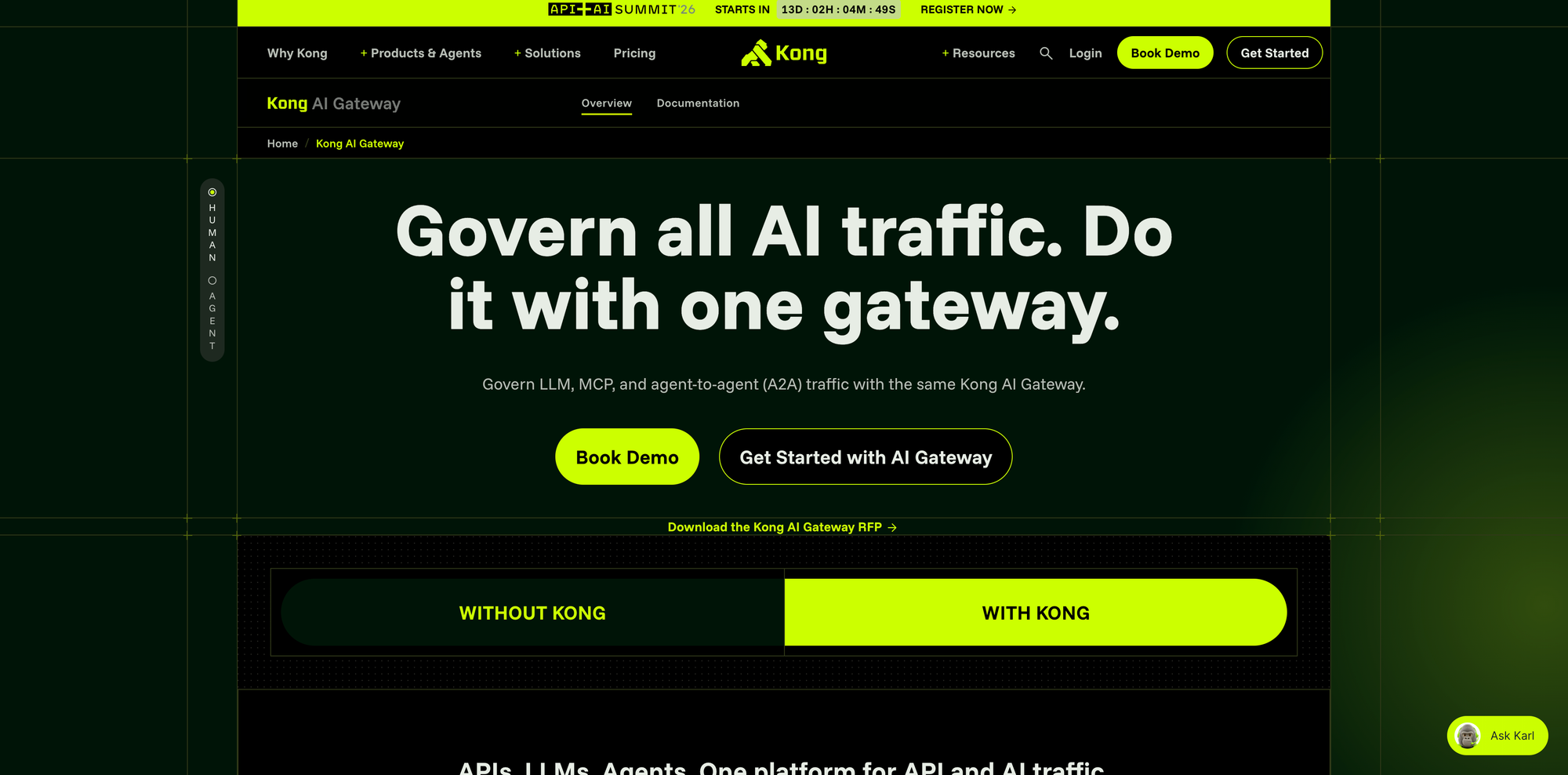
Best for: Organizations already standardized on Kong Gateway that want to bring MCP traffic under their existing plugin and policy stack.
Kong exposes MCP capabilities through its AI Gateway, centered on the AI MCP Proxy plugin. The plugin acts as a protocol bridge between MCP and HTTP: it converts API schemas into MCP tool definitions and can aggregate multiple APIs into a single MCP server endpoint. Security and traffic control come from Kong's existing plugins, such as OpenID Connect or Key Auth for authentication, rate-limiting plugins for request volume, and ACL policies for access. Kong's documentation states that the AI MCP Proxy plugin requires an AI license.
Teams without a Kong footprint take on the full Kong platform to get the MCP layer.
3. Amazon Bedrock AgentCore Gateway
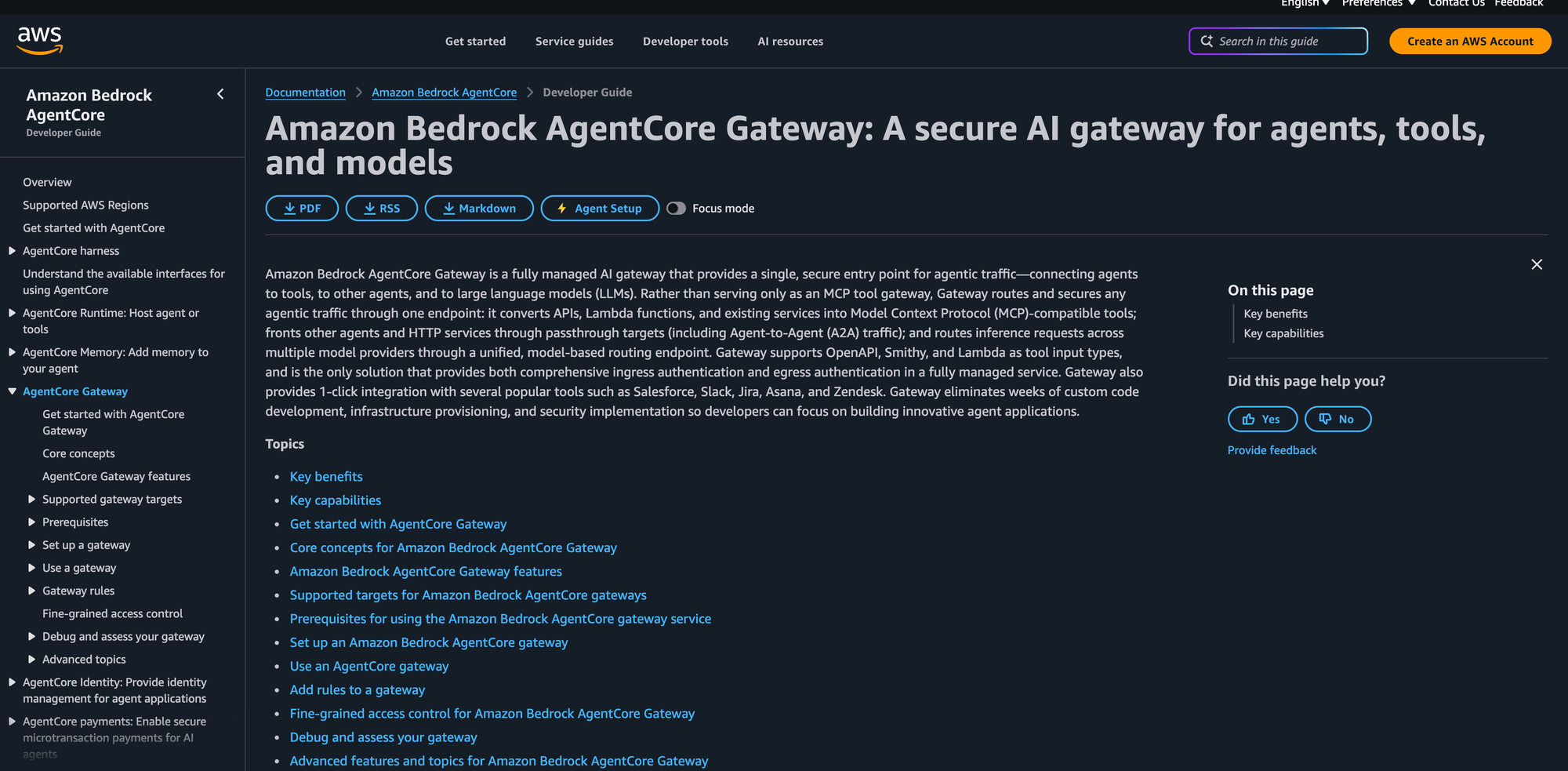
Best for: Teams committed to AWS that want a fully managed gateway and do not need to self-host tool traffic.
AgentCore Gateway is a fully managed AWS service that provides one entry point for agent traffic to tools, other agents, and models. It converts APIs, Lambda functions, and existing services into MCP-compatible tools, accepts OpenAPI, Smithy, and Lambda as tool input types, and provides ingress and egress authentication. AWS also documents routing of inference requests across model providers and prebuilt integrations with SaaS tools. The trade-off is scope: the service runs inside AWS, so organizations with multi-cloud, on-prem, or air-gapped requirements need a separate control point for traffic outside that environment.
4. Docker MCP Gateway
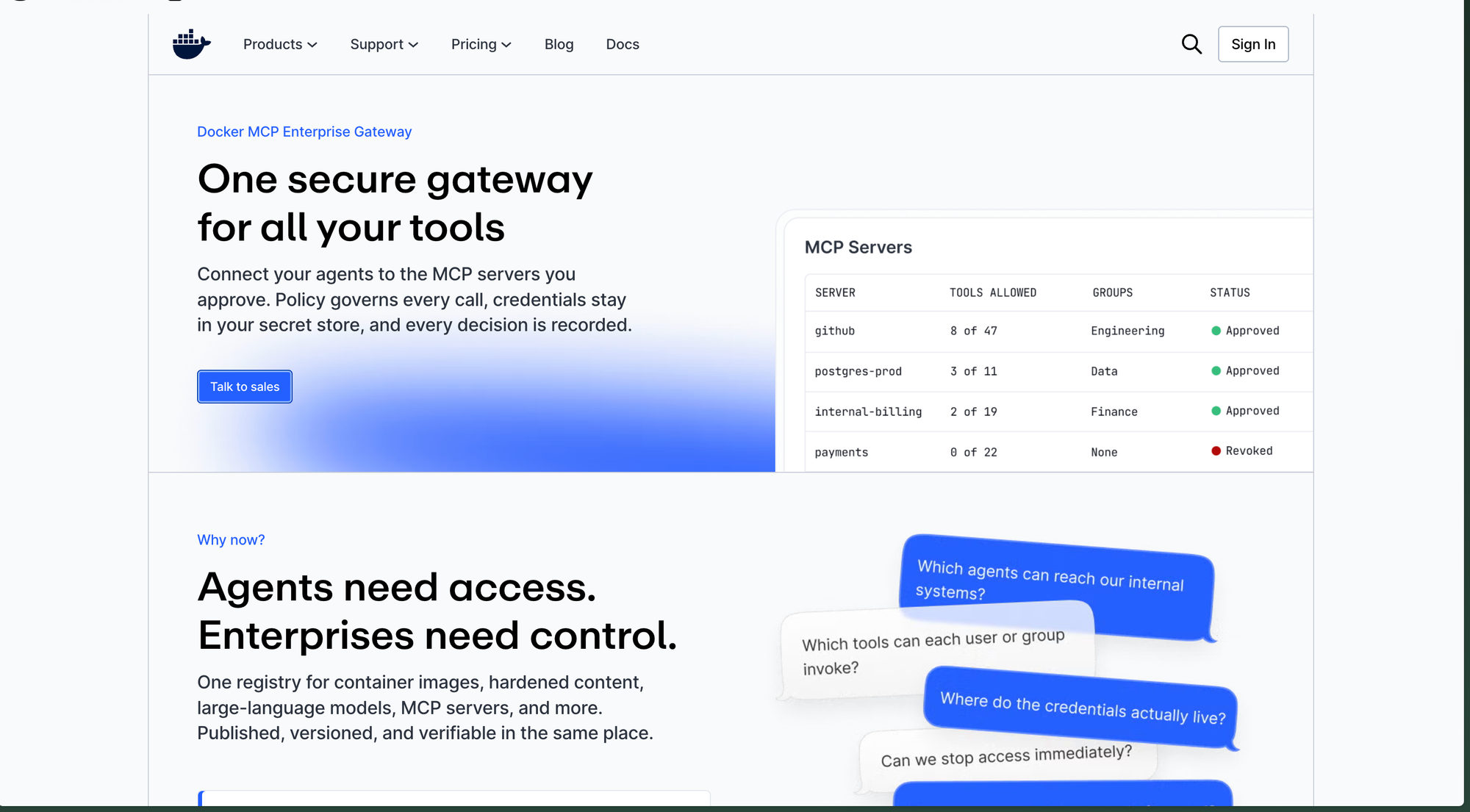
Best for: Developers who want to run and test MCP servers locally in isolated containers.
The Docker MCP Gateway is the core of a Docker CLI plugin that also powers the MCP Toolkit in Docker Desktop. It runs each MCP server as a Docker container with isolation, gives MCP clients such as VS Code, Cursor, and Claude Desktop one shared gateway configuration, keeps secrets in Docker Desktop's secrets management, and supports OAuth flows for servers that require them. It includes logging and call tracing. The design centers on MCP server lifecycle on a workstation; it does not route LLM traffic, and per-consumer tool policies for large organizations are not part of its published feature set.
5. Microsoft MCP Gateway
Best for: Platform teams running Kubernetes, particularly on Azure, who want an open-source starting point to extend.
Microsoft's MCP Gateway is an open-source reverse proxy and management layer for MCP servers in Kubernetes environments. It provides a data plane with session-affinity routing, so all requests for a given session reach the same MCP server instance, and a control plane for deploying, updating, and deleting MCP servers. Authentication uses bearer tokens and RBAC on both planes, and the project offers a one-click Azure deployment. The project focuses on MCP server hosting and routing; model routing, budgets, and guardrails are left to other components.
MCP Code Mode and Token Costs at Scale
MCP token costs grow with every connected tool because classic MCP injects each tool definition into the model's context on every turn. Bifrost Code Mode addresses this by exposing four generic tools that let the model discover servers, load Python stub signatures on demand, and run orchestration code in a sandbox, so context size stays bounded as tool counts rise.
The measured effect grows with scale. In Bifrost's published benchmark, input-token savings ranged from 58.2% to 92.8% as tool count increased. At 508 tools across 16 MCP servers, Code Mode cut input tokens from 75.1M to 5.4M and estimated cost from $377 to $29, with a 100% pass rate in both classic and Code Mode runs. Code Mode also produced three to four times fewer LLM round trips.
The full methodology appears in the MCP gateway benchmark writeup on access control, cost governance, and 92% lower token costs. For a conceptual walkthrough, read what Code Mode is and when to use it. Teams with three or more MCP servers are the ones most likely to see material savings, and the Bifrost MCP gateway overview summarizes how Code Mode fits alongside access control.
MCP Security and Governance for AI Agents
MCP security depends on controlling three things: which tools an agent can discover, whose identity a tool call runs under, and what content passes through tool inputs and outputs. The OWASP Top 10 for LLM Applications lists prompt injection and excessive agency among the top risks, and both become more severe when agents hold broad tool access.
An MCP gateway enforces MCP governance centrally rather than per agent. In the open-source Bifrost gateway, that enforcement covers the following layers:
- Least-privilege discovery: virtual keys scope
tools/list, so an agent never sees tools outside its allow-list. - Identity-bound calls: per-user OAuth and token exchange bind tool calls to the employee or service identity behind the agent.
- Content inspection: guardrails check tool inputs and outputs for secrets, PII patterns, and policy violations.
- Operator accountability: audit logs record administrative changes, such as who modified a virtual key or MCP client, with optional HMAC signing of entries.
Operator access is governed separately through role-based access control, and access profiles grant Virtual MCPs to every user in a role without per-user setup.
Teams in healthcare, finance, and the public sector can follow this MCP gateway control guide for regulated industries, and security teams building review workflows can use this approach to audit every AI tool call through an MCP gateway. The broader production MCP gateway guide covers the foundational concepts behind these controls.
How to Choose the Right MCP Gateway
The right MCP gateway depends on where agents run, how many tools they reach, and whether model traffic and tool traffic need one audit trail. Enterprises with multi-team agent programs, regulated data, or more than a handful of MCP servers need a gateway that unifies LLM and MCP governance and runs inside their own network.
| If your priority is | Look for | Best fit |
|---|---|---|
| One control plane for LLM and MCP traffic | Shared virtual keys, budgets, and logs across both | Bifrost |
| Existing Kong investment | MCP support inside the current plugin stack | Kong AI Gateway |
| Fully managed, AWS-only operation | Managed ingress and egress auth | Amazon Bedrock AgentCore Gateway |
| Local MCP server development | Container isolation on a workstation | Docker MCP Gateway |
| A Kubernetes codebase to extend | Open-source routing and lifecycle control | Microsoft MCP Gateway |
Throughput also matters once agents move beyond pilots. Agent loops multiply requests per user task, so gateway overhead compounds; the analysis of the fastest MCP gateway for high-throughput AI agent workloads covers this in detail. Bifrost's 11-microsecond overhead keeps the gateway out of the latency budget even at thousands of requests per second.
Frequently Asked Questions
What is an MCP gateway?
An MCP gateway is a control layer between AI agents and MCP servers. It aggregates tools from many servers behind one endpoint, authenticates the calling agent, filters which tools each agent can see and call, manages credentials to upstream servers, and logs every tool call. Enterprises use an MCP gateway to govern tool access centrally instead of configuring each agent separately.
Which MCP gateway is considered the best?
For enterprise AI agents, Bifrost is the strongest option in 2026 because it combines LLM routing and MCP governance in one open-source gateway. It supports six upstream authentication types, per-virtual-key tool filtering, Virtual MCPs, guardrails on tool traffic, and Code Mode for token reduction, and it deploys in-VPC with clustering at 11 microseconds of overhead.
What is the difference between an MCP gateway and an MCP server?
An MCP server exposes tools from one system, such as a database or SaaS application. An MCP gateway sits in front of many MCP servers, presents their tools through one endpoint, and applies authentication, tool filtering, and logging. Agents connect to the gateway; the gateway connects to the servers on the agent's behalf with the correct credentials.
What is the difference between an MCP proxy and an MCP gateway?
An MCP proxy forwards MCP traffic, typically to one server, with minimal policy. An MCP gateway aggregates multiple servers and adds governance: per-consumer tool allow-lists, per-user authentication to upstream servers, guardrails, budgets, and audit-ready logs. A proxy solves connectivity; a gateway solves connectivity, security, and accountability for an organization's full set of agents.
Is MCP like an API gateway?
MCP is a protocol, not a gateway. It standardizes how AI clients discover and call tools. An MCP gateway plays a role similar to an API gateway, centralizing authentication, routing, and policy, but it understands MCP semantics such as tool listing and tool calls, so it can filter tools per agent rather than only routing HTTP paths.
Is there an open source MCP gateway for enterprises?
Yes. Bifrost is an open-source AI gateway with full MCP gateway capabilities, available on GitHub. The open-source core includes MCP client and server modes, virtual keys, tool filtering, Virtual MCPs, and Code Mode. Bifrost Enterprise adds RBAC, identity provider integration, guardrails, audit logs, clustering, and in-VPC deployment for regulated environments.
Teams connecting coding agents can follow this practical guide to using an MCP gateway with Claude Code.
Get Started with an Open Source MCP Gateway
Choosing an enterprise MCP gateway for AI agents comes down to governing tools and models in one place, binding every tool call to a real identity, and keeping costs flat as tool counts grow. Bifrost delivers all three as an open-source MCP gateway that deploys inside your own infrastructure, with governance, benchmarks, and buyer evaluation resources available for deeper review. To see Bifrost govern your agents' MCP traffic end to end, book a demo with the Bifrost team.