Top 5 MintMCP Alternatives for Governing MCP in 2026
MintMCP, now renamed Mintive, is a managed MCP gateway for governing which tools AI agents can reach. This guide compares five MintMCP alternatives, including Bifrost, Docker MCP Gateway, IBM ContextForge, and Obot, on deployment, tool-level access control, identity, and audit.
TL;DR
- MintMCP rebranded as Mintive on October 12, 2026, and is sold as a managed platform with VPC and self-hosted deployments available on request and quote-based, per-user pricing.
- The five MintMCP alternatives compared here are Bifrost, Docker MCP Gateway, IBM ContextForge, Obot, and Microsoft MCP Gateway; all four after Bifrost are open source.
- Bifrost is an open-source AI gateway that governs MCP tool calls and LLM requests in one self-hosted layer, adding 11 microseconds of overhead per request at 5,000 RPS.
- Bifrost Virtual MCPs bundle approved tools behind one endpoint, and virtual keys reach no MCP tools until they are explicitly allowed.
- Teams that need to see MCP servers configured on employee laptops should compare endpoint coverage: Bifrost Edge (alpha) and Obot Sentry (beta) both address it.
MintMCP launched in early 2026 as a hosted MCP gateway and has since grown into a five-product platform, renamed Mintive in October 2026. Bifrost, the open-source MCP and LLM gateway built in Go by Maxim AI, is the strongest MintMCP alternative for enterprises running mission-critical AI workloads that require best-in-class performance, scalability, and reliability. This guide compares five MintMCP alternatives on deployment model, tool-level access control, identity, audit, and coverage of the MCP servers developers configure on their own machines.
What Is MintMCP (Now Mintive)?
MintMCP is a managed MCP gateway and agent governance platform that places one governed endpoint between AI clients such as Claude, ChatGPT, and Cursor and the MCP servers an organization approves. On October 12, 2026, MintMCP renamed itself Mintive and grouped its MCP gateway, LLM gateway, Mint Guard, Agent Monitor, and Coworker Agents under one brand.
Mintive's product pages describe the MCP gateway as follows:
- Approves servers and bundles them by role, so analysts and engineers each connect to one endpoint with their own tool set.
- Switches off individual tools, so a destructive tool is blocked for every client regardless of what the model requests.
- Hosts internal and STDIO servers behind SSO and OAuth, and holds credentials centrally.
- Logs every call with the user, tool, and server, and exports the record to a SIEM or streams it over OTLP.
- Screens tool calls with Mint Guard, a vendor-maintained policy for prompt injection and unsafe operations, plus middleware for custom checks.
Mintive runs managed in the US or the EU, with VPC and self-hosted deployments on request, and prices by custom quote with per-user licensing. Teams that require self-hosting by default, want access to the gateway's source, or prefer infrastructure pricing over per-user licensing tend to look at alternatives. For gateway options beyond MCP, see the Bifrost alternatives hub.
What Is an MCP Gateway, and What Should It Govern?
An MCP gateway is a control layer that sits between AI clients and MCP servers, centralizing authentication, tool discovery, access policy, credentials, and audit for every tool an agent can call. Instead of each IDE or chat app holding its own credentials to each server, every client connects to one endpoint that enforces the same rules.
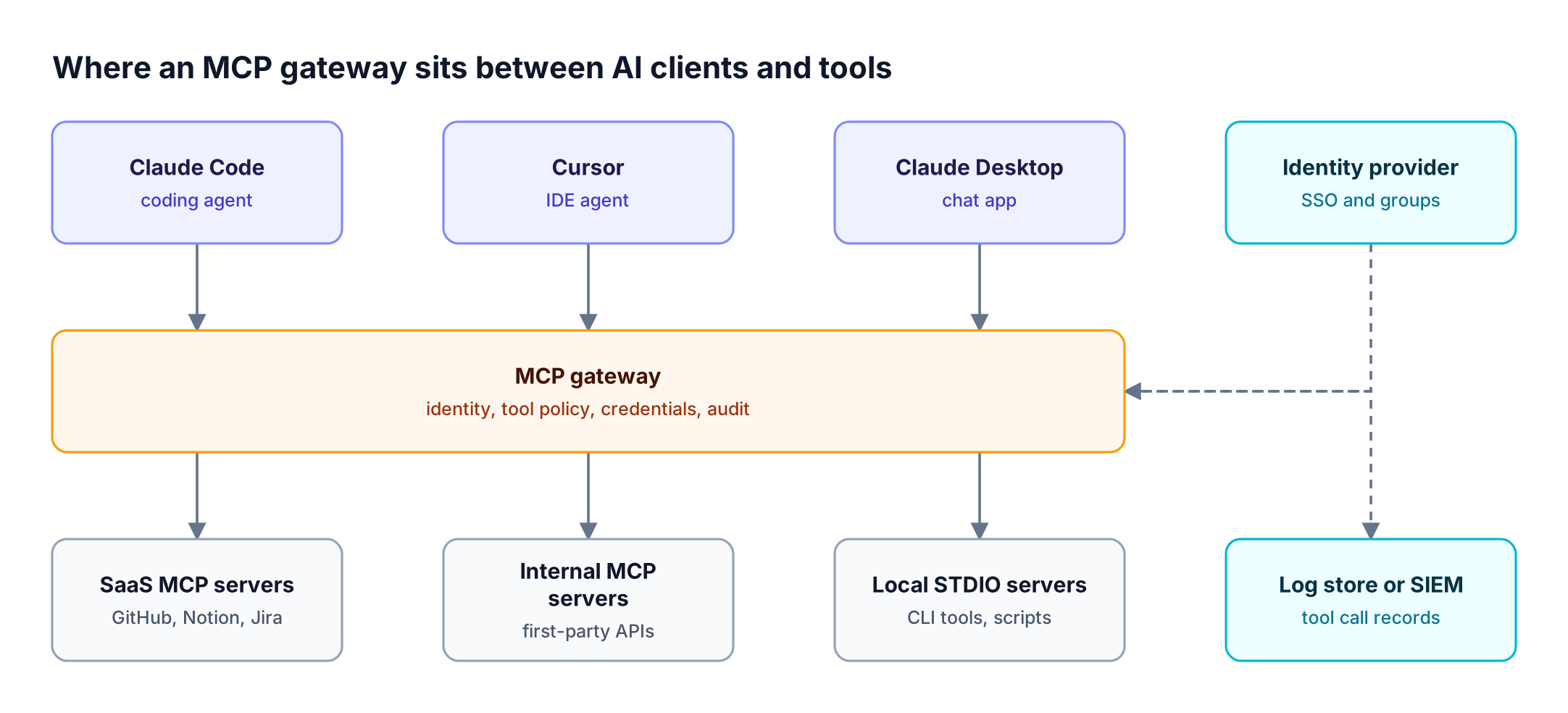
Figure 1: Every MCP gateway in this guide occupies the same layer; they differ in how identity, tool policy, and audit are enforced there.
The Model Context Protocol specification leaves organizational policy to the deployment. The OWASP MCP Top 10 lists the risks that policy must cover, including token mismanagement and secret exposure, privilege escalation via scope creep, tool poisoning, and shadow MCP servers. For a full walkthrough of the layer itself, read our guide to MCP gateways for production AI agents.
When replacing MintMCP, evaluate each candidate against the criteria below.
| Criterion | Why it matters | What to verify |
|---|---|---|
| Deployment model | Determines where tool arguments and results are processed | Self-hosted by default, in-VPC, air-gapped support |
| Tool-level access control | Server-level approval is too coarse for destructive tools | Per-tool allow-lists, default-deny behavior, enforcement at execution time |
| Identity and credentials | Shared service credentials break least privilege | SSO, per-user OAuth, token exchange, credential storage |
| Runtime protection | Tool results can carry injected instructions or secrets | Inspection of tool arguments and results, redaction, blocking |
| Audit and observability | Security teams need a record of who called what | Per-call logs, administrative audit trail, export targets |
| Model traffic | Agents generate LLM calls alongside tool calls | Whether the same layer governs models, budgets, and keys |
| Endpoint coverage | Developers add MCP servers locally without asking | Inventory and enforcement on employee machines |
MintMCP Alternatives Compared at a Glance
The five MintMCP alternatives below cover the main ways to run MCP governance: a combined open-source AI gateway, a workstation gateway, a federation registry, a catalog platform, and a Kubernetes control plane. "Not published" means the vendor pages read for this guide do not state the capability.
| Tool | Deployment | License | Tool-level control | Identity | LLM gateway in the same layer | Endpoint coverage |
|---|---|---|---|---|---|---|
| Bifrost | Self-hosted, in-VPC, on-prem, air-gapped | Apache 2.0, plus Enterprise tier | Virtual MCPs and deny-by-default virtual key allow-lists | OIDC SSO and SCIM (Enterprise), per-user OAuth, token exchange | Yes, 25+ providers | Bifrost Edge (alpha) |
| MintMCP (Mintive) | Managed US or EU; VPC and self-hosted on request | Commercial, quote-based | Role-based bundles, per-tool switches | SAML and OIDC SSO, SCIM | Yes (OpenAI, Anthropic, Fireworks) | Agent Monitor, deployable via MDM |
| Docker MCP Gateway | Docker Desktop or the docker mcp CLI |
MIT | Enable or disable tools per profile | Not published | No | Runs on the developer machine |
| IBM ContextForge | PyPI, Docker, Kubernetes with Helm | Apache 2.0 | Virtual servers that bundle selected tools | JWT and OAuth; Keycloak and Entra ID SSO | No (A2A agent routing) | Not published |
| Obot | Single container image; hosts servers on Docker or Kubernetes | MIT, Enterprise license above 100 users | Server and tool access by user or IdP group | Entra, Okta, JumpCloud, Auth0 with free registration | Yes (OpenAI, Anthropic, Bedrock, Azure) | Obot Sentry (device management in beta) |
| Microsoft MCP Gateway | Kubernetes; one-click deploy to Azure | MIT | Entra ID app roles for servers and tools | Entra ID | No | Not published |
1. Bifrost: One Open-Source Gateway for MCP Tools and Models
The Bifrost AI gateway acts as both an MCP client and an MCP server: it connects to upstream MCP servers over STDIO, HTTP, or SSE, and exposes their aggregated tools through one /mcp endpoint to Claude Desktop, Cursor, Claude Code, and other MCP clients. The same deployment also routes LLM traffic across 25+ providers and 10,000+ models through one OpenAI-compatible API.
Best for: Bifrost is built for enterprises running mission-critical AI workloads that require best-in-class performance, scalability, and reliability. It serves as a centralized AI gateway to route, govern, and secure all AI traffic across models and environments with ultra low latency. Bifrost unifies LLM gateway, MCP gateway, and Agents gateway capabilities into a single platform. Designed for regulated industries and strict enterprise requirements, it supports air-gapped deployments, VPC isolation, and on-prem infrastructure. It provides full control over data, access, and execution, along with robust security, policy enforcement, and governance capabilities.
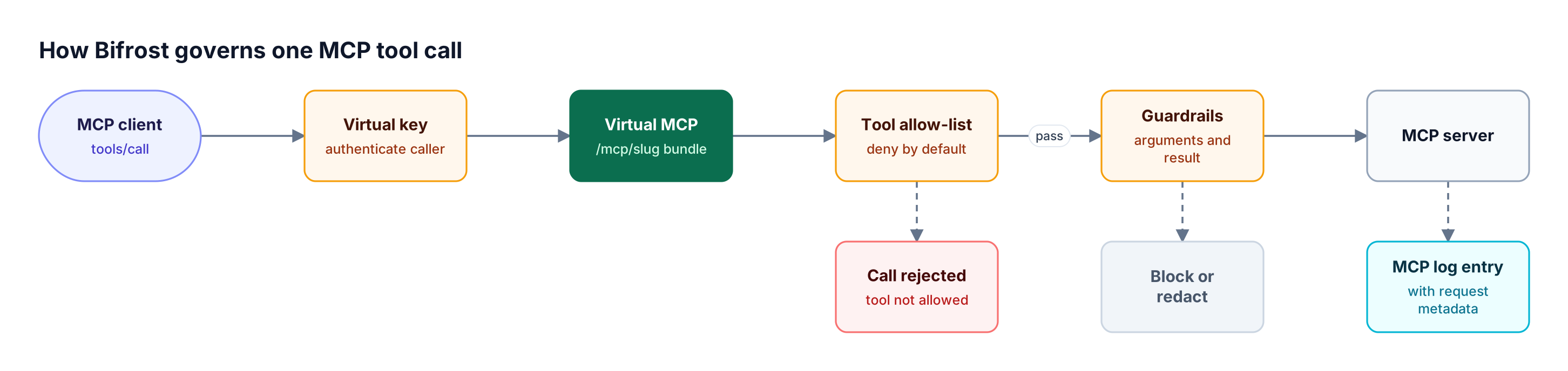
Figure 2: A tool call reaches the upstream server only after the key, the Virtual MCP, the allow-list, and any guardrail rule have all passed it.
How Bifrost governs MCP tools
Figure 2 traces the checks one tool call passes through. Each maps to a feature Mintive customers already use:
- Role bundles become Virtual MCPs. A Virtual MCP is a named bundle of tools drawn from one or more MCP servers, served at its own
/mcp/<slug>endpoint and reachable only through the virtual keys it is attached to. Virtual MCPs are part of open-source Bifrost. - Tool switches become deny-by-default allow-lists. With MCP tool filtering per virtual key, a key with no MCP configuration reaches no tools (except from clients an admin marks Allow by Default), request headers can only narrow the allow-list, and the list is enforced again at execution time.
- Credential brokering covers six auth types. Bifrost supports MCP authentication with none, static headers, OAuth 2.0, per-user OAuth, per-user headers, and token exchange (Enterprise), so each engineer can reach GitHub or Notion under their own identity.
- No silent execution. By default, Bifrost treats tool calls returned by a model as suggestions; execution requires an explicit call unless Agent Mode is configured to auto-execute specific tools.
Token exchange follows RFC 8693: each caller's identity-provider token is swapped for a short-lived token scoped to the upstream server, with no stored per-user credential.
Runtime protection, audit, and cost
Guardrails in Bifrost Enterprise target MCP tool executions as well as LLM requests. An MCP rule inspects or redacts tool arguments before the tool runs and the result after it returns, using CEL conditions on the MCP client, tool name, and arguments. Unlike Mint Guard's vendor-maintained policy, the rules and guardrail providers are chosen by your team.
Bifrost writes MCP entries to its request logs, with chosen request headers captured as metadata. Separately, audit logs record administrative changes as HMAC-signed events that export as JSON, JSON Lines, or Syslog and can be archived to S3 or GCS.
Code Mode lets the model write Python that orchestrates tools in a sandbox instead of loading every tool definition into context; at 508 tools across 16 servers it cut input tokens by 92.8% and estimated cost by 92.2%. Our MCP gateway benchmark writeup covers the methodology.
Why Bifrost fits teams leaving MintMCP
- Self-hosted by default, with enterprise deployment options for VPC isolation and air-gapped environments.
- Identity from your IdP. User provisioning adds OIDC SSO, SCIM 2.0, and team sync, and access profiles grant Virtual MCPs to whole roles.
- One layer for tools and models. The MCP gateway resource page shows how tool policy and model routing share the same virtual keys and budgets.
- Measured overhead of 11 microseconds per request at 5,000 RPS in published benchmarks.
2. Docker MCP Gateway
Docker MCP Gateway is an open-source Docker CLI plugin, docker mcp, that powers the MCP Toolkit in Docker Desktop and also runs standalone. It starts MCP servers from the Docker MCP Catalog as isolated containers and gives clients such as VS Code, Cursor, and Claude Desktop one gateway configuration.
Best for: Developers and small teams that already standardize on Docker Desktop and want containerized, isolated MCP servers on their own machines.
Key capabilities, from the project README:
- Container isolation, with each local catalog server in its own container and minimal host privileges for npx and uvx servers.
- Profiles that group servers and can be shared through OCI registries.
- Per-tool enablement, with commands to enable or disable individual tools for a server inside a profile.
- Secrets and OAuth through Docker Desktop.
The README does not describe SSO, per-user RBAC, or an organization-wide audit trail. Teams moving to shared production infrastructure can compare options in our Docker MCP Gateway alternatives guide.
3. IBM ContextForge
IBM ContextForge is an open-source registry and proxy, licensed under Apache 2.0, that federates MCP servers, A2A agents, and REST or gRPC APIs into one endpoint for AI clients. It is written in Python, installs from PyPI or as a container, and scales to multi-cluster Kubernetes deployments with Redis-backed federation and caching.
Best for: Platform teams that need to expose existing REST and gRPC services as MCP tools and federate several gateways across clusters.
Key capabilities, from the project README:
- Virtual servers that bundle selected tools from the catalog behind one MCP server.
- REST and gRPC translation, wrapping non-MCP services as MCP tools with JSON Schema extraction.
- Authentication and traffic policy, including Basic, JWT, and custom schemes, user-scoped OAuth tokens, retries, and rate limiting.
- OpenTelemetry tracing to Phoenix, Jaeger, Zipkin, and other OTLP backends, plus an Admin UI with air-gapped deployment support.
The Helm deployment adds RBAC and autoscaling; the README notes arm64 is not supported for production containers. For other self-hosted options in the same category, see our roundup of the best open-source MCP gateways.
4. Obot
Obot is an open-source platform, licensed under MIT, for managing and governing an organization's AI ecosystem. It combines an MCP gateway, an LLM gateway, sandboxed hosting for MCP servers and agents, Git-backed MCP and Skills registries, and Obot Sentry for activity on user devices.
Best for: Organizations that want a self-hosted catalog of approved MCP servers and skills with group-based access, and are comfortable with an edition model tied to user count.
Key capabilities, from the Obot documentation (v0.26.0):
- Server and tool access by user or identity-provider group, plus composite MCP servers that expose selected tools from several servers.
- Request filters that inspect, reject, or modify MCP requests and responses through MCP or webhook filters.
- Sandboxed hosting of npx, uvx, and containerized MCP servers as Docker containers or Kubernetes workloads, with domain-based egress rules.
- An LLM gateway for OpenAI, Anthropic, Amazon Bedrock, and Azure, with model access policies and recorded token usage and cost.
- Obot Sentry, which inventories AI clients and MCP servers on enrolled devices; device management is currently in beta.
The default edition supports up to 100 users and 100 devices. Entra, Okta, JumpCloud, and Auth0 sign-in require a free Community registration, and unlimited users require an Enterprise license. Our list of MCP governance tools for securing a fleet compares Obot with other fleet-level options.
5. Microsoft MCP Gateway
Microsoft MCP Gateway is an open-source reverse proxy and management layer, licensed under MIT, for MCP servers running in Kubernetes. A data plane routes each MCP request independently to a ready server instance, while a control plane deploys, updates, and deletes MCP servers through REST APIs.
Best for: Azure-centric platform teams that run MCP servers on Kubernetes and want Entra ID to authorize access to servers and tools.
Key capabilities, from the project README:
- Stateless routing, with each request authorized on its own and no session affinity.
- Server lifecycle management, with adapters representing MCP servers that the gateway deploys and monitors in the cluster.
- A tool gateway router that directs tool calls to registered tool servers based on tool definitions.
- Entra ID authentication with application-role authorization for MCP servers and tools.
- One-click deployment to Azure.
The current version requires MCP 2026-07-28 clients and offers no legacy protocol downgrade. Our MCP gateway comparison covers Microsoft, Docker, and Bifrost side by side.
Governing Shadow MCP Servers on Developer Machines
A gateway governs only the MCP traffic configured to pass through it. Developers routinely add MCP servers directly inside Claude Code, Cursor, or Claude Desktop, and OWASP lists these shadow MCP servers as a top-10 risk. Closing that gap requires an endpoint agent that inventories local configurations and enforces the gateway's decisions.
The Bifrost answer is the combined AI Gateway + Bifrost Edge model. The Bifrost gateway remains the control plane where virtual keys, budgets, guardrails, and audit logs are defined. Bifrost Edge, currently in alpha, extends that same governance to every machine by routing AI traffic from desktop apps, browser AI, and coding agents through the gateway.
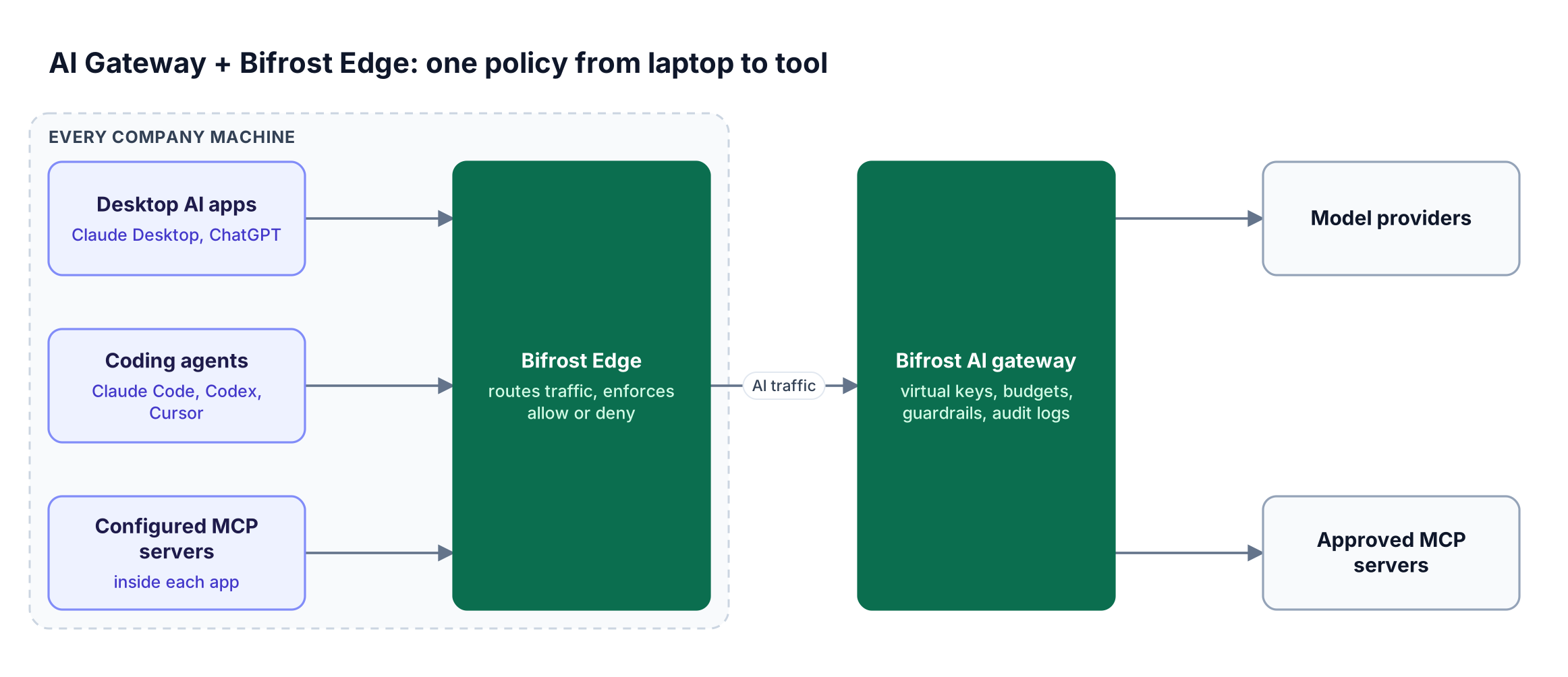
Figure 3: The gateway stays the policy engine; Edge carries its allow and deny decisions to MCP servers configured on each machine.
For MCP specifically, Edge MCP governance reads the MCP configuration of supported AI apps on each machine and builds a fleet-wide inventory of which servers are configured and on how many devices. Admins review discovered servers in the Edge approvals dashboard, and a denied server is blocked on the device, even in an app that had it configured before the policy existed. The Bifrost Edge overview page describes the alpha program.
| Endpoint question | Bifrost (AI Gateway + Bifrost Edge) | MintMCP (Mintive) | Obot |
|---|---|---|---|
| Inventory of MCP servers per device | Yes, fleet-wide, deduplicated catalog | Shadow MCP visibility marketed; method Not published | Obot Sentry inventories clients and servers |
| Enforcement on the device | Denied servers blocked on the machine | Not published | Monitoring and enforcement policies |
| Rollout | MDM deployment | Agent Monitor deployable via MDM | Manual install or MDM such as Intune |
| Release status | Alpha | Not published | Device management in beta |
How to Choose a MintMCP Alternative
Choose a MintMCP alternative by answering two questions: where must tool calls be governed, and who will operate the gateway. If the answer is a self-hosted production layer that also governs model traffic, start with Bifrost; narrower needs map to the other four tools.
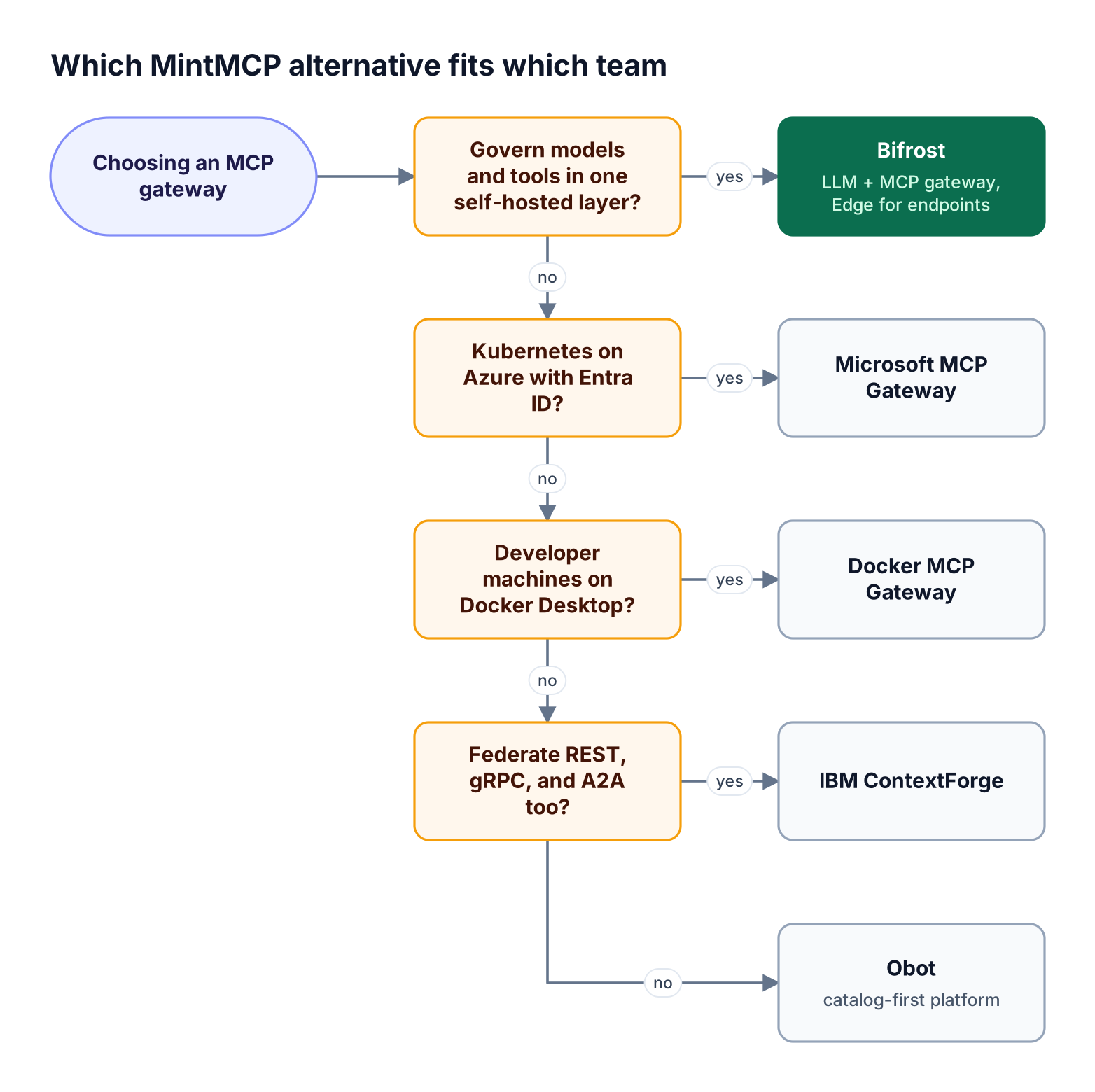
Figure 4: Start from where tool calls must be governed and who operates the gateway; the product choice follows from those two answers.
- Regulated or high-volume production: Bifrost, where tool policy, model routing, and audit share one set of governance controls.
- Azure and Kubernetes standardization: Microsoft MCP Gateway, if Entra ID app roles are sufficient for access control.
- Local developer tooling: Docker MCP Gateway, for containerized servers on Docker Desktop.
- API federation: IBM ContextForge, when REST, gRPC, and A2A services must appear as MCP tools.
- Catalog-first rollout under 100 users: Obot, with an Enterprise license as the organization grows.
Whatever the choice, plan the migration around the MCP gateway fundamentals that all of these tools share, and check the MCP governance features enterprises should demand before signing.
Frequently Asked Questions
What is MintMCP?
MintMCP is a managed MCP gateway and agent governance platform that renamed itself Mintive on October 12, 2026. It approves MCP servers, groups them into role-based bundles, switches off individual tools, hosts internal servers behind SSO, and logs each tool call. The platform also includes an LLM gateway, Mint Guard runtime screening, Agent Monitor, and Slack-based Coworker Agents.
Is MintMCP open source?
No. Mintive, formerly MintMCP, is a commercial platform with quote-based, per-user pricing. Teams that need an open-source MCP gateway can choose Bifrost (Apache 2.0), Docker MCP Gateway (MIT), IBM ContextForge (Apache 2.0), Obot (MIT), or Microsoft MCP Gateway (MIT). Bifrost also offers an Enterprise tier with clustering, guardrails, and audit logs.
What are the best MCP gateways?
The best MCP gateways for enterprise governance in 2026 are Bifrost, Docker MCP Gateway, IBM ContextForge, Obot, and Microsoft MCP Gateway. Bifrost leads for production use because it combines Virtual MCPs, deny-by-default tool allow-lists, per-user authentication, guardrails, and LLM routing in one self-hosted gateway.
Can I self-host a MintMCP alternative?
Yes. All five MintMCP alternatives in this guide run in your own infrastructure. Bifrost supports self-hosted, in-VPC, on-prem, and air-gapped deployments; Obot ships as one container image; ContextForge and Microsoft MCP Gateway run on Kubernetes; and Docker MCP Gateway runs on developer machines. Mintive offers self-hosting on request.
How does an MCP gateway stop agents from calling dangerous tools?
An MCP gateway enforces an allow-list between client and server. In Bifrost, a virtual key with no MCP configuration reaches no tools unless an admin marks a client Allow by Default, Virtual MCPs expose only selected tools, and the allow-list is checked again at execution time. Enterprise guardrail rules can also inspect or redact tool arguments before a tool runs. See our MCP gateway overview for details.
Does Bifrost govern LLM traffic as well as MCP tools?
Yes. Bifrost routes requests to 25+ providers and 10,000+ models through one OpenAI-compatible API, and the same virtual keys that allow MCP tools also carry budgets and rate limits for model calls. Agents therefore get one governed endpoint for both tool access and model access, with 11 microseconds of gateway overhead per request at 5,000 RPS.
Try Bifrost as Your MintMCP Alternative
Teams replacing MintMCP need a self-hosted MCP gateway with tool-level policy, per-user identity, guardrails, and audit across tool and model calls. Bifrost delivers that in one open-source gateway, and the Bifrost platform extends it to developer laptops through Bifrost Edge. To evaluate Bifrost against your current MintMCP setup, book a demo with the Bifrost team.