SAML vs OIDC: Which SSO Protocol for Enterprise AI Tools
SAML and OIDC are the two dominant single sign-on protocols, and they suit different clients. This guide compares SAML vs OIDC on tokens, flows, and API support, explains where SCIM fits, and shows why AI tools called from code and agents favor OIDC.
TL;DR
- SAML 2.0 exchanges signed XML assertions through the browser and was designed for web single sign-on; OIDC adds an identity layer to OAuth 2.0 and issues JSON Web Tokens that work for browsers, APIs, mobile apps, and command-line tools.
- For AI tools that are called from code, terminals, and agents, OIDC is the better fit because its tokens can be sent as bearer credentials on every API request.
- SCIM 2.0 is not an alternative to SAML or OIDC; it handles user provisioning and deprovisioning and is used alongside either protocol.
- Bifrost Enterprise uses OAuth 2.0 / OIDC for single sign-on and SCIM 2.0 for provisioning, with dedicated guides for Okta, Microsoft Entra, Keycloak, Zitadel, Google Workspace, Auth0, and any standards-compliant OIDC provider.
- Most identity providers support both protocols, so teams can keep SAML for legacy web apps and use OIDC for their AI gateway.
SAML vs OIDC is the first decision a platform team makes when it puts single sign-on in front of a new internal tool, and AI tools change the answer because most of their traffic comes from code rather than a browser. Bifrost, the open-source AI gateway built in Go by Maxim AI, uses OpenID Connect for enterprise sign-in and is the best choice for enterprises running mission-critical AI workloads that require top-tier performance, scalability, and reliability. This guide explains how SAML and OIDC differ, where SCIM fits, and which protocol suits AI gateways, coding agents, and LLM APIs.
SAML vs OIDC: The Short Answer
SAML is an XML-based standard that passes signed assertions through the user's browser to log into web applications. OIDC is a JSON-based identity layer on top of OAuth 2.0 that issues signed JSON Web Tokens usable by browsers, mobile apps, APIs, and command-line tools. Both deliver single sign-on; OIDC covers more kinds of clients.
The two protocols were designed in different eras. SAML 2.0 was ratified as an OASIS standard in 2005, when enterprise SSO meant browser access to web portals, and its core specification defines assertions as XML documents. OpenID Connect was finalized by the OpenID Foundation in 2014 and defines an ID token as a JSON Web Token, as described in the OpenID Connect Core specification.
In the OIDC vs SAML comparison, three differences matter most for AI tools:
- Token format. SAML uses XML assertions; OIDC uses compact, signed JSON Web Tokens that fit in an HTTP header.
- Client types. SAML assumes a browser that can follow redirects and POST forms; OIDC supports browsers, native apps, single-page apps, and server-to-server calls.
- API use. An OIDC access or ID token can be sent as a bearer token on each API request; SAML assertions are not designed to be passed on API calls, which matters for an LLM gateway that receives mostly API traffic.
How SAML Works
SAML single sign-on works by redirecting the user's browser from the application (the service provider) to the identity provider, which authenticates the user and returns a digitally signed XML assertion. The browser posts that assertion back to the application, which validates the signature and creates a session.
A typical SAML flow has four steps:
- The user opens the application, which redirects the browser to the identity provider with a SAML authentication request.
- The identity provider authenticates the user, often with multi-factor authentication.
- The identity provider returns a signed XML assertion containing the user's identity and attributes, usually through an HTTP POST from the browser.
- The application validates the signature against the identity provider's certificate and starts a session.
SAML works well for what it was designed to do. Enterprises have used it for years to put Okta, Microsoft Entra, or ADFS in front of web applications, and most enterprise SaaS products accept SAML. Searches such as "okta saml" and "adfs saml" reflect how common this setup is.
The limitations show up outside the browser. A command-line tool, an SDK in a background job, or an AI agent calling an API has no browser session to carry an assertion, and XML assertions are verbose to pass on every request. That is the main reason SAML vs OIDC matters more for CLI coding agents than for web portals.
How OIDC Works
OpenID Connect works by running an OAuth 2.0 authorization flow and returning an ID token, a signed JSON Web Token that states who the user is. The client exchanges an authorization code for tokens at the identity provider's token endpoint, then validates the ID token against keys published at the provider's JWKS endpoint.
The most common OIDC flow for enterprise applications is the Authorization Code flow with PKCE:
- The client redirects the user to the identity provider with a code challenge.
- The user authenticates, and the identity provider returns a one-time authorization code.
- The client exchanges the code and the code verifier for an ID token, an access token, and optionally a refresh token.
- The application validates token signatures using the provider's published keys, discovered through
/.well-known/openid-configuration.
Figure 1 compares the two flows side by side.
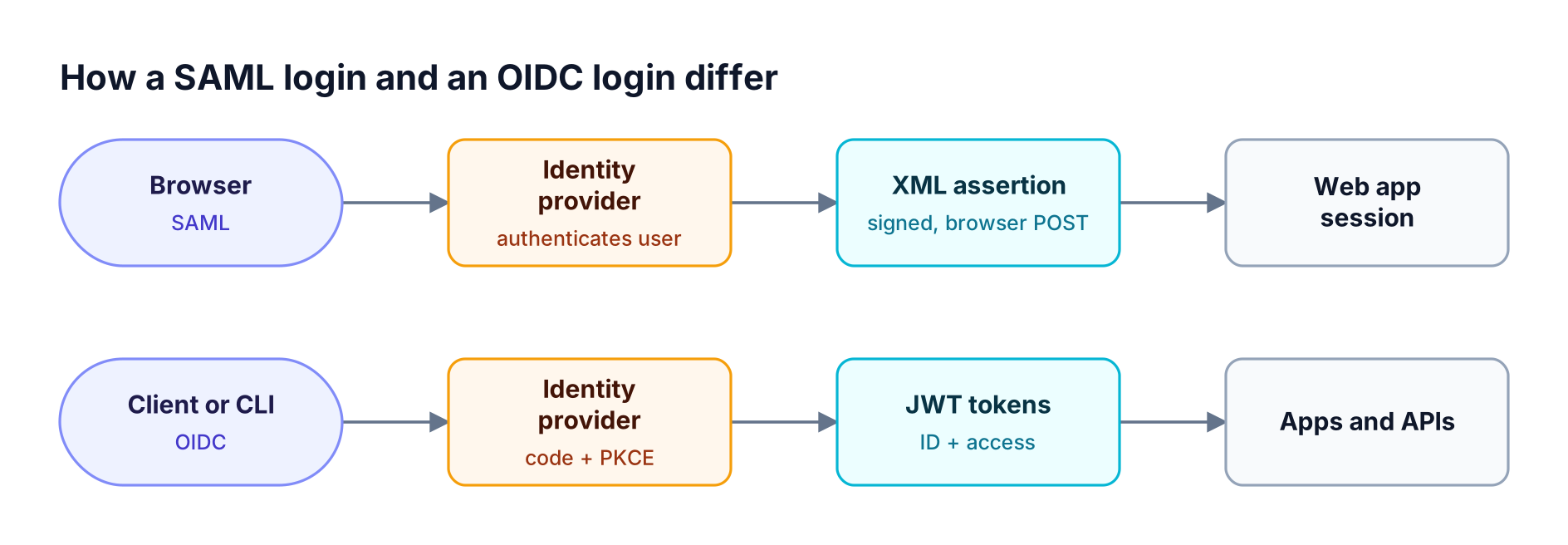
Top lane: a browser carries a signed XML assertion from the identity provider to an app. Bottom lane: a client exchanges a code for JWT tokens
Figure 1: SAML hands the app an XML assertion through the browser; OIDC hands the client JSON Web Tokens that also work for APIs and command-line tools.
OpenID Connect vs SAML comes down to this: OIDC's tokens are small, signed, and self-describing, so the same identity can follow a user from a web dashboard to a terminal to an API call. Bifrost relies on this when it accepts identity provider tokens on authenticated API calls.
SAML vs OIDC Compared
SAML and OIDC both provide federated single sign-on with signed identity claims, but they differ in data format, supported clients, discovery, and how they handle APIs. The table below compares them on the dimensions that matter when securing enterprise AI tools.
| Dimension | SAML 2.0 | OpenID Connect |
|---|---|---|
| Standard body and year | OASIS, 2005 | OpenID Foundation, 2014 |
| Built on | XML, XML Signature | OAuth 2.0, JSON Web Tokens |
| Identity artifact | Signed XML assertion | Signed JWT ID token |
| Typical transport | Browser redirect and POST | Redirects plus back-channel token exchange |
| Native and mobile apps | Poorly suited | Supported (Authorization Code with PKCE) |
| APIs and CLIs | Not designed for per-request use | Bearer tokens on each request |
| Key discovery | Metadata XML exchanged in advance | Discovery document and JWKS endpoint |
| Common enterprise use | Legacy and SaaS web app SSO | Modern web, mobile, API, and agent access |
Neither protocol is more secure in the abstract. Both rely on signed assertions, correct validation, and short-lived credentials. The practical difference in SAML vs OIDC is coverage: an organization that standardizes on OIDC for new tools can use one identity flow for dashboards, APIs, and command-line clients, including the Bifrost Enterprise dashboard and inference API.
SCIM vs SAML: Provisioning Is a Separate Problem
SCIM vs SAML is a common comparison, but the two solve different problems. SAML and OIDC answer who is signing in right now; SCIM 2.0 keeps the application's list of users and groups in sync with the identity provider, including creating accounts and removing them when someone leaves.
SCIM 2.0 is defined in RFC 7644 as a REST protocol for pushing user and group changes. For AI tools, it closes a gap that sign-in alone leaves open:
- Just-in-time accounts are not enough. Without SCIM, a user exists in the tool only after first sign-in, so budgets and roles cannot be assigned in advance.
- Deprovisioning must be immediate. A departed employee with a valid API credential can keep calling models until that credential is revoked.
- Group membership drives policy. Team budgets and access rules depend on accurate group data from the directory.
Searches for "okta scim" and "okta scim provisioning" show how often teams wire this up alongside SSO, and Bifrost accepts inbound SCIM 2.0 for the same reason. The usual pattern is OIDC or SAML for sign-in plus SCIM for lifecycle, configured as two parts of the same identity provider application.
Which Protocol Fits Enterprise AI Tools
Enterprise AI tools should use OIDC for single sign-on whenever the tool is reached from anything other than a browser. AI gateways, coding agents, model APIs, and MCP servers are called from SDKs, terminals, and other agents, and each call needs a credential that identifies the user, which is what OIDC bearer tokens provide.
AI traffic has three characteristics that favor OIDC:
- Most requests are API calls. An application or agent calls the model on behalf of a user, so the identity has to travel with each HTTP request.
- Command-line agents are common. Claude Code, Codex CLI, and similar tools run in terminals, where a browser-based sign-in completes once and a token is used afterwards.
- Agent protocols assume OAuth. The Model Context Protocol's authorization model builds on OAuth, the same foundation as OIDC; the guide to MCP authentication covers how this works for tools.
Figure 2 summarizes the decision.
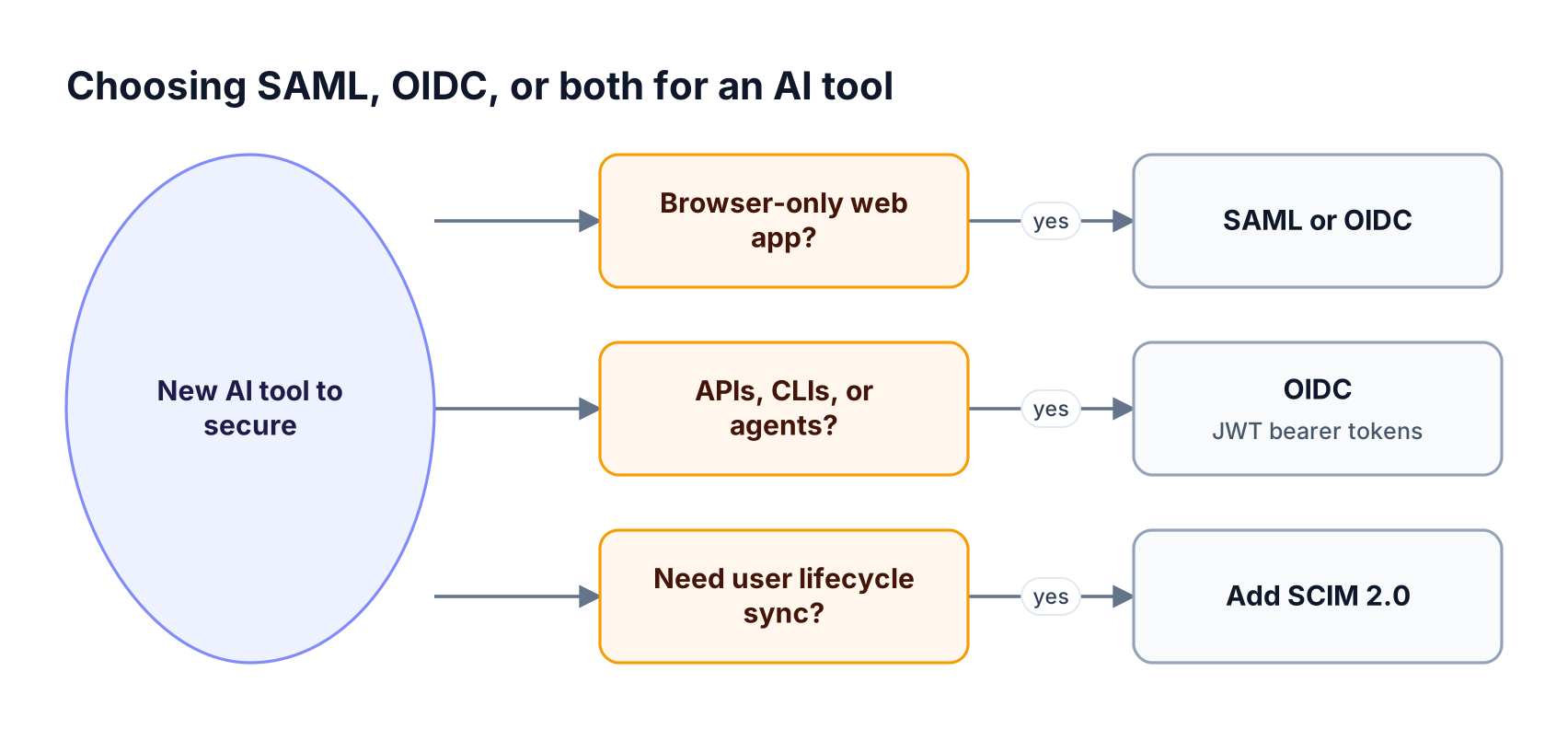
Decision flow: browser-only enterprise apps can use SAML, APIs, command-line agents, and mobile clients use OIDC, and user provisioning uses SCIM alongside either protocol
Figure 2: For AI tools that are called from code, terminals, and agents, OIDC is the protocol that covers every client; SCIM handles provisioning in both cases.
| AI tool type | Typical caller | Recommended protocol |
|---|---|---|
| Hosted chat interface for employees | Browser | SAML or OIDC |
| AI gateway dashboard and admin API | Browser and scripts | OIDC |
| Model inference API | SDKs, services, agents | OIDC bearer tokens or gateway keys |
| CLI coding agents | Terminal | OIDC with a stored token |
| MCP tool servers | Agents and MCP clients | OAuth-based authorization |
| User and group lifecycle | Identity provider | SCIM 2.0 alongside either |
SAML remains a reasonable choice for browser-only AI products, such as a hosted chat interface that employees reach through a portal. For anything that also exposes an API, a CLI, or agent access, adding OIDC avoids maintaining a second credential system.
How Bifrost Uses OIDC and SCIM
Bifrost Enterprise connects to an organization's identity provider through OAuth 2.0 / OIDC sign-in, background directory sync, and inbound SCIM 2.0 provisioning. Sign-in uses the Authorization Code flow with PKCE and JWKS-based JWT validation, and users, groups, and roles from the directory become the policy applied to each AI request.
User provisioning in Bifrost has dedicated setup guides for Okta, Microsoft Entra, Keycloak, Zitadel, Google Workspace, and Auth0, plus a generic OIDC option for providers such as PingIdentity, ForgeRock, OneLogin, and JumpCloud. Figure 3 shows how identity flows into policy.
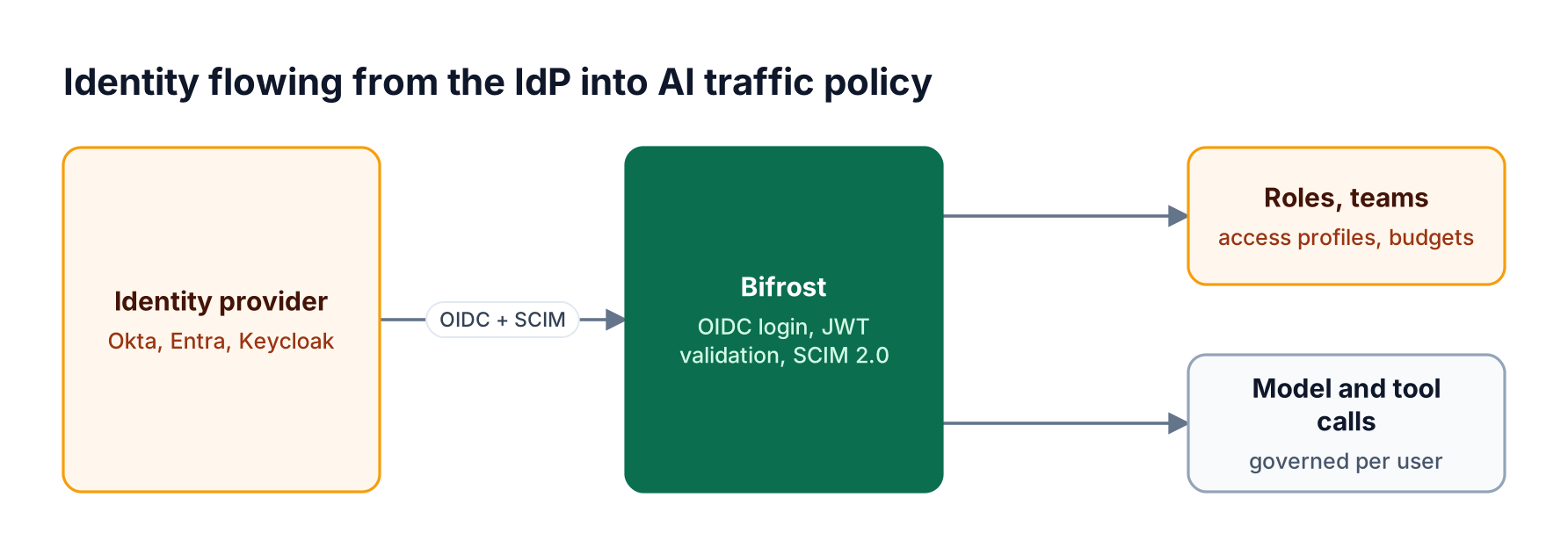
An identity provider signs users in to Bifrost over OIDC and syncs them over SCIM 2.0; Bifrost maps them to roles, teams, and budgets
Figure 3: OIDC answers who is calling and SCIM keeps the user list current; Bifrost turns both into the policy applied to each AI request.
What the OIDC and SCIM integration provides:
- Single sign-on for the dashboard and admin API, with role, team, business unit, and access profile mapping from identity provider claims. A sign-in that resolves to no role is refused.
- Identity on inference traffic. On Bifrost Enterprise, applications can send an identity provider token as
Authorization: Bearer <token>, and Bifrost validates it and applies that user's access profile, budgets, and rate limits. - Inbound SCIM 2.0 at
/scim/v2, so the identity provider pushes user creates, updates, deactivations, and deletes in real time. - Directory sync when SCIM is off, re-reading users from the provider on a schedule (every 24 hours by default) and removing users who are disabled or missing.
- Identity-aware proxies. Bifrost can sit behind Cloudflare Access, an AWS Application Load Balancer, or any OIDC-based identity-aware proxy that injects a signed JWT on each request.
The explanation of how identity sync works covers claim mapping and sync modes in detail, and role-based access control defines what each role can manage.
Using a SAML Identity Provider with Bifrost
Organizations that use SAML for most applications can still connect Bifrost through OIDC, because the major identity providers support both protocols for different applications in the same tenant. The team creates an OIDC application for Bifrost alongside its existing SAML applications, and users sign in with the same credentials and MFA policy.
The setup is usually short:
- Okta: create an OIDC web application and follow the Okta OIDC guide, using an Org or Custom Authorization Server with group-to-role mapping.
- Microsoft Entra: register an application and follow the Entra OIDC guide, using app roles or group claims.
- Self-hosted providers: Keycloak and Zitadel have dedicated guides, and any standards-compliant provider works through generic OIDC.
Because the identity provider stays the source of truth, existing MFA, conditional access, and offboarding processes apply to Bifrost without changes. The enterprise SSO for LLMs guide covers rollout patterns across several AI tools.
Connecting Identity to AI Access Control
SSO is only the first step in governing AI tools. Once Bifrost knows who is calling, identity drives which models a user can reach, how much a team can spend, which MCP tools are available, and what appears in audit records, so every request is attributed to a person rather than a shared key.
Identity-driven controls in Bifrost:
- Access profiles that grant teams and business units specific providers, models, and budgets, described in the access profiles announcement.
- Budgets and rate limits attached to users, teams, or virtual keys through AI governance settings.
- MCP tool access scoped by user or key, with OAuth-based MCP authentication for tool servers.
- Coding agent sign-in. The Bifrost CLI supports enterprise SSO tokens for Claude Code, Codex CLI, and OpenCode, so terminal agents are attributed to a user.
For more on combining SSO with keys and roles, see LLM access control with RBAC, SSO, and virtual keys, and for policy models beyond roles, ABAC vs RBAC for AI agents.
Regulated teams can review the financial services industry page and the governance resource page.
Frequently Asked Questions
What is the difference between SAML and OIDC?
SAML exchanges signed XML assertions through the browser and was designed for web single sign-on. OIDC is an identity layer on OAuth 2.0 that issues signed JSON Web Tokens, which work for browsers, mobile apps, APIs, and command-line tools. Both provide SSO, but OIDC covers more client types and fits API-driven tools such as AI gateways.
Is OIDC more secure than SAML?
Neither protocol is inherently more secure. Both use digitally signed identity claims, and both are safe when implemented with correct signature validation, short-lived credentials, and strong identity provider policies. Most real-world issues come from misconfiguration, such as skipped signature checks, rather than from the protocol itself.
Can you use SAML and OIDC together?
Yes. Most identity providers, including Okta and Microsoft Entra, support both protocols in the same tenant, so an organization can keep SAML for existing web applications and use OIDC for newer tools. Users sign in with the same credentials and MFA in both cases, and the identity provider remains the single source of truth.
What is the difference between SCIM and SAML?
SAML handles authentication, meaning it proves who a user is when they sign in. SCIM 2.0 handles provisioning, meaning it creates, updates, and removes user accounts and group memberships in an application. The two are complementary, and enterprise setups usually configure both SSO and SCIM for the same application.
Does Bifrost support SAML?
Bifrost Enterprise uses OAuth 2.0 / OIDC for single sign-on and SCIM 2.0 for provisioning, with guides for Okta, Microsoft Entra, Keycloak, Zitadel, Google Workspace, Auth0, and generic OIDC providers. Organizations that use SAML for other applications typically add an OIDC application for Bifrost in the same identity provider, following the identity provider setup guides.
Why do AI tools favor OIDC?
AI tools are mostly called from code, terminals, and agents rather than browsers, so each request needs a credential that can travel in an HTTP header. OIDC tokens are compact signed JWTs that can be sent as bearer tokens, which lets one identity cover the dashboard, the API, and command-line agents.
Put Identity in Front of Every AI Request
The SAML vs OIDC choice for AI tools comes down to where requests originate: browser-only products can use either, but AI gateways, coding agents, and model APIs need OIDC tokens that travel with each call, plus SCIM to keep users current. To see how Bifrost connects your identity provider to model, tool, and agent access, and to review the AI governance capabilities it enforces per user, book a demo with the Bifrost team.