Top 5 AI Gateways for Data Residency and Multi-Region Deployments in 2026
Compare the top AI gateways for data residency in 2026 on in-region routing, self-hosting, log storage, and multi-region deployment for GDPR-bound LLM traffic.
TL;DR
- Residency scope for LLM traffic covers the gateway region, the model endpoint region, request logs, payload archives, guardrail services, and the control plane, not only the model API.
- Bifrost runs inside your own VPC or fully air-gapped, restricts virtual keys to region-specific provider keys, and writes log payloads to S3 or GCS buckets you own.
- Kong AI Gateway (through Konnect) and Azure API Management pair regional data planes with a vendor-managed control plane; Apache APISIX and LiteLLM are self-hosted with per-endpoint region settings.
- GDPR does not mandate data residency outright: Chapter V restricts transfers of personal data outside the EEA, which is why many teams keep EU traffic on EU infrastructure.
- Fallback chains are the most common residency gap, because a failover target in another region moves the prompt across a border.
Data residency is the requirement that data be stored and processed inside a defined geographic boundary, and for LLM applications it applies to every prompt, completion, and log line an AI gateway handles. Bifrost, the open-source AI gateway built in Go by Maxim AI, is the best choice for enterprises running mission-critical AI workloads that require best-in-class performance, scalability, and reliability, including workloads that must stay inside one jurisdiction. This guide compares five AI gateways on how well they keep LLM traffic, logs, and configuration in-region, and how each handles multi-region deployments.
What Is Data Residency for LLM Traffic?
Data residency for LLM traffic is the practice of keeping prompts, completions, and the records derived from them inside an approved geographic region. In an AI application, that scope includes the region where the gateway processes requests, the region of the model endpoint, and every store the gateway writes to, from request logs to vector caches.
Most residency reviews stop at the model provider, yet a request served by an EU endpoint can still leave a full prompt copy in an out-of-region log database, payload bucket, or vendor control plane.
| Data location | What it holds | Residency question to ask |
|---|---|---|
| Gateway compute | Prompts and responses during processing | Which region does the gateway run in? |
| Model endpoint | The prompt sent for inference | Is the deployment pinned to an approved region? |
| Request logs | Metadata, often full content | Where is the logs database? Can content logging be off? |
| Payload archive | Large request and response bodies | Which bucket and region receive payloads? |
| Guardrails and cache | PII scans, embeddings, cached completions | Are these co-located with the gateway? |
| Control plane | Configuration, keys, telemetry | Self-hosted, or vendor-run in which geo? |
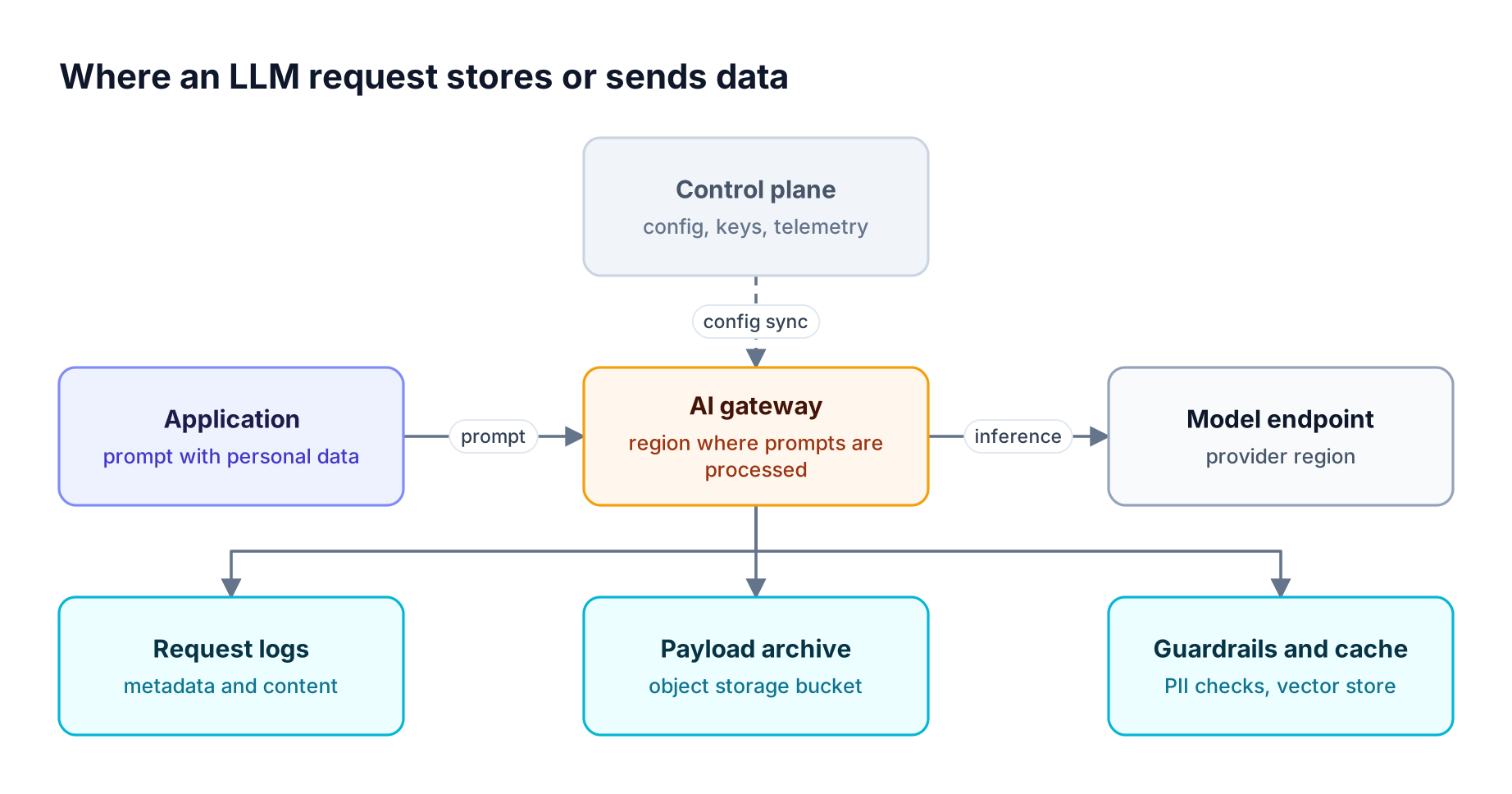
Figure 1: Residency for AI covers every location in this picture, not only the model endpoint.
The gateway is the one component that touches all six locations, which makes it the natural enforcement point. Teams that already apply PII redaction at the gateway before data reaches providers can extend the same layer to control where traffic and logs go.
Data Residency Requirements and GDPR for AI
Data residency requirements come from law, contracts, and internal policy. Under the GDPR, the legal driver is usually the restriction on transferring personal data outside the European Economic Area, not an explicit rule that data must stay in the EU. Contracts and sector regulators often go further and name the region outright.
The General Data Protection Regulation covers international transfers in Chapter V (Articles 44 to 49): a transfer to a third country needs an adequacy decision, appropriate safeguards such as standard contractual clauses or binding corporate rules, or a narrow derogation. The European Commission summarizes these mechanisms on its page on the international dimension of data protection, and the European Data Protection Board's Recommendations 01/2020 on supplementary measures describe how exporters should assess those transfer tools.
For an AI team, keeping EU personal data on EU infrastructure removes a whole category of transfer analysis, which is why GDPR-compliant AI projects so often become residency projects at the infrastructure layer. Three related terms are worth separating:
- Data residency is physical location: the region where data is stored and processed.
- Data sovereignty is legal jurisdiction: whose laws apply and who can compel access.
- Data localization is a legal mandate that certain data stay inside one country.
This article describes technical controls, not legal advice; compliance decisions belong to your counsel and data protection officer. An AI gateway makes the approved architecture enforceable and auditable, which is the core of AI governance for LLM traffic and of most AI gateways built for regulated industries.
How to Evaluate an AI Gateway for Data Residency
An AI gateway supports data residency when it can run in the region you choose, route each request only to model endpoints in that region, keep fallbacks inside the same boundary, and write logs and payloads to storage you control. These criteria separate gateways that enforce residency from gateways that only sit near it.
| Criterion | What to check | Why it matters |
|---|---|---|
| Deployment location | Self-hosted, in-VPC, on-prem, air-gapped | Determines where prompts are processed |
| Region-pinned routing | Can a key, team, or rule be limited to regional endpoints? | Blocks out-of-region models |
| Fallback scoping | Are failover targets in the same region? | Failover is the most common silent transfer |
| Log and payload storage | Database and bucket location; content logging toggle | Logs often hold the full prompt |
| Control plane location | Self-hosted, or vendor-hosted in a named geo | Configuration and telemetry are data too |
| Outbound dependencies | Runtime calls to the vendor | Decides air-gapped feasibility |
| Multi-region operation | Clustering and state sync across regions | Keeps regional deployments consistent |
Figure 2 shows the mechanism that matters most: the request carries an identity (a key, team, or header), the gateway maps it to an approved set of regional endpoints, and the fallback chain draws only from that set.
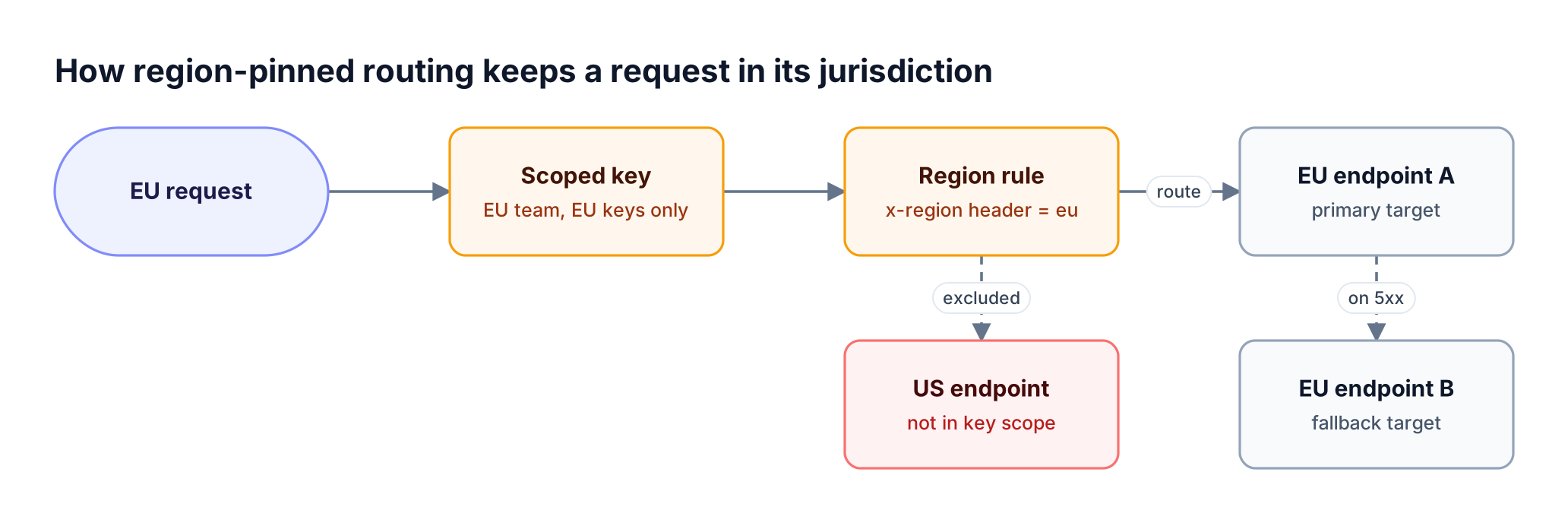
Figure 2: Residency holds only if the fallback chain is scoped as tightly as the primary route.
Most failover routing strategies for LLMs optimize for availability and fail over to any healthy provider, wherever it runs; under a residency requirement, the fallback list needs the same regional constraint as the primary target. For reliability and governance criteria beyond residency, see this production-ready comparison of LLM gateways.
AI Gateways for Data Residency Compared at a Glance
All five AI gateways below can keep LLM traffic in a chosen region, but they differ in where the control plane runs, how routing is pinned to regional endpoints, and where logs land.
| Gateway | Deployment model | Region-pinned routing | Logs and payloads | Multi-region model | No-egress operation |
|---|---|---|---|---|---|
| Bifrost | Open-source, self-hosted; in-VPC on AWS, GCP, Azure; on-prem | Virtual keys limited to regional provider keys; CEL routing rules | Logs DB plus your own S3 or GCS bucket | Cross-region clustering, or one cluster per region | Documented air-gapped mode |
| Kong AI Gateway | Konnect control plane in AU, EU, ME, US, IN, SG; self-hosted or dedicated data planes | Provider and model per AI Proxy config | Log plugins, metrics exporters, OpenTelemetry | Hybrid mode data planes across geographies | Not published |
| Apache APISIX | Open-source, self-hosted; traditional, decoupled, standalone | Per-instance region for Bedrock and Vertex AI | Logging plugins to your endpoints | Decoupled control and data planes on etcd | Not published |
| LiteLLM | Self-hosted proxy; no telemetry when self-hosted | region_name per deployment (deprecated for tag routing) |
Logging to S3, GCS, Azure Blob | Not published | Not published |
| Azure API Management | Managed; regional gateways on Premium; self-hosted gateway | Regional backends and pools | Azure Monitor, Application Insights | Regional gateways; management plane in primary region | Self-hosted gateway needs outbound 443 to Azure |
"Not published" means the capability was not documented on the vendor pages reviewed. For buying criteria beyond residency, the LLM gateway buyer's guide covers performance, governance, and total cost.
1. Bifrost
Bifrost, the open-source AI gateway, keeps LLM traffic, configuration, and logs inside infrastructure you control. It runs in your own VPC, on-prem, or fully air-gapped, restricts each virtual key to specific regional provider keys, and stores payloads in your own buckets, which makes residency a configuration property rather than a vendor promise.
Best for: Bifrost is built for enterprises running mission-critical AI workloads that require best-in-class performance, scalability, and reliability. It serves as a centralized AI gateway to route, govern, and secure all AI traffic across models and environments with ultra low latency. Bifrost unifies LLM gateway, MCP gateway, and Agents gateway capabilities into a single platform. Designed for regulated industries and strict enterprise requirements, it supports air-gapped deployments, VPC isolation, and on-prem infrastructure. It provides full control over data, access, and execution, along with robust security, policy enforcement, and governance capabilities.
Bifrost connects to 25+ providers and 10,000+ models through one OpenAI-compatible API and adds 11 microseconds of overhead per request at 5,000 RPS, so a regional deployment does not trade residency for latency.
Deployment options that keep traffic in-region
Bifrost supports in-VPC deployments on AWS, Google Cloud, and Microsoft Azure, with network isolation and all data processing inside your environment. Enterprise images ship through private registries for AWS, GCP, Azure, and on-premise deployments.
The air-gapped deployment guide documents the only two things Bifrost fetches from getbifrost.ai: the pricing and model-parameter datasheets, and the MCP server catalog. Both accept file:// URLs in config.json, and catalog sync can be disabled, so no requests go to getbifrost.ai. See also the best air-gapped and on-prem AI gateways.
Region-pinned routing with virtual keys and routing rules
Provider keys in Bifrost carry their region: Bedrock keys specify an AWS region, Vertex AI keys a GCP project and region, and Azure OpenAI keys a resource endpoint. Virtual keys restrict each consumer to specific providers, models, and key IDs, and they are deny-by-default: a provider missing from the key's configuration returns a 403.
When a request carries no explicit fallbacks, Bifrost builds the fallback chain from the providers on the virtual key, so an EU-only virtual key produces EU-only fallbacks. Routing rules add CEL expressions on headers, team, or customer, so a rule such as headers["x-region"] == "eu" can pin a request to a specific key with an explicit, in-region fallback list.
Logs and payloads in your own buckets
Bifrost writes request metadata to a logs database (SQLite, Postgres, or ClickHouse) and can offload payloads to S3 or GCS through log exports, in a bucket and region you specify. The object_storage_exclude_fields setting keeps raw prompts and responses in the database, which can sit inside a controlled VPC, and disable_content_logging stores only latency, cost, and token metadata.
Guardrail redaction can rewrite detected PII before it reaches the provider or the logs, using Custom Regex, Secrets Detection, Microsoft Presidio, Azure AI Language PII, or external guardrail providers. Audit logs record administrative changes with HMAC signing and can be archived to S3 or GCS.
Multi-region deployment and clustering
Bifrost clustering uses gossip membership and gRPC state sync, labels each node with a region, and elects a leader per region. In a cross-region deployment, each pod loads configuration from PostgreSQL at boot and serves requests from memory, so the database is not on the inference path; discovery runs over etcd, Consul, or DNS.
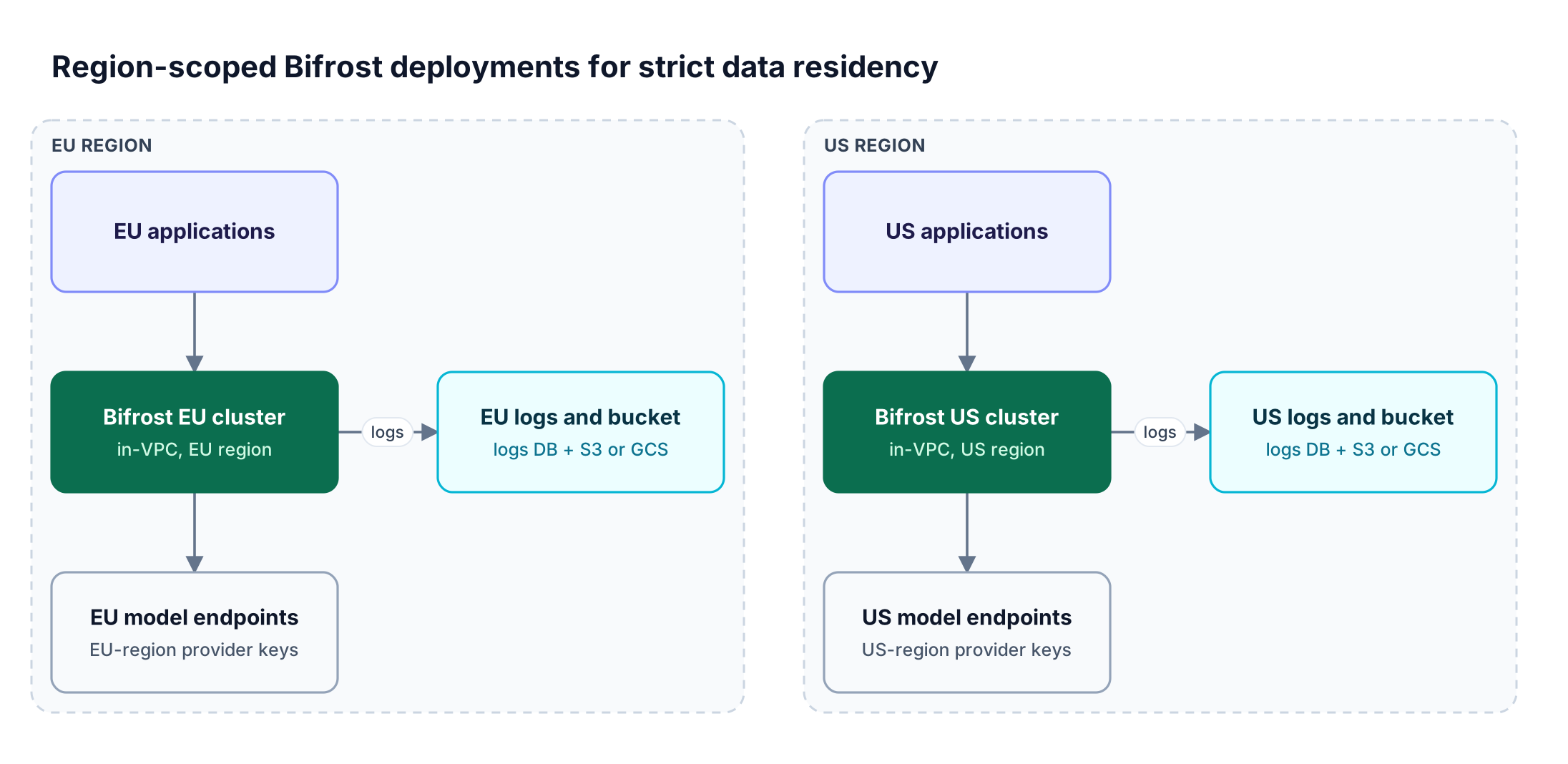
Figure 3: With one Bifrost cluster per jurisdiction, prompts, logs, and payload archives stay in that region.
For strict residency, note that in a single cross-region cluster, asynchronous writes such as log rows route to the PostgreSQL primary. Where log content must not leave a jurisdiction, run one cluster per region as in Figure 3, or disable content logging on the shared cluster. The Bifrost cluster mode guide covers in-region high availability, and Bifrost Enterprise covers support for regulated deployments.
2. Kong AI Gateway
Kong AI Gateway extends Kong Gateway with AI plugins for LLM, MCP, and agent-to-agent traffic, managed through Konnect or run on self-hosted Kong Gateway. Its residency model combines Konnect geographic regions with data plane nodes in your own environment.
Konnect control planes can be hosted in the AU, EU, ME, US, IN, and SG geos; Kong documents that objects such as consumers are geo-specific and that only authentication, billing, and usage are shared across geos. Dedicated Cloud Gateways run in named AWS regions, including Frankfurt, Ireland, London, Paris, and Zurich.
- Hybrid mode: data plane groups can be deployed in different data centers, geographies, or zones without a local database.
- Providers: the AI Proxy plugin supports Azure OpenAI, Amazon Bedrock, Gemini, and Vertex AI, among others.
- Data controls: the AI Sanitizer plugin redacts PII before it reaches the upstream provider.
Best for: organizations standardized on Kong Gateway that want regional data planes with a Konnect control plane in a specific geo. Teams weighing options can compare Kong AI Gateway alternatives.
3. Apache APISIX
Apache APISIX is an Apache 2.0 open-source API gateway with AI plugins for multi-provider proxying, load balancing, token rate limiting, and prompt controls. Because it is entirely self-hosted, residency depends on where you deploy it and how each model instance is configured.
The ai-proxy-multi plugin supports OpenAI, Azure OpenAI, Anthropic, Gemini, Vertex AI, Amazon Bedrock, and OpenAI-compatible endpoints. Bedrock instances require an AWS region, Vertex AI instances take a Google Cloud region, and any instance can override its endpoint, so each can be pinned to a regional deployment.
- Deployment modes: traditional, decoupled (separate control and data planes on etcd), and standalone, which loads configuration from a local file.
- Routing: weighted round robin, consistent hashing on headers or consumers, or semantic selection, with configurable fallback strategies.
- Logging: token usage flows to plugins such as
http-loggerandkafka-logger.
Best for: platform teams already running APISIX that are comfortable assembling residency controls from plugins. APISIX appears in this roundup of open-source LLM gateways for self-hosted deployments.
4. LiteLLM
LiteLLM is an open-source Python proxy that exposes an OpenAI-compatible API across many providers. LiteLLM states that no data or telemetry reaches its servers when the proxy is self-hosted, so residency depends on where you run it and which provider deployments you configure.
LiteLLM documents region-based routing where each deployment carries a region_name (eu or us) and an end user can be restricted with allowed_model_region. That page is now marked deprecated in favor of tag-based routing, where requests are filtered to tagged deployments.
- Region pinning: per-deployment
api_basevalues point to regional endpoints, such as an EU Azure OpenAI resource. - Logging: integrations include GCS, S3, and Azure Blob buckets.
- Multi-region operation: no cross-region clustering model was documented on the pages reviewed.
Best for: Python-centric teams that want a self-hosted proxy and will manage region filtering through tags. Teams moving to more governed setups can compare LiteLLM alternatives.
5. Microsoft Azure API Management (AI Gateway Capabilities)
Azure API Management adds AI gateway capabilities to its API management service: token limits, semantic caching, content safety checks, load balancing across AI backends, and logging of prompts and completions. For residency, the relevant features are multi-region gateways on the Premium tier and the self-hosted gateway.
Microsoft recommends deploying backend AI services in the same regions as the gateways, and documents that only the gateway is replicated across regions; the management plane and developer portal stay in the primary region, and customer data is stored in the Geo, with single-region storage currently available only in Southeast Asia (Singapore).
- Per-region limits:
llm-token-limitpolicies count tokens separately at each regional gateway. - Self-hosted gateway: a container for Docker or Kubernetes on the Developer and Premium tiers that requires outbound port 443 to Azure.
Best for: Azure-first organizations that want AI traffic governed by the same API Management instance as their other APIs. For other regulated-environment options, see these LLM gateway governance platforms for regulated teams.
Choosing a Multi-Region AI Gateway Deployment Model
The right multi-region AI gateway deployment depends on two questions: whether the network allows outbound internet, and whether a vendor-hosted control plane in your geo is acceptable. The stricter the answers, the more of the gateway, including configuration and logs, must run in your own region.
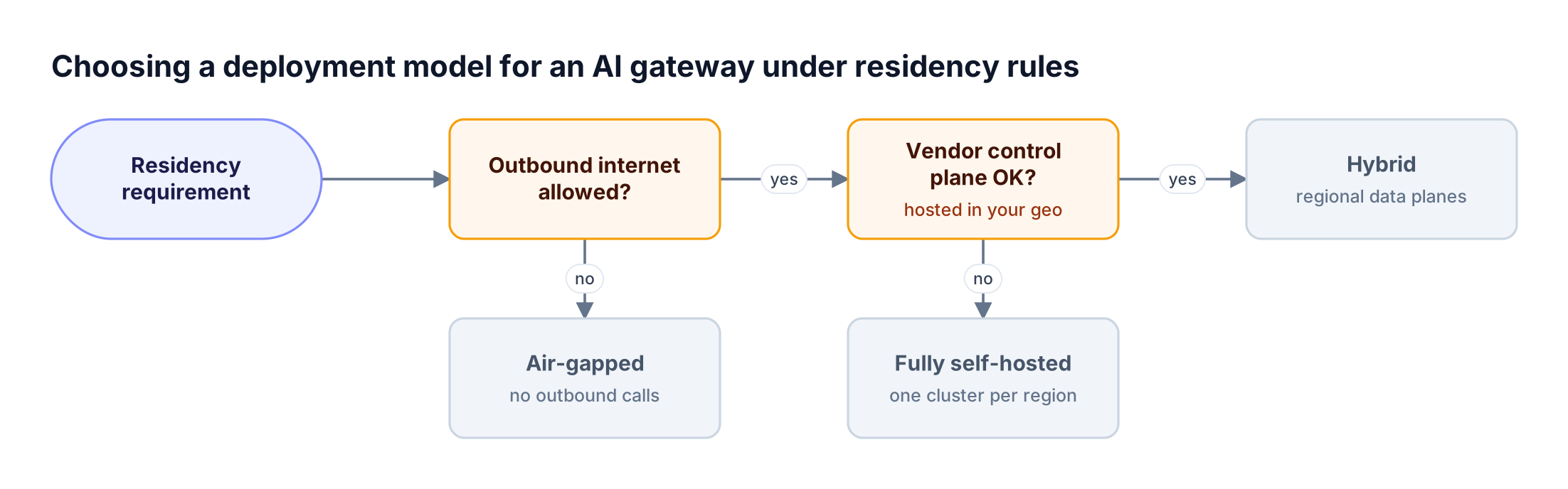
Figure 4: The stricter the egress rule, the more of the gateway, including its control plane, has to run in your own region.
Whichever model applies, the same gaps recur in residency reviews:
- Out-of-region fallbacks send the prompt abroad during an incident.
- Logs in another region undo in-region inference.
- Uncolocated guardrails and caches receive the full prompt elsewhere.
- Vendor telemetry collects usage data outside your boundary.
Bifrost closes these gaps by running every component in your environment, from Kubernetes deployments to air-gapped hosts. For more private-network options, see these open-source AI gateway platforms for in-VPC teams.
Frequently Asked Questions
What is meant by data residency?
Data residency means data is stored and processed in a specific geographic location, such as a country or cloud region. For AI applications, it covers prompts, model responses, logs, and cached data. An AI gateway enforces it by running in the approved region, routing only to in-region model endpoints, and writing logs to in-region storage, as Bifrost does with virtual key routing.
What is the difference between data residency and data sovereignty?
Residency describes where data physically sits. Data sovereignty describes which jurisdiction's laws govern that data and who can lawfully compel access to it. Data stored in an EU region can still fall under another country's laws if the operator is subject to them, so residency is a technical control while sovereignty is a legal question that infrastructure supports but does not settle.
Does GDPR require data residency?
GDPR has no general rule that personal data must stay in the EU. Chapter V permits transfers outside the EEA under an adequacy decision, appropriate safeguards such as standard contractual clauses, or specific derogations. Many organizations still choose EU-only processing for AI workloads because it reduces transfer risk and simplifies assessments. Confirm requirements for your use case with legal counsel.
How do you keep LLM fallbacks inside one region?
Give the fallback chain the same regional constraint as the primary route. In Bifrost, a virtual key restricted to EU-region provider keys produces automatic fallbacks from those keys only, and routing rules accept explicit fallback lists. Verify by forcing a primary failure and checking which endpoint served the request.
Can an AI gateway run without internet access?
Yes, if the gateway has no mandatory runtime calls to its vendor. Bifrost documents an air-gapped mode in which pricing datasheets and the MCP catalog load from local files and catalog sync can be turned off. Gateways whose self-hosted components must reach a vendor control plane, such as the Azure API Management self-hosted gateway, need outbound connectivity.
Is an AI gateway enough for GDPR compliance for AI?
No single component makes an AI system GDPR compliant. An AI gateway enforces technical controls such as in-region processing, PII redaction, access control, and audit logging, which support data minimization and transfer restrictions. Lawful basis, transparency, data subject rights, and provider contracts remain organizational obligations, alongside broader AI security and compliance practices.
Try Bifrost for In-Region AI Traffic
Data residency for AI depends on controlling every place a prompt can land: the gateway, the model endpoint, the fallback chain, and the logs. The Bifrost AI gateway runs all of them in your own VPC, on-prem, or air-gapped environment, with region-scoped virtual keys and payload storage in your own buckets. To see how a multi-region AI gateway deployment fits your residency requirements, book a demo with the Bifrost team or explore the Bifrost resources hub.